
Reports
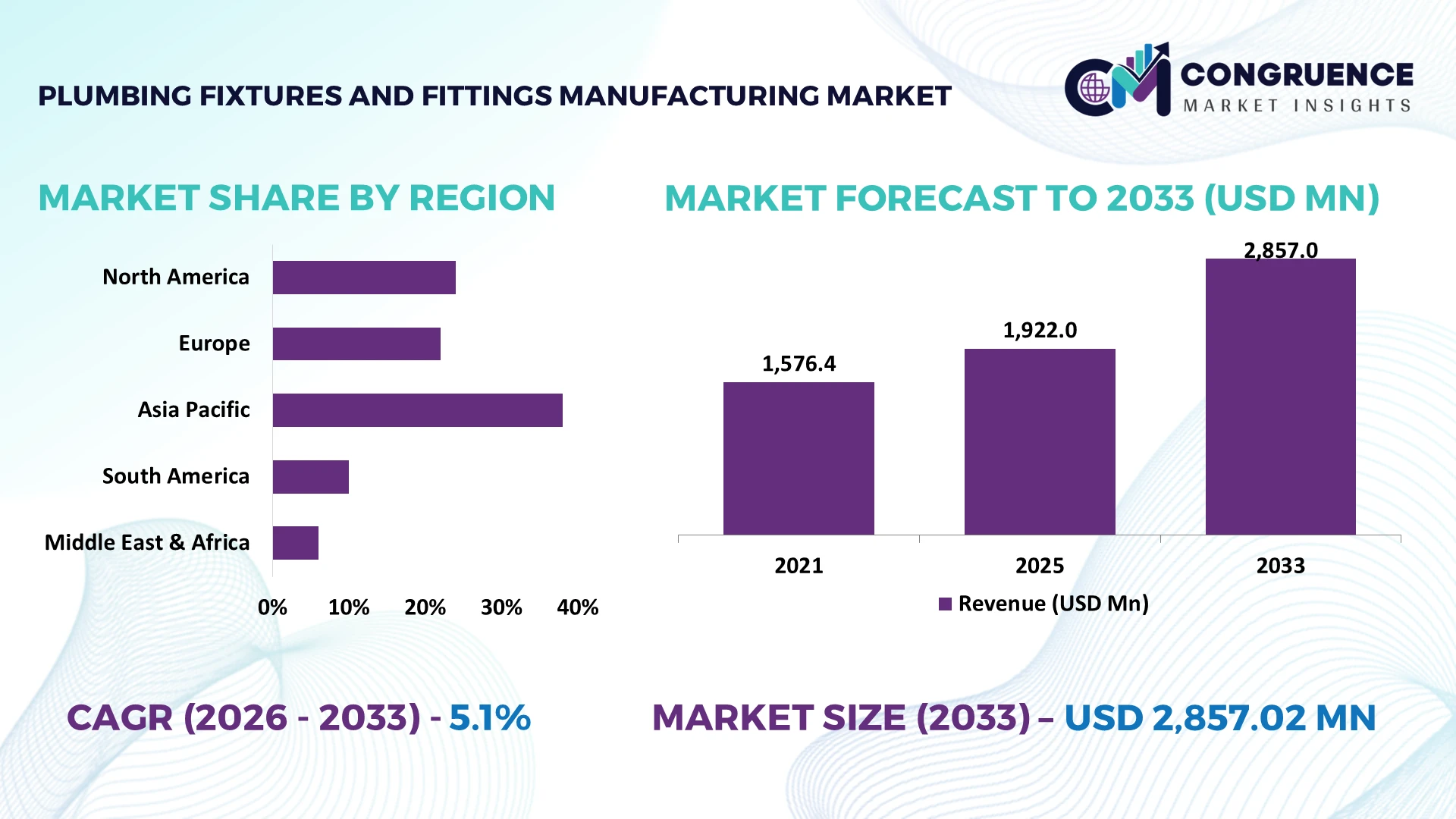
The Global Plumbing Fixtures and Fittings Manufacturing Market was valued at USD 1,922.0 Million in 2025 and is anticipated to reach a value of USD 2,857.0 Million by 2033 expanding at a CAGR of 5.08% between 2026 and 2033. Growth is anchored in water-efficiency mandates and replacement demand across aging residential and commercial building stocks, with India’s BIS IS 17650 star-rating regime for water-efficient sanitaryware pushing manufacturers toward low-flow product redesign at scale.
China dominates with approximately 40% of global plumbing fitting market share, supported by an extensive sanitaryware and component ecosystem concentrated in hubs such as Morbi and Thangadh; by contrast, India’s domestic manufacturing base remains more fragmented, though water-efficiency labeling adoption is accelerating specification-led procurement.
This concentration means sourcing decisions and capacity investments increasingly hinge on Chinese component availability and Indian regulatory trajectory, making supply-chain localization a first-order competitive lever rather than a secondary cost exercise.
Market Size & Growth: USD 1,922.0 Million in 2025, forecast to USD 2,857.0 Million by 2033, at 5.08% CAGR; water-efficiency regulation and replacement-cycle demand drive volume.
Top Growth Drivers: Water-conservation compliance (regulatory influence across 60%+ of new commercial specifications), renovation activity (residential replacement cycles at 4.72% growth), and commercial construction demand in hospitality and healthcare.
Short-Term Forecast: By 2027, automated visual inspection and AI-assisted casting in Chinese and Taiwanese plants target 12–18% defect-rate reduction and 8% throughput gain on ceramic lines .
Emerging Technologies: Sensor-integrated touchless fixtures, IoT-enabled leak diagnostics, and recycled-content vitreous china and brass formulations entering premium specification libraries.
Regional Leaders: China (~40% fitting share, component ecosystem depth) ; North America and Europe (combined ~40%, replacement-led demand) ; India (rising water-efficiency labeling adoption via IS 17650) .
Consumer/End-User Trends: Dual-flush WC adoption now baseline in Indian municipal bye-laws; premium 4.5/3 L and sensor-metered taps capturing specification credit differentials .
Pilot/Case Example: 2025–2026 Indian green-building projects specifying 3-star BIS-rated fixtures achieved 35–40% indoor water-demand reduction against conventional baselines, unlocking IGBC/GRIHA credits .
Competitive Landscape: Top five manufacturers hold over 20% combined share; Geberit, Kohler, LIXIL, Masco, and TOTO lead through specification support and regional distribution .
Regulatory & ESG Impact: India’s IS 17650 voluntary star labeling and revised IS 2556/IS 774 standards embed water-efficiency into product compliance, shifting procurement criteria toward documented flow and flush performance .
Investment & Funding: Capacity localization in APAC accelerates; manufacturers prioritize regional production and supplier partnerships to reduce logistics exposure and align with country-specific water standards .
Innovation & Future Outlook: Convergence of ceramic fabrication with electronics and controls; manufacturers building capabilities beyond metal and polymer forming toward software-enabled diagnostics and specification platforms.
The Plumbing Fixtures and Fittings Manufacturing Market is shifting from volume-driven ceramic output toward specification-led, water-efficient product platforms. Demand concentrates in bathroom renovation and commercial retrofit, where dual-flush and low-flow fixtures now command procurement attention beyond baseline code compliance. In India, BIS star-rating uptake and IGBC/GRIHA credit pathways are reshaping how builders evaluate fixture packages, with water-performance documentation influencing specification decisions alongside price. This regulatory-operational convergence sets the stage for strategic choices around localization, product breadth, and channel capability.
The market’s strategic weight now rests on regulatory compliance and supply-chain positioning rather than raw capacity expansion. Water-efficiency labeling regimes in India and green-building credit systems across Asia are converting fixture specification into a documented performance exercise, forcing manufacturers to treat product data and certification as competitive infrastructure. A manufacturer supplying sensor-metered faucets with verified 4–6 LPM flow rates and digital specification sheets can displace incumbents locked into legacy 8–12 LPM product lines, compressing the sales cycle for specifier-approved platforms .
Regional contrasts sharpen the investment case. China’s component depth and 40% fitting share support scale economics, but Indian and Southeast Asian localization offers shorter lead times and alignment with country-specific water standards . Automated visual inspection and AI-assisted casting on Taiwanese and Chinese ceramic lines demonstrate measurable quality gains—12–18% defect reduction—that translate directly into margin protection where labor costs rise. Over the next two to three years, manufacturers that couple regional production with documented water-performance portfolios will capture specification-driven demand; those relying on undifferentiated ceramic volume face pricing pressure from low-cost Southeast Asian capacity.
Regulatory compliance as a procurement gatekeeper is the primary growth driver, with India’s IS 17650 star-rating framework and revised IS 2556/IS 774 standards embedding water performance into product acceptance . Municipal bye-laws now mandate dual-flush configurations in major Indian markets, while green-building rating systems—IGBC and GRIHA—reward fixture packages achieving 35–40% indoor water reduction against conventional baselines. This regulatory layer converts replacement demand into specification-led purchasing: a builder specifying 3-star fixtures gains both code compliance and credit pathway optionality. Manufacturers are responding by expanding low-flow product lines and pursuing BIS labeling across SKUs, with Indian sanitaryware clusters in Morbi and Thangadh retooling casting and glazing lines for tighter tolerance control. The operational insight: water-performance documentation is becoming a pre-qualification asset, and manufacturers without verified flow/flush data lose specification slots before price is discussed.
Brass and ceramic input cost swings constrain margin predictability, particularly for manufacturers without long-term raw material contracts. Chinese component concentration—approximately 40% of fitting market share—creates single-geography exposure for global buyers, with logistics disruptions and tariff adjustments amplifying lead-time variance. Indian manufacturers face parallel pressure from fragmented domestic supply chains and energy-intensive kiln operations, where fuel cost fluctuations directly impact per-unit economics. The business impact is most acute in mid-tier residential segments where price sensitivity limits pass-through capability. Companies are mitigating through supplier diversification into Southeast Asian brass sources, localized component molding near assembly operations, and indexed contract structures with institutional buyers. A non-obvious constraint: water-efficiency labeling adoption itself adds testing and certification cost per SKU, disproportionately burdening smaller manufacturers and accelerating consolidation among specification-capable suppliers.
Integrated commercial fixture packages represent the clearest expansion pathway, particularly in hospitality, healthcare, and institutional construction where standardized performance reduces maintenance complexity and lifecycle cost. The opportunity lies not in individual fixtures but in coordinated product families—toilets, faucets, shower systems, and replacement components—supported by digital specification libraries and dependable spare-part availability. Indian green-building project pipelines and Southeast Asian hospitality expansion create untapped demand for suppliers capable of serving entire project schedules rather than discrete SKU orders . A less-obvious angle: sensor-based touchless fixtures in high-use commercial restrooms generate usage data that facility managers can deploy for predictive maintenance, creating a service-revenue layer beyond unit sales. Manufacturers positioning early with platform-level specification support and documented water performance across product families can capture specification share before price competition begins.
Electronics-ceramic convergence demands manufacturing capabilities that traditional sanitaryware producers lack, from sensor calibration and firmware validation to connectivity module integration and diagnostic data handling. This shift is not incremental—it requires engineering teams fluent in both vitreous china forming tolerances and embedded systems reliability. Indian and Southeast Asian manufacturers face a compounded challenge: workforce gaps in mechatronics and quality engineering limit automation deployment speed, while the capital intensity of smart-fixture production lines favors incumbents with existing R&D infrastructure. The long-term sustainability risk is bifurcation: manufacturers that master electronics integration move into specification-protected premium segments, while ceramic-only producers face commoditization and margin compression. Companies must solve this through targeted partnerships with sensor and connectivity providers, phased automation investment focused on quality-critical processes, and workforce development aligned with electronics assembly rather than traditional casting skills.
Low-Flow Mandates Reshape Product Portfolios Water-efficiency labeling in India and tightening municipal bye-laws are pushing dual-flush and 4–6 LPM faucet configurations into baseline product lines rather than premium options. Indian green-building projects specifying 3-star BIS-rated fixtures document 35–40% indoor water reduction, converting regulatory compliance into credit-earning specification value. Manufacturers are retooling Morbi and Thangadh lines for tighter flow-control tolerances, with aerator and pressure-compensating cartridge sourcing becoming a bottleneck for rapid SKU conversion.
Automated Inspection Targets Ceramic Yield AI-assisted visual inspection and automated glazing lines in Chinese and Taiwanese sanitaryware plants are delivering 12–18% defect-rate reduction, directly addressing labor cost pressure and skilled-caster shortages. Adoption concentrates in export-oriented facilities where specification customers demand batch consistency documentation. The operational insight: inspection automation is becoming a qualifying capability for supply contracts, not merely an efficiency play.
Touchless Commercial Specification Accelerates Sensor-integrated faucets and flush valves are moving from premium commercial projects into mainstream institutional specifications across India and Southeast Asia. High-use environments—airports, hospitals, hospitality—drive adoption because touchless operation reduces maintenance frequency and water waste simultaneously. Manufacturers are responding through modular sensor platforms that share electronics across product families, reducing certification cost per SKU while enabling specification libraries to cover complete restroom packages.
Recycled Content Enters Specification Language Architects and institutional buyers increasingly evaluate recycled vitreous china and brass content alongside flow performance, with environmental product declarations entering specification documents in European and Indian green-building projects. Manufacturers documenting material transparency gain preference in sustainability-weighted tenders, while those without material traceability face exclusion from premium specification slots. This trend rewards upstream supplier relationships and waste-recovery integration—capabilities that traditional ceramic producers often lack.
Bath and shower fixtures command the largest type share at approximately 38%, sustained by replacement-cycle demand across aging residential housing stocks in North America and Europe and new construction in Asia Pacific. The segment’s dominance rests on installation scale and the non-discretionary nature of bathroom refits during property turnover. Lavatory fittings represent the fastest-shifting type, with sensor-integrated and low-flow faucet configurations gaining specification traction in Indian and Southeast Asian commercial projects; touchless lavatory faucet adoption in high-use institutional settings is rising as facility managers prioritize hygiene and water control.
Kitchen and other sink fittings hold a stable share near 22%, driven by remodel activity in the United States and Germany, while bath and shower fittings benefit from modular shower system upgrades in hospitality refurbishments. Companies are concentrating product development on coordinated bath-and-shower families that simplify specification and reduce SKU proliferation, while lavatory fitting innovation centers on aerator and cartridge standardization to lower certification costs across water-efficiency labeling regimes.
Residential application leads with approximately 58% share, reflecting the vast installed base of housing units across North America, Europe, and urban India where bathroom and kitchen replacement occurs independent of broader construction cycles . Demand concentration here is operational rather than project-driven: individual homeowner decisions aggregate into predictable replacement volume, with dual-flush toilet and low-flow faucet upgrades now standard in Indian municipal retrofit contexts.
Commercial application represents the fastest-evolving segment, where hospitality, healthcare, and institutional projects demand documented water performance and standardized maintenance protocols; specification-led procurement in these verticals favors suppliers capable of delivering complete fixture packages with replacement-part availability. Industrial applications remain a narrower but technically demanding segment, with process water and specialized fitting requirements in food processing and pharmaceutical facilities in Gujarat and Maharashtra. Companies are adapting by building specification support teams for commercial channels while maintaining distributor depth for residential replacement, and by developing modular product architectures that share internal components across both segments to reduce manufacturing complexity.
Residential end-users account for approximately 60% of fixture demand, anchored by the recurring replacement cycle across owner-occupied and rental housing in established markets and first-time fixture installation in Indian and Southeast Asian urban housing expansion. This segment’s purchasing behavior is price-sensitive at the entry level but increasingly responsive to water-cost savings and branded reliability at the mid-tier. Commercial end-users—hotels, hospitals, office complexes, and educational institutions—represent the fastest-shifting buying group, where procurement decisions now incorporate lifecycle cost, maintenance frequency, and documented water performance alongside unit price.
Facility operators in hospitality and healthcare verticals favor touchless fixtures for hygiene compliance and reduced maintenance callouts, while green-building certification pathways in India reward fixture packages achieving measurable water reduction. Industrial end-users remain a specialized segment with process-specific fitting requirements and longer procurement cycles. Companies are targeting residential buyers through distributor networks and retail partnerships, while commercial expansion relies on specification teams, architect relationships, and facility-management partnerships that position fixture platforms as lifecycle solutions rather than discrete product sales.
Asia-Pacific accounted for the largest market share at 38% in 2025; however, South America is expected to register the fastest growth, expanding at a CAGR of 5.35% between 2026 and 2033.
North America holds a 24% regional share, anchored by the United States’ vast installed housing base and a renovation culture that sustains fixture replacement independent of new construction cycles. Faucets and taps represent the dominant product category, while showers register the fastest growth as homeowners upgrade to low-flow and thermostatic configurations. The region’s operational dynamic is retrofit-led rather than greenfield: municipal water-conservation guidelines and utility rebate programs accelerate the displacement of legacy 2.5 gpm fixtures with WaterSense-certified alternatives. Moen’s multi-year exclusive supply agreement with Meritage Homes, covering faucets and bath accessories across nationwide developments, illustrates how specification partnerships lock in volume across replacement and new-build channels simultaneously. Manufacturers are responding by aligning distribution depth with homebuilder relationships and by positioning water-performance documentation as a specification requirement for multifamily projects.
United States Market Outlook: The United States commands 23.63% of global fixture demand, with residential applications absorbing USD 11.48 billion in 2025 . The country’s competitive advantage lies in its specification infrastructure—WaterSense labeling, builder procurement platforms, and a renovation market that treats bathroom upgrades as routine property maintenance. Smart leak-detection integration is emerging as a differentiator in insurance-linked residential channels.
Europe accounts for 22% of global fixture demand, with Germany, the United Kingdom, and France forming the core specification markets. The region’s structural distinction is regulatory: EU water-efficiency requirements and national building codes embed flow and flush performance into product acceptance, converting fixture selection into a documented compliance decision rather than a design preference. Germany alone represents 8.51% of global market value, with faucets and taps dominating product mix and sinks and basins projected for the fastest segment growth. German sanitaryware industry data for the first nine months of 2025 showed sanitary fittings and products revenue rising 5%, while installation components for bathrooms grew 3%, indicating resilient replacement demand despite broader construction softness. Manufacturers are responding through EPD documentation and recycled-content formulations that satisfy both regulatory and green-building procurement criteria.
Germany Market Outlook: Germany’s fixture market reached USD 9.08 billion in 2025, supported by a manufacturing ecosystem that includes Hansgrohe, Grohe, and Dornbracht . The country’s operational advantage lies in the integration of fixture production with building-services engineering—German manufacturers treat fixtures as components within broader HVAC and water-system architectures, enabling specification pull-through across commercial and residential projects.
Asia-Pacific leads with 38% regional share, driven by China’s component ecosystem depth and India’s expanding construction and retrofit activity. China holds 7.88% of global market value, with toilets positioned as the fastest-growing product segment as water-efficiency standards tighten and replacement cycles accelerate. The region’s manufacturing concentration in clusters such as Morbi and Thangadh supports cost-competitive volume, but the operational shift is toward specification compliance: Indian BIS star-rating adoption and green-building credit pathways are converting municipal and commercial procurement into performance-documented purchases. Taiwan’s projected fixture market expansion to USD 2.65 billion by 2034 reflects the region’s electronics-ceramic convergence capabilities, where sensor integration and automated inspection lines serve both domestic and export specification customers .
China Market Outlook: China’s fixture market reached USD 8.41 billion in 2025, anchored by faucet and shower production scale and an export-oriented component supply chain . The country’s competitive position rests on vertical integration—ceramic forming, brass casting, and electronics assembly co-located within industrial clusters—which compresses lead times and supports rapid SKU iteration for water-efficiency-compliant product lines.
South America represents 10% of global fixture demand, with Brazil accounting for the dominant share at 2.15% of global market value. The region’s operational constraint is manufacturing depth: Brazil maintains domestic sanitaryware production capability, but neighboring markets rely heavily on imported fixtures and distribution networks, creating price-tier segmentation and availability gaps. Brazil’s fixture demand is supported by a large housing base requiring replacement and retrofit, with showers projected as the fastest-growing product category. Water scarcity in southeastern urban corridors is accelerating low-flow fixture adoption, though affordability constraints limit premium specification penetration. Manufacturers are adapting through portfolio tiering—localized product configurations for price-sensitive channels and imported specification lines for hospitality and commercial projects—while exploring distribution partnerships to extend reach beyond primary metropolitan markets.
Brazil Market Outlook: Brazil’s fixture market reached USD 2.29 billion in 2025, with faucets and taps leading product demand and showers driving incremental growth . The country’s strategic relevance lies in its domestic production base, which distinguishes it from import-dependent regional neighbors and positions Brazilian manufacturers to serve replacement demand across a geographically dispersed housing stock.
The Middle East & Africa region holds 6% of global fixture demand, concentrated in Gulf Cooperation Council construction pipelines and South African replacement activity. The region’s operational dynamic is project-driven: hospitality, mixed-use, and infrastructure developments in the UAE and Saudi Arabia specify fixtures as part of broader building-services packages, favoring manufacturers capable of meeting international water-efficiency and quality standards. Supply-chain dependence on imports shapes competitive dynamics—local manufacturing remains limited outside Turkey and Egypt, creating opportunities for specification-support teams and distribution partnerships. Water scarcity across Gulf markets is a structural demand driver, with dual-flush and sensor-metered fixtures entering baseline specification for government and commercial projects. Manufacturers are positioning through project-based specification support and spare-part availability commitments, recognizing that lifecycle maintenance capability is as decisive as unit price in institutional procurement.
Saudi Arabia Market Outlook: Saudi Arabia’s fixture demand is embedded within the country’s infrastructure modernization program, where hospitality and residential megaprojects specify water-efficient fixtures as standard. The country’s operational advantage lies in procurement scale—centralized project specification enables manufacturers to secure volume commitments across multi-phase developments, provided they can document compliance with Saudi Building Code water-performance requirements and maintain in-country spare-part availability.
Global leaders Masco (Delta, hansgrohe), Kohler, LIXIL (GROHE, American Standard), TOTO, and Geberit compete against regional cost manufacturers concentrated in China and India, while ceramic-only producers face displacement from specification-capable platforms. The top five hold approximately 27.6% combined share, leaving a fragmented field where scale alone no longer secures specification slots. Competition pivots on water-efficiency documentation, supply-chain localization, and electronics-ceramic integration—TOTO’s $224 million Georgia plant raises Americas capacity by 150% and cuts lead times, while Masco integrates Liberty Hardware into Delta Faucet to consolidate channel leverage. The decisive shift is from component manufacturing to platform specification: manufacturers bundling fixtures, sensors, and replacement-part ecosystems pre-qualify for institutional projects before price is discussed. Entry barriers now include certification infrastructure and localized production depth; winners will be those converting regulatory compliance into specification lock-in.
Masco Corporation (Delta, hansgrohe)
Kohler Co.
LIXIL Corporation (GROHE, American Standard)
TOTO Ltd.
Geberit AG
Fortune Brands Innovations
Roca Sanitario
Villeroy & Boch
Jaquar Group
CERA Sanitaryware
Hindware (Somany Impresa)
Huayi
Globe UNION Industrial Corp
Ideal Standard
Ceramic casting and glazing remain the production backbone, but automation is converting yield economics. AI-assisted visual inspection and robotic tank-bonding on TOTO’s Georgia line target defect-rate reduction and throughput gains, with high-pressure casting expanding complex one-piece design capability. Touchless sensor integration in commercial faucets and flush valves is shifting from premium option to institutional baseline, compressing SKU certification costs through shared electronics platforms.
The decisive comparison is automated versus legacy ceramic lines: robotic handling and QR-coded process tracking deliver measurable quality consistency, while planned convection kilns at TOTO’s Morrow facility promise approximately 23% CO₂ reduction against current models. Manufacturers mastering electronics-ceramic convergence capture specification-protected commercial segments; ceramic-only producers face commoditization.
Between 2026 and 2028, sensor diagnostics and water-performance data will enter procurement language, rewarding manufacturers with digital specification libraries and localized production depth. Companies without verified flow/flush documentation and electronics integration capability lose pre-qualification status before pricing is negotiated—acting now on automation and specification infrastructure is a competitive necessity, not an efficiency upgrade.
August 2025 – TOTO Opened $224 million Morrow, Georgia facility, raising Americas capacity to approximately one million units annually and adding 300,000 luxury one-piece toilet units per year; localized production cuts Asia-to-America lead times. Source: totousa.com
February 2026 – Masco Corporation Announced integration of Liberty Hardware into Delta Faucet Company, consolidating decorative hardware into the Plumbing Products segment; restructuring actions target approximately $50 million in 2026 charges to fund growth initiatives. Source: businesswire.com
September 2025 – Kohler Co. Formed strategic partnership with Pinduoduo targeting 100% compound annual growth and 100 million consumers in China’s county-level markets, expanding sustainable product reach through e-commerce channels. Source: chinadaily.com.cn
March 2026 – Geberit AG Reported 2025 net sales of CHF 3,163 million, up 2.5% (4.8% currency-adjusted), with EBITDA margin at 29.4% and free cashflow up 7.4% to CHF 659 million despite European construction weakness. Source: lesechos-comfi.lesechos.fr
The report covers the full manufacturing value chain across bath and shower fixtures, lavatory fittings, kitchen and sink fittings, and associated components, segmented by type, application (residential, commercial, industrial), and end-user (residential buyers, commercial operators, institutional facilities). Regional analysis spans Asia-Pacific, North America, Europe, South America, and Middle East & Africa, with country-level breakdowns for China, India, the United States, Germany, Brazil, and Saudi Arabia.
Quantitative coverage includes segment distribution, adoption patterns for water-efficient and touchless fixtures, deployment concentration across manufacturing hubs, and competitive positioning of leading manufacturers. The report supports investment planning through localized production benchmarks, expansion strategy via specification-capability assessment, and competitive positioning against the top five players holding approximately 27.6% combined share. Coverage extends to emerging niche areas including sensor-integrated commercial fixtures and recycled-content material specifications, with forward-looking analysis of specification-led demand through 2033.
| Report Attribute / Metric | Details |
|---|---|
| Market Revenue (2025) | USD 1,922.0 Million |
| Market Revenue (2033) | USD 2,857.0 Million |
| CAGR (2026–2033) | 5.08% |
| Base Year | 2025 |
| Forecast Period | 2026–2033 |
| Historic Period | 2021–2025 |
| Segments Covered |
By Type
By Application
By End-User
|
| Key Report Deliverables | Revenue Forecast; Market Trends; Growth Drivers & Restraints; Technology Insights; Segmentation Analysis; Regional Insights; Competitive Landscape; Regulatory & ESG Overview; Recent Developments |
| Regions Covered | North America; Europe; Asia-Pacific; South America; Middle East & Africa |
| Key Players Analyzed | Masco Corporation (Delta, hansgrohe); Kohler Co.; LIXIL Corporation (GROHE, American Standard); TOTO Ltd.; Geberit AG; Fortune Brands Innovations; Roca Sanitario; Villeroy & Boch; Jaquar Group; CERA Sanitaryware; Hindware (Somany Impresa); Huayi; Globe UNION Industrial Corp; Ideal Standard |
| Customization & Pricing | Available on Request (10% Customization Free) |




