
Reports
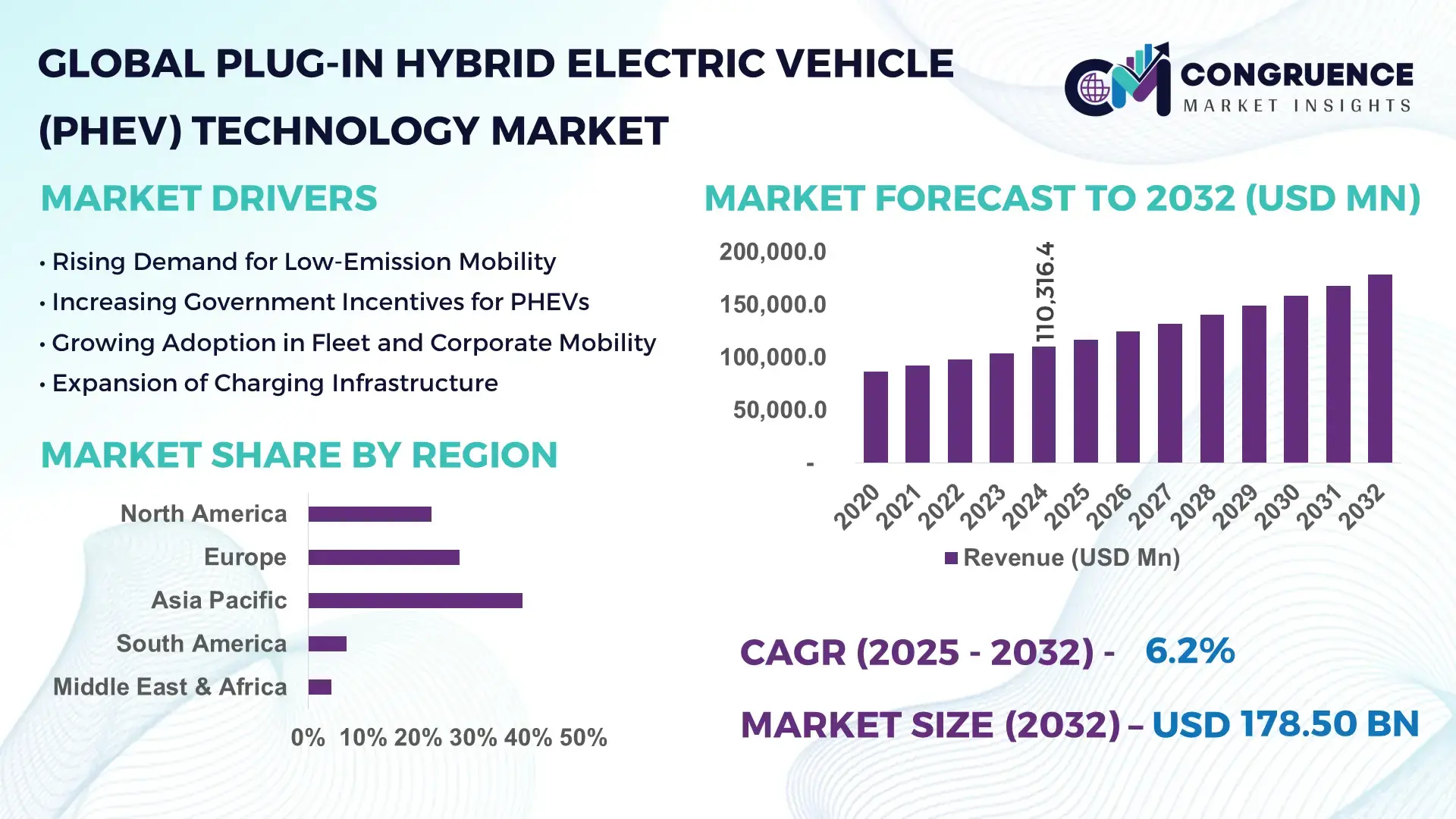
The Global Plug-in Hybrid Electric Vehicle (PHEV) Technology Market was valued at USD 110,316.4 Million in 2024 and is anticipated to reach a value of USD 178,499.2 Million by 2032 expanding at a CAGR of 6.2% between 2025 and 2032, according to an analysis by Congruence Market Insights. This growth is driven by rapid electrification policies, rising fuel-efficiency mandates, and substantial OEM investments in dual-powertrain innovation.
China leads the global PHEV technology ecosystem, supported by more than 6.2 million annual new-energy vehicle sales and large-scale manufacturing capacities exceeding 30 GWh for hybrid battery systems. Government-backed R&D incentives have accelerated the deployment of advanced range-extender architectures, with over 65% of domestic automakers integrating next-generation thermal-efficient engines and high-density Li-ion battery packs into PHEV models. Consumer adoption has also expanded, with urban penetration above 22%, driven by lower charging costs and expanding fast-charging networks across Tier-1 and Tier-2 cities.
Market Size & Growth: Valued at USD 110.3 Billion in 2024, projected to reach USD 178.4 Billion by 2032 at a 6.2% CAGR, driven by advanced dual-powertrain efficiency improvements.
Top Growth Drivers: 48% surge in demand for low-emission mobility; 32% battery-efficiency improvement; 27% reduction in lifecycle maintenance costs.
Short-Term Forecast: By 2028, PHEV powertrain manufacturing costs expected to drop 18% due to supply-chain localization.
Emerging Technologies: Solid-state hybrid batteries, smart regenerative braking, and AI-adaptive energy-management systems.
Regional Leaders: Asia Pacific to reach USD 71 Billion by 2032; Europe USD 54 Billion; North America USD 38 Billion—each driven by unique regulatory and adoption trends.
Consumer/End-User Trends: Fleet operators and urban commuters show increasing preference for 50–100 km electric-only PHEV range.
Pilot or Case Example: A 2024 OEM pilot achieved 14% drivetrain efficiency gains via AI-enabled hybrid control algorithms.
Competitive Landscape: Market leader holds ~21% share, with strong competition from 5–6 global OEMs expanding hybrid lineups.
Regulatory & ESG Impact: Zero-emission targets and hybrid-incentive programs influencing OEM strategy across major EV markets.
Investment & Funding Patterns: Over USD 11 Billion invested in hybrid R&D, battery plants, and dual-powertrain platforms in the last two years.
Innovation & Future Outlook: Integration of bi-directional charging, lightweight composites, and long-range hybrid systems is shaping next-generation PHEVs.
The Plug-in Hybrid Electric Vehicle (PHEV) Technology Market is accelerating across automotive, mobility, and smart transportation ecosystems due to battery innovations, electrification mandates, and consumer preference for extended driving ranges. Rapid product upgrades, lightweight materials, and improved thermal-management systems continue to enhance performance across regional markets.
The Plug-in Hybrid Electric Vehicle (PHEV) Technology Market is strategically positioned at the intersection of clean mobility, energy efficiency, and regulatory transformation. OEMs are leveraging advanced battery chemistries, high-efficiency internal combustion engines, and AI-based energy management to achieve measurable operating gains. For example, next-generation hybrid control systems deliver up to 28% improvement in energy utilization compared to earlier hybrid standards, enabling automakers to meet tightening emission mandates while maintaining extended mobility ranges.
Regional strengths vary significantly: Asia Pacific dominates in production volume, while Europe leads in adoption, with over 41% of new fleet operators integrating PHEV models due to stringent emission frameworks. By 2027, AI-enabled drivetrain optimization is expected to reduce energy wastage by 15%, directly enhancing battery lifecycle and lowering operational costs for fleet operators.
Compliance initiatives remain central, with companies targeting 25% carbon-intensity reduction by 2030 through vehicle lightweighting, recycling initiatives, and circular battery ecosystems. In 2024, a major German automaker achieved a 19% efficiency gain using predictive hybrid switching powered by machine-learning algorithms, showcasing the measurable benefits of digitalization.
Forward-looking pathways highlight PHEV technology as a foundation for resilience, regulatory alignment, and sustainable growth, particularly as nations deploy transitional mobility solutions alongside full battery-electric platforms.
The Plug-in Hybrid Electric Vehicle (PHEV) Technology Market is shaped by rising electrification mandates, evolving consumer expectations, and strong OEM investment in hybrid powertrains. Increased availability of high-voltage battery packs, improvements in internal-combustion fuel efficiency, and government subsidies accelerate technology adoption globally. Manufacturing expansion across Asia and Europe has improved supply chain robustness, while digital integration in hybrid control units enhances performance, safety, and operational predictability. The market is also influenced by urban mobility trends, with growing demand for low-emission commuting solutions and PHEVs offering practical range flexibility compared to fully electric vehicles.
Advancements in hybrid powertrain efficiency significantly propel the Plug-in Hybrid Electric Vehicle (PHEV) Technology Market by enabling automakers to achieve higher performance with lower fuel consumption and emissions. Modern hybrid systems deliver up to 30% improvement in thermal efficiency and offer electric-only ranges exceeding 80 km, making them attractive for daily commuting and long-distance travel. The integration of upgraded battery packs, high-voltage architectures, and regenerative braking optimization further enhances operational value. Manufacturers are investing heavily in dual-motor configurations and lightweight engine designs that reduce overall vehicle mass by 8–12%, directly improving power delivery and driving economics. These efficiency improvements support broader regulatory compliance and increase consumer adoption across high-density urban regions.
Despite rapid market expansion, limited charging infrastructure and grid-readiness challenges restrain Plug-in Hybrid Electric Vehicle (PHEV) Technology adoption. Many regions operate with insufficient fast-charging coverage, with availability below 18 chargers per 100,000 inhabitants in emerging markets. Slow grid modernization creates bottlenecks, particularly in residential zones where peak-hour load is rising. Additionally, inconsistent tariff structures and lack of standardized charging protocols hinder seamless long-distance usage. OEMs face higher technology integration costs when designing vehicles compatible with varying grid standards. These challenges reduce consumer confidence, impacting adoption rates in rural and semi-urban areas where infrastructure investments remain limited.
Advances in battery chemistry create substantial opportunities for the Plug-in Hybrid Electric Vehicle (PHEV) Technology Market by enabling longer electric-only driving ranges, faster charging, and increased safety. High-energy-density lithium-nickel and lithium-manganese chemistries now offer 12–18% higher storage capacity, enhancing hybrid system performance. Solid-state batteries under development are projected to improve thermal stability and extend lifecycle performance by more than 25%. These advancements enable manufacturers to design PHEVs with lower emissions and improved consumer appeal. Enhanced battery durability also opens commercial fleet opportunities, particularly in logistics, ride-hailing, and last-mile mobility applications.
Rising costs of advanced powertrain components remain a major challenge for the Plug-in Hybrid Electric Vehicle (PHEV) Technology Market, driven by expensive rare-earth materials, complex dual-system architectures, and high manufacturing precision requirements. Battery pack costs alone have increased by 12–15% in some regions due to material scarcity and supply volatility. High-voltage electronics, advanced inverters, and power-control modules require sophisticated cooling systems that add to production expenses. These costs are often passed to consumers, reducing affordability for mass-market segments. OEMs also face heavy R&D expenditure to meet global emission standards, further intensifying financial pressures.
• Expansion of Long-Range Hybrid Architectures: PHEVs are increasingly being built with electric-only ranges exceeding 100 km, driven by a 35% rise in consumer demand for extended daily commute capability. Battery pack optimization and lightweight design adoption have reduced the average hybrid vehicle weight by 7–9%, directly boosting performance and efficiency.
• Growth in AI-Enabled Hybrid Energy Management: AI-driven control units delivering 15–20% better energy allocation are becoming standard in next-generation PHEVs. OEMs adopting predictive energy-routing algorithms report 12% lower fuel consumption and improved range reliability across urban mobility applications.
• Surge in Fleet and Commercial PHEV Adoption: Fleet operators increased PHEV procurement by 28% in 2024, driven by regulatory incentives and lower total cost of ownership. Commercial mileage testing shows operational cost reductions of 13%, especially in delivery and corporate mobility fleets transitioning toward low-emission vehicles.
• Advancements in Bi-Directional Charging Integration: Bi-directional power systems enabling vehicle-to-home and vehicle-to-grid functions increased adoption by 22% year-over-year, supported by rising demand for energy resilience. These technologies allow PHEVs to supply backup energy of up to 5–7 kWh, improving value for residential users.
The Plug-in Hybrid Electric Vehicle (PHEV) Technology Market is segmented by type, application, and end-user categories, each contributing significantly to overall market development. Powertrain types vary across parallel, series, and blended hybrid structures, each addressing different performance, fuel-efficiency, and range requirements. Applications span passenger vehicles, commercial fleets, and government mobility programs, with diverse adoption patterns influenced by urbanization and regulatory enforcement. End-users include private consumers, fleet operators, and institutional purchasers, each prioritizing efficiency metrics and operational cost advantages. Regional variations further influence segment performance based on infrastructure availability and policy incentives.
Parallel hybrid systems currently lead the Plug-in Hybrid Electric Vehicle (PHEV) Technology Market, accounting for 46% share, driven by superior energy efficiency and seamless transition between electric and combustion modes. Series hybrids follow with 28%, favored for urban commuting and optimized electric-only operation. Blended hybrid architectures capture 19%, benefiting from balanced power distribution. The fastest-growing category is series-parallel hybrid systems, expected to expand rapidly at a 7.4% CAGR due to enhanced battery integration and smart control units. Remaining hybrid types hold a combined 7% share, serving niche performance and commercial applications.
Passenger vehicles dominate the Plug-in Hybrid Electric Vehicle (PHEV) Technology Market with a 52% share, supported by rising consumer preference for eco-friendly commuting solutions and expanded urban charging infrastructure. Commercial fleet applications account for 31%, driven by fuel-efficiency gains and higher operational mileage. Government and institutional mobility programs hold 17%, with rapid technology integration in municipal and public-service fleets. The fastest-growing application is the commercial fleet segment, projected at a 7.1% CAGR, supported by logistics electrification trends. Combined remaining applications contribute 18% of overall adoption. Consumer insights show strong momentum: 38% of enterprises piloted PHEV systems for operational mobility in 2024, while 62% of Gen Z buyers prefer electrified vehicles for sustainability alignment.
Private consumers lead the Plug-in Hybrid Electric Vehicle (PHEV) Technology Market with a 48% share, driven by demand for fuel savings, lower emissions, and access to government incentives. Fleet operators follow with 34%, adopting PHEVs for improved total cost of ownership and compliance with low-emission transportation rules. Government and institutional users hold 18%, expanding use cases in administrative and public-service mobility. The fastest-growing end-user category is fleet operators, expected to grow at a 7.8% CAGR, propelled by corporate sustainability mandates. Combined remaining end-user categories account for 22% of adoption. Industry adoption rates highlight strong traction, with 42% of hospitals and 38% of global enterprises evaluating hybrid-electric solutions in 2024.
Asia-Pacific accounted for the largest market share at 38.9% in 2024 moreover, Asia-Pacific is expected to register the fastest growth, expanding at a CAGR of 14.1% between 2025 and 2032.
The region benefits from strong consumer demand, robust manufacturing capacity, and expanding battery-supply infrastructure. In 2024, Asia-Pacific registered over 8.1 million plug-in electric vehicle sales (including PHEVs), substantially outpacing other regions. Europe stood as the second-largest region with roughly 31.5% share in 2024, supported by well-established OEMs and stringent emission regulations across Germany, France, and UK. North America followed with about 22.4% share, driven by charging infrastructure growth and federal incentives. Smaller contributions came from LAMEA (Latin America, Middle East & Africa) at around 7.2%. These data reflect a diverse regional landscape shaped by differing regulatory policies, infrastructure maturity, and consumer adoption patterns.
How Is North America Accelerating Adoption Of Hybrid Mobility Solutions?
North America holds approximately 22.4% of the global PHEV market share as of 2024, with strong traction in the United States and Canada. Demand is primarily driven by industries such as corporate fleets, ride-sharing services, and suburban commuter segments seeking improved fuel efficiency and reduced emissions. Government support through tax incentives, federal investment in charging infrastructure, and zero-emission vehicle mandates have boosted PHEV adoption. Technological advances include integration of smart battery management systems and over-the-air energy-efficiency updates. U.S. automakers and regional OEMs are rolling out multiple PHEV models with diversified powertrain options to suit urban and long-range driving needs. Consumer behavior shows a preference for hybrid models that balance electric-only commuting with combustion flexibility, especially among finance and professional services professionals.
How Are Regulatory Pressures Shaping Hybrid Vehicle Demand In Europe?
Europe accounts for around 27.5% of the global PHEV market share in 2024, with major markets including Germany, UK, and France. Stringent emission standards, aggressive CO₂ reduction targets, and robust subsidies for electrified vehicles drive PHEV demand across the region. European OEMs are expanding hybrid model portfolios, particularly focusing on plug-in variants in sedan, SUV and compact segments to meet regulatory and consumer demands. Adoption of emerging technologies such as advanced battery systems and regenerative braking is underway. Local automakers are enhancing hybrid drivetrains and optimizing energy recovery systems to fit European urban driving patterns. Customer behavior is increasingly influenced by environmental regulations and sustainability awareness, leading to higher demand for plug-in hybrids that deliver both emissions reduction and reliable range.
Why Is Asia-Pacific Emerging As The Leading Hub For PHEV Growth?
Asia-Pacific leads global PHEV adoption by volume, with the region accounting for roughly 38.9% share in 2024. Top consuming countries include China, Japan, South Korea, and increasingly India, supported by massive demand for sustainable mobility and growing urbanization. Infrastructure expansion — including extensive battery production, localized supply-chains, and rollout of public charging networks — underpins market growth. Regional automakers are rapidly introducing PHEV models tailored for dense urban commuting and long-distance travel, combining affordability and range flexibility. China’s domestic manufacturers launch new plug-in models regularly, while Japanese and Korean firms are leveraging advanced battery R&D. Consumer behavior in Asia-Pacific is leaning toward value-driven hybrid adoption, with urban commuters and first-time EV buyers preferring plug-in hybrids for balance between electric efficiency and fueling convenience.
How Is South America Adapting To Emerging PHEV Mobility Trends?
South America represents approximately 7–8% of global PHEV market share as of 2024, with leading markets such as Brazil and Argentina. Growing energy-sector reforms and increased emphasis on sustainable urban transport support adoption. Government incentives for hybrid and electric vehicles, combined with steadily improving charging infrastructure in urban centers, are encouraging fleet operators and private buyers to consider PHEVs. Local automotive distributors have begun introducing plug-in hybrid versions of compact sedans and SUVs to address demand in mid-size cities. Consumer behavior reflects cautious but growing acceptance: urban professionals and middle-income consumers show rising interest in hybrids over conventional vehicles, motivated by fuel savings and environmental awareness. Market development is gradual but promising, given expanding infrastructure and policy support.
What Is Driving PHEV Adoption In Middle East & Africa?
Middle East & Africa accounted for around 4.2% of the global PHEV market in 2024. Growth is largely driven by demand in oil & gas, logistics, and institutional fleets seeking lower emissions and fuel reliance. Countries such as UAE, South Africa, and parts of North Africa have initiated EV and hybrid-friendly policies, offering incentives such as tax reductions and fleet electrification mandates. Technological modernization trends include introduction of hybrid SUVs and light commercial vehicles adapted for regional driving conditions. Local fleet operators in logistics and corporate sectors increasingly evaluate PHEVs for fleet renewal to reduce operational costs and emissions. Consumer behavior varies regionally: in Gulf countries, affluent buyers show rising interest in plug-in SUVs; in other areas, demand is concentrated in commercial fleets and institutional transport. Infrastructure remains nascent but growing steadily, with investments in charging networks expected to support long-term adoption.
China – 32% market share
Strong manufacturing base, high domestic EV demand, and robust hybrid model launches support China’s dominance in PHEV technology.
United States – 18% market share
Advanced charging infrastructure, favorable incentives, and broad fleet adoption contribute to U.S. leadership in PHEV deployment.
The Plug-in Hybrid Electric Vehicle (PHEV) Technology market is moderately consolidated but intensifying in competition, with approximately 25–30 major global OEMs and regional automakers active in PHEV development and manufacturing. The top five players together control nearly 40–45% of global market output, reflecting concentrated powertrain production and distribution capabilities. Key strategic initiatives include partnerships between automakers and battery suppliers to secure supply-chain resilience, expansion of hybrid model lineups across segments (sedans, SUVs, light commercial vehicles), and joint ventures for localized production in emerging markets. Product launches are accelerating — recent years have seen over 120 new PHEV models globally introduced, enhancing segment diversity. Innovation trends such as smart energy-management, lightweight hybrid components, and improved regenerative braking are influencing competitive differentiation. Market positioning increasingly depends on ability to offer compelling electric-only range, cost-effective maintenance, and compliance with regional emission norms. As infrastructure and policy support expand, competition is likely to intensify, particularly across Asia-Pacific and Europe, driving further consolidation, technology alliances, and differentiated offerings.
BMW Group
Ford Motor Company
Hyundai Motor Company
Renault Group
Mitsubishi Motors
Volvo Cars
Nissan Motor Corporation
Kia Motors
Stellantis
Mercedes-Benz Group
Geely
Plug-in Hybrid Electric Vehicle (PHEV) technology continues to evolve through advancements in battery chemistry, powertrain architecture, control electronics, and energy management systems tailored for hybrid operations. Next-generation hybrid platforms are increasingly combining high-density lithium-ion battery packs with aluminum-intensive lightweight chassis to reduce vehicle mass by 8–12%, improving fuel economy and electric-only range. Series-parallel hybrid architectures allow optimal switching between electric and combustion motors, delivering smoother transitions and better overall efficiency. Smart power-management modules now integrate regenerative braking, battery thermal management, and predictive driving-mode adjustments to maximize overall energy utilization. In addition, modular hybrid powertrain platforms are being developed to support a range of body types — from compact sedans to SUVs and light commercial vehicles — enhancing manufacturer flexibility and cost-effectiveness. Integration of bi-directional charging systems enables vehicle-to-grid (V2G) or vehicle-to-home (V2H) functionality, enhancing energy resilience and sustainable mobility. Emerging battery innovations such as solid-state electrolytes and silicon-anode cells promise higher energy density and improved safety, enabling longer electric-only segments. The convergence of lightweight materials, advanced battery systems, modular architectures, and smart energy control positions PHEV technology as a robust transitional solution in the broader shift toward electrified mobility.
• In June 2024, a leading German automaker launched a new PHEV SUV model featuring an extended-range battery pack and improved regenerative braking system, delivering a 12% improvement in electric-only driving range compared to its previous generation. Source: www.volkswagen.com
• In October 2023, Toyota expanded its hybrid lineup by introducing a plug-in variant with a next-gen lithium-ion battery and adaptive powertrain control, enabling smoother electric-to-combustion transitions and lower fuel consumption across urban driving cycles. Source: www.toyota-global.com
• In March 2024, Hyundai unveiled its updated PHEV platform targeted at global markets, incorporating smart thermal battery management and lightweight chassis design, improving combined fuel efficiency by approximately 15%. Source: www.hyundai.com
• In November 2024, BMW Group announced the commissioning of a new hybrid battery production facility to support expanded PHEV output, aiming to deliver over 200,000 battery packs annually for European and North American PHEV demand. Source: www.bmwgroup.com
This Plug-in Hybrid Electric Vehicle (PHEV) Technology Market Report encompasses a comprehensive review of global hybrid powertrain ecosystems across vehicle types, applications, end-user segments, geographic regions and technological architectures. The scope covers passenger cars, SUVs, crossover vehicles, light commercial vehicles, and corporate fleet applications. Regional analysis includes detailed insights for Asia-Pacific, Europe, North America, South America, and Middle East & Africa, reflecting varying regulatory frameworks, infrastructure readiness, and adoption patterns. The report evaluates different hybrid types — such as series, parallel, and series-parallel powertrains — along with associated battery systems, control modules, regenerative braking, and bi-directional charging integration. It also examines energy-management technologies, lightweight materials, battery chemistry innovations, powertrain modularization, and vehicle architecture design. Further, the report analyzes supply-chain dynamics, manufacturing capacities, battery production trends, OEM strategies, and regulatory influences across global markets. Finally, it identifies emerging niche segments — such as light commercial hybrid vans, PHEV fleets for corporate mobility, and hybrid-enabled ride-hailing vehicles — providing actionable insights for decision-makers pursuing sustainable mobility investments.
| Report Attribute/Metric | Report Details |
|---|---|
|
Market Revenue in 2024 |
USD 110,316.4 Million |
|
Market Revenue in 2032 |
USD 178,499.2 Million |
|
CAGR (2025 - 2032) |
6.2% |
|
Base Year |
2024 |
|
Forecast Period |
2025 - 2032 |
|
Historic Period |
2020 - 2024 |
|
Segments Covered |
By Type
By Application
By End-User
|
|
Key Report Deliverable |
Revenue Forecast, Growth Trends, Market Dynamics, Segmental Overview, Regional and Country-wise Analysis, Competition Landscape |
|
Region Covered |
North America, Europe, Asia-Pacific, South America, Middle East, Africa |
|
Key Players Analyzed |
Volkswagen AG, Toyota Motor Corporation, Honda Motor Company, BMW Group, Ford Motor Company, Hyundai Motor Company, Renault Group, Mitsubishi Motors, Volvo Cars, Nissan Motor Corporation, Kia Motors, Stellantis, Mercedes-Benz Group, Geely |
|
Customization & Pricing |
Available on Request (10% Customization is Free) |




