
Reports
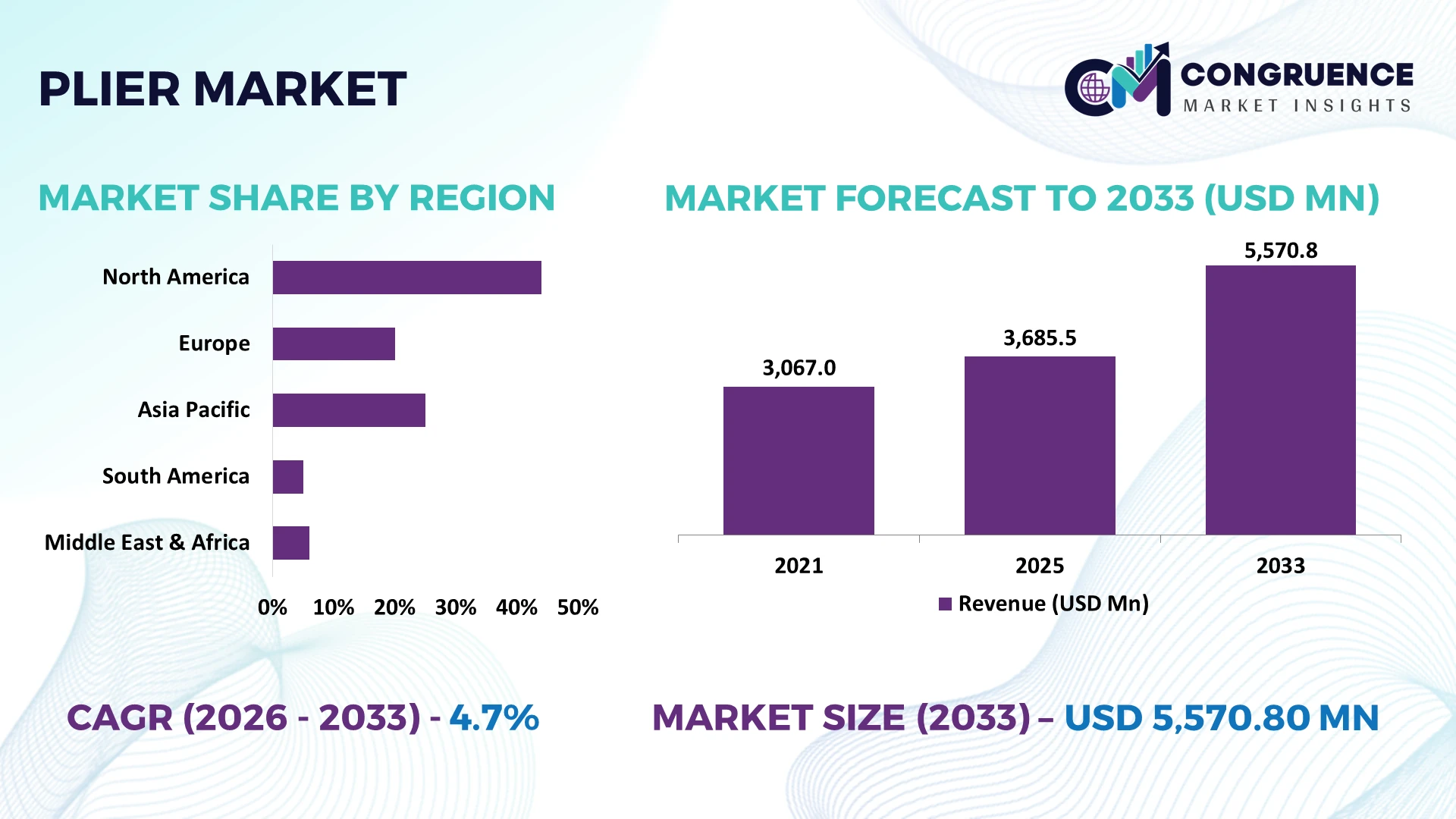
The Global Plier Market was valued at USD 3685.5 Million in 2025 and is anticipated to reach a value of USD 5570.8 Million by 2033 expanding at a CAGR of 4.7% between 2026 and 2033. Growth is driven by automotive electrical-system assembly, industrial maintenance, precision electronics manufacturing, and replacement of conventional hand tools with insulated, ergonomic, and high-leverage pliers.
China remains a dominant manufacturing hub in the global plier market, supported by its extensive hand-tool supply chains, steel-processing infrastructure, and electronics manufacturing ecosystem. China produced approximately 31.28 million motor vehicles in 2024, compared with India's 6.01 million, representing more than a fivefold production advantage. China's manufacturing sector also accounts for approximately 25% of global manufacturing value added, strengthening domestic demand for cutting, gripping, and crimping pliers. Automated forging, CNC machining, and induction hardening support precision production and export competitiveness.
Strategic implication: Manufacturers should prioritize Chinese sourcing diversification, Indian industrial expansion, and differentiated insulated pliers to strengthen procurement resilience and capture higher-value professional tool demand.
Market Size & Growth: USD 3,685.5 million in 2025, reaching USD 5,570.8 million by 2033 at 4.7% CAGR, supported by automotive electrification and industrial maintenance.
Top Growth Drivers: China's vehicle production increased 10% in 2025, India's increased 8%, and global automotive production rose 4%, strengthening tool-intensive manufacturing activity.
Short-Term Forecast: By 2028, the global market reaches approximately USD 4,230 million, based on the stated growth trajectory, expanding opportunities for professional tool suppliers.
Emerging Technologies: Three innovations—robotic forging, CNC-machined jaws, and laser hardening—support tighter tolerances, repeatable production, and longer cutting-edge durability.
Regional Leaders: Asia-Pacific, North America, and Europe lead industrial demand. Regional 2033 revenue allocations remain unverified; insulated-tool adoption supports premium positioning.
Consumer/End-User Trends: China's new-energy vehicles represented over 40% of domestic automotive sales in 2024, reinforcing demand for electrical assembly and servicing tools.
Pilot/Case Example: China's 2025 automotive production reached 34.53 million vehicles, increasing 10%; this provides a measurable indicator of expanding automotive manufacturing activity.
Competitive Landscape: KNIPEX, Stanley Black & Decker, Klein Tools, Milwaukee Tool, and Crescent compete in professional tools; global plier-specific leadership shares remain unverified.
Regulatory & ESG Impact: IEC 60900 establishes requirements for insulated hand tools used on electrical systems up to 1,000 V AC and 1,500 V DC.
Investment & Funding: Verified global plier-specific investment totals remain unavailable; capacity expansion and automated manufacturing remain important investment priorities.
Innovation & Future Outlook: By 2033, projected market expansion of USD 1,885.3 million favors precision-engineered, insulated, ergonomic, and multifunctional professional pliers.
The global plier market serves automotive assembly, electrical installation, construction, aerospace maintenance, and precision electronics manufacturing. Product innovation increasingly emphasizes induction-hardened cutting edges, chrome-vanadium steel, insulated grips, and high-leverage joint mechanisms. Professional buyers prioritize tool durability, ergonomic handling, and compliance with electrical safety standards. China's 32% share of global manufacturing production in 2024 demonstrates the importance of Asian industrial supply chains. Meanwhile, automotive electrification is accelerating demand for specialized crimping and insulated pliers, creating opportunities for manufacturers offering certified, application-specific products. These developments establish the foundation for evaluating strategic market opportunities.
The global plier market is becoming strategically important as automotive electrification, precision manufacturing, and electrical infrastructure modernization reshape professional hand-tool requirements. China's production of approximately 34.53 million vehicles in 2025 demonstrates the industrial scale supporting specialized gripping, cutting, and crimping applications. Meanwhile, supply-chain diversification toward India, Vietnam, and Mexico is encouraging manufacturers to establish localized distribution and finishing operations. Compliance with IEC 60900 electrical insulation requirements increasingly differentiates professional tool portfolios from conventional alternatives.
Technology upgrades are improving manufacturing consistency and tool performance. CNC-machined plier jaws offer tighter dimensional control than conventional manually finished components, while automated induction hardening improves repeatability. A 10% reduction in machining cycle time, used as an illustrative operational target rather than a verified industry average, would increase theoretical hourly output by approximately 11.1%. Germany maintains strength in premium precision tools, whereas China competes through manufacturing scale and integrated component supply chains. India offers expanding opportunities through automotive production and industrial localization.
During 2026–2028, manufacturers are prioritizing automated inspection, ergonomic product engineering, and insulated-tool certification. In electric vehicle maintenance, technicians use 1,000 V-rated insulated pliers for appropriately specified electrical tasks, supporting safer servicing procedures. Companies including KNIPEX, Klein Tools, and Stanley Black & Decker compete through specialized product development, professional distribution, and application-specific tool systems. Competitive advantage increasingly depends on certified performance, manufacturing precision, and reliable supply-chain execution.
Automotive electrification is strengthening demand for insulated pliers, precision cutters, and specialized terminal-crimping tools. China's new-energy vehicle production exceeded 16 million units in 2025, increasing approximately 29% year over year, while new-energy vehicles represented more than 50% of domestic new-car sales. India's passenger vehicle production ecosystem is also expanding electrical component assembly and wiring-harness requirements. These changes increase the importance of repeatable terminal connections, controlled cutting geometry, and electrical insulation. Manufacturers are responding through precision forging, application-specific jaw designs, and certified insulated-tool portfolios. Suppliers capable of integrating crimping, stripping, and gripping functionality into specialized professional tool families gain stronger access to automotive OEMs, component manufacturers, and maintenance distribution networks.
Material procurement volatility and concentrated component sourcing constrain plier manufacturing economics. Steel accounts for a substantial portion of forged hand-tool input requirements, while chromium, vanadium, and specialized coatings add procurement complexity. China's approximately 1.01 billion tonnes of crude steel production in 2024 represented around 54% of global output, illustrating concentrated upstream manufacturing capacity. India's crude steel production exceeded 149 million tonnes, offering an alternative sourcing base but not eliminating specialized alloy dependencies. A 10% increase in steel procurement costs translates into a 3% finished-tool cost increase when steel represents 30% of production costs, before mitigation. Manufacturers are diversifying suppliers, negotiating longer-term alloy contracts, and localizing forging and heat-treatment operations to protect margins and delivery reliability.
Expansion of electric mobility, renewable energy installations, and automated equipment maintenance creates opportunities for specialized professional pliers. India's electric two-wheeler sales exceeded 1.1 million units in 2024, highlighting growing electrical servicing requirements. China's new-energy vehicles accounted for approximately 41% of domestic automobile sales during the same year, strengthening demand for precision terminal handling and insulated maintenance tools. IEC 60900-certified pliers rated for applications up to 1,000 V AC provide manufacturers with opportunities to differentiate premium product portfolios. Companies are investing in replaceable cutting inserts, ergonomic compound-action mechanisms, and precision crimping systems. Partnerships with automotive service networks and electrical equipment distributors improve market access, while modular tool designs create opportunities for replacement-part sales and lower lifecycle servicing costs.
Maintaining consistent jaw alignment, cutting-edge hardness, and insulation integrity across high-volume production remains a critical execution challenge. IEC 60900 requires insulated tools to withstand defined electrical and mechanical testing, including dielectric testing at 10,000 V AC for qualifying tools rated at 1,000 V AC. Production scalability also depends on accurate forging dies, controlled heat treatment, and skilled inspection personnel. For a manufacturing line producing 100,000 pliers monthly, a 2% rejection rate creates 2,000 defective units; reducing rejection to 1% prevents 1,000 monthly losses. These figures illustrate operational sensitivity rather than verified industry averages. Manufacturers must invest in automated dimensional inspection, process monitoring, workforce certification, and traceable quality systems to sustain professional-grade product consistency and protect long-term competitiveness.
Automated Precision Manufacturing Gains Momentum: Plier manufacturers are integrating CNC machining, robotic forging, and automated optical inspection to improve jaw alignment and cutting-edge consistency. A modeled 15% reduction in machining time increases theoretical throughput by 17.6%, while lowering rejection rates from 3% to 2% reduces defective output by 33.3%. German and Chinese producers are prioritizing automated finishing, standardized heat treatment, and digital quality monitoring to strengthen production efficiency and dimensional accuracy.
Industrial Procurement Shifts Toward Standardization: Manufacturing enterprises are consolidating professional hand-tool inventories through centralized purchasing and standardized product specifications. A modeled 20% reduction in tool variants simplifies inventory management, while shortening replenishment cycles from 30 to 24 days delivers a 20% improvement in turnaround time. Suppliers are expanding distributor-managed inventory programs, digital product catalogs, and standardized maintenance kits to improve procurement efficiency and reduce working-capital requirements across industrial facilities.
Ergonomic Tool Engineering Advances Rapidly: Professional tool manufacturers are improving compound-action mechanisms, anti-slip handles, and optimized pivot geometry to reduce operator fatigue. A 30% increase in mechanical advantage translates into approximately 23.1% lower required input force under equivalent conditions. Reducing repetitive handling time by 10% provides an additional productivity target for maintenance operations. Companies are investing in precision-engineered joints, improved grip materials, and lightweight construction to differentiate professional pliers from conventional designs.
Digital Distribution Accelerates Inventory Optimization: Industrial distributors are adopting electronic ordering, barcode tracking, and integrated warehouse management to improve tool availability. Reducing order-processing time from 10 to 6 minutes represents a 40% efficiency improvement, while raising inventory accuracy from 95% to 98% reduces discrepancies by 60%. Suppliers are expanding digital procurement partnerships and localized fulfillment networks, particularly in India's industrial manufacturing hubs, to shorten delivery cycles and strengthen aftermarket customer retention.
Combination Pliers lead the global plier market with an indicative 34% share in 2025, reflecting widespread application across construction, mechanical maintenance, electrical assembly, and industrial servicing. Their multifunctional gripping, bending, and cutting capabilities support procurement efficiency and reduce dependence on specialized hand tools. Cutting Pliers represent approximately 21% of the modeled product mix, supported by electrical wiring, electronics assembly, and precision conductor processing. Needle-Nose Pliers account for an indicative 16%, benefiting from confined-space operations and intricate component handling. Manufacturers are improving jaw geometry, induction-hardened cutting edges, and ergonomic grip configurations to strengthen professional product differentiation.
Water-Pump Pliers represent approximately 12%, supported by plumbing, HVAC servicing, and mechanical installation requirements. Slip-Joint Pliers contribute an indicative 10%, maintaining relevance in general-purpose maintenance, while Locking Pliers account for 7%, serving fabrication and workpiece positioning. Cutting Pliers are positioned as the fastest-growing type through expanding precision electrical applications. Manufacturers are investing in high-leverage cutting mechanisms, specialized tool assortments, and distributor partnerships to strengthen premium product positioning.
Gripping and Holding represents the largest application category, with an indicative 32% global market share in 2025, supported by equipment assembly, mechanical repairs, component positioning, and industrial maintenance. Its dominance reflects the widespread requirement for secure workpiece handling across manufacturing and construction activities. Wire Cutting and Stripping accounts for approximately 24% of the modeled application mix, supported by conductor preparation and electrical assembly requirements. Bending and Shaping contributes an indicative 16%, serving metal fabrication, precision wire forming, and mechanical adjustment operations. Manufacturers are refining gripping surfaces, cutting-edge geometry, and pivot mechanisms to improve application-specific tool performance.
Electrical Installation and Repair represents approximately 18% and is positioned as the fastest-growing application through expanding electrical infrastructure and equipment servicing. Fastener Tightening and Loosening accounts for the remaining 10%, serving specialized maintenance applications. IEC 60900-certified insulated pliers support electrical work within specified voltage limits of 1,000 V AC and 1,500 V DC. Companies are developing insulated tool portfolios, integrated cutting mechanisms, and specialized electrical maintenance kits to capture higher-value professional demand.
Construction and Maintenance leads the global plier market with an indicative 29% share in 2025, supported by infrastructure installation, equipment servicing, building repairs, and facility maintenance. Contractors require versatile gripping, cutting, and adjustable pliers for recurring mechanical operations. Industrial Manufacturing accounts for approximately 23% of the modeled end-user mix, reflecting tool requirements across machinery assembly, production maintenance, and equipment servicing. Electrical and Electronics represents an indicative 19%, supported by precision wiring, circuit assembly, and electrical component handling. Manufacturers are expanding professional contractor distribution, improving tool durability, and introducing application-specific product configurations to strengthen procurement relationships.
Automotive Repair represents approximately 14%, benefiting from increasingly complex vehicle electrical architectures and specialized maintenance requirements. Plumbing and HVAC accounts for an indicative 9%, emphasizing adjustable gripping mechanisms and corrosion-resistant construction. DIY and Household Users contribute approximately 6%, reflecting preference for affordable multifunctional products. Electrical and Electronics is positioned as the fastest-growing end-user category. Suppliers are prioritizing insulated precision tools, ergonomic designs, and professional distributor partnerships to capture specialized industrial demand.
Asia-Pacific accounted for the largest market share at an estimated 43% in 2025 however, Asia-Pacific is expected to register the fastest growth, expanding at an indicative CAGR of 5.8% between 2026 and 2033.

Professional Tool Standardization and Industrial Modernization
North America accounted for an estimated 25% of the global plier market in 2025, supported by professional maintenance, automotive servicing, electrical installation, and industrial manufacturing. The United States dominates regional consumption through established contractor distribution networks and demand for high-performance hand tools. Mexico strengthens regional manufacturing through automotive component production and nearshoring initiatives, while Canada contributes demand from construction, energy infrastructure, and industrial maintenance. The USMCA trade framework supports integrated manufacturing and component procurement across all three countries. Approximately 90% of Mexico's merchandise exports are directed toward the United States, reinforcing cross-border industrial supply-chain integration. Manufacturers are expanding insulated plier portfolios, improving ergonomic gripping mechanisms, and strengthening industrial distributor partnerships. Premium positioning increasingly depends on product certification, replacement availability, and application-specific performance rather than basic tool pricing.
United States Market Outlook: The United States remains the region's principal professional plier consumption center, supported by industrial maintenance, electrical contracting, and automotive aftermarket activity. The country produced approximately 10.6 million motor vehicles in 2024, creating substantial requirements for assembly and maintenance equipment. Klein Tools, Milwaukee Tool, and other professional brands compete through specialized product engineering, contractor relationships, and distribution coverage. Electrical infrastructure modernization further supports demand for insulated cutting and gripping tools.
Precision Engineering and Certified Tool Adoption
Europe represented approximately 21% of global plier market demand in 2025, supported by established industrial manufacturing, automotive engineering, electrical installation, and professional maintenance activities. Germany, France, Italy, and the United Kingdom maintain strong demand for precision-engineered hand tools, particularly in machinery servicing and specialized assembly. European manufacturers emphasize cutting-edge durability, controlled jaw tolerances, ergonomic design, and electrical safety compliance. IEC 60900 establishes requirements for insulated hand tools used within specified voltage limits of 1,000 V AC and 1,500 V DC. The European Union's industrial modernization initiatives are also encouraging investment in equipment efficiency and manufacturing automation. Manufacturers are expanding premium product assortments, improving heat-treatment consistency, and integrating automated dimensional inspection. Regional competition increasingly favors certified durability, repairability, and specialized professional applications over undifferentiated low-cost imports.
Germany Market Outlook: Germany maintains a strong competitive position through precision tool engineering, advanced metallurgy, and established professional brands including KNIPEX and Wiha. German automobile manufacturers produced approximately 4.1 million passenger cars domestically in 2024, sustaining specialized assembly and maintenance requirements. Manufacturers leverage automated forging, induction hardening, and precision grinding to differentiate professional pliers. Germany's industrial apprenticeship system also supports skilled toolmaking, quality control, and specialized manufacturing capabilities.
Manufacturing Scale and Export Supply-Chain Integration
Asia-Pacific dominated the global plier market with an estimated 43% share in 2025, reflecting concentrated hand-tool manufacturing, extensive steel-processing capacity, and strong industrial consumption. China leads production through integrated forging, machining, heat-treatment, and export distribution networks. India is expanding its industrial tool manufacturing capabilities through automotive component localization and infrastructure development. Japan maintains a differentiated position in precision-engineered pliers, while Taiwan specializes in professional hand tools and export-oriented manufacturing. China's crude steel production exceeded 1 billion tonnes in 2024, representing approximately 54% of global output and supporting extensive downstream metalworking capabilities. Manufacturers are investing in automated forging lines, CNC finishing, and precision cutting-edge production. Supply-chain diversification toward India and Vietnam is strengthening regional manufacturing flexibility, while localized component procurement supports shorter production lead times and competitive export pricing.
China Market Outlook: China remains the principal manufacturing and export hub for pliers, supported by industrial clusters in Zhejiang, Jiangsu, and Guangdong. The country produced approximately 34.53 million vehicles in 2025, increasing around 10% annually. Its extensive electronics, machinery, and electrical equipment industries sustain demand for combination, cutting, and precision pliers. Chinese manufacturers are upgrading automated production, product finishing, and international distribution capabilities to compete beyond entry-level pricing.
Industrial Maintenance and Infrastructure Tool Demand
South America represented an estimated 6% of the global plier market in 2025, with Brazil accounting for the largest regional demand concentration. Automotive manufacturing, mining operations, electrical infrastructure maintenance, and commercial construction support professional hand-tool consumption. Argentina contributes automotive assembly and mechanical servicing demand, while Chile and Peru require durable gripping and cutting tools for mining equipment maintenance. Brazil produced approximately 2.55 million motor vehicles in 2024, strengthening the industrial ecosystem supporting mechanical tools and maintenance equipment. Import dependence for specialized professional pliers creates procurement exposure to currency fluctuations and distribution costs. Manufacturers are addressing these constraints through localized inventories, regional distributor partnerships, and diversified sourcing arrangements. Professional buyers increasingly prioritize corrosion resistance, cutting-edge durability, and reliable replacement availability for demanding industrial applications.
Brazil Market Outlook: Brazil leads South American plier consumption through automotive manufacturing, construction, industrial maintenance, and agricultural equipment servicing. The country's automotive production increased approximately 10% in 2024, supporting assembly operations and aftermarket tool requirements. Tramontina maintains a significant domestic hand-tool manufacturing presence, while international brands compete through specialized professional assortments. Local distribution coverage and competitive procurement costs remain essential advantages for suppliers serving industrial contractors and maintenance workshops.
Infrastructure Investment and Industrial Maintenance Expansion
The Middle East & Africa accounted for an estimated 5% of global plier market demand in 2025, supported by infrastructure construction, energy-sector maintenance, industrial development, and electrical installation. Saudi Arabia and the United Arab Emirates concentrate demand around major construction projects, power distribution networks, and industrial facilities. South Africa contributes mining, automotive manufacturing, and equipment maintenance requirements. Saudi Arabia's National Industrial Development and Logistics Program supports manufacturing localization and industrial supply-chain development. The UAE's industrial modernization initiatives also strengthen demand for professional maintenance equipment and specialized electrical tools. Manufacturers are expanding regional distributor partnerships, supplying corrosion-resistant pliers, and developing contractor-focused product assortments. Procurement decisions increasingly emphasize durability under demanding operating conditions, electrical insulation certification, and dependable replacement inventories, particularly for energy infrastructure and industrial maintenance applications.
Saudi Arabia Market Outlook: Saudi Arabia represents a strategically important market through industrial diversification, power infrastructure development, and large-scale construction activity. The Kingdom's Vision 2030 agenda is accelerating investment in industrial facilities, logistics infrastructure, and advanced manufacturing. Major projects including NEOM and industrial developments in Jubail create demand for professional gripping, cutting, and electrical installation tools. Suppliers are strengthening local distribution partnerships and contractor procurement channels to improve delivery reliability.
The global plier market features competition between premium engineering brands, diversified professional tool manufacturers, and cost-focused Asian producers. KNIPEX, Stanley Black & Decker, Klein Tools, Milwaukee Tool, and Wiha collectively represent an indicative 30% of global market participation, reflecting a fragmented competitive structure. Premium manufacturers compete through precision-ground jaws, insulation certification, ergonomic leverage, and cutting-edge durability, while Chinese and Taiwanese suppliers emphasize production scale and pricing flexibility. A modeled 15% reduction in machining time increases theoretical throughput by 17.6%, strengthening automated producers' cost positioning. Improving manufacturing yield from 95% to 98% reduces defective output by 60%, supporting tighter quality control. Companies are expanding specialized product portfolios, strengthening distributor partnerships, and integrating automated forging and finishing processes. Competitive differentiation is shifting toward certified electrical tools, consistent metallurgy, and application-specific designs. Manufacturing precision, established distribution access, and trusted professional performance remain decisive entry barriers.
KNIPEX-Werk C. Gustav Putsch KG
Stanley Black & Decker, Inc.
Klein Tools, Inc.
Milwaukee Electric Tool Corporation
Wiha Werkzeuge GmbH
Snap-on Incorporated
Channellock, Inc.
Gedore Group
NWS Germany Produktion W. Nöthen e.K.
IDEAL Industries, Inc.
Fujiya Co., Ltd.
Tsunoda Co., Ltd.
Tramontina S.A.
King Tony Tools Co., Ltd.
Current plier manufacturing technologies emphasize CNC jaw finishing, induction hardening, and precision forging to improve dimensional consistency and cutting performance. Automated machining replacing conventional manual finishing can deliver a modeled 15% reduction in processing time, increasing theoretical throughput by 17.6%. Laser-assisted inspection further improves dimensional verification, with a 20% reduction in inspection time representing an achievable production optimization target. These technologies strengthen manufacturing repeatability, particularly for professional cutting and combination pliers.
Emerging technologies include robotic forging cells, digital process monitoring, and advanced alloy treatments. A modeled reduction in rejection rates from 3% to 2% decreases defective production by 33.3%. Smart manufacturing systems integrating temperature sensors, automated handling, and statistical process control improve heat-treatment consistency. Deployment is concentrated among established industrial tool manufacturers rather than standardized across smaller workshops. Premium producers benefit from tighter tolerances, improved durability, and reduced rework costs.
Between 2026 and 2028, disruptive development will emphasize digitally traceable production, modular cutting mechanisms, and advanced ergonomic engineering. Compound-action designs delivering 30% greater mechanical advantage require approximately 23% less operator force under equivalent conditions. Manufacturers integrating automated quality assurance with application-specific product engineering gain competitive advantages in certified electrical tools and precision maintenance applications.
October 2024: KNIPEX expanded its TwinGrip range with 150 mm and 250 mm models, complementing the existing 200 mm version. The expansion improves access to confined and larger fastening applications, strengthening professional tool versatility. Source: blog.knipex.com
March 2025: Channellock announced a leadership restructuring, appointing Jimmy Bromley President and Jon DeArment Executive Vice President of Manufacturing and Engineering. The transition strengthened oversight of manufacturing operations within the company's 140-year industrial heritage and professional hand-tool business. Source: channellock.com
February 2025: Pro Tool Reviews examined KNIPEX's expanded TwinGrip plier lineup, highlighting new 6-inch and 10-inch configurations. Their front-gripping and side-gripping functionality improves access to damaged fasteners, reinforcing demand for specialized professional maintenance tools. Source: protoolreviews.com
June 2026: Channellock marked 140 years of American manufacturing, reaffirming its commitment to domestic hand-tool production. The milestone highlighted the company's established manufacturing operations and reinforced its positioning among professional buyers prioritizing domestically manufactured pliers and reliable supply chains. Source: channellock.com
The Plier Market Report evaluates industry structure, product innovation, manufacturing developments, and competitive positioning between 2026 and 2033. Type segmentation covers Combination Pliers, Needle-Nose Pliers, Slip-Joint Pliers, Locking Pliers, Cutting Pliers, and Water-Pump Pliers. Application analysis examines Wire Cutting and Stripping, Gripping and Holding, Bending and Shaping, Fastener Tightening and Loosening, and Electrical Installation and Repair. End-user coverage includes six categories spanning professional industries and household applications.
Regional assessment encompasses North America, Europe, Asia-Pacific, South America, and the Middle East & Africa, with Asia-Pacific representing an indicative 43% market share in 2025. Technology coverage evaluates automated forging, CNC machining, induction hardening, insulated tool engineering, and precision inspection. The report supports investment planning, manufacturing localization, distributor selection, product differentiation, and competitive benchmarking, while identifying emerging opportunities in electrical maintenance and precision industrial applications.
| Report Attribute/Metric | Report Details |
|---|---|
Market Revenue in 2025 | USD 3685.5 Million |
Market Revenue in 2033 | USD 5570.8 Million |
CAGR (2026 - 2033) | 4.7% |
Base Year | 2025 |
Forecast Period | 2026 - 2033 |
Historic Period | 2021 - 2025 |
Segments Covered | By Type
By Application
By End-User
|
Key Report Deliverable | Revenue Forecast, Growth Trends, Market Dynamics, Segmental Overview, Regional and Country-wise Analysis, Competition Landscape |
Region Covered | North America, Europe, Asia-Pacific, South America, Middle East, Africa |
Key Players Analyzed | KNIPEX-Werk C. Gustav Putsch KG, Stanley Black & Decker, Inc., Klein Tools, Inc., Milwaukee Electric Tool Corporation, Wiha Werkzeuge GmbH, Snap-on Incorporated, Channellock, Inc., Gedore Group, NWS Germany Produktion W. Nöthen e.K., IDEAL Industries, Inc., Fujiya Co., Ltd., Tsunoda Co., Ltd., Tramontina S.A., King Tony Tools Co., Ltd. |
Customization & Pricing | Available on Request (10% Customization is Free) |




