
Reports
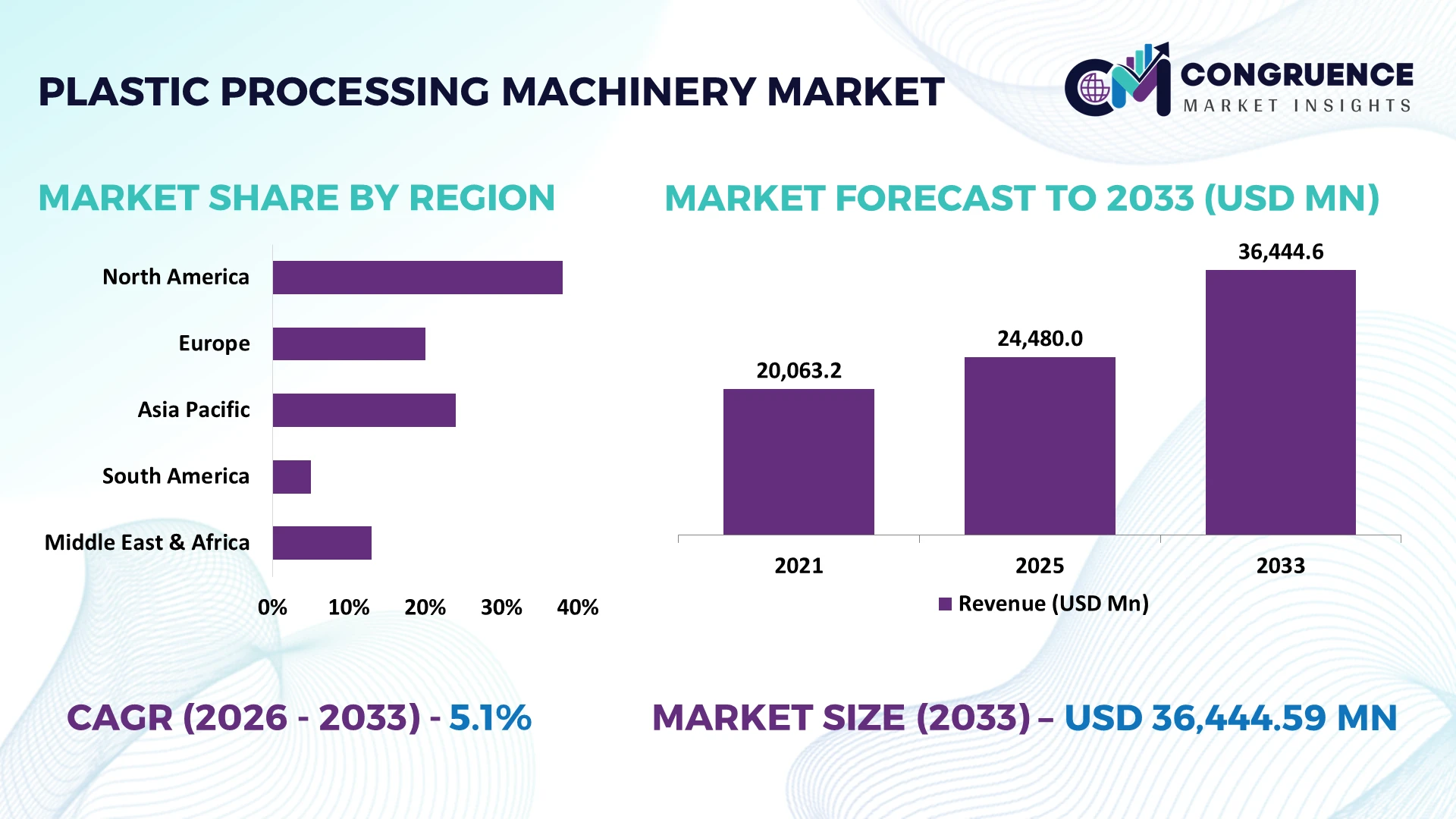
The Global Plastic Processing Machinery Market was valued at USD 24480 Million in 2025 and is anticipated to reach a value of USD 36444.59 Million by 2033 expanding at a CAGR of 5.1% between 2026 and 2033. Growth is driven by lightweight automotive components, high output packaging lines, recycled polymer processing, precision molding, and factory automation that reduces scrap and cycle times.
China anchors global plastic processing machinery production, supported by its plastics conversion ecosystem and manufacturing scale. The country produces more than 30% of global manufacturing output, while electric vehicles exceeded 11 million units of domestic sales in 2024, strengthening requirements for injection molded battery, electrical, interior, and thermal management components. Machinery suppliers are accelerating servo electric drives, robotic handling, closed loop controls, and recycled resin compatibility. Compared with Germany, China competes through manufacturing scale and equipment cost, while Germany maintains strength in precision, automation, and premium extrusion technologies.
China plus one supply chain diversification strategies are simultaneously directing machinery capacity toward India and Southeast Asia, expanding opportunities for localized equipment production and aftermarket services.
Market Size & Growth: USD 24,480 million in 2025 advances to USD 36,444.59 million by 2033 at 5.1% CAGR, supported by automated molding and recycled polymer processing.
Top Growth Drivers: Packaging modernization, automotive lightweighting, and recycled plastics integration are pushing converters toward systems targeting 20% lower energy consumption.
Short Term Forecast: By 2028, advanced servo driven machinery can deliver energy savings exceeding 20% against conventional hydraulic configurations in suitable molding applications.
Emerging Technologies: AI process optimization, machine vision, digital twins, and all electric injection molding are shifting factories toward automated quality control and predictive maintenance.
Regional Leaders: Asia Pacific leads manufacturing scale, Europe commands advanced engineering adoption, while North America accelerates automation investment as processors address labor availability and reshoring priorities.
Consumer and End User Trends: Packaging accounts for roughly 40% of global plastics use, keeping high throughput extrusion, blow molding, thermoforming, and injection equipment strategically important.
Pilot and Case Example: In 2024, digitally optimized molding operations demonstrated double digit energy reduction potential through servo control, process monitoring, and tighter cycle management.
Competitive Landscape: Global competition includes Haitian International, ENGEL, ARBURG, KraussMaffei, and Sumitomo Heavy Industries, with leading suppliers differentiating through electrification, automation, and application engineering.
Regulatory & ESG Impact: The European Union targets at least 25% recycled plastic in PET beverage bottles from 2025, directly increasing machinery requirements for variable recycled feedstock processing.
Investment & Funding: Multimillion dollar factory expansions across Asia, Europe, and North America increasingly prioritize localized production, automation cells, energy efficient equipment, and shorter equipment supply chains.
Innovation & Future Outlook: Next generation machinery combines 100% electric actuation potential, intelligent controls, robotics, recycled material compatibility, and connected service platforms, shifting competitive advantage toward lifecycle productivity.
The Plastic Processing Machinery Market is increasingly shaped by precision packaging, electric vehicle components, medical plastics, electronics, construction products, and circular polymer processing. All electric injection molding, intelligent temperature control, automated material handling, and machine vision are improving repeatability while reducing production waste. Packaging represents roughly 40% of plastics use globally, making converter productivity a central equipment investment criterion. European recycled content requirements are also forcing processors to handle more variable feedstocks without sacrificing quality. These operational changes are repositioning machinery selection around energy efficiency, material flexibility, automation readiness, and lifecycle performance, establishing the foundation for strategic market assessment.
Plastic processing machinery is becoming strategically important as converters compete on production flexibility, precision, and material adaptability rather than installed capacity alone. Brand owners are redesigning packaging and components for circularity, while the European Union’s Packaging and Packaging Waste Regulation introduces a 2030 framework for recyclable packaging and recycled content. This transition makes machinery capable of processing secondary polymers, lightweight structures, and complex resin blends increasingly valuable.
Technology economics are reinforcing equipment replacement. Modern all electric injection molding systems can consume 30% to 60% less energy than conventional hydraulic machines in suitable applications while providing tighter repeatability and faster response. Japan remains influential in precision electric molding, whereas China competes through substantially greater equipment manufacturing scale and integrated automation ecosystems. Through 2028, investment priorities will increasingly favor connected controls, automated inspection, and energy monitoring rather than standalone mechanical upgrades.
A practical automotive deployment combines injection molding cells with six axis robots, cavity pressure monitoring, and automated inspection, allowing continuous component production with fewer manual interventions. Machinery manufacturers are consequently increasing application engineering investment, local service capacity, and partnerships with robotics and control specialists. Competitive positioning will increasingly depend on delivering integrated processing cells that improve utilization, material flexibility, and lifecycle productivity.
Automotive lightweighting is a primary equipment replacement catalyst as manufacturers substitute engineered polymers for heavier metal assemblies across interiors, electrical systems, underbody components, and thermal management. Plastics can reduce component weight by 20% to 50% in suitable applications, while electric vehicles require specialized polymer processing for battery housings, connectors, insulation, and charging components. India recorded more than 4 million passenger vehicle sales in 2024, expanding the addressable base for precision molding capacity. Localization programs are also strengthening domestic component sourcing. Machinery suppliers are responding with larger clamping platforms, multimaterial molding, integrated robotics, and application development centers. The strategic advantage lies in supplying complete validated production cells rather than individual machines, shortening qualification cycles for automotive Tier 1 suppliers.
Recycled polymer variability creates a structural constraint because inconsistent viscosity, contamination, moisture, and thermal history complicate stable high volume processing. Mechanical recycling can produce material property losses exceeding 10% after repeated processing cycles depending on polymer type and operating conditions, increasing requirements for filtration, drying, dosing, and process control. Europe generated around 32 million tonnes of plastic waste in 2022, yet converting heterogeneous waste streams into predictable industrial feedstock remains difficult. Electricity can represent more than 50% of injection molding conversion costs excluding raw material in energy intensive facilities, magnifying exposure to power price volatility. Processors are mitigating these pressures through long term resin contracts, closed loop scrap recovery, localized recycling partnerships, and adaptive control systems. Equipment vendors that stabilize variable feedstock conditions gain stronger aftermarket and retrofit opportunities.
Artificial intelligence assisted process control creates an opportunity to increase output without equivalent additions to factory floor space. Advanced cavity monitoring and automated parameter adjustment can cut molding scrap by 20% or more in suitable precision applications, while predictive maintenance programs can reduce unplanned equipment downtime by 30% when supported by sufficiently mature sensor data. Singapore’s highly automated manufacturing environment illustrates how connected equipment can support production where labor availability and space constrain conventional expansion. Through 2028, machinery platforms will increasingly combine edge analytics, machine vision, digital twins, and standardized connectivity with molding hardware. Manufacturers are expanding software development and automation partnerships accordingly. A particularly valuable opportunity lies in monetizing installed machines through remote diagnostics, optimization subscriptions, and performance services, converting equipment relationships into recurring lifecycle engagement.
The long term challenge is integrating increasingly software intensive machinery into plants still operating mixed generations of equipment, controls, and communication protocols. Industrial organizations can lose 5% to 20% of productive capacity through unplanned downtime, while digitally connected machinery expands cybersecurity exposure across production networks. Germany illustrates the execution pressure: manufacturing employers face persistent shortages of engineering and skilled technical personnel as experienced workers retire. Adding artificial intelligence, vision systems, robotics, and industrial connectivity increases requirements for controls engineers, data specialists, maintenance technicians, and cybersecurity expertise. Machinery companies must therefore build interoperable architectures, remote support capabilities, technician training programs, and secure software update processes alongside hardware innovation. Competitive durability will depend on whether suppliers can make advanced processing technology deployable across heterogeneous factories without increasing operational complexity faster than productivity.
Circular Feedstock Handling Becomes Standard: Processors are redesigning production lines for higher recycled resin variability as packaging rules tighten material specifications. Advanced filtration and melt monitoring can remove contaminants below 100 microns, while gravimetric dosing can maintain blend accuracy within 0.5%. European converters are adding specialized screws, dryers, and filtration modules to stabilize post consumer resin. Equipment manufacturers are responding with modular plasticizing units and automated recipe management, reducing changeover complexity while allowing processors to qualify broader recycled material streams without replacing complete production lines.
Mold Change Automation Gains Momentum: High mix manufacturing is pushing processors toward automated mold handling rather than longer dedicated production campaigns. Quick mold change systems can reduce changeovers from more than 60 minutes to below 20 minutes, while magnetic clamping can shorten setup operations by over 50%. Italian and German processors serving diversified component programs are integrating standardized mold interfaces and automated parameter retrieval. Machinery builders are consequently redesigning platens, controls, and auxiliary interfaces around rapid product switching, improving asset utilization for shorter production runs.
In Mold Functions Consolidate Steps: Manufacturers are combining molding, decoration, labeling, assembly, and functional integration inside individual production cycles. In mold labeling can eliminate a separate labeling stage, while multicomponent molding can consolidate 2 or more materials within one part. Packaging and consumer product manufacturers are deploying integrated cells to reduce handling, work in process inventory, and secondary equipment footprints. Suppliers are expanding turnkey engineering partnerships covering molds, automation, inspection, and downstream handling, shifting competition toward process consolidation expertise.
Large Tonnage Platforms Expand: Battery systems, logistics products, household components, and structural plastic parts are increasing demand for larger shot volumes and clamping forces. Modern presses increasingly exceed 4,000 tonnes, while structural components can consolidate 10 or more smaller parts into one molded assembly. Chinese machinery producers are scaling large format platforms alongside automated part extraction and centralized material delivery. The less obvious shift is economic: part consolidation reduces assembly stations and tooling count, making machine selection increasingly dependent on total manufacturing architecture rather than press productivity alone.
Injection Molding leads the type landscape with an estimated 45% share, supported by high production repeatability, multicavity tooling, automation compatibility, and applicability across precision components and mass manufactured products. Its mature installed base gives processors access to extensive tooling, auxiliary equipment, and technical expertise. Blow Molding remains essential for hollow containers, while Compression Molding retains strategic relevance in thermosets and composite components. Calendering serves continuous sheet and film requirements where uniform thickness remains critical.
Extrusion is the fastest expanding type as processors increase output of pipes, profiles, sheets, films, and recycled polymer compounds. Modern extrusion lines can operate continuously at utilization levels above 80%, strengthening economics for standardized high volume products. Thermoforming is gaining attention for lightweight trays and formed packaging, while Rotational Molding remains valuable for large seamless products requiring relatively low tooling complexity. Machinery manufacturers are prioritizing modular extruders, multilayer processing, precision controls, and application specific configurations, directing investment toward platforms offering flexible material processing and downstream integration.
Packaging represents the leading application with an estimated 35% share, reflecting continuous production requirements for bottles, closures, containers, films, trays, and protective formats. High throughput operations favor short cycle molding, multilayer extrusion, automated inspection, and integrated downstream handling. Consumer Goods remain a mature application requiring flexible tooling for frequent design changes, while Construction Products depend on durable pipe, profile, sheet, and insulation processing. Industrial Products sustain demand for engineered components requiring dimensional consistency and chemical resistance.
Medical Products are the fastest advancing application as manufacturers expand clean production of syringes, diagnostic consumables, drug delivery components, and laboratory products. Medical molding operations commonly target reject rates below 1%, making process validation, traceability, and cavity monitoring decisive equipment criteria. Electrical Components are becoming more technically demanding as connectors, housings, insulation systems, and miniature parts require tighter tolerances. Automotive Parts increasingly emphasize complex engineered polymers and integrated functions. Suppliers are responding with cleanroom compatible platforms, automated inspection, traceability software, and specialized process packages, concentrating investment where compliance and precision support higher equipment differentiation.
Packaging is the dominant end user with an estimated 34% share because converters operate large fleets of extrusion, injection, blow molding, and thermoforming equipment across continuous production environments. Production economics depend heavily on uptime, cavity utilization, rapid tooling changes, and integrated auxiliary systems. Consumer Goods and Industrial Manufacturing remain substantial equipment buyers requiring flexible platforms across diverse product geometries. Construction maintains equipment demand for pipes, profiles, panels, fittings, and other high volume fabricated products.
Healthcare is the fastest expanding buyer group as device manufacturers increase validated polymer processing capacity for disposable, diagnostic, laboratory, and drug delivery products. Clean manufacturing environments commonly require ISO Class 7 or Class 8 configurations, raising demand for contamination controlled machinery and automated handling. Electronics buyers prioritize precision micro components and connector systems, while Automotive procurement increasingly emphasizes engineered resin capability. Agriculture remains specialized around irrigation components, films, containers, and durable equipment parts. Machinery suppliers are targeting these buyers with sector specific machine packages, validation support, service agreements, and application engineering, shifting competitive advantage toward end user specialization rather than standardized equipment portfolios.
Asia Pacific accounted for the largest market share at 46% in 2025 however, Asia Pacific is expected to register the fastest growth, expanding at a CAGR of 6.2% between 2026 and 2033.
Reshoring Strengthens High Precision Processing
North America accounted for an estimated 22% market share in 2025, with machinery demand concentrated across packaging, transportation equipment, healthcare manufacturing, building products, and engineered components. United States processors are prioritizing equipment modernization as reshoring programs increase requirements for repeatable domestic production and shorter supplier networks. The Inflation Reduction Act and semiconductor manufacturing expansion have also stimulated downstream requirements for polymer components used in energy and electronics infrastructure. Mexico strengthens the regional production network through automotive and appliance manufacturing clusters connected to United States customers. Processors increasingly specify automated auxiliary equipment, centralized material management, and integrated quality inspection. Machinery suppliers are expanding technical service coverage and application engineering close to manufacturing corridors, making response time, parts availability, and process support increasingly important purchasing criteria alongside machine specifications.
United States Market Outlook: The United States combines advanced polymer conversion capabilities with large medical device, aerospace, packaging, and industrial manufacturing bases. Manufacturing contributed roughly 10% of national economic output in 2024. Machinery investment increasingly targets domestic production resilience, precision manufacturing, and flexible capacity capable of supporting shorter product cycles and stringent quality requirements.
Circularity Reshapes Equipment Specifications
Europe represented an estimated 24% market share in 2025, supported by sophisticated plastics processing clusters and established machinery engineering capabilities. Regulatory pressure is materially changing capital equipment specifications. The Packaging and Packaging Waste Regulation establishes recyclability requirements applying from 2030, encouraging converters to prepare production assets for redesigned packaging structures and higher circular material utilization. Machinery buyers are therefore emphasizing melt quality management, traceability, efficient heating systems, and adaptable processing windows. Italy maintains an extensive machinery manufacturing ecosystem, while Austria and Switzerland contribute specialized injection molding and automation expertise. European equipment producers are also strengthening retrofit businesses because processors increasingly seek productivity upgrades without replacing complete installed lines. This creates an attractive service opportunity around controls modernization, auxiliary integration, refurbishment, and process optimization while reinforcing premium suppliers’ lifecycle relationships with converters.
Germany Market Outlook: Germany remains strategically significant through its engineering depth, automotive supplier network, technical plastics expertise, and high specification manufacturing environment. The country generated more than 4 million passenger cars during 2024, sustaining requirements for sophisticated polymer component production. German machinery developers differentiate through precision controls, integrated automation, engineering services, and complex application support.
Manufacturing Scale Drives Equipment Localization
Asia Pacific's 46% share reflects unmatched concentration of polymer conversion, electronics assembly, appliance manufacturing, packaging production, and export oriented industrial capacity. China, India, Japan, South Korea, Vietnam, and Thailand support distinct equipment demand profiles ranging from high volume commodity conversion to precision engineered plastics. India processed more than 20 million tonnes of polymers annually by the middle of the decade, strengthening requirements for extrusion, molding, compounding, and downstream equipment. Southeast Asian manufacturing diversification is simultaneously encouraging localized converter capacity as international companies rebalance production networks beyond single country sourcing. Japanese manufacturers retain advantages in precision controls and electric machine architecture, while Chinese suppliers increasingly compete internationally through vertically integrated manufacturing and shorter equipment delivery cycles. Machinery producers are expanding local assembly, application laboratories, distributor networks, and service centers to capture customers requiring faster commissioning and localized technical support.
China Market Outlook: China remains the region's principal equipment manufacturing and deployment center, supported by enormous packaging, electronics, appliance, automotive, and consumer product supply chains. The country manufactured more than 31 million vehicles in 2024, creating extensive requirements for polymer processing across interiors, lighting, connectors, exterior assemblies, and electrical systems. Domestic machinery suppliers increasingly combine scale with sophisticated control platforms.
Converter Modernization Concentrates Around Brazil
South America held an estimated 5% market share in 2025, with equipment deployment concentrated in Brazil, Argentina, Colombia, Chile, and Peru. Packaging converters, beverage producers, construction material manufacturers, agribusiness suppliers, and household goods producers form the principal machinery customer base. Brazil dominates industrial processing capacity, while neighboring markets depend more heavily on imported production equipment and technical support. Currency volatility and elevated financing costs can delay machinery replacement, encouraging processors to extend asset life through control retrofits and auxiliary upgrades. At the same time, agricultural export infrastructure supports specialized requirements for irrigation products, crates, films, containers, and protective packaging. Equipment suppliers are strengthening distributor led maintenance networks and financing arrangements, recognizing that accessible servicing and spare parts can materially influence purchasing decisions where imported machinery faces longer logistics cycles.
Brazil Market Outlook: Brazil combines South America's deepest plastics conversion base with substantial food, beverage, automotive, construction, and agricultural manufacturing. The country produces more than 2 million vehicles annually, supporting localized demand for technically demanding molded components. Equipment vendors that combine financing flexibility, Portuguese language engineering support, and domestic spare parts availability gain a practical procurement advantage.
Petrochemical Integration Supports Downstream Conversion
Middle East and Africa represented an estimated 3% market share in 2025, but equipment demand is becoming more industrially concentrated around Gulf downstream diversification and African consumer manufacturing hubs. Saudi Arabia and the United Arab Emirates are using established petrochemical feedstock positions to deepen domestic conversion into packaging, pipes, construction materials, and industrial products. Saudi Vision 2030 reinforces manufacturing localization, while major Gulf industrial zones provide logistics and utility infrastructure suitable for large processing facilities. African demand remains more fragmented, with Egypt and South Africa providing established conversion bases and East African markets emphasizing packaging and construction applications. Machinery vendors increasingly combine equipment sales with operator training, maintenance agreements, and turnkey plant engineering because technical capability and dependable servicing directly determine utilization in developing production environments.
Saudi Arabia Market Outlook: Saudi Arabia offers a distinctive advantage through direct proximity to large polymer resin production and expanding downstream industrial policy. Manufacturing localization programs are encouraging domestic conversion of polyethylene and polypropylene into higher value products. Machinery suppliers are consequently targeting industrial cities with turnkey lines, technical training, and long duration service arrangements rather than relying solely on imported equipment sales.
Haitian International competes aggressively on scale and equipment economics, while ENGEL, ARBURG, KraussMaffei, and Sumitomo Heavy Industries emphasize precision, application engineering, automation, and specialized processing. The top five suppliers account for an estimated 30% of global machinery sales, leaving substantial demand distributed among regional specialists. Chinese manufacturers can price standardized platforms 15% to 30% below premium European configurations, while advanced electric machines can deliver energy reductions exceeding 40% against older hydraulic designs in suitable applications. Custom engineered cells can shorten downstream handling requirements by 20% through integrated robotics and inspection. Suppliers are expanding localized assembly, automation partnerships, application centers, and vertically integrated controls to improve delivery responsiveness. Competition is shifting from standalone machine specifications toward complete production ecosystems combining equipment, software, auxiliaries, tooling integration, and lifecycle support. Engineering capability, installed service infrastructure, qualification expertise, and capital intensity remain substantial entry barriers. Winning requires competitive lifecycle economics backed by application specific engineering and dependable local support.
Haitian International Holdings Limited
ENGEL Austria GmbH
ARBURG GmbH + Co KG
KraussMaffei Group GmbH
Sumitomo Heavy Industries, Ltd.
The Japan Steel Works, Ltd.
NISSEI Plastic Industrial Co., Ltd.
Shibaura Machine Co., Ltd.
Chen Hsong Holdings Limited
Husky Technologies
Milacron
SACMI Imola S.C.
Davis Standard, LLC
Reifenhäuser Group
Plastic processing machinery is moving from isolated electromechanical equipment toward sensor rich, software controlled production cells. Servo electric drives, cavity pressure sensing, and automated quality control reduce energy use by 20% while improving repeatability by 15%. Connected machine controls are deployed across high specification medical, electronics, and packaging plants, giving processors faster parameter stabilization, traceable production records, and lower dependence on manual adjustment.
Emerging systems combine machine vision, digital twins, edge analytics, and adaptive process control. AI assisted parameter optimization can reduce scrap by 10% to 20% while digital twins shorten commissioning and process validation. Compared with legacy hydraulic platforms, redesigned all electric machines can deliver 20% lower energy consumption while occupying 20% less floor space. Integrated robotics converts molding equipment into synchronized manufacturing cells rather than standalone presses.
Disruptive development through 2026 to 2028 will center on autonomous correction, machine connectivity, closed loop coordination between molding equipment, inspection, auxiliaries, and material systems. Plants deploying these architectures benefit from faster troubleshooting and consistent output across sites. Premium machinery builders gain competitive advantage by combining hardware with proprietary controls, analytics, and lifecycle services. Processors should act now because software compatibility increasingly determines future automation flexibility and supports rapid multi site scaling.
May 2024 Haitian International shifted most injection molding machine deliveries for United States and Canadian customers to Mexico, avoiding a 25% tariff on Chinese machinery while shortening logistics exposure and strengthening localized North American supply resilience.
August 2025 KraussMaffei launched its redesigned all electric PX series for K 2025, cutting machine footprint and energy consumption by 20% each. The 800 to 2,000 kN platform improves factory space utilization and operating economics for processors worldwide.
October 2025 ENGEL demonstrated an all electric e motion 420 cell producing thin wall PET yoghurt cups containing 30% food grade rPET. The production setup aligns precision molding with circular packaging requirements and scalable recycled material processing capacity.
April 2026 ARBURG announced its ALLROUNDER 1000 e TREND deployment for FIP 2026, processing PBT containing about one third post consumer recyclate in a turnkey cell. A 60 second cycle demonstrates automated recycled material processing with integrated robotics.
The Plastic Processing Machinery Market report evaluates seven equipment types spanning injection molding, extrusion, blow molding, compression molding, thermoforming, rotational molding, and calendering. Coverage extends across seven applications and eight end user industries, connecting machinery selection with packaging, mobility, healthcare, electronics, construction, agriculture, consumer products, and industrial manufacturing requirements. Analysis also examines automation architecture, process monitoring, robotics integration, material handling, and specialized equipment configurations.
Geographic assessment covers North America, Europe, Asia Pacific, South America, and Middle East and Africa, with country level examination of manufacturing ecosystems, localization, industrial policy, and equipment deployment. Strategic coverage addresses competitive positioning, circular processing capability, aftermarket services, production localization, and emerging niche requirements including micro molding and multimaterial processing. The 2026 to 2033 framework supports capital allocation, manufacturing expansion, partnership selection, technology roadmaps, and identification of equipment categories where differentiation increasingly depends on integrated processing expertise rather than machine capacity alone.
| Report Attribute/Metric | Report Details |
|---|---|
Market Revenue in 2025 | USD 24480 Million |
Market Revenue in 2033 | USD 36444.59 Million |
CAGR (2026 - 2033) | 5.1% |
Base Year | 2025 |
Forecast Period | 2026 - 2033 |
Historic Period | 2021 - 2025 |
Segments Covered | By Type
By Application
By End-User
|
Key Report Deliverable | Revenue Forecast, Growth Trends, Market Dynamics, Segmental Overview, Regional and Country-wise Analysis, Competition Landscape |
Region Covered | North America, Europe, Asia-Pacific, South America, Middle East, Africa |
Key Players Analyzed | Haitian International Holdings Limited, ENGEL Austria GmbH, ARBURG GmbH + Co KG, KraussMaffei Group GmbH, Sumitomo Heavy Industries, Ltd., The Japan Steel Works, Ltd., NISSEI Plastic Industrial Co., Ltd., Shibaura Machine Co., Ltd., Chen Hsong Holdings Limited, Husky Technologies, Milacron, SACMI Imola S.C., Davis Standard, LLC, Reifenhäuser Group |
Customization & Pricing | Available on Request (10% Customization is Free) |




