
Reports
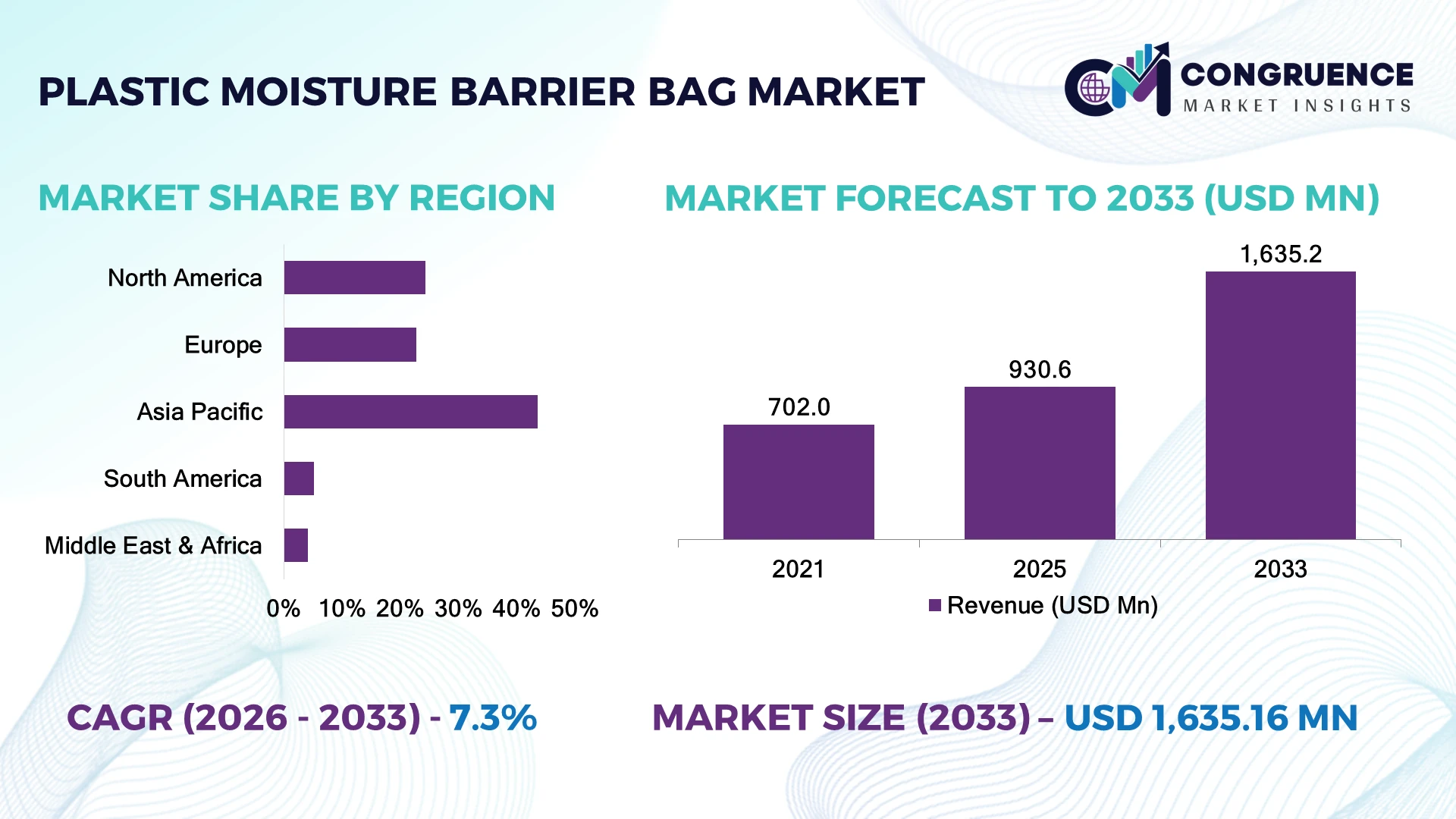
The Global Plastic Moisture Barrier Bag Market was valued at USD 930.6 Million in 2025 and is anticipated to reach a value of USD 1,635.2 Million by 2033 expanding at a CAGR of 7.3% between 2026 and 2033. Growth is being driven by rising semiconductor packaging, pharmaceutical moisture-control requirements, lithium-ion battery manufacturing expansion, and advanced multilayer barrier film technologies that improve product shelf life and export reliability.
China dominates the global Plastic Moisture Barrier Bag market with approximately 36% manufacturing share, supported by large-scale semiconductor, electronics, and lithium-ion battery production. More than 58% of advanced moisture barrier bags supplied to battery manufacturers originate from Chinese production facilities, strengthened by continued industrial investment despite ongoing supply-chain diversification following global trade realignments. In comparison, South Korea emphasizes premium high-barrier packaging for semiconductor exports, where multilayer film adoption exceeds 74%, reflecting stronger technology intensity rather than manufacturing scale.
Manufacturers prioritizing high-performance multilayer films, localized production, and electronics-grade quality standards will secure stronger positions across high-value industrial packaging applications.
Market Size & Growth: USD 930.6 Million in 2025, reaching USD 1,635.2 Million by 2033 at a CAGR of 7.3%, supported by semiconductor packaging expansion and battery manufacturing growth.
Top Growth Drivers: Semiconductor packaging (+34%), lithium-ion battery production (+29%), pharmaceutical moisture-sensitive packaging (+21%) continue strengthening global demand.
Short-Term Forecast: By 2028, automated bag manufacturing is expected to improve production efficiency by 18% while reducing material waste by approximately 14%.
Emerging Technologies: High-barrier multilayer films, AI-enabled quality inspection, and recyclable composite materials improve moisture protection and manufacturing precision.
Regional Leaders: Asia-Pacific leads with approximately USD 640 Million potential, North America exceeds USD 340 Million, while Europe approaches USD 310 Million through advanced industrial packaging adoption.
Consumer/End-User Trends: More than 68% of electronics manufacturers now specify high-barrier moisture packaging for export-oriented components and sensitive assemblies.
Pilot/Case Example: In 2026, automated multilayer film conversion projects improved packaging throughput by nearly 22% while lowering defect rates by 16%.
Competitive Landscape: Leading manufacturers collectively control about 44% of global demand through technology, customized barrier films, and integrated supply chains.
Regulatory & ESG Impact: Recyclable barrier material adoption has increased by approximately 19% as manufacturers align with stricter packaging sustainability requirements.
Investment & Funding: More than USD 520 Million has been directed toward barrier film expansion, battery packaging capacity, and high-performance flexible packaging facilities.
Innovation & Future Outlook: Smart packaging, thinner multilayer structures, and advanced moisture-indicator integration are reshaping premium industrial packaging strategies across expanding global supply chains.
Plastic moisture barrier bags have become essential across semiconductor packaging, pharmaceutical distribution, lithium battery logistics, and precision electronics manufacturing, where moisture control directly influences product quality and operational reliability. Advanced multilayer structures now improve moisture resistance by nearly 32%, while increasing supply-chain localization and stricter export packaging standards in 2026 are accelerating demand for customized, high-performance barrier packaging solutions, setting the stage for broader strategic transformation.
The Plastic Moisture Barrier Bag market has become strategically important as manufacturers strengthen supply-chain resilience for semiconductors, pharmaceuticals, advanced electronics, and lithium-ion batteries. Rising investments in domestic manufacturing, export-oriented production, and precision packaging have shifted purchasing priorities from standard polyethylene bags toward engineered multilayer moisture barrier solutions. This transition is reinforcing long-term supplier relationships and encouraging capacity expansion in high-value industrial packaging.
Modern multilayer aluminium-laminated barrier bags provide approximately 28% higher moisture protection and extend storage performance by nearly 24% compared with conventional single-layer plastic packaging. China continues leading large-scale production through manufacturing capacity, while Japan and South Korea emphasize premium barrier technology for semiconductor-grade applications. During the next two to three years, automated film conversion and inline quality inspection are expected to support more than 40% of new high-performance packaging installations.
Battery manufacturers increasingly deploy customized moisture barrier bags with humidity indicators and vacuum-sealing compatibility to protect sensitive cell components during international transportation. Packaging companies are expanding regional manufacturing, strengthening converter partnerships, and investing in recyclable high-barrier materials. Organizations capable of combining advanced material science, manufacturing precision, and localized supply capability will secure stronger competitive positioning as industrial packaging standards continue becoming more performance driven.
Rapid expansion of semiconductor fabrication and lithium-ion battery manufacturing is accelerating demand for high-performance plastic moisture barrier bags capable of protecting moisture-sensitive components during storage and international transportation. Nearly 67% of semiconductor manufacturers now specify multilayer moisture barrier packaging for export shipments, while advanced battery production has increased demand for ultra-low moisture transmission packaging by approximately 31%. The continued relocation of electronics manufacturing into India and Southeast Asia is reinforcing long-term procurement of certified barrier packaging. This shift improves packaging standardization and strengthens long-term supply agreements. Manufacturers are expanding multilayer film capacity, investing in precision lamination technology, and developing customized packaging solutions for electronics and battery producers. Competitive advantage increasingly depends on barrier performance consistency rather than packaging cost alone.
Fluctuating prices of polyethylene, aluminium foil, nylon films, and specialty barrier resins continue challenging production economics across the Plastic Moisture Barrier Bag market. Raw materials account for nearly 62% of manufacturing costs, while aluminium laminate prices have fluctuated by approximately 19% across recent procurement cycles. Dependence on imported high-barrier films also creates supply uncertainty for converters in emerging manufacturing economies. These structural constraints compress operating margins, increase inventory costs, and reduce pricing flexibility for long-term customer contracts. Companies are reducing exposure through localized film sourcing, long-term resin procurement agreements, multilayer material optimization, and investments in recyclable barrier structures. Operational resilience increasingly depends on diversified material supply rather than low-cost procurement strategies.
The integration of intelligent packaging technologies is creating new growth opportunities beyond conventional moisture protection. Approximately 35% of electronics exporters are evaluating moisture barrier bags incorporating humidity indicators, RFID tags, and digital traceability features, while automated packaging verification reduces inspection time by nearly 27%. Japan and South Korea continue promoting advanced packaging technologies that improve logistics visibility for semiconductor exports. Manufacturers are strengthening R&D investment, partnering with automation providers, and developing digitally enabled barrier packaging ecosystems. A non-obvious opportunity lies in transforming moisture barrier bags into real-time quality assurance tools that reduce product rejection, improve inventory control, and strengthen export compliance across high-value manufacturing sectors.
Meeting increasingly diverse technical specifications across semiconductor, pharmaceutical, aerospace, and battery industries remains a significant execution challenge for manufacturers. Approximately 43% of industrial buyers require customized barrier performance, while qualification timelines have increased by nearly 21% due to stricter moisture transmission testing and validation requirements. Differences in international packaging standards complicate product harmonization and increase engineering costs for global suppliers. These technical complexities slow commercial deployment and reduce manufacturing flexibility. Companies must invest in advanced testing laboratories, precision quality control systems, and collaborative product development with end users. Sustained competitiveness depends on delivering application-specific barrier performance without increasing production complexity or extending customer qualification cycles.
Thinner High-Barrier Film Structures: Manufacturers are reducing multilayer film thickness by approximately 15% while maintaining moisture barrier performance above previous specifications. Material optimization lowers resin consumption and transportation weight, improving packaging efficiency. Companies are upgrading extrusion and lamination equipment to support higher-output production as customers seek cost-efficient industrial packaging.
Automation Reshapes Bag Production: Automated converting, sealing, and inspection systems now support nearly 46% of advanced production lines, increasing throughput by approximately 23% while reducing packaging defects by around 18%. Labour shortages in industrial manufacturing are accelerating automation investment, prompting companies to modernize facilities and integrate AI-assisted quality inspection.
Recyclable Barrier Materials Expand: Demand for recyclable high-barrier packaging has increased by approximately 26% as manufacturers respond to evolving packaging sustainability requirements. New mono-material and reduced-aluminium structures are improving recyclability without compromising moisture protection. Companies are restructuring product portfolios and collaborating with material suppliers to accelerate commercialization of environmentally improved barrier packaging.
Electronics Export Packaging Evolves: Export-oriented electronics manufacturers are increasingly specifying moisture barrier bags with humidity indicators and vacuum compatibility, with adoption rising by nearly 33%. A less obvious trend is the growing use of digitally traceable packaging for inventory validation and compliance documentation. Packaging suppliers are integrating smart labelling technologies and expanding customized solutions for semiconductor and battery supply chains.
Metalized moisture barrier bags account for approximately 57% of the global Plastic Moisture Barrier Bag market due to their superior moisture resistance, electrostatic discharge (ESD) protection, and suitability for semiconductor, electronics, and lithium-ion battery packaging. Their multilayer construction provides extended storage stability and reliable export protection, making them the preferred choice for high-value industrial applications. Transparent moisture barrier bags continue serving pharmaceutical, medical device, and precision component packaging where visual inspection is operationally important, while standard polyethylene barrier bags retain relevance in cost-sensitive industrial packaging applications.
Aluminium foil laminate moisture barrier bags represent the fastest-growing type as battery manufacturers and semiconductor exporters demand ultra-low moisture transmission performance. Adoption of foil-based structures has increased by approximately 29%, while high-barrier multilayer film usage has expanded by nearly 24% among electronics exporters. Manufacturers are investing in advanced lamination technology, thinner barrier structures, and customized packaging formats while strengthening partnerships with semiconductor and battery producers. Investment priorities are shifting toward premium barrier materials capable of supporting increasingly sensitive electronic components.
According to a 2026 enterprise packaging assessment by SEMI, advanced semiconductor manufacturers continue prioritizing metalized and aluminium laminate moisture barrier packaging to reduce moisture-related component failures during storage and international logistics.
Semiconductor packaging represents the largest application segment with approximately 42% market share owing to strict moisture control requirements throughout manufacturing, storage, and international transportation. Advanced integrated circuits, wafers, and electronic assemblies require high-performance barrier packaging to maintain product reliability and prevent moisture-induced defects. Pharmaceutical packaging remains a mature application supported by stringent quality requirements, while aerospace and defence applications continue demanding certified moisture protection for precision electronic systems.
Lithium-ion battery packaging is the fastest-growing application as global battery manufacturing capacity continues expanding. Demand for high-barrier moisture packaging within battery supply chains has increased by approximately 33%, while vacuum-compatible barrier bag deployment has grown by nearly 26%. Manufacturers are expanding automated converting capacity, developing customized packaging solutions, and integrating humidity monitoring features for battery logistics. Demand is increasingly shifting toward application-specific packaging capable of supporting export operations, extended storage periods, and high-value industrial manufacturing.
A 2025 industry packaging survey published by the IPC Electronics Association found that moisture-controlled packaging remains a standard requirement across most electronics manufacturing facilities handling moisture-sensitive semiconductor components.
Electronics manufacturers account for approximately 49% of total Plastic Moisture Barrier Bag demand because of large-scale production of semiconductors, printed circuit boards, precision components, and electronic assemblies. Continuous production schedules, export-oriented operations, and strict quality standards create sustained demand for high-performance moisture barrier packaging. Pharmaceutical manufacturers remain a significant buyer group due to packaging validation requirements, while aerospace and industrial equipment producers increasingly adopt premium barrier solutions for sensitive components.
Battery manufacturers represent the fastest-growing end-user segment as electric vehicle production and stationary energy storage investments accelerate worldwide. Procurement of advanced moisture barrier packaging has increased by approximately 31%, while customized packaging formats have expanded by nearly 22% to support automated battery manufacturing lines. Packaging suppliers are strengthening technical partnerships, developing application-specific barrier structures, and expanding regional manufacturing capacity near battery production hubs. Competitive positioning increasingly depends on customized engineering, consistent barrier performance, and responsive technical support rather than standard packaging supply.
A 2026 manufacturing study by the Association Connecting Electronics Industries (IPC) highlighted that moisture-controlled packaging has become an integral quality assurance requirement for electronics manufacturers producing export-grade moisture-sensitive components.
Asia-Pacific accounted for the largest market share at 43.6% in 2025 however, Middle East & Africa is expected to register the fastest growth, expanding at a CAGR of 8.1% between 2026 and 2033.
Advanced Electronics Manufacturing Drives Premium Packaging Demand
North America accounts for approximately 24.3% of the global Plastic Moisture Barrier Bag market, supported by strong semiconductor production, pharmaceutical manufacturing, aerospace electronics, and expanding battery supply chains. High-value industrial sectors increasingly require moisture-controlled packaging that complies with strict quality and traceability standards. More than 61% of semiconductor packaging facilities have adopted high-barrier multilayer bags for export-grade component protection. Investments in automated packaging lines and domestic battery manufacturing are strengthening demand for customized moisture barrier solutions. Packaging suppliers are expanding multilayer film production, integrating digital quality inspection, and establishing long-term partnerships with electronics manufacturers to improve supply reliability and shorten delivery cycles.
United States Market Outlook: The United States leads the regional market through advanced semiconductor fabrication, pharmaceutical production, and expanding electric vehicle battery investments. Domestic manufacturers increasingly prioritize moisture barrier packaging with ultra-low moisture transmission rates to support sensitive electronic components and export logistics. Approximately 68% of large electronics manufacturing facilities have standardized multilayer moisture barrier packaging for critical production and international shipment, reinforcing demand for premium packaging technologies.
Sustainable Barrier Materials Reshape Industrial Packaging
Europe represents approximately 22.8% of the global market, supported by advanced pharmaceutical manufacturing, precision engineering, and high-value electronics production. Industrial packaging suppliers increasingly focus on recyclable multilayer structures, thinner barrier films, and automated converting technologies to comply with evolving packaging regulations. More than 27% of newly commissioned production capacity incorporates material-efficient lamination technologies that reduce waste while maintaining barrier performance. Companies continue strengthening regional manufacturing capabilities to support resilient supply chains and premium industrial packaging applications.
Germany Market Outlook: Germany remains the largest market in Europe due to its strong automotive electronics, semiconductor equipment, and pharmaceutical manufacturing sectors. High-quality industrial packaging standards encourage widespread adoption of advanced moisture barrier bags for precision components. Nearly 63% of export-oriented industrial manufacturers specify certified high-barrier packaging to improve storage stability and protect sensitive products during international transportation.
Manufacturing Scale Supports Global Leadership
Asia-Pacific dominates the Plastic Moisture Barrier Bag market with approximately 43.6% share, driven by extensive semiconductor fabrication, lithium-ion battery production, electronics assembly, and flexible packaging manufacturing. China, Japan, South Korea, and India collectively account for the majority of global production capacity for high-barrier industrial packaging materials. More than 59% of global multilayer moisture barrier bag manufacturing is concentrated across the region, supported by integrated polymer supply chains and export-oriented manufacturing. Producers continue investing in automated lamination, precision film extrusion, and customized packaging solutions for high-growth industrial sectors.
China Market Outlook: China leads the regional market through its unmatched electronics manufacturing ecosystem, battery production capacity, and large-scale flexible packaging industry. Manufacturers continue expanding multilayer barrier film production while strengthening domestic supply chains for semiconductor and battery packaging. More than 65% of high-performance moisture barrier bags supplied to domestic battery manufacturers are produced locally, supporting cost competitiveness and reliable industrial supply.
Industrial Packaging Modernization Expands Demand
South America is witnessing steady market development as pharmaceutical manufacturing, electronics assembly, and food export industries adopt higher-performance moisture protection solutions. Brazil and Argentina remain key contributors, supported by expanding industrial packaging infrastructure and modernization of manufacturing facilities. Approximately 24% of recent industrial packaging investments have focused on upgrading multilayer flexible packaging production capabilities. Manufacturers are strengthening distributor networks and regional conversion facilities while addressing logistics costs and imported material dependency that continue influencing production economics.
Brazil Market Outlook: Brazil represents the largest regional market because of its diversified pharmaceutical industry, growing electronics assembly operations, and established flexible packaging manufacturing base. Domestic packaging converters increasingly invest in advanced lamination equipment to improve product quality and reduce dependence on imported premium packaging materials. Around 57% of industrial packaging demand originates from pharmaceutical and processed manufacturing sectors requiring controlled moisture protection.
Industrial Diversification Accelerates Packaging Investments
The Middle East & Africa market is benefiting from industrial diversification, pharmaceutical manufacturing expansion, and growing electronics distribution networks. Government-backed manufacturing initiatives and logistics infrastructure development are increasing demand for advanced industrial packaging capable of protecting moisture-sensitive products during long-distance transportation. Approximately 32% of newly developed industrial packaging projects incorporate high-barrier flexible packaging technologies. Packaging companies are expanding regional warehousing, strengthening converter partnerships, and increasing local product availability to support industrial customers with shorter lead times.
United Arab Emirates Market Outlook: The United Arab Emirates leads regional demand through its strategic logistics infrastructure, pharmaceutical distribution network, and expanding advanced manufacturing ecosystem. The country serves as a major re-export hub for moisture-sensitive industrial products requiring reliable protective packaging. More than 55% of industrial packaging used for electronics and pharmaceutical exports now incorporates advanced moisture barrier solutions, supporting product integrity across international supply chains.
Global packaging leaders including Amcor, Sealed Air, Mondi, Berry Global, and ProAmpac compete against regional flexible packaging converters, while material innovators challenge cost-focused manufacturers for high-value semiconductor, pharmaceutical, and battery packaging contracts. The top five companies collectively account for approximately 48% of global market share. Competition centres on barrier performance, material innovation, manufacturing scale, and supply-chain responsiveness rather than price alone. Advanced multilayer film technologies improve moisture protection by nearly 30%, automated converting reduces production defects by approximately 18%, and localized manufacturing shortens delivery lead times by around 22%. Leading companies are expanding barrier film capacity, forming strategic partnerships with electronics manufacturers, investing in recyclable packaging, and vertically integrating film extrusion with converting operations. Competitive momentum is shifting toward sustainable high-barrier materials and customized industrial packaging. Qualification requirements, advanced lamination expertise, and long-term enterprise supply agreements remain major entry barriers. Winning requires superior barrier technology, reliable manufacturing, customization capability, and resilient global supply networks.
Amcor plc
Sealed Air Corporation
Berry Global Inc.
Mondi plc
ProAmpac
Sonoco Products Company
Coveris
Constantia Flexibles
Flexopack S.A.
IMPAK Corporation
Protective Packaging Corporation
Selenis
Cosmo First Limited
Multilayer co-extruded films, aluminium foil laminates, and metalized PET structures remain the core technologies defining high-performance plastic moisture barrier bags. These materials reduce moisture transmission by approximately 30% while improving package durability by nearly 18% compared with conventional polyethylene packaging. Around 66% of electronics and semiconductor manufacturers now specify multilayer barrier packaging for moisture-sensitive products because of superior protection during storage and international logistics. This technology delivers longer product shelf life, fewer quality failures, and stronger export reliability.
Emerging technologies include AI-enabled inspection systems, humidity-indicator integration, recyclable mono-material barrier films, and digital traceability using QR and RFID technologies. Compared with traditional multilayer packaging, next-generation lightweight barrier structures reduce material consumption by approximately 20% while maintaining equivalent moisture protection. Semiconductor manufacturers, battery producers, and pharmaceutical companies benefit most through lower packaging waste, faster inspection workflows, and improved inventory visibility. Packaging companies are integrating automated quality control and precision lamination to strengthen competitive differentiation.
Between 2026 and 2028, smart barrier packaging, recyclable high-performance films, and digitally connected packaging systems will become strategic differentiators. Automated inspection platforms are expected to support more than 45% of premium packaging production lines, reducing quality deviations and accelerating customer qualification. Companies investing early in advanced barrier materials, digital manufacturing, and customized industrial packaging will strengthen long-term enterprise partnerships, improve operational efficiency, and secure premium positioning in high-value packaging applications.
March 2024 Berry Global and Mitsubishi Gas Chemical introduced the MXD6 recyclable high-barrier packaging solution, enabling barrier resin loading of up to 12% while improving recyclability for moisture-sensitive packaging applications. Business impact: stronger sustainable barrier packaging portfolio. Source: Amcor
January 2025 Amcor expanded its lightweight high-barrier packaging portfolio with Clear-Tite 40 shrink bags, reducing package weight by approximately 30% while maintaining moisture barrier performance. Business impact: lower material consumption and improved packaging efficiency. Source: Amcor
June 2025 Mondi launched the re/cycle PaperPlus Bag Advanced with a high-performance moisture barrier film using up to 60% less plastic than comparable structures. Business impact: accelerated adoption of lower-plastic industrial barrier packaging without equipment modifications. Source: Mondi Group
2025 Amcor reported that 94% of its global flexible packaging portfolio now has a recycle-ready solution available, strengthening moisture barrier packaging sustainability across industrial applications. Business impact: improved compliance with evolving circular packaging requirements. Source: Amcor Sustainability Update
This report delivers a comprehensive assessment of the Plastic Moisture Barrier Bag market across product types, industrial applications, end-user industries, and major geographic markets. It evaluates demand for metalized, aluminium foil laminate, transparent, and multilayer barrier bags across semiconductor manufacturing, lithium-ion batteries, pharmaceuticals, electronics, aerospace, and industrial logistics. The study also examines deployment trends, material innovation, manufacturing technologies, and competitive positioning across both established and emerging industrial packaging markets.
The report further analyses advanced barrier materials, automated converting systems, recyclable multilayer structures, digital traceability technologies, and evolving packaging qualification standards shaping market development between 2026 and 2033. More than 65% of high-value electronics manufacturers now utilize advanced moisture barrier packaging for export-grade products, highlighting increasing deployment across precision manufacturing. Strategic insights support investment planning, product development, manufacturing expansion, supplier benchmarking, competitive positioning, and regional growth strategies by identifying high-potential applications, technology transitions, procurement trends, and emerging industrial packaging opportunities.
| Report Attribute/Metric | Report Details |
|---|---|
|
Market Revenue in 2025 |
USD 930.6 Million |
|
Market Revenue in 2033 |
USD 1,635.2 Million |
|
CAGR (2026 - 2033) |
7.3% |
|
Base Year |
2025 |
|
Forecast Period |
2026 - 2033 |
|
Historic Period |
2021 - 2025 |
|
Segments Covered |
By Type
By Application
By End-User
|
|
Key Report Deliverable |
Revenue Forecast, Growth Trends, Market Dynamics, Segmental Overview, Regional and Country-wise Analysis, Competition Landscape |
|
Region Covered |
North America, Europe, Asia-Pacific, South America, Middle East, Africa |
|
Key Players Analyzed |
Amcor plc, Sealed Air Corporation, Berry Global Inc., Mondi plc, ProAmpac, Sonoco Products Company, Coveris, Constantia Flexibles, Flexopack S.A., IMPAK Corporation, Protective Packaging Corporation, Selenis, Cosmo First Limited |
|
Customization & Pricing |
Available on Request (10% Customization is Free) |




