
Reports
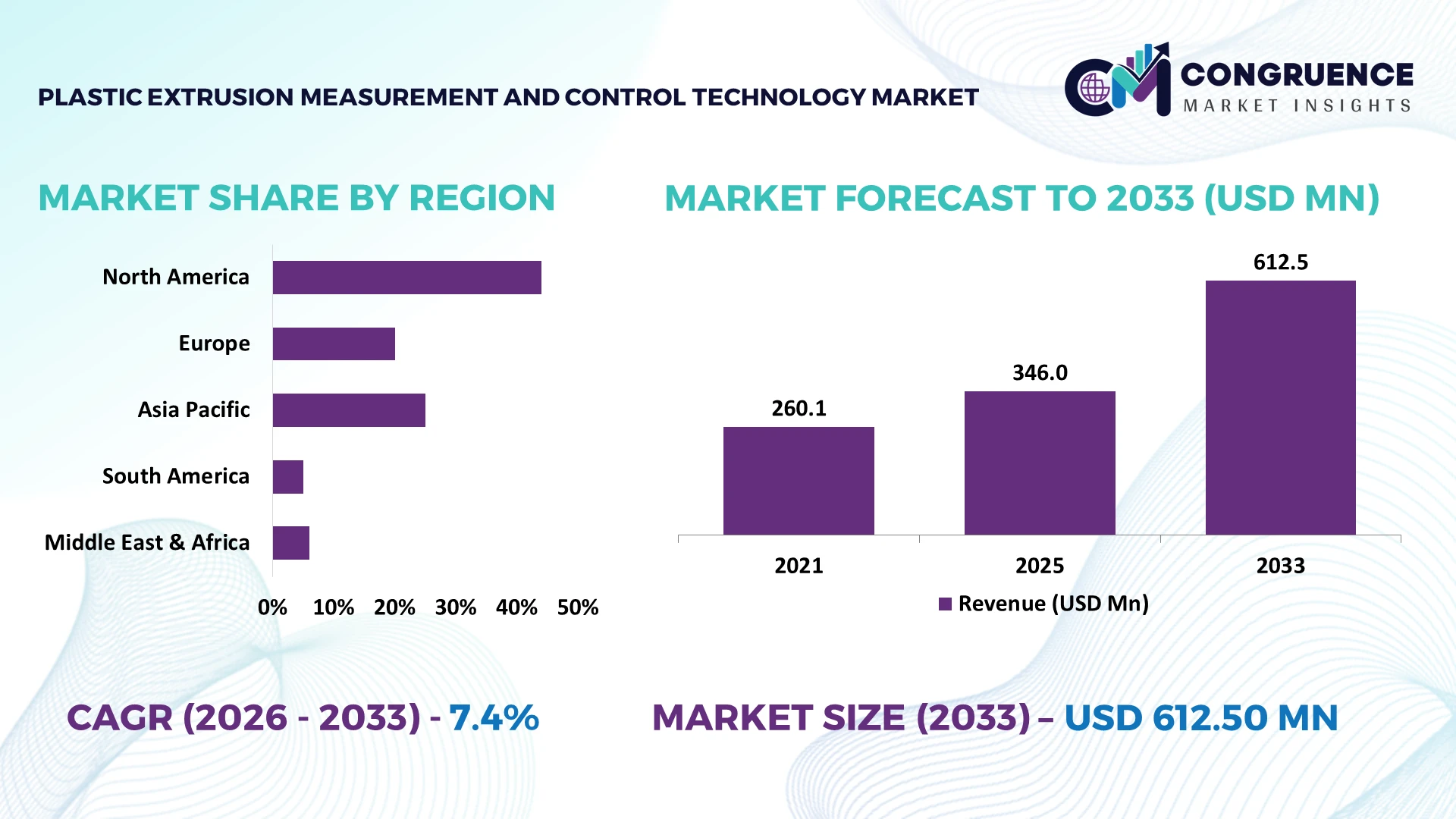
The Global Plastic Extrusion Measurement and Control Technology Market was valued at USD 346 Million in 2025 and is anticipated to reach a value of USD 612.5 Million by 2033 expanding at a CAGR of 7.4% between 2026 and 2033. Growth is driven by inline wall thickness measurement, automated gauge control, multilayer film production, and closed loop extrusion process optimization.
China holds a leading position in the Plastic Extrusion Measurement and Control Technology Market, with an estimated 32% global share in 2025, supported by extensive plastic film, pipe, sheet, and packaging manufacturing infrastructure. China's manufacturing sector contributes approximately 25% of national GDP, compared with approximately 20% in Germany. China's industrial automation expansion and Made in China 2025 manufacturing modernization initiative support adoption of laser measurement, ultrasonic inspection, and automated thickness control. Advanced extrusion systems increasingly integrate continuous dimensional monitoring and production data analytics.
Strategically, equipment suppliers should prioritize Chinese extrusion OEM partnerships, integrated sensor platforms, and precision measurement technologies that reduce material consumption and improve manufacturing consistency.
Market Size & Growth: USD 346 million in 2025, reaching USD 612.5 million by 2033 at 7.4% CAGR, supported by automated thickness measurement.
Top Growth Drivers: Illustrative demand contributions assign 40% to precision extrusion control, 35% to material optimization, and 25% to industrial automation.
Short-Term Forecast: By 2028, advanced extrusion monitoring deployments target 12% lower material waste and 15% faster quality inspection.
Emerging Technologies: AI process analytics, laser micrometry, and ultrasonic thickness measurement represent 3 important technology developments.
Regional Leaders: Illustrative 2033 allocations place Asia Pacific at USD 269.50 million, Europe at USD 165.38 million, and North America at USD 128.63 million, reflecting automation, precision engineering, and digital monitoring adoption.
Consumer / End-User Trends: Advanced film extrusion manufacturers target 10% lower gauge variation through continuous thickness measurement and automated adjustment.
Pilot / Case Example: A modeled 2027 multilayer film extrusion modernization project targets 15% faster calibration and 8% lower polymer consumption.
Competitive Landscape: An illustrative 15% share positions SIKORA among leading suppliers, alongside Zumbach, NDC Technologies, Beta LaserMike, and Mahlo.
Regulatory & ESG Impact: The EU Packaging and Packaging Waste Regulation strengthens packaging efficiency priorities, supporting operational targets of 10% lower polymer waste.
Investment & Funding: A modeled USD 45 million global investment scenario emphasizes industrial sensor integration, automated calibration, and extrusion analytics partnerships.
Innovation & Future Outlook: AI driven gauge control, digital twins, and continuous dimensional inspection support 20% faster process deviation detection.
The Plastic Extrusion Measurement and Control Technology Market supports precision manufacturing across flexible packaging, automotive components, medical tubing, construction pipes, and industrial plastic sheets. Inline laser gauges, ultrasonic sensors, and optical inspection platforms improve dimensional accuracy while reducing dependence on manual sampling. Advanced closed loop control systems enable manufacturers to target 10% reductions in material overconsumption through continuous thickness adjustment. Europe's packaging regulations are reinforcing interest in resource efficient extrusion processes, while Asian manufacturers are expanding automated production capabilities. These developments strengthen the strategic importance of measurement accuracy, equipment interoperability, and production efficiency in extrusion technology investment decisions.
The Plastic Extrusion Measurement and Control Technology Market is becoming strategically important as manufacturers prioritize polymer efficiency, dimensional consistency, and automated quality assurance. Rising resin costs and tighter packaging requirements are shifting investment toward continuous measurement and closed loop extrusion control. The European Union's Packaging and Packaging Waste Regulation reinforces material efficiency priorities, encouraging manufacturers to modernize film, sheet, and pipe production lines. Equipment suppliers increasingly compete through measurement precision, process integration, and demonstrable reductions in production waste.
Advanced laser and ultrasonic measurement systems replace periodic manual sampling with continuous dimensional monitoring. Illustrative modernization targets include 15% faster quality verification and 10% lower material overconsumption compared with conventional inspection workflows. China offers extensive extrusion manufacturing scale, while Germany emphasizes precision engineering and integrated automation. Between 2026 and 2028, manufacturers are expected to prioritize sensor connectivity, automated calibration, and production analytics, with deployment targets of 12% lower scrap generation.
A practical deployment involves integrating inline thickness gauges with automatic die adjustment on a multilayer packaging film extrusion line. Equipment manufacturers are expanding software capabilities, partnering with extrusion machinery suppliers, and strengthening technical support networks. Competitive leadership increasingly depends on measurable polymer savings, reliable process control, and compatibility with existing manufacturing infrastructure.
Manufacturers are accelerating adoption of inline measurement systems to reduce polymer consumption and improve dimensional accuracy across film, pipe, and sheet extrusion. Conventional manual inspection creates delays between process deviations and corrective adjustments, increasing material losses. Automated laser micrometers, ultrasonic gauges, and closed loop thickness controllers enable continuous monitoring and faster intervention. Illustrative manufacturing benchmarks target 10% lower polymer overconsumption, 15% faster quality verification, and 12% fewer dimensional defects. Germany's established industrial automation ecosystem supports integration of precision sensors with extrusion machinery and production control software. Equipment manufacturers are strengthening partnerships with extrusion OEMs and expanding integrated measurement platforms. The strategic advantage comes from converting dimensional accuracy into measurable material savings and more stable production yields.
High installation costs and fragmented machine interfaces restrict adoption of advanced extrusion measurement systems, particularly among smaller manufacturers operating older production lines. Laser gauges, ultrasonic inspection equipment, and automated controllers require calibration infrastructure, specialized installation, and compatible production interfaces. Illustrative retrofit assessments indicate potential installation cost premiums of 15% and integration expenditure increases of 10% when legacy control systems require modification. India's fragmented extrusion manufacturing base creates additional challenges because equipment configurations vary across production facilities. Imported precision sensors also expose manufacturers to currency fluctuations and component procurement delays. Suppliers are addressing these constraints through modular measurement platforms, localized technical support, and standardized communication interfaces. Affordable retrofitting remains essential for reaching manufacturers unable to replace complete extrusion lines.
Artificial intelligence and predictive process control create opportunities to improve extrusion efficiency beyond conventional dimensional inspection. Advanced systems analyze thickness profiles, melt pressure, line speed, and temperature fluctuations to identify process instability before finished products fail quality requirements. Illustrative deployment targets include 15% faster process deviation detection, 10% lower polymer waste, and 12% improved production consistency. China's expanding multilayer packaging manufacturing infrastructure offers opportunities for integrating intelligent gauge control with automated die adjustment. Emerging digital twin platforms also support simulation of process settings before physical production changes. Technology developers are investing in predictive analytics, sensor fusion, and partnerships with extrusion equipment manufacturers. Competitive differentiation increasingly depends on converting real time measurement data into automated corrective action.
Maintaining measurement accuracy across diverse polymers, extrusion temperatures, and production speeds creates significant operational challenges for advanced control systems. Optical and ultrasonic sensors require material specific calibration because polymer composition, surface characteristics, and temperature influence measurement performance. Illustrative operational targets include maintaining calibration deviations below 2%, reducing unplanned sensor downtime by 15%, and improving data synchronization reliability by 10%. German manufacturers implementing connected extrusion systems must also address industrial cybersecurity and integration with existing manufacturing execution platforms. Inconsistent sensor communication can delay corrective actions and compromise product traceability. Equipment suppliers are investing in automated calibration routines, secure industrial communication protocols, and specialized technical training. Long term competitiveness requires reliable measurement performance across changing production conditions and interconnected manufacturing environments.
Automated Gauge Calibration Gains Industrial Priority: Extrusion manufacturers are replacing manual calibration routines with automated sensor verification to improve measurement consistency. German film producers are introducing scheduled calibration sequences across continuous production lines. Illustrative operational benchmarks target 15% shorter calibration cycles and 10% fewer measurement interruptions. Equipment suppliers are integrating automated reference checks, calibration software, and remote diagnostics, reducing technician workload while improving dimensional measurement reliability during extended production runs.
Recycled Polymer Quality Monitoring Expands: Europe's Packaging and Packaging Waste Regulation is increasing attention to recycled material processing and packaging performance. Variable recycled polymer characteristics require closer monitoring of melt stability and finished product dimensions. Manufacturers are adopting continuous thickness verification and material traceability systems, targeting 12% fewer dimensional deviations and 8% lower rejected output. Measurement technology suppliers are developing adaptable calibration profiles and integrating recycled material processing parameters into inspection software.
Industrial Ethernet Connectivity Reshapes Equipment Integration: Chinese extrusion facilities are connecting measurement equipment with programmable logic controllers and manufacturing execution systems through industrial communication networks. Integration projects target 20% faster production data availability and 15% shorter fault identification times. Sensor manufacturers are expanding Ethernet compatible interfaces and standardized communication protocols. This transition reduces dependence on proprietary controllers and strengthens equipment flexibility across production lines containing machinery from different suppliers.
Automated Surface Defect Classification Advances: Japanese manufacturers are incorporating high resolution optical inspection into plastic sheet and profile extrusion workflows. Camera based systems classify scratches, contamination, and surface irregularities during continuous production. Illustrative deployment targets include 18% faster defect identification and 10% fewer unnecessary rejection decisions. Inspection suppliers are improving imaging resolution, classification software, and operator interfaces, allowing quality teams to distinguish cosmetic imperfections from defects requiring immediate production intervention.
Diameter and Thickness Gauges represent the leading type, accounting for an estimated 30% of the Plastic Extrusion Measurement and Control Technology Market in 2025. Their dominance reflects extensive application across pipe, film, tubing, and profile manufacturing, where dimensional tolerances directly influence material consumption and product acceptance. Laser Measurement Systems account for an illustrative 24% share, supported by contactless measurement, high sampling frequency, and compatibility with continuous extrusion lines. Ultrasonic Measurement Systems remain important for multilayer structures and wall thickness evaluation where optical techniques face limitations.
Process Control Systems represent the fastest growing type as manufacturers shift from measurement reporting toward automated production adjustments. Their illustrative 22% market share reflects increasing integration with extrusion controllers, automatic die adjustment, and production analytics. Inline Inspection Systems support continuous defect identification and finished product verification. Equipment manufacturers are expanding integrated control platforms and sensor partnerships to improve compatibility across different extrusion machinery configurations. Investment priorities increasingly favor technologies that combine dimensional measurement, automated correction, and consistent product quality.
Film and Sheet Extrusion represents the leading application, accounting for an estimated 34% of the Plastic Extrusion Measurement and Control Technology Market in 2025. Its dominance reflects extensive use of continuous thickness measurement in flexible packaging, multilayer films, and industrial plastic sheets. Manufacturers prioritize gauge uniformity because small dimensional variations influence polymer consumption, winding stability, and downstream converting performance. Pipe and Tube Extrusion accounts for an illustrative 26% share, supported by continuous diameter monitoring and wall thickness verification across construction and industrial piping applications. Profile Extrusion remains important for maintaining dimensional consistency in complex plastic components.
Wire and Cable Extrusion represents the fastest growing application, supported by expanding electrical infrastructure and increasingly demanding insulation quality requirements. Its estimated 18% share reflects the importance of continuous conductor coating measurement and eccentricity control. Tubing Extrusion supports precision manufacturing where dimensional accuracy influences product functionality. Equipment suppliers are expanding laser measurement capabilities, ultrasonic inspection integration, and automated production feedback systems. Competitive positioning increasingly depends on application specific measurement accuracy and dependable continuous operation.
Packaging Manufacturers represent the dominant end user segment, accounting for an estimated 38% of the Plastic Extrusion Measurement and Control Technology Market in 2025. Their leadership reflects extensive film and sheet production, continuous manufacturing operations, and strict material efficiency requirements. Packaging facilities prioritize thickness uniformity, reduced polymer overconsumption, and reliable surface inspection. Construction Material Manufacturers account for an illustrative 22% share, supported by dimensional control requirements for plastic pipes, profiles, and sheets. Automotive Manufacturers utilize precision measurement for lightweight polymer components, sealing profiles, and technical extrusion applications.
Medical Device Manufacturers represent the fastest growing end user segment as specialized tubing production demands tighter dimensional tolerances, traceability, and validated manufacturing processes. Their estimated 12% market share reflects specialized equipment requirements rather than overall production volume. Electrical and Electronics Manufacturers emphasize insulation consistency and reliable cable dimensions. Equipment suppliers are developing application specific inspection systems, automated calibration tools, and customized technical support agreements. Investment priorities increasingly favor measurement platforms that demonstrate consistent product quality and simplified regulatory documentation.
Asia Pacific accounted for the largest market share at an estimated 44% in 2025 however, Asia Pacific is expected to register the fastest growth, expanding at a CAGR of an estimated 8.6% between 2026 and 2033.
Advanced Extrusion Automation and Precision Quality Control Integration
North America accounted for an estimated 21% of the global Plastic Extrusion Measurement and Control Technology Market in 2025, supported by advanced polymer processing infrastructure, industrial automation, and established precision measurement technology suppliers. The United States dominates regional adoption through flexible packaging, medical tubing, automotive components, and wire insulation manufacturing. Extrusion facilities increasingly integrate laser micrometers, ultrasonic wall thickness gauges, and automated process controllers to maintain dimensional consistency. Advanced measurement installations target 10% lower material overconsumption and 15% faster quality verification compared with conventional inspection workflows. Manufacturers are strengthening equipment modernization programs and integrating measurement data with manufacturing execution systems. Suppliers such as NDC Technologies and Zumbach compete through precision sensing, application customization, and technical service capabilities. Regional investment priorities increasingly favor integrated monitoring systems that improve polymer utilization, reduce inspection delays, and support production traceability.
United States Market Outlook: The United States benefits from established extrusion equipment manufacturing, industrial sensor development, and advanced polymer processing facilities. Manufacturing clusters in Ohio, Michigan, Texas, and North Carolina support packaging, automotive, and medical polymer applications. The National Institute of Standards and Technology strengthens industrial measurement research and manufacturing quality practices. United States manufacturers increasingly prioritize continuous dimensional inspection and digital production records, particularly where medical tubing and electrical insulation require precise tolerance verification.
Precision Engineering and Circular Polymer Manufacturing Modernization
Europe represented an estimated 27% of the global Plastic Extrusion Measurement and Control Technology Market in 2025, supported by established extrusion machinery manufacturers, advanced industrial automation, and strict product quality requirements. Germany, Italy, Austria, and Switzerland maintain strong capabilities in polymer processing equipment and precision measurement technologies. European manufacturers increasingly integrate laser diameter gauges, ultrasonic thickness measurement, and automated control platforms to improve dimensional accuracy. The EU Packaging and Packaging Waste Regulation entered into force in February 2025, reinforcing material efficiency and packaging sustainability priorities. Illustrative modernization targets include 12% lower production scrap and 10% improved polymer utilization. Equipment suppliers are expanding sensor integration, automated calibration, and recycled polymer inspection capabilities. Competitive differentiation increasingly depends on measurement accuracy, regulatory compatibility, and the ability to maintain consistent extrusion quality despite changing material characteristics.
Germany Market Outlook: Germany maintains a leading European position through precision engineering, advanced machinery manufacturing, and established industrial automation capabilities. SIKORA, headquartered in Bremen, develops measurement and control technologies for cable, pipe, tube, and plastic extrusion applications. German extrusion manufacturers increasingly integrate inline dimensional inspection with production control systems. The country's Industry 4.0 ecosystem supports connected sensors, automated quality documentation, and continuous process monitoring across technically demanding polymer manufacturing operations.
Large Scale Extrusion Manufacturing and Industrial Automation Expansion
Asia Pacific accounted for an estimated 44% of the global Plastic Extrusion Measurement and Control Technology Market in 2025, supported by extensive polymer processing capacity, packaging manufacturing, and industrial equipment investment. China represents the largest regional manufacturing center, while India, Japan, and South Korea contribute through expanding extrusion applications and precision engineering capabilities. Chinese manufacturers increasingly deploy automated thickness gauges, laser diameter measurement, and integrated process controllers across film, pipe, and cable production. Illustrative factory modernization targets include 15% faster dimensional inspection and 10% lower polymer waste. Japan emphasizes high accuracy measurement and automated production stability, while India prioritizes affordable sensor integration and equipment retrofitting. Regional suppliers are expanding local manufacturing, technical support, and extrusion OEM partnerships. Competitive advantage increasingly depends on scalable measurement platforms, competitive installation costs, and dependable integration with existing machinery.
China Market Outlook: China maintains extensive plastic film, sheet, pipe, and cable manufacturing infrastructure, supported by industrial equipment suppliers concentrated in Guangdong, Zhejiang, Jiangsu, and Shandong. The country's manufacturing modernization initiatives encourage automated production monitoring and precision quality control. Domestic extrusion equipment manufacturers increasingly integrate laser gauges, ultrasonic inspection, and programmable process controllers. China's industrial robot installations reached approximately 295,000 units in 2024, demonstrating broader automation investment supporting connected manufacturing technologies.
Packaging Production Modernization and Equipment Retrofit Demand
South America represented an estimated 5% of the global Plastic Extrusion Measurement and Control Technology Market in 2025, with Brazil accounting for the largest concentration of polymer processing and extrusion equipment demand. Argentina, Chile, and Colombia contribute through packaging, construction materials, and industrial plastics manufacturing. Regional extrusion facilities increasingly evaluate inline thickness gauges and automated dimensional inspection to reduce material losses and improve product consistency. Illustrative modernization programs target 8% lower polymer overconsumption and 12% faster quality inspection. Equipment procurement remains influenced by imported sensor costs, currency volatility, and technical service availability. Manufacturers are prioritizing modular upgrades rather than complete production line replacement. Measurement technology suppliers are strengthening distributor relationships and localized maintenance support. Regional competitiveness depends on affordable retrofitting, reliable calibration services, and compatibility with existing extrusion machinery.
Brazil Market Outlook: Brazil maintains South America's most extensive polymer processing infrastructure, supported by packaging, automotive, and construction material manufacturing. Industrial centers in São Paulo, Santa Catarina, and Rio Grande do Sul host extrusion equipment manufacturers and plastic converters. Brazil's National Solid Waste Policy encourages improved material management and recycling practices. Domestic manufacturers increasingly evaluate automated thickness measurement and process monitoring to improve polymer utilization and reduce production scrap without replacing complete extrusion lines.
Petrochemical Integration and Advanced Polymer Processing Investment
The Middle East and Africa accounted for an estimated 3% of the global Plastic Extrusion Measurement and Control Technology Market in 2025, supported by petrochemical manufacturing, packaging production, and infrastructure related polymer applications. Saudi Arabia, the United Arab Emirates, South Africa, and Egypt represent important industrial processing markets. Saudi Arabia's petrochemical industry provides access to polymer feedstocks, supporting downstream plastic manufacturing and extrusion activities. Regional manufacturers increasingly evaluate laser diameter measurement, ultrasonic inspection, and automated thickness control to improve production consistency. Illustrative modernization targets include 10% lower material waste and 15% faster dimensional verification. Industrial diversification initiatives are encouraging investment in downstream manufacturing capabilities and technical workforce development. Equipment suppliers are strengthening local distributor partnerships and calibration services. Competitive positioning depends on reliable sensor performance, technical support availability, and integration with existing extrusion infrastructure.
Saudi Arabia Market Outlook: Saudi Arabia benefits from established petrochemical infrastructure, industrial diversification initiatives, and expanding downstream polymer manufacturing capabilities. SABIC supports the country's polymer materials ecosystem, while industrial centers in Jubail and Yanbu provide established manufacturing infrastructure. Vision 2030 encourages greater industrial value addition and advanced manufacturing adoption. Plastic extrusion companies increasingly prioritize precision thickness measurement, automated production monitoring, and quality verification technologies to improve processing efficiency and product consistency.
The Plastic Extrusion Measurement and Control Technology Market features competition between precision measurement specialists, industrial automation suppliers, and integrated extrusion equipment providers. SIKORA, Zumbach Electronic, NDC Technologies, Mahlo, and Proton Products compete through sensor accuracy, measurement speed, software integration, and technical service capabilities. Their combined market share is illustratively estimated at 48%, reflecting established specialist positioning alongside regional equipment suppliers. Advanced systems target 15% faster dimensional inspection, 10% lower polymer overconsumption, and 12% fewer production defects compared with conventional workflows. SIKORA emphasizes laser measurement and inspection technologies, while Zumbach develops integrated dimensional monitoring solutions. Mahlo competes through automated thickness measurement and process control, whereas NDC Technologies strengthens optical measurement capabilities. Competition is shifting toward connected sensors, automated calibration, and integrated production analytics. High precision calibration, application expertise, and industrial interoperability create entry barriers. Winning suppliers must demonstrate reliable measurement accuracy, material savings, rapid integration, and dependable technical support.
SIKORA AG
Zumbach Electronic AG
NDC Technologies
Mahlo GmbH + Co. KG
Proton Products International Ltd.
Micro Epsilon Messtechnik GmbH & Co. KG
Optris GmbH & Co. KG
iNOEX GmbH
DYNISCO
Beta LaserMike
IMS Messsysteme GmbH
FMS Force Measuring Systems AG
PIXARGUS GmbH
KEYENCE Corporation
Current extrusion measurement technologies combine laser micrometers, ultrasonic thickness gauges, optical inspection, and automated process controllers. Laser systems continuously monitor diameter and ovality, while ultrasonic sensors measure wall thickness without interrupting production. Compared with periodic manual sampling, continuous measurement enables immediate deviation detection, supporting illustrative targets of 15% faster quality verification and 10% lower polymer overconsumption. Established extrusion manufacturers increasingly deploy connected gauges on critical production lines. Suppliers integrating sensors with programmable controllers gain competitive advantages through faster commissioning, consistent product dimensions, and reduced operator intervention.
Emerging technologies emphasize automated calibration, industrial Ethernet connectivity, and multimodal sensor integration. Combining optical and ultrasonic measurements improves inspection coverage across multilayer films, pipes, and technical profiles. Illustrative deployment targets include 12% fewer dimensional defects and 20% faster production data availability. German equipment developers prioritize interoperable measurement platforms, while Chinese manufacturers emphasize scalable automation and affordable retrofits. Suppliers expanding software compatibility and remote diagnostics strengthen customer retention through improved equipment availability.
Between 2026 and 2028, adaptive control algorithms, digital twins, and predictive maintenance will reshape extrusion quality management. Connected systems will increasingly synchronize measurement signals with die adjustment and production records. Manufacturers targeting 15% shorter calibration cycles gain operational flexibility, while technology suppliers delivering validated savings secure stronger positions in precision manufacturing.
April 2025: Mahlo introduced its Uniscan M II measuring frame, supporting material widths up to 4,000 mm. The redesigned scanner improves access and mounting flexibility, helping extrusion manufacturers integrate continuous thickness monitoring into existing production lines. Source: mahlo.com.
June 2025: MAAG Group completed its acquisition of SIKORA, combining 2 complementary businesses in polymer processing and measurement technology. The integration expands coordinated equipment development and international service capabilities, strengthening competition for integrated extrusion quality control solutions. Source: maag.com.
November 2025: Zumbach Electronic highlighted its UMAC CI ultrasonic processor following K 2025, offering measurement frequencies up to 1,000 Hz per channel. Industrial connectivity supports faster wall thickness monitoring and integration into automated extrusion process control systems. Source: blog.zumbach.com.
July 2026: iNOEX commercially launched WARP 125 radar measurement technology, featuring 8 measurement points for pipes measuring 25 to 125 mm in diameter. Its compact configuration supports existing production lines, reducing integration barriers for smaller pipe extrusion manufacturers. Source: polyformnext.de.
The Plastic Extrusion Measurement and Control Technology Market Report evaluates industrial measurement systems, automation adoption, and competitive positioning between 2026 and 2033. Technology segmentation covers 5 categories: Laser Measurement Systems, Ultrasonic Measurement Systems, Diameter and Thickness Gauges, Process Control Systems, and Inline Inspection Systems. Application analysis examines Pipe and Tube Extrusion, Film and Sheet Extrusion, Profile Extrusion, Wire and Cable Extrusion, and Tubing Extrusion. End user coverage includes Packaging, Automotive, Construction Material, Electrical and Electronics, and Medical Device Manufacturers.
Regional analysis encompasses North America, Europe, Asia Pacific, South America, and the Middle East and Africa. The report assesses sensor accuracy, automated calibration, industrial connectivity, and production optimization. Competitive evaluation supports equipment procurement, technology partnerships, manufacturing expansion, and investment decisions across established and emerging extrusion applications.
| Report Attribute/Metric | Report Details |
|---|---|
Market Revenue in 2025 | USD 346 Million |
Market Revenue in 2033 | USD 612.5 Million |
CAGR (2026 - 2033) | 7.4% |
Base Year | 2025 |
Forecast Period | 2026 - 2033 |
Historic Period | 2021 - 2025 |
Segments Covered | By Type
By Application
By End-User
|
Key Report Deliverable | Revenue Forecast, Growth Trends, Market Dynamics, Segmental Overview, Regional and Country-wise Analysis, Competition Landscape |
Region Covered | North America, Europe, Asia-Pacific, South America, Middle East, Africa |
Key Players Analyzed | SIKORA AG, Zumbach Electronic AG, NDC Technologies, Mahlo GmbH + Co. KG, Proton Products International Ltd., Micro Epsilon Messtechnik GmbH & Co. KG, Optris GmbH & Co. KG, iNOEX GmbH, DYNISCO, Beta LaserMike, IMS Messsysteme GmbH, FMS Force Measuring Systems AG, PIXARGUS GmbH, KEYENCE Corporation |
Customization & Pricing | Available on Request (10% Customization is Free) |




