
Reports
The Global Plastic Drums Market was valued at USD 4,697.8 Million in 2025 and is anticipated to reach a value of USD 6,629.8 Million by 2033 expanding at a CAGR of 4.4% between 2026 and 2033. Growth is being driven by replacement of steel drums with lightweight HDPE formats, rising chemical and lubricant shipments, and stronger demand for reusable, UN-certified industrial packaging.
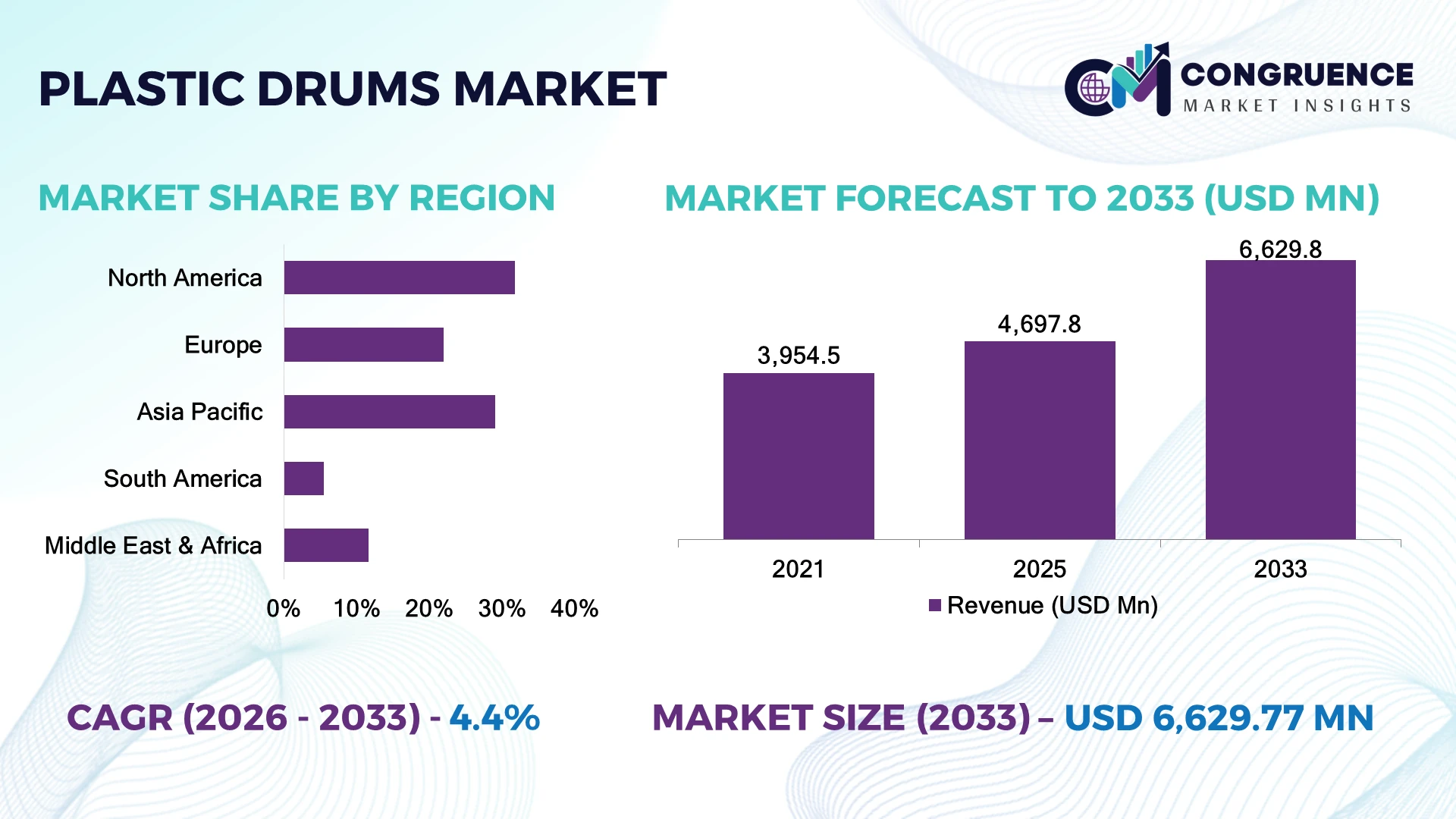
China represented approximately 29% of global plastic drum demand in 2025, supported by chemical manufacturing, lubricants, food processing, and export-oriented logistics. The country maintains a clear scale advantage over India at roughly 9%, while Southeast Asian production hubs are expanding blow-molding capacity. EU packaging reforms taking effect from 2026 are accelerating recycled-resin integration, with PCR content increasingly incorporated into industrial containers.
Strategically, manufacturers should prioritize high-barrier HDPE grades, recycled-content capability, and localized production near chemical and logistics clusters.
Market Size & Growth: USD 4,697.8 million in 2025 to USD 6,629.8 million by 2033 at 4.4% CAGR, driven by HDPE substitution and chemical logistics.
Top Growth Drivers: Chemical packaging 32%, lubricant distribution 24%, food and beverage applications 18% collectively shape the strongest demand pools.
Short-Term Forecast: By 2028, automated blow-molding and lightweighting can reduce resin consumption by 8–12% while improving production throughput by 10%.
Emerging Technologies: Multilayer HDPE, PCR-compatible formulations, and intelligent tracking are advancing, with digitally traceable containers targeting approximately 15% of premium industrial deployments.
Regional Leaders: Asia-Pacific is projected at approximately USD 3.1 billion by 2033, North America at USD 1.6 billion, and Europe at USD 1.2 billion, led by lightweight and recycled-content adoption.
Consumer/End-User Trends: Industrial buyers increasingly specify UN-certified and reusable drums, with sustainability-linked procurement requirements influencing more than 30% of large chemical packaging decisions.
Pilot/Case Example: 2025 lightweighting programs reduced drum resin usage by approximately 10%, improving transport economics without changing standard 200-liter handling configurations.
Competitive Landscape: Leading manufacturers including Greif, Mauser Packaging Solutions, SCHÜTZ, Berry Global, and Time Technoplast collectively command an estimated 30–35% of organized global supply.
Regulatory & ESG Impact: EU packaging rules taking effect in 2026 are accelerating recycled-material integration, with manufacturers targeting 20–30% PCR content in compatible industrial packaging.
Investment & Funding: Approximately USD 500 million in recent capacity and modernization commitments across major producers are favoring automated molding, recycling integration, and regional manufacturing.
Innovation & Future Outlook: 2026–2028 investment is shifting toward lightweight HDPE, barrier structures, digital traceability, and closed-loop recycling, strengthening lifecycle economics over single-use packaging models.
Plastic drums are gaining traction across chemicals, lubricants, paints, food ingredients, pharmaceuticals, and specialty materials because standardized 120–250-liter formats combine stackability, corrosion resistance, and lower tare weight. Approximately 30% of premium industrial buyers are increasingly incorporating recycled-content or lifecycle criteria into packaging specifications. In 2026, EU packaging compliance is pushing converters toward PCR-compatible formulations and traceability, making material engineering a central competitive factor.
Plastic drums are becoming strategically important as industrial packaging buyers balance transport efficiency, chemical compatibility, worker handling, and increasingly stringent packaging regulations. The shift from conventional steel toward HDPE containers reduces corrosion exposure and tare weight while supporting automated filling and palletized logistics. Chemical producers, lubricant companies, and food processors are therefore evaluating drums as part of total delivered-cost optimization rather than simply packaging procurement.
Modern lightweight HDPE drums can achieve approximately 8–12% lower material consumption than older heavy-wall designs while maintaining required impact and stacking performance. Automated extrusion blow molding further improves production throughput by roughly 10%, creating a measurable advantage for high-volume converters. China emphasizes manufacturing scale and export logistics, while Europe is prioritizing recycled content and circularity as packaging requirements tighten from 2026.
Over the next 2–3 years, investment will increasingly target PCR-compatible resin systems, multilayer barrier technology, automated inspection, and digital traceability. A practical deployment model is the use of 200-liter UN-rated drums for chemicals and lubricants, where standardized dimensions simplify warehouse handling and return logistics. Manufacturers that combine localized capacity with resin flexibility and compliance-ready product portfolios will secure stronger positions as industrial buyers increasingly evaluate packaging on cost, sustainability, and supply continuity.
Industrial buyers are accelerating HDPE drum adoption as lightweighting lowers logistics costs without sacrificing chemical resistance or stack performance. Advanced designs can reduce resin consumption by 8–12%, while automated blow-molding systems improve throughput by approximately 10%. Chemical and lubricant producers in China and India are increasingly specifying UN-certified plastic drums for standardized bulk handling, replacing heavier steel formats in selected applications. European packaging-policy changes entering force in 2026 are also strengthening demand for recycled-content-compatible designs. Manufacturers are responding through high-output molding lines, multilayer barrier structures, and PCR-capable formulations. The strategic advantage is shifting from simply producing low-cost drums toward engineering lighter containers that meet transport, safety, and regulatory specifications simultaneously.
Polyethylene remains the largest cost component in plastic drum production, exposing converters to feedstock-price volatility and margin compression. Resin and polymer costs can represent roughly 45–55% of manufacturing cost, while recycled resin availability remains inconsistent across several developing markets. In India, Southeast Asia, and parts of Latin America, supply disruptions can increase procurement lead times by 10–20%, complicating fixed-price contracts with chemical and lubricant customers. Regulatory requirements for recycled content also introduce formulation and quality-control costs when PCR streams vary in melt flow or contamination. Producers are mitigating exposure through multi-supplier contracts, localized resin sourcing, inventory buffers, and flexible formulations. The operational priority is securing consistent-grade polyethylene rather than pursuing nominal material-cost reductions that compromise drum performance.
The strongest opportunity lies in engineered plastic drums that combine recycled content with certified mechanical and chemical performance. PCR integration of 20–30% is increasingly technically feasible for selected industrial formats, while lightweighting can deliver an additional 8–12% resin reduction. European converters are prioritizing recyclable mono-material structures as packaging rules tighten, creating demand for drums designed around circular-material streams from the outset. In India, chemical and lubricant clusters offer an attractive expansion pathway because localized manufacturing reduces empty-container transport costs and improves supply responsiveness. Manufacturers are investing in barrier-layer technology, automated quality inspection, and recycling partnerships to capture premium contracts. A non-obvious opportunity is closed-loop drum recovery from large industrial customers, converting discarded containers into controlled feedstock and strengthening material security.
Scaling circular plastic drums remains technically demanding because recycled polyethylene can vary in contamination, molecular weight, color, and mechanical properties. PCR-heavy formulations can require 5–10% tighter process-control tolerances, while inconsistent feedstock can reduce impact or stacking performance by several percentage points if formulation is poorly controlled. Automated sorting and extrusion systems therefore become critical as producers increase recycled content. Large chemical customers also require traceability across resin batches, container production, and UN-performance testing, adding data-management complexity. Manufacturers are responding with dedicated PCR qualification programs, spectroscopy-based inspection, closed-loop recycling partnerships, and dual-material sourcing. The strategic challenge is not recycled-content availability alone; it is maintaining identical field performance across variable feedstock while meeting increasingly strict packaging specifications.
PCR Content Enters Mainstream: European packaging requirements are accelerating recycled-resin adoption, with manufacturers targeting 20–30% PCR content in compatible industrial drums. Converters are redesigning formulations and qualification protocols rather than simply substituting virgin resin, while chemical customers increasingly include recycled-content thresholds in procurement specifications.
Lightweighting Becomes More Precise: Advanced finite-element modeling and automated blow-molding controls are enabling 8–12% resin reductions while maintaining stacking and impact requirements. Producers in China and India are prioritizing optimized wall distribution, reducing material use and transportation weight without changing standard 200-liter handling infrastructure.
Smart Traceability Gains Traction: Digital identification, serialized labels, and batch-level tracking are expanding across premium industrial packaging, with approximately 10–15% of higher-value deployments incorporating enhanced traceability. Manufacturers are linking drum identifiers to resin batches and filling records, improving recall readiness and inventory visibility.
Barrier Performance Drives Innovation: Multilayer HDPE structures and advanced additives are gaining attention for chemicals, agrochemicals, and solvents, with barrier improvements of roughly 15–20% in targeted applications. Producers are investing in material-engineering partnerships to extend product compatibility, reduce permeation losses, and compete more effectively against steel and composite containers.
Open-Head Drums Retain Scale Leadership
Open-head plastic drums are estimated to account for approximately 55% of global demand, supported by removable lids that simplify filling, emptying, cleaning, and handling of powders, viscous chemicals, paints, and industrial compounds. Their broad compatibility with automated filling lines and reconditioning workflows gives them a cost and operational advantage over specialized formats. Closed-head drums represent roughly 35%, with stronger penetration where leak resistance, tamper control, and liquid containment are priorities. The fastest-growing shift is toward higher-performance closed-head designs, particularly UN-rated formats for hazardous-liquid logistics.
Material optimization is also reshaping product strategies. Lightweight designs can reduce resin consumption by 8–12%, while multilayer or barrier-enhanced structures improve chemical compatibility and shelf-life. Companies are therefore prioritizing lightweighting, closure engineering, recycled-resin qualification, and application-specific drum portfolios rather than competing solely on unit price. The investment implication is clear: scalable manufacturers with certified designs and flexible molding capacity gain greater purchasing leverage.
Chemical Handling Remains the Core Demand Pool
Chemical and industrial chemical applications are estimated to represent nearly 42% of plastic drum consumption, reflecting extensive requirements for corrosion-resistant, stackable, and UN-certified containment. Paints and coatings follow at about 19%, supported by high-volume handling of pigments, resins, solvents, and formulated products. Food and beverage applications account for roughly 15%, while pharmaceuticals and other specialized uses collectively represent about 24%. Chemical logistics remains the mature demand base, but pharmaceutical and specialty-material applications are expanding faster as contamination control and traceability requirements intensify.
The fastest-growing application is pharmaceutical and specialty chemical handling, where demand is shifting toward higher-purity polymers, tamper-evident closures, and controlled manufacturing environments. Companies are responding through dedicated production lines, validated materials, and stronger batch traceability. In contrast, conventional industrial applications remain more price-sensitive, encouraging standardized drum designs and high-volume production. This divergence is shifting investment toward specialized molding, barrier technologies, and compliance-oriented product development rather than undifferentiated capacity.
Chemical Producers Drive Deployment Scale
Chemical manufacturers are estimated to represent approximately 38% of plastic drum purchases, reflecting high shipment volumes, hazardous-material handling requirements, and recurring demand for standardized 30–220-liter formats. Food and beverage producers account for nearly 18%, while pharmaceutical manufacturers contribute around 14%; paints, coatings, lubricants, and other industrial users comprise the balance. Chemical buyers prioritize UN certification, chemical compatibility, stacking strength, and supply continuity, giving large-scale producers an advantage in framework contracts.
Pharmaceutical and specialty chemical manufacturers form the fastest-growing buyer group as procurement shifts toward higher-purity packaging and documented material control. Their purchasing requirements are less price-driven than conventional industrial buyers, with specification compliance and contamination prevention carrying greater weight. Manufacturers are responding through customized closures, validated resin formulations, regional inventory hubs, and direct partnerships with high-volume users. The strategic shift favors suppliers capable of serving both standardized chemical volumes and specialized, compliance-intensive accounts without disrupting production economics.
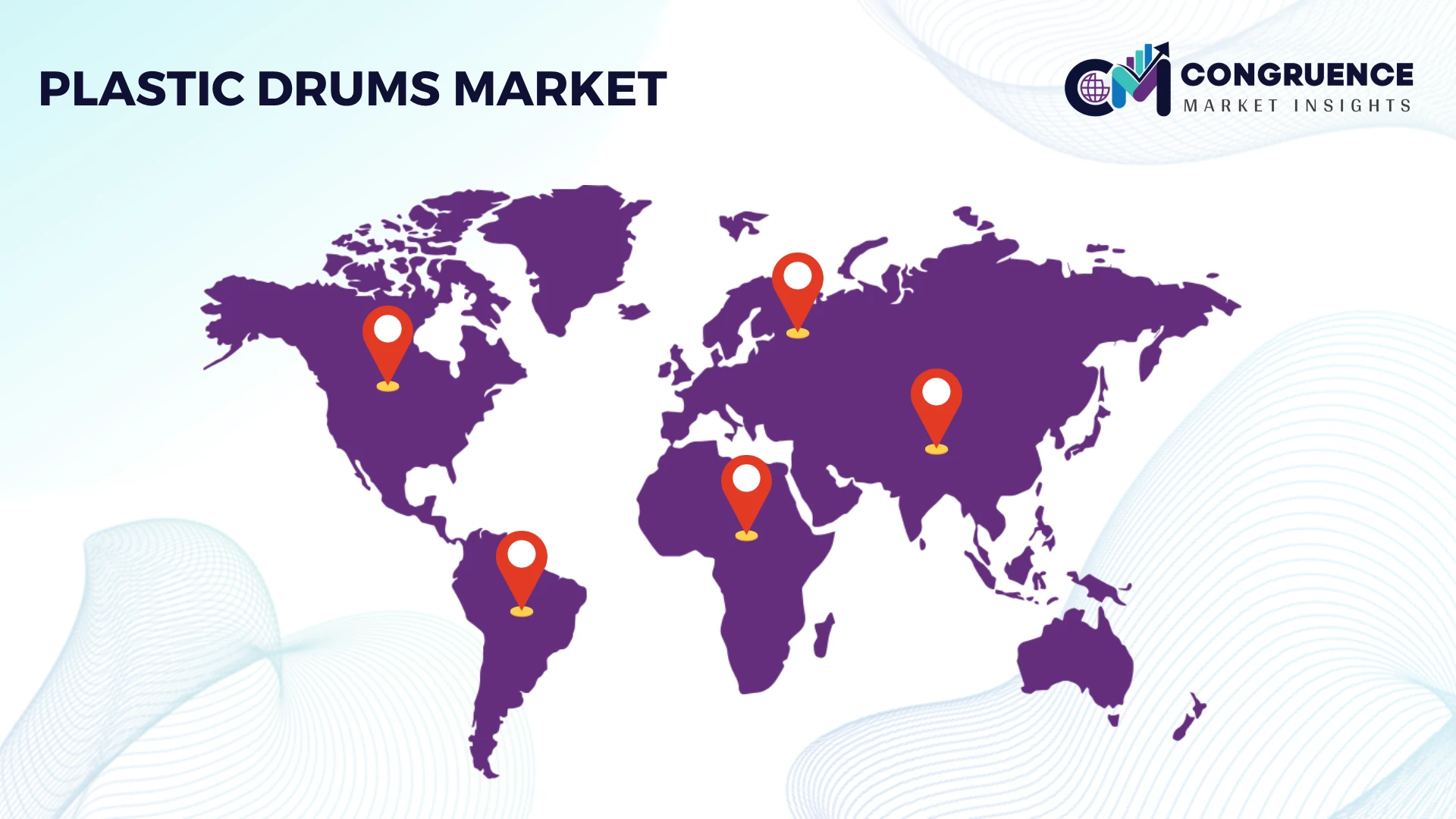
North America accounted for the largest market share at 31.8% in 2025 however, Asia-Pacific is expected to register the fastest growth, expanding at a CAGR of 5.3% between 2026 and 2033.
Reshoring and Chemical Logistics Strengthen Premium Drum Demand
North America holds a leading position in the global plastic drums market, supported by concentrated chemical manufacturing, food processing, lubricants, and specialty materials production across the United States and Canada. The region represents approximately 32% of global demand, with industrial chemicals and coatings accounting for a substantial share of recurring drum consumption. U.S. manufacturers are increasing lightweighting and recycled-content integration, with resin optimization reducing material usage by roughly 8–12% in selected drum designs. Strong domestic polymer availability also limits exposure to long-distance packaging imports. Suppliers are prioritizing UN-certified designs, automated molding, and regional inventory hubs to serve hazardous-material logistics more efficiently. The strategic advantage is shifting toward manufacturers that combine high-volume production with certified customization and dependable resin sourcing.
United States Market Outlook: The United States dominates regional demand because of its extensive chemical, petrochemical, pharmaceutical, agricultural, and coatings manufacturing base. More than 40% of North American plastic drum consumption is linked to chemical and industrial applications. Domestic resin production, established distribution infrastructure, and stringent hazardous-material packaging requirements support local manufacturing. Suppliers are expanding automated molding capacity and recycled-polymer qualification to secure long-term contracts with major industrial buyers.
Circular Packaging Rules Reshape Material and Design Economics
Europe's plastic drums market is increasingly shaped by circularity requirements, hazardous-goods compliance, and industrial packaging modernization. Germany, France, Italy, and the Netherlands remain important manufacturing and logistics centers, while recycled-polymer integration is becoming a purchasing criterion for large chemical and consumer-product companies. Recycled-content adoption in industrial packaging is advancing from niche procurement toward mainstream qualification, while lightweighting can reduce resin consumption by approximately 8–10%. Manufacturers are responding with mono-material structures, improved recyclability, and closed-loop collection partnerships. The competitive advantage increasingly rests on documented material traceability and compliance rather than basic container pricing.
Germany Market Outlook: Germany provides the strongest industrial base through its chemical, pharmaceutical, automotive, coatings, and machinery sectors. Chemical production generates sustained requirements for UN-rated drums capable of handling corrosive and hazardous materials. German packaging producers are investing in recycled-polymer validation and lightweight designs, while automated filling and palletization systems improve throughput. The country's dense industrial logistics network supports shorter replenishment cycles and strengthens the business case for regional drum production.
Manufacturing Scale Accelerates High-Volume Drum Localization
Asia-Pacific is the fastest-expanding market for plastic drums, driven by chemical manufacturing, agricultural inputs, pharmaceuticals, food processing, and export-oriented industrial production. China and India account for major consumption and production volumes, while Southeast Asian manufacturing hubs are strengthening regional supply chains. The region is estimated to contribute about 29% of global demand, with localized molding capacity expanding alongside chemical and specialty-material investments. China remains dominant in production scale, while India is strengthening domestic packaging capacity for pharmaceuticals, chemicals, and agricultural products. Manufacturers are increasingly deploying automated extrusion blow molding and injection molding, improving output consistency by approximately 10–15% in modern facilities. Localization is reducing dependence on imported finished packaging and shortening replenishment cycles.
China Market Outlook: China remains the region's largest manufacturing base, supported by extensive chemical, petrochemical, pharmaceutical, coatings, and agricultural-input production. Large-scale polymer availability enables competitive drum production, while coastal industrial clusters support export logistics. Automated molding and lightweighting programs are increasingly integrated into new capacity, with high-volume facilities targeting 10% or greater productivity improvements. Producers are also developing recycled-content formulations to address tightening environmental requirements and multinational procurement specifications.
Chemical and Agricultural Logistics Drive Localized Demand
South America's plastic drums market is concentrated around Brazil and Argentina, where chemicals, fertilizers, agricultural inputs, food processing, lubricants, and industrial coatings generate recurring packaging requirements. Brazil represents the region's primary demand and manufacturing center, supported by its large agricultural and chemical-processing base. Plastic drums are increasingly replacing heavier rigid containers in selected logistics applications because lower tare weight improves handling efficiency. Local producers are emphasizing 50–220-liter formats, UN-certified designs, and shorter delivery cycles to reduce exposure to imported packaging. However, currency volatility and polymer-price movements continue to pressure margins, encouraging manufacturers to secure resin contracts and increase domestic sourcing. The strategic opportunity lies in serving agricultural and chemical corridors with localized production rather than relying on imported finished drums.
Brazil Market Outlook: Brazil is the most strategically significant South American market because of its large-scale agribusiness, fertilizer, chemicals, food, and lubricant industries. Agricultural chemicals and industrial formulations create recurring requirements for durable, stackable containers. Domestic polymer availability supports local conversion, while producers are expanding certified drum portfolios for hazardous-material transport. Regional logistics networks around São Paulo and southern industrial clusters provide efficient access to major manufacturing and agricultural distribution routes.
Petrochemical Investment Creates High-Volume Packaging Corridors
Middle East & Africa demand is increasingly linked to petrochemicals, lubricants, chemicals, paints, agricultural inputs, and food processing. Saudi Arabia and the United Arab Emirates benefit from strong polymer availability and expanding industrial-processing capacity, creating favorable conditions for localized drum manufacturing. The region represents an estimated 12% of global demand, while petrochemical and chemical applications account for a disproportionately large share of industrial consumption. Manufacturers are investing in automated molding and larger storage inventories to support project-driven demand. Dubai and Jebel Ali are strengthening redistribution capabilities across Gulf and African markets. The key competitive shift is from imported packaging toward locally converted drums supported by integrated polymer supply chains.
Saudi Arabia Market Outlook: Saudi Arabia holds a strong strategic position because its petrochemical ecosystem provides direct access to polyethylene and other polymers used in drum manufacturing. Chemical and lubricant producers create sustained industrial demand, while manufacturing localization programs encourage domestic conversion capacity. Large industrial clusters can support high-volume production and regional exports. Suppliers combining polymer access, automated molding, and UN-compliant designs are best positioned to serve chemical producers while reducing exposure to imported packaging costs.
Mauser Packaging Solutions, Greif, SCHÜTZ, Berry Global, and regional drum converters compete across industrial packaging, with global leaders challenging cost-focused regional manufacturers. The top five players collectively hold approximately 28% share, leaving meaningful space for specialized suppliers. Price remains decisive for 35–40% of procurement decisions, while sustainability influences roughly 20–25%. Competition increasingly centers on recycled-content certification, lightweighting, UN compliance, and supply reliability. Mauser is expanding African capacity, Greif is vertically integrating specialty packaging, and SCHÜTZ is localizing production in India. Global producers increasingly pair resin sourcing with reconditioning networks, while regional converters compete through shorter lead times and customization. The competitive shift is moving from volume pricing toward circularity, certified performance, and localized supply. Entry barriers remain significant because UN certification, molding expertise, resin qualification, and established chemical-industry relationships require substantial investment. Winning requires integrated manufacturing, dependable feedstock, certified customization, and geographically distributed production that lowers delivered cost without compromising compliance.
Mauser Packaging Solutions
Greif, Inc.
SCHÜTZ GmbH & Co. KGaA
Berry Global Inc.
C.L. Smith
Time Technoplast Ltd.
Snyder Industries, Inc.
Müller Group
CurTec International
Tosca
The Cary Company
Eagle Manufacturing Company
FDL Packaging Group
High-output extrusion blow molding, lightweighting software, and automated quality inspection are reshaping current drum production. Servo-controlled molding can improve cycle consistency by 5–10%, while lightweight designs reduce resin consumption by 8–12% without compromising specified performance. Automated vision inspection is increasingly deployed on high-volume lines, reducing dimensional and closure defects by roughly 10–15%. These technologies favor large manufacturers with integrated molding, testing, and material-engineering capabilities.
Recycled-content and multilayer barrier technologies are becoming commercially important. Advanced PCR formulations can replace substantial virgin resin while maintaining UN-certified performance; Mauser’s Infinity portfolio, for example, reaches up to 85% recycled content in selected configurations and claims carbon-footprint reductions of up to 49%. Compared with conventional virgin-resin drums, optimized PCR designs deliver materially lower embodied-carbon performance while preserving chemical containment. The strongest beneficiaries are suppliers serving chemicals, pharmaceuticals, and regulated industrial logistics.
From 2026–2028, smart packaging integration, digital batch traceability, and automated material handling will move from specialized applications toward broader industrial deployment. RFID-enabled identification can improve asset visibility, while connected production systems reduce manual inspection and inventory errors. Companies investing now gain advantages through lower material intensity, faster quality release, and stronger compliance documentation. The technology race is therefore shifting toward combining circular materials, intelligent manufacturing, and certified performance rather than pursuing lightweighting alone.
August 2024 Mauser Packaging Solutions acquired a Pinetown, South Africa plastic-drum business, expanding operations to five manufacturing and reconditioning facilities and strengthening UN-certified supply for chemicals, mining, food, and lubricants. Source: PackagingMEA
March 2024 Greif completed its Ipackchem acquisition, adding 1,400 employees across 13 facilities and targeting $7 million in synergies, strengthening high-performance plastic packaging capabilities and accelerating global specialization in barrier containers for demanding chemical applications. Source: Greif
April 2024 SCHÜTZ began manufacturing PE-restricted plastic drums at Dahej, Gujarat, introducing F1 and India-specific F2 variants, improving local supply for chemical users and strengthening domestic production capability amid rising industrial packaging requirements. Source: Global Market Insights
October 2025 CurTec launched ECO LITE drums using 30% biobased plastic and a tapered, lightweight design, delivering a claimed 30% lower carbon footprint and improving storage efficiency for pharmaceutical and specialty-chemical supply chains. Source: CPHI Online (CPHI Online)
The Plastic Drums Market Report covers open-head and tight-head formats, polyethylene and polypropylene materials, capacity categories, and applications spanning chemicals, petrochemicals, lubricants, food and beverages, pharmaceuticals, agriculture, paints, coatings, and specialty industrial products. End-user analysis evaluates chemical manufacturers, food processors, pharmaceutical companies, agricultural producers, and other industrial buyers. Regional coverage includes North America, Europe, Asia-Pacific, South America, and the Middle East & Africa, with country-level assessment of manufacturing concentration and deployment patterns.
The report evaluates lightweighting, recycled-content polymers, multilayer barrier structures, automated molding, smart identification, and reconditioning systems, alongside competitive positioning across major suppliers. With top-five players representing approximately 28% of the market, the analysis distinguishes global scale leaders from regional converters and specialized manufacturers. The study supports investment planning, capacity localization, supply-chain diversification, product development, partnership strategy, and competitive positioning through 2026–2033, including emerging opportunities in circular packaging and compliance-intensive industrial applications.
| Report Attribute/Metric | Report Details |
|---|---|
|
Market Revenue in 2025 |
USD 4,697.8 Million |
|
Market Revenue in 2033 |
USD 6,629.8Million |
|
CAGR (2026 - 2033) |
4.4% |
|
Base Year |
2025 |
|
Forecast Period |
2026 - 2033 |
|
Historic Period |
2021 - 2025 |
|
Segments Covered |
By Type
By Application
By End-User
|
|
Key Report Deliverable |
Revenue Forecast, Growth Trends, Market Dynamics, Segmental Overview, Regional and Country-wise Analysis, Competition Landscape |
|
Region Covered |
North America, Europe, Asia-Pacific, South America, Middle East, Africa |
|
Key Players Analyzed |
Mauser Packaging Solutions, Greif, Inc., SCHÜTZ GmbH & Co. KGaA, Berry Global Inc., C.L. Smith, Time Technoplast Ltd., Snyder Industries, Inc., Müller Group, CurTec International, Tosca, The Cary Company, Eagle Manufacturing Company, FDL Packaging Group |
|
Customization & Pricing |
Available on Request (10% Customization is Free) |




