
Reports
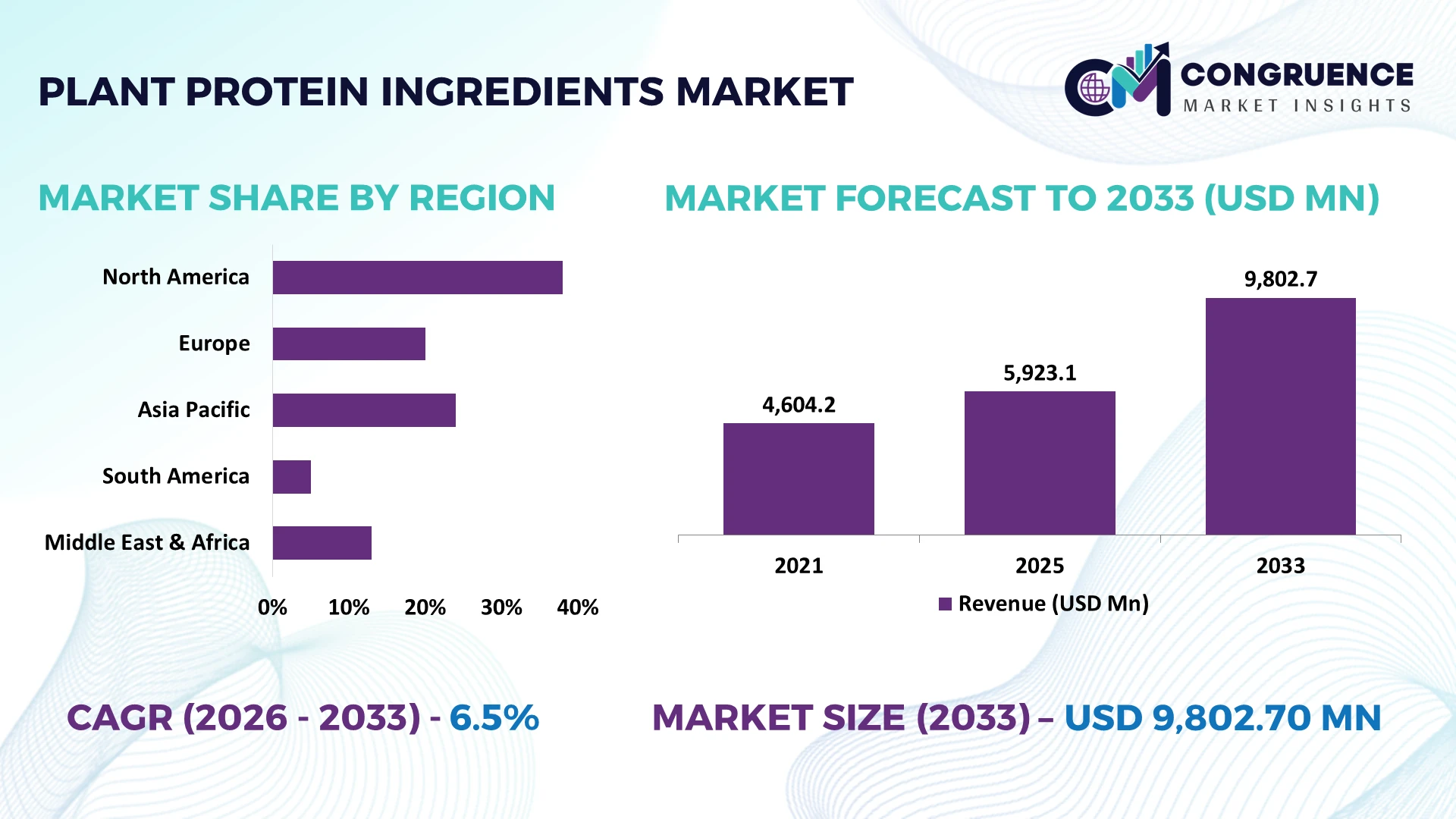
The Global Plant Protein Ingredients Market was valued at USD 5923.1 Million in 2025 and is anticipated to reach a value of USD 9802.7 Million by 2033 expanding at a CAGR of 6.5% between 2026 and 2033. Growth is driven by high-protein food reformulation, expanding sports nutrition applications, advanced protein extraction technologies, and diversification of soy, pea, and pulse-based ingredient supply chains.
The United States maintains a leading position in plant protein ingredients, supported by extensive soybean processing infrastructure, advanced food manufacturing, and established ingredient suppliers. US soybean production reached approximately 4.37 billion bushels in 2024, providing substantial domestic feedstock availability. Soybeans typically contain approximately 35–40% protein by dry weight, supporting commercial concentrate and isolate production. Compared with Canada, which maintains strong pea protein processing capabilities, US manufacturers benefit from integrated soybean crushing, extrusion technologies, and established food ingredient distribution networks.
Ingredient manufacturers prioritizing protein purity, consistent functionality, and diversified domestic sourcing are positioned to secure stronger supply agreements across food, beverage, and nutritional applications.
Market Size & Growth: Valued at USD 5923.1 Million in 2025, projected to USD 9802.7 Million by 2033 at 6.5% CAGR, driven by flexitarian adoption and clean-label formulation demands.
Top Growth Drivers: Flexitarian and vegan lifestyle expansion, technological advancements in protein extraction and texturization, and food and beverage product innovation diversification .
Short-Term Forecast: By 2027, high-moisture extrusion texturization advances reduce off-flavor markers by up to 30% through hybrid protein integration, improving sensory acceptance for meat alternatives .
Emerging Technologies: High-moisture extrusion for hybrid plant-cultivated protein systems, laccase-catalyzed crosslinking for texture enhancement, and AI-driven protein extraction from byproducts including spent grain and vegetable peels .
Regional Leaders: North America at 45% share with sports nutrition and beverage demand, China at over 30% with soy protein dominance, and Europe led by Germany through clean-label and medical nutrition applications .
Consumer/End-User Trends: Food and beverage applications command approximately 60% of demand; sports nutrition and dietary supplements represent fastest-growing application segments .
Pilot/Case Example: High-moisture extrusion with 2% cultivated beef inclusion reduced pea protein off-flavor markers by up to 30% while improving water holding capacity by 16.7-fold in hybrid extrudates .
Competitive Landscape: ADM, Cargill, CHS, DuPont, and Manildra lead with over 40% combined share; Axiom Foods, Roquette, and Glanbia compete on specialty isolate capabilities .
Regulatory & ESG Impact: Allergen labeling requirements and novel food approvals create compliance complexity; GMO concerns drive non-GMO and domestically sourced ingredient demand in China .
Investment & Funding: Major players expand manufacturing facilities and R&D investments; fava bean protein isolates from Burcon, Roquette, and Bunge debut as emerging growth opportunities .
Innovation & Future Outlook: Rubisco from alfalfa and duckweed, precision fermentation-derived proteins, and enzymatic treatment technologies reshape next-generation ingredient portfolios .
Plant protein ingredients serve sports nutrition, fortified beverages, bakery products, dairy alternatives, and specialized nutritional formulations. Soy isolates remain important for protein density and emulsification, while pea, chickpea, and fava bean proteins offer diversification opportunities for food manufacturers. Recent innovations include enzymatic flavor modification, high-moisture extrusion, and membrane-assisted fractionation, improving ingredient functionality across different processing conditions. In 2025, approximately 60% of US households purchased plant-based foods, indicating substantial consumer exposure to alternative protein formulations. Increasing scrutiny of allergen labeling and ingredient traceability is also influencing sourcing decisions, establishing a foundation for evaluating strategic investment priorities and future market pathways.
Plant protein ingredients are becoming strategically important as food manufacturers restructure sourcing, reformulate nutritional products, and invest in specialized protein processing infrastructure. The shift toward diversified agricultural feedstocks is reducing reliance on individual protein crops while creating opportunities for higher-value ingredient production. Soy protein isolates typically contain at least 90% protein on a dry basis, making them suitable for concentrated nutritional formulations. Manufacturers are increasingly integrating agricultural procurement with extraction, purification, and application development to improve supply reliability.
Technology modernization is strengthening processing efficiency and ingredient functionality. Dry fractionation generally consumes less water than conventional wet extraction, although achievable protein purity is typically lower. Pea protein concentrates produced through air classification commonly contain approximately 50–65% protein, compared with 80–85% in commercial isolates. The United States emphasizes soybean processing scale, while Canada advances pulse fractionation and specialized pea protein manufacturing. European processors prioritize functionality improvements and ingredient traceability.
Between 2026 and 2028, membrane filtration, enzymatic modification, and hybrid protein formulations will influence manufacturing investment. Roquette's Manitoba facility, designed to process approximately 125,000 metric tons of yellow peas annually, illustrates industrial-scale feedstock specialization. Ingredient suppliers are strengthening partnerships with food manufacturers to optimize solubility, texture, and flavor. Competitive advantage will increasingly depend on consistent protein functionality, processing economics, and diversified agricultural sourcing.
Food manufacturers are increasing plant protein incorporation across nutritional beverages, bakery products, meat alternatives, and specialized dietary formulations. Approximately 60% of US households purchased plant-based foods in 2025, demonstrating established consumer exposure to alternative protein products. Soy protein isolates containing at least 90% protein support high-density nutritional applications, while pea protein isolates typically provide 80–85% protein for allergen-conscious formulations. Growing interest in protein-enriched foods is encouraging manufacturers to improve amino acid composition, emulsification, and sensory performance. ADM, Ingredion, and Roquette are expanding application development and customized ingredient portfolios. The strategic advantage lies in supplying multifunctional proteins that deliver nutritional value alongside texture stability, reducing the need for additional formulation ingredients.
Plant protein ingredient production faces structural limitations from agricultural commodity fluctuations, crop quality variability, and energy-intensive wet extraction. Soybeans typically contain 35–40% protein, while yellow peas contain approximately 20–25%, creating substantial differences in processing yields and feedstock requirements. Wet fractionation requires multiple extraction, separation, and drying stages, increasing utility consumption and production complexity. Canada's pea processing industry is exposed to agricultural production variability, while US soybean processors face competing demand from food, feed, and biofuel applications. Manufacturers are responding through diversified crop sourcing, long-term agricultural procurement agreements, and improved extraction efficiency. Profitability increasingly depends on optimizing protein recovery and processing utilization rather than relying exclusively on higher ingredient selling prices.
Advanced protein fractionation is creating opportunities for chickpea, fava bean, lentil, and other pulse-derived ingredients with differentiated nutritional and functional characteristics. Conventional dry fractionation commonly produces protein concentrates containing approximately 50–65% protein, while membrane-assisted purification supports higher-purity ingredient development. Fava beans typically contain 25–30% protein, providing an alternative feedstock for manufacturers seeking diversified agricultural inputs. India's extensive pulse cultivation infrastructure offers opportunities for localized ingredient processing and food fortification applications. Between 2026 and 2028, enzymatic modification and precision separation technologies will improve ingredient solubility and sensory performance. Manufacturers are investing in pilot-scale processing, crop partnerships, and application-specific formulations. Competitive advantage increasingly favors suppliers capable of commercializing underutilized pulses without excessive purification costs.
Scaling plant protein ingredients across diverse food applications requires consistent solubility, emulsification, texture, and flavor performance. Soy isolates generally exceed 90% protein purity, while pea isolates commonly contain 80–85%, yet protein concentration alone does not determine functional suitability. High-temperature processing can alter protein structure, reducing solubility and affecting beverage stability. Plant proteins also differ in amino acid composition, creating formulation challenges for nutritionally balanced products. European food manufacturers face additional requirements for allergen labeling and ingredient traceability, increasing quality management complexity. Ingredient suppliers are investing in enzymatic modification, sensory optimization, and application testing to improve commercial consistency. Long-term competitiveness depends on maintaining reproducible functionality across processing conditions, agricultural seasons, and finished-product categories.
• Protein Purity Drives Ingredient Standardization: Food manufacturers increasingly specify protein isolates containing 80–90% protein for nutritional beverages and fortified formulations. Soy isolates typically exceed 90% protein, while commercial pea isolates commonly contain 80–85%. ADM and Roquette are refining purification processes and functional ingredient portfolios to improve batch consistency, reduce formulation variability, and support standardized nutritional labeling across multiple product categories.
• High-Moisture Extrusion Improves Product Texture: Plant-based food producers are adopting high-moisture extrusion to create fibrous structures resembling conventional meat products. Processing commonly uses moisture levels of approximately 40–80%, compared with 10–35% in low-moisture extrusion. Ingredient manufacturers are adjusting protein blends and thermal processing parameters to improve structural alignment, increase moisture retention, and reduce dependence on additional binding ingredients in finished formulations.
• Hybrid Protein Blending Strengthens Nutritional Performance: Manufacturers are combining complementary protein sources to improve amino acid composition and functional characteristics. Soy protein contains approximately 35–40% protein in raw seeds, while yellow peas typically provide 20–25%. Food developers are optimizing ingredient ratios to balance nutrition, emulsification, and sensory properties. This formulation approach supports diversified agricultural sourcing while reducing reliance on individual protein ingredients.
• Localized Processing Restructures Pulse Supply Chains: Ingredient suppliers are strengthening regional processing capabilities to reduce transportation exposure and improve agricultural traceability. Roquette's Manitoba facility was designed to process approximately 125,000 metric tons of yellow peas annually, supporting large-scale pea protein production. Companies are expanding farmer partnerships, improving feedstock grading, and integrating processing infrastructure to stabilize ingredient specifications and strengthen supply continuity.
Soy Protein represents the leading type in the global plant protein ingredients market, supported by extensive soybean processing infrastructure, established food applications, and competitive extraction economics. Soy isolates typically contain at least 90% protein, making them suitable for concentrated nutritional formulations. Pea Protein is among the fastest-expanding categories, benefiting from diversification away from soy and wheat allergens and improvements in flavor and solubility. Commercial pea isolates generally contain 80–85% protein, supporting applications requiring concentrated nutritional content. Wheat Protein remains important for elasticity and structure, particularly in bakery formulations, while Rice Protein supports specialized nutritional products.
Potato Protein offers functional advantages in emulsification and foaming, while Fava Bean Protein provides an alternative pulse-derived ingredient for food reformulation. Canola Protein is attracting attention as processors investigate additional uses for oilseed processing streams. Manufacturers are expanding extraction capabilities, improving sensory characteristics, and developing customized protein blends. Competitive investment increasingly favors ingredients combining nutritional density, processing efficiency, and reliable agricultural availability.
Meat Alternatives represent a major application category for plant protein ingredients, supported by demand for structured protein formulations and improvements in extrusion technology. Soy and pea proteins provide essential functionality for fibrous texture development, while Wheat Protein contributes elasticity and binding characteristics. Dairy Alternatives utilize proteins for nutritional enrichment and emulsion stability, particularly in beverages and cultured products. Protein Beverages are gaining momentum as manufacturers develop ready-to-drink formulations with improved solubility and reduced sedimentation. Sports Nutrition remains an established application, supported by concentrated protein isolates and powdered nutritional products.
Bakery Products incorporate plant proteins to enhance nutritional composition and dough functionality, while Snacks and Nutrition Bars benefit from compact protein fortification. Infant Nutrition requires tightly controlled ingredient specifications and nutritional suitability. Meat and Seafood Processing uses functional proteins for moisture retention, binding, and texture management. High-moisture extrusion commonly operates at approximately 40–80% moisture, supporting advanced meat alternative structures. Manufacturers are expanding application laboratories, improving protein modification technologies, and developing category-specific formulations to strengthen product performance and commercial differentiation.
Food and Beverage Manufacturers represent the dominant end-user group because their operations incorporate plant proteins across beverages, bakery products, nutritional formulations, and processed foods. Their purchasing requirements emphasize consistent protein purity, reliable ingredient functionality, and scalable supply agreements. Plant-Based Food Producers represent a specialized customer group focused on meat and dairy alternatives, requiring extrusion-compatible proteins and optimized sensory performance. Sports Nutrition Brands prioritize concentrated isolates, while Dietary Supplement Manufacturers seek standardized nutritional specifications and efficient powder processing. Ingredient suppliers increasingly customize protein functionality according to manufacturing conditions and finished-product requirements.
Infant Food Manufacturers require strict nutritional controls and ingredient traceability, creating specialized procurement requirements. Animal Feed Producers utilize plant-derived protein materials within formulated feed systems, while Foodservice Providers increasingly incorporate plant-based products into commercial menus. Soy isolates commonly exceed 90% protein purity, supporting concentrated nutritional applications, while pea isolates generally provide 80–85%. ADM, Cargill, and Ingredion are strengthening application development and customer partnerships to support differentiated formulations. Competitive positioning increasingly depends on technical support, consistent ingredient performance, and flexible manufacturing capabilities.
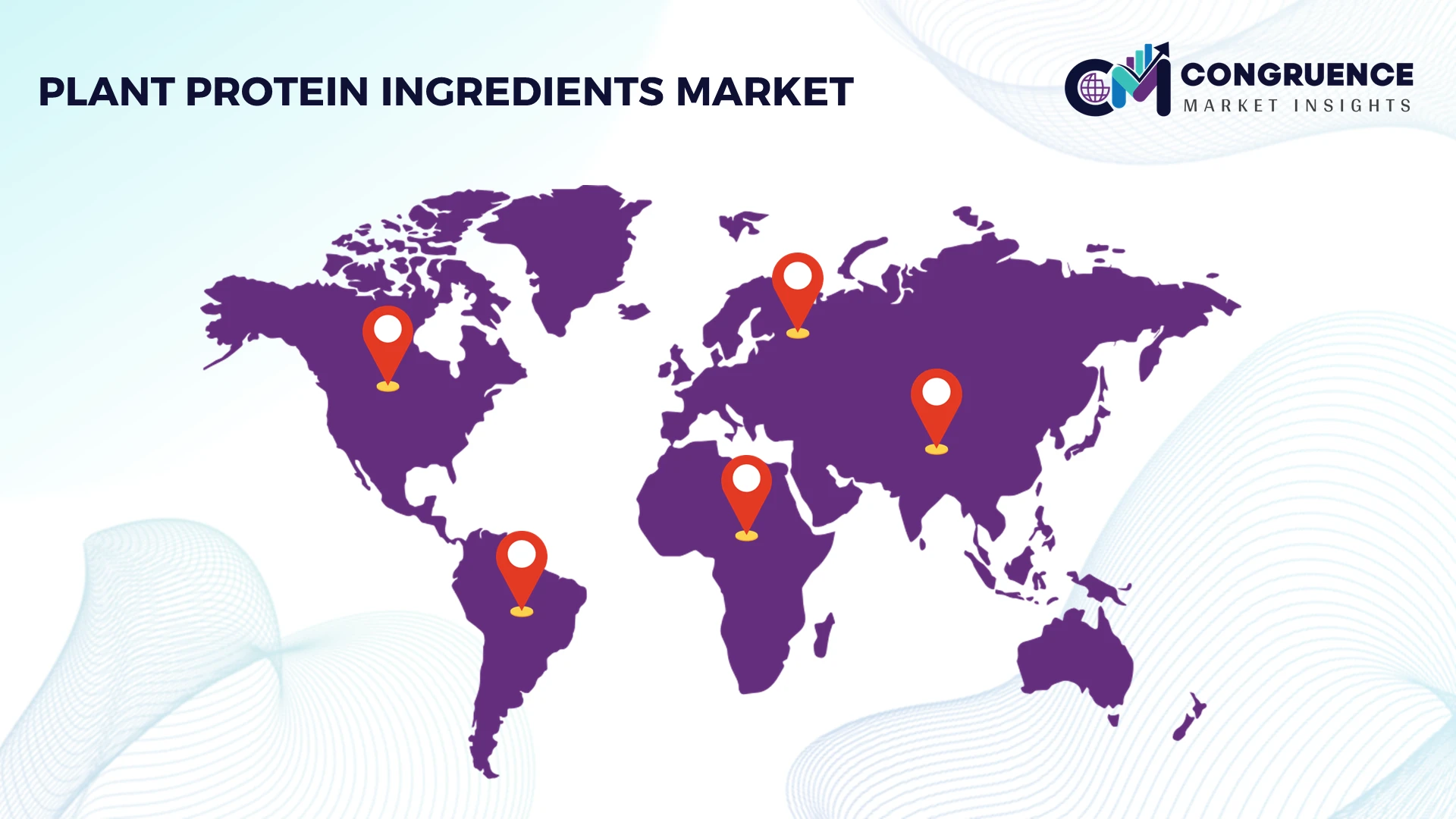
North America accounted for the largest market share at approximately 36% in 2025 however, Asia-Pacific is expected to register the fastest growth, expanding at a CAGR of approximately 8.2% between 2026 and 2033.
Integrated Soy Processing and Advanced Protein Formulation
North America maintains a leading position in the plant protein ingredients market, supported by established soybean processing infrastructure, specialized pea protein manufacturing, and extensive food formulation capabilities. The United States accounts for substantial regional ingredient production, while Canada contributes advanced pulse processing and agricultural sourcing. Soy protein isolates containing at least 90% protein remain important for nutritional beverages, sports nutrition, and processed food applications. Canada's pea processing infrastructure supports commercial production of isolates containing approximately 80–85% protein. Roquette's Manitoba facility was designed to process approximately 125,000 metric tons of yellow peas annually, strengthening regional ingredient specialization. ADM, Cargill, and Ingredion are expanding technical formulation capabilities and customized ingredient portfolios. Regional manufacturers increasingly prioritize supply-chain integration, consistent protein functionality, and application-specific processing to secure long-term contracts with food and beverage producers.
United States Market Outlook: The United States benefits from extensive soybean cultivation, advanced ingredient processing, and established food manufacturing infrastructure. Soybean production reached approximately 4.37 billion bushels in 2024, providing substantial domestic feedstock availability. ADM and Cargill maintain integrated agricultural sourcing and processing capabilities, supporting competitive ingredient production. Expanding demand for fortified beverages, protein bars, and specialized nutritional formulations is encouraging manufacturers to improve protein solubility, emulsification, and sensory performance.
Pulse Protein Innovation and Sustainable Ingredient Manufacturing
Europe represents an established market for plant protein ingredients, supported by advanced food processing, ingredient innovation, and regulatory emphasis on nutritional transparency. Germany, France, the Netherlands, and the United Kingdom maintain substantial capabilities in plant-based food development and specialized protein formulation. European manufacturers increasingly utilize pea, wheat, potato, and fava bean proteins to diversify ingredient portfolios and reduce dependence on imported soybean materials. Roquette, Tereos, and Emsland Group maintain significant processing expertise across plant-derived ingredients. The European Union's Farm to Fork Strategy targets a 50% reduction in chemical pesticide use and risk by 2030, influencing broader agricultural sourcing priorities. Manufacturers are investing in enzymatic modification, protein fractionation, and application development to improve ingredient functionality. Competitive differentiation increasingly depends on agricultural traceability, consistent processing performance, and compliance with evolving food labeling requirements.
France Market Outlook: France benefits from established agricultural processing capabilities, specialized ingredient manufacturers, and extensive food innovation infrastructure. Roquette maintains significant expertise in pea protein development and processing, supporting applications across nutritional foods and specialized formulations. France's national protein strategy has supported investment in domestic plant protein production, including a public funding commitment of approximately EUR 100 million, strengthening agricultural diversification and local ingredient supply chains.
Soy Processing Scale and Expanding Nutritional Applications
Asia-Pacific is positioned for accelerated plant protein ingredient adoption, supported by established soybean processing, expanding food manufacturing, and increasing protein fortification across nutritional products. China maintains substantial capabilities in soy protein manufacturing and food ingredient processing, while India offers opportunities through pulse cultivation and specialized food formulation. Japan contributes advanced soybean processing technologies and established applications in traditional and functional foods. China imported approximately 105 million metric tons of soybeans in 2024, illustrating the scale of its soybean processing ecosystem. Manufacturers are expanding production of soy isolates, textured vegetable proteins, and customized protein blends for domestic and export applications. Regional food companies increasingly integrate plant proteins into beverages, processed foods, and nutritional supplements. Competitive advantages center on processing scale, efficient agricultural procurement, and formulation adaptation to local dietary preferences.
China Market Outlook: China benefits from extensive soybean crushing infrastructure, established soy-based food production, and large-scale ingredient manufacturing capabilities. Domestic processors supply soy protein concentrates, isolates, and textured ingredients to food manufacturers and international customers. The country's population exceeds 1.4 billion, supporting a substantial consumer food processing ecosystem. Investment in extraction efficiency, quality standardization, and application-specific formulations strengthens China's position in global plant protein ingredient supply chains.
Soybean Processing Integration and Export-Oriented Ingredient Supply
South America's plant protein ingredients market is shaped by extensive soybean cultivation, agricultural processing infrastructure, and growing opportunities for value-added ingredient manufacturing. Brazil and Argentina maintain substantial soybean production and crushing capabilities, providing feedstock for protein concentrates, isolates, and textured ingredients. Brazil harvested approximately 147.7 million metric tons of soybeans during the 2023–2024 crop season, demonstrating significant agricultural processing potential. Argentina contributes established soybean meal and oil processing infrastructure, supporting opportunities for higher-value protein extraction. Regional manufacturers are evaluating ingredient diversification to capture additional value from agricultural commodities. However, specialized purification infrastructure, transportation logistics, and export concentration influence commercial expansion. Companies are strengthening agricultural partnerships and exploring advanced fractionation technologies to improve ingredient quality and expand participation in food-grade protein supply chains.
Brazil Market Outlook: Brazil benefits from extensive soybean cultivation, integrated agricultural logistics, and established food processing industries. The country maintains one of the world's largest soybean production systems, supporting reliable feedstock availability for protein ingredient manufacturing. Brazilian processors are expanding opportunities in soy concentrates and textured vegetable proteins, while domestic food companies increasingly explore protein fortification and plant-based formulations. Processing investment priorities emphasize value addition, product quality, and export market diversification.
Food Security Strategies and Nutritional Manufacturing Diversification
The Middle East & Africa plant protein ingredients market is influenced by food security initiatives, expanding food processing infrastructure, and demand for specialized nutritional ingredients. Saudi Arabia and the United Arab Emirates are developing food manufacturing capabilities and diversified ingredient supply chains, while South Africa maintains established food processing and agricultural industries. Saudi Arabia's Vision 2030 framework supports industrial diversification and domestic food manufacturing development, creating opportunities for protein ingredient formulation and distribution. Imported soy, pea, and wheat proteins remain important inputs for regional nutritional products. Manufacturers are strengthening distribution partnerships, expanding application development, and evaluating local processing opportunities. Regional competitive positioning depends on reliable imported feedstocks, efficient food manufacturing operations, and ingredient formulations adapted to local nutritional requirements and processing conditions.
Saudi Arabia Market Outlook: Saudi Arabia benefits from industrial diversification initiatives, expanding food manufacturing capabilities, and strategic investment in domestic supply chains. The Saudi Food and Drug Authority regulates food ingredient safety and labeling, influencing product formulation and import compliance. The country's population exceeds 35 million, supporting substantial demand across packaged foods and nutritional products. Manufacturers are developing local formulation capabilities and supplier partnerships to improve ingredient availability, quality assurance, and production continuity.
ADM, Cargill, CHS, DuPont, and Manildra anchor the plant protein ingredients market, with the top five players commanding approximately 40% combined share through vertically integrated sourcing, extraction, and application development capabilities. Competition bifurcates between global agricultural processors competing on supply chain control and scale economics, and specialized ingredient innovators including Roquette, Axiom Foods, and Burcon competing on isolate purity and application-specific functionality. The basis of competition is shifting from commodity protein pricing toward application performance: high-moisture extrusion texturization and hybrid protein architectures now determine win rates in meat alternative and beverage formulations, where off-flavor reduction and water-holding capacity drive formulation decisions. Players compete through manufacturing expansion into pea and fava protein isolates, partnerships with food manufacturers for co-development, and vertical integration from seed sourcing through finished ingredient delivery. The competitive shift is toward regional processing localization as India and Southeast Asia seek import substitution. Entry barriers center on extraction technology expertise and food manufacturer qualification cycles.
ADM
Cargill
CHS
DuPont Nutrition & Biosciences
Manildra Group
Roquette Frères
Axiom Foods
Burcon NutraScience
Glanbia Nutritionals
Kerry Group
Ingredion
Cosucra Groupe Warcoing
Shandong Yuwang Ecological Food Industry
Gushen Biological Technology
Current plant protein processing relies on alkaline extraction, isoelectric precipitation, membrane filtration, and extrusion to produce concentrated functional ingredients. Commercial soy isolates generally contain at least 90% protein, while pea isolates typically achieve 80–85%. High-moisture extrusion operates at approximately 40–80% moisture, compared with 10–35% in conventional low-moisture systems, enabling improved fibrous texture development. Established processors benefit from integrated extraction and application testing, reducing formulation variability across nutritional foods and meat alternatives.
Emerging technologies include ultrasound-assisted extraction, enzymatic modification, and membrane fractionation. These processes target improved protein recovery, solubility, and reduced thermal damage. Dry fractionation produces concentrates containing approximately 50–65% protein while avoiding several water-intensive wet processing stages. Automated process monitoring helps manufacturers maintain extraction conditions and manage feedstock variability. Suppliers combining advanced separation technologies with crop-specific formulation expertise gain competitive advantages in specialized beverages, bakery products, and nutritional ingredients.
Between 2026 and 2028, precision fermentation, AI-assisted formulation, and hybrid protein processing will expand technological options. Digital process controls will support consistent protein functionality, while enzymatic treatments improve flavor and emulsification. Manufacturers investing in pilot facilities, application laboratories, and agricultural partnerships will strengthen commercialization capabilities. Competitive differentiation will increasingly depend on validated processing performance, ingredient consistency, and efficient production economics.
November 2024: ADM showcased expanded hybrid protein solutions at Fi Europe, combining plant-based and animal proteins to close taste and texture gaps. The company reported global alternative protein production capacity growth exceeding 30% following its $300 million Decatur facility investment, strengthening its position in hybrid formulation capabilities for mainstream food applications.
October 2025: Cargill launched its multi-source protein toolkit featuring Abunda mycoprotein and RadiPure pea protein, targeting flexitarian demand with fermentation-enhanced sensory performance. The company projects precision-fermented markets will reach $36.3 billion by 2030, positioning Cargill to capture premium pricing through hybrid and mycoprotein applications.
June 2024: Protein Industries Canada committed CAD 10.7 million to a CAD 24.5 million project with Roquette, Prairie Fava, BioNeutra, and Plant Up to develop fava-based ingredients and optimize pea processing. The initiative addresses global competition and demand for improved taste and functionality in Canadian plant protein exports.
January 2025: Ingredion launched VITESSENCE Pea 200 D isolate and Pea 100 HD for cold-pressed bars, addressing solubility and texture challenges in protein beverages and bars. The ingredient delivers 80% protein on a dry basis with neutral flavor, reducing masker requirements for formulators.
The Plant Protein Ingredients Market Report evaluates industry developments from 2026 to 2033 across seven protein types: Soy, Pea, Wheat, Rice, Potato, Fava Bean, and Canola Protein. Application analysis covers eight categories, including Meat Alternatives, Dairy Alternatives, Protein Beverages, Bakery Products, Sports Nutrition, Infant Nutrition, Snacks and Nutrition Bars, and Meat and Seafood Processing. End-user assessment examines seven buyer groups, including food manufacturers, specialized plant-based producers, nutrition brands, and foodservice providers.
Geographic coverage encompasses North America, Europe, Asia-Pacific, South America, and the Middle East & Africa, examining agricultural sourcing, ingredient processing, and commercial adoption. Technology analysis addresses protein fractionation, enzymatic modification, extrusion, and precision formulation. The report supports processing investment decisions, supplier diversification, regional expansion, competitive benchmarking, and product innovation strategies, with particular attention to emerging pulse proteins and specialized nutritional applications.
| Report Attribute/Metric | Report Details |
|---|---|
Market Revenue in 2025 | USD 5923.1 Million |
Market Revenue in 2033 | USD 9802.7 Million |
CAGR (2026 - 2033) | 6.5% |
Base Year | 2025 |
Forecast Period | 2026 - 2033 |
Historic Period | 2021 - 2025 |
Segments Covered | By Type
By Application
By End-User
|
Key Report Deliverable | Revenue Forecast, Growth Trends, Market Dynamics, Segmental Overview, Regional and Country-wise Analysis, Competition Landscape |
Region Covered | North America, Europe, Asia-Pacific, South America, Middle East, Africa |
Key Players Analyzed | ADM, Cargill, CHS, DuPont Nutrition & Biosciences, Manildra Group, Roquette Frères, Axiom Foods, Burcon NutraScience, Glanbia Nutritionals, Kerry Group, Ingredion, Cosucra Groupe Warcoing, Shandong Yuwang Ecological Food Industry, Gushen Biological Technology |
Customization & Pricing | Available on Request (10% Customization is Free) |




