
Reports
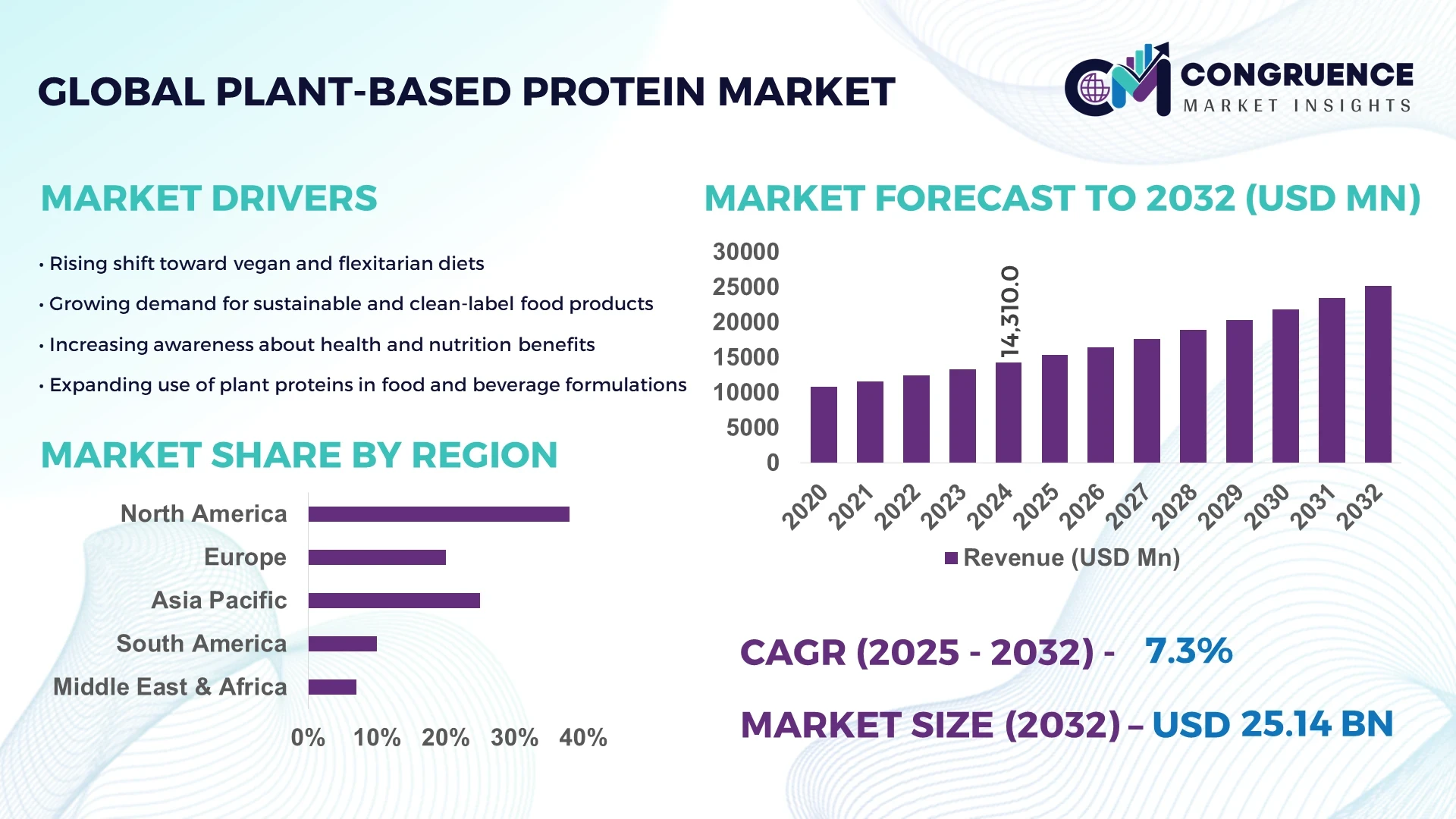
The Global Plant-Based Protein Market was valued at USD 14,310 Million in 2024 and is anticipated to reach a value of USD 25,145 Million by 2032 expanding at a CAGR of 7.3% between 2025 and 2032. The growth is driven by the rising global shift toward sustainable, high-nutrition dietary alternatives.
The United States leads the global plant-based protein market, supported by robust production capacity exceeding 2.1 million metric tons annually and investments surpassing USD 1.8 billion in food innovation and sustainable protein R&D. Key applications dominate in food & beverage formulations, sports nutrition, and dietary supplements. Technological advancements in precision fermentation, extrusion processing, and flavor optimization have accelerated production efficiency by over 30%, with consumer adoption rates reaching 48% among flexitarian households by 2024.
Market Size & Growth: Valued at USD 14.31 billion in 2024, projected to reach USD 25.14 billion by 2032, registering a CAGR of 7.3%, driven by increasing health awareness and sustainable protein preferences.
Top Growth Drivers: 56% surge in vegan product innovation, 42% improvement in protein extraction efficiency, and 38% increase in consumer preference for dairy alternatives.
Short-Term Forecast: By 2028, manufacturing efficiency expected to improve by 25% with reduced production costs by nearly 15%.
Emerging Technologies: Expansion in precision fermentation, enzyme-assisted processing, and plant-protein texturization enhancing product quality and scalability.
Regional Leaders: North America projected at USD 9.2 billion, Europe at USD 7.8 billion, and Asia-Pacific at USD 6.5 billion by 2032, with Asia showing strong growth in functional food adoption.
Consumer/End-User Trends: Rising consumption among athletes and health-conscious consumers, with retail and foodservice integration growing rapidly across major economies.
Pilot or Case Example: In 2024, ADM’s pilot plant achieved a 28% improvement in protein isolate purity using novel enzyme-assisted extraction technology.
Competitive Landscape: Market led by Cargill Inc. (approx. 17% share), followed by Archer Daniels Midland Company, Roquette Frères, Kerry Group, and Ingredion Incorporated.
Regulatory & ESG Impact: Increasing alignment with EU and FDA regulations supporting clean-label protein ingredients and carbon-neutral production initiatives.
Investment & Funding Patterns: Over USD 3.2 billion invested globally in 2023–2024 toward plant-based protein startups and infrastructure development.
Innovation & Future Outlook: Advancements in hybrid protein formulations, 3D food printing, and sustainable crop utilization to define the next decade of plant-based protein innovation.
The plant-based protein market is evolving through advancements across key sectors such as food & beverages, nutraceuticals, and pharmaceuticals, with each segment contributing substantially to total market demand. Innovations in pea and soy protein isolates, enzyme modification, and precision fermentation are reshaping texture, digestibility, and amino acid profiles. Regulatory support promoting low-emission production and environmentally responsible sourcing continues to drive industrial adoption. Regional consumption is rising fastest in Asia-Pacific and Europe due to dietary diversification and sustainability goals. The future outlook indicates strong expansion fueled by technological integration, ingredient innovation, and evolving consumer dietary preferences.
The strategic relevance of the Plant-Based Protein Market lies in its ability to redefine the global protein supply chain through sustainable, scalable, and consumer-driven innovation. As traditional animal protein sources face environmental and ethical constraints, plant-based proteins offer a viable alternative that aligns with global ESG and carbon neutrality goals. Companies are integrating advanced food technologies to optimize production efficiency—Precision Fermentation Technology delivers 35% higher protein yield compared to conventional wet extraction methods.
Regionally, North America dominates in volume, while Europe leads in adoption with 52% of enterprises actively integrating plant-based formulations into their product portfolios. By 2027, AI-powered ingredient analytics and extrusion modeling are expected to improve texture optimization efficiency by 28%, significantly reducing processing variability and waste. Firms are committing to ESG metrics such as achieving 40% water recycling and a 25% reduction in CO₂ emissions by 2030, aligning with UN Sustainable Development Goals.
In 2024, Beyond Meat implemented a digital fermentation optimization initiative, achieving a 22% energy reduction through predictive AI calibration. The convergence of biotechnology, AI, and clean-label formulation continues to create resilient, compliant, and economically viable growth models. As a result, the Plant-Based Protein Market is positioned as a pillar of sustainability, food security, and industrial transformation for the next decade.
The increasing global emphasis on sustainable nutrition has become a key growth catalyst for the Plant-Based Protein Market. Consumers are actively shifting toward environmentally responsible dietary choices, with 63% of surveyed consumers in 2024 prioritizing plant-based options for health and ecological reasons. Governments and food industries are supporting this transition by investing in sustainable protein technologies and eco-friendly production infrastructure. Additionally, plant-based proteins provide comparable amino acid profiles to animal proteins, making them ideal substitutes in sports nutrition and functional food applications. The shift toward high-protein, low-fat diets is further expanding product acceptance, encouraging food manufacturers to integrate advanced processing and flavor-enhancement techniques to meet quality expectations.
Despite steady progress, the Plant-Based Protein Market faces significant challenges in achieving sensory and nutritional equivalence to animal proteins. Many plant protein sources possess beany flavors, lower solubility, and less favorable texture profiles, limiting their application in mainstream food products. Manufacturers are investing in enzymatic hydrolysis and fermentation technologies to overcome these issues, yet scalability and cost efficiency remain barriers. Inconsistent raw material quality, especially for soy and pea proteins, adds to supply chain complexity. Furthermore, stringent food labeling regulations in the U.S. and EU regarding “meat analogues” and “milk alternatives” create market entry hurdles, slowing down innovation cycles and increasing compliance costs.
The integration of hybrid protein systems—combining plant-based and microbial or cell-cultured proteins—presents significant growth potential for the Plant-Based Protein Market. These systems can deliver enhanced amino acid balance, improved texture, and reduced processing time. In 2024, hybrid protein R&D funding increased by 47%, reflecting strong industry and investor confidence. Food-tech startups are leveraging AI and precision fermentation to design next-generation proteins with customizable functional attributes. The adoption of hybrid protein blends is particularly high in ready-to-eat meals, dairy alternatives, and sports supplements, expanding the scope for mainstream acceptance. With growing consumer inclination toward balanced nutrition, hybrid protein systems are set to become a key commercialization avenue.
Rising raw material costs and global supply chain disruptions remain critical challenges in the Plant-Based Protein Market. Prices of essential crops like soy and peas have fluctuated by over 18% since 2023 due to climate-related yield variability and geopolitical tensions affecting trade routes. Limited sourcing diversity and high dependence on specific crop regions amplify volatility in production costs. Moreover, inflationary pressures on packaging, logistics, and processing machinery further strain profit margins. Manufacturers are responding by localizing raw material procurement and adopting vertical integration strategies to reduce dependency on imports. However, sustained inflation and environmental risks continue to pose operational uncertainties across the value chain.
• Expansion of High-Protein Functional Foods: The demand for plant-based proteins in functional and fortified food products has surged by over 48% between 2022 and 2024, driven by consumer interest in protein-enriched snacks, beverages, and meal replacements. Manufacturers are increasingly formulating soy, pea, and lentil proteins into bakery, cereal, and dairy-alternative products to enhance nutritional density. Approximately 62% of new food product launches in 2024 featured plant-derived protein components, reflecting a clear shift toward performance-oriented and health-driven food innovation.
• Technological Advancements in Protein Extraction: Modern processing technologies such as enzyme-assisted extraction and dry fractionation have improved protein yield by nearly 30% while reducing energy consumption by 22% across large-scale production plants. AI-integrated control systems now enable precision monitoring, minimizing material waste by 18% per production cycle. These advancements are particularly evident in North America and Europe, where processing efficiency and sustainability compliance remain top priorities among manufacturers.
• Growth in Plant-Based Meat Alternatives: The market for plant-based meat substitutes expanded by 41% in 2024, fueled by rapid innovation in texture replication and flavor development. Companies are deploying extrusion and 3D structuring technologies to achieve realistic meat analogues with protein content exceeding 24 grams per 100 grams of product. Consumer penetration has reached 37% in developed markets, supported by increasing retail shelf space and quick-service restaurant adoption.
• Integration of Sustainable Crop Sourcing Practices: Sustainability-led sourcing initiatives have grown significantly, with 52% of global producers now implementing traceable and regenerative agriculture systems for key protein crops such as peas, soy, and chickpeas. Carbon emission reductions of 26% and water-use efficiency improvements of 19% have been recorded among leading producers since 2023. These practices align with global ESG commitments, reinforcing plant-based protein production as an environmentally viable industrial model.
The Plant-Based Protein Market is segmented into three major categories: by type, by application, and by end-user. Each segment contributes distinctly to the market’s overall structure, reflecting consumer preferences, technological integration, and industrial advancements. Soy protein, pea protein, and wheat protein form the primary product categories, while applications span food and beverages, dietary supplements, and pharmaceuticals. End-user segments include retail, foodservice, and industrial processing. The market shows increasing convergence between technology and nutrition science, with demand driven by clean-label production and innovation in protein texture and flavor. Regional trends further diversify consumption patterns, as Asia-Pacific exhibits accelerating adoption within ready-to-eat and health-focused food categories.
Soy protein remains the leading type in the Plant-Based Protein Market, accounting for approximately 39% of total market share in 2024 due to its high digestibility, amino acid completeness, and versatility in applications ranging from meat analogues to infant nutrition. Pea protein, holding around 27% share, is witnessing the fastest adoption rate, projected to grow at a CAGR of 9.2%, driven by allergen-free properties and expanding use in vegan food formulations. Rice and wheat proteins collectively contribute about 21% of the market, primarily serving niche segments like gluten-free and sports nutrition formulations, while emerging proteins such as fava bean and chickpea proteins hold the remaining 13% combined.
Food and beverages dominate the application segment of the Plant-Based Protein Market, accounting for 46% of total utilization in 2024, owing to increased inclusion of plant-derived proteins in meat substitutes, dairy alternatives, and bakery products. Dietary supplements represent 29% of the market, fueled by growing consumer awareness of fitness and personalized nutrition trends. The pharmaceutical application segment, comprising 15%, is rapidly expanding with a CAGR of 8.4%, driven by protein-based formulations in medical nutrition and therapeutic treatments. Other applications, including cosmetics and animal feed, jointly account for the remaining 10%.
The food processing industry leads the end-user segment in the Plant-Based Protein Market, accounting for 44% of total consumption in 2024. Its dominance stems from the integration of plant proteins into mainstream packaged food and alternative meat production lines. The retail and foodservice sectors collectively represent 33% of the market, with plant-based menu items in quick-service restaurants increasing by 37% since 2023. The nutraceutical sector is the fastest-growing end-user category, exhibiting a CAGR of 9.6%, supported by consumer preference for plant-sourced protein supplements and powders. Other industrial end-users, including cosmetics and biopolymer producers, make up the remaining 23%.
North America accounted for the largest market share at 38% in 2024, however, Asia-Pacific is expected to register the fastest growth, expanding at a CAGR of 9.4% between 2025 and 2032.
Europe followed closely with 31% of global consumption, driven by strict sustainability standards and rapid adoption of clean-label food innovations. South America represented 12%, with Brazil being the regional leader, while the Middle East & Africa captured 7%, supported by rising plant-based food imports and expanding urban retail networks. North America remains dominant due to high consumer awareness, large-scale investments exceeding USD 1.5 billion in plant protein manufacturing, and early integration of advanced protein extraction technologies. Meanwhile, Asia-Pacific’s rapid growth is fueled by increasing urban dietary transitions and large-scale industrial food processing capabilities, especially in China and India.
North America holds approximately 38% of the global Plant-Based Protein Market, supported by advanced food manufacturing infrastructure and a health-conscious consumer base. The region’s key industries—food & beverage, sports nutrition, and dietary supplements—drive significant demand for pea and soy proteins. Regulatory support through initiatives encouraging plant-based alternatives has strengthened regional innovation, while the adoption of AI-assisted protein texturization and fermentation systems has improved product quality consistency by 26%. Local player Beyond Meat has expanded its domestic production capacity by 34% since 2023, reinforcing supply stability and reducing import dependency. Consumers in the U.S. and Canada increasingly favor clean-label and allergen-free formulations, with 48% of households purchasing plant-based products monthly, reflecting evolving dietary preferences and growing environmental consciousness.
Europe accounts for nearly 31% of the global Plant-Based Protein Market, led by major economies including Germany, the U.K., and France. The region’s growth is propelled by stringent sustainability initiatives under the European Green Deal, emphasizing low-carbon food production. Regulatory bodies continue to promote alternative protein research and labeling transparency. Technological innovation centers in the Netherlands and Denmark are pioneering precision fermentation and hybrid protein models, improving amino acid efficiency by 18%. Local player Roquette Frères has increased production of pea protein isolates by 22%, enhancing regional export capacity. European consumers demonstrate strong ethical awareness, with over 55% prioritizing sustainably sourced and certified plant proteins, reflecting high regulatory and social alignment toward green nutrition strategies.
Asia-Pacific ranks as the fastest-growing region in the global Plant-Based Protein Market, accounting for around 27% of total volume in 2024. China, India, and Japan lead consumption, supported by expanding manufacturing bases and technological modernization in food processing. Regional innovation hubs in Singapore and South Korea are developing smart fermentation facilities capable of increasing protein yields by 29% while reducing energy consumption by 17%. Local producers in China have introduced over 1,200 new plant-based products in the past year, reflecting high innovation velocity. Consumer behavior is shifting rapidly toward plant-centric diets, with 41% of urban households preferring plant-based proteins over traditional animal sources due to affordability, health benefits, and sustainability awareness.
South America represents approximately 12% of the global Plant-Based Protein Market, dominated by Brazil and Argentina. The region benefits from vast agricultural resources, supporting large-scale production of soy and chickpeas for protein extraction. Government-backed programs promoting sustainable farming and export diversification are enhancing market resilience. Brazil’s Ministry of Agriculture reported a 19% rise in plant-protein processing facilities since 2023, with energy-efficient manufacturing contributing to regional competitiveness. Local companies are integrating vertical farming and renewable energy systems, reducing operational costs by 15%. Consumer adoption is increasing among younger demographics, with 33% of urban consumers preferring plant-based alternatives as part of wellness-focused diets.
The Middle East & Africa accounted for nearly 7% of the global Plant-Based Protein Market in 2024, with strong growth potential led by the UAE, Saudi Arabia, and South Africa. Increasing health awareness and dietary diversification are driving demand for plant proteins in processed foods and nutritional beverages. Governments are encouraging sustainable food production through innovation parks and investment-friendly trade policies. Local producers in the UAE have implemented advanced extrusion technologies, achieving a 21% boost in production efficiency. The region’s consumers are showing greater openness toward meat alternatives, particularly in urban areas, where 29% of retail food innovation now involves plant-based formulations.
United States – 24% Market Share: Dominates due to high production capacity, advanced processing technologies, and strong retail penetration across health-focused food categories.
China – 19% Market Share: Leads in consumption and manufacturing scalability, supported by rapid industrialization and strong government investment in sustainable food technologies.
The global Plant-Based Protein market exhibits a moderately consolidated structure, with the top 5 companies collectively accounting for around 42% of the total market share in 2024. Over 350 active competitors operate globally, with regional clusters in North America, Europe, and Asia-Pacific contributing to over 78% of total production capacity. The competitive environment is characterized by rapid innovation, with more than 110 new product launches recorded in the last 18 months, focusing on pea, soy, and fava-based protein formulations to meet clean-label and allergen-free preferences.
Strategic collaborations and joint ventures are intensifying as companies aim to expand their supply chains and enhance production scalability. For example, over 65 merger or partnership deals were reported between 2023 and 2024, particularly in plant-based meat and beverage applications. Technology-driven differentiation remains a key competitive lever, with approximately 30% of the top market players investing in precision fermentation and extrusion advancements to improve texture, taste, and digestibility.
Additionally, sustainability and traceability have become decisive factors for brand positioning, as over 50% of leading companies now emphasize carbon-neutral production or regenerative agriculture sourcing. As the market matures, competitive intensity is expected to remain high, with smaller players leveraging niche protein sources and regional distribution networks to gain share against established global brands.
Roquette Frères
Kerry Group
DuPont Nutrition & Health
Glanbia Nutritionals
Burcon NutraScience Corporation
Sotexpro
Axiom Foods Inc.
Now Foods
A&B Ingredients
Shandong Jianyuan Foods Co., Ltd.
The Scoular Company
Crespel & Deiters Group
Technological advancements are reshaping the global Plant-Based Protein market, driving innovation across processing, formulation, and sustainability. In 2024, over 65% of manufacturers integrated advanced wet and dry fractionation technologies to improve protein purity, yield, and flavor retention. These processes have increased protein concentration levels by nearly 30% while reducing waste generation by 18%, supporting more sustainable production practices.
Extrusion technology remains at the forefront, with high-moisture extrusion (HME) systems enabling meat-like textures for plant-based alternatives. Approximately 40% of new product launches now utilize HME or hybrid extrusion methods, allowing for customized texture and improved sensory appeal. Companies are also investing in low-shear extrusion technologies to preserve nutritional integrity and enhance digestibility, a critical factor influencing consumer acceptance in premium food segments.
Precision fermentation is another transformative area, with more than 70 startups globally focusing on bio-identical protein synthesis. This method enables scalable production of functional proteins such as casein and whey analogs from microbial cultures, improving nutritional profiles and reducing reliance on traditional crops. AI and machine learning are increasingly applied to optimize ingredient blending and taste modeling, reducing R&D time by up to 25%.
Furthermore, advancements in enzymatic hydrolysis and membrane filtration have expanded the potential for plant proteins with enhanced solubility and reduced bitterness, fostering application diversity across beverages, nutraceuticals, and bakery sectors. As automation and process digitalization rise, the next phase of competition will hinge on technological integration that balances efficiency, cost, and clean-label consumer expectations.
The Plant-Based Protein Market Report provides an extensive analysis of the global industry landscape, examining key segments by type, application, end-user, and region. The report covers proteins derived from soy, pea, wheat, fava bean, chickpea, and other sources, analyzing their comparative performance in terms of texture, solubility, and nutritional value. It evaluates the adoption of these proteins across diverse applications including food and beverages, dietary supplements, pharmaceuticals, and animal feed, with food and beverage applications currently representing more than 55% of overall usage.
Regionally, the report encompasses North America, Europe, Asia-Pacific, South America, and the Middle East & Africa, highlighting market share distribution, consumption volumes, and industrial growth patterns. North America accounted for approximately 38% of global demand in 2024, driven by strong adoption in processed food manufacturing, while Asia-Pacific demonstrates the fastest expansion supported by population growth and dietary shifts.
The scope also covers technological developments such as high-moisture extrusion, precision fermentation, and enzymatic processing that enhance functional properties of plant proteins. It includes insights into sustainability initiatives, government policies promoting protein diversification, and corporate strategies influencing competitive positioning. The report further analyzes emerging trends such as clean-label demand, hybrid protein innovations, and investment in plant-based protein startups, offering a holistic view for manufacturers, investors, and policymakers to identify growth opportunities and strategic pathways within the evolving protein economy.
| Report Attribute/Metric | Report Details |
|---|---|
Market Revenue in 2024 | USD 14310 Million |
Market Revenue in 2032 | USD 25145 Million |
CAGR (2025 - 2032) | 7.3% |
Base Year | 2024 |
Forecast Period | 2025 - 2032 |
Historic Period | 2020 - 2024 |
Segments Covered | By Types
By Application
By End-User
|
Key Report Deliverable | Revenue Forecast, Growth Trends, Market Dynamics, Segmental Overview, Regional and Country-wise Analysis, Competition Landscape |
Region Covered | North America, Europe, Asia-Pacific, South America, Middle East, Africa |
Key Players Analyzed | Archer Daniels Midland Company, Cargill, Incorporated, Roquette Frères, Ingredion Incorporated, Kerry Group, DuPont Nutrition & Health, Glanbia Nutritionals, Burcon NutraScience Corporation, Sotexpro, Axiom Foods Inc., Now Foods, A&B Ingredients, Shandong Jianyuan Foods Co., Ltd., The Scoular Company, Crespel & Deiters Group |
Customization & Pricing | Available on Request (10% Customization is Free) |




