
Reports
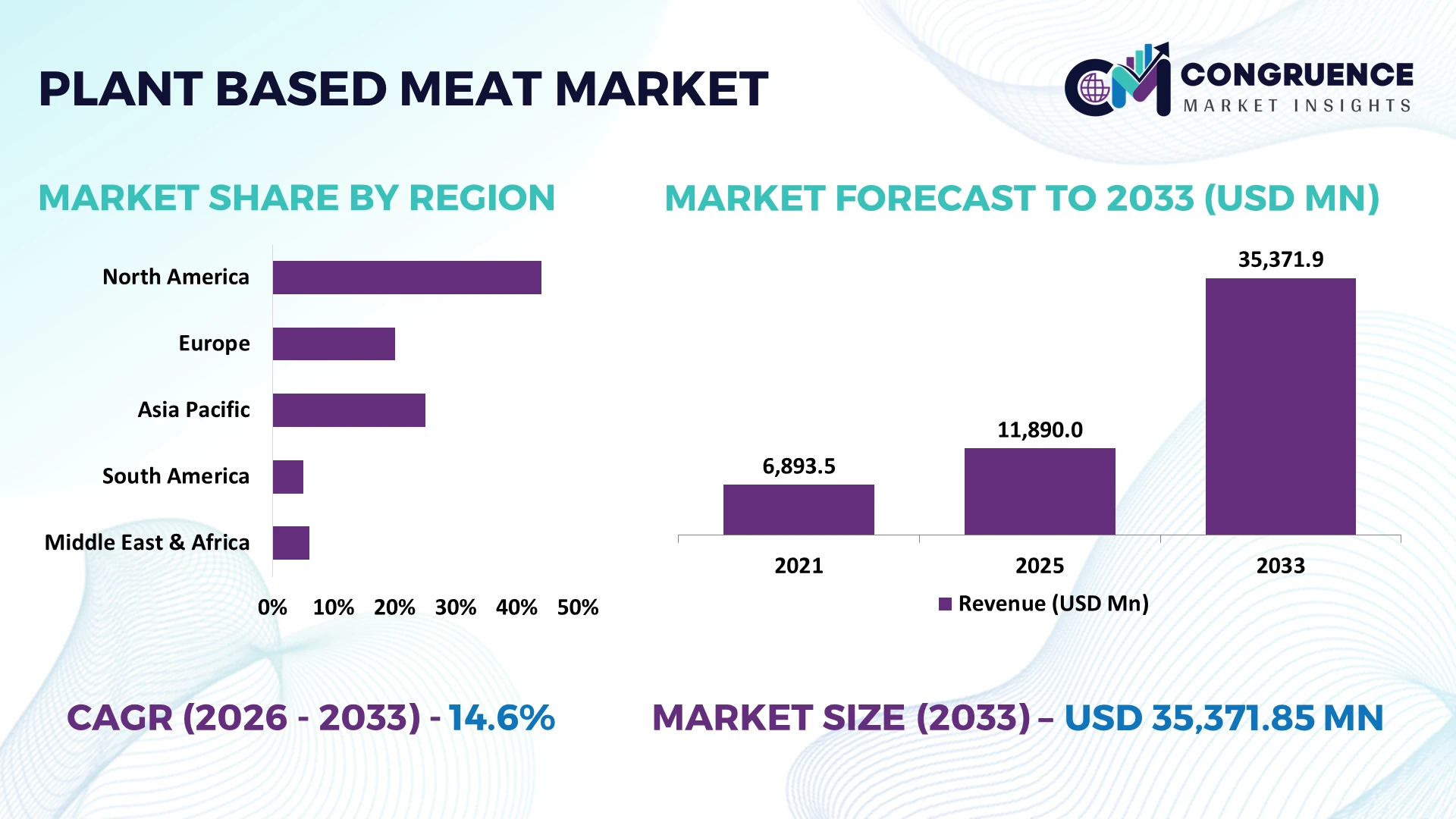
The Global Plant Based Meat Market was valued at USD 11889.97 Million in 2025 and is anticipated to reach a value of USD 35371.85 Million by 2033 expanding at a CAGR of 14.6% between 2026 and 2033. Growth is driven by high-moisture extrusion, improved plant protein texturization, foodservice menu diversification, and reformulation to address taste, nutritional quality, and price competitiveness.
The United States remains a major commercial center for plant based meat, supported by established retail distribution, foodservice partnerships, and advanced alternative protein manufacturing. Approximately 60% of US households purchased plant-based foods in 2024, although meat alternatives represented only a portion of those purchases. Companies including Beyond Meat and Impossible Foods use extrusion and protein structuring technologies to develop meat substitutes. Compared with Germany's established European retail market, the United States offers a larger integrated ecosystem of ingredient suppliers, contract manufacturers, and restaurant chains.
Manufacturers that improve sensory performance while reducing processing costs are better positioned to secure repeat purchases and expand distribution across mainstream food channels.
Market Size & Growth: Valued at USD 11889.97 Million in 2025, projected to USD 35371.85 Million by 2033 at 14.6% CAGR, driven by fermentation-derived protein technologies and foodservice menu expansion.
Top Growth Drivers: Global retail sales reaching USD 28.9 billion across plant-based categories in 2025, foodservice/QSR menu penetration, and high-moisture extrusion texturization advances reducing off-flavor markers .
Short-Term Forecast: By 2027, high-moisture extrusion systems operating at 60-70% moisture reduce cycle time by 40% at Alpha Foods facilities, while in-line flavor injection enables continuous production .
Emerging Technologies: Fungi fermentation producing meaty texture from oats and split peas, precision-fermented heme proteins replicating Maillard browning, and shear-cell processing for whole-cut analogues .
Regional Leaders: North America at 32.18% share with US market dominance, Europe fastest-growing with MATR Foods and Heura scaling production, and Asia-Pacific driven by China’s CNY 4 billion biomanufacturing commitment .
Consumer/End-User Trends: Burgers maintain 38.15% product share; sausages and hot dogs grow at 21.35% CAGR as QSR breakfast menus and stadium concessions incorporate handheld formats .
Pilot/Case Example: Pow.Bio and Bühler demonstrated continuous fermentation of dairy proteins at 3,000-liter scale achieving threefold productivity gain and 50% cost reduction, signaling scalable precision fermentation economics .
Competitive Landscape: Beyond Meat, Impossible Foods, Maple Leaf Foods, Quorn Foods, and Kellanova lead; at least 19 plant-based companies were acquired in 2025 reflecting portfolio consolidation .
Regulatory & ESG Impact: EU trilogue negotiations on meat terminology ban collapsed in December 2025, pushing decision to 2026; South Africa requires minimum 9% protein content for plant-based meat labeling .
Investment & Funding: Plant-based companies raised USD 450 million in 2025, up from USD 342 million in 2024; Europe-headquartered companies secured USD 418 million outpacing North America’s USD 347 million .
Innovation & Future Outlook: Hybrid protein architectures combining plant isolates with fermentation-derived ingredients, and price parity progress through process optimization and vertical integration reshape mainstream adoption .
The Plant Based Meat Market covers meat substitutes developed from soy, pea, wheat, and other plant proteins, serving retail, foodservice, and institutional buyers. Manufacturers are introducing improved whole-cut formats, cleaner-label burgers, and high-moisture extruded products to address texture and taste limitations. In 2025, 96% of US households purchasing plant-based meat also bought conventional meat, identifying flexitarian consumers as a commercially important audience. European retailers are also testing competitive pricing and integrated shelf placement to encourage switching. These developments make product performance, purchase frequency, and manufacturing economics central to the market's strategic direction.
Plant based meat is becoming strategically important as food manufacturers shift from rapid product expansion toward manufacturing efficiency, repeat purchases, and stronger retail economics. In the United States, approximately 96% of plant-based meat purchasing households also buy conventional meat, positioning flexitarian consumers as a critical commercial audience. Manufacturers are restructuring ingredient sourcing, reducing formulation complexity, and concentrating investment on products capable of competing with conventional meat on taste, convenience, and price.
High-moisture extrusion typically operates at 40–80% moisture, compared with approximately 10–35% for conventional low-moisture extrusion, enabling more integrated fibrous structures without separate rehydration. Germany is advancing retail price parity and integrated merchandising, while the United States maintains extensive alternative protein research and manufacturing capabilities. These differences influence product positioning, distribution strategies, and investment priorities across established markets.
Between 2026 and 2028, manufacturers will prioritize higher production utilization, shorter ingredient lists, and improved sensory performance. Lidl's Vemondo initiative demonstrates how competitive pricing and conventional shelf placement support mainstream accessibility. Beyond Meat and Impossible Foods are refining product formulations and commercial partnerships to improve purchasing frequency. Long-term competitive advantage will depend on combining efficient protein structuring, reliable distribution, and consistent consumer acceptance rather than expanding product portfolios indiscriminately.
Flexitarian purchasing behavior is reshaping plant based meat distribution and product development. Approximately 96% of US households purchasing plant-based meat also purchase conventional meat, demonstrating substantial overlap between alternative and traditional protein consumers. Around 11% of US households purchased plant-based meat and seafood in 2025, highlighting opportunities to increase category penetration. Retailers are responding through integrated merchandising, while manufacturers are prioritizing familiar formats such as burgers, sausages, and chicken alternatives. Germany's Lidl has implemented price parity across selected Vemondo products, reducing the financial barrier to trial. Beyond Meat and Impossible Foods are refining taste and texture to improve repeat purchasing. The strongest commercial opportunity lies in increasing purchase frequency among existing flexitarian consumers.
Plant based meat manufacturers face structural cost disadvantages associated with specialized protein ingredients, extrusion equipment, and relatively limited production scale. High-moisture extrusion commonly requires 40–80% moisture, creating additional thermal processing and refrigeration requirements compared with lower-moisture protein products. US plant-based meat household penetration remained near 11% in 2025, limiting the volume available to distribute fixed manufacturing costs. Price competition with conventional meat further restricts manufacturers' ability to recover processing expenses. Beyond Meat's restructuring affecting approximately 17% of its global non-production workforce illustrates industry cost pressure. Companies are simplifying formulations, consolidating production, and negotiating ingredient supply agreements. Improving capacity utilization remains essential for sustainable pricing and profitability.
Whole-cut plant based meat represents an opportunity to move beyond established burger and sausage formats into chicken fillets, steak alternatives, and structured seafood substitutes. High-moisture extrusion operates at approximately 40–80% moisture, supporting fibrous texture formation, while conventional low-moisture extrusion generally uses 10–35%. These processing differences enable manufacturers to develop products with more integrated structures and reduced rehydration requirements. Singapore's alternative protein innovation ecosystem supports pilot manufacturing and advanced food technology development. Companies including Planted are investing in whole-cut protein structuring and commercial foodservice partnerships. Between 2026 and 2028, improved extrusion controls and formulation optimization will support broader menu integration. Suppliers offering versatile products suitable for multiple cooking methods gain stronger commercial differentiation.
Achieving consistent taste, texture, and cooking performance remains a significant challenge for industrial plant based meat production. High-moisture extrusion requires tightly controlled processing conditions, with moisture levels commonly ranging from 40–80%. Protein ingredients also vary in functionality, with soy isolates generally exceeding 90% protein and pea isolates typically containing 80–85%. These differences influence extrusion behavior, water retention, and final product structure. Manufacturers must maintain consistent performance across agricultural feedstock batches and production facilities. Regulatory differences in product labeling and ingredient approvals create additional complexity for international expansion. Companies are investing in process automation, sensory testing, and ingredient standardization to improve reproducibility. Long-term competitiveness depends on achieving reliable commercial-scale production without compromising product quality.
• Retailers Prioritize Leaner Product Assortments: US plant-based meat and seafood household penetration stood near 11% in 2025, while purchasing households averaged approximately six shopping occasions. Retailers are concentrating shelf space on established products rather than expanding every category. Manufacturers are responding through SKU rationalization, packaging redesign, and improved inventory planning to reduce unsold stock and strengthen product availability.
• Cleaner Labels Reshape Protein Formulations: Manufacturers are reducing ingredient complexity while maintaining texture and cooking performance. Soy protein isolates typically contain at least 90% protein, compared with approximately 80–85% in pea isolates, influencing formulation choices. Beyond Meat has introduced products emphasizing nutritional improvements and simpler ingredient positioning. Ingredient suppliers are adjusting protein blends and functional systems to balance nutritional labeling, sensory performance, and manufacturing costs.
• Refrigerated Distribution Gains Operational Importance: Plant-based meat manufacturers are reassessing refrigerated and frozen product portfolios as distribution costs and retail turnover influence profitability. High-moisture products commonly contain 40–80% water during extrusion, creating different downstream handling requirements from dry textured proteins processed at 10–35% moisture. Companies are optimizing production scheduling, packaging formats, and logistics partnerships to improve shelf-life management and distribution efficiency.
• European Retail Pricing Strategies Evolve: German retailers are strengthening plant-based product accessibility through integrated merchandising and competitive pricing. Lidl's Vemondo initiative established price parity across selected alternatives, reducing the premium associated with switching. Plant-based purchasing households in the United States overlap heavily with conventional meat consumers, at approximately 96%. Manufacturers are adjusting pack sizes, retailer partnerships, and promotional strategies to improve category competitiveness.
Soy-Based Meat represents a leading segment of the global plant based meat market, supported by mature ingredient processing, established texturization technologies, and reliable manufacturing scalability. Soy protein isolates typically contain at least 90% protein, enabling concentrated formulations with consistent functional properties. Pea-Based Meat is gaining adoption through allergen-conscious positioning and improvements in flavor and texture. Commercial pea protein isolates generally contain 80–85% protein, supporting diversified ingredient sourcing. Wheat-Based Meat remains important for its elastic gluten structure, particularly in products requiring chewiness and cohesive texture.
Mycoprotein-Based Meat offers a distinct fibrous structure developed through fungal fermentation, while Jackfruit-Based Meat serves minimally processed formulations emphasizing naturally shredded textures. Blended Plant Protein Meat is emerging as a strategically important category because manufacturers combine complementary ingredients to improve amino acid composition, water retention, and cooking performance. Beyond Meat, Impossible Foods, and Quorn are refining formulations and processing technologies to differentiate products. Investment priorities increasingly emphasize ingredient functionality, manufacturing consistency, and competitive production economics.
Burgers and Patties represent a leading application in the plant based meat market, supported by established retail distribution, familiar consumer formats, and standardized foodservice preparation. Their commercial position benefits from scalable extrusion and forming technologies, allowing manufacturers to produce consistent portion sizes and cooking characteristics. Sausages maintain demand through breakfast and grilling applications, while Nuggets and Tenders are gaining momentum through convenient preparation and family-oriented product positioning. Meatballs and Minced Meat Alternatives support versatile meal preparation, particularly in pasta dishes, sauces, and prepared foods.
Deli Slices address sandwich and convenience applications, while Ready-to-Eat Meals represent an expanding opportunity for manufacturers integrating plant-based proteins into complete meal formats. Approximately 11% of US households purchased plant-based meat and seafood in 2025, indicating an established but selective consumer base. Manufacturers are adapting through automated portioning, improved breading systems, and differentiated product formats. Competitive positioning increasingly depends on cooking consistency, distribution efficiency, and product familiarity rather than extensive category diversification.
Retail Consumers represent the dominant end-user group in the plant based meat market, supported by supermarket distribution, household meal preparation, and established branded product portfolios. Approximately 11% of US households purchased plant-based meat and seafood in 2025, while 96% of purchasing households also bought conventional meat. These patterns demonstrate that alternative protein consumption frequently complements rather than replaces traditional meat purchasing. Restaurants and Quick-Service Restaurants represent important commercial channels, offering standardized plant-based menu items and opportunities for repeat exposure. Hotels and Catering operators incorporate alternatives into diverse menus and specialized dietary offerings.
Foodservice Providers increasingly prioritize products that maintain texture and quality under high-volume preparation conditions. Food Manufacturers purchase plant-based meat ingredients for integration into prepared foods, while Institutional Kitchens evaluate alternatives for structured meal programs. Beyond Meat and Impossible Foods are strengthening foodservice partnerships and adapting products for commercial cooking environments. Manufacturers are prioritizing channel-specific formulations, distribution partnerships, and competitive pricing to improve operational adoption.
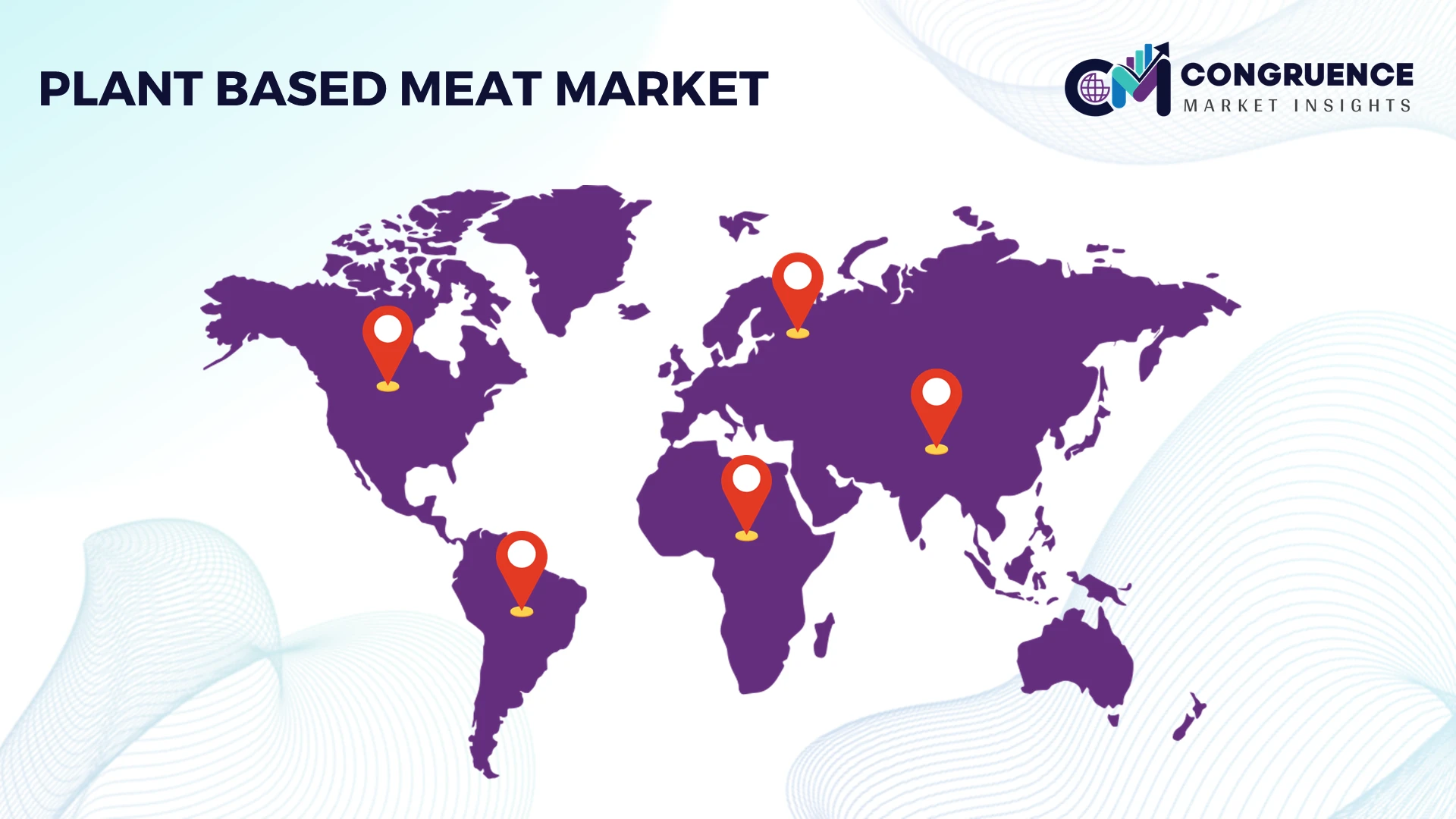
North America accounted for the largest market share at an estimated 38% in 2025 however, Asia-Pacific is expected to register the fastest growth, expanding at a CAGR of an estimated 17.2% between 2026 and 2033.
Retail Portfolio Rationalization and Advanced Protein Manufacturing
North America maintains a leading position in the plant based meat market, supported by established retail distribution, alternative protein manufacturing infrastructure, and specialized food technology capabilities. The United States dominates regional commercialization through companies including Beyond Meat, Impossible Foods, and MorningStar Farms, while Canada contributes ingredient processing and product development capabilities. US plant-based meat and seafood household penetration stood near 11% in 2025, highlighting opportunities to improve repeat purchasing and category accessibility. Manufacturers are restructuring product portfolios, emphasizing familiar formats, and strengthening operational efficiency. High-moisture extrusion technologies support advanced fibrous structures, while ingredient optimization improves nutritional composition and cooking performance. Retailers increasingly prioritize established products with reliable turnover, encouraging suppliers to refine packaging, production scheduling, and distribution strategies. Competitive differentiation increasingly depends on product consistency, manufacturing economics, and strong retailer relationships.
United States Market Outlook: The United States benefits from advanced food processing infrastructure, established alternative protein brands, and extensive supermarket distribution networks. Approximately 96% of households purchasing plant-based meat also buy conventional meat, reinforcing the importance of flexitarian consumers. Beyond Meat and Impossible Foods are refining formulations and expanding commercial partnerships, while retailers prioritize competitive pricing, familiar product formats, and improved shelf performance.
Retail Price Parity and Mainstream Product Integration
Europe represents an established plant based meat market, supported by advanced food manufacturing, retailer-led product innovation, and extensive alternative protein distribution. Germany, the United Kingdom, the Netherlands, and France maintain significant capabilities in plant-based food development and commercial processing. Germany's retail sector has advanced price parity initiatives, including Lidl's Vemondo strategy, reducing purchasing barriers across selected alternative protein products. European manufacturers increasingly prioritize shorter ingredient lists, improved nutritional profiles, and product formats suitable for conventional cooking applications. Companies including The Vegetarian Butcher, Quorn, and Planted maintain established product development capabilities and commercial partnerships. Regional innovation also includes fermentation-derived proteins and advanced extrusion technologies. Competitive positioning increasingly depends on manufacturing efficiency, retailer collaboration, and alignment with food labeling requirements. Integrated merchandising strategies are strengthening product visibility within conventional supermarket categories.
Germany Market Outlook: Germany benefits from established food manufacturing infrastructure, extensive discount retail networks, and strong consumer familiarity with meat alternatives. Lidl's Vemondo initiative has introduced price parity across selected plant-based products, strengthening mainstream accessibility. Germany also maintains advanced protein processing and food technology capabilities, supporting product reformulation, improved texture development, and competitive manufacturing operations.
Food Manufacturing Scale and Localized Product Development
Asia-Pacific is positioned for accelerated plant based meat commercialization, supported by extensive food processing infrastructure, established soy-based food traditions, and expanding alternative protein innovation. China maintains substantial soybean processing capabilities, while Japan contributes advanced food manufacturing technologies and established plant-derived protein applications. Singapore has developed a specialized food technology ecosystem supporting alternative protein research and commercialization. China's soybean imports reached approximately 105 million metric tons in 2024, demonstrating the scale of its agricultural processing supply chain. Manufacturers are developing plant-based products adapted to regional culinary preferences, including dumpling fillings, prepared meals, and protein-rich convenience foods. Advanced extrusion and protein blending technologies support texture optimization and scalable production. Regional companies increasingly collaborate with ingredient suppliers and foodservice operators to strengthen distribution. Competitive advantage depends on localized flavor development, efficient manufacturing, and accessible pricing.
China Market Outlook: China benefits from extensive soybean processing infrastructure, large-scale food manufacturing, and established consumption of soy-derived products. Domestic producers are developing textured vegetable proteins and meat alternatives for retail and foodservice applications. With a population exceeding 1.4 billion, China offers substantial opportunities for localized product development. Manufacturers are improving protein structuring, seasoning systems, and production efficiency to support commercial adoption.
Agricultural Integration and Alternative Protein Manufacturing Diversification
South America's plant based meat market is shaped by extensive soybean production, established food processing capabilities, and emerging alternative protein brands. Brazil represents the principal regional market, supported by agricultural feedstock availability, established food manufacturing infrastructure, and increasing product development activity. Argentina contributes soybean processing capabilities and opportunities for value-added protein ingredient production. Brazil harvested approximately 147.7 million metric tons of soybeans during the 2023–2024 crop season, providing substantial agricultural processing capacity. Companies including JBS and Marfrig have participated in plant-based protein product development and distribution. Manufacturers are refining formulations and exploring local ingredient sourcing to improve cost competitiveness. However, specialized extrusion equipment, refrigerated distribution requirements, and consumer price sensitivity influence commercial expansion. Regional competitiveness increasingly depends on processing integration, product affordability, and established retail relationships.
Brazil Market Outlook: Brazil benefits from extensive soybean cultivation, established meat processing infrastructure, and experienced food manufacturers. JBS has developed plant-based product capabilities through its broader alternative protein activities, while domestic brands are adapting products to local culinary preferences. Brazil's population exceeds 200 million, supporting a substantial packaged food market. Ingredient localization and manufacturing efficiency remain important priorities for commercial expansion.
Food Security Investment and Alternative Protein Commercialization
The Middle East & Africa plant based meat market is developing through food manufacturing diversification, alternative protein investment, and expanding modern retail infrastructure. The United Arab Emirates and Saudi Arabia represent important commercial centers, supported by food technology initiatives and imported ingredient distribution networks. South Africa contributes established food processing capabilities and growing interest in alternative protein products. Saudi Arabia's Vision 2030 framework emphasizes industrial diversification and domestic food production, supporting opportunities for specialized ingredient processing and product manufacturing. The UAE has attracted food technology initiatives focused on alternative protein innovation and regional supply-chain development. Manufacturers are adapting plant-based formulations to local dietary preferences while strengthening retail and foodservice distribution. Competitive positioning depends on efficient ingredient sourcing, localized production capabilities, and compliance with regional food safety and labeling requirements.
United Arab Emirates Market Outlook: The United Arab Emirates benefits from advanced logistics infrastructure, diversified foodservice operations, and a growing food technology ecosystem. Dubai and Abu Dhabi support alternative protein innovation through investment initiatives and specialized food manufacturing development. The country's population exceeds 10 million, providing a concentrated consumer market. Companies are exploring local production partnerships, ingredient distribution, and plant-based menu integration to strengthen commercial accessibility.
Beyond Meat, Impossible Foods, Tyson Foods, Kellanova (MorningStar Farms), and Maple Leaf Foods anchor the plant-based meat market, with the top five players commanding approximately 35–40% of global retail revenue through established brand recognition and retail distribution depth. Competition bifurcates between branded innovators competing on sensory parity and foodservice partnerships, and private-label manufacturers competing on price and retailer relationships as grocery chains expand own-brand alternatives. The basis of competition is shifting from brand marketing toward unit economics: fermentation-derived protein platforms reduce input costs by 50% versus conventional extrusion, enabling price parity progress critical for mainstream adoption. Players compete through QSR menu integration—McDonald's McPlant expansion, Burger King's Impossible Whopper—and fermentation technology partnerships including Motif FoodWorks and Every Company. Consolidation accelerated with at least 19 plant-based companies acquired in 2025, reflecting portfolio rationalization. Entry barriers center on taste parity, texture engineering, and retail slotting economics.
Beyond Meat
Impossible Foods
Tyson Foods
Kellanova (MorningStar Farms)
Maple Leaf Foods (Greenleaf Foods)
Conagra Brands (Gardein)
Nestlé (Sweet Earth)
Unilever (The Vegetarian Butcher)
Quorn Foods
Oatly Group
Heura Foods
MATR Foods
Sunfed Meats
v2food
High moisture extrusion remains central to commercial plant based meat manufacturing, combining thermal processing, mechanical shear, and controlled cooling to create fibrous protein structures. Production typically operates at 40–80% moisture, compared with 10–35% for conventional low moisture extrusion. This represents at least a 5 percentage point increase in processing moisture, enabling cohesive textures without separate rehydration. Soy and pea protein blends support burgers, sausages, and chicken alternatives, while automated extrusion controls improve consistency across production batches and reduce formulation adjustments.
Emerging technologies include shear cell processing, enzymatic protein modification, and three dimensional food printing. Shear cell systems align protein structures through controlled deformation, supporting larger whole cut formats. Enzymatic treatments modify protein functionality without relying exclusively on chemical additives. Digital formulation platforms integrate ingredient composition, thermal profiles, and sensory measurements to accelerate product development. Manufacturers combining these capabilities with existing extrusion infrastructure gain advantages in product differentiation, technical flexibility, and processing efficiency.
Between 2026 and 2028, artificial intelligence assisted formulation and continuous process monitoring will strengthen manufacturing optimization. Real time viscosity, temperature, and pressure measurements will improve batch reproducibility and reduce material losses. Companies investing in pilot equipment, specialized cooling systems, and ingredient partnerships will accelerate commercialization. Competitive advantage will increasingly depend on scalable texture engineering, reliable cooking performance, and disciplined manufacturing economics.
August 2025: Quest Diagnostics received FDA Breakthrough Device Designation for its Haystack MRD ctDNA test for stage II colorectal cancer, with 96% of surveyed oncologists confirming MRD testing detects recurrence earlier than conventional CEA monitoring. This regulatory milestone accelerates the shift toward molecular surveillance workflows that complement serum biomarker testing. Source: questdiagnostics.com
December 2024: Anhui Province-led 28-province IVD procurement alliance finalized CEA reagent price reductions averaging 52.62%, with Roche, Abbott, Beckman, and Siemens accepting cuts exceeding 50% to retain volume access across 11,800 hospitals. CEA reagent pricing dropped from 15.4 yuan to 8.5 yuan per test, restructuring the economics of CEA testing in China. Source: wehefei.com
June 2026: Quest Diagnostics secured New York State CLEP approval for Haystack MRD, authorizing patient testing across all 50 US states with demonstrated 100% specificity at 3-year follow-up in DYNAMIC trial specimens. This removes the final regulatory barrier for nationwide commercial deployment of ctDNA-based recurrence surveillance. Source: haystackmrd.com
October 2025: MVZ HPH launched HPH MRD in Hamburg, Germany, a locally performed ctDNA blood test based on Haystack MRD technology, enabling European clinicians to access next-generation MRD testing without international sample shipping. This expands Haystack’s footprint into European oncology markets while maintaining data protection compliance. Source: questdiagnostics.com
The Plant Based Meat Market Report examines industry developments between 2026 and 2033 across six product types: Soy-Based Meat, Pea-Based Meat, Wheat-Based Meat, Mycoprotein-Based Meat, Jackfruit-Based Meat, and Blended Plant Protein Meat. Application coverage includes seven categories spanning Burgers and Patties, Sausages, Nuggets and Tenders, Meatballs, Minced Meat Alternatives, Deli Slices, and Ready-to-Eat Meals. End-user analysis evaluates Retail Consumers, Restaurants, Quick-Service Restaurants, Hotels and Catering, Foodservice Providers, Food Manufacturers, and Institutional Kitchens.
The report assesses five major geographic regions, comparing manufacturing infrastructure, distribution channels, consumer purchasing patterns, and competitive strategies. Technology coverage includes high-moisture extrusion, shear-cell structuring, automated processing, and digital formulation. Strategic analysis examines product innovation, ingredient sourcing, manufacturing economics, and foodservice partnerships to support investment decisions, geographic expansion, supplier positioning, and commercialization planning.
| Report Attribute/Metric | Report Details |
|---|---|
Market Revenue in 2025 | USD 11889.97 Million |
Market Revenue in 2033 | USD 35371.85 Million |
CAGR (2026 - 2033) | 14.6% |
Base Year | 2025 |
Forecast Period | 2026 - 2033 |
Historic Period | 2021 - 2025 |
Segments Covered | By Type
By Application
By End-User
|
Key Report Deliverable | Revenue Forecast, Growth Trends, Market Dynamics, Segmental Overview, Regional and Country-wise Analysis, Competition Landscape |
Region Covered | North America, Europe, Asia-Pacific, South America, Middle East, Africa |
Key Players Analyzed | Beyond Meat, Impossible Foods, Tyson Foods, Kellanova (MorningStar Farms), Maple Leaf Foods (Greenleaf Foods), Conagra Brands (Gardein), Nestlé (Sweet Earth), Unilever (The Vegetarian Butcher), Quorn Foods, Oatly Group, Heura Foods, MATR Foods, Sunfed Meats, v2food |
Customization & Pricing | Available on Request (10% Customization is Free) |




