
Reports
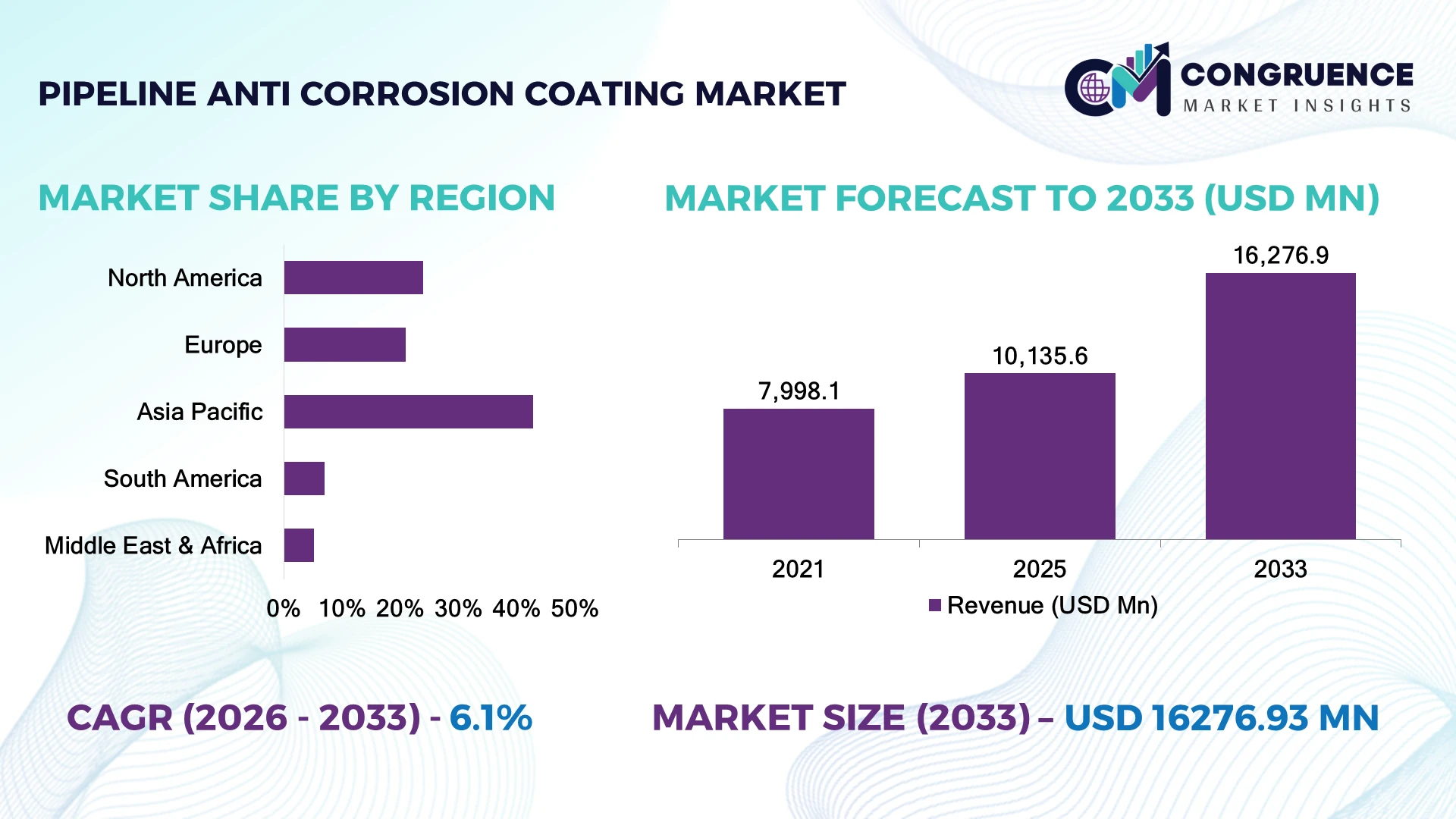
The Global Pipeline Anti-corrosion Coating Market was valued at USD 10,135.6 Million in 2025 and is anticipated to reach a value of USD 16,276.9 Million by 2033 expanding at a CAGR of 6.1% between 2026 and 2033. Expansion of cross-border oil, gas, hydrogen, and water transmission infrastructure, combined with stricter pipeline integrity regulations and advanced fusion-bonded epoxy and multilayer coating adoption, continues to accelerate global market deployment.
China dominates the global pipeline anti-corrosion coating market with approximately 34% of installed coating capacity, supported by large-scale oil, gas, and water infrastructure projects, annual investments exceeding USD 20 billion, and rapid deployment of automated coating facilities. Compared with the United States, China commissions longer transmission networks annually, while North America leads in rehabilitation and integrity management following ongoing energy security initiatives reshaped after the Russia-Ukraine conflict.
Organizations prioritizing high-performance coating technologies and region-specific infrastructure investments are strengthening long-term asset reliability while reducing lifecycle maintenance costs.
Market Size & Growth: USD 10,135.6 million (2025) to USD 16,276.9 million (2033) at 6.1% CAGR, driven by advanced pipeline integrity programs and infrastructure expansion.
Top Growth Drivers: Pipeline rehabilitation (+32%), hydrogen infrastructure (+24%), offshore energy investments (+21%) accelerate coating demand.
Short-Term Forecast: By 2028, automated coating operations reduce application time by 18% while improving inspection efficiency by 22%.
Emerging Technologies: AI-enabled coating inspection, robotic application systems, and nanocomposite coatings extend service life by nearly 30%.
Regional Leaders: Asia-Pacific (~USD 6.4 billion), North America (~USD 4.8 billion), Europe (~USD 3.3 billion); regional expansion follows energy infrastructure modernization and supply-chain diversification.
Consumer/End-User Trends: Nearly 68% of new transmission pipeline projects specify multilayer protective coating systems for extended operational durability.
Pilot/Case Example: A 2026 cross-country transmission project achieved 25% lower maintenance requirements through automated coating quality control.
Competitive Landscape: Top five suppliers collectively hold about 46% market share, led by AkzoNobel, Sherwin-Williams, Jotun, PPG Industries, and Axalta.
Regulatory & ESG Impact: Enhanced pipeline integrity standards reduce corrosion-related failures by approximately 20%, supporting environmental compliance.
Investment & Funding: More than USD 7 billion supports pipeline modernization, manufacturing expansion, and strategic coating partnerships worldwide.
Innovation & Future Outlook: Smart monitoring, self-healing coatings, and digital asset management improve maintenance planning while strengthening long-term infrastructure resilience.
Pipeline anti-corrosion coating solutions are witnessing stronger demand across oil and gas transmission, hydrogen pipeline development, district heating, and municipal water infrastructure. Advanced multilayer systems and automated application technologies improve coating consistency, while high-performance formulations extend operational life by nearly 30%. Growing localization of coating production amid global supply-chain realignment is reinforcing procurement resilience and supporting broader infrastructure modernization initiatives. This evolving landscape sets the foundation for the strategic market assessment below.
The pipeline anti-corrosion coating market has become strategically important as governments and energy companies accelerate pipeline modernization, strengthen asset integrity programs, and expand hydrogen-ready infrastructure. Competitive advantage increasingly depends on coating durability, application efficiency, and lifecycle maintenance performance rather than material cost alone. Supply-chain restructuring since recent geopolitical disruptions has also encouraged regional manufacturing expansion and diversified raw material sourcing.
Advanced multilayer coating systems outperform conventional single-layer coatings by extending maintenance intervals by approximately 25% while reducing corrosion-related repair costs by nearly 20% through improved adhesion, chemical resistance, and automated quality inspection. Asia-Pacific leads new pipeline deployment supported by large-scale infrastructure construction, whereas North America focuses on rehabilitation, digital integrity management, and replacement of aging transmission assets. Over the next two to three years, automated coating inspection and robotic application are expected to increase production efficiency by around 15% across major manufacturing facilities.
Large transmission pipeline projects increasingly integrate automated blasting, coating, curing, and digital inspection within a unified production process to improve quality consistency and commissioning speed. Manufacturers are expanding regional coating plants, strengthening raw material partnerships, and investing in high-performance formulations compatible with hydrogen and carbon capture infrastructure. Companies securing advanced coating capabilities alongside localized production networks are expected to achieve stronger competitive positioning, lower operational risk, and greater long-term infrastructure reliability.
Large-scale expansion of oil, gas, hydrogen, carbon dioxide, and water transmission networks is strengthening demand for advanced pipeline anti-corrosion coating systems. More than 70% of newly installed long-distance pipelines now specify multilayer protective coatings, while automated coating lines improve application consistency by nearly 25% and reduce inspection defects by approximately 18%. China and India continue expanding strategic pipeline corridors, while the United States is upgrading aging transmission infrastructure under stricter integrity management requirements. This combination of new construction and asset rehabilitation is shifting procurement toward higher-performance coating technologies. Leading manufacturers are responding by expanding production capacity, investing in automated coating facilities, and developing advanced formulations that extend pipeline service intervals while lowering lifecycle maintenance costs.
Volatility in epoxy resins, specialty polymers, and performance additives continues to pressure production economics and procurement planning. Raw material costs fluctuate by nearly 15–20% across procurement cycles, while imported specialty chemicals account for approximately 40% of selected high-performance coating formulations in several manufacturing markets. Logistics disruptions affecting Red Sea shipping routes have extended delivery schedules for selected inputs, increasing inventory requirements and contract complexity. These pressures reduce margin stability for coating suppliers and complicate long-term project pricing. Companies are mitigating risk by localizing raw material sourcing, expanding qualified supplier networks, securing long-term procurement agreements, and reformulating products to improve flexibility without compromising corrosion resistance.
Hydrogen transmission infrastructure is creating a high-value opportunity for specialized coating technologies capable of withstanding demanding operating environments. More than 30% of planned hydrogen pipeline projects incorporate enhanced protective coating specifications, while digital coating inspection systems improve defect detection accuracy by nearly 28%. Germany and Japan are accelerating hydrogen infrastructure investments, encouraging manufacturers to develop coatings with greater resistance to permeation and environmental degradation. Companies are expanding research partnerships with material science specialists and pipeline operators to validate next-generation formulations under real operating conditions. Early investment in hydrogen-compatible coating portfolios also positions suppliers to address future carbon capture and industrial gas transportation applications with higher technical entry barriers.
Maintaining consistent coating performance across thousands of kilometers of pipeline remains a significant execution challenge as projects become larger and technically more complex. Field-applied coating defects still account for nearly 22% of reported quality deviations, while shortages of experienced coating inspectors increase project verification timelines by approximately 15%. The United States and Canada continue facing workforce constraints for large transmission projects, particularly in remote construction corridors. Variations in surface preparation, environmental conditions, and inspection procedures directly influence long-term coating durability and maintenance requirements. Companies are addressing these challenges by investing in robotic application systems, AI-assisted inspection platforms, workforce certification programs, and standardized digital quality management processes to improve deployment consistency.
Automated Coating Line Expansion: Automated blasting, coating, and curing systems are replacing manual production across major manufacturing facilities, increasing throughput by approximately 22% while reducing coating defects by nearly 18%. Labor shortages and stricter quality requirements are accelerating automation investments, particularly in China. Manufacturers are integrating robotic application equipment with digital inspection platforms to improve production consistency, shorten delivery schedules, and strengthen competitiveness for large infrastructure contracts.
Smart Inspection Integration: AI-enabled coating inspection and digital asset management platforms are improving defect detection accuracy by around 30% while reducing manual inspection time by approximately 25%. Pipeline operators increasingly combine predictive maintenance software with coating performance analytics to optimize maintenance planning. Technology providers are expanding partnerships with inspection specialists to deliver integrated quality assurance solutions that reduce operational disruptions and improve long-term infrastructure reliability.
Localized Manufacturing Strategies: Supply-chain diversification is driving greater localization of coating production and raw material procurement. More than 35% of manufacturers have expanded regional production or warehousing capabilities to reduce logistics exposure following recent global shipping disruptions. India has emerged as an important manufacturing destination for protective coating materials, while suppliers are strengthening long-term procurement agreements and dual-sourcing strategies to improve supply continuity and contract execution.
Advanced Functional Coatings Adoption: Demand is increasing for multifunctional coating systems combining corrosion protection with abrasion resistance, chemical durability, and extended service life. Next-generation formulations improve operational lifespan by nearly 30% while lowering maintenance interventions by approximately 20%. Environmental compliance requirements and infrastructure modernization programs are encouraging manufacturers to accelerate product development, expand material science collaborations, and commercialize high-performance coatings tailored for hydrogen, carbon capture, and high-pressure transmission pipelines.
Fusion Bonded Epoxy (FBE) remains the leading pipeline anti-corrosion coating type, accounting for approximately 39% of the global market due to its excellent adhesion, long-term corrosion resistance, and cost-efficient application across transmission pipelines. Its compatibility with automated coating lines and reduced maintenance requirements make it the preferred choice for oil, gas, and water infrastructure projects. Three-Layer Polyethylene (3LPE) continues to gain traction for pipelines exposed to harsh mechanical conditions, while Coal Tar Enamel retains a limited presence in rehabilitation projects despite declining adoption because of environmental regulations. Liquid epoxy coatings remain strategically important for field joint protection and repair applications.
Three-Layer Polypropylene (3LPP) is the fastest-growing coating type as operators increasingly require high-temperature resistance for offshore and industrial transmission systems. Demand for advanced multilayer coatings has increased by nearly 24% over the past two years, while automated FBE application improves coating consistency by approximately 20%. Manufacturers are expanding multilayer product portfolios, strengthening material partnerships, and investing in advanced powder technologies to support hydrogen transmission and carbon capture infrastructure. These investment priorities reflect the industry's transition toward higher-performance protective coating systems with extended service life.
Industry observations released during 2026 by the Association for Materials Protection and Performance (AMPP) indicate that advanced multilayer coating systems are specified in more than 70% of newly constructed high-pressure transmission pipeline projects, reflecting increasing emphasis on lifecycle asset protection.
Oil and gas transmission remains the dominant application, representing approximately 58% of global demand due to continuous investment in crude oil, natural gas, and refined product transportation networks. Long-distance transmission pipelines require durable corrosion protection capable of operating under demanding environmental conditions, making advanced coating systems operationally essential. Water transmission pipelines continue expanding through municipal infrastructure modernization, while chemical processing pipelines require specialized coatings with superior chemical resistance. Mining slurry pipelines also maintain steady demand for abrasion-resistant protective technologies.
Hydrogen transportation is emerging as the fastest-growing application as countries including Germany and Japan accelerate clean energy infrastructure deployment. Hydrogen-compatible coating specifications have increased by nearly 28%, while advanced inspection technologies improve coating quality verification by approximately 25%. Companies are expanding dedicated product development programs, integrating automated coating technologies, and strengthening engineering collaborations to support evolving infrastructure requirements. Demand is steadily shifting toward specialized applications where long-term durability, chemical resistance, and lower maintenance frequency deliver measurable operational value.
According to findings published during 2025 by the International Energy Agency (IEA), hydrogen transmission infrastructure planning continues to accelerate globally, driving increased specification of high-performance protective coating systems for new pipeline developments.
Energy utilities represent the largest end-user segment, accounting for approximately 61% of global demand due to extensive ownership and operation of crude oil, natural gas, and refined product transmission networks. Continuous investment in pipeline integrity management, rehabilitation, and new infrastructure construction sustains procurement of advanced anti-corrosion coating systems. Midstream pipeline operators remain significant buyers, while municipal water authorities steadily increase coating adoption through aging infrastructure replacement programs. Industrial processing companies continue investing in specialized coatings for chemical and high-temperature applications requiring enhanced durability.
Hydrogen infrastructure developers are emerging as the fastest-growing end-user group as governments and private investors expand clean energy transportation networks. Procurement of hydrogen-compatible coating technologies has increased by nearly 27%, while digital inspection adoption among large infrastructure operators exceeds 40% for newly commissioned projects. Manufacturers are responding through customized coating solutions, strategic engineering partnerships, localized technical support, and performance-based service offerings that strengthen customer retention and long-term infrastructure contracts.
A 2026 assessment by the Association for Materials Protection and Performance (AMPP) highlighted that pipeline operators implementing structured coating inspection and integrity management programs reported measurable reductions in corrosion-related maintenance interventions and longer asset service intervals.
Asia-Pacific accounted for the largest market share at 42.8%in 2025 however, Middle East & Africa is expected to register the fastest growth, expanding at a 6.8% CAGR between 2026 and 2033.
Pipeline Rehabilitation Accelerates Advanced Coating Adoption
North America accounted for approximately 24% of the global pipeline anti-corrosion coating market, supported by extensive rehabilitation of aging oil, gas, and water transmission infrastructure. Asset integrity programs, stricter inspection standards, and increased deployment of automated coating application systems are shifting procurement toward high-performance multilayer coatings. More than 65% of major transmission pipeline rehabilitation projects now specify advanced epoxy-based protection systems to reduce maintenance frequency and improve operational reliability. Expansion of carbon capture infrastructure and hydrogen demonstration pipelines is also increasing demand for specialized coating technologies. Manufacturers are strengthening regional production, expanding technical service capabilities, and investing in automated quality inspection to support long-term infrastructure modernization.
United States Market Outlook: The United States remains the largest national market due to its extensive interstate pipeline network, mature midstream industry, and continuous integrity management investments. More than 3.3 million kilometers of pipeline infrastructure require ongoing maintenance, rehabilitation, and corrosion protection. Operators are increasingly adopting robotic coating inspection, digital asset management, and high-performance multilayer coating systems to extend pipeline life while reducing maintenance costs. Domestic manufacturers continue expanding production capacity and collaborating with pipeline engineering firms to support large-scale replacement and modernization programs.
Hydrogen Infrastructure Reshapes Coating Requirements
Europe represents approximately 21% of the global market, driven by modernization of gas transmission systems and the transition toward hydrogen-ready infrastructure. Regulatory emphasis on pipeline integrity, environmental performance, and long-term asset reliability continues to accelerate adoption of advanced coating technologies. More than 30% of newly planned hydrogen transport projects specify enhanced multilayer coating systems capable of supporting demanding operating environments. Manufacturers are investing in specialized formulations, automated production technologies, and engineering partnerships to address evolving infrastructure specifications while improving lifecycle performance.
Germany Market Outlook: Germany leads the European market through its advanced pipeline engineering capabilities and large-scale hydrogen infrastructure initiatives. National energy transition programs continue supporting upgrades to existing gas transmission assets, while industrial operators invest in coatings compatible with hydrogen transport. Automated coating inspection technologies are increasingly integrated into major infrastructure projects, improving quality assurance and supporting long-term pipeline reliability across industrial corridors.
Large-Scale Infrastructure Construction Sustains Market Leadership
Asia-Pacific leads the global market with approximately 42.8% share, supported by rapid expansion of oil, gas, water, and industrial pipeline infrastructure across China, India, and Southeast Asia. Continuous investment in cross-country transmission networks and automated coating facilities strengthens regional production and deployment capacity. Nearly 70% of newly installed long-distance pipelines in the region utilize advanced fusion bonded epoxy or multilayer coating systems to improve operational durability. Local manufacturers are expanding production capacity, strengthening raw material integration, and developing higher-performance coating technologies to meet growing infrastructure requirements.
China Market Outlook: China remains the largest market globally because of its extensive pipeline construction activity, vertically integrated manufacturing base, and large domestic coating production capacity. National infrastructure investments continue supporting expansion of crude oil, natural gas, hydrogen, and municipal water transmission networks. Automated coating production lines and advanced quality control systems are widely deployed, enabling manufacturers to supply high-volume infrastructure projects while improving production efficiency and export competitiveness.
Pipeline Expansion Supports Long-Term Demand
South America accounts for approximately 7% of the global market, driven by oil and gas transportation projects, mining infrastructure, and gradual modernization of regional pipeline networks. Brazil and Argentina continue investing in transmission infrastructure to improve domestic energy distribution and industrial connectivity. New pipeline developments increasingly incorporate multilayer protective coatings, while rehabilitation projects prioritize longer service life and reduced maintenance frequency. Manufacturers are expanding local distribution partnerships and technical support capabilities to improve project execution despite logistical and infrastructure challenges across remote operating environments.
Brazil Market Outlook: Brazil represents the largest market within South America owing to its extensive offshore oil production, refining infrastructure, and expanding natural gas transportation network. Investment in pre-salt developments continues supporting demand for high-performance anti-corrosion coatings designed for aggressive operating environments. Domestic suppliers and international manufacturers are strengthening regional partnerships and localized technical services to support pipeline construction, rehabilitation, and offshore energy projects.
Energy Infrastructure Investment Drives Advanced Coating Demand
The Middle East & Africa is the fastest-growing regional market as governments accelerate investment in oil, gas, hydrogen, and water transmission infrastructure. Large cross-border pipeline developments and refinery expansion projects continue increasing demand for advanced anti-corrosion coating technologies capable of operating under extreme environmental conditions. More than 60% of major pipeline projects in the Gulf region specify multilayer protective coating systems for enhanced durability and lower maintenance requirements. Manufacturers are expanding regional manufacturing partnerships, technical support centers, and localized supply networks to improve project delivery and reduce procurement lead times.
Saudi Arabia Market Outlook: Saudi Arabia leads the regional market through its extensive oil and gas pipeline network, ongoing downstream expansion, and large-scale industrial infrastructure investments. National energy diversification programs continue supporting new transmission projects alongside modernization of existing assets. Pipeline operators increasingly adopt advanced fusion bonded epoxy and multilayer coating systems to improve long-term reliability under harsh desert conditions, while manufacturers strengthen local production partnerships and technical service capabilities to support strategic infrastructure expansion.
The market is moderately consolidated, with the top five companies controlling approximately 46% of global demand. AkzoNobel, Sherwin-Williams, PPG Industries, Jotun, and Axalta compete through technology leadership and global project execution, while regional manufacturers challenge them through pricing, localized production, and faster delivery. Competition increasingly centers on coating durability, automated application compatibility, and technical support rather than product price alone. Advanced multilayer systems deliver nearly 20% longer maintenance intervals, while localized manufacturing reduces delivery lead times by approximately 15% and integrated supply contracts lower procurement costs by around 10%. Global suppliers are expanding manufacturing footprints, strengthening EPC partnerships, investing in hydrogen-compatible coatings, and integrating digital inspection capabilities through vertical collaboration. The competitive shift favors suppliers controlling raw materials, technical certifications, and engineering support. High qualification standards, long customer approval cycles, and performance validation create significant entry barriers. Winning requires proven lifecycle performance, reliable supply chains, localized service, and continuous coating innovation.
AkzoNobel N.V.
The Sherwin-Williams Company
PPG Industries, Inc.
Jotun A/S
Axalta Coating Systems Ltd.
Hempel A/S
Kansai Paint Co., Ltd.
Nippon Paint Holdings Co., Ltd.
Carboline Company
Teknos Group Oy
Sika AG
3M Company
Pipeline protection technologies are rapidly shifting from conventional single-layer coatings toward advanced multilayer systems combining Fusion Bonded Epoxy (FBE), Three-Layer Polyethylene (3LPE), and Three-Layer Polypropylene (3LPP). These systems improve corrosion resistance and extend service life by nearly 30%, while automated application lines reduce coating defects by approximately 20%. More than 70% of newly constructed high-pressure transmission pipelines now utilize advanced multilayer coating technologies, reflecting broad industry adoption. Companies with integrated coating formulation and automated production capabilities gain stronger operational efficiency and qualification advantages.
Emerging technologies include AI-assisted coating inspection, robotic application systems, digital quality management, and nanocomposite protective formulations. AI-enabled inspection improves defect detection accuracy by around 30%, while robotic coating systems increase production efficiency by approximately 18% compared with conventional manual workflows. Digital inspection platforms are being deployed across nearly 40% of large transmission pipeline projects, enabling faster quality verification and improved lifecycle asset management. Technology leaders benefit through stronger project qualification, lower warranty exposure, and higher-value service offerings.
Between 2026 and 2028, hydrogen-compatible coating systems, self-healing polymer technologies, and smart coating performance monitoring will reshape competitive positioning. Compared with traditional epoxy-only systems, advanced multilayer intelligent coatings improve maintenance intervals by approximately 25% while reducing lifecycle operating costs by nearly 15%. Companies investing early in automated manufacturing, material science innovation, and digital inspection ecosystems will secure greater participation in hydrogen, carbon capture, and next-generation energy infrastructure projects.
May 2025 – AMPP launched its Fusion Bonded Epoxy (FBE): Application and Inspection training program covering plant-applied single- and dual-layer FBE systems, providing 3.8 CEUs and standardized qualification for pipeline coating professionals. The initiative strengthens workforce capability, improves inspection consistency, and supports higher-quality pipeline coating deployment worldwide. Source: AMPP (AMPP)
August 2025 – PPG Industries renewed its joint venture with Asian Paints through a new 15-year agreement extending operations from 2026 through 2041. The partnership expands long-term manufacturing and supply capabilities for protective coatings across India's industrial and infrastructure sectors, reinforcing regional production resilience. Source: PPG Newsroom (investor.ppg.com)
September 2025 – AMPP and the International Association of Oil & Gas Producers (IOGP) signed a Memorandum of Cooperation covering corrosion control, protective coatings, pipeline integrity, and standards alignment across almost 100 member companies. The agreement strengthens global technical collaboration and accelerates harmonized asset integrity practices. Source: AMPP News (AMPP)
June 2026 – AMPP expanded its presence in India through enhanced technical collaboration and welcomed GAIL (India) Limited as a Corporate Member. GAIL's announced plan to add approximately 40,000 kilometers of pipeline over the next five years supports increasing demand for corrosion protection, workforce development, and pipeline integrity solutions across the country. Source: AMPP India Expansion
This report delivers a comprehensive assessment of the global pipeline anti-corrosion coating market across key coating types, applications, end-users, and regional markets. It evaluates Fusion Bonded Epoxy, Three-Layer Polyethylene, Three-Layer Polypropylene, liquid epoxy, and other protective technologies used across oil and gas, water, chemical, mining, and hydrogen transportation infrastructure. The analysis covers North America, Europe, Asia-Pacific, South America, and the Middle East & Africa, representing more than 95% of global pipeline deployment activity and industrial demand.
The report examines technology adoption, competitive positioning, manufacturing developments, supply-chain strategies, and infrastructure investment trends shaping the market between 2026 and 2033. It includes segmentation analysis, regional operational insights, company benchmarking, and technology evaluation while highlighting deployment patterns, advanced coating adoption, digital inspection integration, and emerging hydrogen infrastructure opportunities. The findings support strategic investment decisions, product portfolio development, expansion planning, competitive benchmarking, partnership evaluation, and long-term market positioning across established and emerging pipeline infrastructure sectors.
| Report Attribute/Metric | Report Details |
|---|---|
|
Market Revenue in 2025 |
USD 10,135.6 Million |
|
Market Revenue in 2033 |
USD 16,276.9 Million |
|
CAGR (2026 - 2033) |
6.1% |
|
Base Year |
2025 |
|
Forecast Period |
2026 - 2033 |
|
Historic Period |
2021 - 2025 |
|
Segments Covered |
By Type
By Application
By End-User
|
|
Key Report Deliverable |
Revenue Forecast, Growth Trends, Market Dynamics, Segmental Overview, Regional and Country-wise Analysis, Competition Landscape |
|
Region Covered |
North America, Europe, Asia-Pacific, South America, Middle East, Africa |
|
Key Players Analyzed |
AkzoNobel N.V., The Sherwin-Williams Company, PPG Industries, Inc., Jotun A/S, Axalta Coating Systems Ltd., Hempel A/S, Kansai Paint Co., Ltd., Nippon Paint Holdings Co., Ltd., Carboline Company, Teknos Group Oy, Sika AG, 3M Company |
|
Customization & Pricing |
Available on Request (10% Customization is Free) |




