
Reports
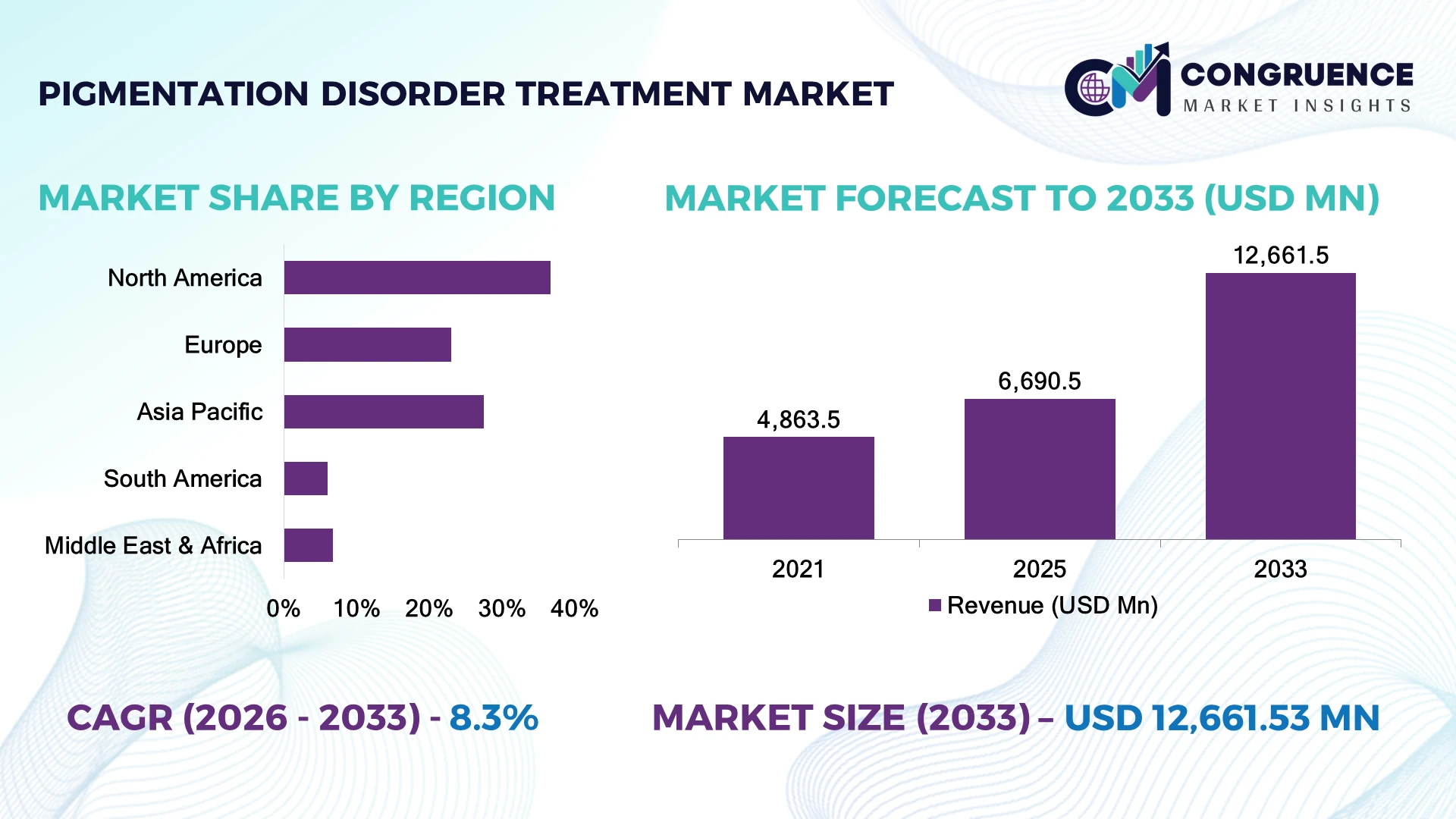
The Global Pigmentation Disorder Treatment Market was valued at USD 6,690.5 Million in 2025 and is anticipated to reach a value of USD 12,661.5 Million by 2033 expanding at a CAGR of 8.3% between 2026 and 2033. Growth is being driven by wider adoption of targeted dermatology therapies, rising diagnosis of melasma and vitiligo, and the shift toward non-invasive laser, light-based, and prescription topical treatments.
The United States remains the dominant country market, representing roughly 31–36% of global demand, supported by advanced dermatology infrastructure, high specialist density, and rapid uptake of prescription therapies. Asia-Pacific is expanding faster, with adoption growing around 7–8%, particularly across China, India, Japan, and South Korea. The 2026 U.S. dermatology landscape increasingly reflects targeted treatment adoption following regulatory acceptance of topical JAK inhibition for vitiligo.
Strategically, investment is shifting toward targeted therapies, precision diagnosis, and scalable treatment platforms that combine medical efficacy with differentiated patient outcomes.
Market Size & Growth: The market reaches USD 6,690.5 million in 2025 and USD 12,661.5 million by 2033 at an 8.3% CAGR, driven by targeted dermatology therapies and wider adoption of advanced non-invasive procedures.
Top Growth Drivers: Targeted pharmacological therapies contribute approximately 30% of incremental demand, aesthetic dermatology around 25%, and rising diagnosis and treatment access approximately 20%.
Short-Term Forecast: By 2028, digital dermatology screening and treatment-monitoring workflows are positioned to improve clinical assessment efficiency by approximately 15–20%, reducing repeat diagnostic effort.
Emerging Technologies: AI-assisted lesion assessment, topical JAK inhibitors, fractional laser platforms, and personalized combination protocols are reshaping treatment selection for vitiligo, melasma, and post-inflammatory hyperpigmentation.
Regional Leaders: North America is projected near USD 4.5 billion, Europe around USD 2.7 billion, and Asia-Pacific approximately USD 3.5 billion by 2033, with Asia-Pacific showing stronger expansion in aesthetic and dermatology-clinic adoption.
Consumer/End-User Trends: Dermatology clinics account for approximately 44% of market activity, while home-use and digitally enabled treatment channels are gaining traction as consumers seek fewer clinic visits and personalized regimens.
Pilot/Case Example: In 2022, topical ruxolitinib became the first FDA-approved pharmacological treatment addressing repigmentation in nonsegmental vitiligo for patients aged 12 and older, establishing a targeted-treatment pathway.
Competitive Landscape: Leading companies collectively hold an estimated 25–30% of the market, with Galderma, Incyte, L’Oréal, Pierre Fabre, Merz, and specialist dermatology brands competing across pharmaceuticals, devices, and professional skincare.
Regulatory & ESG Impact: Regulatory preference for evidence-backed targeted treatments is increasing product-development requirements, while non-invasive therapies can reduce procedure-related material consumption by approximately 10–15% versus more resource-intensive interventions.
Investment & Funding: Pharmaceutical and dermatology-device investment is increasingly concentrated in targeted therapies, clinical-stage pipelines, and AI-enabled diagnostics, with strategic partnerships representing a growing share of innovation activity.
Innovation & Future Outlook: By 2028, personalized treatment algorithms, combination pharmacological-device protocols, advanced laser systems, and digitally monitored care will shift competition toward measurable treatment outcomes and patient retention.
Demand is concentrated across dermatology clinics, hospitals, aesthetic centers, and increasingly digital and home-care channels, with topical products remaining a major first-line modality. Targeted JAK inhibitors, advanced laser systems, AI-assisted diagnosis, and combination therapies are reshaping treatment pathways. Asia-Pacific is recording roughly 7–8% adoption growth as medical-aesthetic infrastructure expands, while regulatory scrutiny continues to favor clinically validated formulations, supporting a shift toward evidence-led product portfolios and integrated care models.
Pigmentation disorder treatment is becoming strategically important because competition is moving beyond conventional topical formulations toward targeted pharmacology, energy-based procedures, personalized regimens, and digitally supported dermatology. Vitiligo represented 33.21% of the market by disorder type in 2025 in one recent industry assessment, while dermatology clinics represented 44.12% of end-user activity, highlighting the importance of specialist-led treatment pathways.
The principal market shift is toward precision treatment. Topical JAK inhibition provides a targeted alternative to older broad-spectrum approaches, while AI-supported assessment can shorten diagnostic workflows by approximately 15–20%. Advanced laser platforms are also being optimized for diverse skin tones, improving treatment personalization and reducing reliance on generalized protocols. North America maintains stronger early adoption of innovative therapies, whereas India, China, South Korea, and Japan are expanding procedure capacity and consumer access.
Over the next 2–3 years, companies will prioritize targeted drug pipelines, combination treatment platforms, AI-enabled clinical workflows, and specialist partnerships. Manufacturers and pharmaceutical developers that integrate therapeutic efficacy, patient monitoring, and scalable distribution will gain stronger positioning. The decisive advantage will come from measurable outcomes, regulatory readiness, and treatment personalization rather than product breadth alone.
Targeted therapies are strengthening treatment demand as clinicians shift from broad topical regimens toward indication-specific pharmacological and combination approaches. Vitiligo represented approximately 33% of disorder-specific demand in 2025, while specialist dermatology clinics accounted for more than 44% of end-user activity. In the United States, FDA-approved topical JAK inhibition has accelerated acceptance of targeted repigmentation therapy and strengthened investment in differentiated pipelines. Companies are responding by expanding clinical programs, partnering with dermatology specialists, and combining pharmacological treatments with light-based procedures. The non-obvious advantage is improved treatment segmentation: manufacturers can address distinct disease phenotypes and severity levels rather than competing solely on formulation efficacy, strengthening pricing power and specialist adoption.
Pigmentation treatment development faces tighter evidence requirements, particularly for long-term safety, recurrence control, skin-tone applicability, and combination treatment outcomes. Clinical programs for novel dermatology therapies can require patient populations extending across multiple severity categories, while formulation and device qualification can increase development timelines by approximately 15–25%. In India and China, fragmented treatment access also limits consistent adoption of advanced prescription therapies outside major urban dermatology centers. Supply-chain variability for active pharmaceutical ingredients and specialized device components adds further operational pressure. Companies are reducing exposure through diversified ingredient sourcing, regional manufacturing, staged clinical programs, and established distribution partnerships. A key restraint is therefore not patient demand but the cost of converting promising pigmentation technologies into broadly approved, consistently supplied treatment products.
AI-assisted dermatological assessment is opening a differentiated opportunity by improving lesion classification, treatment selection, and longitudinal monitoring. Digital imaging platforms can reduce preliminary assessment time by approximately 20–30%, while standardized image analysis can improve treatment documentation consistency by 15–20%. India and Southeast Asia present particularly attractive opportunities as teledermatology and smartphone-based imaging extend specialist access beyond major cities. The next opportunity is integrating AI assessment with treatment-response tracking rather than using algorithms solely for diagnosis. Companies are investing in clinical decision-support platforms, imaging partnerships, and connected patient-management systems. This model creates recurring value through monitoring and treatment optimization, giving technology providers and dermatology companies an opportunity to participate in care delivery rather than relying exclusively on one-time product sales.
Pigmentation disorders remain difficult to standardize because treatment response varies by skin phototype, disease severity, lesion location, adherence, and recurrence patterns. Protocol variability can increase treatment-cycle requirements by approximately 15–25%, while inconsistent imaging conditions can introduce 10–20% variation into longitudinal visual assessments. This creates execution challenges for multinational providers attempting to replicate treatment protocols across the United States, India, China, and other markets. AI-enabled workflows also require standardized datasets and clinician validation before integration into routine care. Companies must therefore invest in diverse clinical datasets, interoperable imaging systems, clinician training, and quality-controlled treatment protocols. The strategic challenge is achieving reproducible outcomes across different patient populations without over-automating decisions that still require specialist judgment.
Combination Protocols Gain Clinical Traction: Dermatology practices are increasingly combining topical therapies with phototherapy or laser procedures, particularly for persistent or treatment-resistant pigmentation. Combination approaches now feature in an estimated 25–35% of advanced clinical treatment plans, improving treatment personalization while reducing dependence on a single modality. Clinics are standardizing protocols and pharmaceutical-device partnerships are becoming more important as providers seek measurable response improvements and stronger patient retention.
Skin-Tone Adaptation Becomes Essential: Laser and light-based systems are increasingly being calibrated for broader Fitzpatrick skin types, addressing safety and efficacy differences that previously constrained procedure utilization. Advanced platforms can reduce treatment-related downtime by approximately 15–20%, while improved parameter controls support more consistent energy delivery. Manufacturers are refining wavelength selection, cooling systems, and pulse management, particularly for practices serving diverse populations in India, the United States, and Southeast Asia.
Digital Follow-Up Reduces Clinic Load: Dermatology providers are expanding smartphone imaging, virtual consultations, and remote treatment monitoring to manage follow-up between physical visits. Digitally supported workflows can reduce routine follow-up visits by approximately 15–25% while improving documentation frequency. The operational shift is particularly relevant where specialist availability is limited. Companies are integrating secure imaging, patient portals, and treatment tracking into dermatology platforms, converting episodic consultations into continuous care workflows.
Evidence-Based Skincare Gains Share: Consumers are increasingly moving toward dermatologist-recommended formulations containing hydroquinone alternatives, retinoids, azelaic acid, tranexamic acid, and antioxidant combinations. Clinically positioned skincare products represent an estimated 30–40% of pigmentation-management purchases in developed markets, strengthening demand for evidence-backed formulations. Regulatory scrutiny of claims is simultaneously increasing, pushing manufacturers toward controlled testing, standardized formulations, and clearer treatment positioning rather than broad cosmetic promises.
Melasma is the leading disorder type, accounting for approximately 35–40% of global pigmentation disorder treatment demand, supported by high treatment frequency, recurrence, and strong dermatology-clinic utilization. Vitiligo follows at roughly 25–30%, benefiting from expanding targeted pharmacological options, while albinism represents a smaller but clinically specialized segment. Post-inflammatory hyperpigmentation (PIH) is the fastest-growing category, supported by rising awareness of acne-related pigmentation and greater demand for corrective dermatology procedures. PIH treatment demand is expanding by approximately 8–10% in high-adoption markets, compared with roughly 5–7% for mature melasma therapies.
Companies are increasingly allocating R&D toward indication-specific combinations, safer pigment-modulating agents, and treatment protocols adapted to different skin phototypes. The strategic priority is shifting from broad pigmentation management toward differentiated disease pathways, particularly where recurrence and treatment adherence create repeat-care opportunities.
A 2026 international survey of 48,000 adults across 34 countries found melasma in 10.9% of respondents, PIH in 14.8%, and vitiligo in 7.1%, confirming the broad clinical burden and commercially relevant treatment pool.
Topical treatment is the leading application, representing approximately 37–40% of pigmentation disorder treatment activity because of accessibility, repeat-use economics, and suitability for melasma, PIH, and localized discoloration. Laser and light-based therapy represents roughly 25–30% and is the fastest-growing application, with demand increasing around 9–12% as picosecond, fractional, and wavelength-selective platforms improve treatment precision. Chemical peels and microdermabrasion remain important complementary applications, particularly within aesthetic clinics, while phototherapy retains a specialized role in vitiligo management.
The competitive shift is toward combination protocols rather than single-modality treatment. Clinics in the United States, India, South Korea, and China are increasingly combining topical maintenance with energy-based procedures to improve response consistency. Device manufacturers are responding with adjustable fluence, cooling systems, and multi-wavelength platforms, while pharmaceutical companies are strengthening topical portfolios. This creates greater recurring treatment value but raises the importance of clinician training and standardized protocols.
The American Academy of Dermatology reports that ruxolitinib cream produced at least 75% facial repigmentation in about 30% of patients at week 24, reinforcing the commercial importance of targeted topical treatment for nonsegmental vitiligo.
Dermatology clinics are the dominant end-user, accounting for approximately 45–50% of treatment activity, supported by specialist diagnosis, prescription management, laser procedures, and recurring follow-up. Hospitals represent roughly 20–25%, concentrating on medically complex vitiligo, extensive pigmentation disorders, and multidisciplinary care. Specialty aesthetic clinics are the fastest-growing end-user group, expanding approximately 9–11% as consumers increasingly seek laser, chemical-peel, and combination procedures. Homecare remains strategically important because topical regimens enable treatment continuity between specialist consultations.
Buying behavior is becoming more technology-oriented. Dermatology clinics increasingly prioritize devices offering adjustable treatment parameters and integrated imaging, while specialty clinics emphasize treatment speed, patient throughput, and visible outcomes. Homecare brands are responding with dermatologist-positioned formulations and digital adherence tools. Companies are therefore segmenting commercial strategies by clinical intensity: premium devices and prescription therapies for specialists, standardized protocols for aesthetic chains, and scalable topical products for broader consumer access.
The American Academy of Dermatology confirms that topical ruxolitinib is applied twice daily and is FDA-approved for nonsegmental vitiligo in patients aged 12 years and older, strengthening the role of specialist-prescribed home treatment within pigmentation care.
North America accounted for the largest market share at 36.7% in 2025 however, Asia-Pacific is expected to register the fastest growth, expanding at a CAGR of 7.5% between 2026 and 2033.
Specialist dermatology is shifting toward combination-led treatment pathways
North America represented approximately 36.7% of the global market in 2025, supported by dense dermatology networks, high prescription penetration, established laser infrastructure, and strong consumer spending on corrective skincare. The United States remains the primary demand center, with treatment increasingly moving toward coordinated topical, energy-based, and maintenance protocols. Dermatology clinics account for the largest concentration of specialist activity, while medical-aesthetic centers are expanding their pigmentation-focused device portfolios. Companies are responding by combining prescription therapies with imaging, laser platforms, and post-procedure skincare rather than positioning individual products independently. This favors suppliers capable of providing complete treatment ecosystems and evidence-backed protocols.
United States Market Outlook: The United States combines the region’s largest specialist-care infrastructure with strong adoption of prescription dermatology and aesthetic technologies. FDA approval of ruxolitinib cream for nonsegmental vitiligo has strengthened the treatment pathway for patients aged 12 years and older, while established reimbursement, private-pay, and specialist channels support broader commercialization.
Regulatory discipline is reshaping formulation and product positioning
Europe maintains a significant position through sophisticated dermatology services, strong cosmetic-science capabilities, and consumer preference for clinically supported skincare. Germany, France, Italy, and the United Kingdom represent important treatment and product-development markets, while stricter ingredient scrutiny is pushing manufacturers toward reformulation and stronger safety documentation. The European regulatory environment increasingly influences pigmentation-product launches beyond the region because companies seeking multinational distribution often standardize formulations around European requirements. In 2025, the European Commission’s Scientific Committee on Consumer Safety issued updated scientific advice affecting cosmetic-ingredient safety assessment, reinforcing the need for evidence-led formulation strategies.
Germany Market Outlook: Germany offers a strong combination of specialist dermatology capacity, regulated pharmaceutical distribution, and research-oriented healthcare infrastructure. Its mature medical ecosystem favors prescription-led pigmentation management and clinically validated procedures over purely cosmetic positioning. Manufacturers targeting Germany increasingly need robust safety documentation, physician-oriented evidence, and clear differentiation between therapeutic and cosmetic claims.
High-volume dermatology demand is accelerating localized treatment innovation
Asia-Pacific is the fastest-growing regional market, supported by high pigmentation prevalence, expanding private dermatology networks, increasing aesthetic awareness, and broader access to laser and topical therapies. China, Japan, South Korea, and India are particularly important because treatment preferences increasingly reflect local skin phototypes and climate-related pigmentation concerns. South Korea continues to influence device-led treatment protocols, while India combines large patient volumes with expanding specialty-clinic infrastructure. Companies are responding through localized formulations, lower-downtime laser platforms, and partnerships with dermatology chains. The strategic opportunity is shifting toward scalable treatment systems that combine physician procedures with affordable maintenance products.
China Market Outlook: China represents the region’s most strategically significant scale opportunity, supported by a large urban dermatology base, sophisticated aesthetic-clinic networks, and strong domestic manufacturing capabilities for skincare and energy-based equipment. Premium clinics increasingly differentiate through imaging-assisted diagnosis and combination protocols, while domestic brands are expanding clinically positioned pigmentation products. This creates opportunities for companies offering localized formulations, device partnerships, and digitally supported patient follow-up.
Brazil-led aesthetic demand is widening access to advanced pigmentation care
South America is led by Brazil, where high consumer engagement with aesthetic dermatology supports demand for topical products, chemical peels, lasers, and combination procedures. The region remains more price-sensitive than North America and Europe, making treatment affordability, physician availability, and distribution coverage important commercial factors. Brazil’s established cosmetic and dermatology ecosystem provides a stronger platform for premium treatment adoption, while Argentina, Colombia, and Chile offer expanding specialist opportunities. Companies are increasingly adapting pack sizes, treatment protocols, and distributor strategies to improve accessibility without diluting clinical positioning. Growth opportunities are strongest where manufacturers can connect specialist procedures with lower-cost maintenance regimens.
Brazil Market Outlook: Brazil provides the region’s strongest commercial base because of its mature aesthetic-medicine ecosystem, large dermatology community, and established consumer acceptance of professional skin treatments. Clinics increasingly combine procedural correction with topical maintenance, creating recurring demand beyond individual procedures. Suppliers with locally adapted formulations, training programs, and clinic partnerships are better positioned to penetrate secondary cities where specialist capacity is expanding.
Premium dermatology infrastructure is driving technology-led adoption
Middle East & Africa is developing through premium dermatology centers, medical-aesthetic investment, and modernization of private healthcare infrastructure. The United Arab Emirates and Saudi Arabia represent the strongest commercial hubs, with Dubai particularly notable for regulated dermatology and non-surgical aesthetic facilities. Dubai’s updated 2025 standards require non-surgical cosmetic services to be delivered through appropriately licensed facilities and establish specific requirements for laser-treatment environments, supporting more standardized deployment. Companies are consequently emphasizing certified devices, trained operators, clinical protocols, and premium combination treatments rather than standalone cosmetic services.
United Arab Emirates Market Outlook: The UAE benefits from concentrated private healthcare investment, medical-tourism activity, and a sophisticated aesthetic-clinic network. Dubai’s health authority maintains detailed licensing requirements for dermatology and non-surgical cosmetic facilities, including laser safety provisions. The regulatory structure favors established suppliers able to provide compliant equipment, operator training, maintenance support, and documented treatment protocols, creating a comparatively attractive environment for premium pigmentation-treatment technologies.
The market pits Incyte and Galderma’s therapeutic dermatology portfolios against L’Oréal, Beiersdorf, Pierre Fabre, and aesthetic-device groups such as Candela and Merz Aesthetics. The top five players are estimated to control about 28–32% collectively, indicating a fragmented structure with strong branded niches.
Competition centers on clinical efficacy, technology, formulation safety, physician access, and economics. Premium device suppliers compete on 15–25% faster procedures and tighter energy control, while topical brands compete through tolerability, evidence, and distribution reach. Companies are expanding through dermatology-clinic partnerships, R&D collaborations, and integrated skincare-plus-treatment portfolios.
The competitive shift is moving from standalone products toward combination protocols linking prescription therapies, imaging, lasers, and maintenance skincare. Incyte benefits from targeted pharmacology; Candela and Merz from device innovation; L’Oréal, Beiersdorf, and Pierre Fabre from consumer scale and formulation expertise. Entry barriers include clinical validation, regulatory approvals, specialist relationships, and capital-intensive device development. Winning requires differentiated evidence, physician adoption, and integrated pathways.
Incyte Corporation
Galderma Group AG
L’Oréal S.A.
Beiersdorf AG
Pierre Fabre Laboratories
Merz Aesthetics
Candela Corporation
Cutera, Inc.
Alma Lasers
ISDIN
Shiseido Company, Limited
Sesderma
Obagi Cosmeceuticals LLC
ZO Skin Health, Inc.
Pigmentation treatment is shifting from conventional lasers and single-agent creams toward picosecond lasers, selective-wavelength IPL, topical JAK inhibitors, and imaging-assisted diagnosis. Picosecond platforms can reduce thermal exposure versus older photothermal lasers, while adaptive cooling and wavelength control improve treatment precision by roughly 15–20%. These technologies are already concentrated in premium dermatology and aesthetic clinics.
AI-assisted skin imaging is emerging as the next workflow layer, combining standardized photography, colorimetry, and lesion tracking. Automated assessment can reduce documentation and comparison time by an estimated 20–30%, while supporting more consistent treatment planning. Adoption remains concentrated among digitally enabled clinics, but integration with electronic records and teledermatology is widening deployment. Companies benefiting most are device OEMs and software-enabled dermatology platforms that can convert imaging data into repeatable protocols.
From 2026 to 2028, combination therapy will matter more than standalone technology. Clinics are increasingly pairing prescription topicals with laser or IPL procedures and maintenance programs. Picosecond and multi-wavelength systems can command pricing where they improve clearance, downtime, or skin-type adaptability. Competitive advantage will shift toward interoperable platforms, clinician training, and longitudinal outcome data rather than hardware. Companies that integrate diagnosis, treatment selection, procedure delivery, and follow-up will be better positioned to capture recurring demand.
August 2024 L’Oréal acquired 10% of Galderma and agreed a scientific partnership covering skin biology, diagnostics, and evaluation. The investment strengthens cross-platform dermatology innovation and links consumer skincare capabilities with clinical treatment development. Source: loreal.com
April 2025 Candela launched Vbeam Pro, combining 595-nm pulsed-dye and 1064-nm Nd:YAG wavelengths. The platform delivered 30% tighter energy control, 20% improved lesion clearance, and 50% faster treatment times, strengthening premium device differentiation. Source: candelamedical.com
February 2025 Incyte received Swissmedic approval for Opzelura in non-segmental vitiligo with facial involvement for patients aged 12 years and older. The decision expanded geographic access to targeted topical treatment and strengthened ruxolitinib’s commercial position. Source: incyte.com
June 2026 EMA’s CHMP issued a positive opinion supporting an Opzelura marketing-authorisation variation for non-segmental vitiligo with facial involvement in adults and adolescents aged 12 years and older. The decision supports continued European treatment access. Source: European Medicines Agency
The report covers pigmentation disorder treatment across major disorder types, treatment modalities, applications, and end-user settings, including melasma, post-inflammatory hyperpigmentation, vitiligo, topical therapies, laser and light-based procedures, chemical peels, dermatology clinics, hospitals, aesthetic centers, and homecare. Geographic coverage spans North America, Europe, Asia-Pacific, South America, and Middle East & Africa, with country-level analysis emphasizing the United States, Germany, China, Brazil, and the United Arab Emirates.
Technology coverage evaluates topical JAK inhibitors, picosecond lasers, IPL, multi-wavelength platforms, AI-assisted imaging, and combination treatment protocols. The report assesses leading companies, competitive positioning, adoption patterns, regulatory influences, and emerging niche opportunities. With specialist clinics representing roughly 45–50% of treatment activity and Asia-Pacific showing the strongest adoption momentum, the analysis supports investment planning, geographic expansion, portfolio prioritization, competitive positioning, and strategic decision-making through 2033.
| Report Attribute/Metric | Report Details |
|---|---|
|
Market Revenue in 2025 |
USD 6,690.5 Million |
|
Market Revenue in 2033 |
USD 12,661.5 Million |
|
CAGR (2026 - 2033) |
8.3% |
|
Base Year |
2025 |
|
Forecast Period |
2026 - 2033 |
|
Historic Period |
2021 - 2025 |
|
Segments Covered |
By Type
By Application
By End-User
|
|
Key Report Deliverable |
Revenue Forecast, Growth Trends, Market Dynamics, Segmental Overview, Regional and Country-wise Analysis, Competition Landscape |
|
Region Covered |
North America, Europe, Asia-Pacific, South America, Middle East, Africa |
|
Key Players Analyzed |
Incyte Corporation, Galderma Group AG, L’Oréal S.A., Beiersdorf AG, Pierre Fabre Laboratories, Merz Aesthetics, Candela Corporation, Cutera, Inc., Alma Lasers, ISDIN, Shiseido Company, Limited, Sesderma, Obagi Cosmeceuticals LLC, ZO Skin Health, Inc. |
|
Customization & Pricing |
Available on Request (10% Customization is Free) |




