
Reports
The Global Piezoelectric Materials Market was valued at USD 147.0 Million in 2025 and is anticipated to reach a value of USD 250.3 Million by 2033 expanding at a CAGR of 6.88% between 2026 and 2033. Growth is driven by rising integration of piezoelectric ceramics in precision sensors, medical ultrasound devices, automotive actuators, and energy-harvesting systems, supported by advances in lead-free materials and miniaturized electronic components.
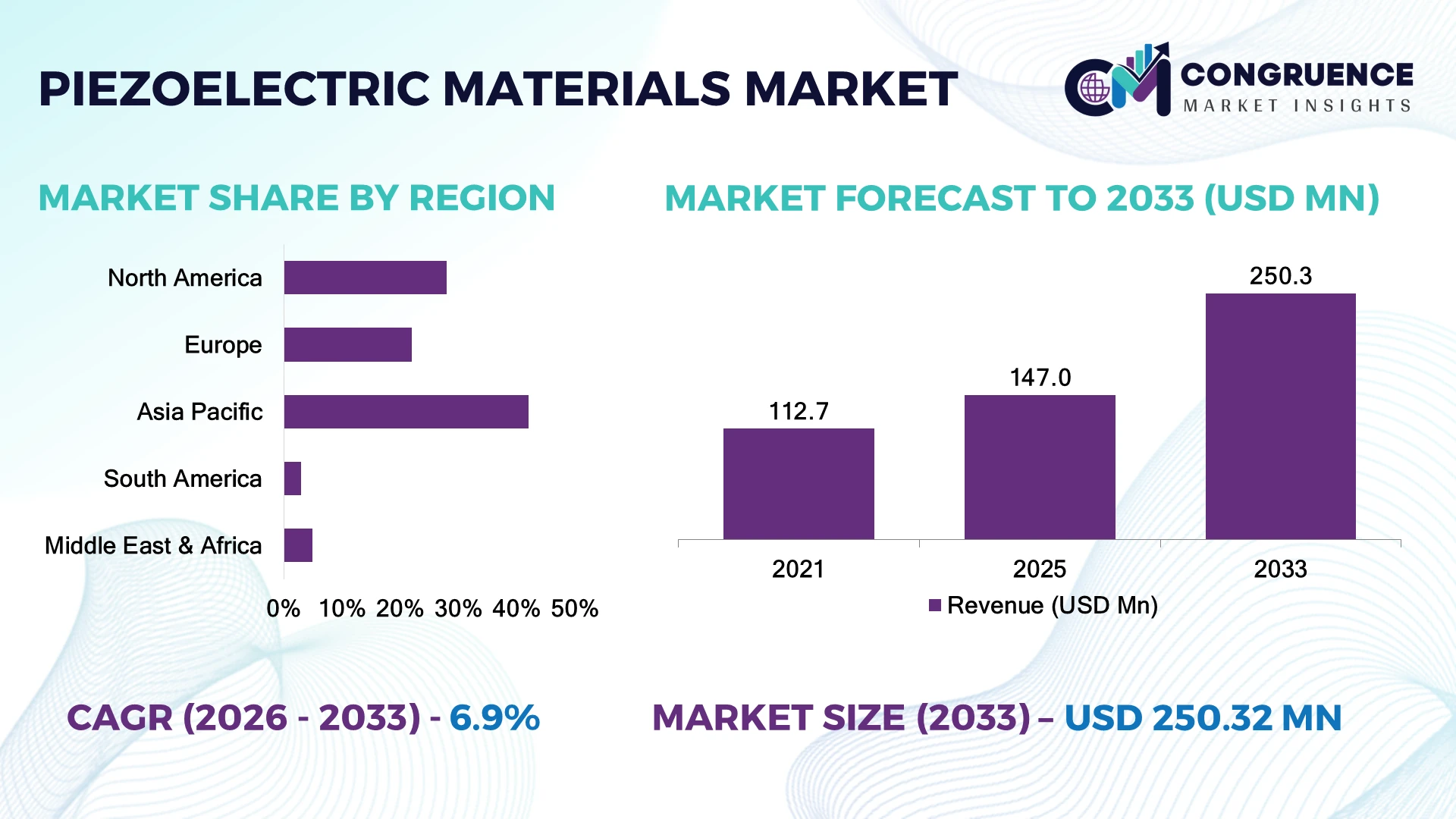
China dominates the market with an estimated 32% share, supported by large-scale investments in semiconductor manufacturing, 5G infrastructure, and industrial automation. Japan contributes nearly 18% through advanced electronics and automotive applications, while the United States maintains strong adoption across aerospace and healthcare sectors with over 25% of global piezoelectric device innovation activity. China’s manufacturing capacity exceeds Japan’s production scale by more than 1.5 times, highlighting supply-chain influence.
Strategic localization of advanced materials and sensor technologies will define competitive advantage.
Market Size & Growth: USD 147.0 Million (2025) to USD 250.3 Million (2033) at 6.88% CAGR, driven by advanced sensor adoption and industrial automation expansion.
Top Growth Drivers: Industrial automation (+35%), medical imaging demand (+28%), automotive sensor integration (+22%).
Short-Term Forecast: By 2028, lead-free piezoelectric material adoption increases by 20%, improving compliance and reducing material dependency.
Emerging Technologies: AI-enabled sensors, smart actuators, nanostructured piezoelectric composites, and IoT-integrated monitoring systems accelerate innovation.
Regional Leaders: China reaches approximately USD 80 Million scale through electronics manufacturing; Japan exceeds USD 45 Million with precision technology adoption; United States approaches USD 40 Million through healthcare and aerospace deployment.
Consumer/End-User Trends: Medical ultrasound and wearable sensing applications record over 30% adoption growth as compact devices gain market acceptance.
Pilot/Case Example: A 2024 industrial vibration-monitoring deployment using piezoelectric sensors achieved nearly 25% predictive maintenance improvement in manufacturing operations.
Competitive Landscape: Key players including CTS Corporation, Murata Manufacturing Co., Ltd., TDK Corporation, APC International, Ltd., and KEMET Corporation compete through material innovation and manufacturing scale.
Regulatory & ESG Impact: Lead-free piezoelectric material development expands by more than 15% as environmental regulations encourage safer alternatives.
Investment & Funding: Over USD 500 Million is directed toward advanced sensor materials, semiconductor partnerships, and smart manufacturing expansion initiatives.
Innovation & Future Outlook: Next-generation flexible piezoelectric films, energy harvesting systems, and AI-connected sensors are reshaping industrial applications and long-term competitiveness.
Piezoelectric materials are becoming essential across healthcare diagnostics, automotive electronics, industrial monitoring, and consumer devices due to their ability to convert mechanical energy into electrical signals. Recent innovations in multilayer ceramics, flexible polymers, and miniaturized transducers are expanding applications, with sensor-based deployments growing by approximately 30%. Supply-chain diversification following global semiconductor disruptions is encouraging manufacturers to develop localized material production capabilities, creating new opportunities across advanced electronics ecosystems.
The Piezoelectric Materials Market is becoming strategically important as industries shift toward intelligent sensing, automation, and compact electronic systems requiring high-precision energy conversion technologies. Automotive electrification, medical device modernization, and smart factory deployment are increasing reliance on advanced piezoelectric components, while supply-chain restructuring is encouraging manufacturers to secure regional material sources and reduce dependence on concentrated suppliers.
Technology advancement is creating measurable advantages over traditional sensing solutions. Modern multilayer piezoelectric sensors deliver approximately 20–30% higher sensitivity and improved miniaturization compared with conventional mechanical sensing components, enabling faster deployment in industrial and healthcare environments. Germany and Japan emphasize high-value precision applications, while China focuses on large-scale manufacturing capacity and cost-efficient production.
Over the next 2–3 years, manufacturers are prioritizing partnerships in semiconductor integration, flexible electronics, and lead-free material development. Companies are expanding production facilities and investing in research collaborations to address automotive vibration monitoring, wearable healthcare devices, and industrial predictive maintenance. Strategic positioning will depend on combining material innovation, supply resilience, and application-specific engineering capabilities.
The primary growth driver is the rapid adoption of piezoelectric sensors in industrial automation, healthcare diagnostics, and automotive systems. Industrial IoT deployments have increased sensor integration by more than 35%, while medical imaging equipment demand continues expanding through advanced ultrasound technologies. China’s smart manufacturing initiatives and Japan’s robotics ecosystem are accelerating adoption of high-performance piezoelectric components. Companies are responding through investments in multilayer ceramic production, strategic partnerships, and R&D programs focused on miniaturized sensors. The shift toward predictive maintenance is creating operational advantages by reducing equipment downtime and improving monitoring accuracy across manufacturing facilities.
Cost volatility in specialized ceramics and dependence on limited raw material suppliers remain major barriers. Lead zirconate titanate (PZT) materials account for more than 60% of commercial piezoelectric applications but face regulatory pressure due to lead content concerns. Supply-chain disruptions have increased material procurement costs by approximately 15–20% in some manufacturing segments. Companies in South Korea and Europe are reducing exposure through supplier diversification, alternative material research, and localized production strategies. The challenge directly impacts scalability, particularly for small manufacturers requiring stable pricing and reliable access to advanced piezoelectric materials.
Emerging opportunities are centered on flexible piezoelectric polymers, environmentally compliant ceramics, and energy-harvesting technologies. Lead-free material research has expanded by more than 25% as industries seek sustainable alternatives for electronic components. Wearable healthcare devices and self-powered sensors represent high-potential application areas, particularly in the United States and South Korea. Companies are increasing R&D spending and forming university-industry partnerships to commercialize next-generation materials. The development of flexible piezoelectric films offers a strategic opportunity to enter untapped markets such as smart textiles, structural monitoring, and low-power IoT devices.
Large-scale production of next-generation piezoelectric materials remains challenging due to manufacturing complexity, quality control requirements, and integration limitations. Advanced piezoelectric composites require precise processing conditions, with production yield variations reaching nearly 10–15% in early commercialization stages. Semiconductor and electronics manufacturers face pressure to maintain consistent performance while reducing manufacturing costs. Companies must strengthen automation capabilities, improve material testing infrastructure, and develop specialized workforce expertise. Long-term competitiveness will depend on achieving scalable production without compromising reliability, especially as demand increases for high-frequency sensors and precision electronic components.
Flexible Material Adoption Surge: Flexible piezoelectric films and polymer-based materials are gaining traction as manufacturers shift toward lightweight electronics, wearable devices, and compact sensors. Adoption of flexible materials has increased by approximately 25%, while research investments in lead-free alternatives have expanded by nearly 20%. Companies are scaling advanced material production and partnering with electronics manufacturers to improve durability, reduce manufacturing complexity, and address environmental compliance requirements.
Smart Sensor Integration Growth: Industrial enterprises are accelerating deployment of piezoelectric sensing systems for predictive maintenance, robotics, and automated quality control. Sensor-based monitoring adoption has increased by around 30%, reducing equipment inspection cycles by nearly 15%. Manufacturing hubs in Germany, Japan, and China are integrating these systems into smart factories, while companies are investing in AI-enabled analytics platforms and connected sensor networks to improve operational efficiency.
Lead-Free Technology Transition: Regulatory pressure on hazardous materials is reshaping material development strategies, particularly in Europe and Japan. Lead-free piezoelectric research activity has grown by more than 25%, with manufacturers testing alternatives such as potassium sodium niobate and bismuth-based ceramics. Companies are restructuring supply chains and expanding R&D partnerships to meet sustainability requirements while maintaining performance standards.
Miniaturized Device Engineering: Electronics manufacturers are prioritizing smaller, higher-performance piezoelectric components for medical devices, automotive systems, and IoT applications. Component miniaturization has improved by nearly 20%, enabling integration into compact diagnostic equipment and smart devices. Companies are adopting automated manufacturing processes and precision fabrication techniques to improve production consistency and capture emerging high-value applications.
Ceramic piezoelectric materials remain the leading segment, accounting for approximately 65% of the market share due to their high electromechanical coupling efficiency, durability, and extensive use in industrial sensors, actuators, and medical ultrasound equipment. Lead zirconate titanate (PZT)-based ceramics continue dominating commercial applications, with more than 60% adoption across traditional piezoelectric device manufacturing. Their established supply chains and cost advantages allow manufacturers to maintain large-scale production. Polymer-based and composite piezoelectric materials represent the fastest-growing segment, expanding adoption by nearly 25% as industries demand flexible, lightweight, and wearable sensing solutions. Companies are increasing investments in nanocomposites, flexible films, and environmentally compliant materials to support next-generation electronics. Single crystals and other advanced materials remain niche segments but are gaining importance in high-frequency medical imaging and precision aerospace applications. Investment priorities are shifting toward materials that combine sustainability, flexibility, and improved performance.
Sensors represent the largest application segment, contributing approximately 45% market share, supported by widespread deployment in industrial automation, automotive monitoring, healthcare equipment, and consumer electronics. Demand concentration is driven by the need for accurate vibration detection, pressure measurement, and real-time condition monitoring. Industrial enterprises have increased smart sensor adoption by nearly 30%, improving predictive maintenance capabilities and reducing operational interruptions. Energy harvesting and actuator applications are emerging as the fastest-growing categories, supported by increasing interest in self-powered electronics and automated systems. Energy harvesting deployments are expanding by approximately 20% as companies explore low-power IoT solutions. Medical ultrasound, acoustic devices, and other specialized applications continue providing stable demand, particularly in Japan, the United States, and Germany. Companies are strengthening application-specific partnerships, integrating piezoelectric technologies with digital platforms, and expanding production capabilities to support industrial automation and healthcare modernization.
The industrial sector is the leading end-user segment, accounting for approximately 40% market share, driven by extensive use of piezoelectric materials in manufacturing automation, process monitoring, and equipment control systems. Industrial facilities rely on these components for operational reliability, with smart factory deployments increasing by nearly 30% in major manufacturing economies such as China, Germany, and Japan. Companies are prioritizing sensor integration to improve productivity and reduce maintenance costs. Healthcare is the fastest-growing end-user category, supported by rising adoption of advanced diagnostic equipment and compact medical devices. Healthcare applications are expanding by approximately 22% as hospitals and device manufacturers invest in improved imaging and monitoring technologies. Automotive, aerospace, consumer electronics, and research institutions continue adopting piezoelectric materials for specialized applications. Companies are responding through customized solutions, strategic partnerships with equipment manufacturers, and expanded production capabilities focused on high-performance components. Future demand is shifting toward industries requiring precision, automation, and sustainable electronic technologies.
Asia-Pacific accounted for the largest market share at 42% in 2025 however, North America is expected to register the fastest growth, expanding at a CAGR of 7.5% between 2026 and 2033.
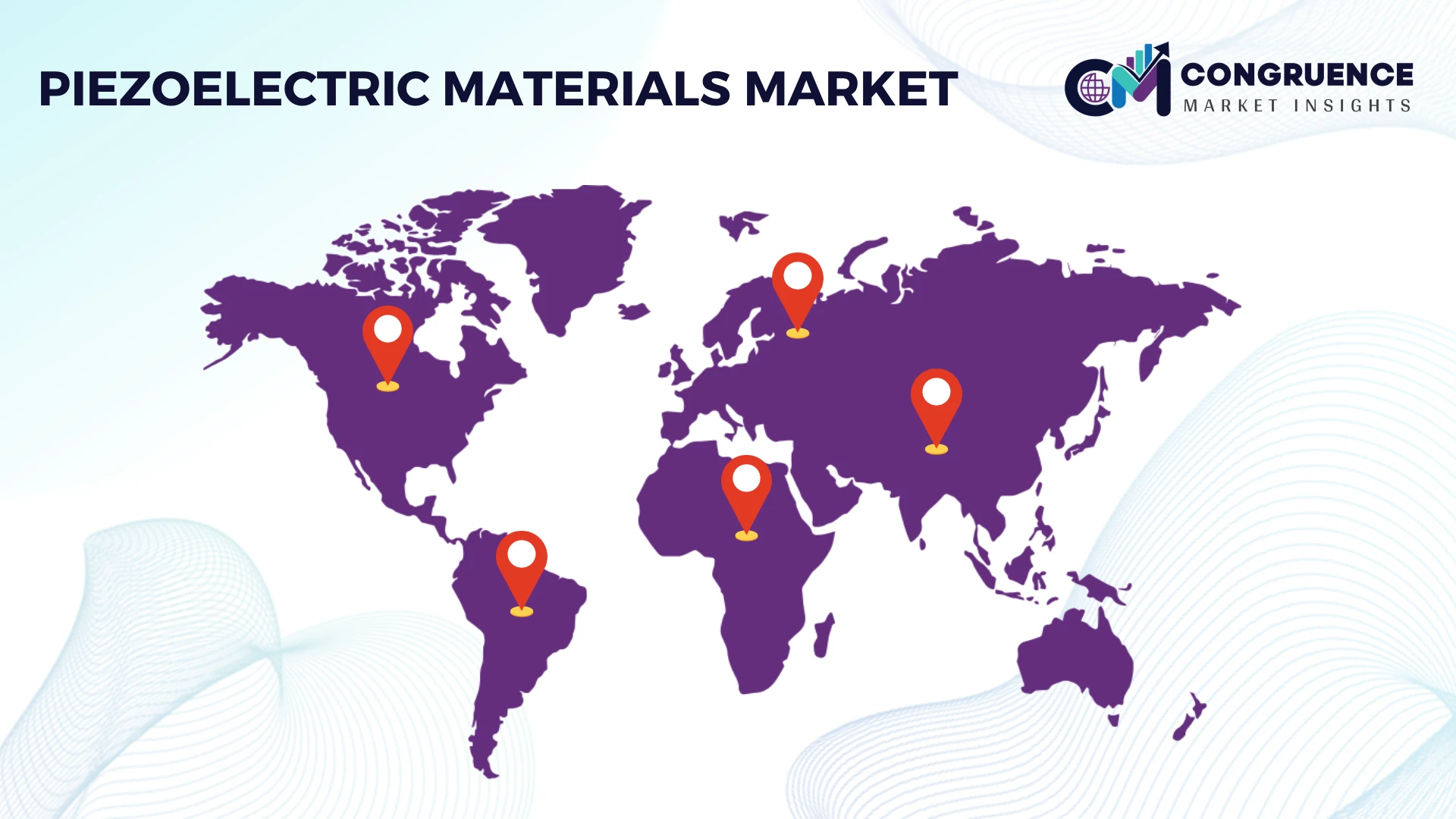
North America represents approximately 28% of the global piezoelectric materials market, supported by strong demand from aerospace, healthcare equipment, automotive electronics, and industrial automation sectors. The United States drives regional adoption through advanced manufacturing capabilities, semiconductor ecosystems, and investments in smart sensing infrastructure. More than 35% of newly deployed industrial monitoring systems in major manufacturing facilities incorporate advanced sensor technologies, increasing demand for high-performance piezoelectric components. Partnerships between electronics manufacturers and research institutions are accelerating development of flexible materials and energy-efficient sensing solutions. Companies are expanding domestic production capabilities to reduce supply-chain dependency and strengthen access to critical electronic materials.
United States Market Outlook: The United States remains the key contributor within North America due to its strong aerospace, medical technology, and semiconductor industries. The country accounts for nearly 75% of regional demand, with significant deployment of piezoelectric sensors in healthcare imaging, defense systems, and industrial automation. Growing investments in domestic electronics manufacturing are encouraging companies to localize advanced material production and develop next-generation sensor platforms.
Europe holds approximately 22% of the global piezoelectric materials market, driven by automotive electrification, industrial automation, and strict environmental regulations supporting advanced material development. Germany, France, and the United Kingdom are leading adoption through precision engineering and smart manufacturing initiatives. European manufacturers are increasingly focusing on lead-free piezoelectric alternatives, with research activity in sustainable materials increasing by nearly 25%. Regulatory frameworks encouraging reduced hazardous substance usage are accelerating technology transition across electronics industries. Companies are investing in localized supply networks, advanced ceramics production, and strategic collaborations to improve material availability and sustainability performance.
Germany Market Outlook: Germany leads Europe’s piezoelectric materials adoption through its automotive manufacturing base, industrial robotics sector, and Industry 4.0 initiatives. The country contributes nearly 40% of European industrial sensor demand, with manufacturers integrating piezoelectric components into automation systems, vehicle technologies, and precision equipment. Companies are strengthening partnerships with research institutes to improve material efficiency and production scalability.
Asia-Pacific dominates the global piezoelectric materials market with approximately 42% share due to large-scale electronics manufacturing, semiconductor production, and automotive component ecosystems. China, Japan, South Korea, and Taiwan represent major production centers, supporting high-volume manufacturing of ceramics, sensors, and electronic components. China contributes nearly 32% of global demand through extensive industrial automation deployment and consumer electronics production. Regional manufacturers are increasing investments in advanced material facilities and automation capabilities, with electronics production capacity expanding significantly across domestic supply chains. Companies are leveraging regional manufacturing advantages to improve cost efficiency and strengthen global component exports.
China Market Outlook: China is the leading country within Asia-Pacific due to its extensive electronics manufacturing infrastructure and industrial automation expansion. The country accounts for more than 30% of global piezoelectric component consumption, supported by semiconductor, automotive, and consumer electronics industries. Government-backed advanced manufacturing initiatives are encouraging domestic companies to expand production capacity and reduce dependence on imported materials.
South America represents a developing market for piezoelectric materials, supported by increasing industrial automation, energy infrastructure upgrades, and modernization of manufacturing operations, accounts for approximately 3% of global demand. Brazil and Argentina account for the majority of regional adoption, with demand concentrated in automotive production, mining equipment monitoring, and healthcare applications. Industrial sensor adoption has increased by nearly 15% as companies seek improved operational efficiency and predictive maintenance capabilities. However, limited advanced manufacturing infrastructure and dependence on imported electronic components continue affecting regional scalability. Companies are addressing these constraints through international partnerships, technology transfers, and selective investments in localized assembly capabilities.
Brazil Market Outlook: Brazil leads South America due to its large industrial base, automotive sector, and expanding healthcare infrastructure. The country contributes nearly 55% of regional demand, with piezoelectric technologies increasingly used in industrial monitoring and medical equipment. Partnerships with international technology providers are helping Brazilian manufacturers improve access to advanced sensing solutions and modernize production processes.
The Middle East & Africa market is expanding through infrastructure modernization, industrial automation projects, and investments in advanced healthcare technologies. Adoption remains concentrated in countries such as the United Arab Emirates, Saudi Arabia, and South Africa, where smart infrastructure and industrial transformation programs are increasing demand for precision sensing technologies. Regional adoption accounts for approximately 5% of global demand, with growth supported by energy-sector monitoring, healthcare upgrades, and automation initiatives. Companies are forming technology partnerships and expanding distribution networks to improve access to advanced electronic materials. Infrastructure investment programs are creating new opportunities for piezoelectric sensor deployment.
United Arab Emirates Market Outlook: The United Arab Emirates represents a strategically important market due to smart city development, advanced infrastructure projects, and technology-driven industrial initiatives. The country is increasing adoption of intelligent monitoring systems across construction, energy, and healthcare sectors. Investments in automation and digital infrastructure are encouraging companies to introduce advanced sensing technologies and strengthen regional technology ecosystems.
The Piezoelectric Materials Market features competition between global material specialists, electronic component manufacturers, and regional ceramic suppliers. Leading players such as Murata, TDK, CTS Corporation, and KEMET compete against specialized producers including APC International and PI Ceramic through technology leadership, customization, and supply reliability. The top five companies collectively account for approximately 45% of market share, reflecting a moderately consolidated structure. Competition is driven by advanced material performance, with manufacturers improving sensor sensitivity by 15–25% and reducing component size by nearly 20%. Global leaders are expanding production facilities, forming automotive and medical technology partnerships, and investing in lead-free materials. Regional suppliers compete through cost efficiency and faster customization cycles. The competitive landscape is shifting toward sustainable materials, flexible piezoelectric solutions, and localized supply chains. High manufacturing expertise and material innovation create major entry barriers. Winning requires superior technology, reliable supply networks, and application-focused solutions.
Advanced ceramic piezoelectric materials remain the foundation technology, but manufacturers are shifting toward lead-free ceramics, polymer composites, and flexible piezoelectric films. Lead-free materials improve environmental compliance by reducing hazardous substance dependency, while flexible materials increase application adaptability by nearly 25% in wearable electronics and compact sensors. Companies benefiting most are those combining material science with precision manufacturing capabilities.
Smart sensor integration is becoming a major technology transition, with AI-enabled monitoring systems improving predictive maintenance accuracy by approximately 20% compared with conventional inspection methods. Modern multilayer piezoelectric sensors provide nearly 30% higher sensitivity and improved miniaturization compared with older single-layer designs. Automotive, healthcare, and industrial automation companies are adopting these technologies to improve efficiency and reduce operational downtime.
Between 2026 and 2028, disruptive developments will focus on self-powered sensors, nanostructured composites, and IoT-connected piezoelectric systems. Energy harvesting solutions are gaining adoption in low-power applications, reducing battery dependency by around 15%. Companies investing in flexible electronics, advanced manufacturing automation, and material innovation will gain competitive advantages through faster deployment, lower lifecycle costs, and broader application penetration.
February 2025 CeramTec GmbH introduced developments in lead-free piezoceramic materials for medical sensors and devices, focusing on BNT-BT technology as an alternative to traditional lead-based PZT ceramics. The innovation supports regulatory compliance and sustainable medical component development. Source: www.ceramtec-group.com
April 2025 CTS Corporation showcased advanced piezoelectric solutions at Ocean Business 2025, including single crystal, ceramic, and piezocomposite materials for sonar and underwater systems. The company highlighted expanded application capability across marine technologies with multiple material platforms. Source: www.ctscorp.com
October 2025 Murata Manufacturing Co., Ltd. advanced its Picoleaf™ piezoelectric film sensor ecosystem through collaboration-focused technology development for noise-resistant voice input applications. The solution uses vibration sensing technology to improve voice capture reliability in challenging environments and supports next-generation human-machine interfaces. Source: www.collaboration.murata.com
May 2025 CTS Corporation presented new research on piezoelectric single crystals and advanced material formulations at IWATMD 2025. The research focused on improving crystal quality, production efficiency, and application performance for medical ultrasound and acoustic transduction systems.
The Piezoelectric Materials Market Report covers comprehensive analysis across material types, applications, end-users, regional markets, and emerging technology segments. The study evaluates ceramic materials, polymer-based materials, composites, and advanced piezoelectric solutions used in sensors, actuators, medical devices, industrial automation, automotive systems, and energy harvesting applications.
The report provides strategic insights across North America, Europe, Asia-Pacific, South America, and Middle East & Africa, highlighting manufacturing concentration, adoption patterns, technology shifts, and competitive positioning. Coverage includes analysis of leading companies, innovation strategies, supply-chain developments, and niche opportunities such as flexible electronics and lead-free materials. The report supports investment decisions, expansion planning, partnership evaluation, and long-term positioning by identifying high-potential applications and evolving industry priorities through 2026–2033.
| Report Attribute / Metric | Details |
|---|---|
| Market Revenue (2025) | USD 147.0 Million |
| Market Revenue (2033) | USD 250.3 Million |
| CAGR (2026–2033) | 6.88% |
| Base Year | 2025 |
| Forecast Period | 2026–2033 |
| Historic Period | 2021–2025 |
| Segments Covered |
By Type
By Application
By End-User
|
| Key Deliverables | Revenue Forecast; Market Trends; Growth Drivers & Restraints; Technology Insights; Segmentation Analysis; Regional Insights; Competitive Landscape; Regulatory & ESG Overview; Recent Developments |
| Regions Covered | North America; Europe; Asia-Pacific; South America; Middle East & Africa |
| Companies Profiled | Murata Manufacturing Co., Ltd.; TDK Corporation; CTS Corporation; KEMET Corporation; APC International, Ltd.; PI Ceramic GmbH; Kyocera Corporation; CeramTec GmbH; Sparkler Ceramics Pvt. Ltd.; Meggitt PLC; Physik Instrumente (PI) SE; Sensor Technology Ltd. |
| Customization & Pricing | Available on Request (10% Customization Free) |




