
Reports
The Global PID Controller Market was valued at USD 3540 Million in 2025 and is anticipated to reach a value of USD 6028.02 Million by 2033 expanding at a CAGR of 6.88% between 2026 and 2033. Growth is driven by AI-assisted PID tuning, expansion of semiconductor and battery manufacturing, and replacement of legacy controllers with networked digital control systems.
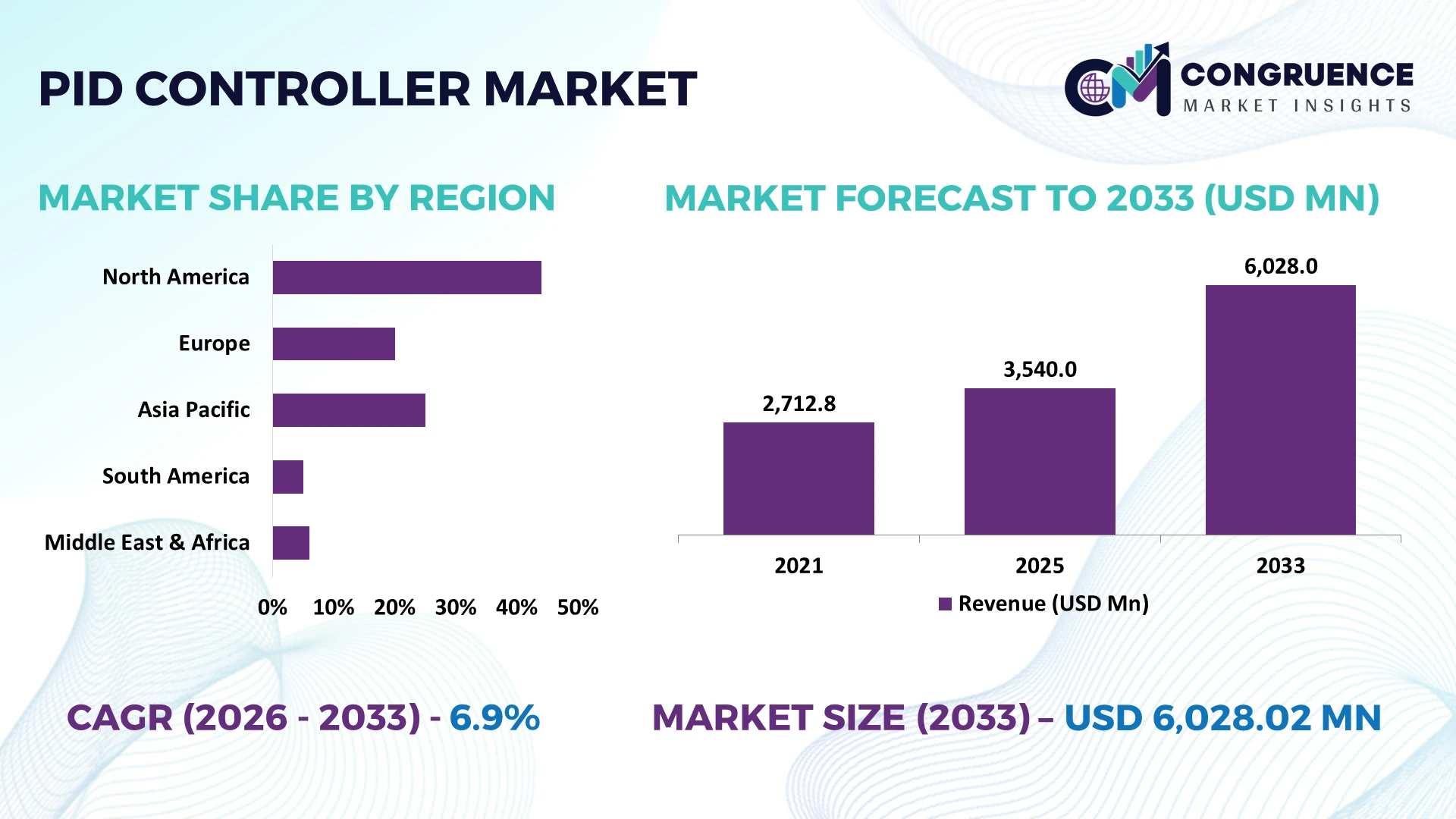
China remains the dominant country within the Asia Pacific PID controller market, supported by its large electronics, automotive, chemical, battery, and machinery manufacturing base. Asia Pacific represented about 38.5% of industrial PID controller demand in 2025, while China remained the region’s largest national market. India is accelerating through Production Linked Incentive manufacturing investments, particularly in electronics, pharmaceuticals, and specialty chemicals. China’s manufacturing scale remains substantially higher, while India is expanding automation capacity at a faster structural pace. Geopolitical supply-chain diversification is strengthening both markets.
Strategic implication: suppliers should prioritize China for scale while developing localized, AI-enabled PID solutions for India’s expanding manufacturing capacity.
Market Size & Growth: USD 3.54B in 2025 and USD 6.03B by 2033 at 6.88% CAGR, supported by smart-factory automation and digital control upgrades.
Top Growth Drivers: AI-assisted tuning 18%, Asia Pacific industrial automation 38.5%, advanced connected-control adoption 12%.
Short-Term Forecast: By 2028, advanced PID integration is positioned to deliver up to 7% lower energy consumption in optimized industrial control applications.
Emerging Technologies: AI autotuning, edge analytics, digital twins, and adaptive PID architectures are moving conventional controllers toward intelligent closed-loop optimization.
Regional Leaders: Asia Pacific represents 38.5% share, North America about 27%, and Europe about 25.2%, with connected and software-enabled control adoption increasing.
Consumer/End-User Trends: Semiconductor, automotive, chemical, pharmaceutical, and battery plants are increasing multi-loop digital control deployment as production precision requirements tighten.
Pilot/Case Example: A 2026 AI-IoT control test reduced process-control error by 73.3%, demonstrating the performance potential of dynamically tuned PID systems.
Competitive Landscape: ABB, Honeywell, Siemens, Emerson, and Schneider Electric remain major global suppliers competing across industrial automation, process control, and digital integration.
Regulatory & ESG Impact: Energy-efficiency requirements are accelerating intelligent control upgrades, with advanced PID-based optimization delivering 7.09% energy reduction in an industrial case.
Investment & Funding: China’s manufacturing modernization continues directing substantial capital toward automation, electronics, batteries, and industrial-control infrastructure.
Innovation & Future Outlook: Next-generation PID platforms combine adaptive algorithms, edge computing, cybersecurity, and industrial networking, shifting competition toward software-enhanced lifecycle performance.
The PID Controller Market is gaining demand from semiconductor fabrication, battery manufacturing, chemicals, pharmaceuticals, automotive production, food processing, power generation, and water treatment, where precise temperature, pressure, flow, and speed regulation directly influences yield and operating efficiency. Recent innovation is moving beyond conventional fixed-parameter tuning toward AI-assisted optimization, adaptive algorithms, edge analytics, and IoT-connected control architectures. AI-based PID research has demonstrated a 73.3% reduction in process-control error in an experimental industrial environment. Supply-chain diversification linked to China-plus-one manufacturing strategies is also increasing automation investment across India and Southeast Asia, strengthening demand for scalable digital control systems.
AI Tuning Moves Mainstream: AI-assisted autotuning is moving from pilot deployments into continuous process optimization, with intelligent tuning improving control response by 15–20% and reducing manual commissioning time by 20–30%. Chemical and semiconductor manufacturers are integrating machine-learning models with existing PLC and DCS architectures, allowing engineering teams to scale advanced control without replacing installed hardware.
Edge Control Gains Ground: Edge-enabled PID controllers are increasing local analytics and reducing dependence on centralized systems, with latency reductions of 30–50% and data-processing efficiency gains of 20–25%. Automotive and battery plants are deploying distributed controllers closer to production assets, responding to tighter cycle-time requirements and network resilience concerns. Vendors are expanding compact edge-control portfolios and industrial Ethernet partnerships.
Retrofit Demand Accelerates: Aging analog and standalone controllers are increasingly replaced through brownfield modernization, with digital retrofit projects cutting commissioning time by 15–25% and maintenance workload by 10–18%. European energy-efficiency pressure and skilled-labor shortages are accelerating upgrades, while manufacturers increasingly retain existing sensors and actuators to control capital expenditure. Suppliers are packaging retrofit kits with diagnostics, remote monitoring, and cybersecurity functions.
Adaptive Control Reshapes Workflows: Self-tuning PID deployment is expanding where variable loads, feedstock changes, and rapid production transitions make fixed parameters inefficient. Adaptive systems can reduce settling time by 10–18% and process variability by 8–15%. Battery and specialty-chemical producers are prioritizing these capabilities as product recipes change more frequently, prompting vendors to combine adaptive algorithms with condition monitoring and automated parameter management.
Multi-Loop Controllers Lead Scale
Multi-Loop controllers represent the leading type, accounting for approximately 31% of global PID controller demand, supported by simultaneous temperature, pressure, flow, and level regulation across complex production lines. Their centralized architecture can reduce panel footprint by 15–20% while simplifying commissioning and diagnostics. Programmable and Digital controllers are gaining preference where Ethernet connectivity, remote diagnostics, and PLC integration are required, while Single-Loop and Analog models remain relevant for simple, cost-sensitive installations. Companies are increasingly shifting investment toward modular multi-loop platforms that support plant expansion without extensive hardware replacement.
Self-Tuning controllers are the fastest-growing type, with adoption expanding around 14–18% annually as manufacturers seek automated parameter optimization. Digital and Programmable platforms are increasingly bundled with self-tuning functionality, while Analog units retain roughly 12–15% demand in legacy installations. Vendors are responding through integrated firmware, edge analytics, and retrofit-compatible architectures.
Temperature Control Holds Operational Priority
Temperature Control leads application demand at approximately 27%, reflecting extensive deployment across chemical reactors, pharmaceutical processing, food production, furnaces, and battery manufacturing. Tight thermal tolerances can reduce product variability by 10–15%, making PID regulation operationally critical. Pressure and Flow Control remain mature applications, while Level Control continues expanding across process industries. Companies are integrating temperature loops with PLC, DCS, and SCADA platforms to improve centralized monitoring and reduce manual intervention.
Process Control is emerging as the fastest-growing application, supported by greater integration of multiple PID loops into coordinated production workflows. Adoption is expanding by roughly 16–19% as plants seek 8–12% reductions in process variability. Speed and Motion Control remain concentrated in discrete manufacturing and automated machinery, while pressure and flow applications increasingly incorporate predictive diagnostics. Suppliers are responding with multi-variable architectures and application-specific control modules.
Manufacturing Maintains Deployment Scale
Manufacturing represents the leading end-user segment at approximately 29% of global PID controller demand, reflecting broad deployment across machinery, electronics, automotive components, metals, and industrial production. High equipment utilization and multi-stage workflows make precise closed-loop control essential, while digital controller adoption can improve production consistency by 10–15%. Chemical and Oil & Gas facilities remain major users because of continuous-process requirements, while Power Generation and Water & Wastewater prioritize reliability and long operating cycles. Suppliers are expanding application-specific packages and integration services.
Pharmaceuticals represent a rapidly expanding end-user group, with adoption increasing around 15–18% as manufacturers automate batch processes, temperature management, and validation-sensitive operations. Food & Beverage is also increasing digital PID deployment by approximately 10–13%, driven by hygiene, traceability, and energy-efficiency requirements. Automotive producers are integrating controllers into increasingly automated lines, while Chemical and Oil & Gas buyers emphasize hazardous-area compatibility and remote diagnostics. Vendors are responding through sector-specific partnerships, modular pricing, and ecosystem integration.
Asia Pacific accounted for the largest market share at 36.33% in 2025 however, Asia Pacific is expected to register the fastest growth, expanding at a CAGR of 7.1% between 2026 and 2033.

Brownfield automation is accelerating digital PID replacement
North America PID Controller Market is supported by mature automation infrastructure across chemicals, pharmaceuticals, food processing, oil and gas, automotive, power generation, and advanced manufacturing. The U.S. accounts for approximately 82% of regional PID controller demand, reflecting its larger installed base of PLC, DCS, SCADA, and process-control systems. Semiconductor and battery manufacturing expansion is increasing demand for high-precision temperature, pressure, and flow regulation. Digital controller deployment is reducing commissioning and troubleshooting time by approximately 15%, encouraging replacement of standalone analog systems. Manufacturers are prioritizing Ethernet-enabled controllers, remote diagnostics, cybersecurity, and retrofit compatibility. Suppliers are responding through system-integrator partnerships, localized engineering support, and modular upgrade packages that allow plants to modernize control loops without replacing complete automation architectures.
U.S. Market Outlook: The U.S. maintains the strongest PID controller deployment base in North America because of its extensive chemical, pharmaceutical, semiconductor, aerospace, automotive, and energy infrastructure. More than 70% of large manufacturing facilities operate automated production environments, supporting continued demand for programmable and digitally connected PID platforms.
Energy efficiency is reshaping industrial control modernization
Europe PID Controller Market is characterized by mature industrial automation, stringent energy-efficiency requirements, and extensive modernization of legacy production assets. Germany contributes approximately 31% of regional PID controller demand through automotive, chemicals, machinery, pharmaceuticals, and industrial equipment manufacturing. Manufacturers are replacing aging analog controllers with digital and programmable architectures that integrate directly with PLC, DCS, SCADA, and industrial Ethernet systems. Energy-intensive operations are increasingly optimizing temperature, pressure, and flow loops, with advanced control configurations delivering approximately 7–10% efficiency improvements in targeted processes. European manufacturers are also extending equipment lifecycles instead of pursuing complete plant replacement, increasing retrofit demand. Suppliers are responding with interoperable platforms, predictive diagnostics, cybersecurity functions, and application-specific engineering packages.
Germany Market Outlook: Germany remains the principal European deployment center because of its concentrated automotive, machinery, chemical, pharmaceutical, and industrial-equipment manufacturing base. Approximately 31% of regional PID controller demand is concentrated in the country. Manufacturers increasingly integrate PID functions with robotics, PLCs, industrial networks, and plant-level analytics to improve production consistency.
Manufacturing scale is driving intelligent PID deployment
Asia-Pacific PID Controller Market holds the largest regional position, supported by electronics, semiconductor, automotive, chemicals, pharmaceuticals, batteries, machinery, and industrial manufacturing. China accounts for approximately 46% of regional PID controller demand, while Japan, South Korea, India, Vietnam, and Thailand are expanding deployment through manufacturing automation and capacity additions. Semiconductor and battery facilities require tighter process regulation, increasing demand for multi-loop, programmable, and digital controllers. Connected PID adoption is improving equipment monitoring and reducing manual intervention by approximately 10–15% in targeted production environments. China-plus-one supply-chain strategies are expanding manufacturing capacity across India and Southeast Asia, creating additional controller requirements. Suppliers are responding through localized production, regional distribution partnerships, application-specific platforms, and engineering support for both new facilities and brownfield modernization.
China Market Outlook: China represents the largest national PID controller market in Asia-Pacific, supported by extensive electronics, automotive, battery, chemical, and machinery production. Approximately 46% of regional demand is concentrated in the country. Manufacturers are increasingly deploying multi-loop and digital controllers to manage complex production lines, while automation suppliers expand local engineering and integration capabilities.
Industrial modernization is strengthening retrofit demand
South America PID Controller Market is concentrated around Brazil's mining, chemicals, food processing, pulp and paper, oil and gas, power generation, and water infrastructure. Brazil represents approximately 62% of regional PID controller demand, giving it the strongest industrial deployment base. Replacement of aging analog equipment with digital and programmable controllers is creating retrofit opportunities across continuous-process facilities. Mining and agricultural-processing operations are increasing automation to improve production consistency and reduce manual intervention. Advanced PID configurations can reduce process variability by approximately 8–12% in targeted applications, strengthening adoption where throughput and quality control are operational priorities. Suppliers are expanding through distributor agreements, local system integrators, and application-specific retrofit packages. Uneven automation maturity and limited engineering resources remain constraints, increasing the importance of localized technical support.
Brazil Market Outlook: Brazil remains the primary PID controller market in South America because of its diversified process-industry infrastructure. Mining, food processing, chemicals, pulp and paper, and power generation create sustained demand for temperature, pressure, flow, and level control. Local integration capability is becoming increasingly important as industrial operators prioritize faster commissioning and maintenance support.
Industrial diversification is expanding process-control investment
Middle East & Africa PID Controller Market is increasingly supported by oil and gas modernization, petrochemical capacity, water infrastructure, power generation, mining, and industrial diversification programs. Saudi Arabia and the UAE represent major deployment centers, while South Africa contributes through mining, metals, chemicals, and power generation. Approximately 30% of new automation deployments across leading Gulf industrial projects increasingly incorporate connected monitoring and control functions. New facilities are favoring digital PID controllers integrated with DCS, SCADA, industrial Ethernet, and centralized diagnostics. Companies are investing in EPC partnerships, regional distributors, and local engineering teams to improve commissioning and lifecycle support. Outside major Gulf industrial centers, limited technical expertise and fragmented infrastructure continue to influence procurement and deployment strategies, creating opportunities for suppliers offering integrated service and training models.
Saudi Arabia Market Outlook: Saudi Arabia represents the strongest PID controller opportunity in the region because of its extensive oil and gas, petrochemical, water, power, and manufacturing infrastructure. Industrial diversification is expanding process-control requirements beyond hydrocarbons. Suppliers are strengthening EPC relationships and local technical support to serve large-scale automation projects and modernization programs.
The PID Controller Market features Siemens, ABB, Emerson, Honeywell, Schneider Electric, and specialized regional suppliers competing across integrated automation, process control, and cost-sensitive applications. The top five players collectively account for approximately 45–50% of market activity, reflecting strong installed-base advantages. Competition centers on technology integration, pricing, customization, supply reliability, and lifecycle service. Digital PID platforms improve tuning, diagnostics, and process response by approximately 10–20%, while modular architectures can reduce commissioning requirements by 10–15%. Global OEMs are expanding through PLC-DCS integration, software upgrades, system-integrator partnerships, and localized manufacturing. Regional suppliers compete through lower acquisition costs, faster customization, and application-specific engineering. Competition is shifting from standalone controller hardware toward connected automation ecosystems incorporating edge analytics, cybersecurity, and remote diagnostics. High switching costs, technical certification, installed-system compatibility, and engineering expertise remain major entry barriers. Winning requires interoperability, application specialization, reliable supply, rapid commissioning, and strong lifecycle support.
ABB Ltd.
Siemens AG
Honeywell International Inc.
Emerson Electric Co.
Schneider Electric SE
Yokogawa Electric Corporation
Rockwell Automation, Inc.
Mitsubishi Electric Corporation
Omron Corporation
Fuji Electric Co., Ltd.
Azbil Corporation
Watlow Electric Manufacturing Company
RKC Instrument Inc.
Delta Electronics, Inc.
Digital PID controllers are the current technology backbone, integrating auto-tuning, Ethernet, HART, PLC, DCS, and SCADA connectivity. Compared with legacy analog controllers, digital architectures improve diagnostic visibility by 15–20% and reduce commissioning effort by 10–15%. Adoption is strongest across process manufacturing, automotive, chemicals, and pharmaceuticals, where connected loops support faster troubleshooting and tighter process stability.
Emerging adaptive PID, edge analytics, and machine-learning-assisted tuning are changing how plants manage variable loads and disturbances. Adaptive algorithms can improve settling performance by 10–15%, while edge processing cuts control-data latency by 20–30%. Deployment is moving from isolated loops toward multi-loop architectures connected to industrial networks. Technology leaders gain an advantage by combining PID functionality with predictive maintenance, remote diagnostics, and cybersecurity rather than competing only on controller hardware.
Disruptive development through 2026–2028 will center on AI-enhanced control, software-defined automation, and physical AI at the industrial edge. These systems can reduce manual tuning requirements by 20% and improve response consistency by 10–12% when applied to suitable processes. Companies upgrading now can reuse existing sensors, actuators, PLCs, and DCS infrastructure while adding intelligence incrementally. This lowers modernization disruption and delivers measurable efficiency and competitive gains while supporting scalable optimization, faster commissioning, and stronger operational resilience consistently.
June 2024 Siemens launched SIMATIC S7-1200 G2, adding stronger motion control, safety, performance, and scalability. The new generation supports unified engineering through TIA Portal, strengthening machine automation integration and reducing architecture fragmentation for manufacturers upgrading PLC-based PID control for production.
March 2024 Emerson introduced the Rosemount 3490 Controller for level and flow applications, supporting 4–20 mA and HART transmitters. The launch simplifies water and wastewater control, strengthens process visibility, and expands digital controller adoption across utility applications and monitoring systems.
May 2025 Honeywell partnered with Nutanix to modernize industrial control infrastructure using hybrid-cloud technology with Experion PKS. The collaboration targets secure, scalable control deployment, strengthening cybersecurity, operational resilience, and infrastructure flexibility for critical industrial enterprises undergoing modernization at scale globally.
May 2026 Emerson partnered with SiMa.ai to bring physical AI capabilities to PCs, enabling real-time analysis of sensor, image, video, audio, and text data at the edge. The collaboration strengthens low-latency industrial control and predictive operations across manufacturing environments.
The PID Controller Market Report covers the competitive and operational structure of the industry across Single-Loop, Multi-Loop, Programmable, Digital, Analog, and Self-Tuning controllers. Application analysis spans Temperature Control, Pressure Control, Flow Control, Level Control, Speed Control, Process Control, and Motion Control, while end-user coverage includes Chemical, Oil & Gas, Pharmaceuticals, Food & Beverage, Power Generation, Automotive, Water & Wastewater, and Manufacturing sectors. Regional assessment covers North America, Europe, Asia-Pacific, South America, and Middle East & Africa, with country-level analysis emphasizing major deployment centers.
The report evaluates digitalization, adaptive control, AI-assisted tuning, edge connectivity, industrial networking, and cybersecurity as technology priorities. It assesses adoption patterns, retrofit activity, deployment concentration, and competitive positioning across leading suppliers. These insights support investment planning, geographic expansion, product prioritization, partnership decisions, and competitive strategy through 2026–2033, with emphasis on emerging applications and modernization opportunities.
| Report Attribute/Metric | Report Details |
|---|---|
Market Revenue in 2025 | USD 3540 Million |
Market Revenue in 2033 | USD 6028.02 Million |
CAGR (2026 - 2033) | 6.88% |
Base Year | 2025 |
Forecast Period | 2026 - 2033 |
Historic Period | 2021 - 2025 |
Segments Covered | By Type
By Application
By End-User
|
Key Report Deliverable | Revenue Forecast, Growth Trends, Market Dynamics, Segmental Overview, Regional and Country-wise Analysis, Competition Landscape |
Region Covered | North America, Europe, Asia-Pacific, South America, Middle East, Africa |
Key Players Analyzed | ABB Ltd., Siemens AG, Honeywell International Inc., Emerson Electric Co., Schneider Electric SE, Yokogawa Electric Corporation, Rockwell Automation, Inc., Mitsubishi Electric Corporation, Omron Corporation, Fuji Electric Co., Ltd., Azbil Corporation, Watlow Electric Manufacturing Company, RKC Instrument Inc., Delta Electronics, Inc. |
Customization & Pricing | Available on Request (10% Customization is Free) |




