
Reports
The Global Phycocyanin Market was valued at USD 204.4 Million in 2025 and is anticipated to reach a value of USD 351.7 Million by 2033 expanding at a CAGR of 7.02% between 2026 and 2033. Growth is driven by replacement of synthetic blue dyes with spirulina-derived phycocyanin, supported by clean-label reformulation, functional beverages, and improved extraction and stabilization technologies.
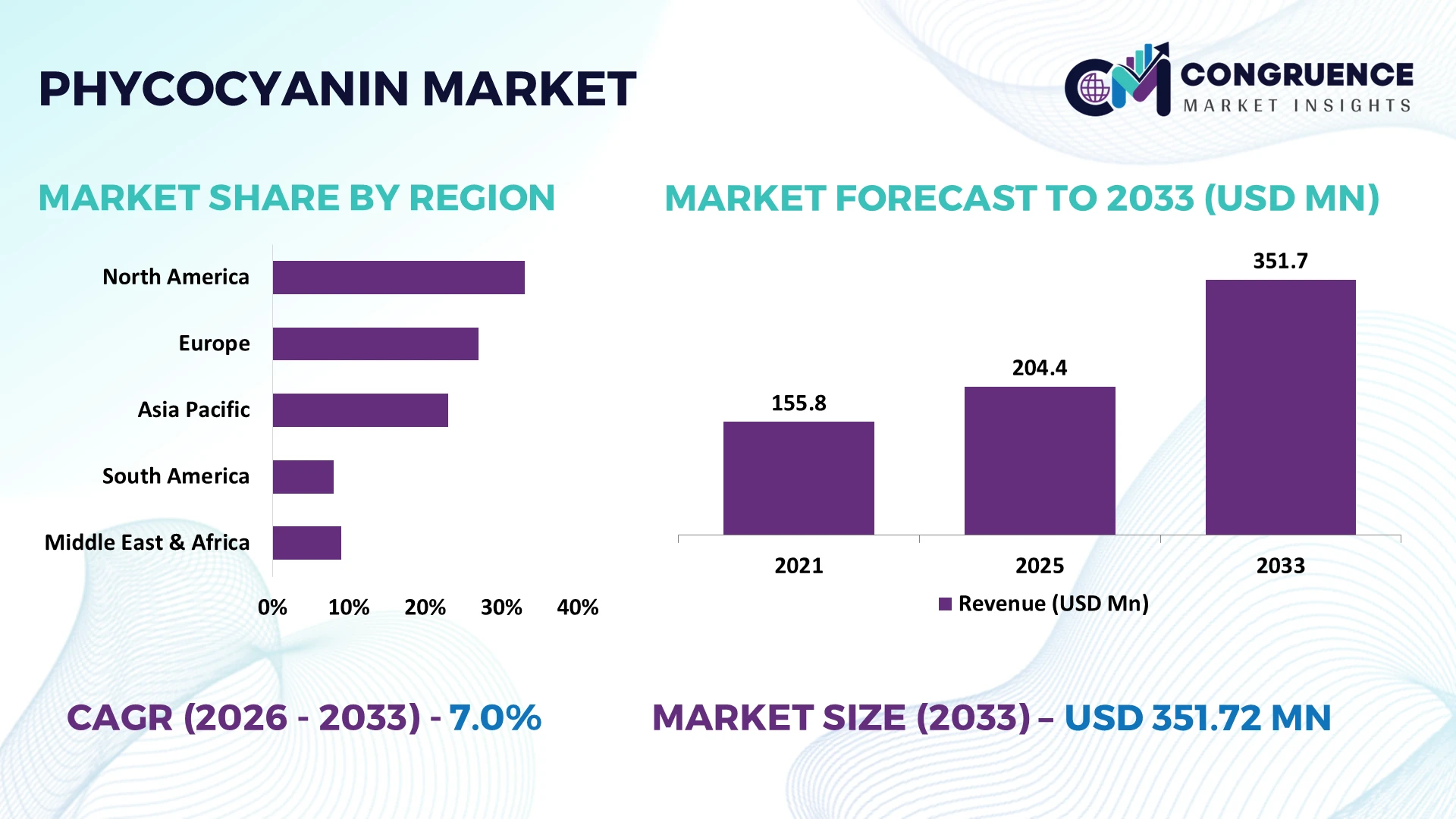
The United States represents the dominant country market, supported by approximately 27.6% of global demand, advanced food-coloring applications, and strong nutraceutical manufacturing. North America held about 33% of global market share in 2025, while Japan accounts for roughly 13% of Asia Pacific demand. U.S. adoption is reinforced by expanded regulatory attention to spirulina extract and natural food colors, strengthening commercial formulation activity.
The strategic priority is to secure reliable spirulina biomass, improve pigment stability, and scale high-purity extraction for food, beverage, nutraceutical, and specialty applications.
Market Size & Growth: USD 204.4 million in 2025 is projected to reach USD 351.7 million by 2033 at 7.02% CAGR, driven by natural-color reformulation and advanced extraction.
Top Growth Drivers: Natural colorant adoption 73%; food and beverage applications 73.18%; powder formats 80.25%, strengthening scalable commercial consumption.
Short-Term Forecast: By 2028, extraction optimization is positioned to reduce processing requirements by approximately 10–15% while improving pigment recovery and production consistency.
Emerging Technologies: Ultrasound-assisted extraction, pulse-electric-field processing, and AI-assisted process optimization are improving yield, purification efficiency, and manufacturing control.
Regional Leaders: North America is projected at approximately USD 116 million by 2033, Europe near USD 102 million, and Asia Pacific around USD 113 million, with Asia Pacific strengthening cultivation and processing capacity.
Consumer/End-User Trends: Food and beverage applications represented 73.18% of 2025 demand, reflecting stronger usage in beverages, confectionery, dairy alternatives, and clean-label formulations.
Pilot/Case Example: In 2025, advanced ultrasound-assisted extraction combined with freeze-thaw processing demonstrated improved C-phycocyanin recovery, targeting higher extraction efficiency and reduced downstream processing.
Competitive Landscape: North America commanded about 33% share, while key competitors include DIC Corporation, GNT Group, Earthrise Nutritionals, Parry Nutraceuticals, and Bluetec Naturals.
Regulatory & ESG Impact: U.S. regulatory expansion for spirulina extract is supporting natural-color substitution, while lower-impact extraction technologies target reduced energy and processing requirements.
Investment & Funding: Industry investment is shifting toward controlled spirulina cultivation, specialized extraction facilities, and formulation partnerships, with commercial expansion increasingly tied to supply reliability and pigment stability.
Innovation & Future Outlook: Next-generation encapsulation, liquid formulations, AI-controlled extraction, and higher-purity grades are shifting competition from basic pigment supply toward performance-driven ingredient solutions.
Phycocyanin demand is concentrating in functional beverages, confectionery, dairy alternatives, supplements, and premium clean-label foods, where natural blue coloration and functional positioning provide dual product value. Powder accounted for about 80.25% of 2025 demand, while liquid formats are gaining traction through ready-to-use beverage applications. U.S. regulatory movement around spirulina extract is also encouraging formulators to accelerate natural-color substitution and strengthen supply-chain qualification.
Phycocyanin is becoming strategically important because food manufacturers are moving beyond simple color replacement toward multifunctional, naturally derived ingredients that support clean-label positioning. The United States and Europe emphasize formulation performance and regulatory compliance, while China and India provide important cultivation and processing capabilities. This geographic split is reshaping procurement strategies toward vertically coordinated biomass and extraction networks.
Technology is becoming a competitive differentiator. Conventional freeze-thaw extraction can deliver strong pigment recovery but has scalability limitations; ultrasound-assisted, pulse-electric-field, and enzyme-assisted approaches are being developed to improve recovery while reducing downstream processing. Phycocyanin can represent about 25% of Spirulina biomass, making efficient cell disruption particularly important for commercial economics.
Over the next 2–3 years, manufacturers are expected to prioritize stabilization, standardized purity, and automated process monitoring. Practical deployment is expanding through beverage, confectionery, nutraceutical, and dairy-alternative formulations. Companies are responding through cultivation partnerships, specialized extraction capacity, and application-development collaborations. The strategic advantage will increasingly come from consistent color performance, secure biomass supply, and scalable processing rather than pigment availability alone.
Natural-color reformulation is the primary structural driver, with food and beverage applications representing approximately 73.18% of 2025 demand and powder formats accounting for 80.25%. Manufacturers are replacing synthetic blue colorants in beverages, confectionery, dairy alternatives, and functional foods while using phycocyanin to reinforce clean-label positioning. In the United States, regulatory activity surrounding expanded spirulina-extract use is accelerating formulation reassessment. Companies are responding by investing in stabilized concentrates, higher-purity grades, and application-specific formulations. The non-obvious advantage is procurement control: vertically coordinated spirulina cultivation can reduce exposure to inconsistent biomass quality and improve pigment standardization across production batches.
Phycocyanin remains constrained by sensitivity to temperature, light, and pH, creating formulation costs that are materially higher than conventional synthetic colorants. Research indicates Spirulina biomass contains approximately 25% phycocyanin, yet recovering and purifying that fraction efficiently remains technically demanding. Freeze-thaw extraction provides high yield but faces industrial scalability limitations, while enzyme-assisted processing introduces additional cost. These constraints directly affect margins, shelf life, and deployment in heat-treated products. Producers are mitigating exposure through controlled cultivation, contract biomass procurement, improved stabilization systems, and alternative extraction technologies. The key operational issue is not biomass availability alone but achieving repeatable pigment quality at commercial processing volumes.
Advanced extraction creates an opportunity to convert phycocyanin production from batch-intensive processing into data-controlled manufacturing. Ultrasound-assisted extraction combined with freeze-thaw treatment can improve recovery, while artificial intelligence and neural-network models are being explored to optimize extraction conditions. Pulse-electric-field and high-pressure homogenization also offer lower-environmental-impact processing pathways. Companies can target 10–15% process-efficiency improvements through automated parameter control, while liquid formulations address rapidly deployable beverage applications. India and China offer particularly important opportunities for upstream cultivation and processing partnerships. The non-obvious opportunity lies in monetizing residual Spirulina biomass through additional bioactive compounds, improving overall facility economics rather than relying exclusively on pigment sales.
Scaling phycocyanin requires consistent pigment purity, color intensity, microbial control, and stability across different biomass batches. Processing variability can affect extraction yield and purification requirements, while contamination control remains important for algae-derived ingredients. Companies also face the challenge of maintaining standardized performance when moving from laboratory extraction toward continuous commercial production. The pressure is particularly significant for beverage and food manufacturers operating high-volume lines where formulation deviations create immediate production losses. Producers must therefore invest in automated quality monitoring, validated cultivation protocols, supplier qualification, and application-specific stabilization. Over the longer term, competitive differentiation will depend on reproducible pigment specifications and integrated production systems rather than simply increasing extraction capacity.
Powder Processing Gains Scale: Powder phycocyanin accounts for about 67% of the market, supported by easier dosing, storage, and dry-line integration. Manufacturers are expanding spray-drying and freeze-drying capacity while improving pigment retention. Liquid formats, at roughly 33%, are gaining traction in ready-to-drink formulations, creating a two-track supply model.
Beverage Formulation Is Accelerating: Food and beverage applications represent approximately 44% of demand, with natural blue coloration moving into functional drinks, dairy alternatives, confectionery, and frozen products. Companies are reformulating existing SKUs rather than building entirely new product lines, shortening commercialization cycles and increasing demand for standardized, pH-tolerant ingredients.
Extraction Workflows Are Modernizing: Conventional freeze-thaw extraction delivers strong recovery but remains difficult to scale; ultrasound-assisted extraction combined with freeze-thaw processing is improving recovery efficiency, while AI-based optimization is entering process development. Companies are shifting investment toward automated extraction control, reducing dependence on labor-intensive batch adjustments.
Domestic Supply Chains Strengthen: India is moving toward localized C-phycocyanin production, with a 2026 commercialization project transferring indigenous Spirulina technology into industrial manufacturing. This reduces dependence on imported natural colorants and creates an emerging supply-chain advantage for domestic food, nutraceutical, and biostimulant manufacturers.
Powder phycocyanin remains the dominant type, accounting for approximately 67% of the global market, as manufacturers favor its dosing precision, transportation efficiency, longer storage stability, and compatibility with dry food, supplement, and confectionery lines. Alternative estimates place powder substantially higher at around 77–82%, reflecting differences in market definitions and coverage. Liquid phycocyanin represents the smaller segment but is expanding its role in beverages, dairy alternatives, and ready-to-use nutritional formulations.
The strategic shift is toward application-specific formats rather than simple powder-versus-liquid substitution. Powder suppliers are investing in stabilization and improved solubility, while liquid producers are targeting direct integration into wet-processing systems. Powder's established infrastructure gives it the scale advantage, whereas liquid offers faster incorporation for beverage manufacturers. Companies are therefore maintaining powder capacity while selectively expanding liquid formulation partnerships to capture higher-value applications.
Food and beverages represent the leading application at approximately 44% of global demand, reflecting concentrated use in functional beverages, confectionery, dairy alternatives, frozen desserts, and other naturally colored products. Nutraceuticals follow at roughly 30%, benefiting from phycocyanin's positioning as both a natural pigment and bioactive ingredient. Pharmaceuticals and cosmetics remain smaller applications at approximately 14% and 12%, respectively, but require tighter purity, stability, and formulation specifications.
The fastest operational expansion is occurring in beverage and nutraceutical formulations, where manufacturers can incorporate phycocyanin into existing liquid or powder workflows. Food manufacturers prioritize color consistency and processing stability, while nutraceutical companies place greater emphasis on purity and functional positioning. Companies are responding with application-specific grades, stabilized concentrates, and formulation partnerships rather than relying on a single universal ingredient specification. The business implication is clear: suppliers able to customize pigment performance for individual processing environments can capture higher-value contracts.
Food and beverage manufacturers constitute the dominant commercial buyer group because phycocyanin is already integrated into high-volume products requiring natural blue coloration. Their purchasing decisions prioritize consistent pigment intensity, batch-to-batch stability, formulation compatibility, and reliable supply. Nutraceutical manufacturers form the next important group, with demand supported by powder-based supplements and functional formulations. Cosmetics and personal-care manufacturers remain a specialized segment where formulation compatibility and color stability carry greater weight.
The fastest structural shift is toward nutraceutical and functional-product buyers that use phycocyanin for both coloration and ingredient positioning. Food manufacturers typically purchase larger standardized volumes, while nutraceutical buyers emphasize purity and specification control. Companies are consequently adopting differentiated pricing, application support, and supply agreements across buyer categories.
North America accounted for the largest market share at 33% in 2025 however, Asia-Pacific is expected to register the fastest growth, expanding at a CAGR of 8.1% between 2026 and 2033.
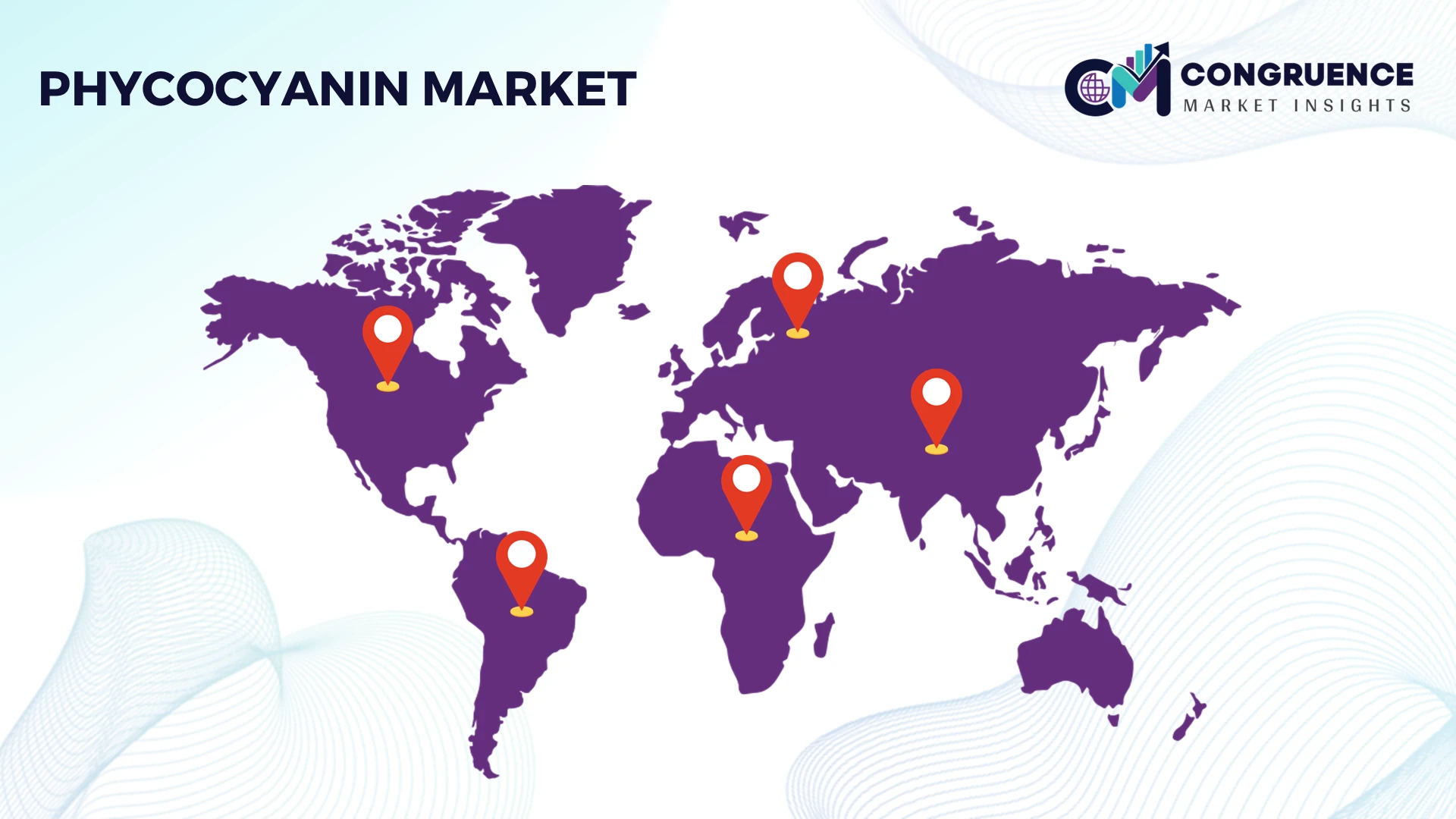
North America represents the leading regional market, supported by strong food, beverage, nutraceutical, and dietary-supplement manufacturing. The region captured approximately 33% of global demand in 2025, with the U.S. accounting for the majority of regional consumption. Regulatory developments around spirulina extract are widening formulation opportunities across beverages, confectionery, frozen desserts, and supplements. U.S. manufacturers are increasingly requiring standardized pigment intensity and stability rather than basic colorant supply. Suppliers are responding with higher-purity grades, stabilized formulations, and application-specific technical support. The region's mature contract-manufacturing infrastructure also enables rapid integration of phycocyanin into established product lines, giving North American buyers greater flexibility in switching from synthetic to naturally derived color systems.
U.S. Market Outlook: The U.S. remains the principal North American market, supported by large-scale functional-food and supplement manufacturing and established distribution networks. Spirulina extract is permitted across multiple food categories, while 2026 regulatory activity further expanded the commercial discussion around permitted uses. This environment is encouraging manufacturers to qualify additional phycocyanin suppliers and develop formulations with tighter purity and stability specifications.
Europe is developing around clean-label formulation, sustainable ingredient sourcing, and tighter food-additive compliance. The region represents approximately 27% of global phycocyanin demand, with Germany, France, Italy, and the United Kingdom accounting for significant downstream activity. European manufacturers increasingly emphasize traceability, environmental credentials, and standardized ingredient documentation. Unlike the U.S., regulatory pathways for phycocyanin as a food colorant remain more restrictive, creating a meaningful commercialization barrier. Companies are therefore concentrating on nutraceutical, cosmetic, and specialized food applications while pursuing regulatory clarification and stronger safety dossiers. Investment is shifting toward extraction systems that reduce solvent use and processing waste, making environmental performance an increasingly important procurement criterion alongside pigment quality and formulation stability.
Germany Market Outlook: Germany provides a strong industrial base through advanced food processing, nutraceutical manufacturing, and specialty-ingredient distribution. The country's large packaged-food sector creates opportunities for natural-color formulation, while stringent quality and traceability requirements favor suppliers capable of providing standardized grades. Companies operating in Germany are increasingly evaluating ingredient provenance, processing efficiency, and documentation alongside color performance when selecting phycocyanin suppliers.
Asia-Pacific is the fastest-expanding regional market, representing approximately 23% of global demand and benefiting from extensive Spirulina cultivation, lower-cost processing capabilities, and expanding food and nutraceutical manufacturing. China, India, Japan, and South Korea are strengthening the regional value chain from biomass cultivation through pigment extraction and formulation. India is particularly important: in 2025, IIT Guwahati transferred low-cost, high-yield C-phycocyanin technology for commercial development, followed by government-backed commercialization support in 2026. This progression is moving the market from imported pigment dependence toward localized production. Companies are investing in controlled cultivation, solvent-free extraction, and integrated processing to improve purity while reducing manufacturing complexity.
India Market Outlook: India is emerging as a strategic production base because domestic biotechnology capabilities are increasingly connecting Spirulina cultivation with commercial pigment extraction. A 2026 commercialization project uses an indigenous Spirulina strain and a solvent-free extraction and purification process to produce food-grade and analytical-grade C-phycocyanin. This supports import substitution while creating opportunities across food, nutraceutical, agriculture, aquaculture, and biostimulant applications.
South America represents a smaller but increasingly relevant phycocyanin market, contributing approximately 8% of global demand. Brazil leads regional activity because of its large food-processing industry, favorable agricultural conditions, and established interest in Spirulina and algae-derived nutritional ingredients. Demand is concentrated in functional foods, supplements, natural beverages, and specialty nutrition products. Local production offers an opportunity to reduce dependence on imported pigment concentrates, although downstream purification capacity remains less developed than in North America and Asia-Pacific. Companies are consequently prioritizing cultivation partnerships and regional processing arrangements rather than building fully integrated facilities immediately. Brazil's broad agricultural biotechnology ecosystem provides an additional advantage for developing integrated algae-processing models that can valorize biomass into multiple products.
Brazil Market Outlook: Brazil is the region's most strategically significant market because of its large food and beverage manufacturing base and established functional-nutrition sector. Domestic Spirulina cultivation provides an upstream foundation for phycocyanin production, while expanding natural-ingredient adoption supports downstream formulation opportunities. Producers are increasingly positioned to combine local biomass sourcing with specialized extraction partnerships, reducing exposure to imported pigment supply.
The Middle East & Africa region accounts for approximately 9% of global phycocyanin demand, with adoption concentrated in nutritional products, functional beverages, cosmetics, and specialty food applications. The Middle East is increasingly relevant for controlled-environment algae cultivation because greenhouse and photobioreactor systems can reduce dependence on conventional agricultural land. Gulf countries are also investing heavily in food-security infrastructure and biotechnology, creating opportunities for algae-derived ingredients. Africa remains more fragmented, with commercial-scale processing concentrated around selected nutritional and biotechnology projects. Companies are responding through localized cultivation partnerships, controlled production systems, and imported downstream purification expertise. The strategic opportunity is to integrate algae cultivation with broader food-security and circular-bioeconomy initiatives rather than treating phycocyanin as a standalone pigment business.
Saudi Arabia Market Outlook: Saudi Arabia offers a strategic platform for controlled algae production through its expanding food-security and biotechnology infrastructure. The country's investment in alternative biological production systems supports potential Spirulina cultivation under controlled conditions, while its large food-import base creates demand for locally produced specialty ingredients. Companies can leverage controlled cultivation to reduce land constraints and establish localized natural-colorant supply chains.
DIC Corporation, Cyanotech, E.I.D. Parry, GNT Group, and Sensient compete as global leaders, while Chinese producers challenge them on bulk pricing and flexible supply. The top five hold about 52% share. Competition centers on price, purity, stability, and supply reliability: bulk pricing can fall over 50%, while premium grades differentiate through certification and application performance. DIC competes through vertically integrated cultivation and extraction; Cyanotech leverages algae specialization; GNT and Sensient emphasize formulation support and distribution. Givaudan adds fermentation-based blue technology through Everzure, challenging conventional Spirulina-derived phycocyanin in acidic applications. Regional suppliers increasingly target customized grades and shorter lead times. The competitive shift is moving from commodity pigment supply toward controlled biomass, precision fermentation, traceability, and application-specific stability. Entry barriers remain high because cultivation, purification, regulatory qualification, and consistent color performance require infrastructure. Winning requires secure biomass, scalable processing, quality, formulation expertise, and customer partnerships that defend margins beyond price competition.
DIC Corporation
Cyanotech Corporation
E.I.D. – Parry (India) Limited
GNT Group B.V.
Sensient Technologies Corporation
Givaudan
Döhler GmbH
AlgoSource S.A.
Fuqing King Dnarmsa Spirulina Co., Ltd.
Dongtai City Spirulina Bio-Engineering Co., Ltd.
Zhejiang Binmei Biotechnology Co., Ltd.
Tianjin Norland Biotech Co., Ltd.
Japan Algae Co., Ltd.
Bluetec Naturals Co., Ltd.
Current phycocyanin production is shifting from open-batch cultivation and labor-intensive extraction toward smart farming, SCADA monitoring, automated water control, and AI biomass assessment. Digital monitoring can improve process efficiency by 5–10%, while automated controls reduce manual intervention and batch variability. Adoption remains concentrated among advanced producers, with deployment strongest in vertically integrated facilities where cultivation and extraction data can be monitored continuously.
Emerging technologies include solvent-free extraction, membrane purification, ultrasound-assisted cell disruption, and precision fermentation. Compared with conventional solvent-intensive processing, optimized extraction can deliver roughly 10–20% higher recovery efficiency, while membrane systems can reduce downstream processing steps by 5–10%, lowering filtration complexity and improving reproducibility at commercial scale. Precision fermentation improves contamination control and pigment consistency, giving technology-led suppliers an advantage in acidic applications.
From 2026–2028, integrated cultivation, purification, stabilization, and digital quality analytics will become more commercially important. Controlled fermentation can expand applications where Spirulina phycocyanin loses stability, while automated analytics can cut qualification delays by 5–10%. DIC benefits from smart-farming integration; Givaudan and Fermentalg benefit from fermentation-based differentiation. Companies acting now can secure proprietary processes, improve traceability, and lock in formulation partnerships before natural-blue specifications become more demanding across beverages, confectionery, supplements, and specialty foods and global brands.
April 2025 DIC’s Earthrise Nutritionals began operating a new California algae facility after approximately ¥1.2 billion investment. Smart farming uses automated controls, AI assessment, and renewable energy, strengthening Spirulina supply, resource efficiency, and production resilience for LINABLUE phycocyanin. Source: dic-global.com
May 2025 Givaudan Sense Colour received US FDA approval for Everzure Galdieria, developed with Fermentalg. The fermented microalgal blue offers low-pH stability, expanding natural-color applications for beverages and confectionery beyond Spirulina and enabling production scale-up from H2 2025. Source: givaudan.com
March 2026 Fermentalg obtained a favorable EFSA safety opinion for Galdieria Blue after more than five years of review. The acid-stable phycocyanin-rich color advances European authorization and strengthens commercialization of fermentation-based natural blue for acidic food applications globally. Source: fermentalg.com
July 2026 Technology Development Board supported K. N. Biosciences to commercialize indigenous C-phycocyanin from Spirulina strain NCIM 5143. The process combines solvent-free extraction and single-step purification, enabling commercial-scale production and reducing India’s reliance on imported natural colorants domestically. Source: tdb.gov.in
The Phycocyanin Market Report covers powder and liquid forms, with analysis across food and beverages, nutraceuticals, pharmaceuticals, cosmetics, and specialty natural-color applications. It evaluates end-user requirements across food manufacturers, supplement producers, pharmaceutical formulators, cosmetic companies, and ingredient suppliers. Powder represents approximately 67% of current demand, reflecting its handling and formulation advantages. Regional coverage spans North America, Europe, Asia-Pacific, South America, and Middle East & Africa, with attention to production hubs, regulatory environments, trade flows, and consumption.
The report assesses conventional Spirulina extraction, solvent-free purification, smart cultivation, automated process control, membrane separation, stabilization, and emerging precision-fermentation platforms. It identifies niche opportunities in acid-stable natural blue colors, clean-label beverages, functional foods, and specialty formulations. The analysis supports investment planning, capacity expansion, supplier selection, partnership development, competitive positioning, and technology adoption decisions while tracking market direction and strategic shifts from 2026 through 2033.
| Report Attribute / Metric | Details |
|---|---|
| Market Revenue (2025) | USD 204.41 Million |
| Market Revenue (2033) | USD 351.70 Million |
| CAGR (2026–2033) | 7.02% |
| Base Year | 2025 |
| Forecast Period | 2026–2033 |
| Historic Period | 2021–2025 |
| Segments Covered |
By Type
By Application
By End-User
|
| Key Deliverables | Revenue Forecast; Market Trends; Growth Drivers & Restraints; Technology Insights; Segmentation Analysis; Regional Insights; Competitive Landscape; Regulatory & ESG Overview; Recent Developments |
| Regions Covered | North America; Europe; Asia Pacific; South America; Middle East & Africa |
| Companies Profiled | DIC Corporation; Cyanotech Corporation; E.I.D. – Parry (India) Limited; GNT Group B.V.; Sensient Technologies Corporation; Givaudan; Döhler GmbH; AlgoSource S.A.; Fuqing King Dnarmsa Spirulina Co., Ltd.; Dongtai City Spirulina Bio-Engineering Co., Ltd.; Zhejiang Binmei Biotechnology Co., Ltd.; Tianjin Norland Biotech Co., Ltd.; Japan Algae Co., Ltd.; Bluetec Naturals Co., Ltd. |
| Customization & Pricing | Available on Request (10% Customization Free) |




