
Reports
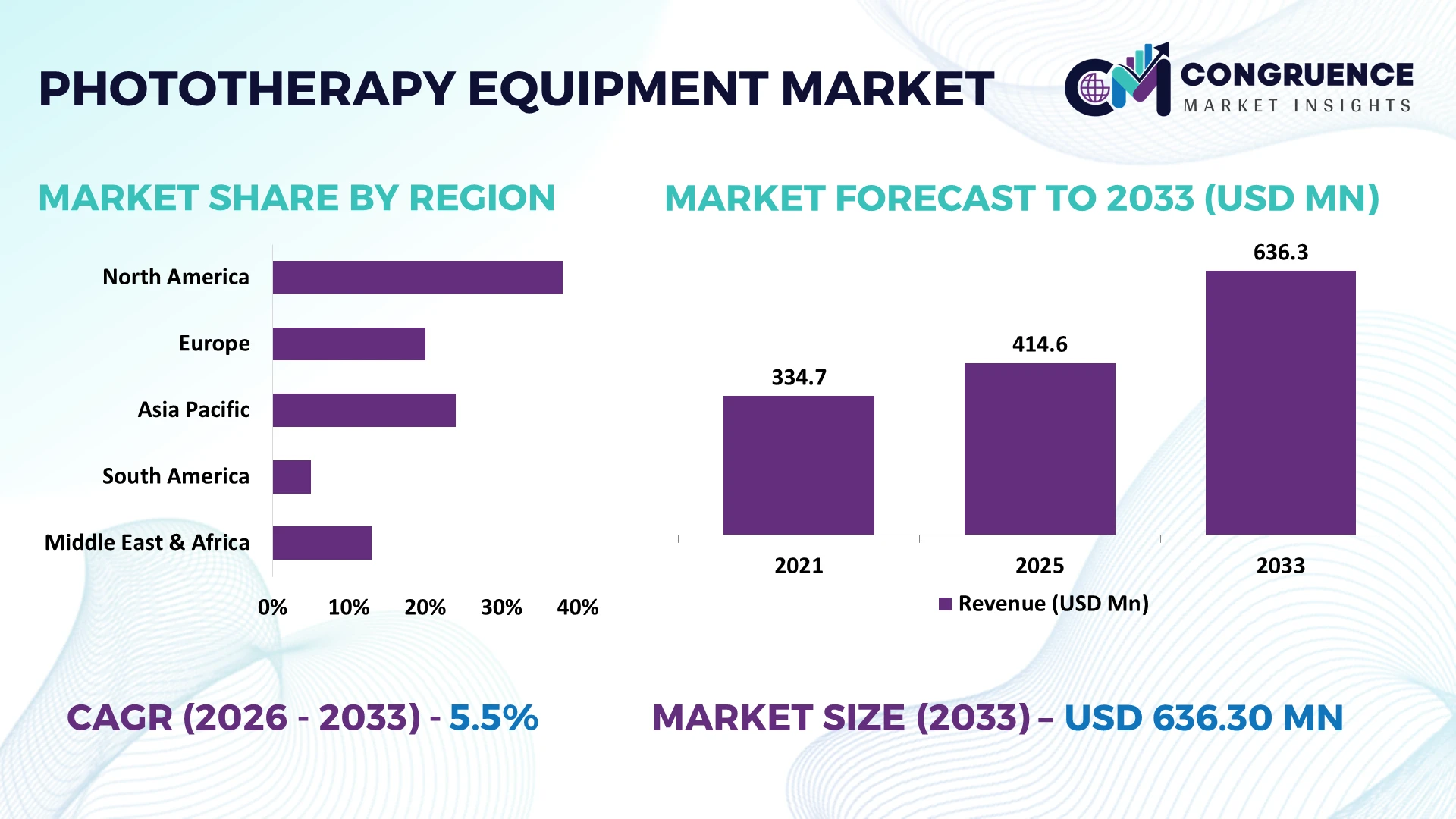
The Global Phototherapy Equipment Market was valued at USD 414.6 Million in 2025 and is anticipated to reach a value of USD 636.3 Million by 2033 expanding at a CAGR of 5.5% between 2026 and 2033. Growth is driven by rising neonatal jaundice treatment volumes, wider adoption of high-intensity LED phototherapy, and the replacement of conventional fluorescent systems with energy-efficient equipment offering controlled irradiance and reduced maintenance requirements.
The United States leads in advanced neonatal care infrastructure, supported by specialized neonatal intensive care units (NICUs), established medical-device manufacturing, and hospital investment in precision-controlled phototherapy systems. China strengthens its position through large-scale hospital expansion, domestic medical-device production, and improving access to neonatal treatment across provincial healthcare networks. India represents an important expansion market as public and private hospitals increase newborn-care capacity. Globally, LED-based systems offer substantially longer operating life than conventional fluorescent lamps, while automated irradiance monitoring improves treatment consistency. Supply-chain diversification following US–China trade tensions also strengthens the strategic case for regional manufacturing and qualified component suppliers.
For manufacturers and investors, prioritizing LED platforms, neonatal-care partnerships, and cost-effective distribution in Asia-Pacific offers a stronger route to competitive growth than relying exclusively on mature hospital markets.
Market Size & Growth: USD 414.6 million in 2025 to USD 636.3 million by 2033, at 5.5% CAGR, driven by LED replacement and expanding neonatal treatment infrastructure.
Top Growth Drivers: Neonatal jaundice treatment (+3 key clinical priorities), dermatological disease management, and energy-efficient LED adoption underpin equipment purchasing.
Short-Term Forecast: By 2028, LED upgrades and irradiance controls target 10–15% lower operating costs, subject to device configuration and hospital utilization.
Emerging Technologies: AI-assisted treatment monitoring, wearable phototherapy, and precision-wavelength LEDs improve treatment control and equipment portability.
Regional Leaders: North America, Europe, and Asia-Pacific remain major markets; modeled 2033 values are approximately USD 198 million, USD 165 million, and USD 191 million, respectively, based on indicative regional allocations.
Consumer/End-User Trends: Hospitals account for a substantial purchasing base, while home phototherapy expands access for clinically eligible patients under medical supervision.
Pilot/Case Example: A 2018 clinical comparison found double-sided LED phototherapy reduced treatment duration by 21% and neonatal-unit stay by 16%.
Competitive Landscape: GE HealthCare, Natus Medical, Philips, Dräger, and Atom Medical compete through neonatal-care integration, device reliability, and product specialization.
Regulatory & ESG Impact: Medical-device safety requirements and energy-efficiency priorities favor validated, durable systems with controlled light output and reduced lamp replacement.
Investment & Funding: Capital deployment increasingly targets portable devices, neonatal-care portfolios, regional manufacturing, and distribution partnerships; a consolidated market-wide investment total is not established.
Innovation & Future Outlook: Connected monitoring, wearable systems, and homecare-compatible equipment shift competition toward clinical performance, treatment accessibility, and lifecycle cost.
The phototherapy equipment market serves neonatal jaundice management and dermatological conditions, including psoriasis, vitiligo, and eczema. Demand is shifting toward LED systems with precise wavelength delivery, consistent irradiance, and lower maintenance requirements. Double-sided neonatal phototherapy demonstrated a 21% reduction in treatment duration in a clinical comparison, highlighting the operational value of optimized light exposure. Portable and wearable devices are also extending treatment options beyond conventional hospital beds, particularly for suitable homecare patients. Meanwhile, medical-device compliance requirements and supply-chain diversification are influencing procurement decisions. These developments make clinical validation, affordability, and service coverage central to manufacturers' competitive positioning.
The phototherapy equipment market is becoming strategically important as hospitals prioritize measurable neonatal outcomes, treatment efficiency, and lower lifecycle costs. LED-based systems are replacing fluorescent platforms because they provide longer service life, targeted wavelengths, and more consistent irradiance. This transition shifts competition from equipment pricing toward clinical performance, uptime, and service support. Manufacturers that integrate irradiance monitoring and treatment documentation strengthen their position in hospital procurement decisions.
Supply-chain restructuring and healthcare infrastructure modernization are reshaping investment priorities. US manufacturers emphasize advanced neonatal systems and clinical integration, while Chinese suppliers leverage domestic manufacturing scale and expanding hospital networks. India presents opportunities for affordable equipment suited to public hospitals and resource-constrained neonatal units. Compared with conventional fluorescent systems, LED platforms reduce lamp-replacement requirements and energy consumption, although actual savings depend on utilization, device design, and maintenance practices.
Over the next two to three years, manufacturers will prioritize portable systems, improved treatment monitoring, and distribution partnerships. For example, hospitals deploying LED phototherapy units can standardize irradiance checks and maintenance schedules to improve equipment availability. Companies are also diversifying component sourcing and strengthening local service networks to limit procurement delays. The strongest competitive position will belong to suppliers that combine validated clinical performance, dependable servicing, and accessible pricing without compromising treatment standards.
Neonatal jaundice remains the principal structural driver of phototherapy equipment demand, affecting approximately 60% of term and 80% of preterm newborns. Increasing emphasis on early bilirubin screening and timely treatment strengthens procurement of LED-based neonatal phototherapy units. Compared with conventional fluorescent systems, LEDs offer longer operating life and reduced lamp-replacement requirements, improving equipment availability in high-volume maternity hospitals. In India, expanding special newborn care units and public neonatal-care programs support demand for compact, energy-efficient systems. Manufacturers are responding through localized assembly, hospital partnerships, and product portfolios tailored to different care settings. The strategic advantage lies in supplying reliable equipment with standardized irradiance performance and manageable maintenance costs.
High initial equipment costs, limited biomedical engineering capacity, and inconsistent neonatal-care infrastructure constrain adoption, particularly among smaller hospitals in India and other price-sensitive markets. Equipment affordability extends beyond purchase price to include maintenance contracts, replacement components, calibration, and staff training. A 10–15% procurement-cost reduction can improve purchasing flexibility, although actual savings depend on supplier terms and device specifications. Dependence on specialized LEDs, optical components, and electronic controllers also exposes manufacturers to sourcing disruptions and component-price volatility. Suppliers are mitigating these pressures through regional assembly, standardized components, tiered product configurations, and multi-year service agreements. The critical commercial issue is reducing total ownership costs without compromising validated irradiance output or treatment safety.
Portable neonatal phototherapy systems and connected irradiance monitoring create opportunities to improve treatment access and equipment utilization. Manufacturers targeting India can develop compact units for district hospitals and smaller neonatal facilities, where space and technical support are constrained. Automated irradiance monitoring that reduces manual measurement workload by 10–20% represents a potential operational target, subject to workflow validation. Wearable phototherapy devices also offer opportunities for clinically eligible infants requiring supervised treatment outside conventional inpatient settings. In the United States, digital documentation and integration with neonatal workflows strengthen product differentiation. Companies should prioritize clinical validation, affordable designs, and partnerships with hospital networks. The strongest opportunity is to deliver measurable treatment consistency through simpler equipment rather than adding expensive digital features without demonstrated clinical value.
Maintaining consistent treatment performance across hospitals remains a major execution challenge as phototherapy equipment varies in wavelength output, irradiance distribution, treatment distance, and monitoring capability. Manufacturers must validate performance across intended operating conditions and ensure that staff can reproduce prescribed treatment settings. A 10% irradiance deviation can materially affect delivered light exposure, making calibration and measurement discipline important operational priorities. Connected systems introduce additional requirements for data integrity, cybersecurity, software maintenance, and interoperability with hospital records. In India, shortages of trained biomedical personnel at smaller facilities can further complicate implementation. Companies must invest in robust device testing, intuitive controls, technician training, and dependable after-sales support. Competitive sustainability will depend on consistent clinical performance across diverse care environments, not product availability alone.
LED Phototherapy Devices Lead as Portable Systems Gain Momentum
LED Phototherapy Devices represent the leading segment, with an estimated 45–50% share of the global phototherapy equipment market, supported by energy efficiency, long operating life, controlled wavelength output, and suitability for intensive neonatal treatment. Hospitals favor LED platforms because reduced lamp replacement and maintenance requirements improve equipment availability. Fluorescent Phototherapy Devices retain relevance in cost-sensitive facilities operating established equipment, although replacement decisions increasingly favor LED technology. Conventional Phototherapy Units serve routine treatment requirements, while Intensive Phototherapy Units address cases requiring higher irradiance and broader light coverage.
Portable Phototherapy Devices are positioned for faster adoption as healthcare providers seek flexible equipment for smaller maternity wards and space-constrained clinical environments. Fiber-Optic Phototherapy Devices remain relevant where localized light delivery and specialized neonatal treatment configurations are preferred. Manufacturers are prioritizing modular LED designs, adjustable irradiance, and portable configurations. A potential 10–20% reduction in maintenance expenditure strengthens the business case for replacing legacy systems, although savings vary by utilization and service costs. Investment priorities are shifting toward equipment platforms that combine treatment consistency, mobility, and lower lifecycle expenditure.
Neonatal Jaundice Dominates Clinical Demand
Neonatal Jaundice is the leading application, accounting for an estimated 55–60% of phototherapy equipment demand, reflecting its established role in newborn care and the need for timely bilirubin management. Approximately 60% of term newborns and 80% of preterm newborns develop jaundice during the first week of life, reinforcing demand across maternity hospitals and neonatal intensive care units. Treatment protocols prioritize appropriate irradiance, exposure duration, and clinical monitoring. Manufacturers are strengthening neonatal product portfolios through adjustable LED intensity, improved treatment coverage, and equipment configurations suited to different hospital capacities.
Among dermatological applications, Psoriasis, Vitiligo, and Atopic Dermatitis sustain demand for targeted ultraviolet phototherapy, while Acne and Seasonal Affective Disorder represent distinct treatment categories with different equipment and clinical requirements. Dermatology applications benefit from controlled exposure protocols and specialized devices, although their purchasing patterns differ from high-volume neonatal procurement. A 10–15% improvement in treatment-room scheduling efficiency is a potential operational target for clinics adopting better appointment and equipment-utilization processes. Manufacturers are differentiating products by wavelength capability, treatment configuration, and intended clinical use, directing investment toward validated platforms that address specific application requirements.
Hospitals Lead Procurement as Home Healthcare Expands
Hospitals represent the leading end-user segment, with an estimated 40–45% share of the global phototherapy equipment market, supported by centralized procurement, maternity services, neonatal intensive care units, and established clinical monitoring infrastructure. Their purchasing decisions prioritize treatment reliability, equipment availability, maintenance support, and compatibility with neonatal workflows. Neonatal Care Units remain essential specialized buyers, often requiring intensive phototherapy systems and consistent irradiance monitoring. Dermatology Clinics and Specialty Clinics purchase equipment according to treatment protocols, patient throughput, and wavelength requirements. Manufacturers are responding through tiered product portfolios, service contracts, and equipment bundles tailored to institutional needs.
Home Healthcare is positioned for faster expansion where clinically eligible patients can receive treatment under appropriate medical supervision. Its growth depends on physician assessment, caregiver training, device suitability, and follow-up arrangements rather than portability alone. Research Institutes represent a specialized market for equipment used in clinical investigations and treatment-development studies. A 10–15% reduction in equipment downtime is a potential operational target for hospitals implementing preventive maintenance and service monitoring. Suppliers are strengthening hospital partnerships while developing compact systems, flexible pricing, and training support for emerging care settings. Competitive advantage increasingly depends on matching equipment specifications and service models to each end-user's clinical responsibilities.
North America accounted for the largest market share at an estimated 35% in 2025; however, Asia-Pacific is expected to register the fastest growth between 2026 and 2033, driven by expanding neonatal-care infrastructure, hospital modernization, and increasing adoption of cost-effective LED phototherapy systems.
Advanced Neonatal Infrastructure and Technology-Led Procurement
North America maintains a strong position in the global phototherapy equipment market through advanced neonatal intensive care units, established medical-device manufacturers, and structured hospital procurement. The United States drives demand through specialized maternity hospitals, clinical treatment protocols, and investment in LED-based neonatal systems. Canada contributes through public healthcare procurement and hospital modernization. The region's competitive advantage lies in clinical validation, established distribution networks, and access to technical servicing. Hospitals increasingly evaluate equipment through irradiance consistency, operating life, maintenance requirements, and treatment reliability. Manufacturers are strengthening hospital partnerships, improving device monitoring, and expanding service coverage to retain institutional contracts. Replacement of older fluorescent systems with LED platforms also supports purchasing activity by reducing routine maintenance requirements and improving equipment availability.
United States Market Outlook: The United States benefits from advanced neonatal-care infrastructure, established medical-device engineering, and hospital demand for clinically validated equipment. Hospitals prioritize treatment reliability, dependable maintenance, and compliance with medical-device requirements. Manufacturers are focusing on LED performance, simplified controls, and responsive technical support. Strong clinical relationships and reliable distribution give established suppliers an advantage when hospitals evaluate new installations or replace aging equipment.
Regulatory Compliance and Hospital Equipment Modernization
Europe's phototherapy equipment market benefits from established healthcare systems, specialist dermatology services, and extensive neonatal treatment infrastructure. Germany, France, the United Kingdom, and Italy contribute through hospital procurement and clinical technology modernization. The European Union's Medical Device Regulation increases the importance of clinical evidence, product traceability, safety documentation, and post-market monitoring. These requirements influence product development costs and supplier selection, particularly for manufacturers entering multiple national markets. Hospitals increasingly assess LED systems through lifecycle expenditure, reliability, and servicing requirements. Dermatology clinics also require equipment suited to specific ultraviolet treatment protocols. Manufacturers with established regulatory capabilities and country-level distribution networks are positioned to manage procurement complexity and maintain institutional relationships. Investment priorities favor validated products, reliable component sourcing, and differentiated clinical performance.
Germany Market Outlook: Germany offers an important market through its advanced hospital infrastructure, medical engineering capabilities, and established medical technology industry. Hospitals prioritize documented safety performance, dependable equipment maintenance, and clinical suitability. Suppliers can strengthen their position through local distribution, regulatory compliance, and responsive technical support. Collaboration with healthcare providers helps manufacturers adapt neonatal and dermatological phototherapy systems to institutional requirements and purchasing priorities.
Healthcare Expansion and Cost-Competitive Manufacturing
Asia-Pacific is becoming increasingly important as China, India, Japan, and South Korea combine expanding healthcare capacity with medical-device manufacturing expertise. China benefits from domestic production capabilities and extensive hospital networks, while India offers opportunities through maternity-care expansion and demand for affordable neonatal equipment. Japan and South Korea contribute through precision engineering and advanced medical technology development. Public hospital investment and private healthcare expansion are increasing demand for reliable equipment at different price points. Manufacturers are developing modular product portfolios, strengthening regional distribution, and considering localized assembly to improve affordability and servicing. An important competitive distinction is the ability to supply smaller hospitals with durable equipment and manageable maintenance requirements rather than concentrating exclusively on premium hospital installations.
China Market Outlook: China combines large hospital networks with domestic electronics manufacturing and medical-device engineering capabilities. Local manufacturers compete through production scale, competitive pricing, and established distribution, while international suppliers differentiate through specialized technology and clinical validation. Product registration, hospital procurement access, and after-sales servicing remain essential to commercial success. Suppliers that balance manufacturing efficiency with dependable treatment performance are positioned to strengthen their presence in the Chinese market.
Hospital Modernization and Uneven Equipment Access
South America's phototherapy equipment demand is concentrated in Brazil and Argentina, where maternity hospitals, neonatal services, and specialist healthcare providers support procurement. Brazil offers the strongest commercial base through its extensive public healthcare system and private hospital networks. However, differences in hospital budgets, regional infrastructure, and access to biomedical technicians create uneven adoption. Imported components and currency fluctuations can increase equipment acquisition and servicing costs, encouraging buyers to evaluate lifecycle expenditure alongside initial pricing. Manufacturers are responding through local distributors, technical-service partnerships, and product configurations suited to different purchasing budgets. LED systems can simplify maintenance, but wider deployment also requires staff training and spare-parts availability. Suppliers with reliable local support are better positioned to serve hospitals beyond major metropolitan centers.
Brazil Market Outlook: Brazil is the region's principal market opportunity because of its large population, maternity-care requirements, and mixed public-private healthcare structure. Suppliers must accommodate public procurement procedures while meeting private hospitals' expectations for reliability and service quality. Local distribution, technician training, and spare-parts availability strengthen market access. Affordable LED systems supported by dependable maintenance can help manufacturers address differences in purchasing capacity across Brazilian healthcare facilities.
Healthcare Investment and Infrastructure Transformation
The Middle East and Africa market combines investment-led hospital modernization in Gulf countries with significant healthcare infrastructure gaps in parts of Africa. Saudi Arabia and the United Arab Emirates are expanding advanced hospital capacity, supporting procurement of modern neonatal equipment. In African markets, adoption is affected by hospital funding, electricity reliability, technical servicing, and equipment availability. These differences create demand for premium systems in advanced medical centers and durable, easy-to-maintain devices in resource-constrained facilities. Suppliers are strengthening distributor partnerships, clinical training, and regional servicing arrangements to improve deployment reliability. Commercial success depends on more than new hospital construction: equipment utilization, maintenance access, and affordable procurement remain decisive factors. Manufacturers that adapt product specifications and service models to local healthcare conditions can improve their competitive position.
Saudi Arabia Market Outlook: Saudi Arabia offers an important market through healthcare modernization, specialist hospital investment, and efforts to strengthen clinical service capacity. Hospitals require dependable equipment, qualified technical support, and compliance with applicable medical-device regulations. Manufacturers can improve market access through local distribution partnerships, clinician training, and service agreements. Reliable post-installation support is essential for translating healthcare infrastructure investment into sustained phototherapy equipment utilization.
The global phototherapy equipment market features established medical-device manufacturers competing with specialist neonatal-care suppliers and regional cost-focused producers. GE HealthCare, Dräger, Philips, and Natus Medical compete through neonatal-care integration, clinical reliability, and hospital relationships, while Atom Medical emphasizes specialized newborn-care equipment. Regional manufacturers challenge established suppliers through competitive pricing, localized distribution, and flexible product configurations. The market remains fragmented across applications and device categories, with no reliably established combined share for the five largest manufacturers. Competition centers on irradiance consistency, LED durability, treatment coverage, regulatory compliance, and after-sales support. A 10–20% reduction in lifecycle maintenance expenditure can strengthen procurement competitiveness when validated against actual utilization. Suppliers differentiate through responsive servicing, customized equipment, and clinical workflow integration. Manufacturers are expanding distribution partnerships, refining LED platforms, and qualifying alternative component suppliers. Clinical validation and regulatory compliance create entry barriers. Winning requires proven treatment performance, dependable servicing, competitive lifecycle costs, and strong hospital relationships.
GE HealthCare
Drägerwerk AG & Co. KGaA
Koninklijke Philips N.V.
Natus Medical Incorporated
Atom Medical Corporation
Fanem Ltda.
Nice Neotech Medical Systems Pvt. Ltd.
Phoenix Medical Systems Pvt. Ltd.
Medela AG
Herbert Waldmann GmbH & Co. KG
Daavlin
UVBioTek
National Biological Corporation
Solarc Systems Inc.
Current-generation LED phototherapy systems are reshaping neonatal treatment through controlled wavelength delivery, improved irradiance consistency, and lower maintenance requirements. Compared with conventional fluorescent units, LED platforms offer longer operating life and reduced energy consumption, with potential energy savings of 20–40% depending on device design and utilization. Adoption is strongest in hospitals replacing aging neonatal equipment. Manufacturers benefit from fewer light-source replacements, improved equipment availability, and more predictable servicing costs. Between 2026 and 2028, LED performance, validated treatment output, and lifecycle economics will remain important procurement differentiators.
Emerging technologies include automated irradiance monitoring, digital treatment documentation, and integrated bilirubin-management workflows. These capabilities can target 1–2% improvements in selected workflow-efficiency measures when properly implemented, although outcomes depend on clinical protocols and system integration. Adoption remains uneven across facilities, with larger neonatal centers better positioned to deploy connected monitoring. Equipment manufacturers are investing in simplified interfaces, traceable treatment records, and compatibility with hospital information systems to reduce documentation burdens and strengthen institutional relationships.
Disruptive development centers on wearable phototherapy, compact fiber-optic systems, and homecare-compatible devices for clinically eligible patients. These designs expand treatment flexibility but require appropriate supervision, validated output, and reliable follow-up. During 2026–2028, companies combining clinical validation, portable engineering, and affordable service models will be better positioned to address underserved facilities. Competitive advantage will increasingly depend on measurable treatment performance and operational reliability rather than device specifications alone.
The Phototherapy Equipment Market Report evaluates industry structure, competitive positioning, technology adoption, and demand patterns across LED Phototherapy Devices, Fluorescent Phototherapy Devices, Fiber-Optic Phototherapy Devices, Conventional Phototherapy Units, Intensive Phototherapy Units, and Portable Phototherapy Devices. Application coverage includes Neonatal Jaundice, Psoriasis, Vitiligo, Atopic Dermatitis, Acne, and Seasonal Affective Disorder. End-user analysis covers Hospitals, Neonatal Care Units, Dermatology Clinics, Specialty Clinics, Home Healthcare, and Research Institutes.
Regional assessment spans North America, Europe, Asia-Pacific, South America, and the Middle East and Africa, highlighting country-level procurement patterns, healthcare infrastructure, and manufacturing capabilities. The report examines LED engineering, wearable phototherapy, irradiance monitoring, and connected treatment workflows. Competitive analysis evaluates established manufacturers, specialist suppliers, product differentiation, and distribution strategies. These insights support investment prioritization, market-entry decisions, product development, procurement planning, and expansion strategies through 2033, with particular attention to affordability, clinical validation, regulatory compliance, and lifecycle operating costs.
| Report Attribute/Metric | Report Details |
|---|---|
Market Revenue in 2025 | USD 414.6 Million |
Market Revenue in 2033 | USD 636.3 Million |
CAGR (2026 - 2033) | 5.5% |
Base Year | 2025 |
Forecast Period | 2026 - 2033 |
Historic Period | 2021 - 2025 |
Segments Covered | By Type
By Application
By End-User
|
Key Report Deliverable | Revenue Forecast, Growth Trends, Market Dynamics, Segmental Overview, Regional and Country-wise Analysis, Competition Landscape |
Region Covered | North America, Europe, Asia-Pacific, South America, Middle East, Africa |
Key Players Analyzed | GE HealthCare, Drägerwerk AG & Co. KGaA, Koninklijke Philips N.V., Natus Medical Incorporated, Atom Medical Corporation, Fanem Ltda., Nice Neotech Medical Systems Pvt. Ltd., Phoenix Medical Systems Pvt. Ltd., Medela AG, Herbert Waldmann GmbH & Co. KG, Daavlin, UVBioTek, National Biological Corporation, Solarc Systems Inc. |
Customization & Pricing | Available on Request (10% Customization is Free) |




