
Reports
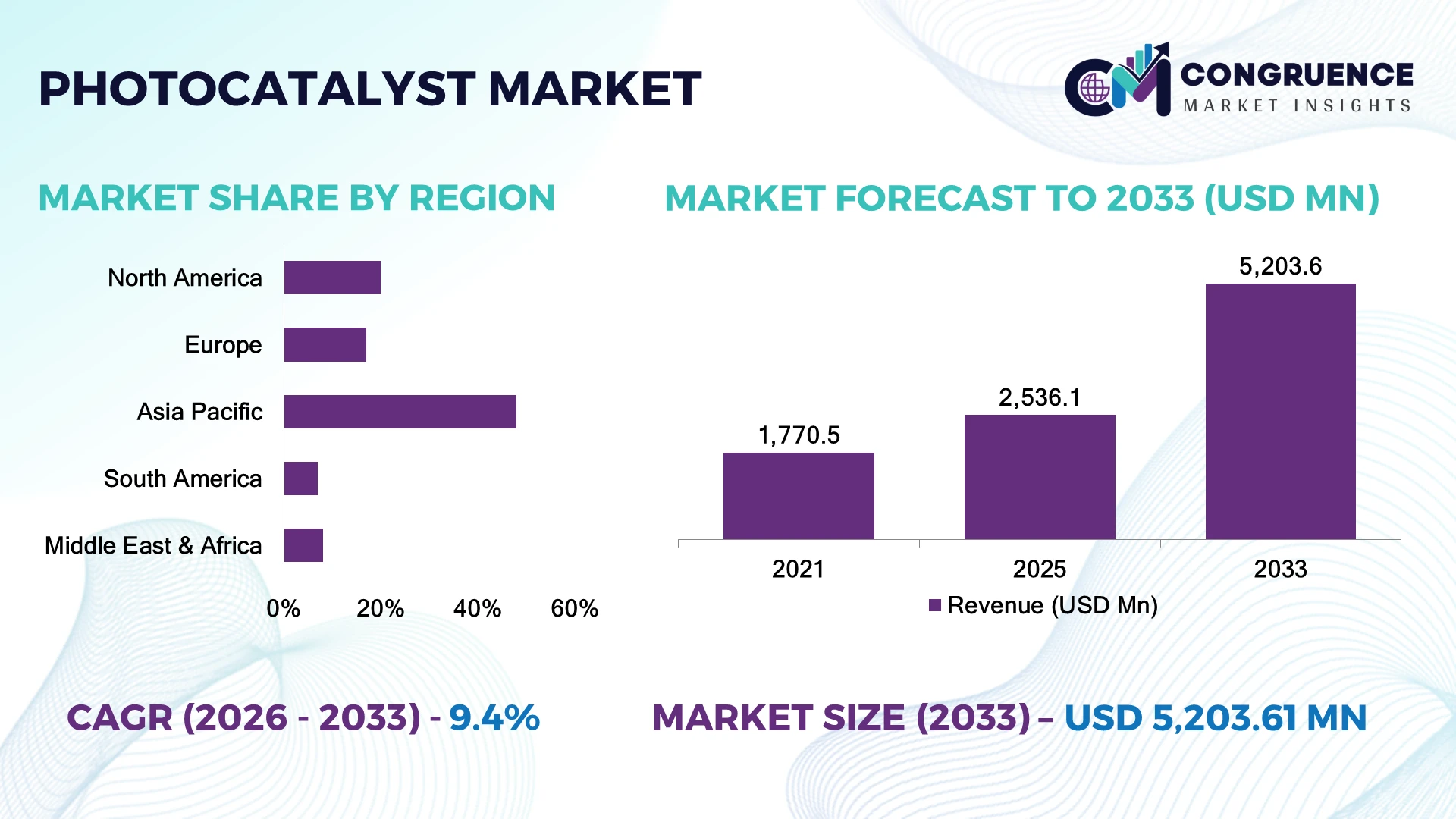
The Global Photocatalyst Market was valued at USD 2,536.1 Million in 2025 and is anticipated to reach a value of USD 5,203.6 Million by 2033 expanding at a CAGR of 9.4% between 2026 and 2033. Growth is being driven by TiO₂-based coatings, photocatalytic air purification, wastewater treatment, and visible-light catalyst development, with manufacturers shifting toward higher-activity formulations.
China remains the dominant country, accounting for an estimated 30–33% of global photocatalyst consumption, supported by cement, construction, environmental-treatment, and chemical manufacturing. Japan contributes roughly 12–15%, led by advanced coating and materials applications, while China’s production scale is approximately 2× Japan’s. Geopolitical supply-chain diversification following U.S.–China trade restrictions is accelerating localized catalyst processing and specialty-grade development.
Strategically, suppliers that combine high quantum efficiency with scalable production and application-specific formulations will capture the strongest industrial opportunities.
Market Size & Growth: USD 2,536.1 million in 2025 to USD 5,203.6 million by 2033 at 9.4% CAGR, supported by environmental remediation and advanced coating adoption.
Top Growth Drivers: Wastewater treatment 31%; air purification 27%; self-cleaning coatings 22%.
Short-Term Forecast: By 2028, process efficiency is projected to improve 12–16%, while catalyst consumption per treated unit declines 8–10%.
Emerging Technologies: Visible-light TiO₂, doped semiconductors, and photocatalytic membranes are advancing activity by 10–20% over conventional formulations.
Regional Leaders: Asia-Pacific leads with approximately 46% share; Europe reaches 24%; North America approaches 20%, driven by environmental-treatment deployment.
Consumer/End-User Trends: Industrial water-treatment adoption is approaching 28%, as manufacturers prioritize lower chemical consumption and continuous treatment systems.
Pilot/Case Example: 2025 industrial photocatalytic wastewater deployments achieved approximately 18% lower organic-load treatment costs through catalyst recovery and optimized irradiation.
Competitive Landscape: Leading suppliers include Kronos Worldwide, Venator Materials, Tronox, Tayca, and Ishihara Sangyo Kaisha, with leading positions concentrated around specialty-grade titanium dioxide and engineered catalysts.
Regulatory & ESG Impact: Stricter pollutant-control requirements are increasing treatment-system adoption by approximately 10–14%, while photocatalysis reduces reliance on chemical oxidants.
Investment & Funding: Industrial investment commitments exceeding USD 500 million are supporting catalyst capacity, membrane integration, and environmental-treatment partnerships.
Innovation & Future Outlook: 2026–2028 development is shifting toward visible-light activation, immobilized catalysts, AI-assisted formulation, and recyclable catalyst architectures.
The Photocatalyst Market is expanding across environmental remediation, architectural surfaces, medical environments, automotive coatings, and industrial process water. Demand is increasingly moving toward visible-light and immobilized formulations, with advanced systems targeting 15–20% higher catalytic activity. In 2026, tighter wastewater discharge controls and supply-chain localization are encouraging manufacturers to develop application-specific catalyst grades, strengthening the strategic value of integrated materials engineering.
Photocatalysts are becoming strategically important because they connect advanced materials engineering with decarbonization, pollution control, and resource-efficiency objectives. Industrial buyers increasingly prioritize technologies that reduce chemical inputs while maintaining treatment performance. In China, Japan, Germany, and the United States, deployment is shifting from laboratory-scale catalyst powders toward immobilized coatings, membranes, and reactor-integrated systems.
Technology differentiation is becoming measurable. Conventional UV-dependent photocatalysts typically require higher irradiation intensity, whereas visible-light-active formulations can deliver approximately 10–15% better usable-light conversion under optimized conditions. Immobilized systems also reduce catalyst recovery requirements, cutting handling losses by an estimated 8–12%. This favors suppliers capable of combining material performance with reactor compatibility rather than competing solely on catalyst purity.
During 2026–2028, industrial wastewater and air-treatment installations are expected to increase adoption of continuous photocatalytic reactors, with automated monitoring improving process consistency by roughly 10%. Companies are responding through R&D partnerships, membrane integration, specialty-grade expansion, and localized production. The strongest competitive position will belong to manufacturers that commercialize durable, recyclable, visible-light catalysts while controlling formulation costs and integration complexity.
Stricter discharge requirements and water-reuse targets are accelerating photocatalytic oxidation in industrial wastewater, particularly across China, Japan, and Germany. Advanced systems can reduce persistent organic contaminants by 80–95% under optimized operating conditions, while catalyst immobilization can reduce material losses by 10–15% versus suspended-powder configurations. China’s industrial parks are increasingly integrating advanced oxidation with membrane treatment, shifting photocatalysts from standalone materials toward process-integrated solutions. This transition improves treatment consistency and reduces downstream chemical demand. Manufacturers are responding through reactor partnerships, immobilized TiO₂ formulations, and visible-light catalyst R&D. The strategic advantage is moving toward suppliers that engineer catalysts around treatment workflows rather than simply maximizing laboratory-level catalytic activity.
Photocatalyst deployment remains constrained by catalyst recovery, irradiation requirements, and performance degradation in complex industrial streams. Suspended catalysts can require 8–15% additional process handling for separation and recovery, while contaminated feedwater can reduce effective catalytic activity by approximately 10–20%. In China and India, variable wastewater composition also increases reactor optimization requirements, complicating standardized deployments. These constraints directly affect operating costs, throughput, and commercial scalability, particularly for continuous treatment facilities. Suppliers are reducing exposure through immobilized catalyst architectures, recyclable supports, and application-specific formulations. The key operational issue is not catalyst availability but maintaining consistent photon utilization and surface activity after repeated industrial cycles, making durability increasingly important in procurement decisions.
Visible-light photocatalysts offer a significant pathway to broaden deployment beyond UV-dependent systems. Doped TiO₂, heterojunction materials, and carbon-based composites can improve usable-light response by approximately 15–30% compared with conventional formulations under optimized conditions. This creates opportunities for lower-energy reactors, indoor air purification, and decentralized wastewater treatment across India, Southeast Asia, and the Middle East. Solar-assisted photocatalytic systems provide another non-obvious opportunity where electricity costs constrain conventional irradiation. Companies are increasing R&D investment in band-gap engineering, catalyst-support integration, and modular reactor platforms. The strongest commercial opportunity lies in designing catalysts that operate efficiently under naturally available light, potentially reducing reactor energy intensity by 10–20% while expanding addressable applications.
Scaling photocatalyst technology from controlled trials to industrial operation remains difficult because catalyst activity can decline 10–25% as surfaces accumulate fouling, inorganic deposits, or reaction intermediates. Reactor-scale photon distribution can also create performance variations of 8–12%, particularly in larger treatment volumes. These factors complicate guaranteed treatment performance and increase commissioning requirements. In Japan and Germany, industrial buyers increasingly demand reproducible performance data across extended operating cycles rather than short laboratory demonstrations. Companies must therefore invest in pilot reactors, real-time optical monitoring, predictive maintenance, and standardized durability testing. The critical competitive challenge is establishing reliable lifetime-performance benchmarks; suppliers that cannot quantify activity retention risk losing projects despite superior initial catalytic efficiency.
Visible-Light Activation Accelerates: Commercial R&D is shifting toward doped TiO₂ and heterojunction catalysts that deliver 15–25% stronger visible-light utilization than conventional TiO₂. Manufacturers are pairing these materials with LEDs and solar-assisted reactors, reducing irradiation intensity requirements by 10–15%. The shift is particularly relevant for decentralized treatment and indoor air-cleaning systems.
Immobilized Catalysts Gain Ground: Industrial operators are moving from slurry-based photocatalysts toward coated membranes, ceramic supports, and structured substrates. Immobilized configurations can reduce catalyst-recovery workload by 20–30% and improve process continuity by approximately 10%. Companies are redesigning reactor modules around reusable catalyst surfaces, responding to labor shortages and stricter wastewater-treatment operating controls.
Hybrid Treatment Systems Expand: Photocatalysis is increasingly integrated with membranes, adsorption, ozonation, and biological treatment rather than deployed independently. Hybrid configurations can improve contaminant-removal efficiency by 10–18% while reducing chemical oxidant requirements by roughly 8–12%. Manufacturers are developing modular treatment trains that allow industrial users to retrofit photocatalytic stages without replacing existing infrastructure.
AI Optimizes Catalyst Performance: Machine-learning tools are entering catalyst formulation and reactor optimization, shortening experimental screening cycles by an estimated 20–30%. Digital models analyze irradiation, residence time, pollutant loading, and catalyst concentration to improve operating consistency. Companies are combining laboratory automation with process sensors, creating a less obvious competitive advantage: faster formulation-to-commercialization cycles rather than simply higher catalyst activity.
Titanium Dioxide (TiO₂) remains the leading photocatalyst type, accounting for approximately 61–62% of the market, supported by mature manufacturing infrastructure, broad supplier availability, chemical stability, and established performance across coatings, air purification, and water treatment. Its scale advantage keeps qualification and formulation costs comparatively low, making TiO₂ the preferred platform for high-volume applications. Zinc Oxide (ZnO) is the fastest-growing major type, advancing at approximately 9–10%, driven by antimicrobial coatings, visible-light activity, and emerging hydrogen-generation applications.
Other types, including Tungsten Oxide (WO₃), graphitic carbon nitride, graphene-based composites, and engineered multi-component catalysts, remain smaller but strategically important where visible-light response and higher selectivity outweigh material cost. Advanced formulations can improve targeted catalytic performance by 10–20%, encouraging suppliers to shift investment toward doped and heterojunction architectures. Companies are retaining TiO₂ capacity for volume markets while allocating R&D toward ZnO and specialty catalysts, creating a two-track portfolio strategy: scale-led conventional supply combined with application-specific premium materials.
A 2025 market assessment placed TiO₂ at approximately 61.45% share and identified ZnO as the fastest-growing major type, reinforcing the shift toward application-specific catalyst engineering.
Self-Cleaning Surfaces represent the leading application, capturing approximately 40–60% of demand depending on market scope, supported by construction façades, architectural glass, automotive surfaces, and other assets where reduced cleaning frequency improves lifecycle economics. Air Purification follows with roughly 30%, benefiting from photocatalytic VOC and odor-control systems integrated into commercial buildings and filtration architectures. Water Treatment remains strategically important at approximately 19–30%, with demand concentrated in industrial facilities handling persistent organic contaminants.
Water Treatment is emerging as the strongest operationally intensive opportunity because photocatalysis can complement biological and membrane processes rather than replace them. Adoption is accelerating as industrial users target approximately 10–20% reductions in chemical-treatment intensity through hybrid oxidation systems. Anti-Fogging and Anti-Soiling Coatings and other niche applications remain smaller but offer higher specialization, particularly for optical surfaces and energy infrastructure. Companies are prioritizing application-specific formulations, reactor integration, and coating partnerships instead of universal catalyst grades. The business implication is clear: self-cleaning surfaces provide scale, while water treatment increasingly drives technology differentiation and engineered-system investment.
A 2025 market assessment placed self-cleaning surfaces at about 41% share, with air purification near 30% and water treatment near 19%, highlighting the expanding role of environmental-treatment applications.
Construction and infrastructure represent the dominant end-user group, accounting for approximately 45% of market demand, because photocatalytic materials can be integrated into façades, glazing, concrete, tiles, and exterior coatings at project scale. Large infrastructure projects favor TiO₂-based formulations because procurement teams prioritize durability, established specifications, and predictable maintenance economics. Industrial environmental-treatment users form the fastest-expanding adoption group, supported by wastewater, VOC, and air-pollution control requirements. Their share is estimated at roughly 20–25%, with purchasing increasingly tied to measurable treatment performance rather than material price alone.
Automotive, chemical and petrochemical, textile and consumer-goods, food and beverage, and other specialized users remain important secondary buyers. Automotive and consumer applications favor antimicrobial, self-cleaning, and anti-soiling functionality, while chemical and industrial buyers prioritize catalyst durability and reactor compatibility. Industrial deployments can achieve approximately 10–15% lower chemical-treatment requirements when photocatalysis is integrated with complementary processes. Companies are responding with customized catalyst grades, technical partnerships, and modular systems tailored to individual operating conditions. Future purchasing power is therefore shifting toward industrial users capable of validating lifecycle savings, while construction remains the principal volume anchor.
A 2025 market assessment identified construction and infrastructure as the largest end-use industry at approximately 45.1%, demonstrating the continuing importance of project-scale material integration.
Asia-Pacific accounted for the largest market share at 47.9% in 2025 however, North America is expected to register the fastest growth, expanding at a CAGR of 9.6% between 2026 and 2033.

Advanced environmental applications are shifting demand toward high-performance photocatalysts
North America remains a high-value photocatalyst market, supported by advanced water-treatment infrastructure, building-material innovation, and demand for air-purification technologies. The United States represents the regional center, accounting for approximately 89% of North American market value in 2025, while technology development increasingly targets visible-light activation and multifunctional coatings. Photocatalytic materials are moving beyond conventional self-cleaning applications into pollution-control surfaces and solar-integrated systems. Recent research has demonstrated TiO₂-coated solar-panel surfaces as a dual-purpose platform for energy generation and NOx remediation, strengthening the commercial case for functional coatings. Companies are responding through R&D partnerships, specialty-material development, and application-specific product portfolios.
United States Market Outlook: The United States leads regional adoption through its combination of advanced materials research, large municipal water-treatment networks, construction activity, and environmental technology investment. Photocatalyst deployment is increasingly tied to multifunctional surfaces rather than standalone treatment equipment. The country generated approximately USD 382.1 million in photocatalyst market value in 2025, reinforcing its role as the principal North American commercialization base.
Regulatory pressure is accelerating visible-light and pollution-control applications
Europe is becoming an important innovation center for photocatalysts as stringent air-quality requirements push manufacturers toward more selective and durable materials. Photocatalytic coatings, concrete, pavements, and indoor surfaces are gaining attention for NOx and VOC mitigation, while visible-light-active formulations address the limitations of conventional UV-dependent TiO₂. Field research has recorded NOx reductions of approximately 5–20% under real-world conditions, strengthening interest in urban infrastructure applications. Companies are therefore prioritizing catalyst selectivity, lower chemical consumption, and integration into construction materials rather than selling catalysts as isolated inputs.
Germany Market Outlook: Germany offers a strong commercialization base through its advanced chemical manufacturing, construction-material ecosystem, and environmental engineering capabilities. Photocatalytic technologies align with industrial decarbonization and urban air-quality priorities, particularly where coatings and cementitious materials can provide passive pollutant treatment. German manufacturers are positioned to benefit from higher-value formulations that emphasize durability, visible-light performance, and integration with building materials rather than commodity catalyst pricing.
Manufacturing scale and application breadth reinforce regional dominance
Asia-Pacific holds the strongest market position, supported by extensive chemical manufacturing capacity, urban construction, water-treatment investment, and established photocatalyst adoption in Japan, China, South Korea, and India. The region represented about 47.9% of the global market in 2025, with Japan retaining a particularly strong position in self-cleaning and functional coating technologies. China combines large-scale materials production with environmental infrastructure deployment, while India is expanding water and sanitation capacity. Companies are strengthening local production, application partnerships, and catalyst formulations suited to construction, environmental remediation, and industrial surfaces. The region’s competitive advantage increasingly comes from combining low-cost production with rapid application commercialization.
China Market Outlook: China represents the most strategically significant country because of its scale in chemicals, construction materials, environmental infrastructure, and industrial manufacturing. Large urban-development programs create extensive surfaces for photocatalytic coatings, while domestic catalyst production supports cost-sensitive deployment. Environmental programs targeting air pollution and water quality continue to reinforce adoption across municipal and industrial applications, giving Chinese producers an advantage in volume manufacturing and integrated supply chains.
Water treatment and urban infrastructure are opening application-led demand
South America remains an emerging photocatalyst market, with Brazil providing the strongest commercial base through construction activity, environmental infrastructure, and industrial water-treatment requirements. Demand is increasingly application-driven rather than catalyst-material driven, creating opportunities for suppliers offering complete coating, filtration, and treatment solutions. Photocatalytic materials can address pollutant degradation while reducing dependence on intensive chemical cleaning in suitable applications. Companies are therefore pursuing distributor partnerships and localized formulation strategies to manage logistics, climatic conditions, and project-specific performance requirements. Brazil’s industrial concentration gives suppliers a practical entry point, while uneven infrastructure investment across neighboring economies limits uniform deployment and favors targeted commercial expansion.
Brazil Market Outlook: Brazil offers the strongest South American opportunity because of its large construction sector, industrial wastewater requirements, and concentration of urban infrastructure projects. Photocatalyst suppliers can target high-value applications such as self-cleaning façades, wastewater treatment, and air-pollution control rather than compete solely on material pricing. Local partnerships remain strategically important because project specifications, technical support, and application engineering strongly influence procurement decisions.
Infrastructure modernization is creating high-value niches for functional coatings
Middle East & Africa is developing through infrastructure modernization, water scarcity, high solar exposure, and large-scale construction programs. Photocatalytic coatings are particularly relevant where self-cleaning surfaces, air purification, and wastewater treatment can reduce recurring maintenance requirements. The region’s strong solar resource also improves the operating proposition for sunlight-activated TiO₂ technologies, although dust accumulation and surface maintenance remain important design considerations. Gulf construction programs are creating opportunities for specialty coatings integrated into façades, pavements, transport infrastructure, and public facilities. Companies are responding through project-based partnerships, localized technical support, and application-specific formulations rather than pursuing broad commodity distribution.
Saudi Arabia Market Outlook: Saudi Arabia represents the region’s strongest strategic market because of its large infrastructure pipeline, water-treatment priorities, and extensive construction investment. Photocatalytic materials can complement smart-building and environmental infrastructure programs where passive surface treatment reduces maintenance intensity. High solar exposure provides a favorable operating environment for light-activated systems, while suppliers with durable formulations and strong project-engineering capabilities are best positioned for large infrastructure contracts.
The photocatalyst market pits global TiO₂ producers such as Tronox, Kronos Worldwide, and Chemours against specialty innovators including Evonik, TOTO, Ishihara Sangyo Kaisha, and application-focused coating specialists. Scale leaders compete on pigment supply, while technology players differentiate through visible-light activation, surface engineering, and application integration. The top five players collectively account for an estimated 35% of market value, indicating moderate concentration. Price remains decisive in commodity TiO₂, with roughly 15–20% cost differences influencing procurement, while specialty formulations command 10–15% performance premiums. Companies are expanding catalyst portfolios, developing coating partnerships, and integrating formulation capabilities to secure downstream margins. Competition is shifting toward visible-light systems, composite catalysts, and application-specific solutions, reducing reliance on conventional UV-driven TiO₂. High qualification requirements, material consistency, and application validation create entry barriers. Winning requires scalable production, validated performance, reliable feedstock access, and customized solutions that convert photocatalytic activity into measurable customer outcomes.
Tronox Holdings plc
Kronos Worldwide, Inc.
The Chemours Company
Evonik Industries AG
Ishihara Sangyo Kaisha, Ltd.
TOTO Ltd.
BASF SE
Tayca Corporation
Sakai Chemical Industry Co., Ltd.
Nippon Soda Co., Ltd.
Nanoptek Corporation
Daicel Corporation
Resonac Holdings Corporation
Saint-Gobain S.A.
Titanium dioxide remains the commercial baseline, accounting for about 61.45% of photocatalyst demand, supported by mature manufacturing and established coating know-how. Visible-light-responsive TiO₂, doped oxides, and surface-modified catalysts are moving beyond UV dependence. These formulations can improve usable-light response by roughly 10–20%, while engineered surfaces reduce recombination losses and improve reaction efficiency by 5–15%. Adoption is strongest in self-cleaning coatings, air purification, and wastewater treatment.
Composite photocatalysts combining TiO₂ with graphene, bismuth oxides, noble metals, or carbon nitride are becoming more relevant for hydrogen generation and pollutant degradation. Advanced laboratory systems have demonstrated substantially higher reaction rates than conventional P25-TiO₂, with some architectures delivering more than threefold faster reaction kinetics. AI-assisted material screening is also shortening formulation cycles, helping developers prioritize high-performing compositions before pilot production. Specialty innovators benefit most because performance differentiation supports premium pricing and application-specific contracts.
Between 2026 and 2028, photocatalyst technology will increasingly integrate catalysts with coatings, membranes, reactors, filtration media, and smart monitoring systems. Solar-activated wastewater platforms and multifunctional building surfaces will gain commercial relevance as customers prioritize lower chemical and maintenance intensity. Companies combining catalyst production with application engineering will hold the strongest competitive position, while commodity suppliers face pressure to upgrade from volume-based TiO₂ toward higher-value functional formulations.
December 2024 BASF inaugurated its Catalyst Development and Solids Processing Center in Ludwigshafen, backed by a high double-digit million-euro investment. The facility enables pilot-scale catalyst synthesis and faster technology development, strengthening industrial catalyst innovation and accelerating commercialization of advanced catalytic processes. Source: basf.com
May 2025 Souma expanded practical photocatalyst deployment through a Tokyo smoking-room project using visible-light PALCCOAT VLAG. The application targeted odors, bacteria, viruses, fungi, and VOCs, demonstrating continued movement toward indoor-air-quality applications and strengthening demand for visible-light coating solutions. Source: palccoat.com
October 2025 Souma secured SIRIM Eco Label and MyHIJAU Mark certifications for PALCCOAT CLEAR products and services. The certification covers environmental performance, safety, manufacturing, and functionality, strengthening procurement positioning for environmentally specified construction and facility-management projects in Malaysia. Source: palccoat.com
July 2026 Researchers demonstrated a 3D microlattice coated with an MXene ternary photocatalyst that achieved 99.5% tetracycline mineralization within 30 minutes under solar light. Reaction kinetics exceeded benchmark P25-TiO₂ by more than threefold, highlighting a disruptive shift toward recoverable, reusable photocatalytic architectures. Source: sciencedirect.com
The Photocatalyst Market Report evaluates the industry across photocatalyst types including titanium dioxide, zinc oxide, tungsten oxide, graphitic carbon nitride, and composite or doped materials. Application coverage includes self-cleaning surfaces and coatings, air purification, water and wastewater treatment, antimicrobial and anti-fogging systems, hydrogen generation, and other emerging uses. End-use analysis spans construction, healthcare, automotive, industrial processing, consumer applications, and environmental infrastructure.
The report provides country-level and regional assessment across North America, Europe, Asia-Pacific, South America, and the Middle East & Africa, with emphasis on China, Japan, the United States, Germany, and India. It evaluates visible-light catalysts, composite nanomaterials, AI-assisted material discovery, photocatalytic membranes, and integrated treatment systems. Competitive analysis covers 10–14 major companies and supports investment planning, technology prioritization, geographic expansion, partnership strategy, and competitive positioning through 2026–2033.
| Report Attribute/Metric | Report Details |
|---|---|
|
Market Revenue in 2025 |
USD 2,536.1 Million |
|
Market Revenue in 2033 |
USD 5,203.6 Million |
|
CAGR (2026 - 2033) |
9.4% |
|
Base Year |
2025 |
|
Forecast Period |
2026 - 2033 |
|
Historic Period |
2021 - 2025 |
|
Segments Covered |
By Type
By Application
By End-User
|
|
Key Report Deliverable |
Revenue Forecast, Growth Trends, Market Dynamics, Segmental Overview, Regional and Country-wise Analysis, Competition Landscape |
|
Region Covered |
North America, Europe, Asia-Pacific, South America, Middle East, Africa |
|
Key Players Analyzed |
Tronox Holdings plc, Kronos Worldwide, Inc., The Chemours Company, Evonik Industries AG, Ishihara Sangyo Kaisha, Ltd., TOTO Ltd., BASF SE, Tayca Corporation, Sakai Chemical Industry Co., Ltd., Nippon Soda Co., Ltd., Nanoptek Corporation, Daicel Corporation, Resonac Holdings Corporation, Saint-Gobain S.A. |
|
Customization & Pricing |
Available on Request (10% Customization is Free) |




