
Reports
The Global Phosphonate Market was valued at USD 1,149.3 Million in 2025 and is anticipated to reach a value of USD 1,659.6 Million by 2033 expanding at a CAGR of 4.7% between 2026 and 2033. Growth is driven by water-treatment scale control, oilfield flow assurance, detergent formulations, and corrosion inhibition, alongside rising adoption of lower-phosphorus formulations.
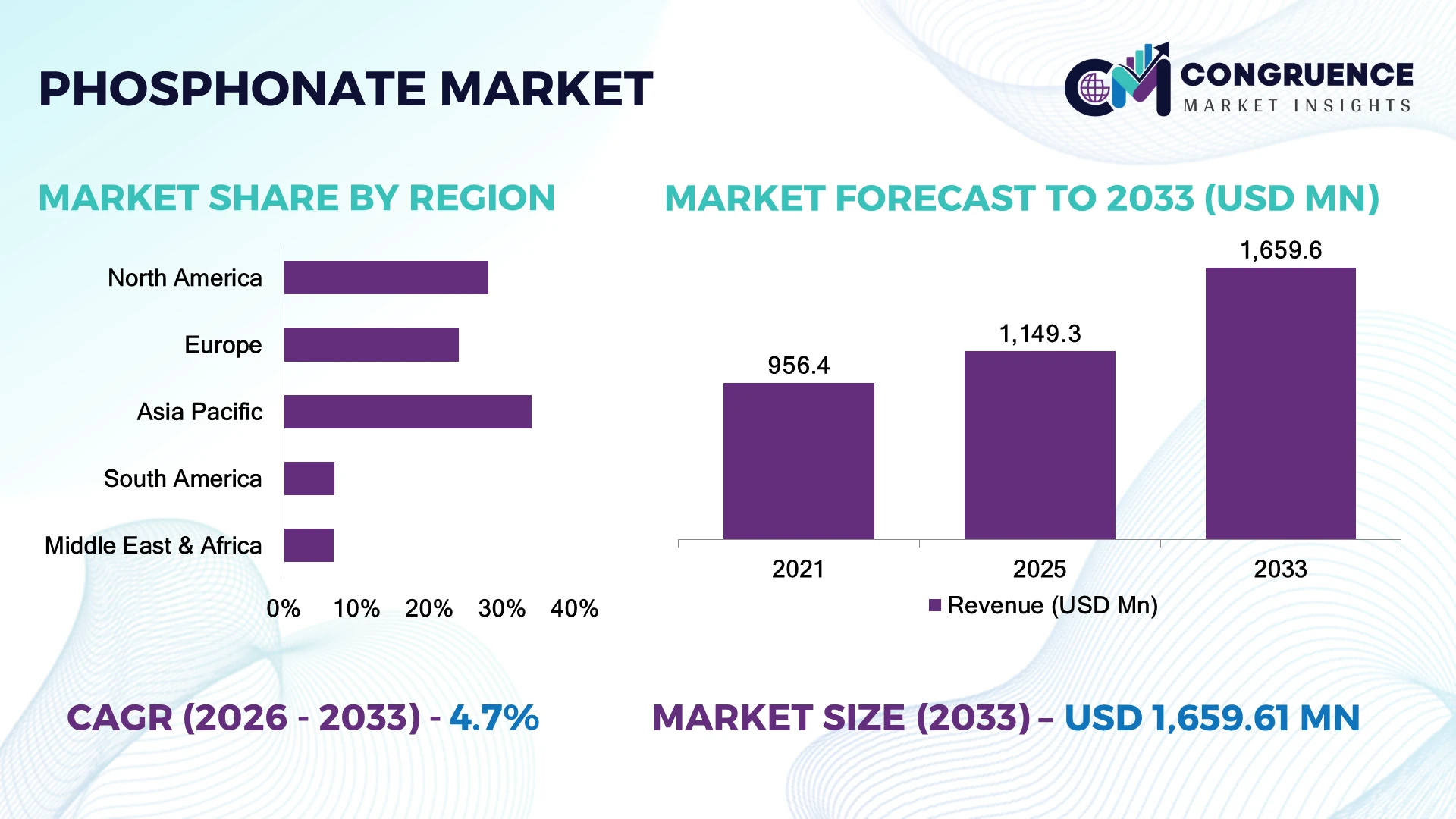
China represents approximately 38% of global phosphonate production capacity, supported by water treatment, oilfield chemicals, detergents, and industrial process chemicals, while the United States contributes about 16%. Advanced phosphonate formulations can deliver scale inhibition at concentrations below 10 mg/L. EU phosphorus-discharge pressure is accelerating development of biodegradable and lower-phosphorus alternatives, while Chinese producers retain cost and feedstock advantages.
Strategically, suppliers should prioritize high-efficiency formulations, regional production, lower-phosphorus chemistry, and application-specific technical support to defend industrial accounts.
Market Size & Growth: USD 1,149.3 million in 2025 to USD 1,659.6 million by 2033 at 4.7% CAGR, driven by industrial water treatment and advanced scale-control chemistry.
Top Growth Drivers: Water treatment 34%; oil & gas 24%; detergents 17%.
Short-Term Forecast: By 2028, optimized inhibitor dosing can reduce chemical consumption 10–15% while maintaining scale-control performance.
Emerging Technologies: Low-phosphorus blends, biodegradable phosphonates, hybrid polymer-phosphonate systems, and AI-assisted water chemistry monitoring.
Regional Leaders: Asia-Pacific USD 640 million; North America USD 390 million; Europe USD 350 million, with lower-phosphorus formulations gaining adoption.
Consumer/End-User Trends: Industrial water-treatment users represent approximately 34% of demand, increasingly adopting automated dosing and online monitoring.
Pilot/Case Example: 2026 hybrid polymer-phosphonate testing demonstrated strong scale-control performance under simulated oilfield water-flooding conditions.
Competitive Landscape: China-based suppliers collectively hold approximately 38% production capacity, competing with Italmatch Chemicals, Thermphos, Aquapharm, and Zschimmer & Schwarz.
Regulatory & ESG Impact: Phosphorus-discharge restrictions are accelerating lower-phosphorus chemistry and improving environmental performance by reducing phosphorus loading in treated effluent.
Investment & Funding: Approximately USD 210 million is being directed toward specialty chemical expansion, green-formulation development, water-treatment partnerships, and regional production.
Innovation & Future Outlook: Hybrid phosphonate-polymer inhibitors, biodegradable chemistry, and precision dosing will shift competition from volume supply toward performance-per-dose and environmental compatibility.
The Phosphonate Market is concentrated in industrial water treatment, oilfield scale inhibition, detergents, cooling systems, desalination, and corrosion control. Water-treatment applications account for approximately 34% of demand, while hybrid polymer-phosphonate formulations and lower-phosphorus chemistries are gaining traction. Stricter phosphorus-discharge requirements are pushing manufacturers toward reformulation, creating a transition from conventional inhibitors toward performance-optimized alternatives.
The Phosphonate Market is becoming strategically important because scale and corrosion control directly affect uptime, energy consumption, membrane performance, and asset life across water-intensive industries. Industrial buyers increasingly evaluate inhibitors on performance per dosage rather than purchase price alone. Regulatory pressure on phosphorus discharge is simultaneously restructuring product portfolios, particularly in Europe and advanced wastewater applications.
Technology is shifting from conventional phosphonate-only formulations toward hybrid polymer-phosphonate systems and lower-phosphorus blends. Optimized formulations can maintain effective scale control at sub-10 mg/L concentrations, while precision dosing can reduce chemical consumption by roughly 10–15% versus poorly optimized treatment programs. China maintains the strongest manufacturing scale, while European suppliers are differentiating through environmental performance and formulation innovation.
During 2026–2028, adoption will concentrate on automated dosing, online water-quality monitoring, biodegradable chemistry, and hybrid inhibitors. Oilfield operators are already evaluating phosphonate-polymer blends under high-salinity and high-temperature conditions, while desalination operators are tightening antiscalant selection around membrane compatibility and concentrate management. Suppliers are therefore increasing R&D, forming application partnerships, and localizing technical service. Competitive advantage will depend on delivering lower dosage, reliable performance, regulatory compatibility, and measurable lifecycle savings.
Industrial water treatment accounts for approximately 34% of phosphonate demand, while cooling-water and boiler applications collectively represent nearly 28%. Rising membrane deployment and tighter asset-efficiency requirements are increasing demand for high-performance scale inhibitors. In China, expanding desalination and industrial water-reuse systems are shifting procurement toward lower-dosage formulations that deliver stronger calcium-carbonate and sulfate control. Precision dosing can reduce inhibitor consumption by 10–15% without sacrificing protection when water chemistry is continuously monitored. Producers are responding through polymer-phosphonate development, technical partnerships with treatment integrators, and localized formulation capacity. The strategic advantage is moving toward performance-per-dose, enabling suppliers to win contracts through measurable chemical savings rather than volume pricing alone.
Phosphonate suppliers face increasing formulation constraints as wastewater operators and detergent manufacturers reduce phosphorus loading. Regulatory pressure can require reformulation affecting 15–25% of product formulations in sensitive applications, while alternative chemistries can increase treatment costs by 8–12%. European manufacturers face stronger discharge-management requirements than many Asian industrial markets, accelerating substitution discussions. Supply dependency also remains concentrated in China, where large-scale production supports competitive pricing but exposes international buyers to freight and trade disruptions. Companies are mitigating risk through regional inventories, dual sourcing, lower-phosphorus formulations, and polymer-based alternatives. The non-obvious constraint is qualification cost: replacing a proven inhibitor requires field validation, compatibility testing, and customer approval, slowing substitution even when regulatory pressure is immediate.
Hybrid phosphonate-polymer inhibitors offer a differentiated opportunity in high-salinity cooling systems, desalination, and oilfield water management. Optimized formulations can reduce chemical dosage by approximately 10–20%, while automated dosing systems can improve treatment consistency by 8–15%. Saudi Arabia and the United Arab Emirates are expanding water-reuse and desalination infrastructure, creating technically demanding applications where membrane compatibility and concentrate management matter. Suppliers are investing in laboratory simulation, digital water-chemistry monitoring, and partnerships with treatment-system integrators. A less obvious opportunity is retrofit economics: upgrading dosing and inhibitor chemistry on existing assets can deliver measurable chemical savings without replacing core equipment. Companies that combine formulation IP with monitoring and technical service can capture recurring treatment contracts and defend margins.
Phosphonate performance varies substantially with hardness, temperature, pH, iron levels, and competing treatment chemicals, making deployment consistency a major technical challenge. Industrial systems can experience 10–20% variation in water chemistry across operating cycles, while high-temperature oilfield environments impose substantially tighter formulation requirements. Digital dosing platforms require reliable sensors, calibration, and operator competency, with poorly maintained instrumentation capable of undermining treatment optimization. U.S. and Middle Eastern operators are therefore increasing laboratory validation and remote monitoring before full-scale deployment. Producers must invest in formulation modeling, sensor integration, field-service expertise, and application testing. The critical strategic issue is proving performance under actual operating conditions: suppliers that cannot translate laboratory efficacy into stable field control face longer qualification cycles and weaker renewal rates.
Hybrid Formulations Gain Traction: Polymer-phosphonate blends are increasingly replacing single-component inhibitors in demanding cooling, desalination, and oilfield systems. Formulation optimization can reduce chemical dosage by 10–20% while improving tolerance to variable hardness and temperature. Producers are expanding laboratory testing and partnering with water-treatment integrators to validate performance across more complex operating conditions.
Digital Dosing Becomes Standard: Automated inhibitor dosing is expanding across industrial water systems as operators seek tighter chemical control. Continuous monitoring can improve dosage consistency by 8–15% and reduce unnecessary chemical consumption by 10–12%. U.S. facilities are increasingly integrating sensors with centralized control platforms, shifting supplier competition toward treatment optimization and service capability.
Lower-Phosphorus Products Accelerate: European discharge-management requirements are pushing detergent and water-treatment formulators toward reduced-phosphorus chemistry. Reformulation programs can affect 15–25% of sensitive product portfolios, increasing demand for polymeric and biodegradable alternatives. Manufacturers are developing hybrid packages that preserve scale-control performance while reducing phosphorus loading, protecting regulatory access without sacrificing operational efficiency.
Regional Supply Buffers Expand: Buyers are strengthening inventories of critical phosphonate grades following freight volatility and supply-chain disruptions. Regional safety stocks are increasing approximately 10–20% for selected industrial users, particularly where imported specialty chemicals face extended lead times. Producers are responding through localized blending, distributor partnerships, and dual-feedstock sourcing, turning supply reliability into a procurement differentiator.
ATMP remains a leading phosphonate type, accounting for approximately 27% of 2025 demand, supported by strong scale inhibition, corrosion control, and compatibility across cooling-water, boiler, oilfield, and industrial cleaning systems. HEDP follows closely at roughly 25%, reflecting its broad operating-temperature tolerance and established formulation base. DTPMP represents about 15–20%, with stronger relevance in demanding oilfield and high-salinity applications. PBTC/PBTCA and EDTMP retain smaller shares but remain strategically important where conventional chemistries face performance or phosphorus constraints.
The fastest-moving shift is toward hybrid phosphonate-polymer systems rather than dependence on a single established chemistry. Companies are investing in application-specific blends that can reduce inhibitor dosage by approximately 10–20% and improve performance under difficult water chemistry. Oilfield applications are particularly important because high salinity, elevated temperature, and complex mineral compositions require more robust inhibition. Producers are therefore expanding formulation R&D, partnering with water-treatment integrators, and prioritizing specialty grades. The business implication is clear: investment is shifting from commodity phosphonate capacity toward differentiated formulations capable of delivering higher performance per unit of chemical consumed.
A 2026 scale-inhibition modeling study achieved R² values of 0.9182 for training and 0.9306 for testing, demonstrating growing potential for data-assisted phosphonate formulation and performance prediction.
Water treatment is the leading application, representing approximately 50% of phosphonate demand in 2025, substantially ahead of oil & gas, detergents and cleaning, pulp and paper, textiles, and other specialty uses. Its dominance reflects continuous requirements for scale inhibition, corrosion control, membrane protection, and metal-ion management across cooling towers, boilers, desalination plants, and industrial reuse systems. Oil & gas is the fastest-shifting application, supported by water flooding, produced-water reinjection, and increasingly severe high-temperature and high-salinity operating conditions. Detergent applications remain mature but are being reshaped by phosphorus-reduction requirements.
Companies are moving beyond conventional dosage programs toward automated treatment and application-specific chemistry. Optimized inhibitor programs can reduce chemical consumption by approximately 10–15%, while hybrid formulations can achieve more than 90% scale inhibition under selected oilfield conditions. This is shifting purchasing criteria from chemical price toward lifecycle performance, retention, and measurable operating savings. Suppliers are expanding technical-service teams, partnering with treatment integrators, and developing customized inhibitor packages for desalination, power generation, and oilfield customers. Water-treatment demand is therefore becoming increasingly technology-intensive rather than simply volume-driven.
Global industrial water consumption reached approximately 828 km³ in 2024, reinforcing the need for scale-control chemistry as manufacturers expand water reuse and closed-loop treatment systems.
Water-treatment operators and industrial water users form the dominant end-user group, accounting for approximately 34% of phosphonate demand based on application-linked consumption patterns. Their purchasing intensity reflects continuous chemical dosing, asset-protection requirements, and dependence on stable water chemistry across manufacturing, power generation, chemicals, and desalination. Oilfield chemical users represent roughly 24%, while detergent and cleaning manufacturers contribute around 17%. Oil & gas is becoming the fastest-changing buyer group because water flooding and reinjection expose assets to increasingly complex brine chemistry, requiring higher-performance inhibitors and tailored formulations.
Established buyers typically prioritize validated performance, supply continuity, and total treatment cost, whereas newer high-performance users increasingly demand digital dosing compatibility and lower-phosphorus formulations. Automated treatment can reduce chemical consumption by approximately 10–15%, while industrial water-efficiency programs can reduce water use by 10–50%. Companies are responding with contract-based technical support, localized blending, customized formulations, and partnerships with engineering firms. The competitive advantage is shifting toward solution bundles combining phosphonate chemistry, dosing equipment, monitoring, and ongoing optimization rather than standalone chemical supply.
A 2025 international water-management survey covering 127 experts across 41 countries found more than 90% of respondents using advanced modeling, while 80% used or planned to use remote sensing, accelerating digital management of industrial water operations.
Asia Pacific accounted for the largest market share at 34.0% in 2025 moreover, Asia-Pacific is also expected to register the fastest growth, expanding at a CAGR of 6.4% between 2026 and 2033.
Industrial Water Reuse Drives Higher-Value Chemistry
North America holds approximately 28.1% of the global phosphonate market, supported by mature industrial water treatment, oilfield operations, power generation, and specialty chemical manufacturing. The United States represents the largest regional demand center, with phosphonates increasingly integrated into cooling-water, membrane, boiler, and refinery treatment programs. Industrial water-treatment modernization is shifting purchasing toward lower-dosage formulations and automated chemical management, while environmental compliance is encouraging biodegradable and lower-impact chemistry. U.S. industrial water-treatment investment is also strengthening demand for specialty scale inhibitors as membrane systems and water reuse expand. Producers are responding through localized supply agreements, technical-service partnerships, and formulation upgrades rather than competing solely on commodity pricing. The strategic shift is toward lifecycle treatment economics, where chemical suppliers increasingly support dosing optimization and asset-performance monitoring.
United States Market Outlook: The United States dominates North American phosphonate consumption because of its extensive refining, chemical, power, food-processing, and industrial manufacturing base. The country's industrial water-treatment market generated approximately USD 9.5 billion in 2024, providing a substantial downstream platform for scale-control and corrosion-inhibition chemicals. Producers are increasingly targeting membrane treatment, industrial reuse, and digitally monitored dosing systems to strengthen recurring enterprise contracts.
Regulatory Reform Accelerates Formulation Redesign
Europe represents a major established phosphonate market, with Germany, France, Italy, and the United Kingdom forming important industrial demand centers. Water treatment, detergents, chemical processing, and manufacturing remain core applications, but regulatory pressure is changing formulation economics. The European Union's 2026 detergent regulation maintains phosphorus limits below 0.5 grams for consumer laundry detergents and 0.3 grams for automatic dishwasher detergents, encouraging manufacturers to optimize phosphorus-containing formulations and evaluate alternatives. Producers are consequently investing in lower-phosphorus blends, biodegradable chemistry, and higher-efficiency treatment packages. The region's competitive advantage is shifting from manufacturing scale toward regulatory expertise, formulation qualification, and specialty-grade development.
Germany Market Outlook: Germany remains a strategically important European market because of its concentrated chemical manufacturing, automotive, industrial-processing, and water-treatment infrastructure. Its phosphonate demand is increasingly shaped by environmental compliance and high-efficiency industrial treatment. Specialty chemical suppliers are emphasizing documented formulation performance and lower-impact chemistry, while industrial buyers increasingly evaluate treatment chemicals according to phosphorus loading, operating efficiency, and regulatory compatibility.
Manufacturing Scale Meets Water-Intensity Demand
Asia-Pacific is becoming the principal expansion engine for phosphonates, supported by China's large chemical manufacturing base, India's industrial water requirements, and expanding Southeast Asian processing capacity. China accounts for approximately 38% of global phosphonate production capacity, giving domestic suppliers substantial advantages in feedstock access, manufacturing scale, and export competitiveness. Water treatment, cooling systems, industrial manufacturing, and detergents collectively create strong regional consumption, while infrastructure modernization is increasing demand for scale-control chemistry. Chinese phosphonate prices reached approximately USD 987 per tonne in March 2025, illustrating the importance of upstream phosphorus economics to regional competitiveness. Producers are expanding capacity, securing feedstock contracts, and developing higher-performance formulations for international customers.
China Market Outlook: China is the region's most strategically significant phosphonate market and production hub, supported by extensive chemical manufacturing, industrial water treatment, and export-oriented specialty chemical capacity. Domestic producers benefit from integrated supply chains and competitive manufacturing economics, while tighter environmental requirements are encouraging improved process efficiency and specialty formulations. Companies are increasingly balancing high-volume production with higher-margin water-treatment grades to strengthen export resilience.
Industrial Water Efficiency Broadens Specialty Demand
South America represents a smaller but strategically relevant phosphonate market, supported by mining, food processing, pulp and paper, chemicals, power generation, and municipal water treatment. Brazil dominates regional demand because of its diversified industrial base and extensive agricultural and mining activity. Water-intensive mining operations are particularly relevant because scale and corrosion control directly affect equipment availability and process-water reuse. Industrial buyers are increasingly adopting treatment programs that combine chemical dosing with water-quality monitoring, creating demand for higher-performance formulations. However, fragmented infrastructure and uneven technical-service coverage can limit deployment consistency outside major industrial hubs. Suppliers are therefore strengthening distributor networks, local technical support, and application-specific formulations. The key opportunity lies in converting large industrial water users from periodic chemical purchasing toward recurring treatment-management contracts.
Brazil Market Outlook: Brazil provides the strongest commercial base in South America because of its mining, pulp and paper, food-processing, chemicals, and industrial utility sectors. Large processing facilities require continuous scale and corrosion management across cooling and process-water systems. Suppliers are increasingly partnering with local treatment companies to improve technical coverage and shorten chemical replenishment cycles, particularly around São Paulo, Minas Gerais, and major mining corridors.
Desalination Investment Reshapes Treatment Demand
Middle East & Africa demand is increasingly concentrated around desalination, municipal water reuse, oilfield operations, and industrial water treatment. Saudi Arabia and the Gulf states represent the strongest demand centers because membrane-based desalination and large-scale water transmission require continuous antiscalant and scale-control programs. Saudi Arabia's water sector had more than USD 64 billion in investment capabilities across desalination, groundwater, and distribution by 2025, while the country operates desalination capacity exceeding 16 million cubic meters per day. These infrastructure programs are increasing demand for high-efficiency phosphonate and hybrid inhibitor packages. Suppliers are responding through long-term service partnerships, localized technical support, and formulations optimized for high salinity and membrane compatibility.
Saudi Arabia Market Outlook: Saudi Arabia is the region's most strategically significant phosphonate market because of its unusually large desalination and water-distribution infrastructure. A 2025 financing agreement committed USD 650 million toward Jubail and Khobar desalination systems, including major reverse-osmosis infrastructure. The scale of these projects increases recurring demand for membrane-compatible antiscalants and high-performance scale inhibitors, while national water-efficiency targets encourage lower-dosage treatment chemistry.
Italmatch Chemicals, Shandong Taihe Water Treatment Technologies, Changzhou Kewei Fine Chemicals, Aquapharm Chemicals, and Zschimmer & Schwarz compete, with global specialty suppliers facing Chinese cost leaders and Indian formulation specialists. The top five players hold approximately 33.4% combined share, leaving substantial fragmented capacity. Competition centers on price, purity, customization, supply security, and formulation performance; specialty grades can command 8–12% premiums, while optimized dosing can reduce chemical consumption 10–20%. Italmatch differentiates through integrated phosphonate-polymer portfolios and global production, Chinese suppliers compete through scale and feedstock economics, and Aquapharm emphasizes specialty and sustainable chemistry. Companies are expanding regional production, strengthening distributor networks, developing biodegradable formulations, and integrating technical services with chemical supply. The competitive shift is moving from commodity phosphonate volumes toward application-specific chemistry and supply control. Entry barriers include customer qualification, formulation know-how, regulatory testing, and reliable phosphorus feedstock. Winners will combine cost-efficient production, validated performance, regional availability, and technical support.
Italmatch Chemicals
Shandong Taihe Water Treatment Technologies Co., Ltd.
Changzhou Kewei Fine Chemicals Co., Ltd.
Aquapharm Chemicals Pvt. Ltd.
Zschimmer & Schwarz Chemie GmbH
Zeel Product
Qingshuiyuan Technology Co., Ltd.
Genesys International Limited
ICL Group Ltd.
Kurita Water Industries Ltd.
Ecolab Inc.
BASF SE
Dow Inc.
Nouryon
Phosphonate technology is shifting from conventional single-component inhibitors toward hybrid polymer-phosphonate systems, automated dosing, and real-time water chemistry monitoring. Optimized formulations can reduce chemical consumption by 10–20%, while automated dosing improves treatment consistency by 8–15%. Adoption is strongest in industrial cooling, desalination, and oilfield water systems where variable hardness and salinity demand tighter control.
Digital modeling is becoming a competitive layer. AI-assisted water mapping and predictive scale analytics can reduce avoidable treatment interventions by 10–15% and improve dose-point optimization. Compared with periodic manual sampling, continuous monitoring can identify chemistry changes materially faster, reducing response delays and protecting equipment uptime. Ecolab, Kurita, and Italmatch benefit because their portfolios increasingly combine chemistry, monitoring, and technical services. Connected dosing also creates recurring service opportunities, allowing suppliers to monetize optimization, maintenance, and performance guarantees alongside chemical volumes, especially across complex industrial assets with demanding uptime requirements globally.
During 2026–2028, lower-phosphorus formulations, biodegradable phosphonates, IoT dosing, and application-specific hybrid inhibitors will move from selective deployment toward broader industrial adoption. Kurita’s digital water initiatives and Italmatch’s expanding phosphonate-polymer portfolio illustrate the shift. Suppliers that integrate formulation IP with sensors, modeling, and service contracts can secure recurring enterprise relationships, reduce chemical waste, and differentiate beyond commodity pricing.
March 2025 Italmatch Chemicals streamlined six business units into three, retaining Advanced Water Solutions while combining specialty operations. The restructuring sharpened accountability, simplified customer coverage, and aligned phosphonate, water-treatment, and specialty-chemistry capabilities around faster market response and portfolio development. Source: italmatch.com
April 2025 Kurita America merged with Avista Technologies to strengthen North American water-treatment operations. The integration combined membrane-chemical manufacturing with RO treatment expertise, expanding customer coverage and accelerating solution development while broadening Kurita’s platform for scale-control and specialty treatment programs. Source: kurita-water.com
June 2024 Kurita established Kurita AquaChemie India Private Limited in Chennai to sell water-treatment chemicals locally. The move created a dedicated Indian commercial platform, strengthening customer proximity, technical support, and supply responsiveness as industrial water-management requirements diversify across manufacturing facilities. Source: kurita-water.com
March 2026 Kurita began full-scale rollout of NEXTANCE, an advanced operations-support service combining system assessment, lifecycle planning, energy efficiency, water efficiency, and IoT integration. Initial implementations in Japan are expanding toward Asia, creating a service-led model around treatment optimization. Source: kurita-water.com
The Phosphonate Market Report evaluates ATMP, HEDP, DTPMP, PBTC/PBTCA, EDTMP, and other specialty chemistries across water treatment, oil & gas, detergents and cleaning, pulp and paper, textiles, mining, and industrial processing. End-user coverage includes industrial water operators, oilfield companies, chemical manufacturers, detergent producers, power generators, and specialty formulators. Regional analysis spans North America, Europe, Asia-Pacific, South America, and Middle East & Africa, with country-level assessment of production, trade, regulation, and application demand.
The report examines hybrid polymer-phosphonate systems, lower-phosphorus formulations, automated dosing, digital water monitoring, and biodegradable alternatives. Market coverage reflects water treatment at approximately 34% of demand and oil & gas near 24%, alongside emerging high-salinity and desalination applications. Findings support investment planning, capacity localization, supplier selection, expansion strategy, technology prioritization, competitive positioning, and assessment of market direction through 2033.
| Report Attribute/Metric | Report Details |
|---|---|
|
Market Revenue in 2025 |
USD 1,149.3 Million |
|
Market Revenue in 2033 |
USD 1,659.6 Million |
|
CAGR (2026 - 2033) |
4.7% |
|
Base Year |
2025 |
|
Forecast Period |
2026 - 2033 |
|
Historic Period |
2021 - 2025 |
|
Segments Covered |
By Type
By Application
By End-User
|
|
Key Report Deliverable |
Revenue Forecast, Growth Trends, Market Dynamics, Segmental Overview, Regional and Country-wise Analysis, Competition Landscape |
|
Region Covered |
North America, Europe, Asia-Pacific, South America, Middle East, Africa |
|
Key Players Analyzed |
Italmatch Chemicals, Shandong Taihe Water Treatment Technologies Co., Ltd., Changzhou Kewei Fine Chemicals Co., Ltd., Aquapharm Chemicals Pvt. Ltd., Zschimmer & Schwarz Chemie GmbH, Zeel Product, Qingshuiyuan Technology Co., Ltd., Genesys International Limited, ICL Group Ltd., Kurita Water Industries Ltd., Ecolab Inc., BASF SE, Dow Inc., Nouryon |
|
Customization & Pricing |
Available on Request (10% Customization is Free) |




