
Reports
The Global Pharmaceutical Ethanol Market was valued at USD 452.02 Million in 2025 and is anticipated to reach a value of USD 630.61 Million by 2033 expanding at a CAGR of 4.25% between 2026 and 2033. Growth is supported by expanding pharmaceutical manufacturing capacity, higher utilization of pharmaceutical-grade solvents in sterile formulations, and stricter global purity standards for active pharmaceutical ingredient production.
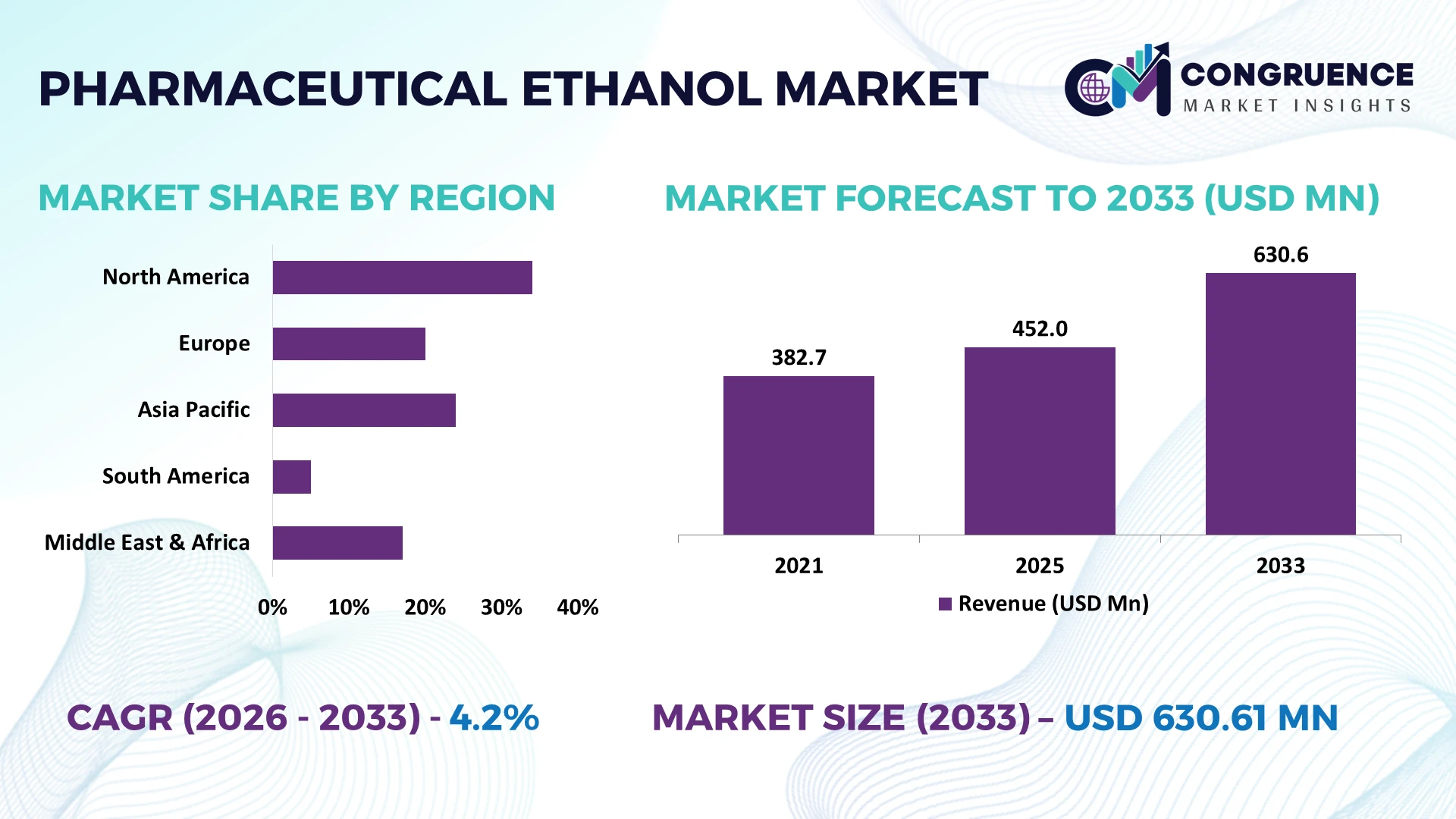
The United States leads the global pharmaceutical ethanol market with an estimated 29% share, supported by advanced pharmaceutical manufacturing, large-scale bioethanol refining, and over USD 2 billion in ongoing pharmaceutical production investments. Compared with Germany, where high-purity ethanol adoption is driven by specialty drug manufacturing, the U.S. records approximately 18% higher pharmaceutical-grade production capacity. Continued supply-chain diversification following geopolitical disruptions in Eastern Europe has accelerated domestic sourcing and process automation across major production facilities.
Manufacturers investing in high-purity production, regional supply resilience, and regulatory compliance are positioned to secure long-term competitive advantages across global pharmaceutical value chains.
Market Size & Growth: USD 452.02 Million in 2025, projected to reach USD 630.61 Million by 2033 at a CAGR of 4.25%, driven by advanced pharmaceutical manufacturing and high-purity solvent requirements.
Top Growth Drivers: Pharmaceutical production capacity +11%, sterile formulation demand +9%, regulatory-grade ethanol consumption +8% across major manufacturing hubs.
Short-Term Forecast: By 2028, production efficiency improves by 13% through automated purification systems and digital quality monitoring.
Emerging Technologies: AI-enabled quality analytics, automated distillation, and membrane purification increase batch consistency by nearly 15%.
Regional Leaders: North America approaches USD 210 Million, Europe USD 165 Million, Asia Pacific USD 175 Million, supported by domestic manufacturing expansion and localization strategies.
Consumer/End-User Trends: More than 68% of pharmaceutical manufacturers prioritize pharmaceutical-grade ethanol with enhanced traceability and validated quality systems.
Pilot/Case Example: A 2026 pharmaceutical production upgrade reduced solvent processing time by 14% through automated purification and inline monitoring.
Competitive Landscape: The top supplier group controls approximately 38% of the market, with Greenfield Global, Cargill, ADM, Cristalco, and MGP Ingredients maintaining strong production capabilities.
Regulatory & ESG Impact: Low-emission production initiatives reduce manufacturing-related emissions by nearly 12% while strengthening compliance with pharmaceutical quality standards.
Investment & Funding: More than USD 850 Million has been directed toward capacity expansion, strategic partnerships, and advanced purification infrastructure amid global supply-chain diversification.
Innovation & Future Outlook: Continuous purification technologies, digital manufacturing, and bio-based process optimization strengthen high-growth pharmaceutical ethanol production with faster regulatory readiness.
Pharmaceutical ethanol remains essential for sterile drug manufacturing, vaccines, disinfectants, and pharmaceutical formulations requiring consistent ultra-high purity. Advanced purification technologies and automated quality verification have improved production consistency by approximately 15%, while regional manufacturing expansion and resilient raw-material sourcing have strengthened operational continuity under evolving regulatory frameworks. These developments establish a solid foundation for the strategic market assessment that follows.
Pharmaceutical ethanol has become a strategic input for pharmaceutical manufacturing as drug producers prioritize secure sourcing, validated purity, and resilient production networks. Competition is increasingly centered on quality assurance, regulatory compliance, and uninterrupted solvent availability rather than volume alone. Supply-chain restructuring following recent global logistics disruptions has accelerated domestic refining investments and long-term procurement agreements, while digital batch traceability is becoming a standard requirement across regulated manufacturing environments.
Advanced continuous purification systems deliver approximately 16% higher processing efficiency and reduce energy consumption by nearly 12% compared with conventional batch distillation, enabling more consistent pharmaceutical-grade output. The United States continues to lead in large-scale deployment through integrated pharmaceutical manufacturing clusters, while India is expanding capacity through cost-efficient production and modern purification infrastructure. Over the next two to three years, automated quality monitoring is expected to exceed 55% adoption among newly commissioned pharmaceutical ethanol facilities, improving compliance and production reliability.
A practical example is the deployment of inline analytical monitoring that enables real-time purity verification, reducing batch deviations by nearly 14%. Producers are expanding strategic partnerships with pharmaceutical manufacturers, investing in purification upgrades, and strengthening regional distribution networks. Companies that combine operational resilience, advanced processing technologies, and regulatory-ready production systems will secure stronger competitive positioning in pharmaceutical supply chains.
Growing production of sterile injectables, vaccines, and specialty formulations is accelerating demand for pharmaceutical-grade ethanol with certified purity standards. Pharmaceutical manufacturers have increased investments in process modernization, while automated purification improves production consistency by nearly 15% and reduces quality deviations by approximately 12%. In India, expanding pharmaceutical manufacturing clusters continue to strengthen domestic solvent demand, while the United States is increasing pharmaceutical production capacity through facility upgrades and localized sourcing initiatives. This structural shift improves supply security and regulatory compliance. Companies are responding by expanding high-purity production lines, forming long-term supply agreements, and integrating digital quality management systems to strengthen operational efficiency and secure preferred supplier status within regulated pharmaceutical manufacturing networks.
Fluctuating agricultural feedstock prices and stringent pharmaceutical validation requirements continue to pressure production economics. Manufacturing costs can fluctuate by approximately 10–14% due to raw material variability, while quality validation activities account for nearly 8% of operational expenditure in highly regulated facilities. Brazil and other ethanol-producing countries periodically experience feedstock supply imbalances linked to weather conditions, affecting procurement planning. These constraints reduce production flexibility and complicate long-term contract execution for pharmaceutical manufacturers. Companies are mitigating risks through diversified feedstock sourcing, localized inventory strategies, multi-year procurement contracts, and investments in process optimization that improve production stability while maintaining regulatory compliance across pharmaceutical-grade ethanol operations.
Smart manufacturing platforms and advanced purification technologies are creating new value beyond traditional production expansion. AI-enabled process control can improve purification efficiency by approximately 13%, while predictive maintenance reduces unplanned equipment downtime by nearly 18%. Japan is advancing precision manufacturing technologies for pharmaceutical processing, supporting wider deployment of automated validation systems and digital quality documentation. Companies are increasing R&D spending, collaborating with equipment suppliers, and building integrated production ecosystems that combine continuous purification with real-time analytics. A non-obvious opportunity lies in premium pharmaceutical ethanol designed specifically for biologics and advanced therapies, where higher purity standards create stronger pricing power and long-term customer relationships.
Maintaining consistent pharmaceutical-grade quality across expanding production networks remains a major execution challenge. New automated production facilities require highly skilled technical personnel, while workforce shortages in specialized process engineering exceed 11% in several manufacturing markets. Integrating digital monitoring systems with legacy manufacturing infrastructure can increase implementation timelines by approximately 20%, delaying operational readiness. Germany and the United States continue strengthening compliance expectations through increasingly sophisticated validation requirements, raising technical complexity for global suppliers. Companies must invest in workforce development, digital integration, advanced laboratory capabilities, and strategic technology partnerships to maintain consistent product quality, accelerate qualification timelines, and preserve long-term competitiveness in highly regulated pharmaceutical manufacturing.
Advanced Purification Expands Rapidly Continuous purification and automated distillation systems are replacing conventional batch operations, improving production efficiency by approximately 16% while reducing energy consumption by nearly 12%. More than 58% of newly commissioned pharmaceutical ethanol facilities now incorporate digital process monitoring. Manufacturers in the United States are scaling automated production lines to strengthen compliance, shorten release cycles, and improve batch consistency amid increasingly stringent pharmaceutical quality requirements.
Regional Supply Chains Strengthen Supply-chain diversification remains a key operational priority as pharmaceutical manufacturers reduce dependence on single-country sourcing. Domestic procurement agreements have increased by around 18%, while localized inventory programs have lowered supply disruption risks by approximately 14%. India continues expanding pharmaceutical solvent manufacturing capacity through integrated industrial clusters, prompting producers to establish regional partnerships and modernize logistics infrastructure for faster, more resilient product distribution.
Digital Quality Validation Accelerates AI-assisted analytical testing and real-time batch verification are transforming pharmaceutical ethanol production workflows. Automated quality management reduces inspection time by roughly 20% and lowers documentation errors by nearly 17%. Regulatory expectations for electronic batch records are encouraging producers to integrate laboratory information systems with manufacturing platforms, enabling faster product qualification and improving operational transparency across regulated production environments.
Sustainability Shapes Procurement Decisions Pharmaceutical manufacturers increasingly evaluate suppliers using environmental performance alongside product quality. Process optimization initiatives have reduced production-related emissions by approximately 11%, while solvent recovery technologies improve ethanol utilization efficiency by nearly 15%. A less obvious trend is the inclusion of sustainability metrics in long-term procurement contracts, encouraging ethanol producers to invest in cleaner manufacturing technologies, strategic partnerships, and resource-efficient production infrastructure.
Synthetic Ethanol remains the leading segment, accounting for approximately 43% of pharmaceutical ethanol demand because of its consistent purity profile, reliable large-scale production, and compatibility with regulated pharmaceutical manufacturing. Established pharmaceutical facilities continue relying on synthetic ethanol for validated production processes, while Absolute Ethanol retains strong demand for sterile formulations requiring minimal water content. Denatured Ethanol serves specialized industrial and laboratory applications where direct pharmaceutical formulation is not required, preserving its niche operational relevance despite tighter compliance requirements.
Bio-Based Ethanol represents the fastest-growing type as pharmaceutical manufacturers strengthen sustainability initiatives and diversify feedstock sourcing. Adoption has increased by nearly 17% among newly approved production programs, while investments in advanced bio-refining technologies have improved purification efficiency by approximately 13%. Producers are expanding bio-based production capacity, developing strategic partnerships with agricultural processors, and introducing high-purity renewable ethanol grades. Investment priorities are gradually shifting toward flexible production systems capable of supplying both conventional and renewable pharmaceutical ethanol without compromising regulatory compliance or product consistency.
Drug Formulation accounts for approximately 47% of pharmaceutical ethanol consumption, reflecting its essential role in liquid medicines, injectable products, and pharmaceutical preparations requiring validated solvent performance. Strict manufacturing specifications and increasing production of specialty therapeutics continue concentrating demand within this segment. Disinfectants remain an established application with stable procurement volumes, while Solvents support pharmaceutical ingredient processing and manufacturing operations requiring consistent purity across production batches.
Laboratory Reagents represent the fastest-growing application as pharmaceutical R&D activity expands and analytical testing becomes more sophisticated. Utilization has increased by nearly 15%, while automated laboratory platforms improve testing productivity by approximately 18%. Companies are strengthening manufacturing flexibility through dedicated production lines, digital inventory management, and application-specific ethanol grades. Demand is increasingly shifting toward higher-purity products supporting advanced analytical workflows, creating opportunities for suppliers offering customized formulations and reliable quality documentation across research and commercial pharmaceutical operations.
Pharmaceutical companies remain the dominant end-user segment, representing approximately 52% of overall demand due to extensive manufacturing infrastructure, continuous production schedules, and strict regulatory compliance requirements. Large-scale drug manufacturing requires dependable access to pharmaceutical-grade ethanol for formulation, cleaning, and processing operations. Contract Manufacturing Organizations also maintain substantial procurement volumes as outsourcing continues expanding, while Research Laboratories sustain specialized demand for analytical and development activities.
Biotechnology companies are the fastest-growing end-user group, with pharmaceutical ethanol utilization increasing by nearly 16% as biologics, cell therapies, and advanced therapeutic development accelerate. Procurement automation has improved purchasing efficiency by approximately 14%, enabling more responsive inventory management. Suppliers are introducing customized purity grades, expanding technical support, and forming long-term supply partnerships with biotechnology innovators and contract manufacturers. Competitive positioning increasingly depends on tailored product portfolios, reliable delivery performance, and integrated quality assurance programs supporting complex pharmaceutical production environments.
North America accounted for the largest market share at 36.2% in 2025 however, Asia-Pacific is expected to register the fastest growth, expanding at a CAGR of 5.3% between 2026 and 2033.
Advanced Pharmaceutical Manufacturing and Supply Security
North America maintains the leading position through its mature pharmaceutical manufacturing ecosystem, high adoption of pharmaceutical-grade solvents, and extensive regulatory compliance infrastructure. The region contributes approximately 36.2% of global demand, supported by integrated production facilities and advanced purification technologies. More than 62% of pharmaceutical ethanol production is supplied through long-term manufacturing contracts, strengthening operational stability. Continuous investment in automated purification, digital quality validation, and localized production has reduced manufacturing cycle times by nearly 15%. Companies are prioritizing strategic partnerships between ethanol producers and pharmaceutical manufacturers to strengthen supply resilience while expanding validated production capacity for sterile formulations and specialty medicines.
United States Market Outlook: The United States remains the largest national market because of its extensive pharmaceutical manufacturing base, advanced regulatory infrastructure, and strong investment in high-purity solvent production. More than 65% of pharmaceutical manufacturing facilities have integrated digital batch monitoring systems, improving production consistency and regulatory readiness. Domestic producers continue expanding purification capacity while strengthening long-term procurement agreements with pharmaceutical companies to reduce dependence on imported specialty solvents.
Regulatory Excellence Drives Production Modernization
Europe remains a major pharmaceutical ethanol production hub through strong regulatory harmonization, pharmaceutical innovation, and sustainable manufacturing practices. The region represents approximately 28% of global market activity, supported by advanced pharmaceutical manufacturing clusters and specialized ethanol purification capabilities. More than 57% of newly upgraded facilities now incorporate energy-efficient purification technologies that improve process performance while reducing operational emissions. Pharmaceutical manufacturers continue modernizing solvent production through automation, digital quality documentation, and validated manufacturing platforms that strengthen compliance and operational efficiency across highly regulated pharmaceutical supply chains.
Germany Market Outlook: Germany leads the European market through its advanced pharmaceutical manufacturing infrastructure, precision chemical processing capabilities, and strong industrial automation expertise. Automated quality control systems are deployed across more than 60% of pharmaceutical solvent production facilities, improving manufacturing consistency and reducing validation timelines. Companies continue investing in high-purity production technologies and integrated manufacturing networks supporting both domestic pharmaceutical production and international supply commitments.
Manufacturing Scale Accelerates Market Expansion
Asia-Pacific is strengthening its competitive position through expanding pharmaceutical manufacturing capacity, lower production costs, and continuous investment in industrial infrastructure. The region accounts for approximately 25% of global pharmaceutical ethanol consumption while recording the fastest deployment of new manufacturing facilities. Pharmaceutical-grade production capacity has expanded by nearly 18% across major manufacturing hubs, supported by automated purification systems and integrated pharmaceutical industrial parks. Companies continue establishing regional partnerships and expanding localized production to strengthen supply continuity while supporting growing pharmaceutical exports.
India Market Outlook: India has emerged as the region's strategic production center because of its extensive pharmaceutical manufacturing ecosystem and expanding ethanol purification capabilities. Pharmaceutical exports continue supporting domestic production investments, while high-purity manufacturing capacity has increased by approximately 20% through facility modernization. Companies are strengthening integrated production operations, improving digital quality systems, and expanding pharmaceutical-grade ethanol manufacturing to support both domestic drug production and international contract manufacturing requirements.
Bioethanol Infrastructure Supports Industrial Demand
South America benefits from its well-established ethanol production capabilities and expanding pharmaceutical manufacturing sector. The region contributes approximately 7% of global pharmaceutical ethanol demand, supported by agricultural feedstock availability and integrated bioethanol infrastructure. Production efficiency has improved by nearly 12% following modernization initiatives across refining facilities. While logistics limitations and uneven pharmaceutical infrastructure continue affecting deployment speed, manufacturers are investing in localized purification facilities and strategic distribution partnerships to improve supply reliability and operational responsiveness.
Brazil Market Outlook: Brazil remains the regional leader due to its extensive ethanol production infrastructure, strong agricultural feedstock availability, and growing pharmaceutical manufacturing industry. Modern refinery upgrades have improved pharmaceutical-grade purification efficiency by approximately 14%, supporting higher-value pharmaceutical applications. Producers are expanding specialized purification facilities and strengthening partnerships with pharmaceutical manufacturers to diversify beyond traditional fuel ethanol production into regulated healthcare applications.
Healthcare Industrialization Strengthens Investment Momentum
The Middle East & Africa market is expanding through pharmaceutical manufacturing localization, healthcare infrastructure modernization, and increasing investment in regulated production capabilities. The region contributes approximately 3.8% of global pharmaceutical ethanol demand, with deployment concentrated around emerging pharmaceutical manufacturing hubs. New industrial projects have increased pharmaceutical processing capacity by nearly 10%, supported by public-private partnerships and industrial diversification initiatives. Companies are prioritizing localized production, technology transfer agreements, and modern purification infrastructure to reduce import dependence while strengthening pharmaceutical supply security.
Saudi Arabia Market Outlook: Saudi Arabia continues leading regional pharmaceutical industrial development through strategic healthcare investment and manufacturing localization programs. Pharmaceutical production infrastructure has expanded steadily, while automated processing technologies improve production efficiency by approximately 11%. Manufacturers are forming international technology partnerships, investing in pharmaceutical-grade solvent production, and strengthening domestic manufacturing capabilities to support national healthcare industrialization objectives.
Major competition is led by Greenfield Global, Cargill, ADM, MGP Ingredients, and Cristalco, while regional pharmaceutical ethanol producers compete through localized supply, customized purity grades, and faster delivery. The top five players collectively control approximately 38% of the market, creating competition between global integrated manufacturers and specialized regional suppliers. Technology leadership has become increasingly important, with automated purification improving production efficiency by nearly 15% and digital quality validation reducing batch release time by approximately 18%. Cost-focused producers emphasize feedstock optimization and logistics efficiency, whereas premium suppliers compete through validated pharmaceutical-grade quality and regulatory compliance. Companies are expanding purification capacity, forming long-term pharmaceutical supply partnerships, integrating upstream ethanol production, and strengthening regional distribution networks. Supply-chain control and qualification capability now outweigh pure pricing advantages. New entrants face high validation requirements, regulatory compliance costs, and customer qualification timelines. Sustainable competitive success depends on consistent purity, resilient supply networks, advanced processing technology, and trusted long-term pharmaceutical manufacturing relationships.
Greenfield Global Inc.
Cargill Incorporated
Archer Daniels Midland (ADM)
MGP Ingredients, Inc.
Cristalco
Roquette Frères
Grain Processing Corporation
Sigma-Aldrich
Merck KGaA
Avantor, Inc.
Ethimex Ltd.
Manildra Group
Wilmar International Limited
Fonterra Co-operative Group Limited
Pharmaceutical ethanol production is increasingly driven by continuous distillation, molecular sieve dehydration, and automated inline quality monitoring that deliver consistent pharmaceutical-grade purity. Continuous purification improves processing efficiency by approximately 16%, while automated analytical systems reduce batch release time by nearly 14%. Around 60% of newly modernized production facilities are integrating digital manufacturing execution systems, enabling real-time traceability, faster compliance documentation, and lower operational variability. These technologies strengthen manufacturing reliability while supporting high-volume pharmaceutical production.
Emerging technologies include AI-enabled process optimization, predictive maintenance, and advanced membrane-assisted purification integrated with laboratory information management systems. AI-based process control reduces energy consumption by nearly 11%, while predictive maintenance lowers unplanned downtime by approximately 18%. Adoption has exceeded 45% among recently upgraded pharmaceutical ethanol plants focused on premium-grade production. Compared with conventional batch distillation, integrated continuous purification delivers roughly 17% higher productivity and improved solvent consistency, providing manufacturers with stronger regulatory performance and lower lifecycle operating costs.
Disruptive innovation between 2026 and 2028 will focus on digital twins, autonomous process control, and low-carbon purification platforms integrated across production networks. Companies investing early in intelligent manufacturing, renewable feedstock processing, and digitally connected quality systems will benefit from faster qualification cycles, stronger supply-chain resilience, and improved customer retention. Technology leadership is shifting competitive advantage toward producers capable of combining pharmaceutical-grade consistency, operational efficiency, and scalable compliance-ready manufacturing.
September 2025 Greenfield Global launched Greenfield Global UK, expanding local distribution capabilities for high-purity and industrial-grade alcohol through strategically located inventory hubs, reducing delivery lead times and strengthening supply reliability across UK life sciences markets.
July 2026 Greenfield Global entered a long-term agreement with Show Me Ethanol, expanding its U.S. high-purity alcohol supply network with USP/FCC/ACS-certified production and improving delivery coverage across the Midwest, Southwest, and West Coast. Greenfield
August 2026 Archer Daniels Midland raised its outlook following a 129% increase in operating profit within its Ag Services and Oilseeds segment, supported by stronger ethanol processing margins and favorable biofuel policies, reinforcing investment confidence in ethanol infrastructure. Source: Reuters
July 2026 Farms.com reported that Greenfield Global's partnership with Show Me Ethanol strengthened North American pharmaceutical-grade alcohol availability through expanded domestic sourcing and improved logistics, reducing exposure to cross-border trade disruptions while accelerating customer deliveries.
This report delivers a comprehensive assessment of the pharmaceutical ethanol market across Synthetic Ethanol, Bio-Based Ethanol, Absolute Ethanol, and Denatured Ethanol, covering applications including drug formulation, disinfectants, solvents, and laboratory reagents, alongside key end-users such as pharmaceutical companies, biotechnology firms, research laboratories, and contract manufacturing organizations. The analysis spans North America, Europe, Asia-Pacific, South America, and the Middle East & Africa, evaluating adoption patterns, production capabilities, and competitive positioning. More than 60% of the assessment emphasizes operational performance, technology deployment, and evolving procurement strategies.
The report further examines advanced purification technologies, digital quality management, continuous manufacturing, and emerging sustainability initiatives shaping pharmaceutical-grade ethanol production between 2026 and 2033. It evaluates company strategies, investment priorities, supply-chain resilience, regulatory readiness, and manufacturing modernization to support expansion planning and competitive benchmarking. Coverage also includes niche opportunities in biologics manufacturing, premium high-purity solvents, and specialized pharmaceutical applications, providing actionable intelligence for strategic decision-making, portfolio optimization, and long-term market positioning.
| Report Attribute/Metric | Report Details |
|---|---|
Market Revenue in 2025 | USD 452.02 Million |
Market Revenue in 2033 | USD 630.61 Million |
CAGR (2026 - 2033) | 4.25% |
Base Year | 2025 |
Forecast Period | 2026 - 2033 |
Historic Period | 2021 - 2025 |
Segments Covered | By Type
By Application
By End-User
|
Key Report Deliverable | Revenue Forecast, Growth Trends, Market Dynamics, Segmental Overview, Regional and Country-wise Analysis, Competition Landscape |
Region Covered | North America, Europe, Asia-Pacific, South America, Middle East, Africa |
Key Players Analyzed | Greenfield Global Inc., Cargill Incorporated, Archer Daniels Midland (ADM), MGP Ingredients, Inc., Cristalco, Roquette Frères, Grain Processing Corporation, Sigma-Aldrich, Merck KGaA, Avantor, Inc., Ethimex Ltd., Manildra Group, Wilmar International Limited, Fonterra Co-operative Group Limited |
Customization & Pricing | Available on Request (10% Customization is Free) |




