
Reports
The Global Pharmaceutical CDMO Automation Market was valued at USD 4920 Million in 2025 and is anticipated to reach a value of USD 10778.76 Million by 2033 expanding at a CAGR of 10.3% between 2026 and 2033. Growth is driven by automated aseptic filling, continuous bioprocessing, robotic material handling, and electronic batch records that improve manufacturing throughput, contamination control, and regulatory compliance.
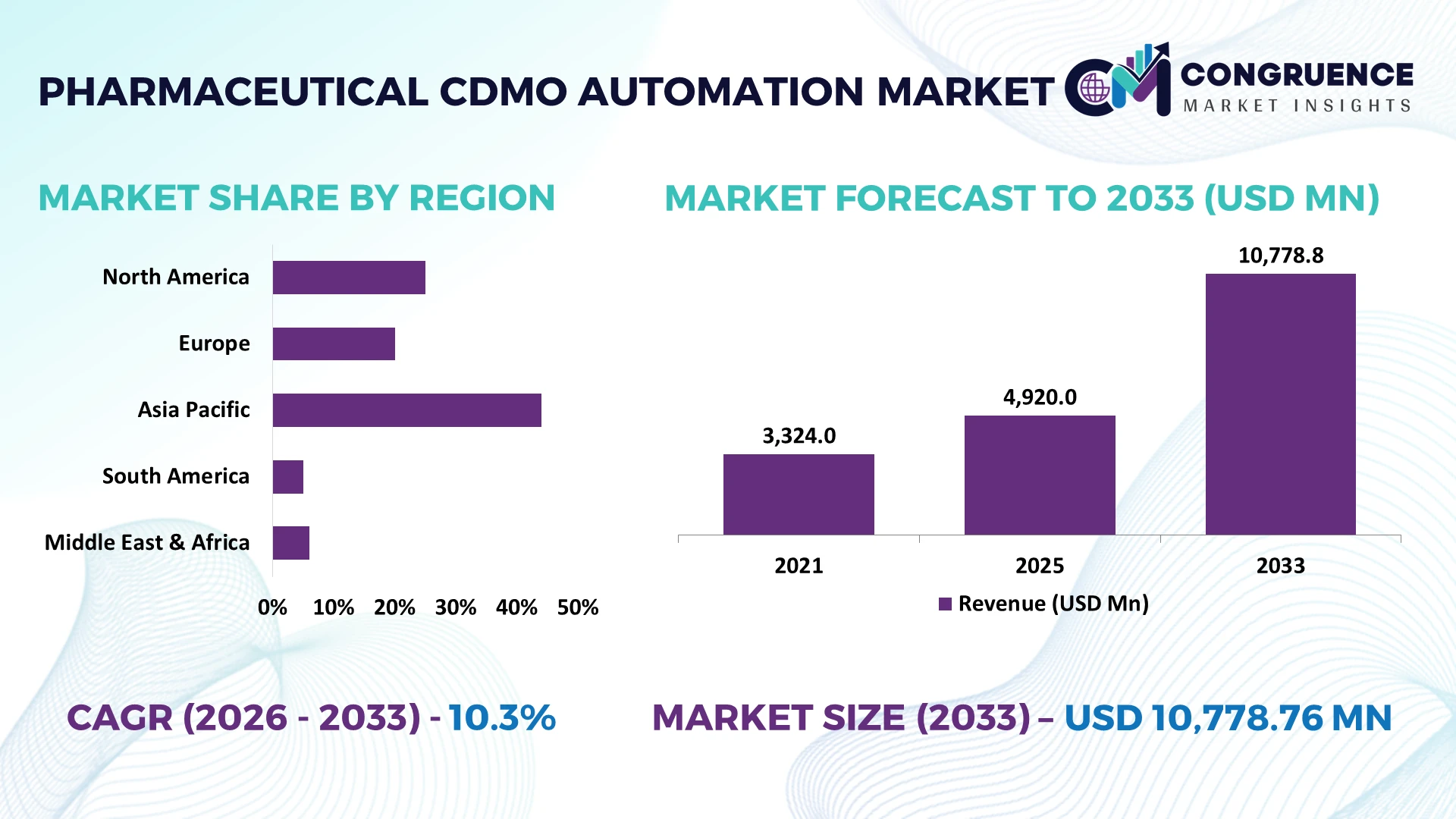
The United States leads pharmaceutical CDMO automation adoption, supported by its extensive biologics manufacturing infrastructure, FDA regulated production facilities, and advanced manufacturing investments. The country accounts for an estimated 35% of global market activity, compared with approximately 12% for China. The US pharmaceutical sector operates under FDA 21 CFR Part 11 requirements, accelerating electronic batch record integration, automated quality inspection, and manufacturing execution systems. Investments in cell therapy, sterile injectables, and biologics production strengthen automation deployment across commercial manufacturing and clinical supply operations.
Strategically, CDMOs prioritizing integrated digital manufacturing and automated quality systems are positioned to capture high value outsourcing contracts while reducing production variability and regulatory exposure.
Market Size & Growth: USD 4,920 million in 2025, reaching USD 10,778.76 million by 2033 at 10.3% CAGR, driven by automated biologics manufacturing.
Top Growth Drivers: Illustrative efficiency targets include 20% faster batch processing, 15% lower manual intervention, and 25% shorter quality review cycles.
Short Term Forecast: By 2028, advanced automation deployments target 18% lower operating costs and 22% higher production efficiency.
Emerging Technologies: AI process analytics, robotic aseptic filling, and digital twins enable predictive maintenance, continuous monitoring, and automated deviation detection.
Regional Leaders: Illustrative 2033 allocations place North America at USD 4,095.93 million, Europe at USD 3,018.05 million, and Asia Pacific at USD 2,802.48 million, supported respectively by biologics automation, serialization, and manufacturing expansion.
Consumer / End User Trends: Advanced CDMOs increasingly integrate electronic batch records and manufacturing execution systems, targeting 30% faster documentation workflows.
Pilot / Case Example: A representative 2026 digital batch release pilot targets 25% shorter review cycles through automated exception reporting and electronic documentation.
Competitive Landscape: Fragmented competition includes Thermo Fisher Scientific, Lonza, Samsung Biologics, Catalent, and WuXi Biologics; individual automation market shares remain undisclosed.
Regulatory & ESG Impact: FDA 21 CFR Part 11 compliance strengthens electronic traceability, while automated utilities target 15% lower energy consumption.
Investment & Funding: Pharmaceutical manufacturing expansion commitments exceeding USD 100 billion in the United States reinforce opportunities for robotics, process controls, and digital infrastructure.
Innovation & Future Outlook: Autonomous manufacturing platforms, AI driven quality systems, and continuous processing target 20% shorter production cycles and greater operational flexibility.
Pharmaceutical CDMO automation is reshaping outsourced drug manufacturing through intelligent process controls, automated fill and finish lines, and integrated quality management platforms. Biologics, sterile injectables, and advanced therapy medicinal products represent important demand areas because contamination prevention and batch consistency directly influence commercial supply reliability. Digital twins and predictive analytics support targeted equipment availability improvements of 15% in advanced deployment scenarios. Increasing manufacturing localization, particularly across the United States and Europe, reinforces investment in validated automation infrastructure. These developments establish the operational and competitive priorities shaping the market's strategic direction.
Pharmaceutical CDMO automation is becoming a competitive differentiator as drug developers prioritize manufacturing reliability, regulatory traceability, and faster technology transfers. Supply chain restructuring in the United States and Europe is accelerating investment in domestic biologics capacity and digitally connected production facilities. Automated manufacturing execution systems, electronic batch records, and robotic aseptic processing reduce dependence on manual interventions while strengthening production consistency across multiple client programs.
Compared with conventional paper based batch documentation, integrated electronic batch records can target 20% to 30% shorter review cycles, depending on validation requirements and exception frequency. The United States emphasizes advanced biologics and cell therapy manufacturing, while Germany prioritizes process engineering and automated quality assurance. China and India are expanding digital manufacturing capabilities alongside contract development infrastructure. Between 2026 and 2028, leading CDMOs are targeting 15% to 20% improvements in equipment utilization through predictive maintenance and integrated production scheduling.
A practical deployment involves connecting automated filling equipment with real time environmental monitoring and electronic batch release workflows. CDMOs are redirecting capital toward modular production lines, digital validation platforms, and technology partnerships with automation specialists. Competitive advantage increasingly depends on validated interoperability, rapid manufacturing transfers, and consistent commercial batch execution.
Biologics manufacturing complexity is accelerating pharmaceutical CDMO automation investment, particularly in sterile injectables, monoclonal antibodies, and advanced therapies. Automated aseptic filling systems can target 20% fewer manual interventions, while integrated process analytical technology supports 15% improvements in production efficiency. Electronic batch records can reduce documentation review time by approximately 25% under optimized workflows. FDA requirements for electronic records and stringent contamination control are encouraging manufacturers to modernize validated production infrastructure. In the United States, CDMOs are expanding robotic filling capabilities and integrating manufacturing execution systems with laboratory information management platforms. Companies including Thermo Fisher Scientific and Lonza are strengthening advanced manufacturing capabilities. The strategic advantage lies in faster technology transfers and consistent batch reproducibility.
High implementation costs and fragmented manufacturing infrastructure restrict automation adoption among smaller pharmaceutical CDMOs. Comprehensive modernization programs can require initial capital allocations 20% to 35% above conventional equipment replacement budgets, depending on integration complexity. Legacy programmable logic controllers and proprietary manufacturing software can increase integration engineering costs by an estimated 15% to 25%. Validation documentation and computerized system qualification can account for approximately 10% to 20% of project expenditure. India's established pharmaceutical manufacturing clusters face additional challenges integrating older production equipment with modern digital control platforms. Companies are responding through phased modernization, modular automation investments, and standardized communication protocols. Prioritizing high utilization production lines protects capital efficiency while reducing disruption to validated manufacturing operations.
Autonomous bioprocessing creates opportunities for pharmaceutical CDMOs to differentiate through flexible production capacity and intelligent manufacturing services. AI enabled process monitoring can target 15% to 20% reductions in unplanned equipment downtime, while digital twin simulations offer potential 10% to 15% improvements in process optimization efficiency. Singapore is strengthening advanced biopharmaceutical manufacturing capabilities through investments in digital production infrastructure and specialized workforce development. Emerging opportunities include automated cell therapy production, continuous bioprocessing, and modular single use manufacturing platforms. CDMOs are establishing partnerships with equipment manufacturers, software developers, and biotechnology companies to accelerate technology commercialization. Integrating predictive process controls with flexible manufacturing assets enables smaller production campaigns without sacrificing equipment utilization or regulatory traceability.
Scaling pharmaceutical CDMO automation across multiple facilities introduces substantial execution challenges involving cybersecurity, workforce capabilities, and manufacturing system standardization. Complex integration programs can experience 15% to 25% longer commissioning schedules when equipment interfaces and validation protocols differ across sites. Advanced digital manufacturing projects can require 20% to 30% additional specialist training hours compared with conventional automation deployments. Cybersecurity exposure is increasing as operational technology networks connect with enterprise platforms and external technology partners. Germany's highly automated pharmaceutical manufacturing environment illustrates the importance of maintaining qualified engineering personnel and secure industrial connectivity. CDMOs must invest in standardized data architectures, cybersecurity monitoring, and workforce development partnerships. Sustainable competitiveness depends on replicating validated automation capabilities across facilities without compromising production continuity or data integrity.
Serialization Integration Across Packaging Networks: Pharmaceutical CDMOs are connecting packaging execution systems with enterprise serialization platforms to meet increasingly stringent traceability requirements. Under optimized deployment scenarios, automated aggregation targets 20% faster packaging verification and 15% fewer reconciliation errors. United States Drug Supply Chain Security Act implementation is accelerating interoperable product tracing. Contract manufacturers are upgrading serialization software and coordinating data exchange with pharmaceutical clients to strengthen distribution compliance.
Digital Scheduling Improves Production Coordination: CDMOs are replacing disconnected production schedules with integrated planning platforms that coordinate equipment availability, materials, and client orders. Advanced scheduling deployments target 12% higher capacity utilization and 18% shorter production changeovers. Manufacturers are integrating enterprise resource planning with shop floor scheduling, reducing idle capacity and improving delivery predictability across facilities handling multiple pharmaceutical products.
Automated Inspection Expands Quality Coverage: Pharmaceutical packaging operations are introducing high resolution machine vision for container inspection, label verification, and cosmetic defect classification. Optimized inspection workflows target 25% faster inspection throughput and 15% fewer false rejections. CDMOs are partnering with inspection equipment specialists to standardize inspection recipes across product formats, improving quality consistency without increasing inspection staffing requirements.
Digital Supplier Qualification Gains Momentum: Pharmaceutical CDMOs are integrating supplier documentation, material certificates, and incoming inspection records into centralized quality platforms. Automated workflows target 20% shorter supplier qualification cycles and 15% faster material release decisions. Supply chain disruptions are encouraging manufacturers to establish digitally qualified alternative suppliers, improving procurement flexibility while preserving material traceability and regulatory documentation integrity.
Process Automation represents the leading segment of the Pharmaceutical CDMO Automation Market, accounting for an estimated 38% share, supported by extensive deployment across formulation, filling, mixing, and production control operations. Its dominance reflects the ability to coordinate multiple manufacturing stages through programmable controllers, distributed control systems, and standardized equipment interfaces. Laboratory Automation maintains an established position through automated sample preparation, analytical testing, and laboratory information management integration. Packaging Automation supports serialization, inspection, and product handling, with optimized installations targeting approximately 20% improvements in packaging throughput. Warehouse Automation strengthens inventory accuracy, controlled storage, and material movement across manufacturing facilities.
Digital Manufacturing Systems represent the fastest growing type as CDMOs integrate manufacturing execution platforms, electronic documentation, and centralized operational intelligence. Advanced implementations target 25% faster production data accessibility compared with disconnected legacy systems. Pharmaceutical manufacturers in the United States and Germany are prioritizing unified manufacturing architectures that connect production equipment with enterprise applications. Automation suppliers are expanding software integration capabilities and modular equipment portfolios, shifting investment priorities toward connected manufacturing infrastructure and scalable operational visibility.
Drug Manufacturing accounts for an estimated 40% of the Pharmaceutical CDMO Automation Market, reflecting extensive automation requirements across formulation, sterile filling, production control, and commercial manufacturing operations. Its leadership is supported by high equipment utilization, strict process consistency requirements, and the operational importance of repeatable batch execution. Bioprocessing represents a substantial application area as contract manufacturers expand automated fermentation, purification, and upstream production capabilities. Quality Control maintains consistent adoption through automated analytical testing and inspection workflows, with optimized installations targeting approximately 20% shorter testing turnaround times. Packaging and Labeling benefits from automated inspection, product identification, and serialization integration.
Batch Monitoring represents the fastest growing application as pharmaceutical CDMOs implement continuous production visibility and automated exception management. Connected monitoring platforms target 25% faster deviation identification compared with periodic manual inspections. Manufacturers are integrating equipment sensors, process historians, and manufacturing execution platforms to strengthen operational oversight. Pharmaceutical companies in the United States are prioritizing automated batch monitoring within sterile manufacturing facilities, while Indian CDMOs are expanding digital production controls. Technology providers are responding with configurable monitoring software and integrated manufacturing solutions.
Pharmaceutical Companies represent the dominant end user segment, accounting for an estimated 45% of Pharmaceutical CDMO Automation Market demand. Their leadership reflects extensive commercial manufacturing requirements, complex supplier networks, and investment in standardized production technologies across outsourced manufacturing partnerships. Large pharmaceutical enterprises prioritize validated automation platforms that maintain product consistency and regulatory traceability across multiple facilities. Biotechnology Companies represent the fastest growing end user group as biologics developers increasingly require flexible manufacturing infrastructure and specialized process automation. Advanced biotechnology production programs target approximately 20% reductions in manual processing activities through integrated manufacturing equipment and automated workflow controls.
Generic Drug Manufacturers emphasize cost efficiency, standardized production, and packaging productivity, with automation initiatives targeting 15% improvements in equipment utilization. Specialty Drug Developers increasingly require configurable manufacturing systems supporting smaller batches and complex formulations. Pharmaceutical CDMOs are responding by offering modular automation services, flexible manufacturing contracts, and integrated digital quality capabilities. In the United States, established pharmaceutical companies prioritize manufacturing network standardization, while biotechnology developers increasingly favor specialized contract manufacturing partnerships. Competitive positioning depends on matching automation investment with customer production complexity.
North America accounted for the largest market share at an estimated 38% in 2025 however, Asia Pacific is expected to register the fastest growth, expanding at a projected CAGR of 12.5% between 2026 and 2033.
Biologics Manufacturing Modernization and Digital Production Leadership
North America maintains approximately 38% of global pharmaceutical CDMO automation demand, supported by established contract manufacturing networks, advanced biologics infrastructure, and extensive pharmaceutical technology investment. The United States dominates regional deployment through automated sterile filling, manufacturing execution systems, and integrated quality control platforms. FDA oversight of computerized manufacturing systems reinforces investment in validated electronic records and automated production monitoring. Canada's pharmaceutical manufacturing sector contributes through specialized biologics development and contract manufacturing capabilities. Eli Lilly announced plans in 2025 to invest at least USD 27 billion in four new United States manufacturing sites, reinforcing demand for advanced pharmaceutical production infrastructure. CDMOs are increasingly integrating robotic equipment, centralized process controls, and digital validation capabilities to support complex outsourcing contracts. Regional competitiveness depends on manufacturing reliability, regulatory readiness, and efficient technology transfer between development and commercial production facilities.
United States Market Outlook: The United States benefits from established pharmaceutical innovation clusters in Massachusetts, North Carolina, and New Jersey. North Carolina's Research Triangle supports biologics manufacturing, pharmaceutical engineering, and specialized contract production services. FDA 21 CFR Part 11 requirements encourage validated electronic documentation and secure manufacturing data management. The country's advanced therapy manufacturing ecosystem also supports investment in automated cell processing, aseptic production, and integrated quality assurance infrastructure.
Regulatory Harmonization Accelerates Manufacturing Infrastructure Modernization
Europe represents an estimated 28% of global pharmaceutical CDMO automation activity, supported by established manufacturing clusters in Germany, Switzerland, Ireland, France, and Italy. European pharmaceutical manufacturers prioritize computerized system validation, automated contamination control, and integrated manufacturing documentation. EU GMP Annex 1 requirements, effective since August 2023, have strengthened contamination control expectations for sterile medicinal products. This regulatory framework encourages deployment of isolator technology, robotic filling equipment, and automated environmental monitoring. Switzerland maintains specialized biologics manufacturing capabilities, while Ireland supports multinational pharmaceutical production and advanced process engineering. Germany's industrial automation ecosystem facilitates integration of manufacturing execution systems with production equipment and quality management platforms. European CDMOs are modernizing existing facilities rather than relying exclusively on new construction, creating opportunities for modular equipment upgrades and validated software integration. Competitive differentiation increasingly depends on inspection readiness and production flexibility.
Germany Market Outlook: Germany maintains a strategic position through pharmaceutical manufacturing clusters in Baden Württemberg, Hesse, and North Rhine Westphalia. Its established engineering sector supports automated formulation, packaging inspection, and industrial control integration. Germany's pharmaceutical manufacturing operations must comply with EU GMP requirements, including Annex 11 governing computerized systems. Manufacturers increasingly prioritize interoperable equipment, electronic documentation, and standardized process control architectures to improve production consistency across established facilities.
Manufacturing Scale Expansion and Advanced Automation Adoption
Asia Pacific accounts for an estimated 26% of global pharmaceutical CDMO automation activity, supported by expanding pharmaceutical manufacturing capacity in China, India, Japan, Singapore, and South Korea. China maintains extensive active pharmaceutical ingredient production infrastructure, while India supports large scale generic drug manufacturing and contract development services. South Korea is strengthening biologics manufacturing through investments in advanced production facilities and automated bioprocessing technologies. Samsung Biologics' Plant 5, inaugurated in 2025, added 180,000 liters of biomanufacturing capacity, strengthening the country's contract manufacturing infrastructure. Singapore emphasizes advanced pharmaceutical production, digital manufacturing systems, and specialized biotechnology operations. Manufacturers are integrating automated process controls, electronic batch documentation, and advanced inspection equipment to improve production reliability. Regional competition increasingly centers on combining manufacturing scale with validated digital capabilities, particularly for international pharmaceutical clients requiring consistent quality and transparent production documentation.
China Market Outlook: China maintains significant pharmaceutical manufacturing capabilities through industrial clusters in Shanghai, Jiangsu, Zhejiang, and Guangdong. Its contract manufacturing ecosystem benefits from established chemical processing infrastructure, biotechnology research facilities, and domestic equipment suppliers. China's National Medical Products Administration regulates pharmaceutical manufacturing quality requirements. Manufacturers are expanding automated bioprocessing, integrated production monitoring, and digital quality management capabilities to strengthen international contract manufacturing competitiveness and reduce operational dependence on manual production systems.
Pharmaceutical Localization Drives Selective Automation Investment
South America represents an estimated 5% of global pharmaceutical CDMO automation activity, with Brazil and Argentina forming important pharmaceutical manufacturing centers. Brazil's pharmaceutical industry supports contract manufacturing, generic medicines, vaccines, and sterile pharmaceutical production. Government procurement requirements and domestic manufacturing initiatives encourage investment in localized production infrastructure. Brazil's health regulatory authority, ANVISA, maintains pharmaceutical manufacturing quality requirements that influence equipment validation and computerized production controls. Argentina contributes through established pharmaceutical formulation and packaging operations. Automation adoption remains concentrated in larger manufacturing facilities, where production volumes support investment in advanced equipment. Currency volatility, imported machinery costs, and limited specialized engineering resources constrain modernization among smaller manufacturers. CDMOs are responding through phased automation investments, local equipment partnerships, and selective deployment of manufacturing execution systems. Operational competitiveness depends on improving production consistency while controlling capital expenditure and imported technology dependence.
Brazil Market Outlook: Brazil leads South American pharmaceutical manufacturing through established industrial clusters in São Paulo, Rio de Janeiro, and Goiás. Its domestic pharmaceutical production infrastructure supports generic medicines, biologics, and vaccine manufacturing. ANVISA's RDC 658/2022 establishes pharmaceutical good manufacturing practice requirements. Manufacturers are prioritizing automated packaging, electronic documentation, and production monitoring to strengthen regulatory compliance and improve operational efficiency across domestic manufacturing networks.
Industrial Localization Strengthens Pharmaceutical Manufacturing Infrastructure
The Middle East and Africa account for an estimated 3% of global pharmaceutical CDMO automation activity, supported by pharmaceutical manufacturing localization initiatives in Saudi Arabia, the United Arab Emirates, Egypt, and South Africa. Saudi Arabia's Vision 2030 industrial transformation strategy emphasizes domestic pharmaceutical production and healthcare supply chain resilience. The United Arab Emirates is developing advanced pharmaceutical manufacturing infrastructure through industrial investment and international technology partnerships. Egypt maintains established pharmaceutical formulation and generic medicine production capabilities, while South Africa supports pharmaceutical manufacturing and vaccine production initiatives. Automation deployment focuses on packaging systems, sterile production equipment, and digital manufacturing controls. Dependence on imported automation equipment and specialized technical expertise remains a significant implementation constraint. Manufacturers are addressing these limitations through international engineering partnerships, workforce training, and phased facility modernization. Competitive positioning increasingly depends on localized manufacturing capabilities and reliable regulatory compliance.
Saudi Arabia Market Outlook: Saudi Arabia is advancing pharmaceutical manufacturing localization through Vision 2030 and the National Industrial Development and Logistics Program. The Saudi Food and Drug Authority regulates pharmaceutical manufacturing and product quality. Domestic manufacturers are investing in automated formulation, sterile manufacturing, and digital quality management systems. Industrial development initiatives encourage technology transfer partnerships and specialized workforce development, strengthening the country's position in pharmaceutical contract manufacturing and regional medicine supply security.
The Pharmaceutical CDMO Automation Market features competition between global contract manufacturers, specialized biologics producers, and industrial automation technology providers. Thermo Fisher Scientific, Lonza, Samsung Biologics, WuXi Biologics, and Fujifilm compete through manufacturing capacity, technical specialization, and integrated production services. Their combined market share is provisionally estimated at 35%, reflecting fragmented automation expenditure across pharmaceutical manufacturing networks. Siemens, Rockwell Automation, and ABB compete as technology suppliers, emphasizing manufacturing execution systems, industrial controls, and digital integration. Advanced automation deployments target 20% shorter batch review cycles and 15% higher equipment utilization, strengthening customer retention. Leading CDMOs are expanding biologics facilities, integrating robotic processing, and partnering with software developers to improve manufacturing flexibility. Competition increasingly favors validated digital ecosystems over isolated equipment purchases. Regulatory qualification costs, specialized engineering requirements, and complex technology transfers restrict market entry. Winning requires scalable automation architectures, proven compliance capabilities, and consistently reliable manufacturing execution across multiple client programs and production sites.
Thermo Fisher Scientific Inc.
Lonza Group AG
Samsung Biologics Co., Ltd.
WuXi Biologics (Cayman) Inc.
FUJIFILM Holdings Corporation
Catalent, Inc.
Recipharm AB
Siegfried Holding AG
AGC Inc.
Piramal Pharma Limited
Aenova Group
Siemens AG
Rockwell Automation, Inc.
ABB Ltd.
Current pharmaceutical CDMO automation technologies center on manufacturing execution systems, robotic aseptic filling, and electronic batch records. Integrated production platforms target 20% faster batch documentation and 15% lower manual intervention compared with conventional workflows. Process analytical technology enables continuous monitoring of critical quality attributes, improving deviation detection and manufacturing consistency. Adoption is concentrated in commercial biologics facilities and sterile manufacturing operations, where validated digital systems support regulatory compliance and efficient production scheduling.
Emerging technologies include AI powered process optimization, digital twins, and automated laboratory integration. Predictive maintenance platforms target 15% reductions in unplanned equipment downtime, while digital twin simulations offer 10% improvements in process optimization efficiency. Compared with legacy manual production monitoring, integrated digital systems target 25% faster operational decision cycles. Advanced CDMOs benefit through improved equipment utilization, reduced process variability, and stronger manufacturing service differentiation.
Disruptive technologies increasingly combine autonomous bioprocessing, adaptive robotics, and intelligent quality management. Automated cell processing platforms target 20% reductions in operator handling requirements, supporting specialized therapy manufacturing. Between 2026 and 2028, CDMOs are prioritizing modular automation, interoperable data architectures, and validated AI applications. Early adopters gain faster technology transfer capabilities, stronger production flexibility, and improved competitiveness across complex pharmaceutical outsourcing contracts worldwide.
April 2025: Thermo Fisher Scientific announced USD 2 billion in additional United States investments over four years, including USD 1.5 billion for manufacturing expansion. The initiative strengthens domestic pharmaceutical production infrastructure and supports advanced manufacturing capabilities and supply chain resilience. Source: thermofisher.com
October 2024: Lonza completed its acquisition of Roche's Vacaville biologics manufacturing facility, adding approximately 330,000 liters of bioreactor capacity. The transaction expands commercial biologics manufacturing capabilities and establishes infrastructure for planned automation upgrades, supporting production flexibility and additional pharmaceutical outsourcing contracts. Source: lonza.com
April 2025: Samsung Biologics brought Plant 5 into operation in Songdo, South Korea, adding 180,000 liters of manufacturing capacity. Equipped with advanced automation and digital systems, the facility strengthens standardized production operations, manufacturing scalability, and contract biologics supply capabilities worldwide. Source: bioprocessintl.com
September 2025: FUJIFILM Biotechnologies inaugurated its Holly Springs manufacturing facility in North Carolina, featuring eight 20,000 liter bioreactors. The expansion strengthens commercial biologics production infrastructure, supports integrated manufacturing services, and increases domestic capacity for pharmaceutical companies pursuing localized supply chains. Source: ncbiotech.org
The Pharmaceutical CDMO Automation Market Report evaluates manufacturing automation technologies, deployment strategies, and competitive developments between 2026 and 2033. Segmentation covers five technology types: Process Automation, Laboratory Automation, Packaging Automation, Warehouse Automation, and Digital Manufacturing Systems. Application analysis examines Drug Manufacturing, Bioprocessing, Quality Control, Packaging and Labeling, and Batch Monitoring. End user coverage includes Pharmaceutical Companies, Biotechnology Companies, Generic Drug Manufacturers, and Specialty Drug Developers.
Regional analysis evaluates North America, Europe, Asia Pacific, South America, and the Middle East and Africa, examining manufacturing infrastructure, regulatory requirements, and investment concentration. The report assesses robotic aseptic processing, AI analytics, electronic batch records, and integrated manufacturing platforms. Strategic insights address supplier positioning, automation investment priorities, technology partnerships, and expansion opportunities across commercial biologics, advanced therapies, and digitally connected pharmaceutical manufacturing facilities.
| Report Attribute/Metric | Report Details |
|---|---|
Market Revenue in 2025 | USD 4920 Million |
Market Revenue in 2033 | USD 10778.76 Million |
CAGR (2026 - 2033) | 10.3% |
Base Year | 2025 |
Forecast Period | 2026 - 2033 |
Historic Period | 2021 - 2025 |
Segments Covered | By Type
By Application
By End-User
|
Key Report Deliverable | Revenue Forecast, Growth Trends, Market Dynamics, Segmental Overview, Regional and Country-wise Analysis, Competition Landscape |
Region Covered | North America, Europe, Asia-Pacific, South America, Middle East, Africa |
Key Players Analyzed | Thermo Fisher Scientific Inc., Lonza Group AG, Samsung Biologics Co., Ltd., WuXi Biologics (Cayman) Inc., FUJIFILM Holdings Corporation, Catalent, Inc., Recipharm AB, Siegfried Holding AG, AGC Inc., Piramal Pharma Limited, Aenova Group, Siemens AG, Rockwell Automation, Inc., ABB Ltd. |
Customization & Pricing | Available on Request (10% Customization is Free) |




