
Reports
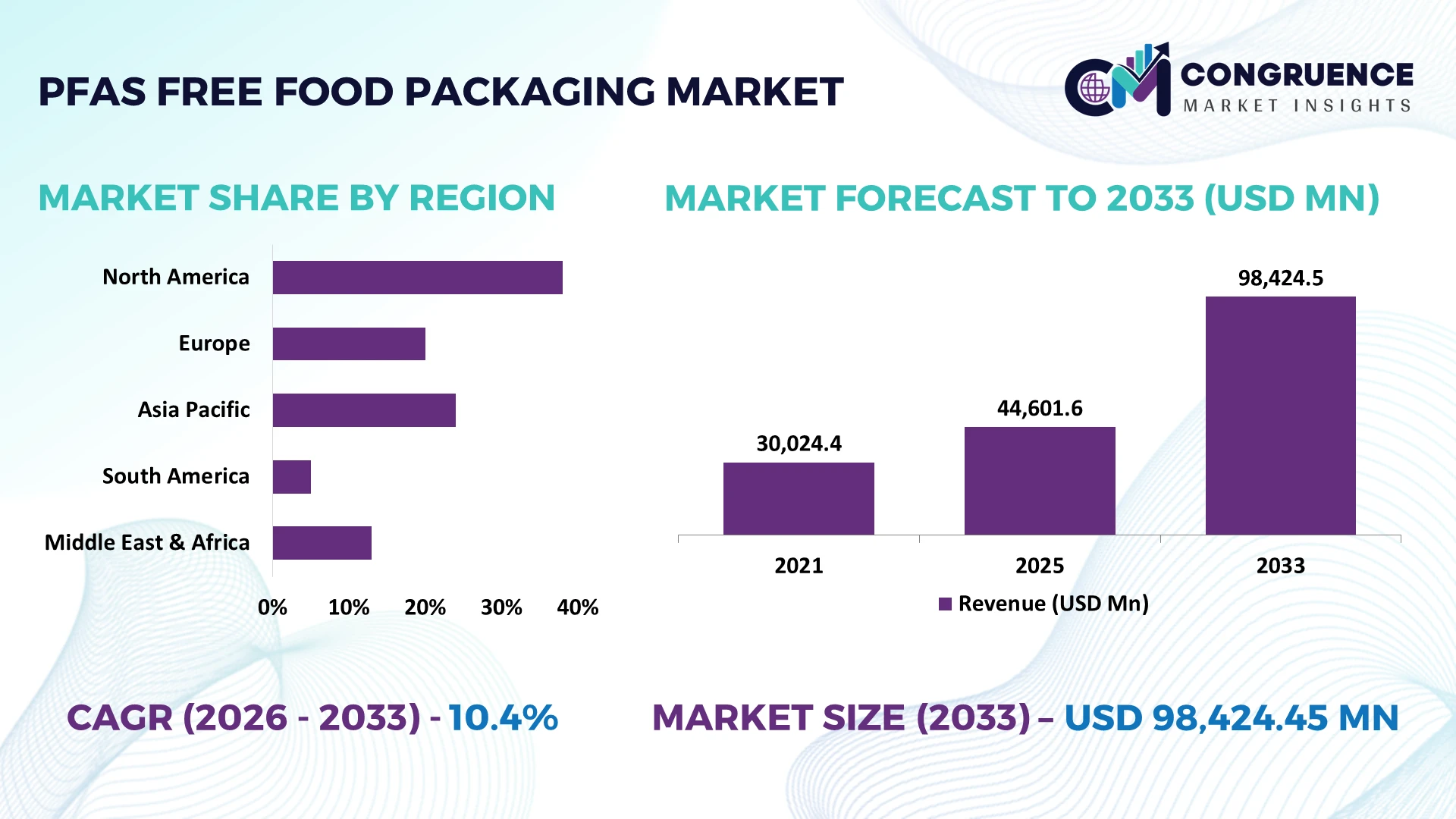
The Global PFAS-Free Food Packaging Market was valued at USD 44601.6 Million in 2025 and is anticipated to reach a value of USD 98424.45 Million by 2033 expanding at a CAGR of 10.4% between 2026 and 2033. Growth is driven by legally enforced PFAS restrictions, conversion to aqueous and dispersion barrier coatings, fiber-based foodservice formats, and brand-level reformulation of grease-resistant packaging.
The United States represents the dominant country market with an estimated 27–30% share, supported by fast-food, foodservice, bakery, pet-food, and packaged-food applications. The FDA ended sales of PFAS grease-proofing agents and rendered 35 related food-contact notifications ineffective in 2025, accelerating substitution. Graphic Packaging’s approximately USD 1.67 billion Waco recycled-paperboard project strengthens domestic fiber-based capacity, while Denmark had already prohibited PFAS-treated paper food-contact materials. The U.S. therefore holds greater scale, while Europe applies tighter cross-border compliance thresholds.
Packaging suppliers that secure PFAS-free barrier performance without sacrificing grease resistance, machinability, recyclability, or shelf life will capture the highest-value conversion programs as regulatory alignment reshapes global procurement.
Market Size & Growth: USD 44,601.6 million in 2025 reaches USD 98,424.45 million by 2033 at 10.4%, driven by mandatory PFAS substitution and advanced fiber-barrier technologies.
Top Growth Drivers: Regulatory conversion contributes approximately 40%; foodservice replacement 30%; recyclable high-barrier material adoption approximately 20% to procurement momentum.
Short-Term Forecast: By 2028, optimized aqueous coatings and scaled converting are positioned to reduce PFAS-free barrier-material premiums by approximately 10–15% across high-volume foodservice formats.
Emerging Technologies: Water-based dispersion coatings, molded fiber, nanocellulose barriers, and multilayer fiber structures now deliver grease protection while retaining paper contents approaching 80–95%.
Regional Leaders: By 2033, modeled demand reaches roughly USD 35–38 billion in North America, USD 27–30 billion in Europe, and USD 24–27 billion in Asia-Pacific as regulatory conversion broadens.
Consumer/End-User Trends: Quick-service restaurants, bakery chains, and packaged-food manufacturers are converting high-contact grease-resistant formats, with some leading paper solutions already exceeding 90% paper content.
Pilot/Case Example: In 2025, Mondi scaled FunctionalBarrier Paper Ultimate after a EUR 16 million Poland investment, achieving oxygen and water-vapor transmission below 0.5 units.
Competitive Landscape: No single supplier dominates; leading groups including Huhtamaki, Mondi, Stora Enso, Graphic Packaging, and Amcor collectively compete through coatings, fiber conversion, scalability, and compliance engineering.
Regulatory & ESG Impact: EU rules effective August 2026 impose PFAS limits of 25 ppb individually, 250 ppb combined targeted PFAS, and 50 ppm including polymeric PFAS.
Investment & Funding: Graphic Packaging’s approximately USD 1.67 billion Waco investment demonstrates large-scale capital migration toward advanced recycled paperboard capacity serving food, beverage, and foodservice packaging.
Innovation & Future Outlook: High-growth PFAS-free packaging is shifting toward recyclable mono-material structures, ultra-thin dispersion coatings, and high-barrier papers containing 90% fiber while remaining compatible with existing filling lines.
PFAS-Free Food Packaging demand is concentrating in fast-food wrappers, bakery papers, takeaway containers, flexible food packs, pet-food bags, and fiber-based foodservice packaging. Advanced dispersion and aqueous barriers now achieve grease and moisture resistance while maintaining 80–95% renewable fiber content. With EU PFAS limits effective from August 2026, converter qualification, coating validation, and compliant material sourcing are becoming immediate strategic priorities.
PFAS-free food packaging has become strategically important because regulatory compliance is now reshaping material qualification, converter investment, and food-brand procurement rather than functioning as a voluntary sustainability upgrade. The U.S. withdrawal of 35 PFAS-related food-contact notifications and the EU’s August 2026 concentration limits are forcing converters to restructure coating supply chains, reformulate grease barriers, and validate alternative substrates. Denmark’s earlier paper-and-board restrictions demonstrate how national rules are converging toward broader market requirements.
Aqueous and dispersion-coated papers increasingly replace fluorinated grease barriers while preserving high fiber content and machinability. Advanced barrier papers can achieve oxygen and water-vapor transmission below 0.5 units, narrowing the performance gap with multilayer plastic or foil structures while simplifying recyclability. Europe leads regulatory intensity, while the U.S. combines federal withdrawal with state thresholds such as California’s 100 ppm total-organic-fluorine limit.
Through 2028, qualification speed will become a decisive competitive metric. A foodservice converter replacing PFAS-treated wrappers with validated water-based coatings can retain existing printing and converting assets while avoiding full-line replacement. Suppliers are therefore investing in coating platforms, testing capability, fiber partnerships, and application-specific certification. Competitive advantage will favor companies that deliver compliant grease resistance at industrial speed without sacrificing sealability, shelf life, or converting efficiency.
Regulatory action is the strongest structural driver because PFAS elimination is moving from brand preference to enforceable procurement criteria. In the U.S., 35 PFAS-related food-contact notifications became ineffective in 2025, eliminating previously authorized grease-proofing uses in paper and paperboard. California additionally prohibits intentionally added PFAS in plant-fiber food packaging and applies a 100 ppm total-organic-fluorine threshold. The EU tightened the framework further in August 2026 with limits of 25 ppb for individual targeted PFAS, 250 ppb for combined targeted substances, and 50 ppm including polymeric PFAS. These thresholds are forcing foodservice chains and converters to requalify coatings, inks, adhesives, and fiber substrates. Suppliers are responding through aqueous-barrier R&D, compliance testing, and converter partnerships. The strategic advantage lies in pre-qualified formulations that shorten customer transition cycles.
PFAS substitution remains constrained by the need to reproduce grease, moisture, heat, sealing, and runnability performance across high-speed packaging lines. California’s 100 ppm threshold and the EU’s substantially tighter 25 ppb targeted limit create different compliance regimes, increasing testing and documentation complexity for exporters. Barrier papers must also perform under oil-rich, hot, frozen, or humid food conditions, meaning a coating validated for one format cannot automatically transfer to another. Reformulated structures can require repeated migration, fluorine, seal-strength, and machinability testing before commercial release, extending qualification cycles by months. European converters supplying multiple countries face particularly high SKU-validation burdens. Companies are reducing exposure by consolidating coating suppliers, securing long-term fiber contracts, and standardizing barrier platforms across several package formats. The key restraint is therefore not material availability alone, but the cost and time required to prove compliance at industrial scale.
The largest opportunity lies in next-generation fiber structures that combine PFAS-free grease resistance with oxygen, moisture, and sealing performance previously associated with complex laminates. Advanced paper barriers now achieve oxygen-transmission rates below 0.5 cm³/m²/day and water-vapor transmission below 0.5 g/m²/day, enabling penetration into dry foods, powders, snacks, and demanding flexible formats. In Poland, a €16 million barrier-paper investment illustrates how coating capacity is shifting toward industrial-scale recyclable structures. Denmark’s PFAS restriction since 2020 and the EU-wide limits effective in 2026 provide a clear policy runway for wider conversion. Suppliers are expanding dispersion-coating lines, nanocellulose research, and mono-material development. A non-obvious opportunity is asset reuse: converters can often adopt upgraded coated papers on existing printing and forming lines, lowering transition capital compared with replacing entire packaging systems.
Long-term execution becomes harder as PFAS regulation fragments across jurisdictions, testing methodologies, thresholds, and product definitions. A package compliant with California’s 100 ppm total-organic-fluorine ceiling can still face materially stricter EU requirements of 25 ppb for individual targeted PFAS and 50 ppm for PFAS including polymers. Recycled fiber introduces another complication because indirect PFAS contamination can enter through recovered paper, inks, or legacy feedstock even when converters intentionally add none. Denmark’s rules explicitly recognize both direct and indirect PFAS presence in paper and board, highlighting the traceability problem. Companies must therefore strengthen incoming-material testing, supplier declarations, batch traceability, and laboratory partnerships while developing cleaner recycling streams. The strategic risk is inconsistent global qualification: without harmonized specifications and contamination control, multinational food brands face SKU fragmentation, duplicated testing, and slower packaging launches across major markets.
Fluorine-Free Coatings Move Mainstream: Converters are replacing fluorinated grease barriers with aqueous dispersion systems across wrappers, cartons, and bakery papers. Commercial fiber structures now exceed 90% paper content, while high-barrier grades achieve oxygen and water-vapor transmission below 0.5 units. U.S. and European packaging producers are scaling coating capacity and reformulating surface chemistry to retain grease resistance, printing performance, and high-speed converting compatibility as food-contact requirements tighten.
Fiber Forming Gains Functional Depth: Molded fiber is moving beyond trays into lids, bowls, clamshells, and compartmented takeaway formats. Advanced thermoformed fiber can reduce plastic content by more than 90%, while optimized forming processes cut material usage by approximately 10–20%. Foodservice packaging companies are expanding tooling, precision forming, and barrier-treatment capabilities, enabling fiber products to handle hotter, wetter, and oil-rich foods without conventional PFAS treatments.
Packaging Portfolios Undergo Simplification: Food manufacturers are reducing complex material combinations as recyclability and chemical-compliance requirements converge. Next-generation paper structures containing 80–95% fiber increasingly replace multilayer constructions in selected dry-food and foodservice applications. Converters are standardizing substrates, coatings, and adhesives across multiple SKUs, reducing qualification complexity and improving procurement leverage. The non-obvious shift is toward fewer packaging architectures rather than simply substituting one chemical treatment.
Barrier Validation Becomes Digitalized: Packaging qualification is increasingly supported by automated coating controls, machine-vision inspection, and inline measurement. Digital process monitoring can reduce coating variability by approximately 10–20%, while automated defect detection can inspect essentially 100% of web output. Suppliers are integrating data-driven quality systems with coating lines, helping converters maintain barrier consistency, minimize rejected material, and accelerate customer qualification under tighter food-contact specifications.
Paperboard Containers lead the PFAS-Free Food Packaging Market with an estimated 38% share, supported by mature converting infrastructure, high production scalability, printability, and compatibility with cartons, trays, takeaway boxes, and bakery formats. Modern paperboard structures can retain more than 90% fiber content while incorporating thin functional barriers, enabling converters to use established printing and forming assets. Molded Fiber Packaging follows as foodservice operators replace plastic clamshells and trays, while Bagasse Packaging is gaining relevance in disposable bowls and compartmented containers where heat resistance and structural rigidity matter.
Bio-Based Coatings represent the fastest-growing type as suppliers develop water-based, cellulose-derived, and other renewable barriers capable of replacing fluorinated grease treatments without changing the underlying package. Selected advanced paper structures achieve oxygen and water-vapor transmission below 0.5 units. Compostable Films remain strategically relevant where flexible packaging performance cannot readily be replicated by rigid fiber. Manufacturers are consequently directing investment toward coating chemistry, fiber-forming capacity, and substrate-barrier integration rather than standalone material substitution.
Food Takeaway represents the leading application with an estimated 34% share, reflecting intensive use of wrappers, bowls, cartons, clamshells, and grease-resistant papers that historically depended heavily on fluorinated barriers. High transaction volumes across quick-service restaurants and delivery platforms make standardized PFAS-free formats commercially attractive because a single material conversion can affect millions of packages. Bakery Products remain an established application, particularly for grease-resistant papers and cartons, while Fresh Produce relies more heavily on breathable fiber trays and paperboard containers requiring less aggressive oil resistance.
Ready Meals represent the fastest-growing application as chilled, frozen, and reheatable products require increasingly sophisticated combinations of moisture, grease, temperature, and sealing performance. Advanced fiber structures containing approximately 80–95% paper are extending into these demanding formats. Meat & Seafood remains technically challenging because liquid and oxygen barriers are critical to shelf-life protection. Packaging companies are responding with multilayer bio-based coatings, precision fiber forming, and application-specific barrier systems, directing innovation toward formats where PFAS elimination previously presented the greatest performance trade-offs.
Foodservice Operators constitute the leading end-user group with approximately 36% of PFAS-free packaging demand because centralized procurement enables restaurant networks, institutional kitchens, delivery operations, and quick-service systems to convert large packaging volumes simultaneously. High-frequency takeaway operations require grease-resistant wraps, cartons, bowls, and containers across thousands of daily transactions. Restaurants form a substantial adjacent buyer group but often procure through distributors rather than direct converter contracts. Catering Companies prioritize portable formats combining leak resistance, stackability, and thermal performance across event and institutional foodservice operations.
Food Manufacturers represent the fastest-growing end-user group as PFAS-free requirements extend from takeaway formats into packaged bakery products, ready meals, meat, seafood, and shelf-stable foods. Large manufacturers can manage packaging specifications across multiple production plants, making standardized barrier platforms strategically valuable. Supermarkets are also expanding private-label prepared foods and fresh-meal offerings, strengthening demand for compliant trays and containers. Suppliers are responding through enterprise contracts, customized coating formulations, technical qualification programs, and packaging platforms that can serve multiple food categories without extensive equipment changes.
North America accounted for the largest market share at 38% in 2025 however, Asia-Pacific is expected to register the fastest growth, expanding at a CAGR of 12.6% between 2026 and 2033.
Regulation Forces High-Volume Material Conversion
North America accounts for approximately 38% of global PFAS-free food packaging demand, led by U.S. foodservice, takeaway, bakery, ready-meal, and packaged-food applications. The withdrawal of 35 PFAS-related food-contact notifications materially accelerated conversion of grease-resistant paper and paperboard toward aqueous-coated and molded-fiber alternatives. California’s 100 ppm total-organic-fluorine threshold adds another procurement requirement for plant-fiber food packaging. Converters are responding by expanding barrier-coating capability, fluorine testing, and fiber-forming infrastructure rather than simply replacing substrates. U.S. containerboard production increased approximately 5% in 2025, providing a substantial domestic fiber base for functional packaging conversion. Canadian operators are similarly prioritizing fiber-rich formats as provincial single-use-plastic policies reshape foodservice procurement. The region’s competitive advantage lies in combining large-scale paperboard production with established food-brand qualification and automated converting infrastructure.
United States Market Outlook: The United States provides the strongest commercial conversion pipeline because federal action has eliminated authorized PFAS grease-proofing uses while state-level requirements tighten material specifications. Graphic Packaging’s approximately USD 1.67 billion Waco recycled-paperboard investment illustrates the scale of domestic fiber infrastructure being developed. Large quick-service and packaged-food buyers increasingly require verified fluorine-free coatings, traceable chemistry, recyclable substrates, and consistent performance across national supplier networks.
Compliance Convergence Reshapes Barrier Technology
Europe represents approximately 30% of global PFAS-free food packaging demand and has the strongest regulatory catalyst for systematic material redesign. EU food-contact packaging requirements effective from August 2026 impose limits of 25 ppb for individual targeted PFAS, 250 ppb for combined targeted PFAS, and 50 ppm for total PFAS including polymers. Denmark moved earlier by restricting PFAS in paper and board food-contact materials, giving converters practical experience with alternative grease barriers. Producers are expanding dispersion coatings, functional papers, molded fiber, and high-barrier mono-material structures while strengthening analytical testing and chemical traceability. A EUR 16 million investment in Poland supporting advanced barrier-paper production demonstrates the shift toward scalable fluorine-free structures. Europe’s established collection and paper-recycling infrastructure further favors fiber-rich packaging, although converters must maintain moisture, oxygen, sealing, and grease performance while meeting increasingly demanding recyclability specifications.
Germany Market Outlook: Germany combines advanced paper converting, chemical engineering, food manufacturing, and packaging machinery capabilities, making it a critical commercialization center for PFAS-free barrier technologies. Its packaging sector benefits from highly automated coating and converting infrastructure and proximity to major food processors. EU-wide restrictions are directing German suppliers toward water-based dispersions, recyclable barrier papers, process monitoring, and standardized chemical documentation suitable for cross-border customer qualification.
Manufacturing Scale Accelerates Material Substitution
Asia-Pacific accounts for approximately 24% of global PFAS-free food packaging demand, supported by enormous food-processing capacity, takeaway consumption, export packaging, and established paper-converting infrastructure. China provides large-scale paperboard, molded-pulp, coating, and food-container manufacturing, while India is expanding fiber alternatives through bagasse availability and growing organized foodservice. Japan and South Korea contribute higher-value barrier-film and coating expertise. Export-oriented converters face an additional catalyst because packaging supplied to U.S. and European customers must increasingly satisfy destination-market PFAS requirements regardless of domestic rules. India produces more than 350 million tonnes of sugarcane annually in typical production years, creating a substantial agricultural-residue feedstock pool for bagasse packaging. Manufacturers are consequently scaling molded-fiber tooling, aqueous coatings, compostable structures, and automated forming lines. Cost-efficient manufacturing combined with improving barrier performance positions the region strongly for international supply contracts.
China Market Outlook: China holds the region’s strongest manufacturing position through integrated paper, pulp, chemical-coating, converting, and food-packaging supply chains. Export exposure makes compliance with European and U.S. chemical requirements commercially important. Chinese converters are investing in water-based barrier chemistry, fluorine testing, molded-fiber automation, and high-speed forming, enabling large food brands to source PFAS-free formats without abandoning established Asian manufacturing ecosystems.
Fiber Resources Support Localized Substitution
South America represents approximately 5% of global PFAS-free food packaging activity, with Brazil providing the strongest combination of pulp resources, food processing, agricultural feedstocks, and packaging conversion. Brazil’s globally significant eucalyptus-pulp industry gives converters access to competitively produced virgin fiber for paperboard and molded applications, while sugarcane processing creates bagasse availability for agricultural-fiber packaging. The country produces more than 600 million tonnes of sugarcane in strong harvest years, creating substantial residue streams for value-added fiber conversion. Chile contributes sophisticated forestry infrastructure, while Argentina supports food-processing demand but faces greater capital and currency constraints. Adoption remains less regulation-driven than in Europe, making export requirements and multinational food-brand specifications important conversion triggers. Suppliers are investing selectively in molded fiber, recyclable coatings, and local feedstock integration while balancing energy, logistics, and imported processing-equipment costs.
Brazil Market Outlook: Brazil provides the region’s strongest vertical-integration opportunity by connecting forestry, sugarcane residues, pulp production, food processing, and packaging conversion. Its large agricultural export sector also exposes packaging suppliers to stricter destination-market chemical standards. Converters can differentiate by transforming locally available eucalyptus fiber and bagasse into compliant trays, cartons, and foodservice containers while reducing dependence on imported finished substrates.
Foodservice Modernization Drives Selective Conversion
Middle East & Africa represents approximately 3% of global PFAS-free food packaging demand, with adoption concentrated in organized foodservice, tourism, packaged foods, airline catering, and multinational restaurant networks. The UAE and Saudi Arabia provide particularly attractive deployment environments because hospitality expansion and large-scale foodservice projects require standardized packaging specifications. South Africa contributes established paper, food-processing, and retail infrastructure, creating demand for recyclable cartons and molded-fiber formats. Saudi Arabia’s tourism strategy targets 150 million annual visits by 2030, increasing long-term packaging requirements across hotels, restaurants, entertainment venues, and institutional catering. Limited regional specialty-coating capacity remains an operational constraint, leaving some converters dependent on imported barrier chemistry or substrates. Suppliers are responding through distribution partnerships, local converting, standardized fiber formats, and qualification programs aligned with international restaurant brands rather than building highly specialized upstream material capacity immediately.
United Arab Emirates Market Outlook: The UAE is strategically significant because Dubai and Abu Dhabi combine international hospitality groups, airline catering, food imports, and premium restaurant operations within concentrated logistics infrastructure. Procurement requirements from multinational operators accelerate adoption of internationally compliant packaging specifications. Local converters increasingly emphasize molded fiber, coated paperboard, takeaway containers, and recyclable foodservice formats supported by imported specialty coatings and high-throughput converting equipment.
Huhtamaki, Graphic Packaging, Mondi, Stora Enso, and Amcor compete through fiber conversion, barrier technology, scale, and multinational food-brand relationships, while specialized coating developers challenge them on functional performance. The top five hold approximately 29% combined share, reflecting fragmented material and converting supply. Global producers leverage integrated fiber and converting networks that can lower procurement and logistics costs by 8–15%, while advanced aqueous coatings target 10–20% material or process efficiencies through thinner functional layers. Molded-fiber specialists compete through customization and plastic displacement exceeding 90% in selected formats. Companies are expanding coating lines, forming capacity, food-contact testing, and partnerships between substrate, chemistry, and converting specialists. Competition is shifting from simple PFAS substitution toward recyclable high-barrier platforms with documented chemical compliance. Qualification cycles, coating know-how, food-contact certification, and industrial-scale consistency create substantial entry pressure. Winning requires validated barrier performance, scalable manufacturing, traceable chemistry, competitive conversion economics, and rapid customer qualification across multiple jurisdictions.
Huhtamaki Oyj
Graphic Packaging Holding Company
Mondi plc
Stora Enso Oyj
Amcor plc
International Paper Company
WestRock
UPM-Kymmene Corporation
Billerud AB
Novolex
Pactiv Evergreen
ProAmpac
Detpak
Solenis
Current technology centers on aqueous dispersion coatings, molded-fiber barriers, and high-performance paperboard engineered for grease and moisture resistance. Water-based dispersions represent roughly 30–40% of PFAS-free coating deployment, while advanced formulations achieve Kit 8–10 grease resistance. Compared with legacy fluorinated barriers, modern molded-fiber systems deliver equivalent 30-minute hot-water protection with less than a 10% cost premium, preserving existing converting infrastructure.
Emerging technologies combine bio-wax coatings, nanocellulose, compostable polymers, precision fiber forming, and inline coating control. Advanced PFAS-free treatments withstand warm oil at 55°C for 30 minutes, while selected paper structures contain over 80% fiber. Automated coating metering and machine-vision inspection improve application consistency by approximately 10–20%, helping converters reduce rejects, accelerate qualification, and standardize performance across high-volume foodservice formats.
Disruptive development is shifting toward polymer-free mineral barriers, plant-protein films, agricultural-residue fibers, and recyclable mono-material architectures. Commercial solutions using 95% bagasse demonstrate growing deployment beyond conventional paperboard. During 2026–2028, digital quality control and thinner functional coatings will move into more converting lines. Integrated substrate producers and coating specialists benefit most because they control qualification speed, chemistry traceability, and scalability. Acting now secures regulatory readiness, customer approvals, and lower conversion risk.
June 2024 Stora Enso expanded PFAS-free barrier-coated paperboard for takeaway boxes, cups, and trays, improving dispersion technology for grease and moisture resistance while retaining recyclability. The expansion broadened commercially viable fluorine-free foodservice applications across existing paper-recovery infrastructure.
March 2025 Ahlstrom expanded LamiBak with LamiBak Flex, a PFAS-free base paper made from 100% certified wood pulp for pouches, sachets, and flowpacks. Recyclability certification in Europe and the U.S. strengthens converters’ pathway toward flexible fiber packaging. Source: ahlstrom.com
January 2026 Sabert launched PulpUltra across Europe, the UK, and Ireland using 95% bagasse fiber and less than 5% barrier coating. The PFAS-free platform expands heat-resistant molded-fiber packaging for fresh, hot, and ready-to-eat food applications. Source: foodbev.com
April 2026 Suspack Technologies activated its Bathinda pilot for PFAS-free, chemical-free molded-fiber food packaging manufactured from rice straw. The food-contact-certified deployment converts agricultural residue into biodegradable packaging, establishing a new feedstock pathway for India’s fiber-packaging manufacturing ecosystem. Source: suspack.co.in
The PFAS-Free Food Packaging Market report evaluates Paperboard Containers, Molded Fiber Packaging, Bagasse Packaging, Compostable Films, and Bio-Based Coatings across Food Takeaway, Ready Meals, Fresh Produce, Bakery Products, and Meat & Seafood applications. Coverage extends to Foodservice Operators, Food Manufacturers, Restaurants, Supermarkets, and Catering Companies, with paperboard representing approximately 38% of type-level demand and food takeaway accounting for roughly 34% of application activity.
Regional assessment covers North America, Europe, Asia-Pacific, South America, and Middle East & Africa, including country-level regulatory conversion, manufacturing capacity, material availability, and deployment patterns. Technology analysis examines aqueous dispersions, nanocellulose, molded-fiber barriers, bio-waxes, compostable polymers, agricultural-residue fibers, and digital coating controls. The 2026–2033 scope supports investment planning, supplier qualification, geographic expansion, competitive benchmarking, compliance strategy, and identification of high-value opportunities where barrier performance and scalable fluorine-free production increasingly determine purchasing decisions.
| Report Attribute/Metric | Report Details |
|---|---|
Market Revenue in 2025 | USD 44601.6 Million |
Market Revenue in 2033 | USD 98424.45 Million |
CAGR (2026 - 2033) | 10.4% |
Base Year | 2025 |
Forecast Period | 2026 - 2033 |
Historic Period | 2021 - 2025 |
Segments Covered | By Type
By Application
By End-User
|
Key Report Deliverable | Revenue Forecast, Growth Trends, Market Dynamics, Segmental Overview, Regional and Country-wise Analysis, Competition Landscape |
Region Covered | North America, Europe, Asia-Pacific, South America, Middle East, Africa |
Key Players Analyzed | Huhtamaki Oyj, Graphic Packaging Holding Company, Mondi plc, Stora Enso Oyj, Amcor plc, International Paper Company, WestRock, UPM-Kymmene Corporation, Billerud AB, Novolex, Pactiv Evergreen, ProAmpac, Detpak, Solenis |
Customization & Pricing | Available on Request (10% Customization is Free) |




