
Reports
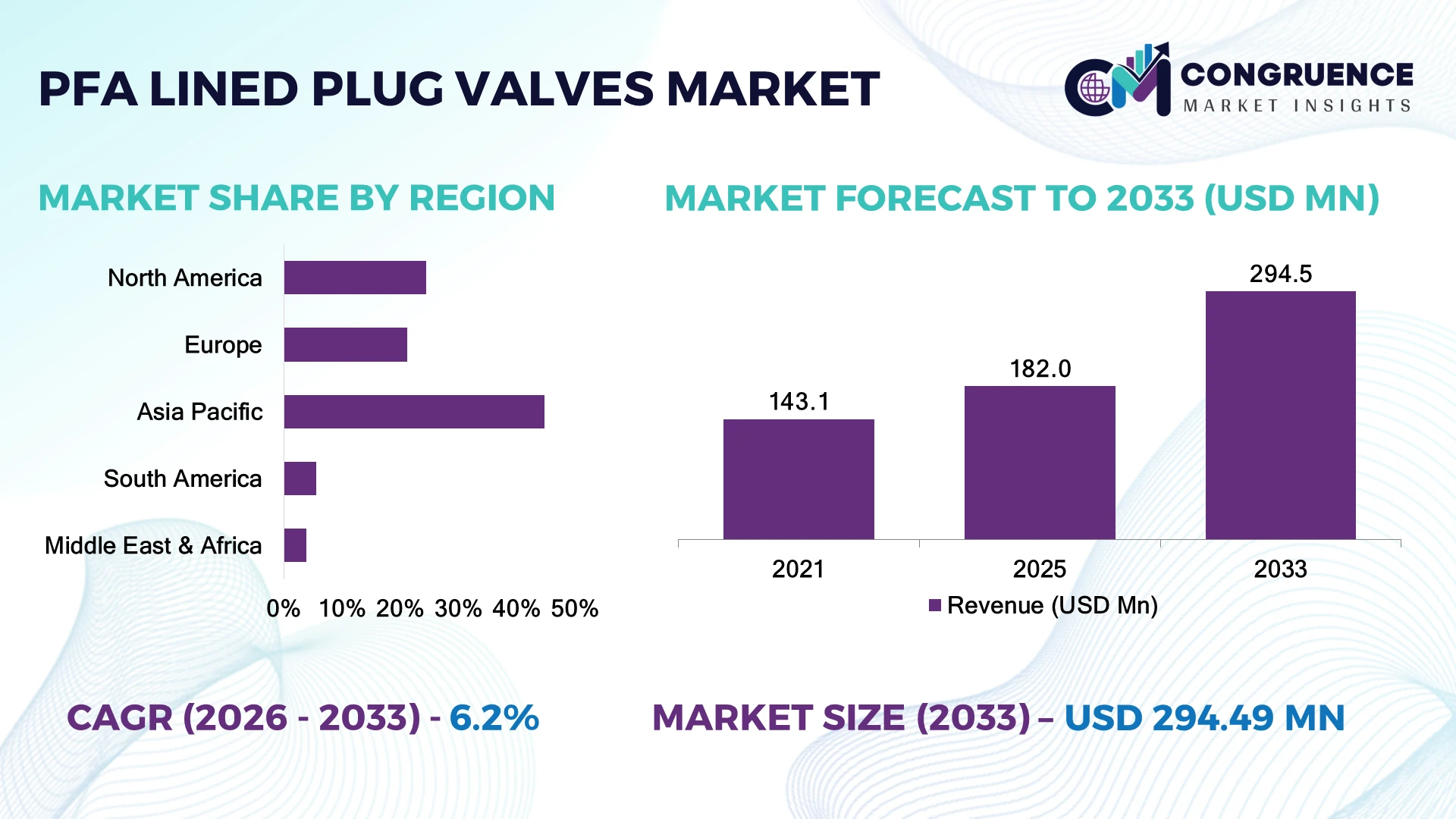
The Global PFA Lined Plug Valves Market was valued at USD 182.0 Million in 2025 and is anticipated to reach a value of USD 294.5 Million by 2033 expanding at a CAGR of 6.2% between 2026 and 2033. Growth is primarily driven by expanding fluoropolymer-lined valve deployment across semiconductor chemical handling systems, specialty chemical processing facilities, and high-purity pharmaceutical manufacturing operations.
China dominates the market with approximately 31% of global manufacturing output, supported by over USD 45 billion in chemical industry investments and more than 35 large-scale semiconductor fabrication projects under development. Compared with Germany’s estimated 9% production share, China benefits from broader industrial integration and localized fluoropolymer supply chains. Adoption of corrosion-resistant flow-control systems exceeds 60% across newly commissioned chemical processing units, reinforced by ongoing industrial modernization initiatives linked to global supply-chain realignment.
Strategically, manufacturers are prioritizing localized production, advanced lining technologies, and high-purity industrial applications to strengthen competitive positioning and secure long-term industrial contracts.
Market Size & Growth: USD 182.0 Million in 2025, reaching USD 294.5 Million by 2033, supported by semiconductor fabrication expansion and specialty chemical investments.
Top Growth Drivers: Chemical processing demand (+18%), semiconductor facility expansion (+22%), pharmaceutical manufacturing upgrades (+15%).
Short-Term Forecast: By 2028, maintenance-related downtime is expected to decline by nearly 20% through advanced corrosion-resistant valve deployment.
Emerging Technologies: AI-enabled predictive maintenance, advanced fluoropolymer lining systems, and industrial automation integration accelerate operational reliability.
Regional Leaders: Asia Pacific (~USD 108 Million), North America (~USD 61 Million), Europe (~USD 54 Million); adoption is driven by chemical, pharma, and semiconductor industries.
Consumer/End-User Trends: More than 58% of new chemical processing projects specify corrosion-resistant lined valve systems as standard equipment.
Pilot/Case Example: In 2024, a semiconductor chemical handling upgrade improved flow-control efficiency by 17% while reducing maintenance interventions by 21%.
Competitive Landscape: Leading suppliers collectively control nearly 42% market share, including Crane, Flowserve, Emerson, Velan, and KSB.
Regulatory & ESG Impact: Emission-control compliance programs reduced hazardous leakage incidents by approximately 14% across regulated facilities.
Investment & Funding: Over USD 1.2 Billion has been directed toward advanced chemical infrastructure and localized manufacturing expansion projects.
Innovation & Future Outlook: Smart valve monitoring, digital diagnostics, and next-generation fluoropolymer materials are reshaping high-performance industrial flow control.
PFA lined plug valves are increasingly deployed in semiconductor wet processing, aggressive chemical transfer systems, and sterile pharmaceutical production environments where contamination control is critical. Recent innovations focus on enhanced fluoropolymer bonding techniques and intelligent condition-monitoring capabilities. More than 40% of newly specified high-purity process lines now incorporate advanced lined valve assemblies. Ongoing supply-chain diversification and stricter process-safety requirements continue to accelerate adoption, setting the stage for deeper strategic evaluation.
The PFA lined plug valves market has become strategically important as chemical, pharmaceutical, and semiconductor operators intensify focus on process reliability, contamination control, and asset longevity. Supply-chain restructuring across Asia and North America is driving investment into localized manufacturing facilities that require highly corrosion-resistant flow-control infrastructure. The ability to withstand aggressive media while minimizing maintenance interventions has elevated these valves from niche components to critical operational assets.
Advanced PFA-lined systems demonstrate up to 25% longer service life compared with conventional metal-seated alternatives operating in corrosive environments. Semiconductor manufacturing facilities increasingly specify high-purity valve assemblies to support process consistency and product quality. While China leads deployment through large-scale industrial expansion, Germany and Japan emphasize precision-engineered solutions and advanced material performance for specialized applications.
Over the next two to three years, industrial automation integration is expected to expand significantly, with smart monitoring capabilities becoming standard across high-value processing facilities. Companies are strengthening partnerships with fluoropolymer suppliers, expanding localized production, and investing in application-specific engineering. Facilities deploying integrated corrosion-management strategies report measurable reductions in maintenance disruptions and process losses. Competitive advantage will increasingly depend on technological differentiation, application expertise, and supply-chain resilience.
Semiconductor fabrication, specialty chemicals, and pharmaceutical manufacturing are accelerating demand for high-performance corrosion-resistant valve systems. More than 60% of new semiconductor chemical handling projects now specify fluoropolymer-lined flow-control equipment, while specialty chemical investments have increased by approximately 18% globally. Stricter process-safety requirements and contamination-control standards are further reinforcing adoption. In China, large-scale chemical and electronics manufacturing clusters continue expanding capacity, creating sustained equipment demand. This industrial shift improves operational reliability, reduces equipment failure rates, and lowers maintenance costs. Manufacturers are responding through capacity expansion, material innovation, and strategic partnerships with fluoropolymer suppliers. A notable strategic insight is that buyers increasingly evaluate total lifecycle performance rather than upfront equipment costs, favoring premium lined valve solutions.
PFA-lined valve manufacturing remains exposed to fluoropolymer supply concentration and specialty material cost fluctuations. Fluoropolymer material prices have experienced periodic swings exceeding 15%, while lead times for certain engineered components remain 20–30% higher than pre-disruption levels. Dependence on specialized processing capabilities limits supplier flexibility, particularly in emerging manufacturing hubs. These constraints directly affect procurement planning, inventory management, and project timelines for industrial operators. Manufacturers are mitigating risks through supplier diversification, long-term material agreements, and regional sourcing initiatives. A key operational insight is that localized manufacturing increasingly functions as a risk-management strategy rather than solely a cost-optimization initiative, particularly for mission-critical industrial applications.
Industrial digitalization is creating significant opportunities for intelligent valve platforms integrated with predictive maintenance systems. Facilities deploying connected monitoring technologies report maintenance-efficiency improvements exceeding 20% and unplanned downtime reductions near 15%. Japan and South Korea are advancing smart manufacturing initiatives that increasingly favor digitally enabled process-control infrastructure. Emerging developments include sensor-integrated valve assemblies, digital diagnostics, and real-time performance monitoring. Companies are investing in research partnerships, software integration, and advanced engineering capabilities to capture higher-value applications. A less obvious opportunity lies in combining corrosion-resistant hardware with operational analytics, enabling facilities to optimize maintenance cycles while extending asset utilization across highly demanding process environments.
The market faces long-term execution challenges associated with specialized manufacturing requirements, workforce expertise, and application-specific engineering complexity. Precision lining processes can increase production cycle times by approximately 12–18%, while skilled technical labor shortages affect deployment consistency across several industrial markets. Semiconductor and pharmaceutical customers require rigorous validation standards, extending qualification timelines and increasing engineering demands. These factors influence scalability, product standardization, and competitive responsiveness. Companies must invest in workforce development, process automation, and advanced quality-control systems to maintain performance consistency. A critical strategic challenge is balancing customization requirements with manufacturing efficiency, as customers increasingly demand application-specific solutions without compromising delivery schedules or operational reliability.
Smart Monitoring Integration Expands Industrial operators are embedding digital monitoring capabilities into critical valve networks, with smart asset coverage increasing by nearly 28% across newly commissioned chemical facilities. Predictive maintenance programs have reduced unplanned shutdown events by approximately 18% while improving inspection efficiency by 22%. Driven by labor shortages and stricter operational reliability targets, manufacturers are partnering with automation providers and expanding intelligent valve portfolios to support data-driven maintenance workflows.
Semiconductor Capacity Reshapes Demand Semiconductor fabrication investments are accelerating adoption of ultra-high-purity flow-control equipment, with specification rates exceeding 35% in newly announced wet-processing projects. Advanced chemical delivery systems have lowered contamination incidents by nearly 20% compared with conventional configurations. Taiwan, South Korea, and China continue expanding fabrication capacity, prompting valve suppliers to increase localized engineering support, strengthen qualification programs, and scale high-purity product manufacturing.
Localization Strategies Gain Momentum Supply-chain diversification initiatives have increased regional sourcing activity by more than 25% among industrial equipment buyers. Lead-time reductions of approximately 15% have been achieved through localized component procurement and manufacturing partnerships. Following recent logistics disruptions and geopolitical trade adjustments, companies are restructuring supplier networks, investing in domestic production capabilities, and securing long-term fluoropolymer material agreements to improve delivery reliability.
Advanced Lining Performance Focus Demand for next-generation fluoropolymer lining technologies has increased by roughly 21% as operators prioritize asset longevity and process consistency. Enhanced lining formulations have extended valve service intervals by nearly 17% in aggressive chemical environments. A notable shift involves customers evaluating lifecycle performance rather than purchase cost alone, encouraging manufacturers to accelerate materials innovation, testing programs, and application-specific engineering development.
The market is segmented into Full Port PFA Lined Plug Valves and Reduced Port PFA Lined Plug Valves. Full Port PFA Lined Plug Valves account for approximately 63% of total demand, making them the leading segment. Their dominance stems from superior flow characteristics, lower pressure loss, and suitability for high-purity and corrosive fluid applications. Chemical processing facilities and semiconductor manufacturing plants increasingly favor full-port designs because they improve process efficiency while minimizing flow restrictions. More than 55% of newly installed corrosion-resistant process lines now specify full-port configurations for critical applications.
Reduced Port PFA Lined Plug Valves represent the fastest-growing segment as operators seek compact designs and lower installation costs for secondary process systems. Adoption has increased by nearly 16% across utility and auxiliary chemical handling networks. Manufacturers are expanding product portfolios with enhanced sealing technologies and lightweight designs to address broader operational requirements. Investment priorities increasingly focus on balancing process performance with installation efficiency, creating opportunities for differentiated valve engineering and application-specific customization.
The market is segmented into Chemical Processing, Pharmaceuticals, Semiconductor Manufacturing, Water Treatment, and Others. Chemical Processing leads with an estimated 42% market share due to extensive handling of aggressive acids, solvents, and specialty chemicals. Large-scale processing facilities require corrosion-resistant flow-control systems capable of maintaining operational continuity under demanding conditions. Semiconductor Manufacturing is the fastest-growing application segment, supported by rising investments in wafer fabrication facilities and ultra-high-purity chemical distribution systems. Adoption within advanced fabrication projects has expanded by approximately 24% over recent project cycles.
Pharmaceuticals continue to strengthen demand as manufacturers modernize sterile production environments and contamination-control systems. Water Treatment applications are also gaining traction, particularly in facilities handling corrosive treatment chemicals. Companies are responding through production expansion, high-purity product development, and application-specific engineering support. Demand growth increasingly reflects operational reliability requirements rather than simple replacement cycles, making advanced valve performance a key purchasing criterion.
The market is segmented into Chemical Industry, Pharmaceutical Industry, Semiconductor Industry, Water & Wastewater Utilities, and Others. The Chemical Industry remains the dominant end-user segment with approximately 45% share, reflecting extensive deployment across production plants handling corrosive process media. High equipment utilization rates, stringent safety requirements, and continuous production operations sustain demand for durable lined valve systems. Semiconductor Industry represents the fastest-growing end-user category, with installation activity rising by nearly 22% as fabrication facilities expand capacity and upgrade process infrastructure.
The Pharmaceutical Industry continues increasing procurement of high-purity process equipment to support regulatory compliance and contamination prevention objectives. Water & Wastewater Utilities maintain stable adoption through chemical dosing and treatment operations. Suppliers are targeting these end-users through customized product designs, localized technical support, and strategic partnerships with engineering procurement contractors. Competitive positioning increasingly depends on sector-specific expertise and the ability to meet demanding process reliability requirements across specialized industrial environments.
Asia-Pacific accounted for the largest market share at 44.8% in 2025 however, North America is expected to register the fastest growth, expanding at a CAGR of 6.9% between 2026 and 2033.

North America represents approximately 24.5% of the global PFA lined plug valves market, supported by expanding semiconductor fabrication capacity, specialty chemical production, and pharmaceutical manufacturing modernization. Industrial operators are increasingly replacing conventional flow-control systems with corrosion-resistant valve infrastructure to improve process reliability and reduce maintenance frequency. More than 30 new semiconductor-related facility expansions announced across the United States over recent years have increased demand for high-purity fluid handling components. Advanced process automation initiatives are also driving integration of intelligent monitoring technologies into critical flow-control networks. Strategic partnerships between valve manufacturers, engineering contractors, and semiconductor suppliers continue strengthening regional deployment capabilities. The market benefits from strong technical standards, localized engineering expertise, and ongoing investments in industrial infrastructure modernization.
United States Market Outlook: The United States remains the largest contributor within North America due to its extensive semiconductor, pharmaceutical, and specialty chemical manufacturing base. Large-scale fabrication projects in Arizona, Texas, and New York continue driving demand for ultra-high-purity process systems. More than 70% of regional semiconductor investment activity is concentrated within the U.S., creating sustained requirements for corrosion-resistant valve technologies. Domestic manufacturers are expanding engineering support, increasing localized production capacity, and strengthening partnerships with process equipment suppliers to support advanced industrial applications.
Europe accounts for approximately 21.2% of global demand, driven by stringent process safety standards, advanced chemical manufacturing, and industrial sustainability initiatives. Chemical processing facilities are increasingly investing in high-performance valve systems that minimize leakage risks and improve operational durability under aggressive process conditions. Modernization programs across Germany, France, and the Netherlands are accelerating replacement cycles for aging industrial infrastructure. Adoption of advanced fluoropolymer-lined technologies has increased by nearly 18% among newly upgraded chemical facilities. Companies are emphasizing operational efficiency, regulatory compliance, and long-term asset performance when selecting flow-control solutions. The region's strong engineering capabilities and established industrial base continue supporting specialized valve deployment across complex manufacturing environments.
Germany Market Outlook: Germany serves as the strategic center of the European market due to its concentration of chemical production, industrial engineering expertise, and process automation leadership. The country hosts some of the world's largest integrated chemical manufacturing clusters, creating sustained demand for corrosion-resistant flow-control systems. Approximately 35% of European specialty chemical production capacity is linked to German industrial operations. Manufacturers continue investing in digital process technologies and advanced materials engineering, strengthening demand for highly reliable valve infrastructure within critical processing environments.
Asia-Pacific commands roughly 44.8% of global market demand and remains the largest production and deployment hub for PFA lined plug valves. Strong activity across semiconductor manufacturing, specialty chemicals, pharmaceuticals, and industrial processing supports extensive adoption of corrosion-resistant valve technologies. China, South Korea, Taiwan, Japan, and India continue expanding industrial capacity, increasing requirements for advanced flow-control systems. Semiconductor-related infrastructure projects alone have contributed to more than 25% growth in high-purity process equipment deployment across key manufacturing clusters. Local manufacturers are increasing production capacity while global suppliers strengthen regional partnerships and technical support networks. The region benefits from integrated supply chains, large-scale industrial investment, and extensive manufacturing ecosystems.
China Market Outlook: China remains the dominant country market due to its extensive chemical processing infrastructure, semiconductor investment pipeline, and large-scale manufacturing ecosystem. The country accounts for approximately 31% of global industrial chemical output and continues expanding advanced manufacturing capabilities. Numerous industrial parks focused on electronics materials, specialty chemicals, and pharmaceuticals require corrosion-resistant process equipment. Domestic suppliers are investing heavily in fluoropolymer processing technologies, localized component manufacturing, and engineering capabilities to support increasing industrial demand and reduce dependence on imported equipment.
South America represents approximately 5.6% of global demand, supported by expanding chemical processing operations, mining-related industrial activity, and infrastructure modernization projects. Demand is concentrated in facilities handling corrosive chemicals, industrial reagents, and process-intensive applications requiring durable flow-control systems. Industrial operators increasingly prioritize maintenance reduction and operational reliability when upgrading processing infrastructure. Recent investments in chemical production and downstream industrial facilities have increased demand for advanced valve technologies by nearly 12%. Despite infrastructure and logistics constraints in some markets, strategic industrial investments continue supporting deployment growth. Companies are focusing on localized distribution networks and technical service capabilities to improve market access and project execution.
Brazil Market Outlook: Brazil leads the regional market through its large industrial base, expanding chemical sector, and significant mining-related processing activity. The country maintains one of the largest chemical industries in Latin America, creating strong demand for corrosion-resistant process equipment. More than 40% of regional industrial processing capacity is concentrated within Brazil. Manufacturers and distributors are expanding service networks, inventory capabilities, and technical support functions to improve responsiveness for large-scale industrial customers operating in demanding process environments.
The Middle East & Africa accounts for approximately 3.9% of global demand and is increasingly influenced by industrial diversification strategies, petrochemical expansion, and infrastructure modernization initiatives. Operators are investing in advanced process equipment capable of supporting highly corrosive operating environments while improving operational reliability. Industrial projects linked to downstream chemicals and specialty manufacturing are increasing adoption of fluoropolymer-lined flow-control technologies. Several large-scale industrial development programs have expanded process infrastructure deployment by nearly 15% across key markets. Companies are strengthening regional partnerships, expanding technical service capabilities, and supporting localization initiatives to capture emerging opportunities. Industrial modernization remains the primary catalyst shaping procurement decisions across the region.
Saudi Arabia Market Outlook: Saudi Arabia is the most strategically important country market due to its extensive petrochemical infrastructure, industrial diversification programs, and large-scale manufacturing investments. The country continues expanding downstream chemical processing capacity through integrated industrial development initiatives. More than 20 major industrial projects linked to chemicals and advanced manufacturing are under active development. Demand for corrosion-resistant flow-control equipment is increasing as operators prioritize operational reliability, asset longevity, and process safety across newly commissioned industrial facilities and modernization programs.
The competitive landscape is led by Flowserve Corporation, Emerson, Crane ChemPharma & Energy, KSB SE & Co. KGaA, and Velan, which collectively account for approximately 48% of global market activity. Competition primarily occurs between global engineering leaders and regional cost-focused manufacturers, while high-performance fluoropolymer specialists compete against broader industrial valve suppliers. Technology performance, delivery reliability, and customization increasingly outweigh pure price competition. Advanced corrosion-resistant designs improve service life by 20–25%, while localized manufacturing strategies reduce lead times by nearly 15%. Digital monitoring integration has improved maintenance efficiency by approximately 18%, creating a new competitive differentiator. Leading companies are expanding production footprints, strengthening fluoropolymer supply partnerships, and investing in application-specific engineering. Vertical integration across materials, manufacturing, and service networks is becoming more common. Market consolidation and high-purity semiconductor demand are shifting competitive advantage toward technically differentiated suppliers. Success increasingly depends on material expertise, application engineering depth, localized support, and resilient supply-chain execution.
Emerson
Crane ChemPharma & Energy
KSB SE & Co. KGaA
Velan Inc.
KITZ Corporation
Samson AG
Neway Valve
Parker Hannifin Corporation
AVK Holding A/S
Bray International
SchuF Group
Asahi Yukizai Corporation
Zhejiang Zhengmao Valve Co., Ltd.
PFA lined plug valve technology is evolving from passive corrosion protection toward intelligent process-control infrastructure. Advanced fluoropolymer bonding technologies now improve lining durability by approximately 20% compared with earlier-generation systems while reducing maintenance interventions by nearly 15%. More than 45% of newly specified valves in semiconductor and specialty chemical projects incorporate enhanced lining architectures designed for aggressive media and high-purity applications. These improvements provide longer operating cycles, reduced contamination risk, and lower lifecycle costs.
Digitalization is emerging as a major differentiator. Smart diagnostics, embedded condition monitoring, and predictive maintenance platforms have improved maintenance efficiency by approximately 18% while reducing unexpected downtime by nearly 12%. Facilities deploying connected valve monitoring systems gain faster fault detection and improved asset visibility. Companies with strong automation capabilities benefit most because customers increasingly evaluate valves as integrated process-performance assets rather than standalone components.
The most significant technology shift is the transition from conventional manually inspected valve systems to digitally monitored and analytics-enabled infrastructure. Connected solutions deliver up to 25% better operational visibility than legacy maintenance models. Between 2026 and 2028, broader adoption of AI-assisted diagnostics, advanced fluoropolymer materials, and intelligent asset-management platforms will strengthen operational reliability, creating a measurable competitive advantage for early adopters.
February 2024 – Emerson introduced its Fisher FIELDVUE DVC7K digital valve controller, enhancing real-time diagnostics and predictive maintenance capabilities. The platform builds on more than 3 million installed FIELDVUE units and improves operational reliability through advanced device analytics, supporting smarter valve asset management. Source: Emerson
July 2024 – Emerson launched the AVENTICS Series XV valve platform featuring higher flow rates within a compact architecture. The interoperable design improves automation flexibility and supports global machine builders seeking standardized pneumatic infrastructure, strengthening industrial productivity and deployment efficiency. Source: Emerson Newsroom
April 2026 – Emerson expanded its Fisher portfolio with the SVX Steam Conditioning Valve for critical process environments. The solution enhances steam pressure and temperature control while supporting improved efficiency, maintainability, and operational reliability across demanding industrial applications. Source: Emerson Corporate News
June 2026 – Flowserve completed the acquisition of Trillium Flow Technologies’ Valves Division for USD 490 million. The transaction expands Flowserve’s engineered valve portfolio and strengthens its position across power generation, industrial infrastructure, and mission-critical flow-control markets. Source: Flowserve Blog
This report provides comprehensive coverage of the global PFA lined plug valves market across major product categories, industrial applications, end-user industries, and regional markets. Analysis includes Full Port and Reduced Port configurations, along with demand assessment across chemical processing, pharmaceuticals, semiconductor manufacturing, water treatment, and related industrial sectors. The study evaluates adoption patterns across chemical, pharmaceutical, semiconductor, utility, and specialized process industries while examining deployment trends across North America, Europe, Asia-Pacific, South America, and the Middle East & Africa.
The report further assesses competitive positioning, technology evolution, supply-chain developments, and operational trends influencing market performance between 2026 and 2033. Coverage includes advanced fluoropolymer materials, intelligent monitoring systems, predictive maintenance integration, and high-purity process technologies. More than 45% of demand remains concentrated in chemical and semiconductor applications, highlighting critical deployment priorities. The analysis supports investment planning, market-entry evaluation, expansion strategy development, partnership assessment, and long-term competitive decision-making across established and emerging industrial opportunities.
| Report Attribute / Metric | Details |
|---|---|
| Market Revenue (2025) | USD 182.0 Million |
| Market Revenue (2033) | USD 294.5 Million |
| CAGR (2026–2033) | 6.2% |
| Base Year | 2025 |
| Forecast Period | 2026–2033 |
| Historic Period | 2021–2025 |
| Segments Covered |
By Type
By Application
By End-User
|
| Key Deliverables | Revenue Forecast; Market Trends; Growth Drivers & Restraints; Technology Insights; Segmentation Analysis; Regional Insights; Competitive Landscape; Regulatory & ESG Overview; Recent Developments |
| Regions Covered | North America; Europe; Asia-Pacific; South America; Middle East & Africa |
| Companies Profiled | Flowserve Corporation; Emerson; Crane ChemPharma & Energy; KSB SE & Co. KGaA; Velan Inc.; KITZ Corporation; Samson AG; Neway Valve; Parker Hannifin Corporation; AVK Holding A/S; Bray International; SchuF Group; Asahi Yukizai Corporation; Zhejiang Zhengmao Valve Co., Ltd. |
| Customization & Pricing | Available on Request (10% Customization Free) |




