
Reports
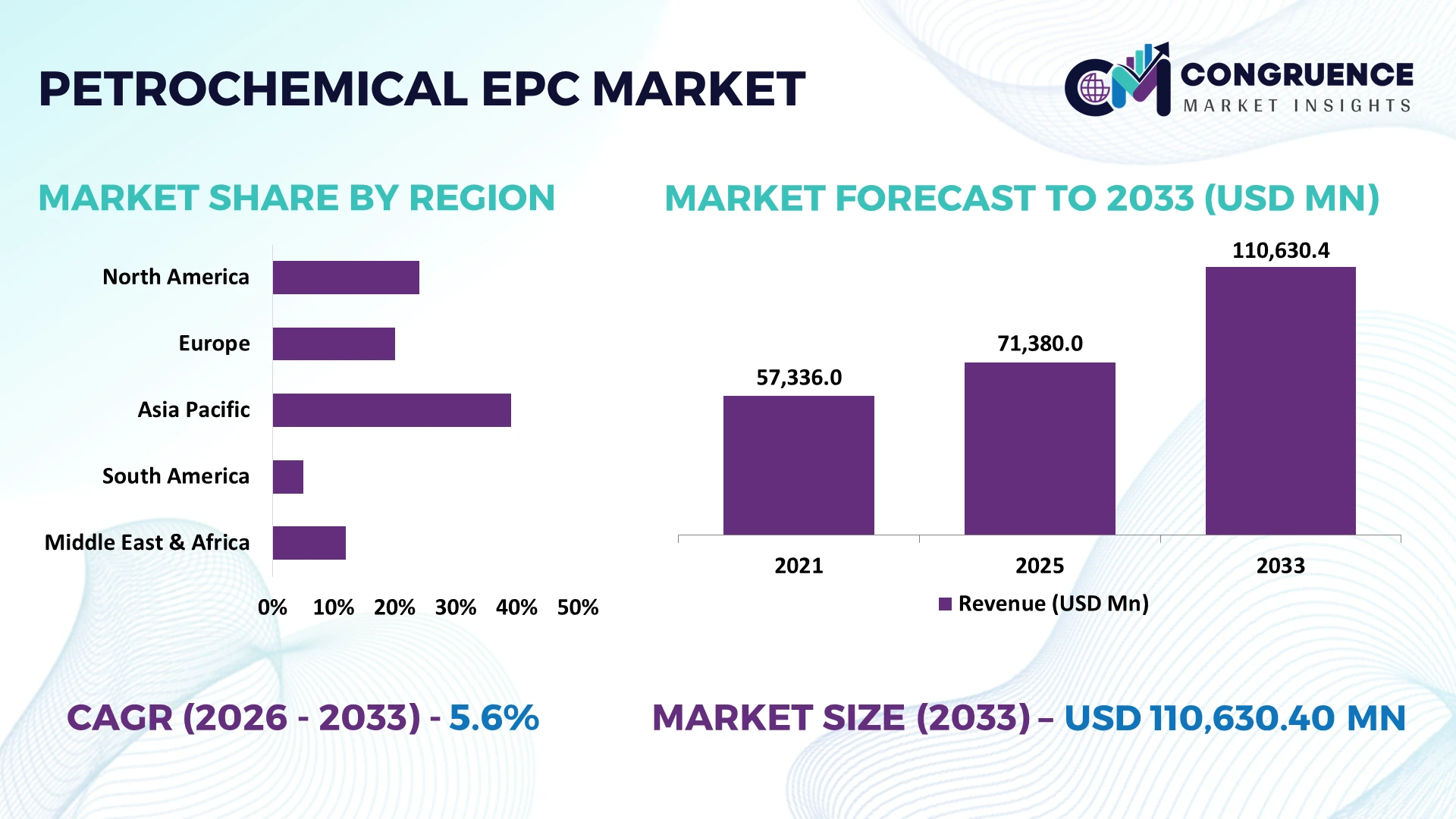
The Global Petrochemical EPC Market was valued at USD 71380 Million in 2025 and is anticipated to reach a value of USD 110630.4 Million by 2033 expanding at a CAGR of 5.63% between 2026 and 2033. Growth is being driven by refinery-to-chemicals integration, world-scale ethylene and propylene additions, feedstock diversification, and accelerated replacement of conventional engineering workflows with modular, digitally controlled EPC execution.
China anchors the global petrochemical EPC pipeline with 62.7 million tonnes/year of ethylene capacity in 2025, versus roughly 8.7 million tonnes/year in India during 2024–25. China added 8.15 million tonnes/year in one year, while PDH technology represented 34.9% of its propylene capacity. Large integrated complexes support polymers, specialty chemicals, battery materials, and high-performance derivatives, reinforced by Sino-Saudi industrial investment.
EPC contractors with strong Asian execution capacity, feedstock-flexible process expertise, and resilient procurement networks are best positioned as Strait of Hormuz supply risks increase the strategic value of diversified equipment sourcing and integrated project delivery.
Market Size & Growth: USD 71.38 billion in 2025 advances toward USD 110.63 billion by 2033 at 5.63%, supported by refinery-to-chemicals integration and world-scale cracker construction.
Top Growth Drivers: China’s ethylene capacity expanded approximately 14.9% in 2025; India targets roughly 9.2% growth by 2026–27; Saudi Arabia targets over 60% higher gas production by 2030.
Short-Term Forecast: By 2028, advanced modularization, automated engineering, and digital procurement workflows are positioned to cut EPC engineering hours by approximately 10–15% on standardized process packages.
Emerging Technologies: AI-assisted engineering, digital twins, automated construction monitoring, and modular fabrication are targeting 10–20% workflow-efficiency gains while improving schedule visibility across complex global petrochemical projects.
Regional Leaders: Modeled 2033 EPC opportunity reaches approximately USD 49.8 billion in Asia-Pacific, USD 23.2 billion in the Middle East, and USD 16.6 billion in North America, led by integrated-complex modernization.
End-User Trends: China’s ethylene-equivalent self-sufficiency reached 78.1%, strengthening localized chemical production and EPC demand for polyethylene, polypropylene, specialty polymers, battery solvents, and advanced derivatives.
Pilot/Case Example: The 2024 Fujian integrated project combines 16 million tonnes/year refining with 1.5 million tonnes/year ethylene capacity; planned petrochemical feedstock equals roughly 31% of refinery throughput.
Competitive Landscape: Technip Energies holds an estimated mid-single-digit global share in a fragmented EPC field alongside Saipem, MAIRE, Samsung E&A, Hyundai E&C, and Sinopec Engineering.
Regulatory & ESG Impact: Next-generation heat integration, electrification, flare optimization, and emissions monitoring increasingly target 10–20% reductions in process energy intensity across advanced petrochemical engineering specifications.
Investment & Funding: Three major integrated developments—Amiral, SABIC Fujian, and BPCL’s Andhra Pradesh project—represent more than USD 28 billion of announced investment, reinforcing partnership-led capacity expansion.
Innovation & Future Outlook: China’s 34.9% PDH penetration highlights feedstock-route diversification; future EPC competition shifts toward flexible crackers, specialty-chemical integration, digital twins, modular construction, and lower-carbon utility systems.
Petrochemical EPC demand is concentrating around integrated refinery-chemical complexes, flexible-feed crackers, specialty polymers, and high-value derivatives. AI engineering, modular construction, digital twins, and advanced process control are reshaping execution, while China’s PDH route already represents 34.9% of propylene capacity. Strait of Hormuz supply-chain exposure further elevates procurement resilience, positioning technology integration and regional execution strategy at the center of competitive decision-making.
Petrochemical EPC is becoming strategically important as producers compete through integrated refining-chemicals assets, feedstock flexibility, faster commissioning, and localized supply chains. China reached 62.7 million tonnes/year of ethylene capacity in 2025 after adding 8.15 million tonnes, while self-sufficiency climbed to 78.1%, shifting EPC priorities from basic capacity expansion toward differentiated derivatives and higher-value process integration.
Execution technology is reinforcing this shift. Modular construction transfers labor-intensive fabrication from congested sites to controlled yards; one petrochemical case estimated a 5.9% total-cost advantage versus conventional stick-built construction. Digital twins further connect FEED, detailed engineering, construction, and operations, reducing fragmented data and rework. China operates at world-leading scale, whereas India’s ethylene capacity stood near 8.7 million tonnes in 2024–25 and is expected to exceed 9.5 million tonnes by 2026–27.
India illustrates the deployment pathway: Indian Oil’s Gujarat Refinery is adding 500 KTPA of polypropylene and 150 KTPA of butyl acrylate while expanding refining capacity from 13.7 to 18 MMTPA. Through 2028, contractors will deepen partnerships around modularization, digital engineering, procurement localization, and integrated process packages. Competitive advantage will increasingly depend on execution certainty, technology transferability, and the ability to deliver complex brownfield and greenfield assets with lower lifecycle risk.
Petrochemical producers are directing capital toward integrated complexes that convert larger portions of refinery streams into olefins, polymers, and specialty derivatives. China added 8.15 million tonnes/year of ethylene capacity in 2025, lifting national capacity to 62.7 million tonnes/year and ethylene-equivalent self-sufficiency to 78.1%. Meanwhile, India’s propylene capacity is expected to rise from 7.96 million tonnes to 10.38 million tonnes by 2026–27, an increase exceeding 30%. This integration improves feedstock optimization while creating larger, technically complex EPC packages. Indian refiners are consequently adding downstream units alongside refinery upgrades. Contractors are responding through process-licensing partnerships, modular execution, expanded engineering centers, and integrated procurement capabilities. The strategic advantage increasingly lies in capturing multiple derivative packages around one infrastructure platform rather than isolated plant contracts.
Rapid capacity additions are intensifying utilization and margin pressure, limiting owners’ willingness to sanction undifferentiated petrochemical projects. China’s ethylene capacity reached 62.7 million tonnes/year in 2025, while oil-based ethylene remained loss-making despite improving margins; PDH already represented 34.9% of national propylene capacity. This creates a structural problem for EPC pipelines: expanding nameplate capacity does not automatically produce attractive project economics when feedstock spreads weaken. Modularization also carries location-sensitive economics—a petrochemical study found one modular configuration 5.9% cheaper than stick-built construction, while another configuration was 1.0% more expensive because fabrication and transportation costs offset site savings. Owners are responding with phased investment approvals, diversified feedstocks, localized fabrication, longer procurement contracts, and greater emphasis on specialty derivatives instead of commodity-only capacity.
The strongest non-capacity opportunity lies in transforming how petrochemical assets are engineered and constructed. Digital twins increasingly connect process simulation, mechanical engineering, controls, construction, training, and operating optimization, replacing fragmented handoffs between conventional EPC stages. Modularization provides an equally tangible economic lever: a petrochemical construction case produced a 5.9% lower project-cost estimate than its stick-built alternative, although outcomes depended heavily on fabrication location and logistics. India provides a scalable deployment base as ethylene capacity moves from approximately 8.7 million tonnes toward more than 9.5 million tonnes by 2026–27, roughly 9% expansion. EPC companies are therefore investing in integrated engineering databases, remote fabrication ecosystems, AI-assisted planning, and technology alliances. The strategic opportunity is selling lifecycle-ready digital assets alongside physical plants rather than competing solely on construction price.
Petrochemical EPC competitiveness increasingly depends on managing integration complexity across engineering databases, licensors, modular yards, automation systems, vendors, and operating platforms. Early modular cost estimates themselves can carry substantial uncertainty: one petrochemical framework produced a 1.8% difference versus the basic engineering estimate but a 12.8% difference against the detailed engineering estimate, demonstrating how project definition materially changes execution economics. China’s 2025 addition of 8.15 million tonnes/year of ethylene capacity also illustrates the scale at which contractors must coordinate equipment, skilled labor, commissioning, and process integration. Unlike near-term feedstock constraints, this is a long-term capability challenge. EPC companies must standardize interoperable engineering data, strengthen cybersecurity governance, develop digital-process talent, qualify multiple fabrication partners, and preserve configuration integrity from FEED through commissioning. Execution consistency will separate scalable global contractors from capacity-constrained competitors.
Capacity Expansion Turns More Selective. China’s ethylene capacity reached 62.7 million tonnes/year in 2025 after 8.15 million tonnes of additions, while ethylene-equivalent self-sufficiency rose to 78.1%. Owners are consequently prioritizing debottlenecking, derivative integration, and feedstock optimization over standalone commodity units. EPC contractors are restructuring portfolios around higher-complexity brownfield scopes, specialty chemicals, and integrated utility packages.
Brownfield Integration Gains Priority. India operated 267.1 million tonnes/year of refining capacity by April 2026, with Reliance’s two Jamnagar facilities representing 68.2 million tonnes. Refiners are increasingly attaching polypropylene, propylene, aromatics, and specialty-chemical units to existing sites, exploiting utilities and logistics already in place. Contractors are expanding brownfield engineering teams and shutdown-planning capabilities to shorten tie-in periods.
Process Safety Becomes Data-Led. In 2025, 42% of surveyed process-industry organizations were using or planning AI for safety, 29% were connecting risk data across assets, and 55% relied on third-party safety solution providers. EPC firms are embedding digital hazard management into commissioning and handover workflows, improving risk visibility while strengthening partnerships with specialist automation and analytics vendors.
Procurement Governance Tightens Rapidly. More than 70% of flagged capital projects assessed by EY showed stressed tendering or procurement processes, while broader operations research identified integration complexity at 47% and data problems at 44%. Owners are tightening package governance, vendor qualification, and data standards. EPC companies are responding with centralized procurement controls, digital supplier platforms, and more disciplined contracting structures.
Lump-Sum Turnkey accounts for an estimated 38% of Petrochemical EPC Market activity, retaining leadership because owners receive integrated engineering, procurement, construction, commissioning, schedule accountability, and performance guarantees under one commercial structure. The model remains especially important for standardized greenfield crackers, polymer units, and refinery-linked chemical facilities where scope definition is sufficiently mature. EPCM represents roughly 27%, gaining relevance in technically complex programs where owners want greater procurement visibility and design flexibility. Design-Build holds approximately 19%, concentrated in defined utility systems, storage infrastructure, and supporting process facilities.
Modular EPC, at approximately 16%, is the fastest-expanding type as companies move fabrication, piping assembly, skids, and equipment integration into controlled off-site environments. The shift lowers site congestion and reduces dependence on scarce construction labor, particularly for remote or schedule-critical projects. Contractors are therefore investing in fabrication-yard alliances, standardized process modules, digital constructability tools, and transport engineering. Lump-Sum Turnkey remains the scale leader, but investment priorities increasingly favor hybrid delivery structures combining EPC accountability with modular execution flexibility.
Petrochemical Processing represents an estimated 34% of market activity, supported by large ethylene, propylene, aromatics, and integrated derivative complexes requiring extensive process engineering, compression, separation, utilities, and off-sites integration. Refining follows at approximately 24%, driven increasingly by modernization and refinery-to-chemicals conversion rather than conventional fuel-capacity additions. Polymer Production holds close to 18%, while Chemical Processing represents about 15% and Gas Processing approximately 9%, reflecting different capital intensity and project complexity.
Polymer Production is the fastest-strengthening application as producers extend upstream olefin assets into polyethylene, polypropylene, engineering plastics, and specialty resin lines. China’s ethylene capacity reached 62.7 million tonnes/year in 2025, while propylene capacity approached 85 million tonnes/year, creating a substantial feedstock platform for downstream conversion. EPC providers are responding with integrated technology licensing, pelletization packages, automated materials handling, and flexible-grade production systems. Gas Processing remains strategically important for feedstock preparation, while Chemical Processing attracts more specialized engineering around high-value derivatives and smaller, technically intensive units.
Petrochemical Producers account for an estimated 39% of EPC demand because their businesses depend directly on continuous capacity additions, feedstock integration, debottlenecking, derivative diversification, and high-utilization process assets. Oil & Gas Companies represent approximately 25%, increasingly commissioning integrated refinery-chemical and gas-to-chemicals infrastructure rather than isolated upstream-linked facilities. Chemical Manufacturers contribute around 17%, Refining Companies approximately 13%, and diversified Industrial Operators close to 6%, with purchasing behavior varying according to asset complexity and integration requirements.
Chemical Manufacturers are the fastest-expanding buyer group as specialty products, performance materials, battery chemicals, coatings, and higher-value intermediates require smaller but more engineering-intensive facilities. Digital adoption is reinforcing this shift: a 2025 German chemical and pharmaceutical industry study found active AI usage reached 76%, compared with 34% in 2020, reflecting broader acceptance of data-driven operations. EPC providers are targeting these customers through modular process packages, automation partnerships, flexible contracting, and specialized engineering centers. Petrochemical producers still command scale, but future competitive differentiation increasingly comes from serving technically demanding chemical manufacturers with shorter product cycles and more configurable assets.
Asia-Pacific accounted for the largest market share at 43.5% in 2025 however, Middle East & Africa is expected to register the fastest growth, expanding at a CAGR of 6.8% between 2026 and 2033.
Gulf Coast Integration Drives Project Strategy
North America represents approximately 21% of global Petrochemical EPC activity, anchored by the U.S. Gulf Coast’s dense network of crackers, refineries, pipelines, storage terminals, and export infrastructure. Low-cost ethane continues to differentiate U.S. projects from naphtha-intensive European facilities, concentrating engineering requirements around polyethylene, ethylene derivatives, gas processing, and brownfield optimization. Texas and Louisiana dominate deployment because established utilities and marine terminals lower infrastructure duplication. Contractors are increasingly applying advanced work packaging, automated engineering, modular fabrication, and digital commissioning to control labor exposure and construction schedules. The current investment cycle is more selective than previous greenfield waves: owners favor debottlenecking, derivative integration, reliability upgrades, and infrastructure optimization. Dow’s decision to delay its Alberta Path2Zero project demonstrates this capital discipline, while U.S. Gulf Coast infrastructure transactions reinforce asset-sharing and portfolio optimization.
United States Market Outlook: The United States remains the region’s strategic EPC center because more than 95% of domestic ethylene capacity is concentrated along the Gulf Coast. Extensive NGL infrastructure and Mont Belvieu connectivity support feedstock flexibility, while export terminals extend market access. Contractors with brownfield integration, modular execution, and turnaround capabilities hold a stronger position as producers prioritize asset productivity over capacity-only expansion.
Asset Rationalization Redirects Engineering Demand
Europe accounts for an estimated 15% of global Petrochemical EPC activity, but engineering demand is shifting decisively from conventional capacity expansion toward modernization, closure management, energy optimization, electrification, and selective high-efficiency replacement assets. Announced changes between 2022 and 2025 imply a net 16% reduction in European steam-cracker capacity, exposing older naphtha-based facilities to feedstock and energy disadvantages. Nine crackers have been affected by announced closures, placing interconnected chemical clusters under additional operational pressure. This restructuring creates specialized EPC requirements for decommissioning, utility reconfiguration, pipeline modifications, downstream feedstock substitution, and lower-emission process systems. Simultaneously, INEOS Project ONE in Antwerp introduces 1.45 million tonnes/year of advanced ethylene capacity, demonstrating that competitive assets continue attracting engineering investment. Contractors are repositioning toward technically sophisticated modernization rather than broad commodity-capacity construction.
Germany Market Outlook: Germany remains strategically important through the Rhine-Ruhr, Ludwigshafen, Leuna, and central German chemical clusters, despite aggressive rationalization. Dow plans to close its 540,000-tonne/year Böhlen ethylene cracker by late 2027, increasing requirements for site restructuring and downstream supply reconfiguration. German EPC demand consequently favors energy-efficiency retrofits, electrification, infrastructure adaptation, decommissioning expertise, and specialty-chemical process engineering.
Integrated Megaproject Scale Defines Leadership
Asia-Pacific commands approximately 43.5% of global Petrochemical EPC activity, supported by unparalleled construction scale across China, India, South Korea, and Southeast Asian industrial corridors. China alone reached 62.7 million tonnes/year of ethylene capacity in 2025 after adding 8.15 million tonnes during the year, establishing the world’s largest production base. Propylene capacity approached 85 million tonnes/year, intensifying engineering activity across PDH, polymers, derivatives, storage, and integrated utilities. India provides a second deployment engine as refiners connect expanding refining infrastructure with polypropylene, aromatics, specialty chemicals, and olefin projects. Contractors are strengthening local engineering centers, procurement networks, fabrication partnerships, and technology-licensing relationships. Importantly, Chinese overcapacity is making project selection more disciplined; future EPC awards increasingly emphasize differentiated derivatives, process efficiency, and integration depth instead of simple nameplate expansion.
China Market Outlook: China defines the global benchmark for petrochemical project scale, but its EPC priorities are changing. Ethylene-equivalent self-sufficiency reached 78.1% in 2025, while PDH represented 34.9% of propylene capacity. Producers are therefore redirecting engineering toward specialty derivatives, advanced polymers, feedstock-route optimization, and integrated refining-chemical platforms, rewarding contractors capable of executing technologically differentiated projects rather than standardized commodity plants.
Brownfield Renewal Reopens Capacity Pathways
South America represents approximately 6% of global Petrochemical EPC activity, with Brazil accounting for the strongest concentration of crackers, polymer assets, refining infrastructure, and engineering capability. The market is increasingly characterized by brownfield modernization, feedstock-security projects, renewable chemical integration, and selective capacity restoration rather than widespread greenfield megaprojects. Brazil’s established petrochemical clusters in Rio de Janeiro, Bahia, São Paulo, and Rio Grande do Sul provide existing logistics and utility systems that support lower-infrastructure-intensity expansions. Braskem’s Transforma Rio initiative targets an additional 220,000 tonnes/year of ethylene capacity with equivalent polyethylene expansion by 2028, creating engineering requirements across process units and supporting infrastructure. However, financing conditions and feedstock availability remain project-selection constraints. EPC providers are responding through phased execution, local procurement, refinery-petrochemical integration, and partnerships that reduce upfront execution exposure.
Brazil Market Outlook: Brazil offers South America’s deepest petrochemical EPC opportunity through established production clusters and an extensive downstream resin industry. Braskem already operates several million tonnes of domestic ethylene capacity, while Transforma Rio adds a significant brownfield expansion pathway. Contractors combining local fabrication, revamp expertise, feedstock integration, and renewable-chemicals engineering gain an advantage as investment shifts toward upgrading existing industrial ecosystems.
Feedstock Advantage Accelerates Downstream Integration
Middle East & Africa represents approximately 14.5% of global Petrochemical EPC activity, with Saudi Arabia, the UAE, Qatar, and Oman concentrating large-scale engineering investment around integrated refining, gas processing, olefins, polymers, and specialty derivatives. Competitive hydrocarbon feedstocks and established export infrastructure support world-scale complexes while national industrial strategies increasingly push producers further downstream. Saudi Arabia’s Amiral complex illustrates this transformation: the integrated development includes a 1.65 million-tonne/year ethylene cracker alongside derivative units connected to the SATORP refinery. Contractors are consequently competing for larger multidisciplinary packages combining process licensing, utilities, off-sites, storage, automation, and infrastructure. African deployment remains more selective because financing, logistics, and utility availability constrain execution outside established hubs. EPC firms are expanding engineering partnerships, localization programs, modular fabrication, and domestic supplier development to meet increasingly stringent in-country value requirements.
Saudi Arabia Market Outlook: Saudi Arabia is the region’s primary strategic EPC hub, combining advantaged feedstocks with refinery integration and localization policy. The 1.65 million-tonne/year Amiral cracker demonstrates the scale of downstream diversification underway. Saudi Aramco and SABIC are increasingly emphasizing chemicals integration, creating opportunities for contractors offering advanced process technologies, local procurement ecosystems, modular execution, and complex interface-management capabilities.
Technip Energies, Saipem, Samsung E&A, MAIRE and Sinopec Engineering compete for integrated petrochemical megaprojects, while Bechtel, Fluor, JGC and Worley challenge through engineering depth, regional execution and brownfield capabilities. The top five are estimated to control approximately 28% of global awards, confirming a fragmented structure where project-specific expertise outweighs scale alone. Technology-led contractors target 10–15% engineering-efficiency improvements through digital design, modularization and automated workflows, while localized procurement can reduce selected package costs by 5–10%. Competition increasingly centers on schedule certainty, licensor integration, supply-chain control and customization rather than headline bidding price. Samsung E&A and MAIRE are expanding technology partnerships; Technip Energies strengthens process integration; Chinese contractors leverage procurement scale; and Gulf projects increasingly demand localization. Digital engineering and modular execution are shifting advantage toward vertically coordinated delivery models. Qualification requirements, performance guarantees and megaproject references remain formidable entry barriers. Winning requires proven execution, technology ownership, procurement resilience, localization capability and disciplined risk allocation across complex international projects.
Technip Energies
Saipem
Samsung E&A
MAIRE
Sinopec Engineering Group
Bechtel
Fluor Corporation
JGC Holdings Corporation
Chiyoda Corporation
Worley
Hyundai Engineering & Construction
KBR
Wood
Digital twins, 3D model-based engineering, advanced work packaging, and automated procurement are becoming core Petrochemical EPC technologies. Integrated engineering databases can improve design productivity by about 10–15%, while automated clash detection reduces rework by roughly 8–12%. Deployment is strongest among tier-one contractors, where cloud collaboration and digital commissioning increasingly connect FEED, procurement, construction, and handover workflows.
Emerging adoption centers on AI-assisted engineering, robotics, modular fabrication, and predictive construction analytics. AI scheduling and document review can cut engineering-cycle effort by 10–20%, while modular execution can reduce selected site labor requirements by 15–25%. Compared with legacy stick-built delivery, digitally coordinated modular EPC can improve schedule performance by around 10–15%, particularly where fabrication yards, logistics, and standardized process packages are tightly integrated.
Disruptive technologies include autonomous inspection, generative engineering, industrial digital twins, additive manufacturing, and carbon-aware process optimization. By 2026–2028, leading contractors are expected to embed AI across 50–60% of repetitive engineering and project-control workflows, increasing bid speed and execution consistency. Technip Energies, Samsung E&A, JGC, and other digitally mature EPC firms benefit most because proprietary process technology plus integrated data platforms strengthen lifecycle differentiation. Acting now matters: technology standardization increasingly determines margin protection, delivery certainty, and qualification for complex megaprojects globally today.
April 2026 Technip Energies secured Long Son Petrochemicals’ Vietnam enhancement contract, converting its steam cracker from naphtha toward ethane using USC furnaces and HRS technology. The shift improves feedstock flexibility, energy efficiency, and operating resilience across volatile markets. Source: ogj.com
March 2024 MAIRE’s Tecnimont won Sonatrach’s EPCC contract for a linear alkyl benzene plant in Skikda, Algeria, scheduled for completion within 44 months. The project expands detergent-intermediate capacity and strengthens Tecnimont’s execution position in North Africa downstream integration. Source: reuters.com
February 2025 Samsung E&A won the TA’ZIZ methanol EPC contract in the UAE for a 1.8-million-tonne-per-year plant with a 44-month duration. Modularization and automation underpin execution, reinforcing Samsung E&A’s competitive position in large-scale Middle Eastern chemicals projects delivery. Source: samsungena.com
October 2025 BPCL’s Bina petrochemical expansion advanced through government e-procurement for bagging and palletizing lines, with the package specifying a 420-day work period. The tender signals continued downstream execution activity and broader supply-chain mobilization around Bina equipment procurement. Source: eprocure.gov.in
The Petrochemical EPC Market Report evaluates project activity across Lump-Sum Turnkey, EPCM, Design-Build, and Modular EPC delivery models, alongside Refining, Petrochemical Processing, Polymer Production, Chemical Processing, and Gas Processing applications. Coverage extends to Petrochemical Producers, Oil & Gas Companies, Chemical Manufacturers, Refining Companies, and Industrial Operators. Asia-Pacific represents roughly 43.5% of current activity, while modular execution accounts for an estimated 16% and is gaining strategic relevance.
Regional analysis spans North America, Europe, Asia-Pacific, South America, and Middle East & Africa, with country-level attention to major industrial hubs. Technology coverage includes digital twins, AI-assisted engineering, automation, modular fabrication, advanced process integration, and digital procurement. The report also examines brownfield modernization, refinery-to-chemicals integration, specialty derivatives, circular-processing infrastructure, and feedstock-flexible projects, supporting investment planning, partnership selection, expansion priorities, competitive benchmarking, and strategic positioning through 2026–2033.
| Report Attribute/Metric | Report Details |
|---|---|
Market Revenue in 2025 | USD 71380 Million |
Market Revenue in 2033 | USD 110630.4 Million |
CAGR (2026 - 2033) | 5.63% |
Base Year | 2025 |
Forecast Period | 2026 - 2033 |
Historic Period | 2021 - 2025 |
Segments Covered | By Type
By Application
By End-User
|
Key Report Deliverable | Revenue Forecast, Growth Trends, Market Dynamics, Segmental Overview, Regional and Country-wise Analysis, Competition Landscape |
Region Covered | North America, Europe, Asia-Pacific, South America, Middle East, Africa |
Key Players Analyzed | Technip Energies, Saipem, Samsung E&A, MAIRE, Sinopec Engineering Group, Bechtel, Fluor Corporation, JGC Holdings Corporation, Chiyoda Corporation, Worley, Hyundai Engineering & Construction, KBR, Wood |
Customization & Pricing | Available on Request (10% Customization is Free) |




