
Reports
The Global Pet Wearable Devices Market was valued at USD 3,132.3 Million in 2025 and is anticipated to reach a value of USD 5,884.1 Million by 2033 expanding at a CAGR of 8.2% between 2026 and 2033. Growth is being driven by the transition from basic identification tags toward GPS-enabled smart collars, biometric sensing, AI-based behavioral analytics, and connected preventive pet-health monitoring.
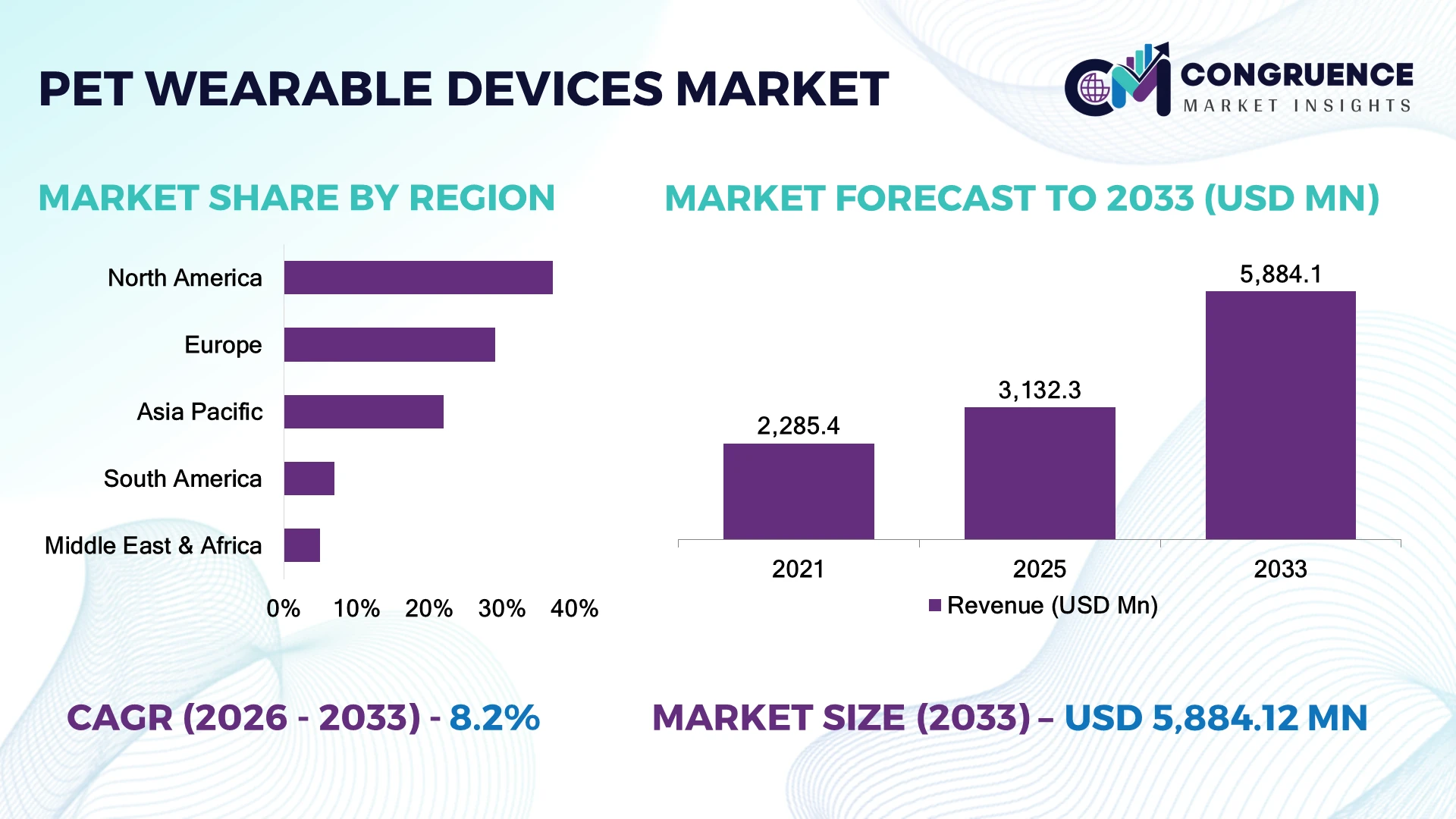
The United States remains the dominant country market, accounting for approximately 32% of global pet wearable demand, supported by 95 million pet-owning households and a pet-care industry exceeding USD 150 billion annually. GPS-enabled products lead adoption, while Europe is strengthening digital pet identification and traceability through 2026 regulatory developments. Compared with Europe, Asia-Pacific has a smaller installed base but faster adoption of connected consumer technologies and mobile-enabled pet services.
Strategically, manufacturers should prioritize AI-enabled GPS collars, veterinary data integration, subscription analytics, and region-specific compliance rather than competing solely on hardware specifications.
Market Size & Growth: USD 3,132.3 million in 2025 is projected to reach USD 5,884.1 million by 2033 at 8.2% CAGR, supported by the transition from basic tracking to AI-enabled health monitoring.
Top Growth Drivers: GPS tracking contributes roughly 32%, health and biometric sensing 24%, and AI-based behavioral analytics 18% to identified adoption drivers.
Short-Term Forecast: By 2028, AI-assisted health alerts and automated activity analysis are positioned to reduce manual monitoring effort by approximately 20–25%.
Emerging Technologies: AI health analytics, GPS-plus-cellular connectivity, biometric sensors, geofencing, and low-power processors are redefining advanced smart collar functionality.
Regional Leaders: North America is projected at approximately USD 3.7 billion by 2033, Europe at USD 3.25 billion, and Asia-Pacific at USD 2.93 billion, with APAC showing stronger digital-device adoption momentum.
Consumer/End-User Trends: Smart collars represented approximately 63.6% of product demand in 2025, reinforcing collars as the primary platform for continuous GPS, activity, and health monitoring.
Pilot/Case Example: In 2026, AI-enabled pet wearables increasingly combined GPS, motion sensing, and behavioral analysis, shifting platforms from basic location alerts toward continuous anomaly detection and personalized health insights.
Competitive Landscape: North America held approximately 37% of global pet wearable revenue in 2025, while Tractive, Garmin, Datamars, Fi, PetPace, and Invoxia compete across tracking, health analytics, and connected-device platforms.
Regulatory & ESG Impact: The EU's 2026 traceability developments increase the strategic importance of reliable digital identification, while low-power electronics and longer battery cycles reduce charging frequency and device waste.
Investment & Funding: Pet-tech financing remained active in 2026, with capital increasingly directed toward AI, connected-device, veterinary technology, and data-driven pet-care platforms.
Innovation & Future Outlook: Next-generation platforms are moving toward AI-generated health insights, veterinary interoperability, virtual fencing, multimodal sensing, and subscription analytics, shifting competition from standalone hardware toward recurring digital pet-care ecosystems.
The Pet Wearable Devices Market is shifting toward smart collars that combine GPS, biometric sensors, cellular connectivity, and AI-driven behavioral analysis. Approximately 43.6% of 2025 technology demand was associated with RFID, while GPS represents a rapidly expanding technology layer. Supply-chain localization and tighter traceability requirements are pushing manufacturers toward integrated, compliant hardware-software platforms.
The Pet Wearable Devices Market is becoming strategically important because hardware is evolving into a recurring digital pet-health platform. Smart collars increasingly combine location, activity, behavioral, and biometric data, allowing manufacturers to build subscription analytics and veterinary connectivity around the device. With U.S. pet ownership reaching approximately 95 million households, the addressable installed base is already substantial.
Technology economics are also shifting. GPS-enabled collars with cloud analytics replace isolated identification hardware with continuous data collection, while AI-based anomaly detection reduces manual interpretation of activity patterns. Smart collars account for more than 60% of product demand, creating a platform advantage for companies able to integrate connectivity, sensors, software, and battery optimization. Newer architectures also support longer battery cycles, reducing charging frequency and improving practical usability.
Regional strategies are diverging. North America remains the largest market, while Asia-Pacific is expanding its connected-device base through rising smartphone penetration, e-commerce access, and urban pet ownership. In 2026, companies are increasing investment in AI-enabled collars, veterinary partnerships, localized connectivity, and subscription services. Europe's evolving traceability requirements further strengthen demand for compliant digital identification. Competitive advantage increasingly depends on combining reliable hardware with actionable data, recurring services, and scalable veterinary integration.
AI-enabled health monitoring is shifting pet wearables from location tools toward continuous wellness platforms. Approximately 64% of product demand is concentrated in smart collars, while GPS-enabled devices account for more than 30% of technology adoption and health-monitoring functions represent roughly 24% of usage drivers. In the United States, connected pet-care platforms are increasingly integrating activity, sleep, location, and behavioral data into unified dashboards. The 2026 emphasis on preventive animal care is accelerating this transition. Companies are responding by embedding edge analytics, biometric sensors, and veterinary-data interfaces into collars. A non-obvious advantage is recurring subscription revenue from analytics, which increases customer lifetime value without requiring frequent hardware replacement.
Hardware affordability remains a structural constraint as advanced collars combine GPS, cellular connectivity, sensors, batteries, and cloud services. Cellular and connectivity components can represent approximately 20–30% of device bill-of-materials costs, while battery and sensor systems collectively add another 15–20%. In price-sensitive markets such as India and Brazil, subscription fees further influence replacement and retention decisions. Global semiconductor and connectivity supply-chain volatility also creates exposure to component lead times and procurement costs. Companies are mitigating this pressure through dual sourcing, standardized chipsets, localized assembly, and tiered product portfolios. The non-obvious constraint is total ownership cost: lowering hardware prices without controlling connectivity and service costs can weaken retention rather than expand adoption.
Integration with veterinary workflows represents a high-value expansion opportunity as pet wearables evolve into continuous health-data platforms. Approximately 35–40% of advanced-device functionality is increasingly centered on activity, sleep, behavioral, or biometric monitoring rather than basic location services, creating opportunities for automated clinical insights. In the United States, veterinary practices and pet-health platforms are expanding digital record infrastructure, enabling wearable data to support longitudinal monitoring. AI-based anomaly detection can reduce manual activity interpretation by approximately 20–25%, creating efficiency gains for owners and veterinarians. Companies are investing in APIs, cloud platforms, and veterinary partnerships. The strategic opportunity lies in owning the data layer rather than competing solely through increasingly commoditized collar hardware.
Connected pet devices require reliable positioning, cellular coverage, cloud availability, firmware updates, and secure data transmission across fragmented networks. Connectivity interruptions affecting even 5–10% of active sessions can materially reduce confidence in location-critical applications, while battery degradation of 15–20% over extended use can increase charging frequency and user abandonment. In countries with uneven rural connectivity, such as India and Brazil, these constraints are particularly relevant for GPS-based safety applications. At the same time, expanding pet-health datasets increase cybersecurity and privacy requirements. Companies must strengthen encrypted communications, over-the-air firmware management, device authentication, and multi-network connectivity. The long-term competitive differentiator will be dependable service continuity, not simply sensor density or feature count.
Smart Collars Become Multifunctional: Smart collars now combine GPS, activity tracking, behavioral analytics, and health sensing, with collars representing approximately 64% of product demand. Manufacturers are consolidating sensors and connectivity into smaller devices, reducing the need for separate trackers while increasing software-service attachment rates.
Cellular Connectivity Gets Smarter: Newer devices increasingly combine GPS with LTE-M, NB-IoT, and low-power positioning, reducing energy consumption by approximately 20–30% versus continuously active cellular configurations. U.S. and European operators are expanding IoT network coverage, prompting manufacturers to redesign devices around longer battery cycles and multi-network compatibility.
AI Shifts From Tracking: AI-based analytics are moving beyond movement classification toward anomaly detection, with automated interpretation capable of reducing manual activity review by roughly 20–25%. Companies are embedding machine-learning models into cloud platforms, creating personalized alerts based on behavioral baselines rather than fixed thresholds.
Traceability Raises Device Value: European traceability developments in 2026 are increasing the operational relevance of digital pet identification. Manufacturers are responding by combining identification, GPS, and ownership records, while supply-chain teams prioritize interoperable components. The non-obvious shift is that compliance functionality is becoming a product differentiator rather than merely a regulatory requirement.
Smart collars lead the Pet Wearable Devices Market with approximately 61–64% share in 2025, supported by their ability to combine GPS, activity monitoring, health sensing, geofencing, and mobile connectivity in one continuously worn device. Their persistent contact with the animal gives collars a measurable advantage over intermittent-use cameras and standalone trackers. Smart harnesses and vests represent the fastest-expanding product category, gaining traction for biometric monitoring, posture analysis, and working-animal applications. Their adoption is particularly relevant for service, detection, and performance-oriented dogs, where collar-based positioning alone provides limited physiological data.
Smart cameras, activity trackers, and other identification devices retain strategic relevance, particularly for indoor monitoring and lower-cost identification. Companies are therefore moving toward modular product ecosystems rather than standalone devices, with approximately 20–25% of advanced product functionality increasingly linked to software, analytics, and subscription services. The business implication is clear: investment is shifting toward multifunctional hardware and interoperable software platforms that increase device utilization and recurring customer engagement.
The 2026 market assessment identifies smart collars at approximately 63.6% of 2025 pet wearable demand, confirming their role as the primary platform for GPS, biometric, and behavioral monitoring.
Identification and tracking represents the leading application, accounting for approximately 61% of 2025 market demand. Its dominance reflects the immediate utility of GPS, RFID, and geofencing for lost-pet recovery, outdoor safety, and location visibility. However, behavior monitoring and control is the fastest-growing application as owners increasingly seek automated detection of inactivity, excessive movement, anxiety-related behavior, and abnormal routines. AI-enabled activity analysis is shifting wearables from reactive location tools toward continuous behavioral intelligence.
Medical diagnosis and treatment is also gaining strategic importance as biometric sensors become more capable of capturing activity, sleep, temperature, and other physiological indicators. Facilitation, safety, and security applications remain important for boarding, training, travel, and controlled environments. Companies are responding by integrating multiple use cases into single devices, reducing the need for separate trackers and improving hardware utilization. The resulting investment priority is increasingly centered on analytics, veterinary connectivity, and automated alerts rather than basic location functionality.
Current 2025 market analysis places identification and tracking at approximately 61.2% of application demand, while behavior monitoring is emerging as the fastest-expanding use case as AI-enabled activity and anomaly detection becomes more practical.
Household pet owners represent the dominant end-user group, accounting for approximately 78% of 2025 demand. Their purchasing behavior is concentrated around GPS tracking, activity monitoring, safety alerts, and mobile-app connectivity, creating a large volume-driven market for smart collars and subscription services. Veterinary hospitals and clinics form the fastest-growing institutional segment, as wearable-generated activity and behavioral data increasingly supports remote observation, preventive care, and longitudinal patient management. Their adoption is shifting demand toward higher-accuracy sensors and clinically useful data rather than consumer-only features.
Commercial users, including pet-care, boarding, training, and specialized service operators, remain a smaller but strategically important segment because one deployment can cover multiple animals and generate recurring service demand. Companies are responding with differentiated pricing, enterprise dashboards, API integration, and veterinary partnerships. Approximately 20–25% of advanced wearable functionality is now increasingly oriented toward health or behavioral intelligence, indicating that future product development will increasingly target professional workflows alongside household use.
The 2025 segmentation assessment places household pet owners at approximately 77.9% of end-user demand, while veterinary hospitals and clinics are identified as the fastest-growing institutional users as wearable data enters preventive and clinical workflows.
Asia-Pacific accounted for the largest market share at 37.0% in 2025 however, Asia-Pacific is expected to register the fastest growth, expanding at a CAGR of 9.4% between 2026 and 2033.

Connected pet care shifts from tracking hardware toward subscription-led health ecosystems
North America represents approximately 37% of global Pet Wearable Devices Market demand, supported by high pet ownership, established e-commerce distribution, widespread smartphone connectivity, and strong adoption of GPS-enabled collars. The United States accounts for the overwhelming majority of regional demand, with approximately 95 million households owning at least one pet. Smart collars dominate purchasing, while veterinary integration and AI-based behavioral monitoring are expanding device utilization beyond location tracking. Cellular connectivity, geofencing, and app-based health dashboards are increasingly bundled into premium products. In 2026, manufacturers are prioritizing recurring service models, veterinary partnerships, and multi-function devices rather than standalone trackers. The region's mature digital infrastructure also enables faster deployment of cloud analytics and over-the-air firmware updates.
United States Market Outlook: The United States remains the principal North American market, supported by approximately 95 million pet-owning households and a highly developed pet-care ecosystem. Major technology companies and specialized pet-tech firms are integrating GPS, biometric sensing, AI analytics, and subscription services. The country's extensive LTE and 5G infrastructure also improves real-time tracking reliability, particularly for outdoor dogs and high-value working animals.
Traceability and preventive monitoring strengthen connected-device adoption
Europe accounts for approximately 29% of global Pet Wearable Devices Market demand, with the United Kingdom, Germany, France, and Italy forming the principal commercial markets. Digital identification is gaining importance alongside GPS tracking as animal traceability requirements become more structured across European markets. Approximately 25–30% of advanced-device functionality is increasingly associated with health, activity, or behavioral monitoring rather than basic identification. Manufacturers are responding with low-power electronics, recyclable materials, and integrated identification technologies. The region's emphasis on animal welfare and data-enabled preventive care is also encouraging veterinary partnerships. Product development is consequently shifting toward longer battery life, interoperable records, and clinically useful analytics.
United Kingdom Market Outlook: The United Kingdom provides a strong commercial base because of high pet ownership, established veterinary networks, and mature digital purchasing behavior. Mandatory dog microchipping has also created familiarity with electronic animal identification, supporting acceptance of connected tracking technologies. Companies are increasingly combining identification with GPS, activity monitoring, and mobile alerts, creating opportunities for subscription-based pet-safety services and veterinary data integration.
Consumer-tech manufacturing and mobile connectivity accelerate adoption
Asia-Pacific represents approximately 22% of global Pet Wearable Devices Market demand and is the fastest-expanding regional market. China, Japan, South Korea, India, and Australia are driving adoption through expanding smartphone ecosystems, e-commerce penetration, domestic electronics manufacturing, and rising expenditure on companion animals. China provides a major manufacturing advantage for sensors, batteries, connectivity modules, and compact electronics, helping reduce production lead times and enabling rapid product iteration. India's expanding digital-payment and mobile-commerce infrastructure is improving access to connected pet products, although price sensitivity remains significant. Manufacturers are responding with mid-priced GPS collars, localized applications, and modular connectivity. Approximately 20–25% lower hardware costs can be achieved through component localization and higher-volume electronics procurement.
China Market Outlook: China combines substantial electronics manufacturing capacity with a rapidly expanding domestic pet-care economy, creating advantages across both supply and demand. Shenzhen and the Pearl River Delta provide dense supplier networks for GPS modules, Bluetooth components, batteries, sensors, and compact processors. This ecosystem enables faster prototyping and product refresh cycles, while major e-commerce platforms support nationwide distribution of connected collars and activity trackers.
Urban pet ownership supports tracking-led digital adoption
South America contributes approximately 7% of global Pet Wearable Devices Market demand, with Brazil representing the principal market because of its large companion-animal population, expanding pet-care sector, and concentration of demand in major metropolitan areas. GPS tracking remains the strongest use case, particularly for dogs with outdoor access. Smartphone penetration supports mobile-based alerts, while e-commerce is widening availability beyond specialist pet stores. However, cellular coverage and device affordability remain important deployment considerations outside major cities. Manufacturers are therefore emphasizing entry-level GPS products, prepaid connectivity, and localized distribution partnerships. Approximately 15–20% price differences between imported premium devices and locally distributed alternatives can materially influence consumer purchasing decisions.
Brazil Market Outlook: Brazil offers the largest commercial opportunity in South America, supported by a substantial dog and cat population and a well-established pet-services industry. São Paulo and Rio de Janeiro concentrate technology-oriented consumers, veterinary providers, and organized pet retailers. Companies targeting Brazil are increasingly using localized e-commerce, installment-based pricing, and Portuguese-language applications to reduce adoption barriers while expanding GPS tracking and activity-monitoring penetration.
Premium pet care and smart-city infrastructure create targeted demand
Middle East & Africa accounts for approximately 5% of global Pet Wearable Devices Market demand, with the United Arab Emirates, Saudi Arabia, and South Africa representing the most commercially relevant markets. High smartphone penetration in Gulf markets, premium pet ownership, expatriate populations, and smart-city infrastructure support demand for GPS tracking and connected safety products. Dubai and Abu Dhabi provide particularly favorable environments for app-based services and premium technology adoption. South Africa offers a broader addressable market but faces greater connectivity and affordability constraints. Manufacturers are responding through premium GPS collars in Gulf markets and lower-cost tracking configurations in African markets. The key operational opportunity is segment-specific pricing rather than a uniform regional product strategy.
United Arab Emirates Market Outlook: The UAE is strategically significant because of its high digital-service adoption, advanced telecommunications infrastructure, and concentration of affluent consumers in Dubai and Abu Dhabi. Extensive 5G availability supports real-time location services and cloud-connected applications, while premium veterinary and pet-care facilities create opportunities for health-monitoring wearables. Companies are increasingly positioning smart collars as integrated safety and wellness platforms rather than basic tracking devices.
Tractive, Fi, PetPace, Garmin, and Datamars compete across connected tracking, health monitoring, and identification. The top five players hold roughly 38% combined share. Competition centers on technology, connectivity, customization, and price, with advanced devices commanding 15–25% premiums. Tractive is expanding through acquisitions and health partnerships, while PetPace integrates veterinary telemedicine. Garmin and Datamars leverage established technology and distribution ecosystems, while regional innovators compete through lower-cost localization. The market is shifting toward integrated hardware, AI analytics, subscriptions, and ecosystem partnerships. Connectivity reliability, clinical validation, data security, and installed-user scale create significant entry barriers. Companies are also diversifying component sourcing and strengthening software capabilities to protect margins and improve deployment speed. Competitive advantage increasingly depends on combining accurate tracking, useful health intelligence, dependable connectivity, and recurring digital services. Winning requires platform integration, trusted data, strong channels, and continuous product innovation rather than hardware differentiation alone across consumer, veterinary, and professional pet-care workflows.
Tractive
Garmin Ltd.
PetPace
Datamars
Invoxia
Life360, Inc.
SATELLAI
FitBark
Sure Petcare
PitPat
Pawfit
Halo Collar
Current pet wearables increasingly integrate GNSS, cellular connectivity, accelerometers, temperature sensors, and cloud analytics. Smart collars represent roughly 64% of product demand, while integrated health functions are expanding beyond basic location tracking. Low-power chipsets and adaptive positioning can reduce energy consumption by 20–30%, extending battery life and lowering charging friction.
Emerging AI models interpret activity, sleep, barking, and physiological patterns to generate anomaly alerts. Automated analysis can reduce manual activity review by approximately 20–25% versus threshold-based monitoring. PetPace and Tractive are strengthening health-data capabilities, while multimodal platforms are combining behavioral, biometric, and location signals. Companies with larger datasets gain an advantage because model accuracy improves through broader behavioral baselines.
From 2026–2028, satellite connectivity, digital-twin modeling, veterinary APIs, and edge AI will reshape premium devices. Satellite-enabled tracking extends coverage beyond cellular networks, while edge processing can reduce cloud-dependent response latency by approximately 15–20%. Tractive benefits from scale and ecosystem integration; PetPace benefits from clinical health specialization. Compared with basic RFID identification, connected GPS-and-AI systems provide continuous monitoring and substantially richer data, shifting competition toward software, analytics, and recurring services. The immediate priority is interoperability: shared data standards can shorten integration cycles, support veterinary workflows, and improve device retention across fragmented platforms.
January 2025 Tractive unveiled its dog tracker at CES, serving over 1.3 million customers. The launch added bark monitoring and planned vital-sign alerts, strengthening its shift from location tracking toward integrated health monitoring and expanding North American product differentiation. Source: tractive.com
July 2025 Tractive acquired Whistle from Mars Petcare, adding technology assets and a U.S. customer base while reaching more than 1.4 million active users. The transaction strengthened Tractive’s scale, distribution reach, and position in connected pet health platforms. Source: tractive.com
April 2026 PetPace expanded retail distribution through Macy’s online marketplace, making its AI smart health collar available to millions of shoppers. The move combined continuous biometric monitoring with 24/7 veterinary telemedicine, strengthening consumer access and accelerating health-focused wearable adoption.
September 2026 SATELLAI unveiled AI-powered pet intelligence at IFA, introducing a cat wearable and satellite-connected dog tracker. Its Tracker Ultra combines GPS with satellite connectivity, extending location coverage beyond cellular networks and positioning connected wearables for off-grid safety applications directly.
The Pet Wearable Devices Market Report covers smart collars, wearable trackers, health-monitoring devices, activity-monitoring products, and other connected pet technologies across identification and tracking, behavior monitoring, medical applications, safety, and security. End-user analysis covers household pet owners, veterinary hospitals and clinics, commercial pet-care operators, and specialized users. The report evaluates GPS, RFID, cellular connectivity, biometric sensing, AI analytics, geofencing, and emerging satellite-enabled tracking.
Geographic coverage includes North America, Europe, Asia-Pacific, South America, and the Middle East & Africa, with country-level analysis emphasizing the United States, United Kingdom, China, India, Brazil, and the UAE. The analysis considers smart-collar dominance, AI adoption, health-data integration, connectivity infrastructure, subscription models, and competitive positioning. It supports investment planning, market-entry decisions, product development, partnerships, regional expansion, and technology prioritization across 2026–2033.
| Report Attribute/Metric | Report Details |
|---|---|
|
Market Revenue in 2025 |
USD 3,132.3 Million |
|
Market Revenue in 2033 |
USD 5,884.1 Million |
|
CAGR (2026 - 2033) |
8.2% |
|
Base Year |
2025 |
|
Forecast Period |
2026 - 2033 |
|
Historic Period |
2021 - 2025 |
|
Segments Covered |
By Type
By Application
By End-User
|
|
Key Report Deliverable |
Revenue Forecast, Growth Trends, Market Dynamics, Segmental Overview, Regional and Country-wise Analysis, Competition Landscape |
|
Region Covered |
North America, Europe, Asia-Pacific, South America, Middle East, Africa |
|
Key Players Analyzed |
Tractive, Garmin Ltd., PetPace, Datamars, Invoxia, Life360, Inc., SATELLAI, FitBark, Sure Petcare, PitPat, Pawfit, Halo Collar |
|
Customization & Pricing |
Available on Request (10% Customization is Free) |




