
Reports
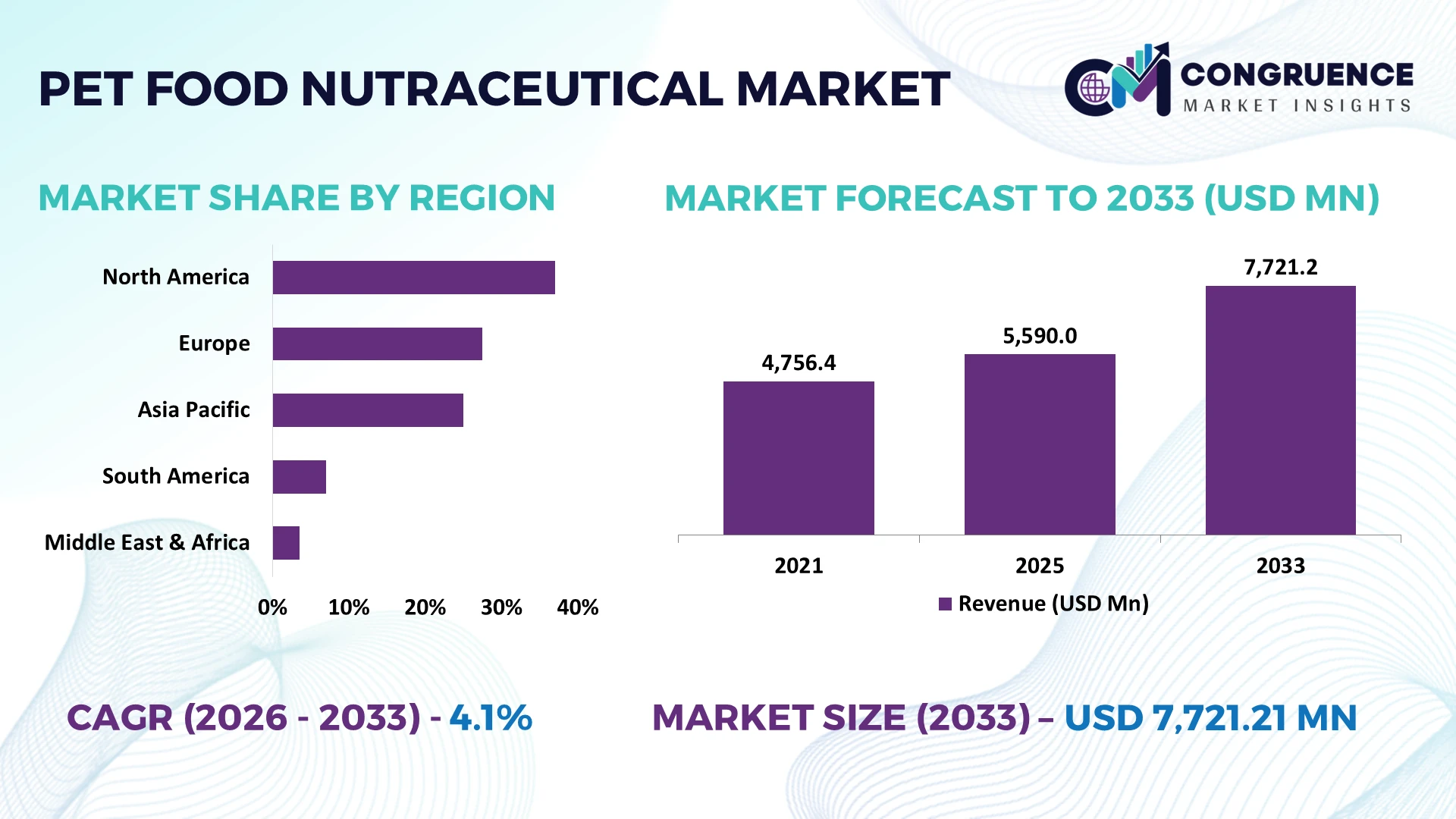
The Global Pet Food Nutraceutical Market was valued at USD 5,590.0 Million in 2025 and is anticipated to reach a value of USD 7,721.2 Million by 2033 expanding at a CAGR of 4.12% between 2026 and 2033. Rising incidences of obesity, digestive disorders, and age-related joint conditions among companion animals are accelerating the incorporation of probiotics, omega-3 fatty acids, antioxidants, and functional proteins into pet nutrition formulations.
The United States dominates the market, supported by approximately 94 million pet-owning households and obesity prevalence exceeding 50% among dogs and cats. Compared with China, the U.S. benefits from more established veterinary nutrition networks and premium functional pet food distribution. Investments in precision fermentation, microbiome research, and domestic ingredient processing are strengthening manufacturing capabilities amid global supply-chain diversification.
Manufacturers prioritizing clinically validated ingredients, targeted nutritional formulations, and veterinary distribution partnerships are positioned to strengthen product differentiation and long-term customer retention.
Market Size & Growth: USD 5,590.0 Million in 2025, reaching USD 7,721.2 Million by 2033 at 4.12% CAGR, driven by preventive pet nutrition.
Top Growth Drivers: Pet obesity prevalence exceeding 50%, U.S. household pet ownership around 71%, and dietary fiber inclusion of 1–5% in targeted formulations.
Short-Term Forecast: By 2028, advanced encapsulation technologies target 10–15% improvements in functional ingredient retention.
Emerging Technologies: Three major innovations include precision fermentation, microencapsulation, and AI-enabled personalized pet nutrition.
Regional Leaders: Illustrative 2033 projections include North America at USD 2,856.8 Million, Europe at USD 2,123.3 Million, and Asia Pacific at USD 1,930.3 Million, emphasizing preventive, sustainable, and premium nutrition, respectively.
Consumer/End-User Trends: Approximately 71% of U.S. households own pets, expanding the addressable market for functional nutrition.
Pilot/Case Example: A 2024 illustrative probiotic formulation pilot targets 15% improvement in digestive health indicators.
Competitive Landscape: Nestlé Purina, Mars Petcare, ADM, DSM-Firmenich, and Hill’s Pet Nutrition represent five prominent competitive participants.
Regulatory & ESG Impact: European feed regulations require traceability throughout the supply chain, targeting 100% ingredient accountability.
Investment & Funding: Mars announced approximately USD 1 billion in U.S. manufacturing investments through 2026, supporting broader pet nutrition capabilities.
Innovation & Future Outlook: Three priority areas include postbiotics, algae-derived omega-3 ingredients, and condition-specific nutritional formulations.
The Pet Food Nutraceutical Market is expanding across digestive health, immune support, joint mobility, skin care, and weight management applications. With obesity affecting over 50% of companion dogs in several developed markets, manufacturers are developing targeted functional formulations using stabilized probiotics and bioavailable nutrients. European feed traceability requirements further encourage standardized ingredient sourcing, reinforcing the strategic importance of formulation quality and clinical validation.
The Pet Food Nutraceutical Market is becoming strategically important as manufacturers transition from conventional nutritional products toward preventive healthcare solutions addressing specific physiological conditions. Pet food companies are integrating functional ingredients into premium diets to strengthen differentiation and recurring purchases. Supply-chain restructuring is also encouraging domestic production of probiotics, alternative proteins, and fermentation-derived nutritional compounds, reducing dependence on imported specialty ingredients.
Microencapsulation offers greater protection against thermal degradation than conventional unprotected ingredient incorporation, with formulation-specific retention improvement targets of 10–20%. The United States leads clinically oriented product development, while China is expanding premium pet nutrition manufacturing through domestic brands and digital distribution. Over the next two to three years, advanced manufacturing facilities are targeting 10–15% reductions in functional ingredient losses during processing.
Practical deployment includes incorporating stabilized probiotics into extruded kibble to maintain microbial viability throughout product storage. Companies are increasing investments in veterinary research partnerships, precision dosing systems, and controlled-release ingredient technologies. Competitive advantage increasingly depends on demonstrating measurable health benefits, maintaining formulation consistency, and translating nutritional science into commercially scalable pet food products.
Increasing awareness of chronic health conditions among companion animals is accelerating demand for nutraceutical-enriched pet food formulations. Obesity affects more than 50% of dogs and cats in several developed markets, while approximately 71% of U.S. households own pets, creating substantial demand for targeted nutritional interventions. Weight management formulations commonly incorporate dietary fiber at inclusion levels of 1–5%, depending on nutritional objectives. The integration of preventive nutrition into veterinary healthcare recommendations is shifting purchasing decisions toward clinically supported products. Manufacturers are responding through veterinary partnerships, condition-specific product development, and investments in functional ingredient research. Embedding nutraceuticals within everyday diets also improves consumption consistency compared with separately administered supplements.
Dependence on specialized ingredients, including marine-derived omega-3 fatty acids, purified botanical extracts, and concentrated probiotic cultures, increases formulation costs and procurement complexity. Fish oil typically contains approximately 20–30% combined EPA and DHA, depending on its origin and processing, while concentrated formulations exceed 50%, requiring additional purification expenditure. Dietary moisture levels below 10% in many dry pet food products also create distinct stability requirements for sensitive functional ingredients. Supply disruptions associated with Peruvian anchovy fisheries expose manufacturers to marine ingredient availability fluctuations. Companies are mitigating procurement risks through algae-derived alternatives, diversified supplier networks, and long-term sourcing agreements. Ingredient potency rather than purchase price increasingly determines effective formulation economics.
Advancements in microbiome science, precision fermentation, and personalized nutrition are creating opportunities for differentiated pet food nutraceutical products. Dietary protein digestibility exceeding 85% provides a practical benchmark for highly digestible premium formulations, while specialized fiber blends incorporated at 1–5% support targeted digestive health applications. Advanced encapsulation systems are targeting functional ingredient retention improvements of 10–20%, depending on processing conditions. In Japan, the established market for senior companion animal nutrition provides opportunities for condition-specific postbiotic, cognitive support, and joint mobility formulations. Manufacturers are expanding research partnerships with biotechnology companies and veterinary institutions. Multifunctional ingredients addressing several physiological needs simultaneously offer opportunities to reduce formulation complexity and improve premium product positioning.
Maintaining consistent nutraceutical efficacy across industrial production batches remains a significant execution challenge for pet food manufacturers. Dry pet food commonly contains approximately 8–10% moisture, while wet formulations contain around 75–85%, requiring substantially different ingredient stabilization strategies. Manufacturers developing advanced functional products increasingly target ingredient retention above 90%, subject to compound characteristics and validated processing conditions. European feed safety requirements and U.S. regulatory distinctions between nutritional and therapeutic claims increase the importance of scientific substantiation. Companies must invest in stability testing, batch-level quality monitoring, controlled-release technologies, and veterinary clinical research. Commercial success depends on maintaining effective nutrient concentrations throughout shelf life rather than merely achieving specified inclusion levels during manufacturing.
Expansion of Functional Treat Formats: Manufacturers are shifting nutraceutical delivery toward soft chews, dental sticks, and functional treats that simplify daily administration. Soft chew formulations commonly contain 10–20% moisture, compared with 8–10% in conventional dry kibble. Companies are expanding dedicated treat production lines to improve palatability, portion control, and repeat purchasing frequency.
Integration of Digital Quality Monitoring: Pet nutrition manufacturers are deploying automated weighing, near-infrared spectroscopy, and digital batch tracking to improve ingredient consistency. Automated dosing systems target accuracy above 98%, while inline inspection reduces manual sampling requirements. Companies are modernizing manufacturing workflows to minimize batch rejection, improve traceability, and accelerate product release.
Vitamins and minerals represent the leading type, with an estimated 32.5% market share in 2025, supported by standardized nutritional requirements, established premix manufacturing infrastructure, and widespread incorporation into commercial pet diets. Omega-3 fatty acids account for an estimated 21.5% share, reflecting their importance in skin health, inflammatory response management, and joint support. Prebiotics and probiotics are expected to register the fastest growth as manufacturers increasingly incorporate microbiome-supporting ingredients into everyday nutritional formulations. Their commercial adoption benefits from improved microbial stabilization and compatibility with industrial processing systems.
Antioxidants support cellular protection and healthy aging, while proteins and peptides provide targeted nutritional benefits through enhanced digestibility and amino acid availability. Dietary fiber supports digestive regulation, whereas milk bioactives offer specialized nutritional functionality. Manufacturers are expanding standardized ingredient portfolios and developing multifunctional premixes that simplify formulation requirements. With advanced stabilization systems targeting 10–20% improvements in ingredient retention, investment priorities are shifting toward processing-compatible nutraceutical compounds that maintain biological functionality throughout manufacturing and distribution.
Digestive health represents the leading application, accounting for an estimated 28.5% market share in 2025, supported by widespread incorporation of prebiotics, probiotics, and dietary fiber into commercial pet diets. Skin and coat health represents approximately 19.5% of market demand, primarily through omega fatty acid enrichment and targeted micronutrient formulations. Cognitive function is expected to emerge as the fastest-growing application as manufacturers develop specialized nutritional products addressing age-related behavioral and neurological changes. Hip and joint health remains an established application, particularly within senior dog nutrition.
Immune support, weight management, and oral and dental health are gaining importance through condition-specific product development. Heart health, multivitamins, allergy relief, and calming, anxiety and stress relief formulations provide additional differentiation opportunities. Functional fiber inclusion levels of 1–5%, depending on formulation requirements, demonstrate the increasing precision of digestive health products. Companies are expanding application-specific production capacity, integrating nutritional research into formulation workflows, and strengthening veterinary partnerships. Commercial demand is increasingly concentrated around measurable physiological benefits rather than undifferentiated nutritional enrichment.
Dogs constitute the dominant end-user segment, accounting for an estimated 62.5% market share in 2025, supported by higher daily food consumption, established functional supplement routines, and extensive availability of condition-specific nutritional products. Canine nutraceutical demand remains concentrated across joint mobility, digestive wellness, weight management, and skin health. Cats represent approximately 31.5% of market demand and are expected to register the fastest growth, driven by expanding feline ownership and increasing adoption of specialized nutritional formulations addressing digestive sensitivity, healthy aging, and physiological requirements.
Other companion animals, including rabbits, birds, and small mammals, represent the remaining estimated 6.0% market share, with demand concentrated in specialized nutritional products. Established canine product portfolios benefit from manufacturing scale, whereas feline formulations require greater attention to palatability, nutrient concentration, and species-specific dietary requirements. Companies are expanding customized product ranges, developing smaller serving formats, and strengthening veterinary distribution partnerships. Investment priorities are increasingly shifting toward feline-specific nutraceutical formulations, where specialized nutrient requirements create differentiation opportunities and support premium product positioning.
North America accounted for the largest market share at 37.0% in 2025 however, Asia Pacific is expected to register the fastest growth, expanding at a CAGR of 5.6% between 2026 and 2033.

North America accounted for an estimated 37.0% market share in 2025, supported by established pet nutrition manufacturing infrastructure, extensive veterinary networks, and widespread adoption of premium functional pet food. Manufacturers are integrating probiotics, omega-3 fatty acids, glucosamine, and specialized micronutrients into condition-specific dietary formulations addressing digestive health, joint mobility, and weight management. Mars announced approximately USD 1 billion in U.S. manufacturing investments through 2026, supporting broader production capabilities across its business portfolio, including pet nutrition. Advanced extrusion systems, automated ingredient dosing, and controlled-temperature processing are improving formulation consistency and manufacturing efficiency. Established specialty retail channels and veterinary distribution networks facilitate commercialization of clinically differentiated products. Companies are prioritizing research partnerships, domestic ingredient procurement, and manufacturing modernization to strengthen product reliability and reduce dependence on specialized imported nutritional compounds.
United States Market Outlook: The United States maintains a strong competitive position through advanced veterinary nutrition research, established ingredient suppliers, and extensive companion animal healthcare infrastructure. Approximately 94 million U.S. households own pets, creating a substantial consumer base for specialized nutritional products. Manufacturers are expanding prescription diet portfolios, functional treats, and targeted nutraceutical formulations while strengthening direct-to-consumer distribution and subscription-based purchasing models.
Europe accounted for an estimated 27.5% market share in 2025, supported by stringent animal feed regulations, established specialty ingredient manufacturing, and increasing integration of sustainable nutritional compounds. Manufacturers across Germany, France, and the Netherlands are developing traceable functional ingredients, including fermentation-derived proteins, botanical antioxidants, and algae-based fatty acids. The European pet population exceeds 290 million animals, providing an extensive consumption base for specialized dietary products. European Union feed safety and labeling requirements are encouraging manufacturers to strengthen ingredient documentation, supplier qualification, and batch-level quality assurance. Companies are also adopting resource-efficient processing technologies and alternative ingredient sourcing strategies to reduce environmental exposure associated with conventional marine and animal-derived compounds. Competitive positioning increasingly depends on combining regulatory compliance, nutritional efficacy, sustainable procurement, and scalable manufacturing capabilities across multiple national markets.
Germany Market Outlook: Germany benefits from established animal nutrition research institutions, advanced chemical processing capabilities, and sophisticated pet specialty retail infrastructure. The country has approximately 34 million companion animals, supporting demand for premium and condition-specific nutritional formulations. German manufacturers are emphasizing standardized nutraceutical premixes, transparent ingredient labeling, and veterinary collaboration to strengthen product credibility and distribution across European markets.
Asia Pacific accounted for an estimated 25.0% market share in 2025, supported by expanding companion animal ownership, domestic pet food manufacturing, and increasing consumer expenditure on specialized animal nutrition. China, Japan, South Korea, and Thailand are strengthening production capabilities across functional ingredients, nutraceutical-enriched diets, and premium pet treats. Thailand exports pet food products worth several billion dollars annually, demonstrating its established manufacturing and international distribution capabilities. Japanese manufacturers are developing senior animal nutrition products, while Chinese enterprises are integrating automated processing and digital distribution into domestic pet nutrition operations. Increasing localization of probiotic cultures, botanical extracts, and functional protein production is improving ingredient availability. Companies are expanding regional manufacturing partnerships and adapting formulations to species-specific requirements, purchasing preferences, and climatic conditions to improve market penetration and operational efficiency.
China Market Outlook: China is emerging as a major production and consumption center for advanced pet food nutraceuticals, supported by domestic biotechnology capabilities and extensive e-commerce infrastructure. The country's urban dog and cat population exceeded 120 million in 2024, strengthening demand for specialized dietary products. Domestic manufacturers are expanding premium formulations, automated production facilities, and veterinary research collaborations to compete with established international brands.
South America accounted for an estimated 7.0% market share in 2025, supported by established agricultural processing industries, expanding commercial pet food production, and increasing adoption of functional nutritional products. Brazil and Argentina benefit from domestic availability of animal proteins, vegetable oils, and agricultural by-products suitable for nutraceutical ingredient development. Brazil produces more than 3 million metric tons of pet food annually, providing substantial manufacturing capacity for incorporating specialized nutritional compounds into commercial formulations. Regional manufacturers are expanding functional product portfolios addressing digestive wellness, skin health, and weight management while maintaining competitive pricing. However, dependence on imported probiotic cultures and concentrated specialty ingredients creates procurement and currency-related pressures. Companies are strengthening local supplier partnerships, improving ingredient processing capabilities, and developing cost-efficient formulations to balance nutritional performance with consumer affordability.
Brazil Market Outlook: Brazil maintains regional leadership through its extensive agricultural supply chain, established animal nutrition manufacturers, and large companion animal population exceeding 150 million. Domestic enterprises are leveraging locally available proteins, botanical compounds, and functional fibers to develop differentiated pet nutrition products. Expansion of specialty pet retail networks and veterinary healthcare services is improving distribution opportunities for nutraceutical-enriched formulations across urban markets.
Middle East & Africa accounted for an estimated 3.5% market share in 2025, supported by expanding urban companion animal ownership, premium pet food imports, and gradual development of domestic nutritional manufacturing capabilities. The United Arab Emirates, Saudi Arabia, and South Africa represent important commercial centers for specialized pet nutrition products. The GCC's six member countries provide an interconnected distribution environment for international suppliers targeting premium retail and veterinary channels. Manufacturers are adapting packaging, ingredient stabilization, and storage practices to address elevated temperatures and extended transportation requirements. Limited domestic production of specialized nutraceutical compounds increases dependence on international suppliers, creating opportunities for regional formulation and packaging partnerships. Companies are strengthening distributor relationships, developing climate-compatible product formats, and expanding veterinary channel coverage to improve accessibility and maintain nutritional quality throughout distribution.
South Africa Market Outlook: South Africa benefits from established commercial animal feed manufacturing, agricultural ingredient availability, and organized pet specialty retail networks. The country's companion animal population includes an estimated 9 million dogs, supporting demand for functional canine nutrition products. Domestic manufacturers are expanding nutraceutical-enriched formulations through local ingredient sourcing, specialized premix development, and partnerships with veterinary professionals to improve affordability and product differentiation.
Nestlé Purina, Mars Petcare, Hill’s Pet Nutrition, ADM, and dsm-firmenich compete across finished functional diets, specialty nutritional ingredients, and customized nutraceutical formulations. The five leading participants collectively account for an estimated 42.5% market share, reflecting a moderately concentrated competitive structure. Established pet food brands compete through veterinary distribution, clinical validation, and premium positioning, while ingredient specialists emphasize formulation flexibility and manufacturing efficiency. Advanced encapsulation systems target 10–20% improvements in ingredient retention, while automated dosing technologies target accuracy exceeding 98%. Companies are expanding manufacturing facilities, establishing biotechnology partnerships, and integrating specialized ingredient development with commercial formulation capabilities. Competition is shifting toward clinically differentiated nutritional solutions rather than conventional vitamin and mineral enrichment. Regulatory compliance, species-specific efficacy testing, and consistent functional ingredient stability create substantial entry barriers. Winning requires proprietary formulation expertise, reliable ingredient procurement, scalable production infrastructure, and strong veterinary partnerships that convert scientifically validated nutritional benefits into commercially differentiated products globally.
Nestlé Purina PetCare
Microencapsulation, precision dosing, and controlled-temperature processing are transforming industrial pet food nutraceutical manufacturing. Compared with conventional direct ingredient incorporation, advanced encapsulation systems target 10–20% improvements in functional compound retention during thermal processing. Automated microingredient dosing targets accuracy exceeding 98%, improving formulation consistency and minimizing material wastage. Manufacturers are integrating these technologies into commercial extrusion and coating lines to maintain probiotic viability, antioxidant stability, and nutrient bioavailability throughout product shelf life.
Emerging postbiotic technologies and precision fermentation are expanding formulation possibilities beyond conventional nutritional supplementation. Heat-treated microbial ingredients eliminate dependence on live microorganism viability, improving compatibility with industrial processing. Clinical evaluation of specialized oral care postbiotics demonstrated a 10% reduction in dental plaque accumulation during the latter study period. Consumer adoption is strengthening, with survey findings indicating 71% of American pet owners have previously purchased biotic products. Biotechnology specialists benefit from proprietary strains and application-specific formulation expertise.
Between 2026 and 2028, microbiome sequencing, AI-assisted formulation modeling, and advanced analytical monitoring are expected to accelerate product development. Digital formulation systems targeting 10–15% reductions in development cycles offer potential operational advantages. Manufacturers combining clinical research, automated production, and specialized ingredient technologies will strengthen competitive differentiation, optimize formulation economics, and accelerate commercialization of condition-specific nutritional solutions.
April 2026 – Nestlé Purina launched Pro Plan AdvantEDGE, introducing two specialized nutritional formulations for adult and senior dogs and cats. Its digestive formula combines prebiotics, probiotics, and postbiotics, strengthening Purina’s competitive positioning in microbiome-focused functional nutrition and targeted wellness products. Source: purina.com
August 2025 – ADM announced clinical research findings demonstrating that its PRIOME Oral Care postbiotic reduced dental plaque accumulation by 10% between days 29 and 57 in dogs receiving the higher dosage, strengthening scientific substantiation for canine oral healthcare nutritional ingredients. Source: adm.com
May 2025 – Hill’s Pet Nutrition expanded its research collaboration with Harvard researcher Curtis Huttenhower, launching the One Health Microbiome Resource portal containing over 2,000 pet microbiome samples. The initiative strengthens scientific infrastructure supporting targeted nutritional innovation and collaborative research activities. Source: hillspet.com
May 2025 – Mars Petcare opened a USD 450 million Royal Canin manufacturing facility in Lewisburg, Ohio, capable of supplying dry pet food for four million pets annually. The expansion strengthens domestic production infrastructure, specialized nutritional product availability, and manufacturing scalability. Source: mars.com
The Pet Food Nutraceutical Market Report provides comprehensive analysis across vitamins and minerals, omega-3 fatty acids, prebiotics and probiotics, antioxidants, proteins and peptides, dietary fiber, and milk bioactives. Application coverage includes digestive health, skin and coat health, hip and joint health, immune support, weight management, cognitive function, oral and dental health, and other specialized nutritional applications. End-user analysis encompasses dogs, cats, and other companion animals, with dogs representing an estimated 62.5% market share.
The report evaluates North America, Europe, Asia Pacific, South America, and Middle East & Africa, covering regional demand patterns, manufacturing capabilities, regulatory frameworks, and competitive positioning. Technology assessment includes microencapsulation, precision fermentation, postbiotics, microbiome sequencing, and automated formulation systems. Strategic insights support investment planning, product portfolio optimization, geographical expansion, supplier partnerships, and identification of emerging commercial opportunities between 2026 and 2033.
| Report Attribute / Metric | Details |
|---|---|
| Market Revenue (2025) | USD 5,590.0 Million |
| Market Revenue (2033) | USD 7,721.2 Million |
| CAGR (2026–2033) | 4.12% |
| Base Year | 2025 |
| Forecast Period | 2026–2033 |
| Historic Period | 2021–2025 |
| Segments Covered |
By Type
By Application
By End-User
|
| Key Report Deliverables | Revenue Forecast; Market Trends; Growth Drivers & Restraints; Technology Insights; Segmentation Analysis; Regional Insights; Competitive Landscape; Regulatory & ESG Overview; Recent Developments |
| Regions Covered | North America; Europe; Asia-Pacific; South America; Middle East & Africa |
| Key Players Analyzed | Nestlé Purina PetCare; Mars Petcare; Hill’s Pet Nutrition; Archer Daniels Midland Company (ADM); dsm-firmenich; Cargill, Incorporated; BASF SE; Kemin Industries, Inc.; Alltech, Inc.; Novonesis; Lallemand Inc.; Virbac; Nutramax Laboratories, Inc.; Symrise AG |
| Customization & Pricing | Available on Request (10% Customization Free) |




