
Reports
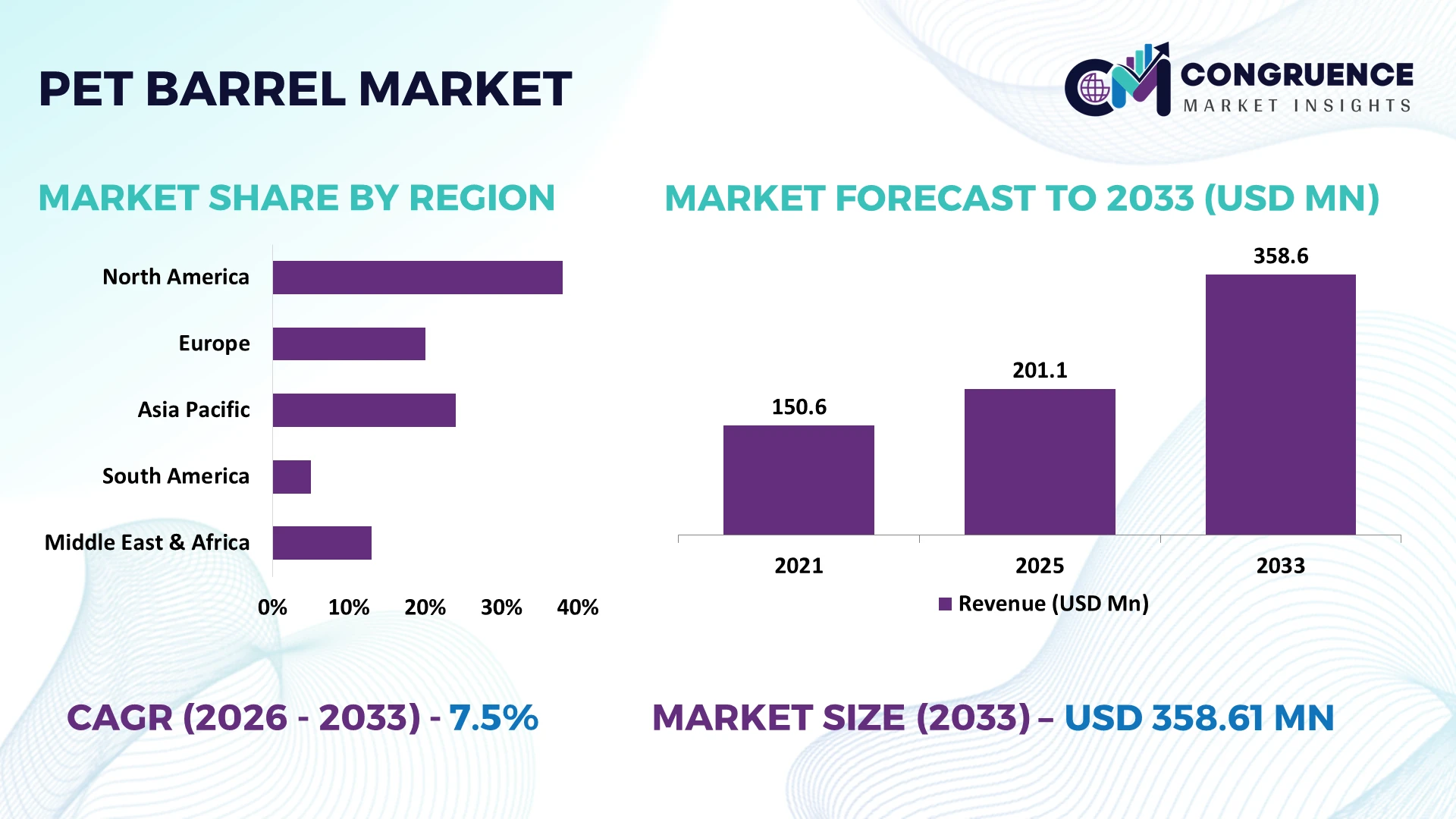
The Global PET Barrel Market was valued at USD 201.07 Million in 2025 and is anticipated to reach a value of USD 358.61 Million by 2033 expanding at a CAGR of 7.5% between 2026 and 2033. Lightweight one-way beverage packaging, reduced return-logistics costs, expanding craft-beverage exports, and improved multilayer PET barrier technologies are accelerating replacement of conventional steel barrels.
The United States accounts for an estimated 24–26% of global PET barrel demand, supported by breweries, wineries, beverage distributors, and localized PET processing. Recent U.S. manufacturing expansion includes approximately USD 10 million of additional PET packaging investment. A 30-liter PET keg weighs roughly 1.1 kg compared with around 10 kg for stainless steel, cutting empty-container transport weight by nearly 89%. Germany represents approximately 10–12% of global demand, compared with 24–26% for the United States, reflecting Germany’s stronger installed reusable-steel keg infrastructure. Meanwhile, EU packaging regulations and geopolitical disruption to international freight routes are increasing attention on recyclable, lightweight formats that reduce reverse-logistics exposure and cross-border transportation requirements.
PET barrel suppliers with localized manufacturing, high-barrier designs, and recyclable mono-material capabilities are positioned to capture the strongest conversion opportunities across beverage export and industrial packaging applications.
Market Size & Growth: USD 201.07 million in 2025 is projected to reach USD 358.61 million by 2033 at 7.5% CAGR, supported by lightweight one-way beverage logistics and expanding PET keg adoption.
Top Growth Drivers: Lightweight logistics contributes approximately 30% of adoption momentum, export-oriented beverage packaging 25%, and recyclable packaging conversion nearly 20%, collectively strengthening global PET barrel deployment.
Short-Term Forecast: By 2027, advanced PET barrel designs are positioned to reduce packaging weight by 80–90% versus stainless-steel alternatives, improving freight efficiency for breweries and beverage exporters.
Emerging Technologies: Multilayer oxygen barriers, recycled-PET integration, and automated stretch-blow molding are advancing, with modern PET keg formats delivering approximately 90% lower empty-package weight than comparable steel containers.
Regional Leaders: North America approaches USD 85–90 million, Europe USD 75–80 million, and Asia-Pacific USD 65–70 million in near-term market potential, supported respectively by craft beverages, circular packaging, and manufacturing localization.
Consumer/End-User Trends: Approximately 35–40% of addressable export-oriented breweries increasingly evaluate one-way packaging to eliminate empty-keg returns, reduce storage requirements, and simplify international beverage distribution.
Pilot/Case Example: In 2024, expanded U.S. PET packaging production involved approximately USD 10 million in manufacturing investment, strengthening localized supply capacity and reducing dependence on long-distance imported packaging.
Competitive Landscape: Leading suppliers collectively command an estimated 45–50% share, with Petainer, Lightweight Containers, PolyKeg, Schaefer Container Systems, and regional PET converters competing through barrier performance, recyclability, and filling-line compatibility.
Regulatory & ESG Impact: EU packaging rules intensify recyclability requirements through 2030, pushing manufacturers toward recyclable structures and higher recycled-content utilization while targeting packaging-waste reductions of approximately 5% per capita versus 2018 levels.
Investment & Funding: Manufacturing projects exceeding USD 10 million demonstrate a shift toward regional PET production, automated molding capacity, and shorter supply chains as beverage companies reduce exposure to freight disruptions.
Innovation & Future Outlook: Next-generation PET barrels combining 25%+ recycled content, digital traceability, improved gas barriers, and automated filling compatibility will shift competition from basic lightweight packaging toward circular, high-performance dispensing systems.
The PET Barrel Market is gaining strategic importance across beer, wine, cider, soft drinks, and other bulk beverage applications as producers prioritize lighter export packaging and simplified distribution. PET formats can reduce empty-container weight by approximately 80–90% versus stainless-steel kegs, directly improving transportation efficiency and warehouse handling. Product innovation is concentrating on multilayer barrier structures, recyclable PET designs, automated blow molding, recycled-content integration, and dispensing compatibility. Export-oriented beverage producers increasingly favor one-way barrels because they eliminate empty-keg return logistics, an operational advantage that becomes more valuable during freight disruptions and cross-border supply-chain volatility. The emerging market trend is therefore shifting from simple steel substitution toward high-barrier, circular PET dispensing systems, creating a stronger strategic case for localized manufacturing, material innovation, and scalable beverage-packaging partnerships.
The PET Barrel Market is becoming strategically important as beverage producers, contract fillers, and exporters restructure packaging around lighter logistics, one-way distribution, and lower asset-recovery requirements. A key market shift is the tightening European packaging regime, which from 2030 requires 40% of specified transport packaging to be reusable and pushes all packaging toward recyclability, forcing suppliers to redesign material structures, collection models, and end-of-life pathways.
Compared with conventional stainless-steel kegs, advanced PET barrels can reduce empty-package weight by roughly 80–90%, directly lowering handling intensity and outbound freight exposure on export routes. Barrier-engineered PET systems now support up to 12 months of typical filled-product shelf life, with oxygen pickup controlled below 10 ppb in some commercial designs. The United States favors one-way formats for distributed craft beverages, while Germany retains stronger reusable-keg infrastructure and circular-return systems.
Over the next 2–3 years, competition will center on high-barrier PET, recycled-content integration, blow-molding efficiency, and dispensing compatibility. A brewery shipping internationally can eliminate reverse transport of empty steel kegs by switching selected export volumes to one-way PET. Suppliers are therefore prioritizing localized production, material partnerships, and filling-line compatibility. Strategic advantage will belong to companies that combine logistics savings with recyclability and dependable beverage protection.
The primary growth driver is the shift toward lightweight, one-way beverage logistics that eliminates empty-keg return cycles and reduces handling complexity. PET barrels can be approximately 80–90% lighter than comparable stainless-steel formats, while modern barrier systems maintain filled-product shelf life near 12 months and oxygen ingress at very low levels. Export-oriented breweries in the United States and United Kingdom increasingly use one-way formats to avoid return freight, cleaning, and keg-pool management. This causes direct reductions in transport weight, warehouse handling, and working capital tied to reusable assets. Suppliers are responding by expanding local blow-molding capacity, improving multilayer barrier technology, and developing filling-line-compatible PET formats. The non-obvious advantage is not packaging cost alone; it is removal of reverse-logistics infrastructure from international beverage distribution.
PET barrels face structural pressure from tightening reuse and recyclability requirements, particularly in Europe. From 2030, 40% of specified transport packaging must be reusable, while all packaging is expected to meet recyclability requirements by 2030. Packaging-waste prevention targets also call for a 5% reduction by 2030 versus 2018 levels. These rules create friction for single-use PET models where collection, sorting, or closed-loop recycling systems remain fragmented. Germany and the Netherlands already operate mature reusable beverage-container ecosystems, raising the competitive threshold for disposable alternatives. The business impact is higher compliance cost, redesign expenditure, and possible limitations on deployment in regulated channels. Companies are reducing exposure through mono-material engineering, recycled-content integration, collection partnerships, and country-specific portfolio strategies rather than applying one universal PET barrel model across all markets.
The strongest opportunity lies in combining one-way logistics with higher recyclability and next-generation barrier performance. Commercial PET keg systems already support about 12 months of filled-product shelf life, oxygen pickup below 10 ppb in selected designs, and light transmission near 0% across critical wavelength ranges. By 2028, suppliers that integrate recycled PET, digital batch traceability, automated blow molding, and recyclable barrier structures can target breweries, wineries, kombucha producers, cold-brew brands, and emerging beverage exporters. India, Brazil, and Southeast Asian beverage hubs offer particular potential because returnable steel-keg pools remain less standardized across fragmented distribution networks. Companies are positioning through R&D, localized resin sourcing, co-development with filler manufacturers, and regional molding partnerships. The non-obvious opportunity is to sell PET barrels as a logistics platform, not merely as lower-cost packaging.
The long-term challenge is maintaining consistent safety, barrier integrity, filling compatibility, and recycling performance across highly fragmented beverage-production networks. Commercial PET kegs operate around maximum working pressures of roughly 3.1–3.5 bar, with burst resistance above 7.7 bar and filled drop-test requirements near 1.2 meters. Small breweries and independent fillers often use heterogeneous couplers, dispense systems, storage conditions, and sanitation practices, increasing execution risk despite standardized container designs. In markets such as India, Mexico, and parts of Eastern Europe, recycling infrastructure also varies substantially between cities. Inconsistent handling can weaken shelf-life performance and customer confidence. Suppliers must therefore invest in connector standardization, filler training, stronger technical service, recycling partnerships, and validation protocols. Competitive durability depends on controlling the entire operating ecosystem, not simply manufacturing a technically compliant PET barrel.
Localized Production Reshapes Supply Chains: PET barrel manufacturers are moving molding and finishing capacity closer to beverage-filling clusters as freight volatility and inventory risk reshape procurement. Local production can shorten replenishment cycles by 20–30%, while standardized preforms reduce inbound storage requirements by approximately 15–20%. U.S. suppliers are expanding domestic conversion capacity and dual-sourcing resin to protect service levels. The operational shift is moving competition from lowest unit price toward supply continuity, shorter lead times, and flexible production scheduling.
Barrier Engineering Extends Product Protection: Manufacturers are refining multilayer structures, oxygen scavengers, and light-protection additives to broaden PET barrel suitability beyond conventional beer. Commercial systems now target oxygen pickup below 10 ppb, filled shelf life approaching 12 months, and near-total protection from critical UV wavelengths. Producers are integrating barrier formulations directly into preform and blow-molding workflows. Better protection enables wineries, cider producers, and specialty beverage brands to consolidate packaging specifications while reducing spoilage exposure and distributor handling complexity.
Filling Automation Gains Operational Priority: Automated filling, pressure testing, inline inspection, and digital batch identification are becoming integral to higher-volume PET barrel deployment. Modern lines can reduce manual handling requirements by approximately 20–25%, improve filling consistency above 95%, and cut changeover time by 10–15% where container interfaces are standardized. German and U.S. equipment suppliers are aligning couplers, filling heads, and quality-control systems. Companies are increasingly forming packaging-equipment partnerships rather than developing barrels independently from downstream dispensing infrastructure.
Circularity Metrics Enter Procurement Decisions: Buyers are placing greater weight on recycled-content compatibility, design-for-recycling, and documented material recovery as European packaging rules tighten. PET containers can incorporate up to 100% post-consumer recycled material in technically suitable applications, while European PET bottle collection has reached approximately 75%. Producers are redesigning labels, additives, sleeves, and barrier components to protect recyclability. A less-visible shift is procurement teams increasingly evaluating packaging on end-of-life compatibility alongside filling performance, changing qualification criteria for future supplier contracts.
PET Barrels represent the leading type, accounting for an estimated 38–42% of the addressed barrel segment because lightweight construction, blow-molding scalability, corrosion resistance, and one-way distribution support beverage and selected industrial applications. Compared with heavier rigid alternatives, PET configurations can reduce empty-container weight by more than 80%, improving export handling and warehouse productivity. HDPE Barrels retain approximately 25–28% share, supported by chemical resistance and established industrial filling infrastructure, particularly for detergents, lubricants, and processing chemicals.
Wide-Mouth Barrels are the fastest-growing type, gaining adoption where rapid filling, dispensing, cleaning access, and viscous-product handling are operational priorities. Tight-Head Barrels remain important for liquids requiring secure closure and controlled discharge, while Open-Head Barrels serve powders, semi-solids, and bulk ingredients requiring full-access loading. Manufacturers are expanding multilayer PET designs, improving closure systems, and integrating recycled resin where technically appropriate. Investment is consequently shifting toward flexible molding platforms capable of producing multiple neck, closure, and handling configurations from standardized resin and preform systems.
Food & Beverage represents the leading application with an estimated 34–37% share, supported by breweries, wineries, edible-liquid processors, beverage concentrates, and foodservice distribution requiring lightweight, hygienic, and transport-efficient bulk packaging. PET barrel adoption is particularly attractive for export beverages because one-way containers eliminate return-keg handling and reduce empty packaging weight by approximately 80–90%. Industrial Packaging accounts for roughly 22–25%, supported by standardized handling systems and demand for corrosion-resistant containers across factory supply chains.
Pharmaceutical Storage is the fastest-growing application as manufacturers tighten contamination control, traceability, and packaging consistency for intermediates and selected non-sterile materials. Chemical Storage remains established where compatible PET formulations provide resistance to specific liquids, while Water Storage benefits from shatter resistance and handling efficiency in controlled commercial applications. Companies are expanding food-contact formulations, high-barrier structures, tamper-evident closures, and automated inspection. Product portfolios are increasingly application-specific rather than universally standardized, directing investment toward resin compatibility, validation testing, and filling-line integration where packaging failure carries higher operational consequences.
Beverage Producers form the largest end-user group with an estimated 35–38% share, reflecting intensive container turnover across beer, wine, cider, soft drinks, and specialty beverages. Export-oriented producers benefit most from PET barrels because disposable formats remove keg-recovery logistics and can reduce empty-container weight by around 85–90%. Food Processors represent approximately 20–23% of demand, using compatible barrel formats for ingredients, concentrates, syrups, and bulk liquids where hygienic handling and rapid filling matter.
Pharmaceutical Companies are the fastest-growing buyer group as procurement increasingly prioritizes validated materials, contamination control, tamper evidence, and traceable packaging workflows. Chemical Manufacturers remain significant users where product compatibility and secure closures outweigh extreme lightweighting, while Industrial Manufacturers demand durable packaging integrated with automated handling systems. Suppliers are responding through customized barrier formulations, sector-specific closures, long-term filling partnerships, and differentiated pricing for high-volume users. Competitive targeting is shifting from selling standardized barrels toward managing application-specific packaging ecosystems, creating stronger customer retention where suppliers support qualification, filling equipment, dispensing interfaces, and recycling pathways.
North America accounted for the largest market share at 32% in 2025 however, Asia-Pacific is expected to register the fastest growth, expanding at a CAGR of 9.1% between 2026 and 2033.
One-Way Beverage Logistics Reshape Procurement
North America accounts for approximately 32% of PET barrel demand, with the United States concentrating deployment across craft beer, wine, cider, cold-brew, and beverage-distribution networks. One-way PET formats are increasingly used for long-distance distribution because empty-container weight can be 80–90% below stainless-steel kegs, removing costly return movements. Domestic packaging capacity is also strengthening: a recent U.S. PET packaging expansion involved approximately USD 10 million of manufacturing investment and 35 additional jobs. Contract fillers and beverage producers are aligning PET formats with automated filling, pressure testing, and standardized dispensing couplers. Canada contributes through breweries and beverage processors seeking recyclable lightweight packaging, while Mexico offers a manufacturing and export platform. Competitive advantage increasingly depends on regional molding capacity, short replenishment cycles, and technical compatibility with installed filling infrastructure.
United States Market Outlook: The United States represents roughly three-quarters of North American PET barrel consumption, supported by more than 9,000 operating breweries and extensive interstate beverage distribution. Domestic PET conversion investment strengthens supply security, while export-oriented producers increasingly evaluate one-way kegs to avoid international retrieval, washing, storage, and repositioning of reusable steel assets.
Circular Packaging Rules Restructure Design
Europe holds approximately 27% of global PET barrel demand, with Germany, the United Kingdom, Netherlands, France, and Italy combining established beverage production with sophisticated packaging infrastructure. The market is undergoing a structural shift as EU packaging rules tighten recyclability, waste-prevention, and reuse requirements. Packaging-waste reduction targets reach 5% per capita by 2030 versus 2018, while specified transport packaging faces a 40% reuse requirement from 2030. This creates a more demanding operating environment for one-way PET barrels and accelerates development of recyclable structures, reduced-material designs, and recovery partnerships. Germany maintains strong reusable-steel keg infrastructure, whereas British beverage exporters provide a more favorable operating case for lightweight one-way formats. Suppliers are consequently differentiating product portfolios by distribution channel instead of treating PET as a universal replacement for reusable containers.
Germany Market Outlook: Germany combines more than 1,400 breweries with advanced filling, recycling, and reusable-container infrastructure, making it a demanding qualification market for PET barrels. Suppliers must demonstrate logistics advantages without weakening established circular systems. High-barrier PET is therefore positioned selectively for exports, seasonal volumes, specialty beverages, and distribution routes where keg recovery is operationally inefficient.
Manufacturing Scale Accelerates Local Conversion
Asia-Pacific represents approximately 24% of global PET barrel demand and offers the strongest manufacturing-scale advantage through China, India, Japan, Australia, and Southeast Asian beverage hubs. China’s extensive PET resin, preform, blow-molding, and beverage-packaging ecosystem supports shorter production cycles and competitive component sourcing. India adds momentum through expanding breweries, beverage processing, food manufacturing, and modern retail distribution. Local production can reduce packaging replenishment lead times by approximately 20–30% compared with import-dependent procurement, while PET barrels provide substantial freight-weight savings for fragmented distribution networks. Australia and Japan emphasize higher-value beverage formats and quality-controlled dispensing. Suppliers are establishing local molding relationships, integrating automated inspection, and tailoring closures to domestic filling equipment. The strategic advantage is increasingly production proximity: standardized preforms can be transported efficiently and blown nearer filling operations, reducing finished-container logistics requirements.
China Market Outlook: China holds an estimated 45–50% of Asia-Pacific PET barrel activity through its dominant polymer-conversion infrastructure and large beverage-processing base. Its advantage extends beyond resin availability to integrated preform molding, closure production, filling machinery, and export logistics, allowing suppliers to compress manufacturing costs and accelerate customized barrel development for domestic and overseas customers.
Beverage Exports Favor Lightweight Formats
South America accounts for approximately 10% of global PET barrel demand, led by Brazil, Argentina, Chile, and Colombia. Breweries, wineries, juice processors, and beverage exporters provide the strongest deployment base, particularly where reusable steel-keg recovery across long domestic or international routes creates operational friction. PET formats weighing around 80–90% less when empty can improve handling economics across Brazil’s geographically dispersed distribution system and wine-export corridors from Argentina and Chile. However, uneven collection infrastructure and differences in municipal recycling performance constrain consistent circular deployment. Packaging companies are responding through localized conversion, distributor partnerships, simplified container specifications, and closer integration with beverage fillers. Rather than replacing steel keg pools broadly, PET barrels are gaining relevance on non-returnable routes, seasonal production peaks, remote distribution lanes, and export programs where asset recovery generates disproportionate cost.
Brazil Market Outlook: Brazil anchors South American demand through a beer market producing more than 15 billion liters annually and an extensive beverage-packaging manufacturing base. Large geographic distances strengthen the economics of lightweight distribution. Domestic PET resin conversion and established recycling capabilities also provide a platform for suppliers developing locally produced barrels rather than relying on imported finished packaging.
Localization Supports Distribution Modernization
Middle East & Africa represents approximately 7% of global PET barrel demand, with adoption concentrated around beverage processing, hospitality supply chains, industrial packaging, and expanding local manufacturing. The United Arab Emirates and Saudi Arabia are investing in downstream manufacturing and food-processing localization, while South Africa provides the region’s strongest established beverage and PET recycling ecosystem. Lightweight barrels offer an operational advantage on long distribution routes because empty packaging can weigh approximately 85–90% less than conventional steel alternatives. However, recycling infrastructure, filling-system standardization, and resin availability remain uneven across African markets. Producers are addressing these gaps through local converter partnerships, standardized dispensing interfaces, and centralized filling operations. Gulf manufacturing strategies additionally encourage local packaging production, creating opportunities for regional preform and blow-molding investment rather than continued dependence on imported finished containers.
South Africa Market Outlook: South Africa provides the strongest PET circularity foundation in the region, with PET beverage-bottle collection rates exceeding 60% in recent industry reporting. Established beverage production, polymer conversion, and recycling networks create transferable infrastructure for PET barrel deployment, particularly for breweries, food processors, hospitality distributors, and industrial users requiring lightweight transport packaging.
The PET Barrel Market pits specialist PET keg innovators such as Petainer, PolyKeg, and Lightweight Containers against established rigid-packaging suppliers and reusable steel-keg manufacturers including SCHÄFER Container Systems. The top five participants collectively control an estimated 48–52% of organized demand, leaving regional converters strongest in price-sensitive applications. Competition centers on barrier performance, filling compatibility, recyclability, and logistics economics: advanced PET formats reduce empty-container weight by 80–90%, localized molding can shorten replenishment cycles by 20–30%, and automated filling interfaces can lower manual handling by 15–25%. Specialists compete through multilayer barrier innovation and dispensing partnerships, while larger packaging groups leverage resin procurement, manufacturing scale, and distribution reach. Competitive positioning is shifting from container selling toward integrated filling, dispensing, traceability, and recovery ecosystems. Qualification testing, pressure safety, food-contact compliance, tooling investment, and customer filling-line integration remain significant entry barriers. Winning requires proven barrier performance, scalable local production, application-specific engineering, and dependable downstream compatibility.
Petainer
PolyKeg
Lightweight Containers
SCHÄFER Container Systems
THIELMANN
Mauser Packaging Solutions
Greif
Time Technoplast
Schutz
ALPLA
Berry Global
Plastipak Packaging
Amcor
RETAL Industries
Current PET barrel technology centers on multilayer oxygen barriers, pressure-relief valves, bag-in-keg systems, and automated stretch-blow molding. Advanced barrier structures can hold oxygen pickup below 10 ppb over 12 months, while lightweight PET formats enable 25–35% more beverage per truckload than steel. Automated filling and standardized couplers are deployed by export breweries, improving line compatibility and reducing handling requirements by 15–20%. These capabilities lower logistics complexity while protecting carbonation and product quality.
Emerging systems combine recycled PET, modular valves, inline pressure inspection, and digitally traceable production. Circular-material formulations already exceed 50% in commercial keg designs, while recycled polypropylene components can reach 100%. Compared with legacy steel kegs weighing about 10 kg empty, one-way PET alternatives near 1 kg deliver roughly 90% tare-weight improvement and eliminate washing infrastructure. Beverage exporters and contract fillers benefit most because reverse logistics releases keg inventory and simplifies cross-border distribution.
From 2026–2028, disruptive development will focus on higher-rPET structures, smart identification, automated quality control, and recyclable barrier layers. Plug-and-play PET systems compatible with existing filling equipment will accelerate conversion without line replacement. Suppliers combining material science, filling integration, and collection networks will gain competitive advantage as buyers evaluate packaging through logistics efficiency, circularity, and dispensing performance.
December 2024 — Petainer Manufacturing USA announced a $10 million expansion into Mt. Pleasant, Tennessee, creating 35 jobs and more than doubling its statewide headcount. The project strengthens PET packaging capacity and improves supply responsiveness for North American beverage customers. Source: TNECD
April 2025 — OneCircle introduced KeyKeg A, engineered around the widely used A-coupler and requiring no modifications to existing dispensing setups. The launch reduces conversion friction for breweries and wineries while extending lightweight PET keg accessibility across established draught networks. Source: CBB
September 2025 — OneCircle partnered with Corimpex to distribute KeyKeg and UniKeg solutions, adding lightweight formats offering 20- and 30-liter capacities. The collaboration expands access for wine and beverage producers while combining sustainable keg technology with Corimpex’s established equipment relationships. Source: Corimpex (
March 2026 — Petainer updated its beer-packaging platform around One-Way Hybrid Kegs, documenting 90% lower tare weight versus steel and elimination of 15 liters of washing water per steel-keg cycle. The positioning targets exporters facing freight, water, and compliance pressures. Source: Petainer
The PET Barrel Market report evaluates HDPE Barrels, PET Barrels, Wide-Mouth Barrels, Tight-Head Barrels, and Open-Head Barrels across Chemical Storage, Food & Beverage, Pharmaceutical Storage, Water Storage, and Industrial Packaging. End-users include chemical manufacturers, food processors, pharmaceutical companies, beverage producers, and industrial manufacturers. Analysis spans North America, Europe, Asia-Pacific, South America, and Middle East & Africa, with PET barrels representing an estimated 38–42% of the assessed type mix.
Technology coverage examines multilayer barriers, bag-in-keg systems, recycled PET, automated stretch-blow molding, pressure-relief systems, dispensing compatibility, and material recovery. The report tracks export beverages, specialty liquids, contract filling, and emerging one-way packaging models. Competitive benchmarking evaluates major suppliers, localized manufacturing, product differentiation, and partnerships. The 2026–2033 framework supports investment planning, capacity expansion, market-entry decisions, technology prioritization, and competitive positioning as buyers balance logistics efficiency, packaging performance, regulatory compliance, and recyclability.
| Report Attribute/Metric | Report Details |
|---|---|
Market Revenue in 2025 | USD 201.07 Million |
Market Revenue in 2033 | USD 358.61 Million |
CAGR (2026 - 2033) | 7.5% |
Base Year | 2025 |
Forecast Period | 2026 - 2033 |
Historic Period | 2021 - 2025 |
Segments Covered | By Type
By Application
By End-User
|
Key Report Deliverable | Revenue Forecast, Growth Trends, Market Dynamics, Segmental Overview, Regional and Country-wise Analysis, Competition Landscape |
Region Covered | North America, Europe, Asia-Pacific, South America, Middle East, Africa |
Key Players Analyzed | Petainer, PolyKeg, Lightweight Containers, SCHÄFER Container Systems, THIELMANN, Mauser Packaging Solutions, Greif, Time Technoplast, Schutz, ALPLA, Berry Global, Plastipak Packaging, Amcor, RETAL Industries |
Customization & Pricing | Available on Request (10% Customization is Free) |




