
Reports
The Global Personal Flotation Devices Market was valued at USD 2,455.0 Million in 2025 and is anticipated to reach a value of USD 3,411.9 Million by 2033 expanding at a CAGR of 4.2% between 2026 and 2033. Growth is driven by mandatory life-jacket compliance in commercial shipping, offshore energy operations, recreational boating, and the adoption of lightweight inflatable flotation systems with automatic inflation technology.
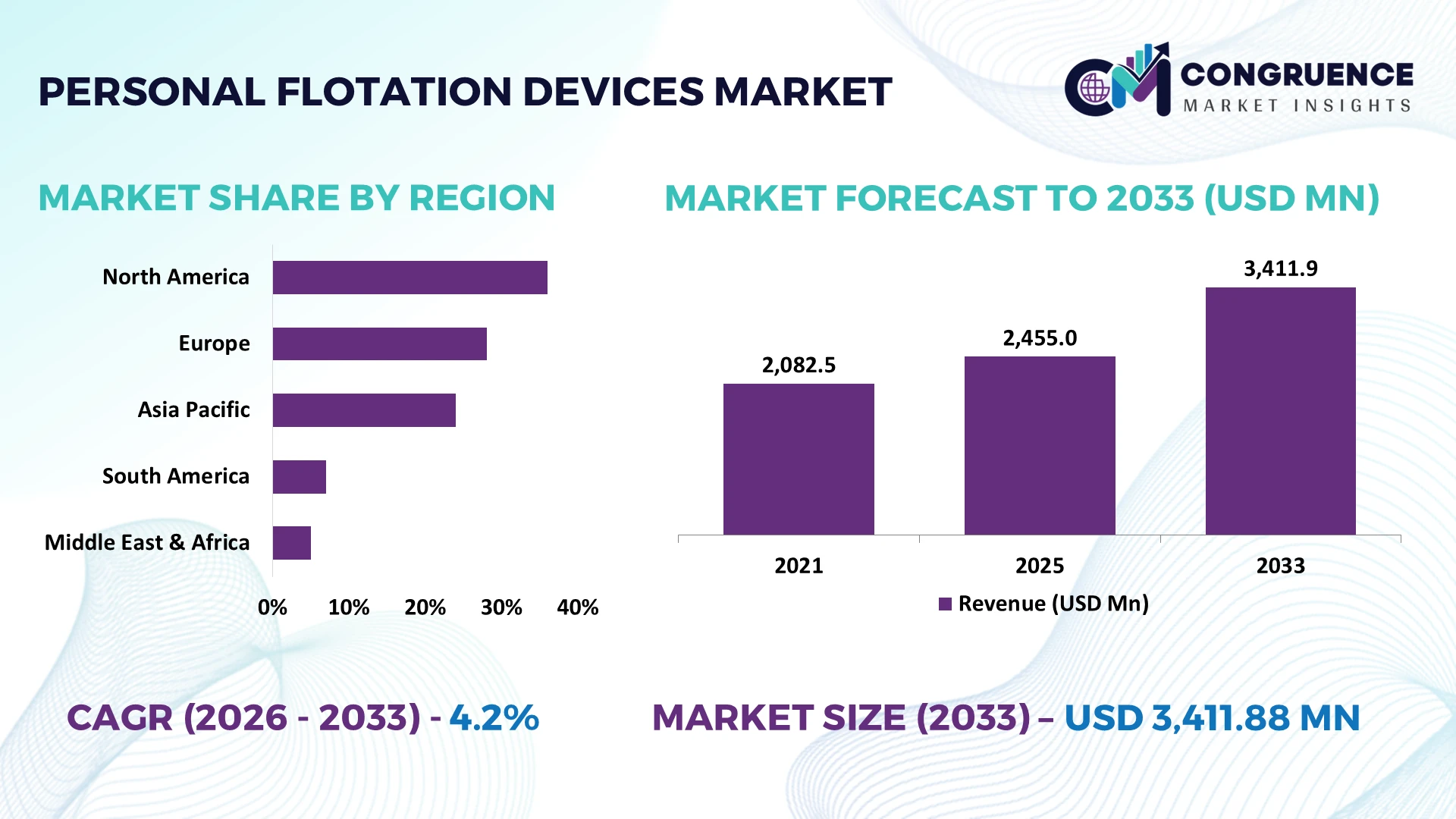
The United States represents a major established market, supported by recreational boating, commercial shipping, offshore operations, and Coast Guard compliance. North America accounts for approximately 33.1% of the related life-jacket market, while the U.S. contributes 87.9% of North American demand. China leads Asia Pacific with approximately 40.23% regional share. The U.S.–Canada harmonization of PFD standards effective January 2025 strengthens cross-border product commercialization.
Strategically, manufacturers should prioritize certified inflatable and hybrid products, while expanding distribution and production partnerships in China, India, and other high-volume maritime markets.
Market Size & Growth: The market reaches USD 2,455.0 million in 2025 and USD 3,411.9 million by 2033, with 4.2% CAGR, supported by inflatable technology and mandatory marine safety equipment.
Top Growth Drivers: Regulatory compliance (35%), recreational boating (30%), and commercial marine safety modernization (25%) represent key demand drivers; these are indicative driver-weight estimates.
Short-Term Forecast: By 2028, manufacturers target 10–15% reductions in product weight and 5–10% improvements in production efficiency through material optimization and automated assembly.
Emerging Technologies: Automatic CO₂ inflation, integrated location-tracking sensors, and lightweight hybrid buoyancy materials are transforming advanced PFD design.
Regional Leaders: North America is projected to reach approximately USD 1,129 million, Asia Pacific USD 1,105 million, and Europe USD 890 million by 2033, supported by recreational boating, commercial shipping, and professional rescue applications.
Consumer/End-User Trends: Recreational applications account for approximately 73.6% of related life-jacket demand, with consumers increasingly prioritizing lightweight, comfortable, and activity-specific designs.
Pilot/Case Example: In 2025, the U.S. Coast Guard's lifejacket approval harmonization introduced aligned U.S.–Canada standards, while selected recreational PFD certificate validity increased from 5 to 10 years under the November 2025 policy.
Competitive Landscape: Stearns represents an established recreational-market competitor, with an indicative 14.3% share in one industry estimate. Key companies include Survitec, Mustang Survival, VIKING, LALIZAS, and Johnson Outdoors.
Regulatory & ESG Impact: U.S. and Canadian standards harmonization supports cross-border certification, while durable construction and recyclable material development strengthen product lifecycle management.
Investment & Funding: Investment priorities center on manufacturing automation, product certification, inflatable-system development, and distribution expansion, with strategic partnerships supporting international market access.
Innovation & Future Outlook: Smart flotation devices, automatic emergency activation, connected rescue technologies, and bio-based buoyancy materials are shaping the next generation of marine safety equipment.
The Personal Flotation Devices Market is witnessing increasing demand for automatic inflatable life jackets, ergonomic foam designs, and hybrid buoyancy systems across recreational boating, fishing, offshore energy, and commercial shipping. Inflatable products can reduce wearable bulk by approximately 50% compared with conventional designs. Manufacturers are also prioritizing integrated emergency identification and improved visibility. Regulatory harmonization and expanding maritime safety procurement are accelerating the shift toward certified, application-specific flotation equipment.
The Personal Flotation Devices Market is becoming strategically important as maritime safety compliance, recreational marine participation, and offshore workforce protection increasingly influence equipment procurement. Manufacturers are competing through buoyancy performance, product comfort, certification capabilities, and lifecycle reliability. The U.S. Coast Guard's January 2025 adoption of harmonized ANSI/CAN/UL 12402 standards creates a more aligned approval pathway between the United States and Canada, encouraging manufacturers to standardize product development and certification strategies.
Technology differentiation is becoming a major competitive factor. Automatic inflatable PFDs offer compact storage and improved wearer mobility compared with conventional foam devices, while hybrid designs combine inherent buoyancy with inflation capability. North America emphasizes certified recreational and professional equipment, whereas China and India offer opportunities through commercial shipping, fishing fleets, passenger transportation, and marine tourism. Over the next 2–3 years, manufacturers will prioritize lighter materials, improved inflation reliability, and broader product availability.
Operationally, commercial vessel operators and offshore contractors are increasingly integrating certified flotation equipment into standardized employee safety programs. Manufacturers are responding through distributor partnerships, localized production, and investments in testing infrastructure. Competitive advantage will increasingly depend on certification readiness, reliable supply chains, and the ability to deliver application-specific products at competitive costs.
Mandatory flotation equipment requirements across commercial shipping, passenger vessels, offshore operations, and recreational boating are strengthening demand for certified PFDs. Recreational applications account for approximately 73.6% of related life-jacket demand, while increasing commercial safety requirements create additional institutional procurement opportunities. The January 2025 U.S. Coast Guard harmonization of lifejacket approval standards with Canada is encouraging manufacturers to develop products meeting aligned performance requirements. This regulatory shift improves cross-border commercialization and reduces duplicated product-development efforts. Companies are expanding certified product portfolios, strengthening laboratory partnerships, and investing in automatic inflation mechanisms to address professional and recreational requirements. The strategic advantage lies in combining regulatory compliance with improved wearer comfort.
Certification requirements, specialized inflation mechanisms, and quality-control procedures increase manufacturing complexity, particularly for inflatable and hybrid PFDs. Premium inflatable products can cost approximately 2–3 times more than entry-level foam alternatives, limiting adoption among price-sensitive recreational users and smaller commercial operators. Dependence on CO₂ cartridges, inflation valves, specialized textiles, and imported components also exposes manufacturers to procurement volatility. The January 2025 U.S. approval transition requires manufacturers to manage product testing and certification carefully. These pressures affect pricing flexibility and inventory planning. Companies are responding through supplier diversification, standardized components, long-term procurement agreements, and localized assembly to protect margins without compromising flotation performance.
Connected flotation equipment presents an attractive opportunity through integrated GPS positioning, automatic emergency activation, man-overboard detection, and wearable monitoring systems. Manufacturers targeting professional marine users can differentiate products through integrated safety features, while lightweight hybrid materials improve mobility and usability. China accounts for approximately 40.23% of Asia Pacific life-jacket demand, providing an established manufacturing and distribution ecosystem for regional expansion. India also offers opportunities across passenger ferries, inland waterways, fishing, and coastal tourism. Companies are investing in sensor integration, advanced textile development, and partnerships with marine electronics providers. An important opportunity lies in supplying connected safety equipment to offshore contractors and commercial fleets rather than focusing exclusively on individual recreational consumers.
Consistent flotation performance across saltwater, freshwater, extreme temperatures, and prolonged outdoor exposure remains a critical engineering challenge. Inflatable devices require reliable activation mechanisms, while automatic systems introduce additional inspection and maintenance requirements. Product manufacturers must maintain performance across multiple buoyancy classifications, including 50N, 70N, and 100N categories. International operators also face differing approval and carriage requirements across jurisdictions, increasing testing and documentation complexity. In offshore and commercial shipping applications, equipment failure directly affects worker safety and operational continuity. Companies must strengthen material testing, automated quality inspection, and lifecycle monitoring. Partnerships with certification laboratories and investment in application-specific product validation are essential to maintaining long-term competitiveness.
Automatic Inflation Technology Adoption: Manufacturers are increasingly integrating hydrostatic and water-activated inflation mechanisms into recreational and professional life jackets. Inflatable PFDs represented approximately 45% of the adult-device segment in 2025, reflecting demand for compact equipment and improved wearer mobility. Companies are refining inflation reliability, re-arming systems, and maintenance procedures to reduce inspection time and improve product usability. The shift is particularly relevant for active boating, sailing, and offshore personnel.
Lightweight and Ergonomic Product Engineering: Product development is shifting toward flexible textiles, low-profile buoyancy chambers, and anatomically designed flotation systems. Neoprene-based products are gaining traction, with projected growth of 6.2% in the 2026–2032 period. Manufacturers are redesigning shoulder panels, closures, and adjustable harnesses to improve comfort during prolonged wear. This improves compliance with onboard safety procedures and strengthens premium-product positioning.
Smart and Connected Safety Systems: GPS-enabled distress alerts, man-overboard detection, and wearable positioning are moving PFDs beyond passive flotation equipment. Connected marine safety systems are increasingly relevant to offshore crews and commercial vessel operators, where response time directly affects emergency outcomes. Manufacturers are integrating compact electronics and emergency signaling components while marine technology partnerships improve compatibility with vessel monitoring systems. This transition creates opportunities for differentiated professional-grade products.
Changing Life Jacket Usage Patterns: U.S. recreational boating safety observations highlight a substantial adoption gap: approximately 20% of observed boaters wore life jackets, compared with 62% of youth boaters and only 9% of adult boaters in reported activity categories. This disparity is shifting attention toward comfortable, activity-specific designs and easier-to-wear products. Manufacturers and distributors are responding with improved fit systems, targeted education, and stronger recreational retail engagement.
Life Jackets dominated the global Personal Flotation Devices Market in 2025, accounting for approximately 62% of product demand. Their leadership reflects broad applicability across recreational boating, commercial marine operations, and professional safety requirements. Standardized designs, established certification pathways, and availability across multiple buoyancy ratings support large-scale procurement. Buoyancy Aids represent the fastest-growing product category, supported by increasing participation in kayaking, paddleboarding, swimming instruction, and other surface-water activities. Their lightweight construction and greater movement flexibility appeal to users prioritizing comfort over conventional full-coverage designs.
Inflatable Life Belts are gaining relevance among experienced boaters seeking compact equipment, while Survival Suits serve specialized cold-water, offshore, and emergency-response requirements. Pool Floats remain concentrated in leisure and swimming applications, with more seasonal purchasing patterns. Buoyancy Aids are projected to expand at approximately 5.6% during 2026–2032, encouraging manufacturers to prioritize ergonomic construction and activity-specific product development. The competitive implication is clear: established life-jacket manufacturers must protect volume leadership while developing differentiated lightweight products.
Boating represented approximately 66% of global Personal Flotation Devices Market application demand in 2025, establishing it as the leading application. Regular vessel operation, onboard safety requirements, recreational boating participation, and commercial fleet procurement sustain demand concentration. Water Sports represents the fastest-growing application, with projected growth of approximately 6.9% during 2026–2032. Increasing participation in kayaking, wakeboarding, paddleboarding, and personal watercraft activities is shifting purchasing preferences toward flexible, lightweight, and sport-specific flotation equipment.
Swimming applications remain relevant through instructional facilities, aquatic recreation, and supervised water activities. Maritime applications serve professional vessel operators, while Leisure covers broader recreational usage and seasonal purchasing. Manufacturers are differentiating portfolios through activity-specific buoyancy ratings, improved mobility, and specialized sizing. Boating provides predictable replacement and institutional procurement opportunities, whereas Water Sports creates opportunities for premium product positioning and specialist distribution. Companies expanding sport-specific designs can capture higher-value consumer demand without relying exclusively on conventional vessel safety procurement.
Adults represented approximately 70% of the global Personal Flotation Devices Market by user type in 2025, supported by widespread participation in recreational boating, fishing, swimming, and water sports. Their dominance reflects broader participation across water-based activities and established purchasing patterns. Kids represent the fastest-growing user segment, with projected growth of approximately 7.4% during 2026–2032. Increased parental attention to drowning prevention, child-specific buoyancy requirements, and mandatory safety practices are strengthening demand for appropriately sized flotation equipment.
Seniors represent a specialized segment requiring improved fit, comfort, and ease of wearing, while Rescue Professionals prioritize operational reliability, visibility, and performance under demanding conditions. Recreational Users remain important through purchases associated with kayaking, leisure boating, and aquatic activities. Manufacturers are responding with age-specific sizing, adjustable flotation systems, differentiated pricing, and specialist distribution partnerships. The competitive opportunity lies in combining high-volume adult products with specialized children's and professional equipment. Companies expanding child-focused product portfolios and improving ergonomic design are positioned to capture changing purchasing priorities.
North America accounted for the largest market share at approximately 36% in 2025 however, Asia-Pacific is expected to register the fastest growth, expanding at a CAGR of 6.8% between 2026 and 2033.
North America maintains its leadership through established recreational boating infrastructure, commercial maritime operations, offshore energy activities, and stringent flotation equipment requirements. The region accounted for approximately 36% of global market demand in 2025, supported by strong institutional procurement and replacement demand. The United States remains the primary consumption center, while Canada contributes through commercial shipping, fishing, and recreational water activities. Regulatory harmonization, including alignment of U.S. and Canadian lifejacket approval standards, is encouraging standardized product development. Manufacturers are prioritizing certified inflatable devices, advanced buoyancy materials, and specialized equipment for professional marine operators. Established marine retailers and distribution networks provide an additional competitive advantage by supporting product availability and replacement cycles.
United States Market Outlook: The United States represents the principal national market, supported by extensive recreational boating participation and commercial marine operations. The country recorded approximately 11.67 million registered recreational vessels in 2024, creating a substantial installed base for flotation equipment. Florida alone accounted for approximately 1.2 million registrations. Manufacturers are focusing on recreational boating, fishing, rescue operations, and offshore workforce applications through specialized distribution and product certification strategies.
Europe accounted for approximately 28% of global Personal Flotation Devices Market demand in 2025, supported by established recreational boating, maritime transportation, yacht manufacturing, and coastal tourism industries. France, Germany, Italy, and the United Kingdom represent important demand centers through commercial vessel operations and recreational marine equipment procurement. The region benefits from established marine safety regulations, established certification systems, and specialized equipment manufacturers. Sustainability requirements are also influencing product engineering, particularly durable flotation materials, recyclable textiles, and longer product lifecycles. European manufacturers are strengthening premium product portfolios and expanding distribution partnerships with marinas, boatbuilders, and marine equipment retailers. Increasing integration of safety equipment into new-vessel manufacturing creates opportunities for suppliers to secure recurring OEM contracts.
France Market Outlook: France holds a strategically important position through its recreational boating manufacturing ecosystem, marine tourism infrastructure, and established nautical equipment industry. The country has approximately 4 million regular recreational boaters and 488 coastal marina facilities, creating substantial demand for certified flotation equipment. Its 2025–2030 nautical industry roadmap emphasizes infrastructure modernization, environmental transition, and improved user safety. These priorities support demand for lightweight, durable, and environmentally responsible PFD products.
Asia-Pacific accounted for approximately 24% of global Personal Flotation Devices Market demand in 2025 and represents the fastest-growing regional market. China, Japan, South Korea, India, and Australia contribute through commercial shipbuilding, fishing, aquaculture, maritime transportation, and expanding recreational water activities. The region benefits from integrated marine manufacturing supply chains and competitive production capabilities. China is particularly influential because its shipbuilding output reached 53.69 million deadweight tonnes in 2025, representing 56.1% of global output. Expanding vessel production increases requirements for onboard safety equipment, including certified life jackets and specialized flotation systems. Manufacturers are strengthening regional sourcing, establishing OEM relationships, and expanding production capabilities to serve commercial maritime customers. India and Southeast Asian markets offer additional opportunities through coastal infrastructure and passenger water transportation development.
China Market Outlook: China represents a strategically significant market through its shipbuilding capacity, marine equipment manufacturing ecosystem, and extensive commercial shipping industry. Its shipbuilding sector secured 69% of global new orders in 2025, strengthening the country's position in vessel manufacturing and associated safety equipment procurement. Domestic manufacturers benefit from established textile, polymer, inflation-system, and component supply chains. Companies are prioritizing production scale, export-oriented distribution, and partnerships with shipbuilders to strengthen their competitive position.
South America accounted for approximately 7% of global Personal Flotation Devices Market demand in 2025, with Brazil representing the principal national market. Demand is concentrated across commercial fishing, coastal shipping, river transportation, offshore energy, and recreational marine activities. Infrastructure modernization is strengthening institutional procurement requirements, particularly around ports, terminals, and passenger transportation operations. Brazil's ports handled approximately 1.4 billion tonnes of cargo in 2025, representing 6.1% annual growth. Private terminal activity and port modernization are creating additional operational requirements for certified marine safety equipment. However, price sensitivity, uneven enforcement, and dependence on imported specialized components influence procurement decisions. Manufacturers are strengthening local distribution agreements, targeting institutional buyers, and offering durable, competitively priced flotation products suited to commercial operating environments.
Brazil Market Outlook: Brazil offers the strongest commercial opportunity through its extensive coastline, inland waterways, offshore energy operations, and large port infrastructure. The country's inland navigation sector handled approximately 91.3 million tonnes of cargo in 2025, recording 19.7% growth compared with 2024. This expansion strengthens the requirement for crew protection, passenger safety, and certified flotation equipment. Suppliers targeting port operators, fishing businesses, and inland transportation companies can benefit from localized distribution and institutional procurement partnerships.
The Middle East & Africa accounted for approximately 5% of global Personal Flotation Devices Market demand in 2025, with purchasing activity concentrated around offshore energy, commercial ports, marine tourism, and coastal infrastructure. Saudi Arabia and the United Arab Emirates are strengthening demand through tourism diversification, marina development, and maritime infrastructure investment. South Africa contributes through commercial fishing, port operations, and recreational marine activities. Saudi Arabia recorded approximately 123 million domestic and international tourists in 2025, reinforcing the commercial importance of tourism-related water activities. Offshore contractors and marine operators also require reliable flotation equipment for workforce protection. Manufacturers are increasingly targeting project-based procurement, regional distributors, and marine equipment suppliers. Import dependence and varying regulatory enforcement remain important considerations for market entry and distribution planning.
Saudi Arabia Market Outlook: Saudi Arabia is emerging as a strategically important market through coastal tourism development, offshore infrastructure, and Vision 2030 diversification initiatives. The country recorded approximately 123 million domestic and international tourist visits in 2025, strengthening opportunities for flotation equipment across marine recreation, coastal resorts, passenger vessels, and water sports facilities. Companies are positioning through partnerships with tourism operators, marine contractors, and local distributors. Demand is increasingly relevant for premium recreational life jackets and professionally certified marine safety equipment.
The global Personal Flotation Devices Market features established marine safety leaders Survitec, VIKING Life-Saving Equipment, and Johnson Outdoors competing with specialist brands LALIZAS, Spinlock, and NRS. Survitec and VIKING dominate institutional and commercial marine procurement, while Johnson Outdoors and NRS target recreational and watersports customers. The top five manufacturers collectively account for an estimated 34.7% share, indicating a moderately fragmented competitive structure. Competition centers on certification, durability, buoyancy performance, pricing, and distribution. Premium inflatable products command approximately 2–3 times the price of conventional foam alternatives, while product differentiation increasingly influences purchasing decisions. Companies are expanding through acquisitions, regional distribution agreements, and specialized product development. LALIZAS's expansion into Brazil strengthens its regional manufacturing and distribution position. The competitive shift favors integrated safety portfolios over standalone products. Certification capabilities, dependable component sourcing, and established marine procurement relationships create significant entry barriers. Winning requires certified innovation, competitive manufacturing economics, and reliable global distribution.
Survitec Group Limited
VIKING Life-Saving Equipment
Johnson Outdoors Inc.
Kent Sporting Goods
LALIZAS Group
Spinlock Limited
Hansen Protection AS
NRS (Northwest River Supplies)
Kokatat Inc.
Astral Buoyancy Company
Secumar GmbH
Stormy Lifejackets Pty Ltd
Hutchwilco Limited
O'Neill
Personal flotation device technology is transitioning from conventional inherently buoyant foam construction toward compact inflatable and hybrid systems. Traditional foam jackets provide continuous buoyancy without activation, whereas automatic inflatable models deploy through water-sensitive or hydrostatic mechanisms. Modern inflatable products achieve full buoyancy in approximately 3 seconds in specified designs and substantially reduce wearable bulk. Premium manufacturers are incorporating lightweight harnesses, ergonomic buoyancy chambers, and improved inflation reliability. This transition benefits offshore personnel, sailors, and recreational users requiring unrestricted movement.
Connected safety technology represents another important development. GPS-enabled distress signaling, AIS man-overboard transmitters, NFC identification, and integrated emergency lighting improve survivor location and rescue coordination. Automatic activation linked to inflation eliminates the need for separate manual emergency signaling. NFC-enabled monitoring also supports battery-status checks and device maintenance. These capabilities strengthen differentiation for professional-grade equipment, although connected electronics increase product cost and servicing complexity. Adoption remains concentrated in specialized marine and offshore applications rather than the entire PFD market.
Between 2026 and 2028, manufacturers will prioritize automatic inflation reliability, connected rescue integration, and advanced textile engineering. The 2025 introduction of NFC-enabled lifejacket identification demonstrates the transition toward digitally traceable safety equipment. Companies combining conventional buoyancy reliability with electronic emergency functionality will gain an advantage in premium procurement. Investment priorities should emphasize certification testing, component integration, repairability, and scalable production rather than electronics alone.
February 2026 – LALIZAS: LALIZAS expanded into Southeast Asia by opening a Philippines branch and an 880-square-meter warehouse in Muntinlupa. The expansion strengthens regional inventory availability, distributor support, and marine safety equipment delivery across emerging maritime markets. Source: lalizas.com
February 2026 – Mustang Survival: Mustang Survival introduced Atlas 190 and Elite 190 inflatable PFD upgrades, incorporating ADAPT airway protection, hydrostatic inflation, and ISO 12401-certified soft harness technology. The redesign improves wearer comfort and flotation performance for offshore and recreational customers. Source: mustangsurvival.com
May 2026 – Spinlock: Spinlock introduced the Deckvest VITO AFS with integrated Advanced Flotation System construction, automatic hydrostatic inflation, and 170N buoyancy. The redesign targets improved rotation, stability, visibility, reduced bulk, and crew safety for offshore sailors and premium safety procurement. Source: spinlock.co.uk
January 2026 – Survitec: Survitec outlined implementation of IMO resolution MSC.554(108), requiring newly supplied SOLAS lifejackets on passenger vessels and cargo ships above 400GT to meet revised in-water performance standards. The change elevates certification, fleet replacement planning, procurement controls, and documentation. Source: survitecgroup.com
The report evaluates the Global Personal Flotation Devices Market across product types, applications, and end-user groups, examining the commercial factors shaping procurement, product development, and competitive positioning. Coverage includes life jackets, buoyancy aids, inflatable life belts, survival suits, and pool floats, alongside boating, water sports, swimming, maritime, and leisure applications. End-user analysis distinguishes adults, kids, seniors, rescue professionals, and recreational users.
Geographic coverage spans North America, Europe, Asia-Pacific, South America, and the Middle East & Africa, with country-level assessment of manufacturing, regulation, maritime infrastructure, and adoption. The study reviews foam and inflatable construction, automatic inflation, hybrid buoyancy, connected distress signaling, and material innovation. Competitive benchmarking of 10+ established manufacturers supports supplier assessment, investment planning, market-entry decisions, expansion prioritization, and product strategy through 2033.
| Report Attribute / Metric | Details |
|---|---|
| Market Revenue (2025) | USD 2,455.0 Million |
| Market Revenue (2033) | USD 3,411.9 Million |
| CAGR (2026–2033) | 4.2% |
| Base Year | 2025 |
| Forecast Period | 2026–2033 |
| Historic Period | 2021–2025 |
| Segments Covered |
By Type
By Application
By End-User
|
| Key Deliverables | Revenue Forecast; Market Trends; Growth Drivers & Restraints; Technology Insights; Segmentation Analysis; Regional Insights; Competitive Landscape; Regulatory & ESG Overview; Recent Developments |
| Regions Covered | North America; Europe; Asia-Pacific; South America; Middle East & Africa |
| Companies Profiled | Survitec Group Limited; VIKING Life-Saving Equipment; Johnson Outdoors Inc.; Kent Sporting Goods; LALIZAS Group; Spinlock Limited; Hansen Protection AS; NRS (Northwest River Supplies); Kokatat Inc.; Astral Buoyancy Company; Secumar GmbH; Stormy Lifejackets Pty Ltd; Hutchwilco Limited; O'Neill |
| Customization & Pricing | Available on Request (10% Customization Free) |




