
Reports
The Global PEM Electrolyzers Market was valued at USD 7650 Million in 2025 and is anticipated to reach a value of USD 16735.3 Million by 2033 expanding at a CAGR of 10.28% between 2026 and 2033. Growth is driven by renewable hydrogen procurement, refinery decarbonization, industrial hydrogen substitution, and deployment of high-current-density proton exchange membrane electrolysis systems.
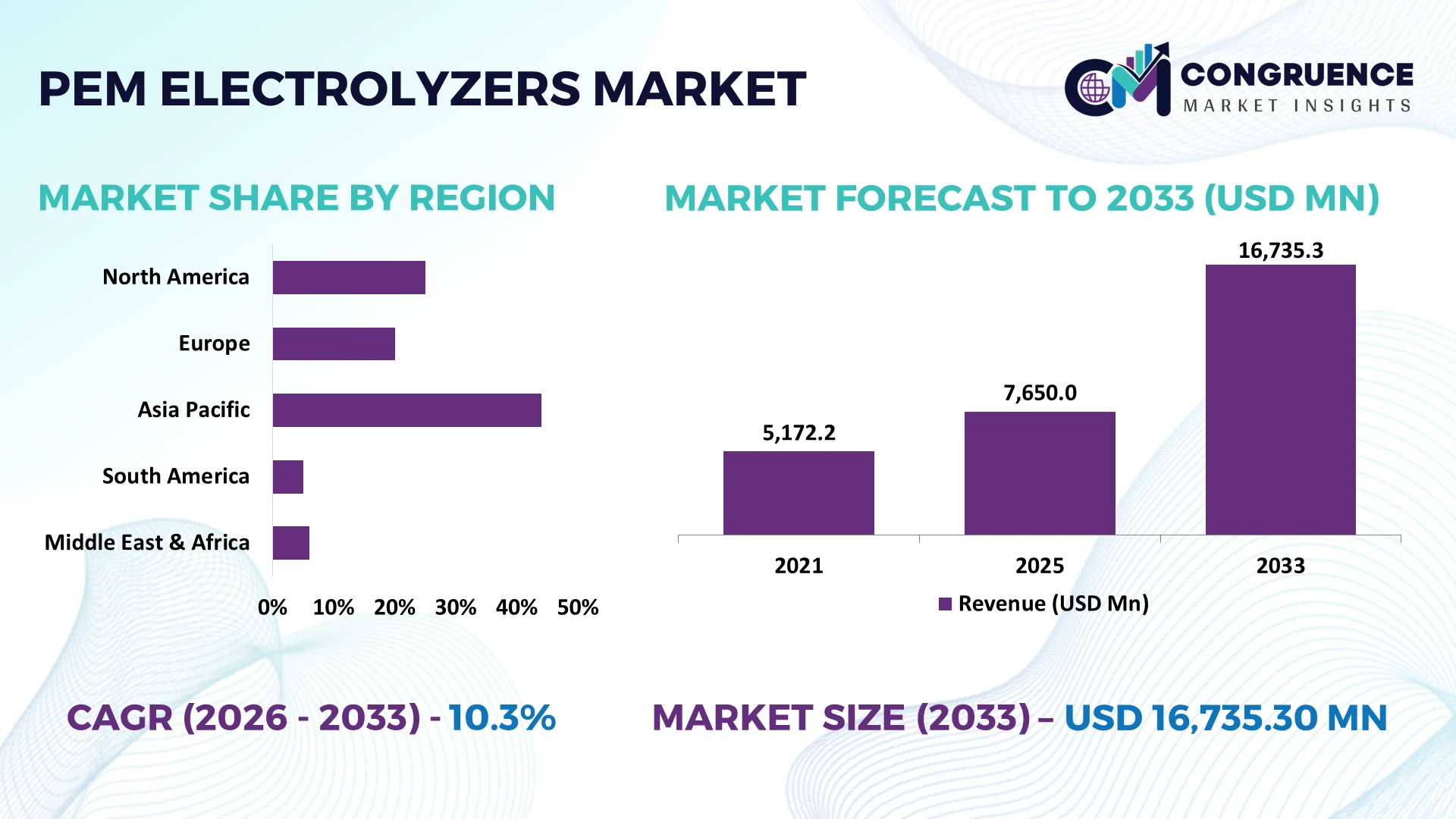
China holds a dominant position in global electrolyzer manufacturing, supported by its extensive hydrogen equipment supply chain and industrial-scale production capabilities. China accounts for approximately 60% of global electrolyzer manufacturing capacity across technologies, although alkaline systems dominate its production base. In comparison, Europe maintains a stronger specialization in advanced PEM electrolyzer technology, supported by Germany's hydrogen infrastructure investments and the European Union's renewable hydrogen policies. The EU targets 10 million tonnes of domestic renewable hydrogen production annually by 2030, creating procurement opportunities for membrane, catalyst, and electrolyzer stack manufacturers.
Strategically, manufacturers prioritizing iridium-efficient catalysts, automated stack production, and long-term industrial hydrogen supply agreements are positioned to secure competitive advantages in large-scale PEM electrolyzer deployment.
Market Size & Growth: Valued at USD 7650 Million in 2025, projected to USD 16735.3 Million by 2033 at 10.28% CAGR, driven by green hydrogen project scaling and renewable integration mandates.
Top Growth Drivers: European Hydrogen Bank auction mechanism expansion, China PEM order growth of 288% year over year, and US IRA 45V production tax credit implementation.
Short-Term Forecast: By 2027, Chinese PEM order volumes expand as the 12 GW pipeline converts to procurement, while Europe maintains 43% global installed capacity share.
Emerging Technologies: Proton exchange membrane stack optimization targeting 4.2 kWh/Nm³ efficiency, AI-integrated renewable energy smoothing, and dual-tech alkaline-PEM hybrid configurations.
Regional Leaders: Europe at 4.2 GW installed capacity and 43% share, North America at 2.5 GW with IRA-driven acceleration, and China at 1.9 GW with a 12 GW pipeline.
Consumer/End-User Trends: Chemicals and refining command dominant demand; power-to-gas and industrial decarbonization represent fastest-growing applications at 45% annual growth for emerging markets.
Pilot/Case Example: Sungrow's Daye facility (May 2025) combines 200 Nm³/h PEM with 1,000 Nm³/h alkaline electrolyzers, demonstrating dual-tech cost-efficiency optimization for China's green hydrogen scaling.
Competitive Landscape: Proton On-Site, Cummins, Siemens, Toshiba, and Shandong Saksay control 68% combined market share; European and Chinese entrants accelerate capacity expansion.
Regulatory & ESG Impact: EU Carbon Border Adjustment Mechanism enters its levy buffer period in January 2026, compelling industrial importers to secure certified green hydrogen supply chains.
Investment & Funding: European Hydrogen Bank committed EUR 139.8 million to Hy2gen's Albatros project; India's SIGHT programme awarded 3,000 MW annual electrolyzer manufacturing capacity to 15 companies.
Innovation & Future Outlook: Global PEM nominal capacity targets 21.5 GW by end-2026, a 74.8% expansion, though utilization rates remain at 58% amid structural oversupply and insufficient high-end capacity.
The PEM Electrolyzers Market is gaining strategic importance across ammonia production, petroleum refining, green steel manufacturing, and renewable hydrogen infrastructure. Advanced proton exchange membranes, optimized bipolar plates, and modular megawatt-scale electrolyzer systems support rapid load adjustment under variable solar and wind generation. Global installed water electrolysis capacity surpassed 4 GW in 2025, demonstrating accelerating commercial deployment across electrolyzer technologies. Meanwhile, iridium supply constraints are encouraging manufacturers to develop lower-loading catalyst architectures and alternative electrode manufacturing processes. These developments increasingly connect equipment procurement with hydrogen offtake commitments, renewable electricity availability, and long-term industrial decarbonization strategies.
PEM electrolyzers are becoming strategically important as hydrogen producers prioritize flexible electrolysis capacity, renewable electricity integration, and industrial decarbonization. Their ability to respond rapidly to fluctuating power availability strengthens commercial positioning in electricity markets with increasing solar and wind penetration. Supply-chain localization is also reshaping equipment procurement, particularly as Germany, the United States, and Japan strengthen domestic hydrogen manufacturing ecosystems. Manufacturers are increasingly integrating stack production, power electronics, and digital monitoring to reduce dependence on external component suppliers.
Compared with conventional alkaline electrolyzers, PEM systems typically operate at current densities of 1–3 A/cm² versus approximately 0.2–0.6 A/cm² for traditional alkaline designs, enabling more compact installations. China emphasizes manufacturing scale, while Germany prioritizes high-performance industrial integration and Japan advances compact hydrogen systems. Through 2028, improvements in catalyst utilization, automated assembly, and predictive maintenance will influence equipment selection, particularly where electricity availability varies throughout the day.
Germany's REFHYNE project demonstrates industrial PEM electrolysis integration through a 10 MW installation at Shell's Rhineland refinery. This operating model connects renewable hydrogen production with existing industrial consumption, reducing dependence on separate distribution infrastructure. Equipment suppliers are responding through engineering partnerships, standardized modular platforms, and investments in membrane electrode assembly production. Competitive advantage increasingly depends on delivered hydrogen efficiency, system availability, and dependable lifecycle performance rather than electrolyzer nameplate capacity alone.
Industrial hydrogen substitution is accelerating PEM electrolyzer deployment as refineries, ammonia manufacturers, and chemical producers seek alternatives to fossil-based hydrogen. Conventional fossil-fuel pathways account for more than 99% of current global hydrogen production, creating substantial conversion potential. PEM systems offer rapid load-following capabilities, supporting operation alongside variable renewable electricity. In Germany, industrial hydrogen infrastructure planning and renewable fuel requirements are encouraging equipment manufacturers to develop higher-capacity modular systems. Electricity represents approximately 60–80% of electrolytic hydrogen production costs under many operating conditions, making power procurement central to project economics. Manufacturers are consequently partnering with renewable energy developers and industrial consumers to secure integrated electricity supply, equipment utilization, and hydrogen offtake arrangements.
PEM electrolyzer manufacturing remains constrained by dependence on iridium-based oxygen evolution catalysts and platinum-group materials. Iridium is produced predominantly as a by-product of platinum mining, with South Africa accounting for approximately 80–90% of global primary supply. This concentration exposes manufacturers to supply interruptions, procurement uncertainty, and limited production flexibility. Conventional PEM catalyst configurations also require higher precious-metal loading than emerging low-iridium electrode designs, increasing sensitivity to material prices. In addition, stack components, titanium porous transport layers, and specialized membranes create procurement barriers for smaller manufacturers. Companies are responding through catalyst recycling, thinner protective coatings, localized component sourcing, and long-term supplier agreements. Reducing iridium intensity without compromising durability remains essential for maintaining manufacturing margins.
Next-generation PEM electrolyzer development creates opportunities in catalyst optimization, automated electrode manufacturing, and decentralized hydrogen production. Advanced membrane electrode assemblies are targeting platinum-group metal loading reductions exceeding 80% compared with earlier stack configurations, improving material productivity. India's National Green Hydrogen Mission supports domestic electrolyzer manufacturing, while industrial clusters in Gujarat and Odisha offer opportunities for localized equipment integration. Emerging catalyst-coated membrane technologies target current densities above 3 A/cm², increasing hydrogen output per unit of active electrode area. Manufacturers are investing in roll-to-roll coating, digital quality inspection, and standardized balance-of-plant modules. Suppliers achieving approximately 10% lower electricity consumption through improved cell performance would gain a significant advantage in long-term hydrogen production contracts.
Scaling PEM electrolyzers from modular installations to industrial hydrogen facilities requires coordinated management of thermal loads, power electronics, water purity, and stack degradation. Frequent renewable electricity fluctuations create operational challenges involving membrane hydration, gas crossover, and electrode durability. Commercial PEM systems commonly achieve electrical conversion efficiencies of approximately 60–70% on a lower heating value basis, leaving considerable scope for thermal and electrical optimization. The United States has established electrolyzer durability targets extending toward 80,000 operating hours, placing greater emphasis on lifetime performance. Meanwhile, large hydrogen installations require availability levels approaching 95% to support continuous industrial consumption. Manufacturers must integrate predictive diagnostics, redundant power conversion equipment, and advanced process controls. Long-term competitiveness depends on maintaining hydrogen purity, production stability, and stack reliability under variable operating conditions.
Factory Automation Reshapes Stack Production: PEM electrolyzer manufacturers are introducing robotic stack assembly, automated leak testing, and digital production traceability. Commercial production lines increasingly support megawatt-scale modules, while individual stacks commonly operate at 1–3 A/cm². Siemens Energy and other equipment suppliers are standardizing manufacturing workflows to improve assembly consistency, reduce inspection bottlenecks, and accelerate delivery schedules for industrial hydrogen projects.
Pressurized Hydrogen Output Gains Commercial Relevance: High-pressure PEM configurations increasingly integrate hydrogen generation and initial compression functions. Systems delivering hydrogen at approximately 20–40 bar reduce downstream mechanical compression requirements compared with atmospheric-pressure configurations. Equipment manufacturers are optimizing pressure-rated stack housings, gas separation controls, and hydrogen purification interfaces, particularly for refueling infrastructure where compression equipment materially influences installation complexity and operating expenditure.
Hydrogen Certification Changes Procurement Workflows: European renewable hydrogen requirements are shifting purchasing decisions toward electricity traceability and time-matched production. EU rules introduce hourly electricity matching from 2030, replacing monthly matching during the transitional period. Electrolyzer suppliers are integrating energy management software, digital metering, and operational scheduling capabilities, enabling developers to document renewable electricity consumption and improve compliance across industrial hydrogen supply contracts.
Water Treatment Integration Becomes Standardized: PEM installations require high-purity feedwater, with approximately 9 liters consumed stoichiometrically per kilogram of hydrogen. Industrial projects typically require additional treatment water for purification and cooling. Manufacturers are packaging deionization, conductivity monitoring, and water recycling into integrated plant designs, reducing engineering interfaces and improving operational consistency in water-constrained industrial locations.
Proton Exchange Membrane systems represent the established technology foundation of the PEM electrolyzers market, with conventional low-temperature configurations forming the largest installed equipment category. Low-temperature PEM electrolyzers typically operate at approximately 50–80°C, enabling rapid startup, compact plant layouts, and compatibility with fluctuating renewable electricity. Their mature membrane electrode assembly architecture supports standardized manufacturing and established maintenance procedures. High-Pressure PEM systems provide an alternative for installations requiring elevated hydrogen delivery pressure, reducing dependence on separate initial compression stages.
Containerized PEM Systems are emerging as a rapidly expanding deployment format because factory-integrated equipment simplifies transportation, installation, and commissioning. Modular PEM Systems support phased capacity additions, allowing operators to match hydrogen production infrastructure with confirmed industrial demand. Containerized configurations commonly use standardized 20-foot or 40-foot enclosures, while modular platforms combine multiple electrolyzer units into larger installations. Siemens Energy, ITM Power, and other manufacturers are emphasizing repeatable engineering designs, integrated cooling, and standardized electrical interfaces. Investment priorities increasingly favor equipment architectures that minimize site-specific construction while preserving maintenance accessibility and operational flexibility.
Green Hydrogen Production represents the leading application of PEM electrolyzers, supported by renewable electricity procurement and industrial decarbonization commitments. Commercial PEM systems generally consume approximately 50–60 kWh of electricity per kilogram of hydrogen, making electricity sourcing and plant utilization decisive procurement considerations. Industrial Feedstock applications provide established consumption pathways through chemical synthesis and petroleum processing, where continuous hydrogen requirements support long-term equipment contracts. Renewable Energy Storage applications emphasize flexible operation, allowing electrolyzers to absorb surplus electricity and convert it into storable hydrogen for subsequent industrial or energy use.
Hydrogen Refueling is emerging as a high-potential application as transportation operators develop dedicated hydrogen supply infrastructure. Fuel Cell Supply supports distributed hydrogen consumption, while Power-to-Gas applications integrate electrolysis with gas networks and energy storage facilities. PEM electrolyzers can achieve startup times measured in seconds to minutes, providing operational advantages for intermittent electricity supply. Manufacturers are developing application-specific hydrogen purification, pressure management, and supervisory control systems. Investment increasingly favors projects combining secured electricity access, predictable hydrogen consumption, and integrated storage capabilities.
The Chemical Industry represents a major established buyer group for PEM electrolyzers, reflecting hydrogen consumption in ammonia synthesis and other chemical manufacturing processes. Global ammonia production requires approximately 180 million tonnes of output annually, creating substantial potential for electrolytic hydrogen substitution. Refineries and Oil & Gas operators represent another important customer base, particularly where existing hydrogen handling infrastructure supports integration with new production equipment. Hydrogen Producers increasingly invest in centralized electrolyzer facilities designed to supply multiple industrial customers through dedicated distribution networks.
Steel Manufacturing is emerging as a strategically important growth segment as producers evaluate hydrogen-based direct reduced iron processes. Hydrogen requirements for such operations can approach 50–60 kilograms per tonne of direct reduced iron, depending on process configuration. Power Generation companies are examining electrolyzers for energy system balancing, while Transportation operators prioritize dependable hydrogen availability and delivery pressure. Manufacturers are responding with sector-specific engineering packages, hydrogen storage integration, and long-term maintenance agreements. Competitive positioning increasingly depends on adapting electrolyzer configurations to individual production schedules, hydrogen purity requirements, and industrial infrastructure constraints.
Europe accounted for the largest market share at an estimated 38% in 2025 however, Asia-Pacific is expected to register the fastest growth, expanding at a CAGR of approximately 13% between 2026 and 2033.
Hydrogen Infrastructure Investment Accelerates Industrial Electrolyzer Commercialization
North America represents an important market for PEM electrolyzers, supported by industrial hydrogen production, domestic equipment manufacturing, and clean energy infrastructure development. The United States leads regional deployment activity through hydrogen production projects serving chemical processing, petroleum refining, and transportation applications. The Department of Energy's Regional Clean Hydrogen Hubs program established seven selected hydrogen hubs, creating a framework for coordinated production, transportation, storage, and industrial consumption infrastructure. Canada contributes specialized electrolysis engineering expertise through established fuel cell and hydrogen technology ecosystems. Regional manufacturers are concentrating on integrated power conversion systems, standardized equipment platforms, and domestic component sourcing. Federal procurement requirements and evolving clean hydrogen incentives increasingly influence project economics. Suppliers with established engineering capabilities and industrial service networks are better positioned to secure long-duration equipment contracts and maintenance opportunities.
United States Market Outlook: The United States maintains a strong competitive position through established PEM electrolyzer manufacturers, including Plug Power and Cummins' Accelera business. Plug Power's Georgia hydrogen production facility has approximately 15 tonnes per day of liquid hydrogen production capacity, demonstrating commercial hydrogen infrastructure development. Domestic manufacturers are emphasizing electrolyzer integration, equipment reliability, and service support for industrial customers. Project developers increasingly prioritize locations with established electrical infrastructure and dependable hydrogen offtake arrangements.
Industrial Hydrogen Regulation Strengthens Advanced Electrolyzer Manufacturing
Europe maintains a leading position in advanced PEM electrolyzer commercialization, supported by industrial decarbonization regulations, established engineering expertise, and hydrogen infrastructure planning. Germany, France, the United Kingdom, and the Netherlands represent important centers for electrolyzer manufacturing, technology development, and industrial deployment. The European Union's renewable hydrogen framework is encouraging industrial consumers to evaluate certified hydrogen production pathways and electricity procurement structures. Germany's hydrogen core network planning covers approximately 9,000 kilometers of infrastructure, supporting future connections between hydrogen production centers, industrial clusters, and storage facilities. European equipment suppliers are investing in membrane electrode assembly engineering, system standardization, and manufacturing automation to improve equipment competitiveness. Collaboration between industrial gas companies, energy utilities, and technology developers is strengthening project integration. Procurement decisions increasingly reflect equipment lifecycle performance, regulatory compliance, and compatibility with existing industrial hydrogen systems.
Germany Market Outlook: Germany combines advanced electrochemical engineering capabilities with significant industrial hydrogen consumption across chemicals, refining, and manufacturing. Siemens Energy's Berlin electrolyzer manufacturing facility supports industrial-scale PEM production, with planned manufacturing capacity reaching 3 GW annually. German industrial developers are integrating electrolyzers into established production sites to reduce infrastructure duplication. Equipment suppliers benefit from domestic engineering expertise, established automation capabilities, and proximity to industrial hydrogen customers.
Manufacturing Scale and Industrial Localization Reshape Competitive Positioning
Asia-Pacific benefits from extensive electrolyzer manufacturing capabilities, expanding hydrogen infrastructure, and established industrial equipment supply chains. China dominates regional electrolyzer manufacturing capacity, although its equipment production remains heavily concentrated in alkaline technology. PEM manufacturers are targeting applications requiring compact installation, rapid response to electricity fluctuations, and high-purity hydrogen output. Japan emphasizes advanced electrochemical materials and integrated hydrogen supply systems, while South Korea supports hydrogen applications across transportation and industrial energy infrastructure. India is developing domestic electrolyzer manufacturing capabilities through production-linked incentives and hydrogen industry investment. China's electrolyzer manufacturing ecosystem accounts for a substantial majority of global production capacity across technologies, providing significant opportunities for component localization. Regional competition increasingly centers on manufacturing automation, catalyst efficiency, membrane durability, and the ability to integrate electrolyzers with industrial energy management systems.
China Market Outlook: China benefits from integrated manufacturing clusters supplying membranes, power electronics, industrial controls, and hydrogen processing equipment. Its renewable electricity infrastructure provides a foundation for large hydrogen production facilities, particularly in Inner Mongolia and other renewable-energy-intensive provinces. Chinese manufacturers are expanding PEM technology portfolios alongside established alkaline electrolyzer production. Domestic supply-chain integration strengthens equipment delivery capabilities, while industrial demonstration projects support commercialization of higher-performance stack configurations.
Renewable Hydrogen Export Projects Strengthen Electrolyzer Demand
South America's PEM electrolyzers market is developing around renewable hydrogen production, industrial feedstock substitution, and export-oriented energy infrastructure. Chile and Brazil lead regional project development, supported by renewable electricity resources and established industrial export facilities. Chile's Atacama region offers exceptional solar generation conditions, while Patagonia provides high-quality wind resources suitable for renewable hydrogen production. Brazil combines substantial renewable electricity availability with fertilizer manufacturing, refining, and port infrastructure. Chile's Haru Oni demonstration facility integrates a 1.2 MW PEM electrolyzer into synthetic fuel production, demonstrating the connection between renewable hydrogen and downstream fuel manufacturing. Regional developers are evaluating electrolyzer configurations that accommodate variable renewable electricity output and remote operating conditions. However, transmission constraints, hydrogen transportation requirements, and limited specialized maintenance infrastructure influence project selection. Equipment suppliers are responding through engineering partnerships, modular installations, and localized technical support.
Brazil Market Outlook: Brazil offers significant opportunities for PEM electrolyzer deployment through renewable hydrogen projects connected to industrial ports and fertilizer production facilities. The Pecém industrial and port complex in Ceará is emerging as a hydrogen investment location, supported by renewable electricity development and export infrastructure planning. Brazil's established industrial gas distribution networks and chemical manufacturing base create opportunities for domestic hydrogen consumption. Equipment suppliers are targeting integrated projects combining renewable power procurement, hydrogen processing, and industrial supply agreements.
Large-Scale Hydrogen Investments Transform Industrial Energy Infrastructure
The Middle East & Africa PEM electrolyzers market is shaped by large renewable hydrogen developments, industrial diversification programs, and investments in hydrogen export infrastructure. Saudi Arabia, the United Arab Emirates, Oman, and Egypt are advancing hydrogen projects linked to renewable electricity generation, ammonia production, and industrial energy transformation. Saudi Arabia's NEOM Green Hydrogen Project incorporates approximately 2.2 GW of electrolyzer capacity, demonstrating the scale of hydrogen infrastructure investment, although its selected electrolysis technology is alkaline rather than PEM. This distinction creates opportunities for PEM suppliers in complementary applications requiring dynamic operation, compact equipment footprints, and distributed hydrogen production. South Africa contributes industrial engineering capabilities and platinum-group metal resources relevant to electrochemical equipment supply chains. Regional procurement increasingly emphasizes equipment durability, cooling performance, and compatibility with high-temperature operating environments. Manufacturers are establishing engineering partnerships and service arrangements to strengthen project execution capabilities.
Saudi Arabia Market Outlook: Saudi Arabia is developing hydrogen infrastructure through Vision 2030 industrial diversification initiatives and large renewable energy investments. The NEOM project targets approximately 600 tonnes of green hydrogen production daily, primarily for conversion into green ammonia. Although the project's electrolyzer technology differs from PEM, its supporting infrastructure strengthens the broader hydrogen equipment ecosystem. PEM suppliers can target specialized industrial applications requiring responsive operation, high-purity hydrogen, and integration with distributed renewable electricity systems.
Proton On-Site, Cummins, Siemens, Toshiba, and Shandong Saksay anchor the global PEM electrolyzer market, with the top five manufacturers commanding over 68% combined market share. Competition bifurcates sharply: Western incumbents leverage proprietary membrane-electrode assembly technology and large-scale project references, while Chinese entrants including Sungrow Hydrogen, CRRC Zhuzhou, and Changchun Lvdong compete on aggressive pricing and rapid domestic deployment. Sungrow Hydrogen captured 35% of China's electrolyzer order share in H1 2026, roughly 2.3 times the second-ranked competitor. The basis of competition is shifting from stack efficiency toward balance-of-plant integration and localized service networks, with Chinese manufacturers delivering over 260MW of electrolyzers to overseas markets in 2026 alone. Entry barriers center on membrane supply access and multi-year field validation.
Proton On-Site
Cummins
Siemens Energy
Toshiba
Shandong Saksay Hydrogen Energy
ITM Power
Nel Hydrogen
McPhy Energy
Elogen
718th Research Institute of CSIC
Teledyne Energy Systems
Sungrow Hydrogen
CRRC Zhuzhou Institute
Shanghai Bright-H Technology
Commercial PEM electrolyzers increasingly incorporate reinforced proton exchange membranes, titanium porous transport layers, and digitally controlled power conversion systems. Modern stacks operate at current densities of 1–3 A/cm², supporting compact installations and responsive hydrogen production. Advanced rectifiers improve electrical conversion efficiency by approximately 2–4% compared with older power electronics, reducing auxiliary energy losses. Industrial deployment increasingly favors megawatt-scale systems with integrated water purification, hydrogen separation, and automated safety controls, enabling operators to maintain production stability during renewable electricity fluctuations.
Emerging technologies focus on catalyst-coated membranes, engineered electrode interfaces, and advanced diagnostic systems. Low-iridium catalyst architectures target precious-metal loading reductions exceeding 80% compared with conventional designs, improving material productivity without proportionately increasing electrode area. AI-assisted monitoring combines voltage signatures, temperature measurements, and pressure data to identify degradation patterns. Manufacturers integrating predictive maintenance can reduce unplanned maintenance exposure while improving stack replacement planning. These capabilities favor established suppliers with electrochemical expertise, proprietary membrane technology, and industrial automation partnerships.
Between 2026 and 2028, disruptive developments will concentrate on high-current-density operation, recyclable membrane materials, and automated stack manufacturing. Next-generation designs targeting 4–6 A/cm² offer substantially greater electrode-area productivity than conventional configurations. Integrated digital twins will support performance optimization, component traceability, and lifetime forecasting. Manufacturers combining advanced catalysts with scalable production processes will gain stronger positions in industrial procurement, where equipment durability and hydrogen output consistency determine competitiveness.
December 2024: Ohmium and Spirare Energy achieved successful green hydrogen production at NTPC’s NETRA campus microgrid in New Delhi, deploying modular PEM electrolyzers integrated with solar PV and fuel cells. The project supports NTPC’s 60 GW renewable target and demonstrates India’s first utility-scale solar-hydrogen microgrid. Source: ohmium.com
December 2024: Accelera by Cummins commissioned a 10 MW PEM electrolyzer system at GAIL’s Vijaipur plant in Madhya Pradesh, producing 4.3 tons of green hydrogen daily for natural gas blending. The system comprises two HyLYZER-1000 units, advancing India’s National Green Hydrogen Mission. Source: afp.com
November 2025: Bosch commissioned its first self-operated 2.5 MW PEM electrolyzer at its Bamberg site, producing over one ton of green hydrogen daily using two Hybrion stacks. The system supports fuel cell testing for heavy-duty transport applications. Source: world-energy.org
September 2026: Nel ASA entered a framework agreement with Hydrasun to establish Scotland’s first PEM electrolyzer assembly facility in Aberdeen. The partnership expands Nel’s European integration capabilities for its MC Series modular platform. Source: markets.ft.markitdigital.com
The PEM Electrolyzers Market Report examines industry performance, technological development, and competitive dynamics across five equipment categories: Proton Exchange Membrane, Low-Temperature PEM, High-Pressure PEM, Modular PEM Systems, and Containerized PEM Systems. Application coverage includes green hydrogen production, renewable energy storage, industrial feedstock, power-to-gas, fuel cell supply, and hydrogen refueling. End-user analysis evaluates chemical manufacturers, oil and gas operators, steel producers, power generators, transportation companies, hydrogen producers, and refineries. Regional assessment covers North America, Europe, Asia-Pacific, South America, and the Middle East & Africa.
The report evaluates electrochemical stack efficiency, catalyst innovation, manufacturing automation, and hydrogen infrastructure integration through 2026–2033. Competitive analysis examines equipment suppliers, industrial partnerships, production localization, and emerging deployment models. Strategic insights support capital allocation, manufacturing expansion, supplier selection, technology investment, and market-entry decisions across established and developing hydrogen economies.
| Report Attribute/Metric | Report Details |
|---|---|
Market Revenue in 2025 | USD 7650 Million |
Market Revenue in 2033 | USD 16735.3 Million |
CAGR (2026 - 2033) | 10.28% |
Base Year | 2025 |
Forecast Period | 2026 - 2033 |
Historic Period | 2021 - 2025 |
Segments Covered | By Type
By Application
By End-User
|
Key Report Deliverable | Revenue Forecast, Growth Trends, Market Dynamics, Segmental Overview, Regional and Country-wise Analysis, Competition Landscape |
Region Covered | North America, Europe, Asia-Pacific, South America, Middle East, Africa |
Key Players Analyzed | Proton On-Site, Cummins, Siemens Energy, Toshiba, Shandong Saksay Hydrogen Energy, ITM Power, Nel Hydrogen, McPhy Energy, Elogen, 718th Research Institute of CSIC, Teledyne Energy Systems, Sungrow Hydrogen, CRRC Zhuzhou Institute, Shanghai Bright-H Technology |
Customization & Pricing | Available on Request (10% Customization is Free) |




