
Reports
The Global Peer to Peer (P2P) Lending Market was valued at USD 8901.22 Million in 2025 and is anticipated to reach a value of USD 39306.24 Million by 2033 expanding at a CAGR of 20.4% between 2026 and 2033. Growth is driven by automated credit underwriting, open-banking data integration, digital borrower onboarding, institutional funding participation, and demand for faster unsecured consumer and SME credit.
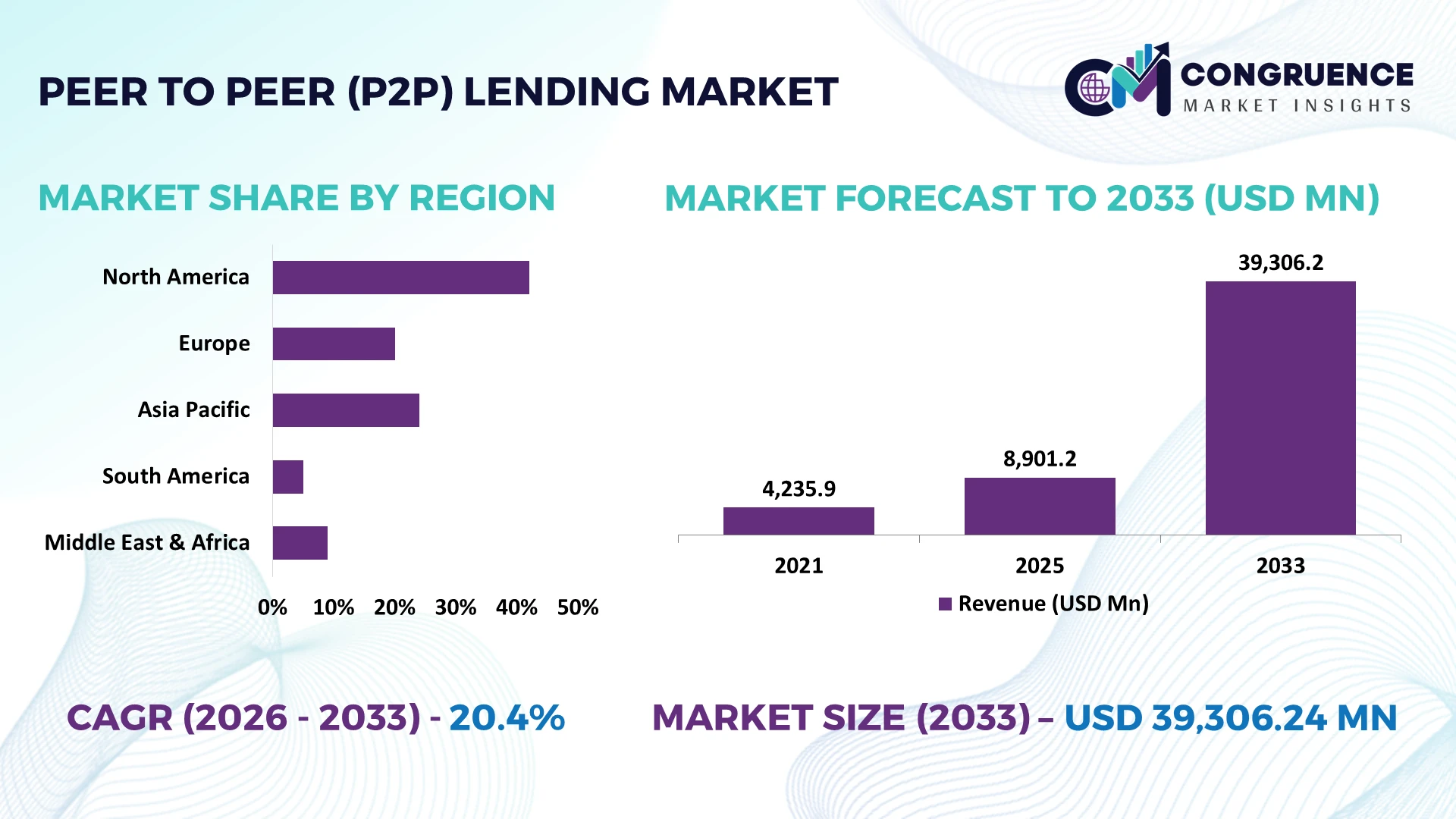
The United States leads the global P2P lending ecosystem with an estimated 35% market share, supported by mature fintech infrastructure, automated underwriting, and large institutional-investor participation. Digital lenders increasingly complete applications within minutes, while API-based income and bank-account verification compresses underwriting cycles from days to hours. The United Kingdom maintains deeper regulatory formalization but smaller lending scale. Following elevated global interest rates since 2022, platforms have tightened borrower selection and repriced credit, making AI-enabled risk segmentation increasingly central to portfolio performance.
Strategically, platforms combining low-cost digital origination, diversified funding, alternative-data underwriting, and disciplined default management hold the strongest position as P2P lending evolves toward institutional-grade digital credit infrastructure.
Market Size & Growth: USD 8,901.22 million in 2025 reaches USD 39,306.24 million by 2033 at 20.4%, driven by automated underwriting and digital origination.
Top Growth Drivers: Digital onboarding contributes approximately 35%, alternative-data underwriting 30%, and institutional funding participation 25% to platform expansion momentum.
Short-Term Forecast: By 2028, automated document verification and straight-through underwriting are positioned to reduce application-processing time by approximately 30–40%.
Emerging Technologies: AI credit scoring, open-banking APIs, and automated fraud analytics increasingly process 100% digital borrower data before loan approval.
Regional Leaders: By 2033, North America approaches USD 13.8 billion, Europe USD 10.2 billion, and Asia-Pacific USD 11.0 billion as digital lending penetration expands.
Consumer/End-User Trends: Unsecured personal borrowing represents approximately 60% of organized platform activity, while SME lending strengthens diversification beyond consumer credit.
Pilot/Case Example: Upstart’s automated lending model has historically delivered more than 80% of approved loans through fully automated processing, demonstrating scalable digital underwriting.
Competitive Landscape: LendingClub maintains a leading U.S. digital-credit position alongside Prosper, Upstart, Funding Circle, and Zopa, with institutional funding increasingly shaping origination capacity.
Regulatory & ESG Impact: U.K. FCA rules require P2P promotions to carry standardized risk warnings, strengthening 100% disclosure discipline for retail-investor marketing.
Investment & Funding: Funding Circle’s U.K. platform has originated more than £13 billion to small businesses, demonstrating institutional-scale digital SME-credit deployment.
Innovation & Future Outlook: Open-banking coverage spanning thousands of financial institutions is shifting underwriting toward cash-flow data, continuous verification, and faster risk-based pricing.
The Peer to Peer (P2P) Lending Market is evolving from retail-investor matching toward technology-led digital credit platforms supported by institutional capital, automated underwriting, and open-banking connectivity. Personal loans remain the largest demand area, while SME financing strengthens platform diversification. AI-based credit models and API-driven income verification are compressing approval workflows, with leading digital lenders automating more than 80% of approved originations. Higher interest rates have simultaneously increased emphasis on borrower quality, pricing discipline, and portfolio monitoring, creating a strategic transition toward scalable, data-intensive lending infrastructure.
Peer to Peer lending is becoming strategically important as digital credit platforms shift from simple borrower-investor matching toward AI-led origination and diversified institutional funding. Upstart originated nearly 1.5 million loans in 2025, up 115%, while 91% were fully automated. Regulation is simultaneously reshaping platform economics: UK rules constrain retail exposure to high-risk investments, pushing established operators toward stronger institutional funding, risk controls, and borrower-focused products.
AI underwriting now delivers materially greater operating leverage than manual credit assessment. Funding Circle reports its AI models discriminate credit risk three times better than traditional bureau scores, with 73% of applicants receiving instant decisions. The United States leads in AI-driven consumer lending scale, while the UK combines advanced SME underwriting with stricter retail-investor controls. This divergence favors platforms capable of separating loan origination growth from dependence on individual lenders.
Through 2026–2028, competitive investment will concentrate on automated verification, cash-flow underwriting, embedded distribution, and diversified funding partnerships. Funding Circle added six funding partners in 2025, reaching 28 active partners, while Upstart connects more than 100 banks and credit unions. Platforms controlling proprietary credit data, funding resilience, and automated decision infrastructure will capture the strongest operational advantage.
Automated credit decisioning is transforming P2P lending economics by increasing processing capacity without proportional workforce expansion. Upstart originated 115% more loans in 2025 while increasing headcount only 18%; 91% of loans were fully automated and conversion reached 19.4%, versus 15.1% in 2024. This technology shift enables platforms to evaluate applicants using broader behavioral and financial variables while compressing manual verification. Funding Circle similarly reports that 73% of applicants receive instant decisions, supported by AI models trained on 10 billion data points. Platforms are investing in proprietary risk engines, bank-data connectivity, and automated fraud controls. The strategic advantage is operating leverage: lenders that decouple origination volume from underwriting headcount can scale faster while maintaining increasingly granular borrower selection.
Retail-investor protection requirements restrict the traditional P2P funding model, particularly in the United Kingdom. FCA guidance states retail clients generally should not place more than 10% of net assets into restricted mass-market investments, while P2P investments lack Financial Services Compensation Scheme protection against investment losses. Platforms must also assess appropriateness, disclose illiquidity, maintain wind-down arrangements, and strengthen credit-risk governance. These requirements increase compliance intensity while narrowing unrestricted retail capital acquisition. The operational consequence is structural: platforms cannot depend on frictionless individual-investor inflows as they scale originations. Established operators are responding by diversifying toward banks, asset managers, forward-flow agreements, and balance-sheet funding. Funding Circle had 28 active funding partners by 2025, demonstrating how regulatory pressure is converting P2P lending into a broader institutional marketplace model.
Institutional capital is creating a scalable pathway beyond conventional one-investor-to-one-borrower P2P structures. Funding Circle entered 2026 with £2.2 billion of future forward-flow capacity, while approximately 10% of its 2025 loan originations flowed through its Marketplace. Upstart reported that 70% of fourth-quarter 2025 Auto and Home funding came from 11 partners, with another 13 partners signed for 2026. This funding diversification allows digital lenders to expand product categories without carrying every originated loan themselves. The next opportunity is combining institutional capital with AI underwriting and embedded distribution, enabling platforms to originate credit inside banking, automotive, and SME ecosystems. Companies are consequently investing in lender APIs, funding partnerships, multi-product underwriting, and capital-light structures. Proprietary borrower-performance data becomes more valuable as institutional funding scales because superior risk discrimination directly strengthens funding economics.
Scaling AI-led lending requires platforms to maintain explainability, cybersecurity, fraud detection, fair-lending controls, and model performance across changing credit cycles. Upstart’s 2025 transaction volume reached nearly 1.5 million loans with 91% fully automated, meaning model errors can propagate rapidly when human review is minimal. Its conversion rate increased from 15.1% to 19.4%, further increasing the importance of disciplined approval calibration. In the UK, platforms must simultaneously satisfy appropriateness, credit-risk, governance, and wind-down requirements. Companies therefore need continuous model validation, bias testing, identity verification, cybersecurity investment, and human escalation mechanisms. The non-obvious competitive pressure is monitoring capacity: automation removes underwriting labor but increases dependence on high-quality data and governance infrastructure. Sustainable leaders must scale model oversight as aggressively as they scale automated origination.
Institutional Capital Reshapes Funding Mix: P2P platforms are reducing dependence on individual investors through forward-flow agreements and bank partnerships. Funding Circle entered 2026 with 28 active funding partners and added six during 2025, while its Marketplace represented roughly 10% of originations. Platforms are restructuring funding channels to maintain lending capacity as UK retail-investor protections tighten, improving capital availability and reducing concentration risk.
Embedded Lending Expands Distribution Reach: Lending platforms increasingly integrate credit directly into partner ecosystems instead of relying exclusively on borrower acquisition through proprietary websites. Upstart connects more than 100 banks and credit unions, while its 2025 originations approached 1.5 million loans. API-based integrations allow financial institutions to use external underwriting infrastructure without rebuilding lending stacks, shifting competition toward platform distribution, partner conversion, and embedded borrower acquisition.
Fraud Controls Move Pre-Approval: Synthetic identities, manipulated documents, and digitally generated application data are pushing fraud screening earlier in lending workflows. Automated identity, income, bank-account, and device verification increasingly operates before final underwriting. With Upstart reporting 91% fully automated loans in 2025, real-time verification becomes operationally critical. Platforms are strengthening machine-learning fraud detection and bank-data connectivity, reducing manual reviews while protecting automated approval systems from scalable digital fraud.
Multi-Product Platforms Replace Specialization: Leading lenders are moving beyond single-category credit toward broader borrower lifecycle models. Upstart expanded across personal, auto, home, and small-dollar lending, while Funding Circle combines business loans with business credit products. This transition raises customer lifetime value and distributes acquisition costs across multiple products. Companies are adapting underwriting models and funding relationships so existing borrower data can support faster cross-product decisions without duplicating onboarding infrastructure.
Consumer Lending leads the type segment with an estimated 52% share, supported by standardized unsecured-credit workflows, high borrower volumes, automated underwriting, and comparatively simple digital fulfillment. Debt Consolidation represents approximately 25–30% of consumer-oriented platform activity and remains strategically important because borrowers can replace multiple revolving obligations with one installment structure. Business Lending holds a smaller but increasingly institutionalized position as platforms combine proprietary SME risk models with forward-flow funding.
Real Estate Lending is the fastest-growing type, supported by property-backed underwriting, digital valuation tools, and growing participation from professional investors seeking alternatives to conventional bank processes. Student Lending remains more specialized because repayment structures and regulatory exposure differ substantially by country. Companies are responding by expanding product-specific credit models rather than applying one underwriting architecture across all categories. Consumer platforms prioritize automated approval and acquisition efficiency, while business and property lenders emphasize cash-flow data, collateral assessment, and institutional capital. Investment priorities are consequently shifting toward reusable underwriting infrastructure capable of supporting multiple credit products.
Personal Loans account for an estimated 50% of P2P lending applications, reflecting standardized loan structures, rapid digital onboarding, and strong use for major purchases and unsecured financing. Debt Refinancing represents approximately 25% of activity and benefits from borrowers consolidating higher-cost revolving obligations. Small Business Loans form an increasingly important application as digital lenders use bank-transaction and cash-flow information to assess enterprises that conventional scoring models can underserve.
Mortgage Financing is the fastest-growing application from a smaller base as digital property valuation, automated verification, and institutional funding extend marketplace lending into secured credit. Student Loans remain comparatively specialized because education-finance regulation and repayment structures constrain uniform cross-country scaling. Platforms are responding by creating application-specific underwriting models, automated documentation, and embedded distribution partnerships. Personal lending emphasizes approval speed and conversion, whereas Small Business Loans require deeper cash-flow analytics. Mortgage Financing increases funding duration and collateral complexity but provides platforms with an avenue to diversify beyond unsecured credit and deepen relationships with higher-value borrowers.
Individual Borrowers dominate end-user activity with an estimated 60% share because consumer credit supports high-volume, standardized digital origination and rapid automated decisioning. Small Businesses represent approximately 20% and form a strategically valuable borrower group where bank-account data can supplement conventional credit files. Self-Employed Borrowers increasingly benefit from cash-flow underwriting because variable income patterns can be evaluated using transaction-level information rather than relying exclusively on traditional salary documentation.
Startups represent the fastest-growing end-user category from a relatively small base as younger enterprises seek flexible financing outside conventional collateral-heavy bank processes. Property Investors remain specialized users requiring larger ticket sizes, collateral valuation, and different risk controls. Platforms are adapting through segmented pricing, alternative-data models, institutional funding arrangements, and partnerships with banks and financial-service ecosystems. The competitive shift is toward borrower-specific underwriting: platforms capable of distinguishing salaried consumers, variable-income borrowers, enterprises, and property-backed applicants can expand addressable demand without weakening portfolio discipline.
North America accounted for the largest market share at 35% in 2025 however, Asia-Pacific is expected to register the fastest growth, expanding at a CAGR of 23.2% between 2026 and 2033.
AI Underwriting Reshapes Credit Distribution
North America represents approximately 35% of global P2P lending activity, led by the United States and its mature fintech, credit-bureau, banking-API, and institutional funding infrastructure. The market is shifting from direct retail-investor matching toward technology-enabled credit marketplaces connecting borrowers with banks, credit unions, and institutional capital. Upstart originated nearly 1.5 million loans during 2025, with 91% fully automated, demonstrating the operating scale achievable through AI underwriting. LendingClub combines digital origination with bank funding, while Prosper retains marketplace-based consumer credit positioning. Higher benchmark interest rates since 2022 strengthened focus on borrower selection, risk-adjusted pricing, and funding diversification. Platforms are consequently investing in cash-flow analytics, fraud detection, embedded distribution, and automated verification, making underwriting accuracy and funding economics more decisive than borrower acquisition volume alone.
United States Market Outlook: The United States benefits from deep consumer-credit infrastructure, standardized bureau data, open banking connectivity, and extensive institutional capital. Upstart works with more than 100 banks and credit unions, illustrating how P2P technology increasingly operates as lending infrastructure for regulated institutions. Automated decisioning, partner-based distribution, and multi-product lending strengthen the country’s technology leadership.
Regulation Accelerates Institutional Funding Shift
Europe accounts for approximately 27% of global P2P lending activity, with the United Kingdom remaining a major digital lending center alongside Germany, France, the Netherlands, and continental marketplace-lending hubs. Regulation increasingly determines platform structure. UK retail investors face stronger appropriateness testing and restrictions around high-risk investment exposure, while European crowdfunding rules impose authorization, disclosure, and investor-protection requirements. These changes are pushing platforms toward institutional funding and professionally managed credit structures. Funding Circle entered 2026 with 28 active funding partners after adding six during 2025, illustrating this capital transition. Digital SME lending remains particularly developed because automated cash-flow assessment can shorten decisions compared with conventional branch processes. Operators are investing in credit analytics, embedded finance partnerships, regulatory technology, and diversified funding arrangements rather than expanding through unrestricted retail-investor acquisition.
United Kingdom Market Outlook: The United Kingdom combines mature fintech infrastructure with established SME digital-credit expertise and stringent investor-protection rules. Funding Circle reports that 73% of applicants receive instant decisions, demonstrating substantial underwriting automation. Open-banking infrastructure further supports transaction-based affordability assessment, enabling lenders to evaluate business cash flows faster while maintaining stronger regulatory controls around investor participation.
Digital Finance Scale Redirects Platform Expansion
Asia-Pacific represents approximately 24% of global P2P lending activity and combines high digital-payment penetration with large underserved consumer and SME credit populations. India, Indonesia, and Southeast Asian markets are increasingly important as smartphone-led financial services and alternative-data underwriting reduce dependence on physical banking distribution. Regulation is simultaneously eliminating loosely controlled marketplace models. India requires RBI-regulated NBFC-P2P platforms to operate as intermediaries rather than assume credit risk, with lender exposure capped at ₹50 lakh across platforms and individual borrower exposure capped at ₹10 lakh. China’s earlier shutdown of conventional P2P platforms demonstrated the consequences of uncontrolled credit intermediation, redirecting regional investment toward licensed digital lending. Operators are responding through compliance-led platform architecture, bank partnerships, automated KYC, bureau integration, and cash-flow underwriting, creating a more institutionally connected model of marketplace credit.
India Market Outlook: India offers strong digital infrastructure through Aadhaar-enabled verification, widespread bank-account connectivity, UPI, and regulated account-aggregator frameworks. RBI supervision provides clearer operating boundaries for NBFC-P2P platforms. The ₹50 lakh aggregate lender exposure ceiling keeps the model diversified, while digital KYC and consent-based financial data support faster borrower assessment and lower manual processing intensity.
SME Credit Gaps Support Alternatives
South America represents approximately 8% of global P2P lending activity, with Brazil dominating digital-credit scale and fintech deployment. High borrowing costs and limited conventional financing access for smaller enterprises create space for marketplace and alternative-credit platforms. Brazil’s Pix infrastructure has normalized real-time digital payments, processing billions of transactions monthly and providing a stronger digital transaction footprint for cash-flow assessment. Regulatory frameworks for fintech credit companies also provide structured routes for technology-based lending. Platforms increasingly combine automated onboarding, bank-data analysis, digital collections, and institutional funding rather than relying solely on individual lenders. Argentina, Colombia, and Chile offer additional opportunities, although inflation, currency volatility, and fragmented credit information complicate risk pricing. Companies are responding with shorter-duration products, localized underwriting models, and partnerships that improve borrower acquisition and repayment visibility.
Brazil Market Outlook: Brazil combines extensive digital banking adoption with Pix-based transaction infrastructure and a large population of SMEs and independent workers. Instant-payment activity provides lenders with increasingly rich cash-flow signals for underwriting and servicing. Fintech operators are using automated onboarding and alternative credit assessment to compete where traditional loan pricing, documentation, and approval processes remain comparatively restrictive.
Fintech Regulation Unlocks Alternative Credit
Middle East & Africa represents approximately 6% of global P2P lending activity, with deployment concentrated in Gulf financial centers and digitally advanced African economies. Saudi Arabia and the United Arab Emirates are developing regulated fintech ecosystems that support alternative lending, while Kenya and South Africa provide substantial mobile-finance and digital-credit experience. Saudi regulatory modernization is bringing debt-based crowdfunding and fintech lending within clearer supervisory structures, strengthening institutional confidence. In Africa, mobile-money infrastructure provides transaction histories that can supplement limited conventional credit files; Sub-Saharan Africa accounts for more than half of registered mobile-money accounts globally. Platforms are using digital identity, mobile-wallet data, automated collections, and institutional partnerships to reduce physical distribution requirements. The principal transformation is infrastructure convergence: payment rails, digital identity, and regulated lending are becoming interconnected foundations for scalable alternative credit.
Saudi Arabia Market Outlook: Saudi Arabia combines strong digital-payment adoption, centralized financial regulation, and government-backed fintech development. The Saudi Central Bank’s licensing framework is formalizing alternative finance participation while Vision 2030 accelerates digital financial services. Platforms capable of integrating regulated onboarding, automated credit assessment, and SME-focused financing are positioned to benefit from expanding non-bank credit channels.
LendingClub, Upstart, Funding Circle, Prosper, and Mintos compete through distinct digital-credit models spanning consumer lending, SME finance, bank partnerships, and investment marketplaces. Together, leading platforms represent an estimated 35–40% of organized P2P and marketplace-lending activity, leaving substantial regional fragmentation. Upstart competes on AI underwriting, with 91% of 2025 loans fully automated; Funding Circle differentiates through SME specialization, where 73% of applicants receive instant decisions. LendingClub leverages integrated banking infrastructure, while Prosper emphasizes consumer marketplace lending and Mintos expands investor diversification. Players are strengthening bank partnerships, institutional forward-flow agreements, embedded distribution, fraud analytics, and proprietary credit models. Competition is shifting from borrower-investor matching toward technology-enabled institutional credit infrastructure. Regulatory licensing, historical repayment data, funding access, and model validation create formidable entry barriers. Customer acquisition costs and credit losses remain key pressure points. Winning requires superior risk discrimination, automated processing, diversified capital, regulatory execution, and repeatable borrower acquisition across multiple lending products and economic cycles.
LendingClub
Upstart
Funding Circle
Prosper Marketplace
Mintos
Kiva
October
EstateGuru
PeerBerry
Bondora
CapitalRise
Kuflink
Folk2Folk
Lendermarket
Current P2P lending technology centers on AI underwriting, automated KYC, fraud detection, bank-data connectivity, and cloud-native loan servicing. Upstart automated 91% of loans in 2025, demonstrating how algorithmic decisioning removes manual underwriting from high-volume workflows. Compared with its 2024 conversion rate of 15.1%, technology-supported optimization lifted conversion to 19.4%, a 28% relative improvement, strengthening borrower acquisition economics.
Emerging platforms integrate open-banking transactions, cash-flow analytics, embedded lending APIs, and automated portfolio allocation. Funding Circle reports proprietary credit models discriminate risk three times better than traditional bureau scores, while 73% of applicants receive instant decisions. These technologies allow platforms to price borrowers using current financial behavior rather than static credit histories. Institutional lenders benefit through faster portfolio deployment and granular risk segmentation, while borrowers receive accelerated decisions.
Through 2026–2028, disruptive development will concentrate on explainable AI, real-time affordability assessment, generative-AI servicing, continuous fraud monitoring, and API-based credit distribution. Machine-readable financial data will increasingly connect underwriting, pricing, funding, and servicing within one decision architecture. Platforms controlling proprietary repayment datasets gain the strongest advantage because model accuracy improves with performance history. Investment now matters as automation increasingly determines approval speed, operating leverage, funding confidence, and scalable multi-product expansion.
August 2024 India’s Reserve Bank tightened P2P lending rules, prohibiting platforms from assuming credit risk, offering guarantees, or replacing one lender’s funds with another’s. The intervention strengthened investor protection and forced regulated NBFC-P2P operators toward stricter intermediary-only models. Source: Reuters
October 2024 LendingClub and Pagaya acquired Tally Technologies’ intellectual property, giving LendingClub credit-management technology for its 5 million members while Pagaya gained a B2B solution deployable across more than 30 lending partners, strengthening automated consumer-debt management capabilities. Source: PR Newswire
April 2025 Prosper Marketplace secured a $500 million forward-flow agreement with Fortress Investment Group affiliates and Edge Focus, covering purchases of unsecured personal loans originated through Prosper. Dedicated institutional capital expands origination capacity while reducing dependence on traditional retail marketplace funding. Source: Prosper
August 2026 Funding Circle added Castlelake as an institutional investor through a commitment of up to £500 million for UK small businesses over two years. Its proprietary credit models discriminate risk three times better than traditional bureau scores. Source: FT Markets
The Peer to Peer (P2P) Lending Market Report evaluates Consumer Lending, Business Lending, Real Estate Lending, Student Lending, and Debt Consolidation across Personal Loans, Small Business Loans, Student Loans, Mortgage Financing, and Debt Refinancing. End-user coverage includes Individual Borrowers, Small Businesses, Startups, Property Investors, and Self-Employed Borrowers across North America, Europe, Asia-Pacific, South America, and Middle East & Africa.
Technology coverage includes AI underwriting, open-banking integration, automated KYC, fraud analytics, embedded lending APIs, cash-flow scoring, and digital servicing. Consumer Lending represents an estimated 52% of type activity, while Individual Borrowers account for approximately 60% of end-user demand. The report examines institutional funding, regulatory restructuring, automated origination, alternative-data adoption, and multi-product platforms, supporting 2026–2033 investment planning, geographic expansion, partnership selection, risk strategy, technology deployment, and competitive positioning.
| Report Attribute/Metric | Report Details |
|---|---|
Market Revenue in 2025 | USD 8901.22 Million |
Market Revenue in 2033 | USD 39306.24 Million |
CAGR (2026 - 2033) | 20.4% |
Base Year | 2025 |
Forecast Period | 2026 - 2033 |
Historic Period | 2021 - 2025 |
Segments Covered | By Type
By Application
By End-User
|
Key Report Deliverable | Revenue Forecast, Growth Trends, Market Dynamics, Segmental Overview, Regional and Country-wise Analysis, Competition Landscape |
Region Covered | North America, Europe, Asia-Pacific, South America, Middle East, Africa |
Key Players Analyzed | LendingClub, Upstart, Funding Circle, Prosper Marketplace, Mintos, Kiva, October, EstateGuru, PeerBerry, Bondora, CapitalRise, Kuflink, Folk2Folk, Lendermarket |
Customization & Pricing | Available on Request (10% Customization is Free) |




