
Reports
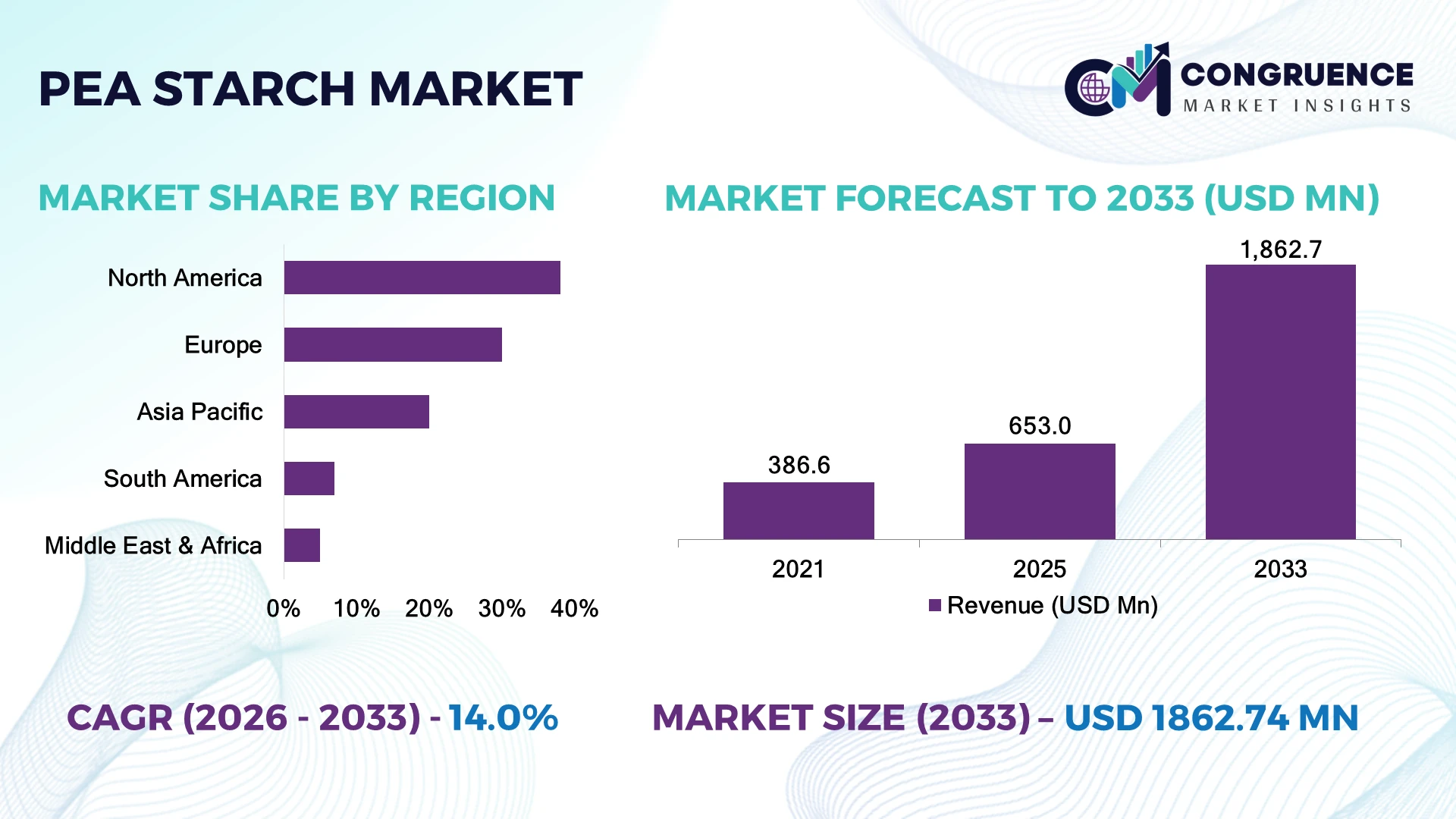
The Global Pea Starch Market was valued at USD 653 Million in 2025 and is anticipated to reach a value of USD 1,862.7 Million by 2033 expanding at a CAGR of 14% between 2026 and 2033. Growth is driven by rising adoption of clean-label plant-based ingredients, increasing pea protein processing capacity, and expanding use of pea starch in gluten-free food formulations, dairy alternatives, and functional nutrition products.
Canada dominates the global pea starch supply landscape, accounting for nearly 40% of global dry pea production capacity, supported by large-scale pulse farming infrastructure and processing investments exceeding USD 100 million in recent years. The country benefits from strong export links to North America and Europe, while China is expanding processing capacity with more than 20% growth in plant-based ingredient facilities. Canada’s advanced extraction systems achieve starch recovery rates above 90%, compared with lower efficiency levels in emerging markets.
Strategic focus on processing expansion, sustainable sourcing, and value-added applications will determine competitive positioning in the global pea starch industry.
Market Size & Growth: USD 653 Million in 2025 expanding toward USD 1,862.7 Million by 2033 at 14% CAGR, driven by clean-label ingredient adoption and plant-based food innovation.
Top Growth Drivers: Plant-based food demand (35%), gluten-free product expansion (28%), and functional ingredient adoption (22%) are accelerating market penetration.
Short-Term Forecast: By 2028, processing efficiency improvements are expected to reduce production waste by 15% and increase starch recovery rates.
Emerging Technologies: Advanced enzymatic extraction, AI-based quality monitoring, and automated processing systems are reshaping pea starch manufacturing.
Regional Leaders: North America reaching USD 720 Million with pulse processing expansion, Europe reaching USD 610 Million through clean-label adoption, and Asia Pacific reaching USD 530 Million through food innovation investments.
Consumer/End-User Trends: Over 45% of food manufacturers are increasing plant-based ingredient usage across bakery, dairy alternatives, and nutrition products.
Pilot/Case Example: In 2024, advanced pea processing projects improved starch separation efficiency by approximately 18% through optimized extraction technologies.
Competitive Landscape: Leading companies including Roquette, Ingredion, Emsland Group, Vestkorn, and Axiom Foods compete through capacity expansion and product innovation.
Regulatory & ESG Impact: Sustainable ingredient policies and reduced-carbon processing initiatives are driving adoption, with some facilities targeting 30% lower processing emissions.
Investment & Funding: More than USD 500 Million has been directed toward pulse ingredient processing expansion, automation, and regional supply-chain development.
Innovation & Future Outlook: Next-generation pea starch applications in meat alternatives, nutraceuticals, and biodegradable materials are strengthening long-term industry transformation.
Pea starch is gaining importance as a multifunctional plant-based ingredient across food, nutrition, and industrial applications. Manufacturers are introducing modified pea starch solutions with improved texture, stability, and processing performance, while demand from gluten-free products represents nearly 40% of new formulation activity. Supply-chain diversification following global agricultural disruptions is encouraging regional pea cultivation and localized processing investments.
The Pea Starch Market is becoming strategically important as food manufacturers shift toward sustainable, non-GMO, and functional plant-based ingredients. Companies are restructuring supply chains to secure reliable pulse sourcing, especially after agricultural disruptions and changing trade dynamics affected global ingredient availability. The market is gaining attention as manufacturers seek alternatives to conventional starches with improved nutritional and environmental profiles.
Advanced extraction technologies are improving operational performance compared with traditional starch separation methods. Automated processing systems deliver approximately 15–20% higher recovery efficiency while reducing manual intervention and processing losses. North America maintains leadership through established pea cultivation networks, while Asia Pacific is expanding faster through investments in food technology, alternative proteins, and local processing infrastructure.
Companies are strengthening partnerships with farmers, ingredient processors, and food innovators to improve supply stability and application development. Recent facility upgrades in Canada and Europe demonstrate the industry’s move toward higher-capacity, energy-efficient production models. Over the next few years, competitive advantage will depend on sustainable sourcing, processing innovation, and the ability to deliver specialized pea starch solutions for evolving food and industrial applications.
Rising demand for clean-label and functional ingredients is accelerating pea starch adoption, with plant-based food manufacturers increasing pea-derived formulations by nearly 30% in recent years. Canada’s pulse-processing ecosystem supports large-scale supply availability, while food companies in the United States are expanding gluten-free and dairy-alternative product portfolios. Advanced extraction technologies are improving starch recovery efficiency by 15–20%, reducing processing losses and enhancing margins. Regulatory momentum around sustainable food ingredients is further strengthening adoption. Companies are responding through processing facility expansions, farmer partnerships, and investments in modified pea starch solutions for bakery, nutrition, and alternative protein applications.
Pea starch production remains exposed to agricultural variability, raw material pricing fluctuations, and processing infrastructure limitations. Canada and France account for significant pea ingredient supply, but seasonal crop variations can affect availability by 10–15% annually. Energy-intensive drying and separation processes increase operational costs, particularly for smaller processors competing with established starch producers. Transportation disruptions and changing trade conditions have created additional pressure on inventory planning. Companies are reducing exposure through multi-year supplier contracts, localized processing facilities, and diversified sourcing strategies. The key operational challenge is maintaining consistent quality standards while controlling input costs across expanding global supply networks.
Growing demand for specialty starch applications is creating opportunities beyond traditional food uses, particularly in meat alternatives, sports nutrition, and biodegradable materials. Modified pea starch products with improved texture and stability are gaining traction, with more than 40% of new plant-based formulations incorporating functional starch solutions. China and India are increasing investments in food processing technologies to support domestic ingredient production. Automation and digital quality-control systems are enabling manufacturers to improve batch consistency and reduce production waste by approximately 15%. Companies are positioning through R&D partnerships, application-specific product development, and collaborations with food technology firms to capture emerging high-value markets.
Large-scale pea starch expansion faces execution challenges related to processing capacity, quality standardization, and technology integration. Industrial processors require significant infrastructure investment, while smaller facilities often operate with 20–25% lower efficiency due to limited automation capabilities. Increasing demand for specialized starch grades requires advanced separation systems, skilled workforce availability, and tighter quality monitoring. European manufacturers face evolving sustainability requirements that influence processing methods and supply-chain decisions. Companies must address these challenges through automated production lines, advanced analytics, workforce training, and strategic partnerships. Long-term competitiveness will depend on achieving reliable high-volume output without compromising sustainability targets or product performance.
Clean Label Reformulation Shift Food manufacturers are accelerating pea starch integration into clean-label products, with plant-based formulations increasing by over 35% in new product launches. United States and European food brands are replacing synthetic additives with natural starch systems to improve texture and consumer acceptance. Companies are expanding ingredient partnerships and investing in application-specific modified pea starch solutions to improve formulation performance and reduce dependency on traditional starch sources.
Processing Automation Expansion Pea starch processors are adopting automated separation, drying, and quality-monitoring systems, improving operational efficiency by 15–20% and reducing production variability by nearly 10%. Canadian facilities are integrating advanced processing controls to optimize starch recovery and manage labor shortages. Companies are restructuring production workflows through automation investments, enabling faster scaling while maintaining consistent food-grade quality standards.
Sustainable Supply Chain Development Supply-chain restructuring is increasing focus on localized pea cultivation and traceable sourcing, with sustainability-focused procurement programs expanding by approximately 25%. European regulatory pressure on environmental reporting is encouraging processors to adopt lower-energy extraction methods. Companies are building farmer networks and regional processing hubs to improve supply reliability and reduce transportation-related operational risks.
Specialty Application Growth Demand is shifting toward high-performance pea starch applications in meat alternatives, sports nutrition, and functional foods, with specialty formulations representing nearly 30% of new application development. Food technology companies are prioritizing customized starch properties such as improved binding and stability. Partnerships between ingredient manufacturers and food innovators are increasing to accelerate commercial adoption of advanced pea starch solutions.
Native pea starch remains the leading type segment, accounting for approximately 60% of market usage due to its cost efficiency, availability, and suitability across bakery, sauces, noodles, and processed food applications. Its natural thickening capability and compatibility with clean-label formulations support broad industrial adoption. Modified pea starch is the fastest-growing type, expanding as manufacturers seek improved heat stability, texture control, and processing performance. Adoption of modified variants is increasing by nearly 20% as food companies develop advanced formulations for convenience foods and plant-based alternatives. Specialty and resistant pea starch categories are gaining strategic importance, particularly in nutrition-focused products requiring fiber enhancement and functional benefits. Native starch continues to dominate high-volume applications, while modified and specialty grades attract higher-value investments. Companies are responding through R&D expansion, customized ingredient development, and partnerships with food manufacturers to improve application performance and capture premium markets.
Food processing represents the leading application segment, accounting for approximately 65% of pea starch consumption due to widespread use in bakery products, sauces, snacks, and gluten-free formulations. Manufacturers prefer pea starch for its neutral taste, clean-label positioning, and improved texture performance. Plant-based meat alternatives and dairy substitutes represent the fastest-growing application area, expanding by nearly 25% as companies improve product similarity and formulation efficiency. Industrial applications, including biodegradable materials and specialty uses, remain smaller but are gaining attention through sustainability initiatives. Food companies are increasing automation and ingredient integration capabilities to improve production consistency and shorten development cycles. Growing demand for allergen-free and non-GMO ingredients is strengthening adoption among multinational food producers. Companies are adapting through formulation partnerships, product customization, and expansion of specialized pea starch portfolios.
Food and beverage manufacturers represent the dominant end-user segment, contributing approximately 70% of pea starch demand due to large-scale utilization in processed foods, bakery products, and plant-based categories. Their purchasing decisions are influenced by ingredient functionality, supply reliability, and consumer demand for natural formulations. Alternative protein producers are the fastest-growing end-user group, with adoption increasing by nearly 30% as companies improve plant-based product quality. Nutraceutical companies, specialty ingredient firms, and industrial users are expanding applications through targeted product development and sustainable material innovation. Large food enterprises are prioritizing long-term supplier agreements, while emerging brands are seeking flexible ingredient partnerships for faster product launches. Companies are strengthening competitiveness through customized formulations, regional supply networks, and technical support programs for manufacturers.
North America accounted for the largest market share at 38% in 2025 however, Asia-Pacific is expected to register the fastest growth, expanding at a CAGR of 15% between 2026 and 2033.

North America holds a leading position in the pea starch market due to strong pulse cultivation networks, established food processing infrastructure, and rising adoption of plant-based ingredients. The region contributes approximately 38% of global demand, supported by Canada’s large-scale pea production ecosystem and the United States’ expanding alternative food sector. Food manufacturers are increasing investment in clean-label formulations, with plant-based product launches growing by more than 30% in recent years. Processing companies are deploying automated extraction and drying technologies to improve efficiency and reduce production losses. Strategic partnerships between farmers, ingredient processors, and food brands are strengthening supply reliability and supporting premium pea starch applications.
Canada Market Outlook: Canada remains the most strategically important country due to its extensive pea cultivation base, export capability, and advanced ingredient processing infrastructure. The country contributes nearly 40% of global dry pea production capacity and has developed specialized pulse-processing facilities focused on starch and protein separation. Investments in automated processing systems are improving extraction efficiency while supporting consistent supply for North American and international food manufacturers.
Europe represents a significant pea starch market driven by clean-label regulations, sustainable food initiatives, and strong demand for plant-based alternatives. The region accounts for approximately 30% of global consumption, supported by advanced food manufacturing networks in Germany, France, and the Netherlands. Regulatory pressure around ingredient transparency and environmental impact is accelerating replacement of synthetic additives with natural starch solutions. European processors are increasing investments in energy-efficient extraction technologies, with some facilities targeting 20% reductions in processing-related emissions. Growing demand from gluten-free foods, functional nutrition, and meat alternatives is encouraging companies to expand specialty pea starch portfolios and establish closer partnerships with food innovators.
France Market Outlook: France maintains a strong position through its agricultural infrastructure, food technology expertise, and established pulse-processing capabilities. French ingredient manufacturers are focusing on sustainable starch production and advanced formulation support for food companies. The country’s strong regulatory alignment with clean-label standards is encouraging manufacturers to develop higher-value pea starch applications for nutrition and specialty food categories.
Asia-Pacific is emerging as the fastest-expanding pea starch market due to rising food processing capacity, increasing plant-based product development, and domestic ingredient manufacturing investments. The region contributes around 20% of global demand, with China, India, and Japan leading adoption across processed foods and functional nutrition sectors. China is increasing local processing capabilities to reduce dependence on imported ingredients, while food manufacturers are adopting automated production systems to improve consistency. Investments in advanced food technology facilities have increased by more than 25% across major processing hubs. Companies are expanding partnerships with agricultural suppliers and technology providers to strengthen local supply chains and support customized starch applications.
China Market Outlook: China is becoming a key growth market due to expanding food manufacturing infrastructure and increasing investment in plant-based ingredient production. The country has recorded more than 20% growth in alternative ingredient processing facilities, supported by rising demand from packaged foods and nutrition products. Domestic companies are improving processing efficiency through automation and localized sourcing strategies.
South America is developing as an emerging pea starch market supported by agricultural resources, expanding food processing activities, and increasing interest in sustainable ingredients. The region contributes approximately 7% of global demand, with Brazil and Argentina showing rising adoption among food manufacturers. Improved agricultural practices and investments in local processing infrastructure are strengthening supply potential. However, limited specialized starch extraction facilities remain a challenge compared with established markets. Companies are addressing these gaps through joint ventures, technology partnerships, and targeted capacity development. Increasing demand for plant-based formulations is encouraging processors to explore value-added pea ingredient opportunities beyond traditional agricultural exports.
Brazil Market Outlook: Brazil represents the strongest market opportunity in South America due to its large food processing industry and expanding demand for alternative ingredients. Food manufacturers are increasing investment in plant-based product development, while local processors are exploring advanced extraction technologies. Growing interest in sustainable sourcing is encouraging partnerships between agricultural producers and ingredient companies.
The Middle East & Africa pea starch market is developing through food security initiatives, import diversification strategies, and modernization of food processing infrastructure. The region represents approximately 5% of global demand, with adoption concentrated in countries investing in advanced food manufacturing capabilities. Governments and private companies are increasing investments in agricultural technology and food supply-chain resilience, with processing infrastructure upgrades expanding by nearly 15% in key markets. Demand is rising from bakery, nutrition, and specialty food sectors as manufacturers seek reliable plant-based ingredients. Companies are focusing on strategic imports, regional partnerships, and localized processing models to improve availability and reduce supply-chain dependency.
United Arab Emirates Market Outlook: The United Arab Emirates is emerging as a strategic hub due to advanced food logistics infrastructure, import diversification programs, and investment in food technology. The country’s modern processing facilities and strong distribution networks support regional ingredient supply. Companies are leveraging partnerships with global suppliers to expand access to sustainable pea starch solutions for food manufacturers.
The pea starch market features global ingredient leaders such as Roquette, Ingredion, and Emsland Group competing with regional processors including Vestkorn and Axiom Foods. Competition centers on supply reliability, processing technology, customization, and cost efficiency. The top five players collectively account for approximately 45% of market influence, driven by established production networks and food industry partnerships. Companies compete through capacity expansion, modified starch innovation, farmer alliances, and vertical integration of pulse sourcing. Technology-focused suppliers emphasize advanced extraction systems, achieving 15–20% efficiency gains, while cost leaders optimize regional sourcing to improve pricing competitiveness by nearly 10%. The market is shifting toward specialty pea starch solutions as food manufacturers demand improved functionality and clean-label performance. High capital requirements, processing expertise, and consistent raw material access create entry barriers. Winning requires scalable production, application-focused innovation, and resilient supply-chain control.
Ingredion Incorporated
Emsland Group
Vestkorn Milling AS
Axiom Foods Inc.
The Scoular Company
PURIS Holdings
Cosucra Groupe Warcoing SA
AGT Food and Ingredients
Yantai Shuangta Food Co., Ltd.
Shandong Jianyuan Group
Meelunie B.V.
Pea starch processing is shifting from conventional separation methods toward automated extraction, membrane filtration, and precision drying technologies. Modern systems improve starch recovery efficiency by 15–20% compared with older mechanical processes while reducing energy consumption by nearly 10%. Large processors in Canada and Europe are integrating digital monitoring platforms to maintain consistent quality and optimize production workflows.
Modified starch technologies are becoming increasingly important as food manufacturers require improved stability, texture, and performance in plant-based products. Advanced formulation techniques enhance functional properties by approximately 20%, enabling wider use in dairy alternatives, gluten-free foods, and specialty nutrition applications. Adoption is strongest among multinational food producers seeking scalable ingredient solutions.
Between 2026 and 2028, AI-enabled quality control, predictive maintenance, and automated processing lines will strengthen competitive advantages. Technology leaders benefit through faster customization and lower operational variability, while smaller processors face pressure to modernize. Companies acting early on automation and digital integration will gain stronger supply-chain positioning and application leadership.
October 2025 Roquettelaunched AMYSTA™ L 123, a thermally soluble pea starch developed through a patented enzyme- and chemical-free process. The innovation improves label transparency and texturizing performance for food manufacturers, strengthening Roquette’s clean-label ingredient portfolio. Source: www.roquette.com
June 2025 Roquetteexpanded its plant-based ingredient portfolio with new NUTRALYS® textured pea protein solutions, supporting food manufacturers developing sustainable protein applications. The launch enhanced formulation flexibility and reinforced Roquette’s position in advanced pea-based ingredient innovation. Source: www.roquette.com
2025 Ingredioncontinued strengthening its clean-label and plant-based ingredient solutions portfolio, supporting manufacturers seeking improved texture, functionality, and formulation performance. The company focused on specialty ingredient innovation and application development to address evolving food industry requirements.
2025 Emsland Group advanced its plant-based ingredient activities by focusing on sustainable potato and pea-based ingredient processing solutions. The company continued developing functional starch applications for food manufacturers, supporting clean-label product innovation and diversified ingredient supply strategies.
The Pea Starch Market Report covers comprehensive analysis across type, application, and end-user segments, including native pea starch, modified pea starch, food processing, specialty applications, food manufacturers, nutraceutical companies, and industrial users. The report evaluates market dynamics across North America, Europe, Asia-Pacific, South America, and Middle East & Africa with focus on production capabilities, adoption patterns, and emerging application areas.
The study examines key technologies such as advanced extraction, automation, quality monitoring, and sustainable processing systems. It provides strategic insights into competitive positioning, supplier networks, investment priorities, and expansion opportunities. With analysis of leading companies and evolving industry trends, the report supports business planning, market entry decisions, and long-term positioning from 2026 to 2033.
| Report Attribute / Metric | Details |
|---|---|
| Market Revenue (2025) | USD 653.0 Million |
| Market Revenue (2033) | USD 1,862.7 Million |
| CAGR (2026–2033) | 14% |
| Base Year | 2025 |
| Forecast Period | 2026–2033 |
| Historic Period | 2021–2025 |
| Segments Covered |
By Type
By Application
By End-User
|
| Key Deliverables | Revenue Forecast; Market Trends; Growth Drivers & Restraints; Technology Insights; Segmentation Analysis; Regional Insights; Competitive Landscape; Regulatory & ESG Overview; Recent Developments |
| Regions Covered | North America; Europe; Asia-Pacific; South America; Middle East & Africa |
| Companies Profiled | Roquette Frères; Ingredion Incorporated; Emsland Group; Vestkorn Milling AS; Axiom Foods Inc.; The Scoular Company; PURIS Holdings; Cosucra Groupe Warcoing SA; AGT Food and Ingredients; Yantai Shuangta Food Co., Ltd.; Shandong Jianyuan Group; Meelunie B.V. |
| Customization & Pricing | Available on Request (10% Customization Free) |




