
Reports
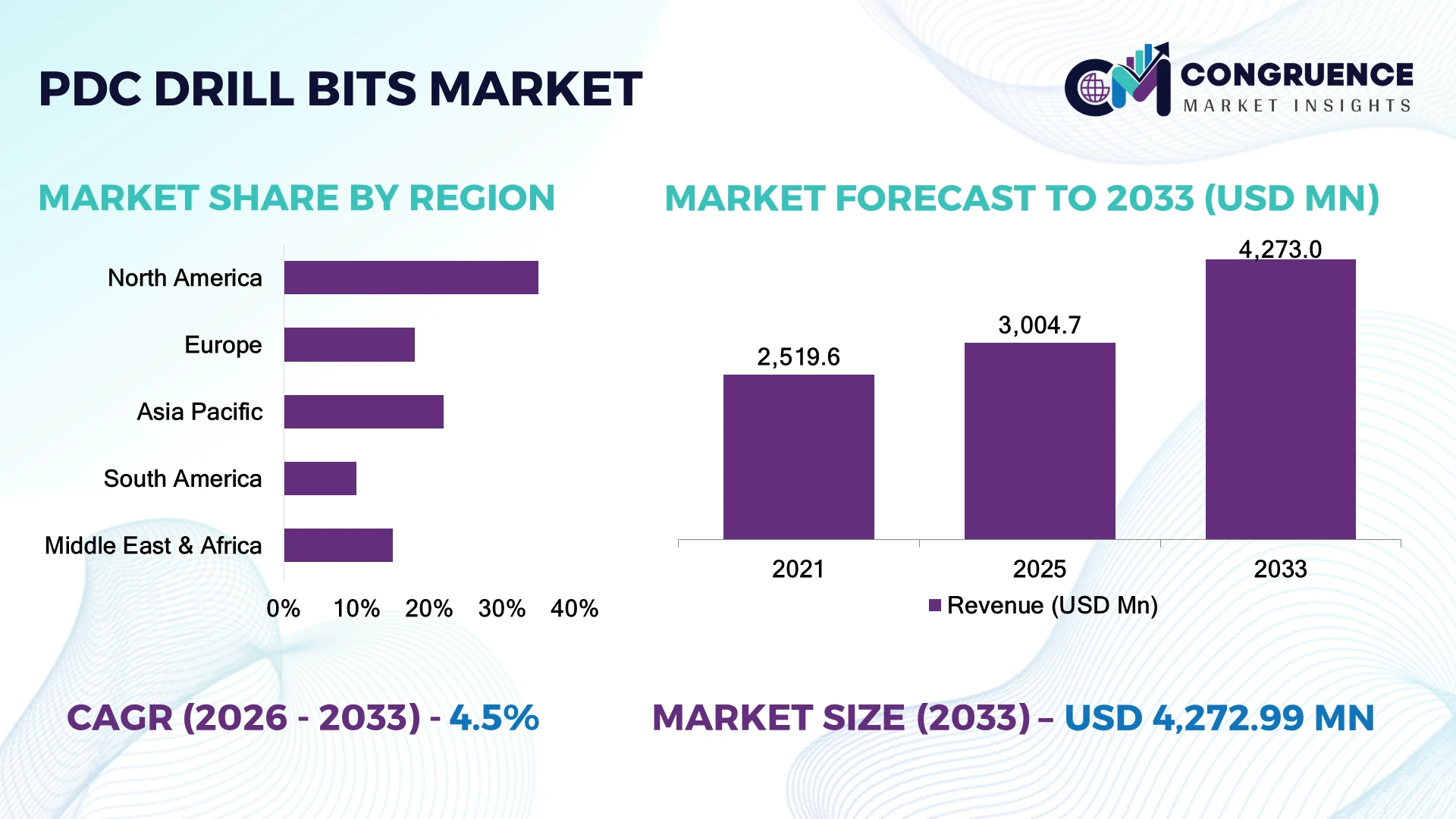
The Global PDC Drill Bits Market was valued at USD 3,004.7 Million in 2025 and is anticipated to reach a value of USD 4,273.0 Million by 2033 expanding at a CAGR of 4.5% between 2026 and 2033. Growth is driven by extended horizontal wells, abrasive shale formations, high-performance cutter materials, and digital bit-design systems that reduce replacement trips and improve footage per run.
The United States anchors demand through its unconventional oil and gas industry, with crude oil production averaging a record 13.6 million barrels per day in 2025. The Permian Basin contributed approximately 48% of national crude output, reinforcing demand for durable PDC bits across long lateral wells. By comparison, Canada averaged 172 active rigs in December 2025, against 546 in the United States, reflecting the latter's larger drilling base. Operators increasingly prioritize cutter durability and formation-specific designs to protect drilling economics amid oil-price volatility and geopolitical supply uncertainty.
For suppliers, competitive advantage depends on delivering measurable drilling performance and reducing total well-construction cost rather than competing on bit price alone.
Market Size & Growth: The market is valued at USD 3,004.7 million in 2025 and is projected to reach USD 4,273.0 million by 2033, supported by high-performance drilling requirements.
Top Growth Drivers: Extended lateral drilling, abrasive formations, and digital bit optimization are strengthening demand for durable, application-specific PDC designs.
Short-Term Outlook: By 2028, operators are expected to emphasize footage per run, reduced trip frequency, and measurable drilling-cost performance in procurement decisions.
Emerging Technologies: Shaped diamond cutters, thermal-resistant materials, and simulation-based bit selection are advancing formation-specific drilling performance.
Regional Leaders: North America remains a core oilfield demand center, while China and the Middle East sustain opportunities through energy development and drilling modernization.
End-User Trends: Oil and gas operators prioritize reliable performance in horizontal wells, where bit durability and directional stability affect total well costs.
Technology Case Example: In a Colombian field application, Baker Hughes reported 50% more footage and 39% higher rate of penetration after simulation-led bit optimization.
Competitive Landscape: SLB, Halliburton, Baker Hughes, NOV, and specialist manufacturers compete through cutter design, formation expertise, and drilling-service integration.
Operational Efficiency: Advanced cutter geometries and improved erosion resistance help extend bit life and reduce unplanned trips in challenging formations.
Investment Priorities: Suppliers are directing resources toward material science, digital engineering, and application-specific product development rather than undifferentiated capacity expansion.
Innovation & Future Outlook: Through 2033, the strongest positioning will come from verified field results, consistent supply, and designs tailored to changing downhole conditions.
The PDC drill bits market is increasingly shaped by the need to drill longer intervals through variable rock formations while maintaining stable penetration rates and controlling nonproductive time. Operators are prioritizing wear-resistant cutters and digital bit selection as drilling programmes become more technically demanding. With global drilling activity exposed to oil-price shifts and geopolitical uncertainty, suppliers that demonstrate repeatable performance improvements are better positioned to secure long-term operator contracts.
PDC drill bits are strategically important because bit performance influences drilling speed, tool reliability, and total well-construction economics. As operators extend horizontal laterals and drill through interbedded formations, bit selection becomes a well-planning decision rather than a routine consumables purchase. The United States illustrates this shift: despite fewer active rigs in 2025 than in 2024, crude production reached a record 13.6 million barrels per day, underscoring the importance of productivity gains per well.
Technology is changing the competitive equation. Conventional flat cutters remain effective in many formations, while shaped and conical diamond elements are engineered to improve rock engagement, impact resistance, and stability. In one Colombian application, simulation-guided optimization delivered 50% more footage and 39% higher rate of penetration than the operator's average PDC bit. Such field-specific outcomes show why validated performance data matters more than generalized product claims.
Over the next two to three years, operators will increasingly assess bits using footage per run, rate of penetration, vibration, and replacement-trip frequency. North American shale programmes reward fast drilling and repeatability, while deep, abrasive, or high-temperature applications place greater emphasis on durability. Manufacturers are investing in simulation, advanced cutter materials, and closer operator collaboration. The strategic priority is to prove whole-well economic value, not merely faster cutting in isolated tests.
Longer horizontal sections and complex well trajectories increase the distance a bit must drill before replacement, raising the value of wear resistance and directional stability. In 2025, the United States averaged 546 active rigs in December, while national crude output reached a record 13.6 million barrels per day, reflecting productivity-led development despite a smaller rig base than in 2024. This operating model favors bits engineered for footage per run rather than low acquisition cost. Operators are working with manufacturers to match cutter geometry, blade configuration, and hydraulics to specific formations. Suppliers that combine field data with application-specific designs can reduce replacement frequency and strengthen their position in performance-based contracts.
PDC drill-bit demand remains exposed to changes in drilling activity, commodity prices, and operator capital discipline. The global average rig count declined 6.7% in 2025 compared with 2024, while the average West Texas Intermediate crude price fell 14.5% to USD 65.46 per barrel. Lower activity can delay bit purchases, increase price competition, and leave manufacturers with underutilized production capacity. Premium cutter materials and precision manufacturing also raise the cost of producing advanced bits, making price-sensitive contracts difficult to serve profitably. Suppliers are mitigating exposure through flexible manufacturing, regional service support, and product portfolios spanning standard and premium applications. The immediate commercial priority is aligning inventory and production commitments with actual drilling programmes.
Digital simulation and advanced cutter geometry create opportunities to optimize bit design before deployment, particularly in heterogeneous formations where premature wear can trigger expensive trips. Baker Hughes reported a Colombian application in which simulation-based optimization increased footage by 50% and rate of penetration by 39% against an average PDC bit. Such results support a shift toward data-backed bit selection and repeatable performance benchmarking. Manufacturers can expand this opportunity by integrating offset-well data, downhole vibration records, and post-run cutter assessments into design workflows. The most attractive opportunity is not simply selling a higher-specification bit, but helping operators reduce drilling time across a complete interval. Suppliers should prioritize field validation and digital engineering partnerships.
Maintaining cutter integrity and directional control across alternating soft, hard, and abrasive rock remains a major engineering challenge. Higher weight on bit and rotational energy can improve penetration but also increase impact damage, vibration, and thermal stress. A design optimized for one formation can underperform when lithology changes within the same interval, creating inconsistent results across wells. Advanced simulation helps narrow design choices, but performance still depends on accurate formation data, compatible bottom-hole assemblies, and disciplined operating parameters. Manufacturers must improve validation across diverse basins and make field feedback usable by drilling teams. Investment in cutter testing, digital dull grading, and application engineering is essential to sustain performance as well complexity rises.
Simulation-Led Bit Selection: Digital design is moving bit selection beyond offset-well comparisons toward calibrated modelling of rock type, trajectory, and drilling conditions. In a Colombian application, simulation-led optimization produced 50% more footage and 39% higher penetration rate. Suppliers are using field data and digital workflows to reduce trial-and-error design changes and improve customer-specific bit performance.
Shaped Cutter Adoption: Ridged, conical, concave, and hyperbolic diamond elements are being engineered to improve rock engagement and manage impact loading. Some manufacturer-reported designs deliver up to 35% higher penetration rates in selected medium-strength formations compared with flat PDC cutters. The gains are application-specific, prompting suppliers to expand cutter portfolios instead of relying on one universal geometry.
Greater Wear Resistance: Manufacturers are developing advanced coatings, reinforced bit bodies, and thermal-resistant cutters to extend service life in abrasive or high-temperature wells. Certain proprietary designs report up to 400% greater erosion resistance and 40% greater blade strength than specified comparison materials. Operators increasingly evaluate these features against footage, failure risk, and trip cost rather than purchase price alone.
Performance-Based Procurement: Drilling programmes are increasingly judged by production efficiency despite tighter rig budgets. U.S. crude output rose 3% in 2025 even as active rig activity in the Lower 48 fell 5%, highlighting productivity's importance. Operators are pressing suppliers for documented footage, penetration rate, and reliability results, while manufacturers strengthen field engineering and post-run analysis to support contract renewals.
Matrix-Body Bits Lead Through Wear Resistance and Design Flexibility
Matrix-body PDC drill bits represent the leading type, with an estimated 58% share of global market demand, supported by strong erosion resistance and suitability for abrasive formations. Their composite construction enables customized blade geometry and cutter placement, making them valuable in demanding oil and gas drilling programmes. Steel-body PDC bits remain important where impact resistance, toughness, and repairability are priorities, particularly in applications requiring robust structural performance. Hybrid PDC designs serve specialized drilling conditions where conventional fixed-cutter performance requires additional impact management, although their commercial footprint remains smaller.
Matrix-body designs are expected to attract greater product-development attention as operators prioritize longer runs and fewer bit-related interruptions. An indicative 2–3% improvement in footage per run can materially influence drilling economics across repeated wells, although actual results depend on formation and operating parameters. Steel-body suppliers are responding through improved cutter placement and body protection, while matrix-body manufacturers emphasize erosion control and application-specific hydraulics. These differences encourage operators to select bits based on total drilling performance rather than purchase price alone.
Oil and Gas Drilling Anchors Demand While Geothermal Gains Attention
Oil and gas drilling is the dominant application, accounting for an estimated 88% of global PDC drill-bit demand. Horizontal wells, extended laterals, and unconventional reservoirs favor fixed-cutter technology because penetration rate and footage per run directly affect well-construction costs. Onshore drilling represents a substantial share of recurring demand through shale and tight-oil development, while offshore projects require application-specific designs for high loads and complex downhole conditions. Mining, geothermal drilling, water-well drilling, and construction applications contribute smaller but strategically relevant demand pools, particularly where hard-rock penetration and reduced tool changes matter.
Geothermal drilling is an emerging opportunity as developers target deeper, hotter formations and seek improved drilling economics. Its expansion depends on cutter durability under thermal and abrasive stress rather than simple substitution for oilfield bits. A 2–3% reduction in drilling-related downtime can improve equipment utilization across repeated drilling campaigns, though outcomes vary by geology. Manufacturers are adapting through specialized cutter geometries, application testing, and closer collaboration with drilling contractors. Mining and infrastructure suppliers similarly benefit from designs tailored to formation hardness, hole diameter, and operating conditions.
Oilfield Buyers Dominate Procurement Through Repeated Drilling Activity
Oil and gas operators, together with their drilling contractors, form the leading end-user group, representing an estimated 85–90% of PDC drill-bit demand. Their scale of drilling activity, dependence on predictable well delivery, and recurring replacement requirements create the largest addressable purchasing base. Integrated drilling-service providers influence specifications through bit selection, bottom-hole assembly compatibility, and performance monitoring. Mining companies constitute a smaller established customer group, prioritizing wear resistance and consistent penetration in hard-rock environments. Geothermal developers, water-well contractors, and construction drillers provide more specialized demand, with purchasing decisions shaped by formation conditions, project duration, and equipment availability.
Geothermal developers are an emerging end-user segment as investment in firm, low-carbon heat and power increases interest in deep drilling. Their requirements differ from conventional shale programmes, particularly around elevated temperatures and abrasive formations. A 2–3% improvement in footage per run can support lower drilling time across repeated projects, although each application requires field validation. Suppliers are responding with tailored cutter designs, trial programmes, and technical partnerships. For smaller contractors, pricing flexibility, reliable local inventory, and repair support remain important, while major oilfield buyers emphasize repeatable performance and measurable total-well cost reductions.
North America accounted for the largest market share at 35% in 2025; however, the Middle East & Africa region is expected to register the fastest growth, supported by sustained gas-development programmes, drilling modernization, and investment in hydrocarbon production infrastructure. Regional shares are indicative estimates for this report's market definition and should be validated against the final market model.
Longer Horizontal Wells Shift Competition Toward Drilling Efficiency
North America remains the principal PDC drill-bit demand center, supported by unconventional oil and gas development in the United States and oil-sands and gas activity in Canada. The Permian Basin sustains substantial demand for fixed-cutter bits because long lateral sections require consistent penetration, directional control, and reliable cutter life. Operators are increasingly evaluating bit designs using footage per run, rate of penetration, and drilling-related downtime rather than acquisition price alone. Baker Hughes reported an average of 736 active rigs across North America in 2025, down from 786 in 2024, illustrating how operators are seeking productivity from a smaller active fleet. Suppliers are responding with basin-specific cutter configurations, digital bit selection, and closer collaboration with drilling teams. Performance validation remains central to maintaining premium product positioning.
United States Market Outlook: The United States leads regional demand through extensive horizontal drilling, particularly in the Permian Basin and other shale formations. U.S. land rigs averaged 546 in 2025, providing a large recurring market for fixed-cutter tools and replacement bits. Operators increasingly favor designs that maintain stability across long laterals and variable lithology. Manufacturers with field-engineering teams, rapid bit availability, and reliable performance data are better positioned to win repeat orders from drilling contractors and integrated service providers.
Mature Offshore Operations Favor Precision and Reliability
Europe's PDC drill-bit demand is concentrated in offshore oil and gas, mature North Sea fields, and selected onshore drilling programmes. Operators prioritize predictable performance, directional accuracy, and bit reliability because offshore intervention and rig time are costly. Norway and the United Kingdom remain important markets for specialized drilling tools, while European service and engineering companies contribute to advanced bit design and downhole optimization. Baker Hughes recorded an average of 123 active rigs in Europe in 2025, compared with 119 in 2024, indicating modest activity growth despite the region's mature production base. Suppliers are emphasizing formation-specific cutters, digital modelling, and tool configurations that reduce unplanned trips. Offshore project economics reward verified performance and dependable technical support over low initial bit prices.
Norway Market Outlook: Norway benefits from an established offshore supply chain, experienced drilling contractors, and technically demanding North Sea operations. These conditions support demand for PDC bits engineered for directional control, changing formations, and extended drilling intervals. Norway recorded 15 active rigs in November 2025 in OPEC's published rig-count data, illustrating continued drilling activity within a mature basin. Suppliers that combine local engineering support with reliable delivery and post-run analysis are well positioned to serve offshore operators.
Manufacturing Scale and Diverse Drilling Conditions Support Demand
Asia-Pacific demand is shaped by China's onshore and offshore oil and gas activity, India's expanding energy requirements, and drilling programmes in Indonesia, Malaysia, and Australia. The region combines substantial domestic manufacturing capability with varied geological conditions, from conventional sedimentary basins to hard-rock and geothermal applications. Baker Hughes recorded 207 active rigs across Asia-Pacific in 2025, down from 223 in 2024, highlighting that tool demand depends on basin-level activity rather than regional industrial scale alone. Chinese manufacturers compete through cost and local availability, while international suppliers differentiate through cutter technology, application engineering, and performance support. Companies are increasingly tailoring bits to local formations and operating practices, while customers assess reliability and total drilling cost alongside purchase price.
China Market Outlook: China combines a large domestic oilfield equipment industry with substantial onshore drilling activity and offshore exploration requirements. Local manufacturers benefit from proximity to drilling contractors and established industrial supply chains, while international suppliers compete in specialized applications that require advanced cutter design and engineering support. China's mix of mature fields and technically challenging wells encourages demand for differentiated bit geometries. Manufacturers that pair competitive pricing with consistent quality and basin-specific performance validation are best positioned to strengthen their presence.
Deepwater Development and Unconventional Plays Shape Tool Selection
South America's PDC drill-bit demand is concentrated in Brazil's offshore basins and Argentina's Vaca Muerta shale formation, with additional activity in Colombia and other producing countries. Deepwater wells require dependable cutter performance and precise directional control, while shale programmes create recurring demand for bits capable of drilling long lateral sections. Baker Hughes recorded an average of 134 active rigs in Latin America in 2025, compared with 158 in 2024, reflecting a softer regional operating base despite selective investment in major projects. Suppliers are targeting high-value offshore and unconventional applications through tailored cutter designs, local service support, and performance monitoring. Import dependence, project timing, and uneven drilling activity remain constraints, making reliable logistics and customer-specific engineering important differentiators.
Brazil Market Outlook: Brazil is the region's strategic center for offshore drilling, particularly in pre-salt developments that require specialized tools and coordinated drilling operations. Baker Hughes recorded 25 active rigs in Brazil in April 2025, including 18 offshore rigs, highlighting the significance of offshore activity in its drilling profile. PDC suppliers must account for well complexity, directional requirements, and operational reliability. Companies that maintain technical support close to offshore operators and demonstrate consistent performance in challenging formations can compete effectively for project-related demand.
Gas Expansion and Field Modernization Support Advanced Bit Deployment
The Middle East & Africa market is supported by sustained drilling across Saudi Arabia, the United Arab Emirates, Iraq, Oman, and selected African producing countries. National oil companies are investing in gas development, field maintenance, and production capacity, creating opportunities for PDC bits designed for repeated use and consistent penetration. Baker Hughes recorded an average of 339 active rigs in the Middle East in 2025, compared with 341 in 2024, showing that a large installed drilling base remains in place despite limited year-on-year change. Buyers increasingly emphasize supplier reliability, technical support, and performance across long drilling intervals. Local-content requirements and demanding delivery schedules encourage manufacturers to develop regional service networks and partnerships with drilling contractors.
Saudi Arabia Market Outlook: Saudi Arabia is a key market because of its large-scale oil and gas operations, extensive drilling infrastructure, and long-term gas-development priorities. Operators require bits that deliver predictable performance across carbonate formations, abrasive intervals, and complex well designs. The Kingdom's operating rig count has been reported at more than 200 units during recent drilling programmes, demonstrating the scale of its procurement ecosystem. Suppliers with regional inventory, local technical support, and validated application-specific designs are positioned to compete for repeat business as operators focus on drilling efficiency and dependable delivery.
The market pits integrated leaders SLB (Smith Bits), Halliburton, Baker Hughes, and NOV against specialists including Ulterra, Varel, and Chinese manufacturers. Service companies compete through cutter technology, digital design, and bundled drilling support; specialists counter with customization, local inventory, and basin-specific engineering. The top five suppliers are estimated to hold 50–60% of the oilfield PDC segment, an indicative range because market shares are rarely disclosed. Competition centers on footage per run, rate of penetration, durability, delivery speed, and total well cost. A 1–3% improvement in penetration or fewer drilling hours can influence annual repeat contracts, but results vary by formation. Leaders integrate shaped cutters, simulation, in-bit sensing, and automated dull grading; regional suppliers focus on price and turnaround. The competitive shift is toward validated performance data and material-cost control. Entry barriers include cutter R&D, field-testing access, qualification cycles, and service coverage. Winning requires proven economics, reliable supply, and application-specific performance globally.
PDC performance depends on cutter geometry, diamond toughness, blade layout, and hydraulics. Flat cutters remain economical in predictable formations, while shaped cutters manage torque and concentrate rock-breaking forces. NOV reported 10% higher penetration rate and 13% more footage across eight Delaware Basin runs using its ION+ Stealth cutter, a specific result rather than a universal benchmark. SLB reports up to 35% higher penetration in selected shaped-cutter applications versus flat designs.
Digital simulation combines offset-well data, downhole dynamics, and automated dull grading. Baker Hughes reported a Colombian application where simulation-led redesign drilled 50% farther and achieved 39% higher penetration rate than an average PDC bit. In-bit sensing and at-bit imaging add formation and vibration information, helping engineers distinguish cutter failure, poor hydraulics, and lithology changes. Industry-wide adoption percentages remain undisclosed, so results should be assessed as application-specific evidence.
During 2026–2028, suppliers combining premium cutters, digital workflows, and field service gain advantage. SLB, Halliburton, Baker Hughes, and NOV integrate bit design with steering systems and post-run analytics; specialists compete through faster customization. Even a 2% reduction in drilling time matters across repeated wells, but buyers should validate results against comparable offsets. Priorities are field trials, interoperable data, thermal testing, and formation-specific designs.
August 2026 NOV introduced its ION+ Stealth shaped PDC cutter, designed to improve penetration while preserving durability. In eight Delaware Basin runs, the company reported 10% higher rate of penetration and 13% more footage, strengthening its proposition for difficult formations. Source: nov.com
February 2026 Baker Hughes documented PermaFORCE-TRU paired with its rotary steerable system in Pennsylvania. The application delivered 17% higher curve penetration rate and saved 7.5 drilling hours against the pad average, supporting demand for bit-and-steering integration in long lateral operations. Source: bakerhughes.com
October 2025 SLB researchers described at-bit imaging technology that embeds sensors in a PDC bit’s cutting structure to generate 360-degree formation images. The modular system adds real-time geological information, potentially improving decisions while drilling across differing fluid and hole conditions. Source: slb.com
May 2026 Reuters reported U.S. drill-bit makers shifting toward steel-bodied products as tungsten prices rose from about $600 to $3,000 per metric ton. Varel and Ulterra adjusted production, prioritizing cost containment while accepting durability trade-offs in less abrasive drilling applications. Source: reuters.com
The report evaluates PDC drill bits by body type, cutter design, size, application, and end-user, emphasizing oil and gas drilling, mining, geothermal wells, water wells, and construction. It examines matrix-body and steel-body designs, shaped and conventional cutters, digital simulation, in-bit sensing, hydraulics, wear resistance, and formation-specific engineering. Regional coverage includes North America, Europe, Asia-Pacific, South America, and the Middle East and Africa, with country-level analysis of drilling intensity, manufacturing capability, offshore activity, and shale development.
Competitive analysis compares integrated service providers with specialist and regional manufacturers, assessing portfolios, field performance, partnerships, supply resilience, and pricing. Performance indicators—including footage per run, penetration rate, vibration, and downtime—help buyers evaluate operating economics. Findings support supplier selection, R&D prioritization, market entry, regional expansion, and investment decisions through 2033, including emerging opportunities in geothermal and technically demanding drilling environments.
| Report Attribute/Metric | Report Details |
|---|---|
|
Market Revenue in 2025 |
USD 3,004.7 Million |
|
Market Revenue in 2033 |
USD 4,273.0 Million |
|
CAGR (2026 - 2033) |
4.5% |
|
Base Year |
2025 |
|
Forecast Period |
2026 - 2033 |
|
Historic Period |
2021 - 2025 |
|
Segments Covered |
By Type
By Application
By End-User
|
|
Key Report Deliverable |
Revenue Forecast, Growth Trends, Market Dynamics, Segmental Overview, Regional and Country-wise Analysis, Competition Landscape |
|
Region Covered |
North America, Europe, Asia-Pacific, South America, Middle East, Africa |
|
Key Players Analyzed |
SLB, Halliburton Company, Baker Hughes Company, NOV Inc., Varel Energy Solutions, Ulterra Drilling Technologies, Sandvik AB, Rockpecker Limited, Tercel Oilfield Products, Drill Master International, Cangzhou Great Drill Bits Co., Ltd., Western Drilling Tools Inc. |
|
Customization & Pricing |
Available on Request (10% Customization is Free) |




