
Reports
The Global PCR Plastic Consumable Market was valued at USD 1,023.5 Million in 2025 and is anticipated to reach a value of USD 1,951.3 Million by 2033 expanding at a CAGR of 8.4% between 2026 and 2033. Growth is driven by mandatory recycled-content requirements, corporate plastic-reduction targets, and increasing conversion of conventional disposable products toward certified post-consumer recycled resin.
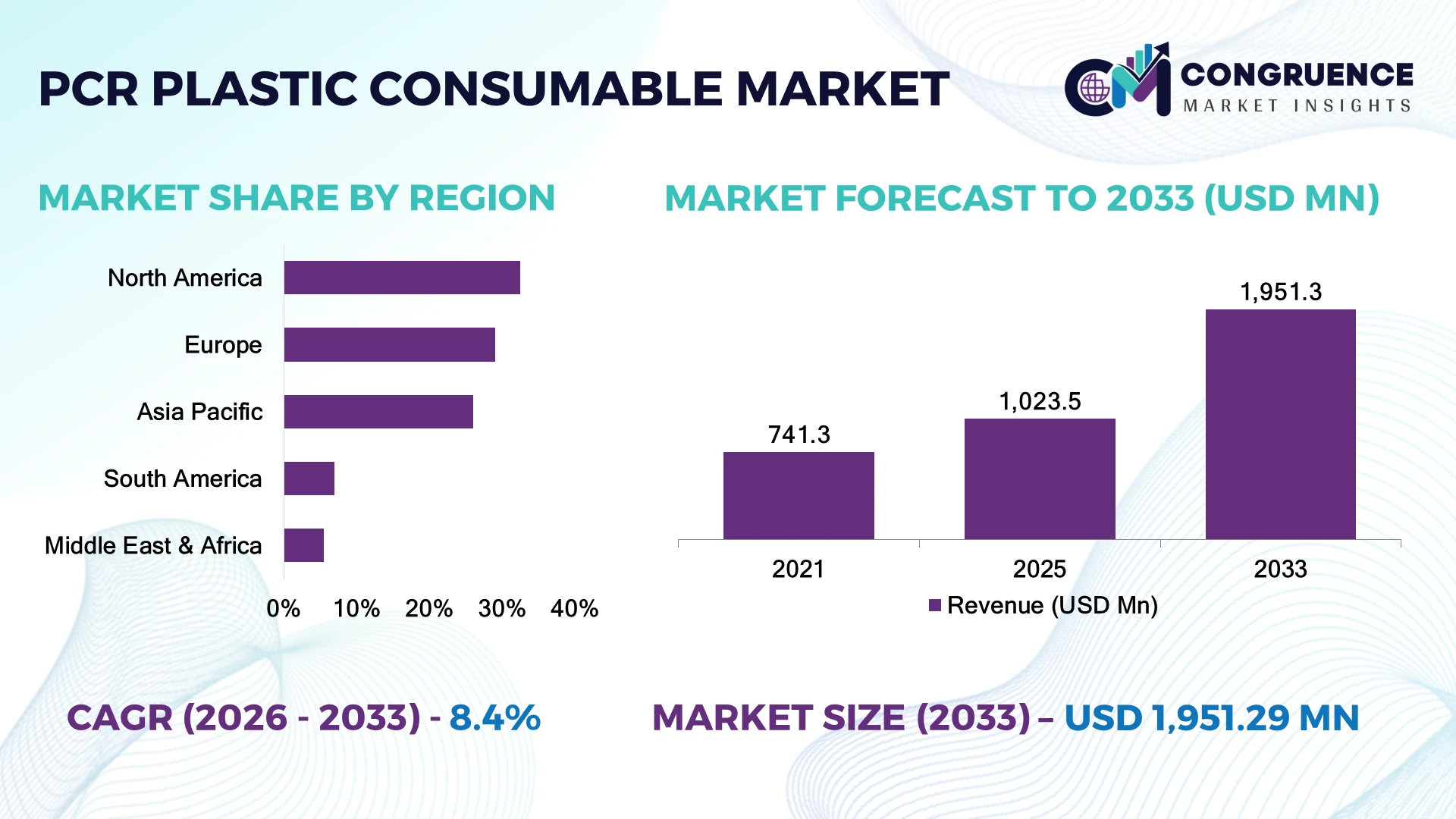
The United States represents approximately 30–33% of global PCR plastic consumable demand, supported by healthcare, foodservice, packaging, and institutional procurement programs. Europe follows at roughly 27–30%, where recycled-content mandates are accelerating qualification of PCR materials. U.S. PCR incorporation remains more application-specific, while European procurement increasingly embeds recycled-content thresholds. In 2026, EU circular-economy regulation and extended producer responsibility requirements are accelerating investment in recycling, compounding, and resin-traceability infrastructure, with PCR adoption in targeted consumable categories approaching 20–30%.
Strategically, manufacturers that secure consistent PCR feedstock, validated material performance, and application-specific regulatory compliance will capture the strongest procurement opportunities.
Market Size & Growth: USD 1,023.5 million in 2025 to USD 1,951.3 million by 2033 at 8.4% CAGR, driven by recycled-content mandates and sustainable procurement.
Top Growth Drivers: Regulatory recycled-content requirements 30–35%, corporate sustainability procurement 25–30%, and packaging/material substitution 15–20%.
Short-Term Forecast: By 2028, optimized PCR compounding can reduce virgin-resin dependence by 15–25% while improving material utilization 5–10%.
Emerging Technologies: AI sorting, advanced washing, compatibilizers, and closed-loop compounding are improving PCR purity and consistency.
Regional Leaders: North America is projected near USD 620 million, Europe USD 570 million, and Asia-Pacific USD 520 million by 2033.
Consumer/End-User Trends: Institutional and commercial buyers increasingly specify recycled-content thresholds of 20–50% for qualifying consumable categories.
Pilot/Case Example: 2026 closed-loop manufacturing programs are targeting 15–25% reductions in virgin plastic use through PCR substitution and improved scrap recovery.
Competitive Landscape: Berry Global, Berry Bramlage, Greif, ALPLA, and Plastipak compete through resin integration, processing scale, and application-specific PCR formulations.
Regulatory & ESG Impact: Recycled-content mandates can shift material specifications by 20–30%, increasing demand for certified PCR resin and traceability systems.
Investment & Funding: More than USD 1 billion in cumulative recycling and circular-material investments across major polymer supply chains is supporting capacity expansion and advanced processing.
Innovation & Future Outlook: High-purity PCR, chemical recycling integration, multilayer-compatible formulations, and digital resin traceability will increasingly determine product qualification.
The PCR Plastic Consumable market is shifting from voluntary sustainability adoption toward specification-driven procurement. Healthcare, foodservice, institutional packaging, laboratory products, and household consumables are increasingly evaluating PCR content alongside hygiene, mechanical strength, and regulatory performance. PCR formulations containing 20–50% recycled content are becoming commercially relevant, while feedstock quality, color consistency, odor control, and batch traceability remain operational priorities. This transition creates a direct link between recycling infrastructure and consumable-product qualification.
PCR plastic consumables are becoming strategically important because recycled-content requirements are moving from corporate sustainability commitments into product specifications, procurement contracts, and regulatory frameworks. In 2026, manufacturers face increasing pressure to replace virgin polymer without compromising strength, hygiene, dimensional stability, or processing efficiency. This is particularly relevant for disposable packaging, foodservice products, laboratory consumables, and institutional applications where plastic usage remains structurally high.
Material-processing technology is narrowing the performance gap between PCR and virgin resin. Advanced sorting, washing, compatibilization, and melt filtration can improve PCR consistency by approximately 10–20%, while optimized compounding can reduce processing losses by 5–10% compared with less-controlled recycled feedstock. Europe leads on regulatory pressure and recycled-content integration, while North America emphasizes corporate procurement and large-scale resin supply; Asia-Pacific combines manufacturing scale with rapidly expanding recycling infrastructure.
Over the next 2–3 years, producers will prioritize certified feedstock, higher-purity PCR grades, and application-specific formulations. A practical deployment model is closed-loop recovery from manufacturing and post-consumer streams into new consumables, reducing virgin resin requirements while improving material traceability. Companies are expanding recycling partnerships, securing long-term resin contracts, and integrating PCR compounding closer to production sites. Competitive advantage will increasingly depend on reliable feedstock, consistent material performance, certification, and scalable conversion economics.
Mandatory recycled-content requirements and corporate procurement specifications are accelerating PCR adoption across packaging, foodservice, laboratory, and institutional consumables. Targeted applications are increasingly moving toward 20–50% PCR incorporation, while sustainability-led procurement programs can influence 25–35% of material-selection decisions. European regulatory requirements are particularly important in 2026, pushing converters to secure certified post-consumer feedstock earlier in product-development cycles. Manufacturers are responding through long-term recycler contracts, in-house compounding, and qualification of multiple resin grades. The sharp strategic shift is that PCR is becoming a supply-planning issue rather than simply a sustainability feature: companies with secured feedstock can protect production continuity and customer contracts when certified recycled resin availability tightens.
Variable post-consumer feedstock remains a major constraint because contamination, polymer mixing, odor, moisture, and color variation can increase processing losses by 5–15% and require additional filtration or compounding. High-specification consumables can face PCR-content limitations of 20–30% when mechanical or appearance requirements are stringent. In the United States, fragmented collection and sorting infrastructure also creates regional differences in resin availability and quality. These inconsistencies raise qualification costs and complicate multi-site manufacturing. Companies are reducing exposure through supplier diversification, controlled feedstock contracts, advanced washing, melt filtration, and virgin-PCR blending. A non-obvious pressure point is color consistency: manufacturers producing white or transparent consumables often require tighter purification, making premium PCR materially more expensive than standard recycled grades.
Chemical recycling, solvent purification, AI-enabled sorting, and high-performance compatibilizers are creating opportunities to increase PCR content in applications previously constrained by contamination or performance requirements. Advanced sorting can improve usable polymer recovery by approximately 10–20%, while optimized compatibilization can improve recycled-material mechanical performance by 5–10%. Japan, Germany, and the United States are expanding technology partnerships around higher-purity recycled polymers and closed-loop material systems. Companies are investing in advanced recycling capacity, resin qualification programs, and converter partnerships to access higher-value applications. The strongest non-obvious opportunity is premium PCR for technically demanding consumables: improving purity and traceability allows suppliers to compete on performance and certification rather than commodity resin price alone.
Scaling PCR consumable production requires synchronized collection, sorting, compounding, certification, and conversion infrastructure. Manufacturing plants can experience 5–10% additional process variability when PCR feedstock characteristics change between batches, while qualification cycles for regulated or high-performance products can extend development timelines by 10–20%. Healthcare and food-contact applications impose particularly demanding contamination and traceability requirements. Companies must integrate digital batch tracking, inline material monitoring, automated blending, and supplier-quality systems to maintain consistency. The long-term challenge is building a closed-loop operating model that remains economically viable across fluctuating feedstock volumes. Manufacturers that connect recycler data with production planning can reduce material mismatch and changeover losses by approximately 5–10%, strengthening both sustainability performance and manufacturing reliability.
PCR Formulations Become More Precise: Converters are moving from broad recycled-content targets toward application-specific PCR formulations, with 20–50% incorporation increasingly specified for suitable consumables. Advanced compounding and compatibilizers are improving mechanical consistency by approximately 5–10%. Manufacturers are creating dedicated resin recipes for rigid packaging, laboratory products, foodservice items, and institutional consumables rather than applying one recycled grade across entire portfolios.
Traceability Enters Material Procurement: Digital resin-traceability systems are becoming more important as buyers demand verified post-consumer content and chain-of-custody information. Automated batch tracking can reduce material-documentation workload by 15–25%, while digital supplier qualification improves batch visibility by approximately 10–20%. European procurement teams are particularly active, prompting manufacturers to integrate recycler data with purchasing, production, and compliance workflows.
Color Control Gains Commercial Weight: PCR suppliers are investing heavily in de-inking, washing, optical sorting, and color-correction technologies because visual variability remains a major qualification barrier. Advanced purification can reduce color-related rejection by approximately 10–20%, allowing higher PCR incorporation in appearance-sensitive products. Manufacturers are increasingly separating natural, light-colored, and dark feedstocks to improve consistency and reduce costly downstream pigmentation adjustments.
Closed-Loop Programs Move Onsite: Large converters are increasingly recovering production scrap and post-consumer material for reintegration into selected consumables, reducing virgin-polymer requirements by approximately 15–30%. The model is gaining traction where collection logistics are geographically concentrated. Companies are forming recycler partnerships or installing onsite compounding capability, turning material recovery into a procurement and cost-control function rather than a standalone sustainability initiative.
PCR PET represents approximately 45–50% of global PCR plastic consumable demand, supported by mature collection systems, established food-contact recycling pathways, and broad compatibility with bottles, trays, containers, and other rigid formats. PCR HDPE follows at roughly 20–25%, benefiting from established household and industrial collection streams, while PCR PP contributes approximately 15–20%. Other polymers account for the balance and remain strategically relevant where specialized performance is required. PET maintains the strongest commercial qualification base, particularly in Europe and Japan, where collection infrastructure supports higher-quality feedstock.
PCR PP is the fastest-growing type, driven by improved sorting, washing, compatibilization, and demand for recycled rigid polypropylene products. Adoption is increasing as converters target approximately 20–30% PCR incorporation without significant processing changes. Companies are investing in dedicated resin streams, advanced compounding, and long-term recycler partnerships. The investment priority is shifting toward polymer-specific purification because consistent melt flow, color, and mechanical properties increasingly determine qualification success.
McKinsey’s 2025 global packaging survey found that 62% of U.S. consumers considered packaging made from recycled content very or extremely important, reinforcing commercial pressure for higher-PCR material adoption.
Packaging consumables account for approximately 55–60% of global PCR plastic consumable demand, reflecting extensive use across bottles, containers, trays, closures, films, and other high-volume formats. Food and beverage packaging represents roughly 30–35%, while household and personal-care packaging contributes approximately 15–20%. Healthcare and laboratory consumables remain smaller but strategically important because contamination control and material qualification restrict PCR penetration. Mature packaging applications increasingly specify recycled content directly within procurement contracts.
Healthcare and laboratory consumables represent the fastest-growing application niche as improved purification, traceability, and regulatory-grade compounding expand the range of products capable of incorporating PCR. Adoption in suitable applications is moving toward 10–20% PCR content, while advanced sorting and filtration can reduce contamination-related rejection by approximately 10–15%. Manufacturers are responding through application-specific resin grades, controlled feedstock streams, and converter partnerships. Demand is strengthening where PCR can satisfy sustainability requirements without compromising barrier properties, hygiene, or dimensional stability.
McKinsey’s 2025 survey covering 11,136 consumers across 11 countries found recyclability was the leading packaging-sustainability attribute globally, while recycled content ranked among the strongest circularity priorities.
Consumer packaged-goods and packaging manufacturers represent approximately 60–65% of PCR plastic consumable demand because they operate the largest high-volume conversion platforms and face direct recycled-content commitments. Food and beverage companies account for around 25–30%, while household, personal-care, and retail brands contribute approximately 20–25%. These established buyers increasingly qualify multiple PCR suppliers to protect material availability and manage resin-price volatility. Their purchasing decisions emphasize certification, consistency, recycled-content percentage, and conversion compatibility rather than recycled resin price alone.
Healthcare, laboratory, and institutional users represent the fastest-growing end-user group, supported by improved material purification and more application-specific PCR grades. Their adoption remains selective, generally targeting approximately 10–20% recycled content where performance and regulatory requirements permit. Manufacturers are responding with customized formulations, traceability systems, controlled-compounding partnerships, and dedicated quality protocols. The strategic shift is toward vertically coordinated supply, where converters work directly with recyclers to secure consistent feedstock. This reduces qualification variability and strengthens long-term contract retention.
McKinsey’s 2025 research found that more than 30 retailers, CPG companies, distributors, and packaging executives identified affordability, performance, regulatory clarity, and unreliable supply among the principal barriers to sustainable-packaging adoption.
North America accounted for the largest market share at 32.5% in 2025 however, Asia-Pacific is expected to register the fastest growth, expanding at a CAGR of 10.1% between 2026 and 2033.
Corporate recycled-content commitments accelerate domestic PCR integration
North America represents approximately 32.5% of global PCR Plastic Consumable demand, supported by established recycling infrastructure, large consumer-packaging manufacturers, and increasingly specific recycled-content procurement requirements. The United States accounts for nearly 85% of regional consumption, with food and beverage, household products, laboratory consumables, and institutional packaging representing major demand centers. U.S. converters are increasingly integrating PCR resin qualification into product development, with 20–50% recycled-content targets common across suitable applications. Advanced sorting, washing, and compounding capacity is expanding as manufacturers seek tighter color, odor, and melt-flow control. Companies are responding through long-term recycler agreements, captive compounding, and multi-source resin qualification, strengthening supply continuity while reducing exposure to virgin-polymer price volatility.
United States Market Outlook: The United States remains the region's primary PCR consumption and manufacturing hub, supported by extensive packaging conversion capacity and growing corporate recycled-content commitments. Large consumer-goods manufacturers are increasingly incorporating PCR requirements into supplier contracts and product specifications. Demand is strongest where converters can maintain 20–30% PCR content without significant changes to existing extrusion, injection-molding, or thermoforming processes.
Regulatory recycled-content requirements reshape material procurement
Europe represents approximately 29% of global PCR Plastic Consumable demand, with Germany, France, Italy, the United Kingdom, and Spain forming major consumption and converting centers. EU circular-economy policies are accelerating recycled-content integration, particularly in packaging and disposable consumer products. Manufacturers increasingly require certified PCR resin, digital traceability, and documented chain-of-custody information before qualification. Advanced sorting and washing facilities are being expanded to improve feedstock purity, while converters are adapting formulations to maintain mechanical performance at 20–50% PCR incorporation. Germany's strong automotive, packaging, chemical, and consumer-goods manufacturing base creates particularly sophisticated demand for consistent recycled polymers.
Germany Market Outlook: Germany is a key European PCR market because of its advanced recycling infrastructure, large packaging-conversion base, and strong industrial focus on circular materials. Manufacturers increasingly integrate recycled resin into procurement specifications and product-development programs. High-quality sorting and compounding systems support more consistent PCR incorporation, while industrial buyers increasingly prioritize documented recycled content and material traceability alongside price and processing performance.
Manufacturing scale drives rapid PCR conversion capacity expansion
Asia-Pacific represents approximately 26% of global PCR Plastic Consumable demand, with China, Japan, South Korea, and India forming the principal manufacturing and conversion centers. China provides the region's largest plastics-processing base, while Japan and South Korea emphasize high-purity recycled polymers and advanced compounding. India is rapidly expanding recycling and polymer-processing infrastructure, creating additional feedstock availability for consumer packaging and institutional products. PCR adoption is increasingly supported by automated sorting, optical separation, washing, and extrusion systems, with advanced facilities improving usable material recovery by approximately 10–20%. Companies are establishing recycler-converter partnerships and localized resin supply networks to reduce transportation costs and improve material consistency.
China Market Outlook: China remains the region's largest plastics-processing and consumables manufacturing center, providing extensive conversion capacity and increasingly sophisticated recycling infrastructure. Large-scale packaging producers can integrate PCR resin into established extrusion and injection-molding operations, while automated sorting improves feedstock consistency. Manufacturers are increasingly developing closed-loop supply relationships to secure recycled polymer for high-volume consumer and institutional applications.
Brazil anchors regional recycled-polymer demand and collection expansion
South America represents approximately 7% of global PCR Plastic Consumable demand, with Brazil accounting for roughly 60% of regional consumption. The country's extensive beverage, food, household-product, and retail packaging industries create strong demand for recycled PET, HDPE, and increasingly PP. Collection cooperatives and formal recycling operators remain important feedstock channels, although fragmented collection limits consistent polymer quality in several markets. Brazilian converters are expanding washing, sorting, and pelletizing capacity while consumer brands increase recycled-content commitments. PCR incorporation of approximately 20–30% is increasingly practical for suitable rigid and packaging applications, strengthening demand for standardized recycled resin and improving the commercial value of organized post-consumer collection.
Brazil Market Outlook: Brazil provides the strongest South American platform because of its large packaging industry, established recycling ecosystem, and extensive PET collection activity. Beverage packaging represents a particularly important feedstock stream, while consumer-goods manufacturers are increasing recycled-content integration. Companies with direct recycler relationships can improve resin consistency and reduce procurement volatility, making vertically coordinated PCR supply increasingly valuable.
Circular-economy investment builds localized recycled-resin capacity
Middle East & Africa represents approximately 5.5% of global PCR Plastic Consumable demand, with the UAE, Saudi Arabia, South Africa, and Turkey serving as important processing and consumption centers. The UAE and Saudi Arabia are investing in recycling infrastructure and circular-material programs as governments diversify industrial activity and reduce dependence on virgin polymer exports. South Africa has a more established collection and recycling ecosystem, particularly for PET and HDPE. Regional converters are increasingly targeting 15–30% PCR incorporation in packaging and institutional products, while advanced sorting and pelletizing improve material consistency. Companies are forming collection partnerships, investing in localized recycling facilities, and integrating recycled resin into regional packaging supply chains.
United Arab Emirates Market Outlook: The UAE is emerging as a strategic PCR hub because of its modern logistics infrastructure, polymer-processing base, and investment in circular-economy capabilities. Dubai and Abu Dhabi provide access to regional packaging markets across the Gulf, while new recycling capacity supports localized feedstock processing. Manufacturers can leverage centralized collection and distribution networks to reduce PCR transportation complexity and strengthen regional supply reliability.
Berry Global, ALPLA, Plastipak, Amcor, and Greif compete through integrated recycling, packaging conversion, and resin supply, while regional recyclers challenge global groups on feedstock cost and flexibility. The top five are estimated to represent roughly 30–35% of organized PCR consumable supply. Competition centers on resin quality, price, traceability, and processing: advanced sorting can improve usable recovery 10–20%, while recycled-content incorporation of 30–50% increasingly differentiates premium packaging. Berry is expanding high-purity PCR and flexible-film capacity; ALPLA is scaling recycling output; Plastipak integrates recycling with bottle production; Amcor is expanding recyclable and PCR-enabled formats. The competitive shift is toward vertical integration, certified feedstock, and closed-loop supply. Entry barriers include collection access, food-contact qualification, contamination control, and capital-intensive washing and compounding. Winning requires secured feedstock, consistent polymer performance, certified traceability, application engineering, and conversion scale that protects customers from resin volatility and regulatory compliance while delivering reliable volume at commercially competitive delivered costs.
Berry Global
ALPLA Group
Plastipak Holdings
Amcor
Greif
Veolia
SUEZ
LyondellBasell Industries
Indorama Ventures
Borealis
KW Plastics
Far Eastern New Century
APK
PureCycle Technologies
Current PCR processing combines optical sorting, near-infrared identification, automated washing, melt filtration, and extrusion to produce consistent recycled resin. Advanced sorting can improve polymer recovery by 10–20%, while automated quality monitoring reduces contamination-related rejection by 5–10%. Adoption is strongest in large European and North American recycling networks, where certified PCR demand requires stable color, odor, melt-flow, and contaminant specifications.
Emerging systems integrate AI sorting, digital traceability, compatibilizers, and closed-loop compounding. AI-enabled identification can improve sorting accuracy by approximately 5–10% versus conventional rule-based separation, while inline spectroscopy enables faster quality decisions. Berry Global, ALPLA, and Plastipak benefit from vertically integrated recycling-to-conversion models, whereas regional processors gain opportunities through modular sorting and compounding partnerships. This integration strengthens feedstock security and qualification speed.
During 2026–2028, chemical recycling, advanced decontamination, digital product passports, and automated resin blending will expand the addressable PCR pool. Compared with basic mechanical sorting, advanced purification can increase usable feedstock yield by roughly 10–15% in suitable streams. Closed-loop systems can reduce virgin-resin dependence by 15–30% for selected products. Competitive advantage will favor companies combining recycling capacity, traceability, material science, and conversion expertise, because customers increasingly demand verified recycled content without sacrificing processing performance, product consistency, or regulatory compliance at scale.
February 2025 Berry Global launched CleanStream Home and Industrial, using AI sorting and decontamination for high-purity PCR. Its UK facility can recycle nearly 40% of domestic PP waste collected, expanding suitable PCR use across demanding non-contact packaging commercially. Source: berryglobal.com
March 2026 ALPLA reported 14 recycling plants across 10 countries, with 400,000 tonnes of installed and planned PCR capacity. The network strengthens rPET and rHDPE availability and supports ALPLA’s target of 30% PCR material use by 2030 globally. Source: alpla.com
July 2025 Amcor invested in its Kentucky facility to enable PCR blending from dedicated silos across multiple lines, including packaging with up to 100% PCR. The upgrade supports customized recycled-content levels and strengthens supply for regulated packaging applications. Source: amcor.com
September 2025 ExxonMobil paused €100 million of planned European plastic-recycling investment, citing draft EU recycled-content accounting rules. Its Rotterdam and Antwerp projects were designed to process 80,000 tonnes of plastic waste annually, highlighting regulatory uncertainty for advanced recycling. Source: reuters.com (Reuters)
The report evaluates the global PCR Plastic Consumable market across PCR PET, PCR HDPE, PCR PP, and other recycled polymers, covering packaging, foodservice, household, personal-care, healthcare, laboratory, and institutional consumable applications. End-user analysis distinguishes consumer-goods manufacturers, packaging converters, food and beverage companies, healthcare organizations, and institutional buyers, with emphasis on recycled-content requirements and material qualification.
Regional coverage spans North America, Europe, Asia-Pacific, South America, and Middle East & Africa, including established recycling hubs and emerging PCR-processing markets. The study examines optical sorting, AI-enabled identification, advanced washing, melt filtration, compatibilization, chemical recycling, digital traceability, and closed-loop compounding. With PET representing approximately 45–50% of demand and suitable applications increasingly adopting 20–50% PCR content, the report supports capacity investment, feedstock sourcing, technology selection, geographic expansion, supplier partnerships, competitive positioning, and strategic planning through 2033.
| Report Attribute/Metric | Report Details |
|---|---|
|
Market Revenue in 2025 |
USD 1,023.5 Million |
|
Market Revenue in 2033 |
USD 1,951.3 Million |
|
CAGR (2026 - 2033) |
8.4% |
|
Base Year |
2025 |
|
Forecast Period |
2026 - 2033 |
|
Historic Period |
2021 - 2025 |
|
Segments Covered |
By Type
By Application
By End-User
|
|
Key Report Deliverable |
Revenue Forecast, Growth Trends, Market Dynamics, Segmental Overview, Regional and Country-wise Analysis, Competition Landscape |
|
Region Covered |
North America, Europe, Asia-Pacific, South America, Middle East, Africa |
|
Key Players Analyzed |
Berry Global, ALPLA Group, Plastipak Holdings, Amcor, Greif, Veolia, SUEZ, LyondellBasell Industries, Indorama Ventures, Borealis, KW Plastics, Far Eastern New Century, APK, PureCycle Technologies |
|
Customization & Pricing |
Available on Request (10% Customization is Free) |




