
Reports
The Global Passenger On-Demand Repair Market was valued at USD 22410 Million in 2025 and is anticipated to reach a value of USD 57091.61 Million by 2033 expanding at a CAGR of 12.4% between 2026 and 2033. Growth is being driven by app-based technician dispatch, connected diagnostics, aging passenger-vehicle fleets, and OEM expansion of mobile service programs that reduce workshop dependency.
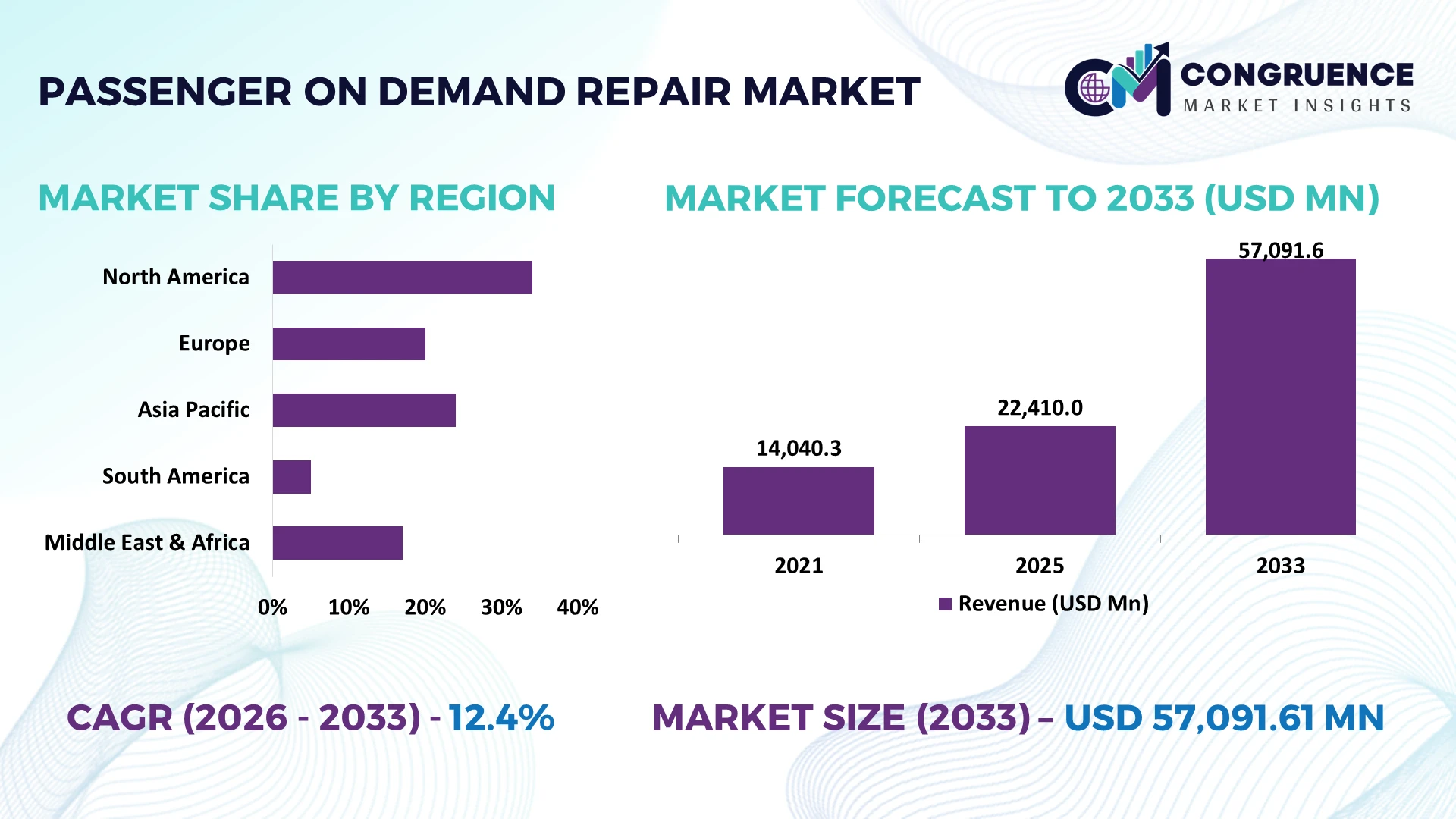
The U.S. dominates the Passenger On-Demand Repair Market, accounting for approximately 34.6% of global demand, supported by its 283 million light-duty vehicle fleet and expanding mobile-service infrastructure. China follows with an estimated 18.2% share, driven by rapid EV adoption and digital vehicle-service platforms. The U.S. has over 70% smartphone-based service booking penetration in urban markets versus roughly 45% in China, highlighting its stronger digital-service maturity.
Strategic implication: providers that combine GPS dispatch, connected diagnostics, EV capabilities, and OEM integrations will capture the strongest high-growth opportunities.
Market Size & Growth: USD 22,410 million in 2025 is projected to reach USD 57,091.61 million by 2033 at 12.4% CAGR, propelled by mobile diagnostics and technician dispatch.
Top Growth Drivers: Digital booking contributes 2.1–2.5% growth impact, connected diagnostics 1.5–2.0%, and aging vehicle fleets 1.2–1.8%.
Short-Term Forecast: By 2028, mature OEM programs are positioned to push mobile servicing beyond 20% of eligible service experiences, reducing fixed-bay dependency.
Emerging Technologies: AI fault triage, GPS route optimization, and connected OBD-II diagnostics are becoming core capabilities, with 67% of surveyed urban owners using apps for maintenance booking.
Regional Leaders: Indicative 2033 values are approximately USD 18.21 billion for North America, USD 15.43 billion for Europe, and USD 23.45 billion for Asia Pacific, with APAC showing the strongest digital expansion.
Consumer/End-User Trends: 67% of surveyed urban vehicle owners used mobile apps for maintenance booking, while 58% prioritized GPS technician tracking and real-time status visibility.
Pilot/Case Example: In 2023, Ford completed more than 2.4 million mobile-service appointments globally, with nearly 20% of Lincoln service experiences delivered remotely.
Competitive Landscape: Tuhu Car leads at approximately 4.5% share; Wrench, AutoNation, ClickMechanic, and Get Spiffy reinforce a fragmented global competitive structure.
Regulatory & ESG Impact: U.S. emissions and vehicle-technology requirements are increasing electronic service complexity, while EV servicing is expanding the need for high-voltage diagnostics and technician certification.
Investment & Funding: Wrench has disclosed approximately USD 93.42 million in funding, while Spiffy secured a USD 30 million financing round, signaling continued platform and network expansion.
Innovation & Future Outlook: AI-enabled diagnostics, telematics-triggered booking, EV battery servicing, and OEM dealership integration will shift competition from individual repairs toward scalable connected-service ecosystems.
Passenger On-Demand Repair Market demand is concentrating around preventive maintenance, corrective repairs, diagnostics, battery services, and EV-specific servicing. Mobile platforms are integrating AI-assisted fault detection, GPS routing, connected diagnostics, and dealership-management systems, while 67% app-based booking adoption signals accelerating digital behavior. U.S. tariff uncertainty and global supply-chain pressures are encouraging dealers to diversify fixed-operations capacity through mobile service networks, strengthening the strategic case for technology-led expansion.
Passenger on-demand repair is becoming strategically important as automakers, dealers, and independent service platforms compete to control customer touchpoints beyond conventional workshops. In the U.S., the average vehicle age reached 12.6 years, expanding the addressable repair pool, while Ford and Lincoln completed more than 2.4 million mobile-service and pickup-and-delivery appointments in 2023. This shift is transforming service capacity from fixed workshop infrastructure toward distributed technician networks.
Technology is accelerating the transition. AI-assisted diagnostics and connected vehicle data can reduce initial fault-triage time by approximately 20–30% versus manual inspection workflows, while GPS-based dispatch improves technician utilization by roughly 10–15%. China is moving faster on electrified-service requirements, with electric cars representing nearly 55% of new-car sales in 2025, compared with about 10% in the U.S., forcing service providers to build battery diagnostics and high-voltage capabilities at different speeds.
Over the next 2–3 years, leading platforms are expected to target 15–25% increases in mobile-service capacity through technician hiring, franchise networks, OEM partnerships, and integrated scheduling platforms. Ford's deployment of more than 3,500 service vehicles demonstrates how distributed servicing can operate at scale. Competitive advantage will increasingly depend on diagnostic intelligence, technician productivity, EV readiness, and network density rather than workshop count alone.
The strongest structural driver is the combination of aging vehicles and digital service booking. U.S. vehicles averaged 12.6 years in 2024, while roadside battery and towing incidents represented roughly 74% of AAA's 2024 emergency-service calls, reinforcing demand for rapid intervention. Digital scheduling, connected diagnostics, and technician routing can improve field utilization by 10–15% and reduce diagnostic handling time by 20–30%. The shift is reinforced by OEM mobile-service programs, with Ford and Lincoln operating more than 3,500 service vehicles globally. Companies are therefore investing in distributed technician fleets, telematics integration, and dealer partnerships. The non-obvious advantage is capacity creation without proportional investment in additional fixed workshop bays.
Parts availability remains a direct constraint on profitable mobile deployment, particularly when repairs require model-specific components or specialist equipment. Approximately 20–30% of complex field-service visits can require additional parts or workshop escalation, reducing first-visit completion efficiency. EV-specific components further increase complexity as China accounted for nearly 75% of global electric-car production in 2025, concentrating portions of the battery and power-electronics supply chain. Shipping disruptions and geopolitical trade friction can extend replacement-part lead times and increase inventory requirements. Companies are responding through regional parts hubs, preferred supplier contracts, predictive stocking, and workshop escalation networks. The strategic issue is not technician availability alone: first-time-fix rates increasingly determine whether mobile expansion generates attractive unit economics.
The largest emerging opportunity lies in AI-enabled diagnostics combined with EV-specific mobile servicing. Electric cars represented nearly 25% of global new-car sales in 2025, while China reached almost 55%, creating a rapidly expanding installed base requiring battery, thermal-management, software, and high-voltage expertise. AI-assisted triage can reduce preliminary diagnostic time by approximately 20–30%, while predictive parts allocation can improve first-visit completion by 10–15%. India, Southeast Asia, and Latin America offer particularly attractive white-space opportunities as vehicle electrification and app-based service adoption develop from a lower installed base. Companies are positioning through battery-diagnostic R&D, technician certification, telematics partnerships, and OEM-platform integration. The strongest opportunity is to monetize vehicle data before physical repair demand becomes visible.
Scaling on-demand repair requires simultaneous expansion of skilled technicians, digital infrastructure, diagnostic interoperability, and cybersecurity controls. EV servicing is particularly demanding because high-voltage systems require specialized training, while connected vehicles increasingly transmit large volumes of diagnostic information across OEM and third-party platforms. Industry operators can face 10–20% productivity variation when technician skill levels, routing density, and parts availability differ across markets. China already has more than 44 million electric cars on its roads, whereas the U.S. EV fleet is developing at a substantially slower pace, creating divergent training requirements. Companies must invest in certification, standardized diagnostic interfaces, secure data architecture, and regional service hubs. Long-term competitiveness will depend on consistent first-time-fix performance across fragmented vehicle technologies.
AI-Led Service Dispatch: In 2025, 93% of field-service organizations had partially implemented AI, while 75% reported improved first-time-fix performance. Passenger repair platforms are integrating AI into fault classification, technician allocation, and work-order sequencing, reducing diagnostic delays and improving field productivity.
Predictive Maintenance Gains Traction: Connected-vehicle data is shifting maintenance from reactive calls toward condition-based intervention, with approximately 55% of field-service leaders prioritizing AI-enabled scheduling and dispatch. Companies are linking telematics with maintenance platforms to anticipate faults, improve parts readiness, and reduce avoidable roadside deployments.
Battery Services Expand Rapidly: American Automobile Association (AAA) recorded more than 27 million U.S. roadside service calls in 2024, including approximately 7 million battery-related incidents. Repair companies are expanding mobile battery testing, replacement, and EV-support fleets, increasing rapid-response capability as vehicle electrification changes service requirements.
AI-Driven Parts Planning: Approximately 62% of field-service organizations expect AI to significantly transform inventory management. Repair providers are integrating parts forecasting with technician dispatch, enabling localized inventory positioning and reducing repeat visits caused by unavailable components. This makes first-visit parts availability a growing operational differentiator.
Mechanical Repair leads the Passenger On-Demand Repair Market with an estimated 38% share, supported by high service frequency, standardized tooling, and broad technician availability. Brake, suspension, cooling, and drivetrain work can be completed through mobile workflows more efficiently than facility-dependent body operations. Electrical Repair follows at approximately 23%, benefiting from increasing electronic-system complexity and connected diagnostics. Tire Repair represents nearly 15%, retaining strong roadside relevance because rapid intervention directly limits vehicle downtime.
Battery Services represent the fastest-growing type, with adoption increasing approximately 18–22% across organized mobile-service networks as EV penetration and advanced battery systems expand. Body Repair remains comparatively constrained at around 10% because structural and paint operations require specialized facilities. Companies are prioritizing mobile diagnostic equipment, battery-service fleets, technician certification, and supplier partnerships. Investment is shifting toward repair categories combining high job frequency, faster deployment, and lower infrastructure dependency.
Roadside Breakdown is the leading application, representing an estimated 42% share, because vehicle failures require immediate intervention and cannot be deferred without increasing downtime. Emergency Repair follows at approximately 27%, supported by digital dispatch, GPS technician tracking, and faster fault identification. Mobile Maintenance is the fastest-growing application, with organized service networks recording approximately 15–20% increases in scheduled mobile interventions as telematics enables condition-based maintenance. Vehicle Inspection remains smaller but strategically relevant for pre-purchase checks, compliance assessments, and preventive workflows.
Companies are expanding roadside technician coverage while shifting investment toward scheduled Mobile Maintenance to improve technician utilization beyond unpredictable emergency calls. Roadside Breakdown remains operationally critical, but profitability increasingly depends on accurate diagnosis and first-visit completion. In the U.S., American Automobile Association (AAA) handled more than 27 million emergency roadside calls in 2024, with towing and battery incidents representing approximately 74% combined, demonstrating the concentration of urgent service demand.
Private Vehicle Owners lead the market with an estimated 48% share, reflecting the large passenger-vehicle population and increasing preference for doorstep servicing over workshop visits. Digital booking and location-tracking adoption is estimated at 15–20% across organized service channels. Fleet Operators represent the fastest-growing end-user group because downtime directly affects utilization, delivery schedules, and operating costs. Their purchasing behavior is shifting from individual repairs toward recurring maintenance contracts and integrated service-level agreements.
Rental Companies and Corporate Fleets represent smaller shares but provide predictable workloads and recurring contract opportunities. Fleet operators are increasingly integrating telematics, predictive maintenance, and automated work orders, with organized fleets targeting approximately 10–15% improvements in technician utilization. Companies are responding through dedicated fleet programs, subscription pricing, priority dispatch, and API-based maintenance integration. The competitive advantage is shifting toward providers capable of combining repair execution with fleet-data management.
North America accounted for the largest market share at 34.6% in 2025 however, Asia Pacific is expected to register the fastest growth, expanding at a CAGR of 13.8% between 2026 and 2033.
OEM Mobile-Service Networks Reshape Service Capacity
North America leads the market through high vehicle density, mature digital booking infrastructure, and strong OEM participation. The U.S. represents the largest demand center, with approximately 283 million highway vehicles and smartphone penetration among vehicle owners exceeding 80%. Ford's mobile-service ecosystem has scaled beyond 3,500 deployment vehicles globally, demonstrating how OEM networks are converting fixed workshop capacity into distributed service coverage. General Motors is also expanding mobile capabilities through its MobileService+ program, including BrightDrop-based service vehicles. Connected diagnostics, GPS dispatch, and pickup-and-return models are increasingly integrated into dealership workflows. The region's competitive advantage lies in technician density and established parts distribution, allowing providers to achieve shorter response windows and higher service consistency.
U.S. Market Outlook: The U.S. remains the region's operational anchor because of its large aging vehicle parc, extensive dealership infrastructure, and advanced telematics ecosystem. More than 2.4 million Ford mobile-service and pickup-and-delivery appointments completed in 2023 demonstrate substantial enterprise-scale deployment. Providers are prioritizing EV diagnostics, fleet partnerships, and digitally coordinated technician networks.
Regulation Accelerates Digital and EV Service Modernization
Europe holds approximately 27.3% of global market demand, with the UK, Germany, and France forming the principal deployment centers. UK mobile-service bookings increased 22% in 2024, indicating movement from niche usage toward mainstream workshop substitution. EU CO2 standards are accelerating vehicle electrification and increasing demand for software-compatible diagnostics, battery checks, and specialized technician capabilities. Europe also benefits from dense urban populations where doorstep servicing can reduce customer downtime and improve route economics. Companies are expanding through independent mechanic marketplaces, OEM-authorized networks, roadside partnerships, and digital scheduling platforms. The region's strategic differentiation is regulatory-driven service modernization: tighter emissions and vehicle standards are increasing electronic complexity while simultaneously encouraging more predictive maintenance workflows.
United Kingdom Market Outlook: The UK offers Europe's most developed mobile-service environment, supported by established roadside networks, digital booking platforms, and dense urban service territories. Mobile service represented approximately 4.2% of UK automotive service bookings in 2024, while bookings increased 22%, encouraging providers to expand technician coverage and EV health-check capabilities.
Scale and Electrification Drive Service Transformation
Asia Pacific is the fastest-growing market, supported by China's enormous vehicle ecosystem, Southeast Asia's digital-service expansion, and rising electrification across emerging economies. China accounted for nearly 75% of global electric-car production in 2025, creating an unusually large technical base for battery diagnostics, electronic repair, and software-enabled servicing. Electric vehicles represented nearly 55% of Chinese new-car sales, accelerating requirements for high-voltage technician certification and specialized mobile equipment. India is developing from a smaller base, with electric-car sales rising 75% in 2025 to approximately 165,000 units. Providers are responding through localized service platforms, OEM partnerships, mobile technician networks, and digitally integrated parts distribution. The region's non-obvious advantage is that new vehicle technologies are entering markets without the same legacy workshop structures found in mature economies.
China Market Outlook: China provides the region's strongest combination of vehicle scale, EV manufacturing depth, digital-platform penetration, and aftermarket service infrastructure. Approximately 44 million electric cars were on Chinese roads at the end of 2025, creating a substantial installed base for battery diagnostics, electronic troubleshooting, software-related service, and mobile maintenance. Companies are increasingly linking digital booking with certified technician networks.
Aging Fleets Create Mobile-Service White Space
South America remains an emerging on-demand repair market where aging vehicles, fragmented workshops, and large urban concentrations create favorable conditions for mobile servicing. Brazil is the principal demand center, with approximately 51.5 million light vehicles in operation at the end of 2025 and an average vehicle age of 13.6 years. More than 50% of Brazil's vehicle fleet sought some form of preventive or repair service during 2025, demonstrating substantial recurring maintenance intensity. Digital platforms are expanding appointment scheduling, technician dispatch, and parts coordination, while Chinese EV manufacturers are increasing local production. Providers are balancing expansion with infrastructure limitations by concentrating technician fleets around major cities and using regional parts hubs. The strategic opportunity lies in converting fragmented workshop demand into standardized, digitally managed service routes.
Brazil Market Outlook: Brazil combines the region's largest automotive aftermarket footprint with a rapidly modernizing vehicle base. Approximately 42 million vehicles sought preventive or repair services during 2025, creating substantial addressable demand. The country's expanding EV manufacturing ecosystem is also increasing requirements for battery diagnostics and electronically trained technicians.
Infrastructure Modernization Supports Premium Mobile Service
The Middle East & Africa market is being shaped by vehicle imports, premium-car ownership, urban infrastructure modernization, and investment in digitally coordinated mobility services. The UAE and Saudi Arabia represent important deployment centers because of high vehicle utilization, advanced urban infrastructure, and strong technology adoption. Saudi Arabia's Vision 2030 mobility investments are encouraging digital automotive ecosystems, while the UAE's smart-mobility infrastructure supports app-based service coordination. Extreme heat also increases battery, cooling-system, and tire-service requirements, strengthening the case for rapid-response maintenance. Companies are deploying mobile workshops, roadside partnerships, fleet contracts, and connected booking systems rather than relying exclusively on fixed facilities. The region's competitive advantage is concentrated in high-value urban markets, where convenience and response speed command stronger commercial value.
Saudi Arabia Market Outlook: Saudi Arabia is the region's most strategically significant market because Vision 2030 is accelerating mobility infrastructure, digital transformation, and automotive ecosystem development. High temperatures intensify battery, cooling, and tire maintenance requirements, while expanding connected-service infrastructure supports technician dispatch, fleet contracts, and digitally managed mobile repair networks.
Tuhu Car leads the competitive field against Wrench, ClickMechanic, Get Spiffy, and AutoNation, while OEM-authorized networks compete with platform aggregators on trust, parts access, and response speed. The top five players collectively hold approximately 7% share, indicating a fragmented structure with room for challengers. Competition centers on technology, technician density, price transparency, and service speed: AI diagnostics can reduce triage time by 20–30%, GPS routing can improve technician utilization by 10–15%, and digital booking penetration in mature urban markets exceeds 60%. Tuhu Car strengthens its position through China’s dense service ecosystem, while Wrench emphasizes mobile delivery and Get Spiffy targets recurring fleet maintenance. AutoNation leverages dealership infrastructure, whereas ClickMechanic competes through marketplace breadth. The competitive shift is moving from doorstep convenience toward integrated diagnostics, EV capability, and parts control. Technician-certification requirements and localized inventory remain key entry barriers. Winning requires dense networks, first-visit completion, technology integration, and disciplined unit economics.
Tuhu Car
Wrench
ClickMechanic
Get Spiffy
AutoNation
Ford Motor Company
General Motors
RAC Motoring Services
Mach1 Services
YourMechanic
GoMechanic
Pitcrew
AI-assisted diagnostics, connected vehicle data, and cloud dispatch are becoming the core technology stack for on-demand repair. Telematics-enabled triage can cut diagnostic handling time by 20–30%, while dynamic routing can improve technician utilization by 10–15%. Adoption is strongest among OEM and fleet programs where vehicle data already feeds service workflows. Integration with mobile apps and technician tablets is reducing information gaps and improving service transparency while reducing avoidable repeat technician visits materially.
Emerging platforms are integrating AI scheduling, digital vehicle inspections, parts forecasting, and dealer-management systems. Compared with phone-based dispatch and manual inspection, automated workflows can reduce coordination time by roughly 20% and improve first-visit preparation by 10–15%. Get Spiffy’s integration with CDK illustrates the shift toward unified scheduling, routing, inventory, payment, and service records. This architecture strengthens control across dispersed dealer operations.
Disruptive capability is moving toward predictive and generative AI that converts vehicle signals into service recommendations before failures become roadside events. By 2026–2028, connected diagnostics, EV battery analytics, and AI dispatch will increasingly determine network productivity and response consistency. OEM-backed networks benefit from proprietary vehicle data, while independent platforms gain competitiveness through open integrations and faster deployment. Early investment will build data advantages before service competition intensifies.
December 2025 Ford Pro expanded Mobile Service to 13 European markets with almost 500 vans, capable of performing more than 70% of servicing, maintenance, and repair actions onsite. The rollout integrates FORDLiive, reducing workshop travel and strengthening fleet uptime globally. Source: media.ford.com
January 2025 Get Spiffy integrated its Digital Servicing platform with CDK and expanded Krause Genesis operations to three locations. The integration connects scheduling, routing, inventory, payments, and dealership data, improving multi-location control and accelerating scalable mobile-service deployment across dealer networks. Source: getspiffy.com
April 2025 American Automobile Association recorded over 27 million U.S. emergency roadside calls during 2024, including approximately 7 million battery incidents. The data highlighted concentrated roadside demand and reinforced investment in battery-response capability, preventive maintenance, and rapid mobile repair networks. Source: newsroom.aaa.com
June 2026 Ford launched an AI assistant within Ford and Lincoln mobile apps, using vehicle data to provide service-related information. The rollout can reach up to 8 million vehicle owners, strengthening engagement and creating a pathway toward predictive service scheduling. Source: theverge.com
The Passenger On-Demand Repair Market report covers Mechanical Repair, Electrical Repair, Tire Repair, Battery Services, and Body Repair across Roadside Breakdown, Emergency Repair, Mobile Maintenance, and Vehicle Inspection applications. End-user analysis includes Private Vehicle Owners, Fleet Operators, Rental Companies, and Corporate Fleets, providing a structured view of demand concentration, service intensity, and purchasing behavior.
The scope spans North America, Europe, Asia-Pacific, South America, and Middle East & Africa, with country-level analysis emphasizing deployment maturity, fleet composition, infrastructure, and digital-service adoption. Technology coverage includes connected diagnostics, AI dispatch, predictive maintenance, telematics, mobile inspection tools, EV battery diagnostics, and integrated dealer-management platforms. Competitive assessment evaluates 10–14 major participants and their expansion, partnerships, technology positioning, and service-network strategies. The report supports investment planning, geographic expansion, technology prioritization, competitive positioning, and operational decisions through 2026–2033.
| Report Attribute/Metric | Report Details |
|---|---|
Market Revenue in 2025 | USD 22410 Million |
Market Revenue in 2033 | USD 57091.61 Million |
CAGR (2026 - 2033) | 12.4% |
Base Year | 2025 |
Forecast Period | 2026 - 2033 |
Historic Period | 2021 - 2025 |
Segments Covered | By Type
By Application
By End-User
|
Key Report Deliverable | Revenue Forecast, Growth Trends, Market Dynamics, Segmental Overview, Regional and Country-wise Analysis, Competition Landscape |
Region Covered | North America, Europe, Asia-Pacific, South America, Middle East, Africa |
Key Players Analyzed | Tuhu Car, Wrench, ClickMechanic, Get Spiffy, AutoNation, Ford Motor Company, General Motors, RAC Motoring Services, Mach1 Services, YourMechanic, GoMechanic, Pitcrew |
Customization & Pricing | Available on Request (10% Customization is Free) |




