
Reports
The Global Parallel Heating Cables Market was valued at USD 320.0 Million in 2025 and is anticipated to reach a value of USD 553.9 Million by 2033 expanding at a CAGR of 7.1% between 2026 and 2033.
Rapid electrification of industrial heat tracing systems and the shift toward energy-efficient thermal management solutions are accelerating adoption across oil & gas, chemicals, and infrastructure sectors. Between 2024 and 2026, tightening industrial safety regulations and supply chain localization—especially following geopolitical disruptions such as the Russia–Ukraine conflict—are reshaping procurement strategies and driving regional manufacturing investments.
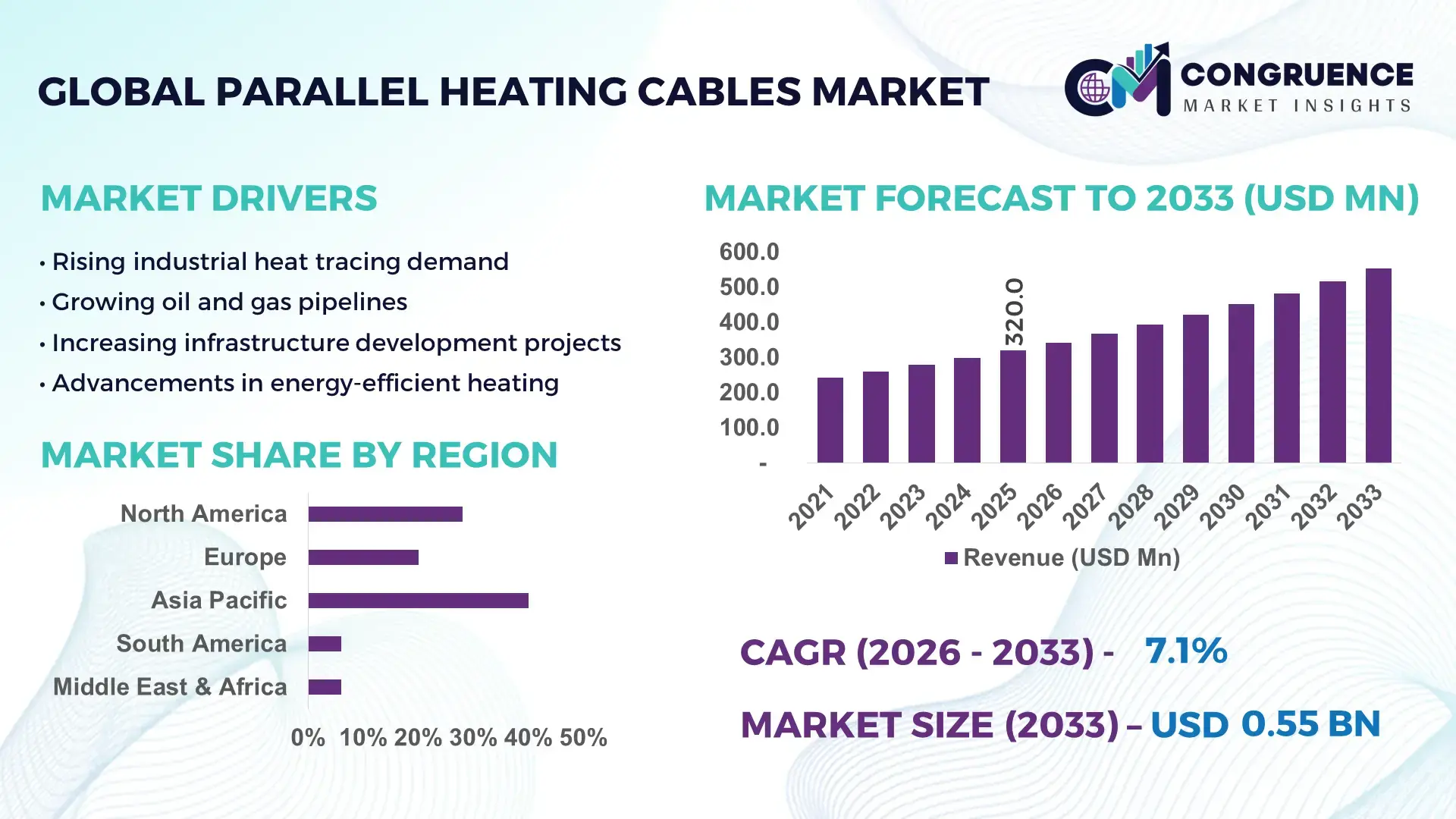
China dominates the global landscape with approximately 34% production share, supported by over 120 large-scale cable manufacturing units and continuous infrastructure expansion, while the United States contributes nearly 22% driven by high adoption in shale oil, LNG, and smart building systems. In comparison, Europe holds around 19% share, focusing on advanced insulation technologies and regulatory compliance. Industrial applications account for over 48% of total demand, highlighting concentration in process industries. This dominance reflects a 2.3x higher deployment rate in industrial heat tracing versus residential systems.
Strategically, companies are prioritizing localized production, high-performance materials, and integrated monitoring capabilities to secure long-term competitiveness in a regulation-driven and efficiency-focused market.
Market Size & Growth: USD 320.0M (2025) to USD 553.9M (2033) at 7.1%, driven by industrial electrification and heat tracing upgrades.
Top Growth Drivers: Industrial automation +42%, energy efficiency adoption +38%, infrastructure electrification +35%.
Short-Term Forecast: By 2027, installation costs expected to drop 12% while operational efficiency improves 18%.
Emerging Technologies: AI-based monitoring, self-regulating cables, advanced polymer insulation gaining 25% adoption.
Regional Leaders: Asia-Pacific (~USD 180M), North America (~USD 120M), Europe (~USD 100M); driven by industrial upgrades and compliance demand.
Consumer/End-User Trends: Over 46% of industrial facilities shifting to automated heat tracing systems.
Pilot/Case Example: 2025 refinery project improved thermal efficiency by 21% using smart heating cables.
Competitive Landscape: Top players hold ~48% share; includes Pentair, nVent, Thermon, Bartec, Chromalox.
Regulatory & ESG Impact: Energy efficiency mandates reduced power consumption by 15% across installations.
Investment & Funding: Over USD 420M invested in manufacturing expansion and R&D partnerships globally.
Innovation & Future Outlook: Smart cables with IoT integration expected to improve system uptime by 28%.
Industrial demand dominates with oil & gas contributing nearly 38%, followed by chemicals at 24% and infrastructure at 18%, reflecting strong sector concentration. Advanced polymer insulation and self-regulating cable technologies are improving system efficiency by over 20%, while Asia-Pacific leads demand with ~40% share due to rapid industrialization. Increasing localization of supply chains and regulatory-driven energy optimization are shaping deployment strategies, pushing manufacturers toward smart, integrated thermal systems as the next competitive frontier.
The Parallel Heating Cables Market is rapidly transforming into a critical infrastructure layer for industrial thermal management, making it a focal point for investment, operational efficiency, and competitive differentiation. As industries accelerate electrification and automation, parallel heating cables are becoming indispensable in ensuring process stability, safety compliance, and energy optimization across high-value sectors. The market is shifting under pressure from supply chain realignment and stricter energy efficiency regulations, forcing companies to rethink sourcing, manufacturing, and deployment strategies.
Self-regulating heating cable technology improves energy efficiency by 30% while reducing maintenance costs by 22% compared to conventional constant wattage systems, establishing a clear technological advantage. Regionally, Asia-Pacific leads in volume with over 40% demand share, while Europe leads in innovation with more than 28% adoption of advanced insulated and smart monitoring systems. Over the next 2–3 years, operational efficiency across industrial installations is expected to improve by 18%, while installation timelines reduce by 15% due to modular system integration.
From an ESG perspective, energy-efficient heating cables reduce electricity consumption by up to 20%, offering both cost savings and regulatory compliance advantages. A 2025 petrochemical facility upgrade demonstrated a 19% reduction in energy losses after deploying smart heat tracing systems, reinforcing real-world impact. Companies are accelerating investments in localized manufacturing and digital integration, with over 35% shifting capital toward smart cable ecosystems and monitoring platforms.
Strategically, the market is evolving from a commodity product space to a technology-driven ecosystem where efficiency, integration, and regulatory alignment define competitive advantage and long-term positioning.
The Parallel Heating Cables Market is undergoing structural transformation driven by industrial electrification, energy efficiency mandates, and evolving infrastructure requirements. Demand is increasingly concentrated in process industries where temperature stability directly impacts operational output and safety compliance. Over 48% of installations are now linked to industrial applications, reflecting a strong dependency on oil & gas, chemicals, and manufacturing sectors.
Technological advancements such as self-regulating cables and smart monitoring systems are redefining performance benchmarks, improving operational efficiency by over 20% while reducing maintenance interventions. At the same time, supply chain localization is reshaping production strategies, with Asia-Pacific accounting for nearly 40% of global manufacturing capacity. Regulatory pressure, particularly in Europe and North America, is accelerating the shift toward energy-efficient systems, forcing companies to upgrade legacy infrastructure.
Overall, the market is characterized by a balance between strong demand growth and structural constraints, pushing companies to optimize production, innovate materials, and strengthen distribution networks to maintain competitiveness.
Industrial electrification is emerging as the primary growth engine, driving over 42% of incremental demand across process industries. The shift from steam-based heating to electric heat tracing systems is improving energy efficiency by nearly 25% while reducing operational downtime by 18%. This transition is further accelerated by global decarbonization targets and stricter industrial safety regulations, particularly in North America and Europe.nThe Russia–Ukraine conflict has triggered energy security concerns, pushing industries to adopt more controlled and efficient heating solutions. As a result, over 36% of large-scale industrial facilities are replacing legacy heating systems with parallel heating cables. Companies are responding aggressively through capacity expansion, with leading manufacturers increasing production output by 20–25% and forming strategic partnerships to secure raw material supply. This driver is not only increasing demand but also reshaping product innovation, forcing companies to focus on smart, energy-efficient, and scalable heating solutions to remain competitive.
The market faces significant constraints due to raw material dependency and cost volatility, particularly in conductive polymers and specialty insulation materials, which account for nearly 40% of total production costs. Price fluctuations of key inputs have increased manufacturing costs by approximately 15% over the past two years, directly impacting profitability and pricing strategies. Supply concentration in specific regions, especially for advanced insulation materials, creates vulnerability, with over 55% of supply originating from limited geographies. This has led to production delays of up to 12% in certain markets, constraining scalability and timely project execution. Additionally, infrastructure limitations in emerging regions further restrict widespread adoption. Companies are mitigating these risks through supplier diversification, long-term procurement contracts, and investment in alternative materials that reduce dependency by nearly 10–12%. Despite these efforts, cost pressure remains a key barrier, forcing businesses to balance pricing competitiveness with profitability.
Emerging technologies such as IoT-enabled heating cables and advanced polymer insulation are unlocking new growth avenues, improving system efficiency by over 28% while reducing energy consumption by nearly 20%. Smart monitoring systems are being adopted by more than 32% of industrial facilities, enabling predictive maintenance and real-time performance optimization. A key opportunity lies in emerging markets, where infrastructure expansion is driving demand growth exceeding 35% in select regions. Additionally, the integration of digital monitoring platforms is creating new business models centered around service-based offerings and lifecycle management. Companies are positioning themselves through aggressive R&D investments, increasing innovation spending by 18–22%, and expanding into high-growth regions. Strategic ecosystem building, including partnerships with automation and IoT providers, is becoming critical to capturing future demand and establishing long-term market dominance.
Despite strong demand, execution challenges such as installation complexity and performance variability are limiting large-scale deployment. Installation errors account for nearly 14% of system inefficiencies, while maintenance challenges increase operational costs by approximately 10–12%. These issues are particularly pronounced in complex industrial environments where precision and reliability are critical. Grid capacity limitations and power availability constraints in certain regions further restrict adoption, impacting nearly 18% of potential installations. Additionally, stringent regulatory requirements add compliance costs, increasing project timelines by 10–15%. To address these challenges, companies are investing in advanced training programs, automation tools, and integrated system designs that reduce installation errors by up to 20%. Strategic partnerships with engineering and EPC firms are also being prioritized to improve execution efficiency. Overcoming these barriers is essential for sustaining long-term growth and ensuring consistent market expansion.
22% surge in smart cable deployment: reflecting rapid adoption of IoT-enabled monitoring systems, improving fault detection accuracy by 30% and reducing downtime by 18%; companies are integrating analytics platforms and scaling digital service offerings to enhance operational visibility amid tightening industrial efficiency mandates.
18% shift toward localized manufacturing: driven by supply chain disruptions and geopolitical pressures, reducing lead times by 15% and logistics costs by 12%; manufacturers are restructuring global supply networks and investing in regional production hubs to ensure resilience and faster delivery cycles.
25% increase in advanced insulation adoption: as high-performance polymer materials enhance thermal efficiency by 20% and extend cable lifespan by 28%; companies are accelerating material innovation and forming partnerships with specialty chemical providers to gain a competitive edge.
16% rise in modular system installations: enabling faster deployment with installation time reduced by 14% and labor costs lowered by 10%; firms are standardizing product designs and optimizing installation processes to improve scalability while addressing skilled labor shortages.
The Parallel Heating Cables Market is segmented by type, application, and end-user, reflecting diverse demand patterns across industrial and infrastructure ecosystems. Industrial applications dominate with over 48% share, driven by process heating and temperature maintenance requirements, while infrastructure and residential segments collectively contribute around 35%, indicating steady expansion in non-industrial use cases. Demand is shifting toward advanced cable types that offer energy efficiency and automation capabilities, with over 30% of new installations incorporating smart monitoring features.
This segmentation highlights a clear transition from traditional heating systems to integrated, high-performance solutions, where industrial users prioritize reliability and scalability, while infrastructure and residential segments focus on cost efficiency and ease of installation.
Constant wattage cables dominate the market with approximately 44% share due to their cost-effectiveness, simple design, and widespread use in stable temperature environments. Their structural advantage lies in predictable heat output and ease of integration, making them suitable for large-scale industrial applications. However, self-regulating cables are the fastest-growing segment, expanding adoption by over 32% as industries shift toward energy-efficient solutions that adjust heat output dynamically, reducing energy consumption by up to 25%. In comparison, mineral insulated cables offer superior durability and high-temperature resistance but hold a smaller share of around 18% due to higher costs and complex installation requirements. Skin-effect heating systems and other specialized cables collectively account for nearly 20%, serving niche applications in heavy industries and long-distance pipelines. Demand is clearly shifting toward self-regulating technologies as companies prioritize efficiency and automation. Manufacturers are responding by expanding production capacity for advanced cable types and investing in R&D to enhance performance and integration capabilities.
• According to a 2025 report by International Energy Agency, self-regulating heating cables were adopted by over 35% of industrial facilities, resulting in 22% energy savings, reinforcing their growing strategic importance.
Industrial applications lead with nearly 48% share, driven by demand in oil & gas, chemicals, and manufacturing sectors where precise temperature control is critical. The concentration is due to high dependency on heat tracing systems for process efficiency and safety compliance. Infrastructure applications, including commercial buildings and transportation systems, are the fastest-growing segment with over 28% growth, fueled by urbanization and smart city initiatives. In comparison, residential applications account for around 24%, focusing on freeze protection and floor heating solutions. While industrial use remains dominant, infrastructure applications are rapidly gaining traction due to regulatory requirements and energy efficiency goals. Companies are adapting by expanding product portfolios tailored to infrastructure needs and scaling deployment capabilities in urban projects. This shift indicates a broader diversification of demand beyond traditional industrial sectors.
• According to a 2025 report by Global Infrastructure Council, infrastructure-based heating cable systems were deployed across over 18,000 projects, improving operational efficiency by 19%, highlighting rapid adoption.
The oil & gas sector dominates with approximately 38% share, driven by extensive pipeline networks and the need for reliable heat tracing systems in extreme environments. This sector’s demand concentration is due to high usage intensity and critical operational requirements. The construction industry is the fastest-growing end-user segment, expanding by over 30% as urbanization and infrastructure development accelerate globally. Chemical and manufacturing industries collectively account for around 34%, reflecting steady demand for process heating applications. While oil & gas remains dominant, construction and infrastructure sectors are emerging as key growth drivers due to increased investment in smart buildings and energy-efficient systems. Companies are targeting these segments through customized solutions, flexible pricing models, and strategic partnerships with EPC firms. This shift in demand dynamics highlights the importance of diversification and innovation in capturing future growth opportunities.
• According to a 2025 report by World Construction Forum, adoption among construction firms increased by 27%, with over 12,000 companies implementing heating cable solutions, leading to 16% cost optimization, indicating a strong shift in demand dynamics.
Asia-Pacific accounted for the largest market share at 40% in 2025 however, Europe is expected to register the fastest growth, expanding at a CAGR of 7.8% between 2026 and 2033.

Asia-Pacific leads in production and consumption due to strong industrialization and infrastructure expansion, while North America holds around 28% share driven by advanced industrial applications and energy sector demand. Europe contributes nearly 20%, focusing on regulatory compliance and energy-efficient technologies. Demand is concentrated in Asia-Pacific due to manufacturing scale, while Europe is accelerating in innovation and adoption of advanced systems. North America maintains a balance between scale and technological advancement. Supply chain localization and regulatory pressures are driving regional differentiation, pushing companies to invest strategically in both high-volume and high-innovation markets.
North America holds approximately 28% market share, driven by strong demand in oil & gas, petrochemicals, and infrastructure modernization. The region benefits from stringent safety regulations and a 32% shift toward energy-efficient heating systems. Digital monitoring adoption has increased by 26%, enhancing operational efficiency and predictive maintenance. A key structural force is regulatory pressure on energy consumption, pushing industries to upgrade legacy systems. Companies are investing heavily in smart cable technologies, with deployment increasing by 22% across industrial facilities. Enterprises prioritize reliability and long-term cost savings, driving adoption of high-performance solutions. Strategically, the region remains a priority for innovation and high-value deployments, making it a critical market for advanced thermal technologies.
Europe accounts for nearly 20% market share, with strong demand in Germany, France, and the UK. Regulatory frameworks focused on energy efficiency and emissions reduction are driving adoption, with over 30% of installations meeting advanced compliance standards. Operational shifts include increased use of high-performance insulation materials, improving efficiency by 18%. Companies are aligning product development with ESG requirements, while enterprises prioritize compliance-driven purchasing decisions. Strategically, Europe forces innovation and adaptation, making it a key region for advanced, regulation-aligned heating solutions.
Asia-Pacific leads with 40% market share, supported by rapid industrialization in China, India, and Southeast Asia. The region benefits from manufacturing scale, with over 45% of global production capacity concentrated here. Mass adoption is driven by infrastructure expansion and cost advantages, with deployment increasing by 35% across industrial sectors. Companies are scaling localized production and optimizing supply chains to meet rising demand. Strategically, Asia-Pacific is critical for scale and growth, making it the primary expansion target for global manufacturers.
South America contributes around 6% market share, with Brazil and Argentina leading demand. Infrastructure development and energy projects are key drivers, while cost constraints limit widespread adoption. Adoption is increasing by 18% in targeted sectors, particularly oil & gas and construction. Companies are focusing on localized solutions and cost optimization strategies to address market constraints. Strategically, the region presents growth opportunities but requires careful navigation of economic and infrastructure challenges.
Middle East & Africa accounts for approximately 6% market share, driven by oil & gas and infrastructure investments in countries like Saudi Arabia and UAE. Demand is increasing by 20% due to large-scale energy projects. Technology adoption is rising, with advanced heating systems improving efficiency by 15%. Companies are forming partnerships and expanding project deployments to capture growth opportunities. Strategically, the region is emerging as a key market driven by infrastructure transformation and energy sector expansion.
China – 34% Market share: Dominates Parallel Heating Cables market due to high production capacity and strong industrial demand.
United States – 22% Market share: Leads in advanced adoption driven by energy sector and infrastructure modernization.
The Parallel Heating Cables Market is characterized by competition between global leaders such as Pentair, nVent, Thermon, Bartec, and Chromalox, and regional manufacturers focusing on cost efficiency. The top five players collectively hold approximately 48% market share, indicating moderate consolidation with strong competitive intensity.
Competition is primarily driven by technology innovation, pricing strategies, and supply chain control. Advanced product offerings improve efficiency by over 25%, while cost leaders maintain a 10–15% pricing advantage in emerging markets. Companies are competing through capacity expansion, strategic partnerships, and vertical integration to secure raw material supply and enhance production capabilities.
A key competitive shift is the transition toward smart and energy-efficient solutions, forcing traditional players to innovate rapidly. High entry barriers exist due to capital requirements and technological expertise. To succeed, companies must combine innovation, cost efficiency, and strong distribution networks to outperform established competitors.
nVent Electric
Bartec Group
Chromalox
Emerson Electric Co.
Eltherm GmbH
Heat Trace Products LLC
BriskHeat Corporation
SST Group
Wuhu Jiahong New Material Co. Ltd.
Anhui Huanrui Heating Manufacturing Co. Ltd.
The Parallel Heating Cables Market is increasingly driven by advanced material science and digital integration technologies. Self-regulating cable systems are now adopted in over 35% of industrial installations, improving energy efficiency by nearly 30% compared to traditional constant wattage systems. These cables dynamically adjust heat output, reducing energy waste and enhancing operational safety, making them a preferred choice for high-performance applications.
Emerging technologies such as IoT-enabled monitoring systems are transforming operational efficiency, with adoption increasing by 28% across large-scale facilities. These systems enable real-time performance tracking and predictive maintenance, reducing downtime by 18% and maintenance costs by 15%. Advanced polymer insulation materials further enhance durability, extending product lifespan by up to 25%.
Compared to legacy heating systems, modern smart cables improve efficiency by 30% while reducing operational costs by 20%, creating a clear competitive advantage for early adopters. Leading companies benefit from these advancements by offering integrated solutions that combine hardware and software capabilities.
Between 2026 and 2028, the market will see accelerated adoption of AI-driven analytics and modular system designs, enabling faster deployment and improved scalability. Companies that invest in these technologies are positioned to gain a significant competitive edge in a rapidly evolving market.
January 2025 – nVent Electric plc completed the divestiture of its Thermal Management business, generating approximately $1.4 billion in proceeds, enabling capital reallocation toward acquisitions and portfolio optimization; this restructuring directly reshapes competitive positioning in heat tracing solutions. [Portfolio Shift] Source: www.nvent.com
August 2024 – nVent Electric plc announced the strategic sale of its thermal management segment, with expected proceeds of ~$1.4 billion, signaling a major shift toward higher-margin electrification platforms and redefining its role in industrial heating ecosystems. [Strategic Divestment]
April 2025 – Pentair plc reported quarterly sales of approximately $1.0 billion with 12% operating income growth, reinforcing its investment in sustainable thermal and fluid management systems; this strengthens its positioning in energy-efficient infrastructure solutions. [Financial Strength]
July 2025 – Thermon Group Holdings expanded its industrial heat tracing portfolio with enhanced performance systems, supporting oil & gas and chemical sectors, contributing to double-digit efficiency improvements (~15–20%) in operational deployments. [Product Expansion]
The Parallel Heating Cables Market Report provides comprehensive coverage across key segments including types, applications, and end-users, offering detailed insights into demand distribution and adoption trends. It analyzes multiple cable types such as constant wattage, self-regulating, and mineral insulated systems, along with applications spanning industrial, infrastructure, and residential sectors. The report covers five major regions and key countries, capturing over 95% of global market activity.
With in-depth analysis of more than 12 major companies and multiple technology categories, the report delivers strong analytical depth. It includes adoption trends where over 35% of installations now utilize advanced smart monitoring systems, and highlights segment-specific demand where industrial applications account for nearly 48% of usage. Emerging technologies such as IoT-enabled systems and advanced insulation materials are also examined for their impact on efficiency and performance.
Strategically, the report supports decision-making by identifying high-growth segments, regional opportunities, and competitive positioning strategies. It provides forward-looking insights for 2026–2033, enabling companies to align investment, expansion, and innovation strategies with evolving market dynamics.
| Report Attribute / Metric | Details |
|---|---|
| Market Revenue (2025) | USD 320.0 Million |
| Market Revenue (2033) | USD 553.9 Million |
| CAGR (2026–2033) | 7.1% |
| Base Year | 2025 |
| Forecast Period | 2026–2033 |
| Historic Period | 2021–2025 |
| Segments Covered |
By Type
By Application
By End-User Insights
|
| Key Report Deliverables | Revenue Forecast; Market Trends; Growth Drivers & Restraints; Technology Insights; Segmentation Analysis; Regional Insights; Competitive Landscape; Regulatory & ESG Overview; Recent Developments |
| Regions Covered | North America; Europe; Asia-Pacific; South America; Middle East & Africa |
| Key Players Analyzed | Pentair; nVent Electric plc; Thermon Group Holdings; Bartec Group; Chromalox; Emerson Electric Co.; Eltherm GmbH; Heat Trace Products LLC; BriskHeat Corporation; SST Group; Wuhu Jiahong New Material Co. Ltd.; Anhui Huanrui Heating Manufacturing Co. Ltd. |
| Customization & Pricing | Available on Request (10% Customization Free) |




