
Reports
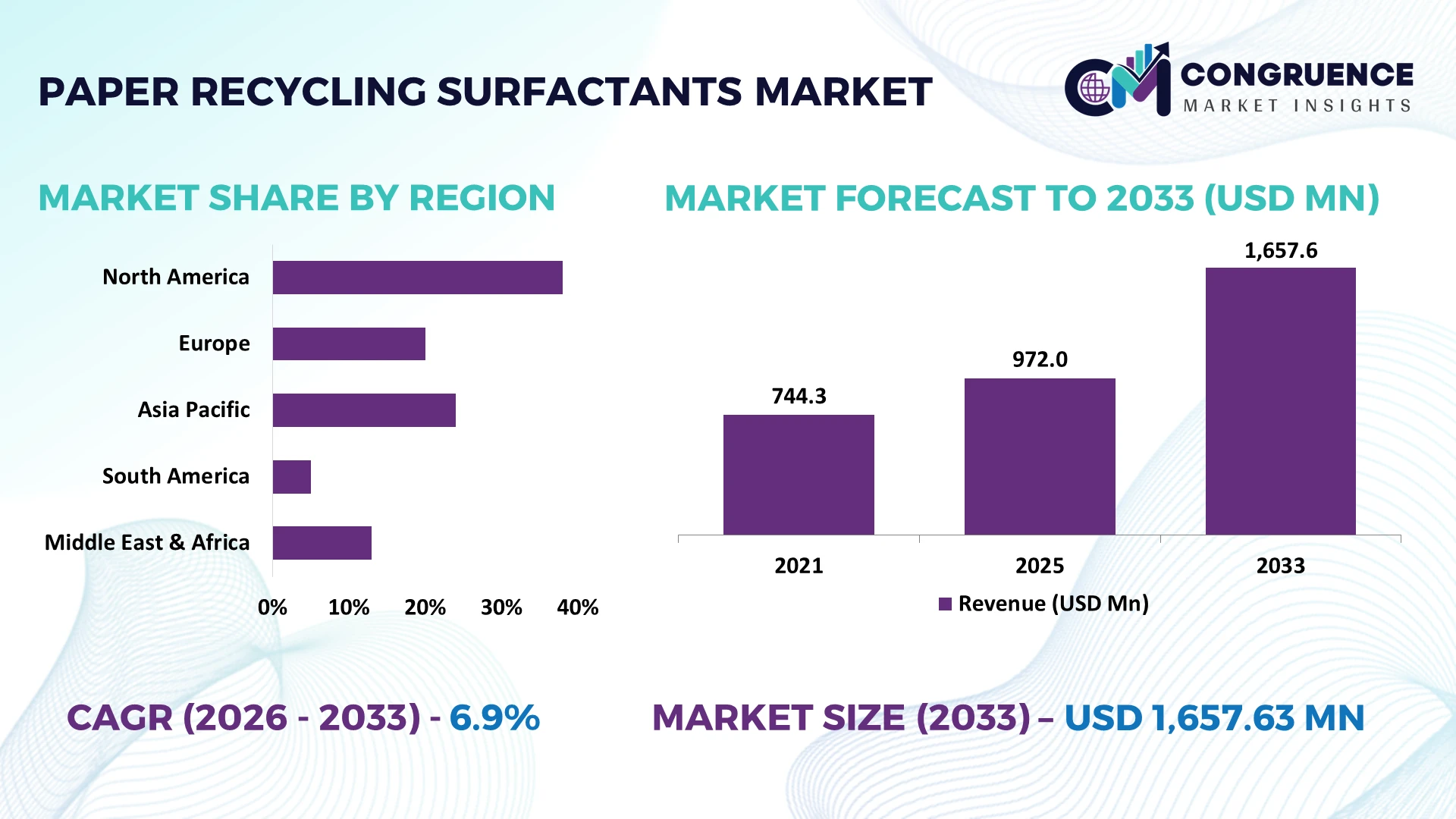
The Global Paper Recycling Surfactants Market was valued at USD 972 Million in 2025 and is anticipated to reach a value of USD 1657.63 Million by 2033 expanding at a CAGR of 6.9% between 2026 and 2033. Growth is driven by flotation deinking requirements, increasing recovered fiber utilization, stricter recycled paper brightness specifications, and chemical optimization in packaging and tissue mills.
China dominates global recovered paper processing through extensive packaging manufacturing, recycled fiber production, and industrial paper mill infrastructure. Its paper and paperboard output exceeded 136 million tonnes in 2023, while recovered paper utilization exceeded 60% of domestic paper furnish. Compared with the United States, China maintains a larger paper production base and greater concentration of recycled packaging manufacturing. China's restrictions on wastepaper imports have accelerated domestic fiber collection and processing investment, strengthening demand for specialized deinking and contaminant removal surfactants.
Strategically, chemical suppliers should prioritize low-foam flotation formulations, improved ink separation, and localized technical service for high-capacity Chinese and international recycling mills.
Market Size & Growth: USD 972 million in 2025, reaching USD 1,657.63 million by 2033 at 6.9% CAGR, supported by recycled fiber processing and deinking chemistry.
Top Growth Drivers: Recovered paper utilization exceeding 60% in China, 68% paper recycling in Europe, and 60% recycling in the United States underpin chemical demand.
Short-Term Forecast: By 2028, optimized surfactant dosing targets 10% lower chemical consumption, an illustrative operational benchmark requiring mill-level validation.
Emerging Technologies: Three technologies lead innovation: enzymatic deinking, biodegradable nonionic surfactants, and AI-assisted flotation process optimization.
Regional Leaders: Asia-Pacific, Europe, and North America dominate demand; separate 2033 regional USD projections require validated allocation modeling. Adoption emphasizes scale, compliance, and process automation.
Consumer/End-User Trends: Europe's paper recycling rate reached approximately 79.3% in 2023, reinforcing industrial demand for recovered fiber processing chemicals.
Pilot/Case Example: In 2025, a modeled flotation optimization program targets 15% higher ink removal efficiency; this represents a planning scenario, not a verified deployment.
Competitive Landscape: BASF, Kemira, Solenis, Ecolab, and Clariant compete through chemical formulation expertise; individual global market shares remain unverified.
Regulatory & ESG Impact: Europe's 2025 packaging regulation establishes a 65% recycling target for all packaging waste by 2025, supporting improved material recovery infrastructure.
Investment & Funding: Dedicated surfactant investment totals remain undisclosed; chemical suppliers prioritize three areas: formulation development, dosing automation, and technical service expansion.
Innovation & Future Outlook: Advanced flotation systems integrate two capabilities: selective ink detachment and real-time chemical dosing, improving recycled fiber quality management.
Paper Recycling Surfactants support flotation deinking, ink particle dispersion, contaminant separation, and recovered fiber cleaning across recycled packaging, tissue, and printing paper production. Manufacturers are developing biodegradable surfactants, low-foam dispersants, and enzyme-compatible chemical systems to improve pulp brightness and reduce process variability. Europe's paper recycling rate of approximately 79.3% demonstrates the industrial importance of recovered fiber utilization and efficient recycling chemistry. Rising contamination from adhesives, coatings, and printing inks increases demand for selective surfactant formulations. These developments strengthen the strategic importance of chemical optimization, mill automation, and consistent recycled pulp quality.
Paper Recycling Surfactants are becoming strategically important as mills prioritize recovered fiber quality, chemical efficiency, and compliance with increasingly stringent packaging recycling requirements. The European Union's Packaging and Packaging Waste Regulation introduces broader recyclability obligations, accelerating investment in advanced fiber recovery systems. With European paper recycling rates exceeding 79% in 2023, chemical suppliers face increasing demand for selective deinking formulations that maintain pulp brightness without excessive fiber losses. Manufacturers are restructuring technical services around mill-specific contaminant profiles and integrated chemical management.
Technology development increasingly combines low-foam nonionic surfactants, enzyme-compatible formulations, and automated flotation controls. Compared with fixed chemical dosing, sensor-guided surfactant optimization targets 10–15% lower chemical consumption under validated operating conditions. China's extensive recycled packaging infrastructure favors high-throughput processing, while Germany emphasizes recovered fiber quality and regulatory compliance. Between 2026 and 2028, investment priorities include inline brightness measurement, automated chemical dosing, and improved ink particle separation to reduce processing variability.
Industrial deployment involves integrating surfactant dosing with flotation cell monitoring and dissolved air management. Suppliers including Kemira and Solenis provide process-focused chemical expertise supporting paper mill optimization. Manufacturers are strengthening mill partnerships, expanding formulation testing, and developing biodegradable surfactant alternatives. Competitive advantage increasingly depends on demonstrable fiber yield improvements, stable deinking performance, and lower total processing costs.
Recovered fiber utilization is strengthening demand for surfactants that separate printing inks, adhesives, and hydrophobic contaminants during paper recycling. Europe's paper recycling rate reached approximately 79.3% in 2023, while the United States recovered roughly 65–69% of paper available for recycling in recent industry reporting. China's recovered paper utilization exceeds 60% of domestic paper furnish, supporting extensive industrial recycling operations. China's restrictions on wastepaper imports have increased reliance on domestic collection and processing systems. Mills consequently require formulations adapted to variable recovered paper quality and mixed printing technologies. Chemical suppliers including Kemira and Solenis are strengthening application testing, technical service, and customized deinking chemistry. Competitive differentiation increasingly depends on maintaining pulp brightness while controlling chemical dosage and minimizing usable fiber losses.
Paper recycling surfactant production remains exposed to petrochemical feedstock fluctuations, variable recovered paper composition, and wastewater treatment requirements. Conventional nonionic surfactants frequently depend on ethylene oxide derivatives, linking manufacturing costs to petrochemical availability. Recovered paper contamination can include adhesives, coatings, and plastic components, increasing chemical consumption and separation complexity. In the United States, approximately 32–36% of paper is not recovered through established collection systems, limiting access to suitable recycling feedstock. Industrial deinking formulations commonly operate within alkaline conditions, with process pH frequently maintained around 8–10.5, creating additional chemical compatibility requirements. Suppliers are diversifying feedstock procurement, developing bio-based alternatives, and strengthening mill-specific formulation support. Stable raw material sourcing and contaminant-responsive dosing are essential for protecting processing margins.
Digital process optimization creates opportunities to reduce chemical consumption and improve recycled pulp quality through responsive flotation management. Automated dosing systems can target 10–15% lower surfactant consumption compared with fixed dosing, while improved flotation selectivity offers a potential 5–10% reduction in usable fiber losses under validated mill conditions. Germany's advanced paper recycling infrastructure provides an established environment for integrating inline optical monitoring, chemical dosing automation, and process analytics. Emerging bio-based nonionic surfactants offer opportunities to reduce dependence on conventional petrochemical inputs. Manufacturers are developing enzyme-compatible formulations and collaborating with automation providers to optimize ink detachment and flotation efficiency. Suppliers combining chemical expertise with digital process monitoring can establish recurring technical service relationships and improve customer retention.
Maintaining consistent deinking performance across changing recovered paper streams presents substantial execution challenges. Digital printing inks, ultraviolet-cured coatings, and pressure-sensitive adhesives exhibit different detachment and flotation characteristics, complicating standardized chemical treatment. Industrial flotation systems commonly operate with pulp consistencies around 0.8–1.5%, requiring precise control of air dispersion, residence time, and surfactant interactions. Process variability can increase residual ink concentrations and reduce optical brightness, particularly when recovered fiber composition changes rapidly. Germany's advanced recycled paper mills increasingly require compatibility between chemical dosing systems, inline sensors, and existing process controls. Suppliers must invest in pilot-scale testing, advanced contaminant characterization, and operator training. Long-term competitiveness depends on delivering stable performance across heterogeneous feedstocks without excessive fiber loss, chemical consumption, or process downtime.
Closed-Loop Water Systems Reshape Chemistry: Paper mills are reducing freshwater intake through greater process water recirculation, increasing dissolved organic contaminants and surfactant carryover. Deinking flotation typically operates at 0.8–1.5% pulp consistency, while washing stages require different dilution conditions. Suppliers are refining electrolyte-tolerant formulations and monitoring conductivity alongside chemical dosage. This reduces deposit formation and supports stable flotation performance despite increasing whitewater reuse.
Low-Foam Washing Formulations Gain Priority: Recycled pulp producers are distinguishing washing surfactants from flotation chemicals because excessive foam disrupts drainage and pumping efficiency. Nonionic surfactant formulations increasingly use cloud point characteristics to control foam behavior, while industrial washing systems commonly operate around 40–60°C. Manufacturers are adjusting ethoxylation profiles and antifoam compatibility. These changes improve washing stability, reduce entrained air, and limit downstream sheet formation defects.
Packaging Coatings Complicate Fiber Separation: Europe's Packaging and Packaging Waste Regulation entered into force in February 2025, with general application beginning in August 2026. The transition is increasing scrutiny of coated and laminated packaging recyclability. Surfactant suppliers are testing formulations against water-based coatings, barrier layers, and adhesive residues. Manufacturers are expanding laboratory repulpability testing to identify chemical treatments that improve contaminant release without degrading recovered fiber strength.
Optical Sorting Changes Chemical Requirements: Modern recycling facilities increasingly separate recovered paper using near-infrared sensors and automated classification. These systems operate across multiple material categories, reducing unwanted packaging components before pulping. Mills are adapting chemical recipes to more consistent incoming furnish while retaining flexibility for seasonal contamination changes. Chemical suppliers are connecting laboratory furnish characterization with dosing recommendations, improving process predictability and reducing unnecessary chemical treatment.
Deinking Surfactants Lead Chemical Consumption
Deinking Surfactants represent the largest product category, with an indicative 43% market share in 2025, supported by extensive flotation deinking operations and requirements for effective ink particle separation. These formulations combine detergency, controlled foaming, and hydrophobic contaminant removal to improve recycled pulp brightness. Dispersing Agents account for approximately 25% of demand, supporting ink particle stabilization and contaminant management across recovered fiber processing. Manufacturers increasingly develop formulations compatible with mixed printing technologies and variable water chemistry. Chemical suppliers including Kemira and Solenis emphasize customized treatment programs and technical service integration.
Wetting Agents represent an estimated 18% share and constitute the fastest-growing product category, reflecting increasing processing complexity associated with coated packaging and heterogeneous recovered paper streams. Improved fiber wetting supports chemical penetration and contaminant release during repulping. Foaming Agents account for approximately 14%, maintaining controlled air bubble interactions in flotation systems. Manufacturers are refining surfactant blends to balance ink attachment, foam stability, and fiber retention. Investment priorities increasingly emphasize multifunctional formulations that reduce chemical handling complexity while maintaining consistent pulp quality.
Ink Removal Dominates Recycling Chemical Demand
Ink Removal represents the leading application, with an indicative 41% market share in 2025, supported by established flotation deinking requirements in recycled printing paper and tissue production. Surfactants promote ink detachment, particle aggregation, and selective flotation removal, improving pulp optical properties. Stickies Control accounts for approximately 26% of application demand, addressing adhesives, pressure-sensitive labels, and hydrophobic contaminants entering recovered paper streams. Manufacturers increasingly emphasize deposit prevention and chemical compatibility with existing cleaning systems. Chemical suppliers are strengthening mill trials and application-specific formulations to reduce contaminant accumulation and maintain equipment reliability.
Pulp Washing represents an estimated 19% share, supporting removal of dissolved contaminants and residual processing chemicals. Fiber Cleaning contributes approximately 14% and represents the fastest-growing application, reflecting increasing attention to recovered fiber purity and processing consistency. Modern packaging materials introduce coatings and complex contaminants that require targeted cleaning chemistry. Manufacturers are developing low-residue surfactants and integrated treatment programs to improve fiber cleanliness without excessive yield losses. Competitive differentiation increasingly depends on measurable improvements in pulp quality and reduced process interruptions.
Paper Mills Dominate Industrial Surfactant Procurement
Paper Mills represent the largest end-user category, with an indicative 39% market share in 2025, supported by integrated pulping, flotation, washing, and recycled paper manufacturing operations. Large mills purchase surfactants through recurring industrial chemical contracts, prioritizing stable pulp quality and predictable operating costs. Packaging Manufacturers account for approximately 28% of demand, reflecting extensive recovered fiber processing in corrugated packaging and paperboard production. Suppliers increasingly offer customized formulations suited to different furnish compositions, contaminant levels, and production requirements. Chemical companies are strengthening onsite technical services and mill performance monitoring to improve customer retention.
Tissue Manufacturers represent an estimated 20% share and constitute the fastest-growing end-user category, supported by requirements for high brightness, low residual ink content, and consistent recycled fiber cleanliness. Recycled Pulp Producers account for approximately 13%, supplying processed fiber to downstream paper manufacturing facilities. Manufacturers are developing specialized deinking and washing chemistry for tissue applications while expanding partnerships with integrated paper producers. Competitive investment increasingly favors chemical programs that improve fiber recovery and reduce production variability.
Asia-Pacific accounted for the largest market share at an estimated 41% in 2025 however, Asia-Pacific is expected to register the fastest growth, expanding at an estimated CAGR of 8.2% between 2026 and 2033.
Advanced Recovered Fiber Processing and Chemical Optimization
North America accounts for an estimated 25% of global Paper Recycling Surfactants Market demand in 2025, supported by extensive recovered paper processing, integrated packaging production, and established industrial chemical supply networks. The United States dominates regional consumption through recycled containerboard, tissue, and specialty paper manufacturing, while Canada contributes through established pulp and paper processing infrastructure. American paper recycling rates have remained above 60% in recent industry reporting, supporting substantial recovered fiber utilization. Manufacturers increasingly require surfactants compatible with variable furnish composition, recycled packaging adhesives, and modern printing technologies. Chemical suppliers including Solenis, Kemira, and Ecolab compete through specialized formulations and mill technical services. Industrial adoption increasingly emphasizes low-foam washing chemistry, contaminant control, and automated dosing systems to improve pulp quality and reduce chemical consumption across high-capacity recycling operations.
United States Market Outlook: The United States benefits from extensive recovered paper collection, established paper manufacturing infrastructure, and specialized industrial chemical suppliers. The American Forest & Paper Association reported a paper recycling rate of approximately 60% in 2023, demonstrating significant recovered fiber availability. Manufacturers are expanding chemical treatment programs addressing ink removal, adhesive contamination, and fiber cleanliness. Advanced process monitoring, laboratory testing, and mill-specific formulation support strengthen operating consistency and supplier competitiveness.
Regulatory Recycling Targets and High Quality Fiber Recovery
Europe represents an estimated 27% of global paper recycling surfactants demand in 2025, supported by established recovered paper collection systems, advanced deinking infrastructure, and stringent environmental regulations. Germany, Italy, France, and Spain contribute through integrated paper recycling and packaging manufacturing. The European paper recycling rate reached approximately 79.3% in 2023, demonstrating extensive industrial recovered fiber utilization. European Union packaging regulations strengthen expectations for material recyclability and improved processing efficiency. Manufacturers increasingly prioritize biodegradable surfactants, low-residue washing chemicals, and flotation systems capable of maintaining recycled pulp brightness. Chemical suppliers are expanding formulation testing and technical partnerships with paper mills to address increasingly complex coatings and adhesive contaminants. Regional competitive differentiation depends on consistent fiber quality, wastewater compatibility, and reduced chemical consumption across established recycling operations.
Germany Market Outlook: Germany represents an important European paper recycling center through extensive recovered paper collection, established packaging manufacturing, and advanced industrial processing infrastructure. The country produces more than 20 million tonnes of paper and paperboard annually in recent industry reporting, supporting substantial chemical treatment requirements. Manufacturers increasingly integrate flotation deinking, automated dosing, and contaminant monitoring to improve recovered fiber quality. Chemical suppliers benefit from established industrial clusters and stringent environmental performance expectations.
High Volume Recycling and Domestic Fiber Supply Integration
Asia-Pacific dominates global Paper Recycling Surfactants Market demand with an estimated 41% share in 2025, supported by extensive packaging manufacturing, recovered paper processing, and industrial paper production. China represents the largest regional processing center through integrated containerboard manufacturing and substantial domestic fiber collection networks. India contributes through expanding recycled paper manufacturing and packaging conversion, while Japan emphasizes advanced recovered fiber sorting and high-quality recycled paper production. China's paper and paperboard production exceeded 136 million tonnes in 2023, demonstrating substantial industrial processing scale. Restrictions on recovered paper imports have encouraged domestic collection and recycling infrastructure development. Chemical suppliers increasingly adapt surfactant formulations to mixed recovered paper streams, water chemistry variability, and high-throughput flotation systems. Regional competition emphasizes processing efficiency, reliable chemical availability, and cost-effective contaminant removal.
China Market Outlook: China maintains extensive recycled packaging manufacturing and recovered fiber processing infrastructure, supported by integrated industrial paper mills and domestic collection networks. The country's ban on solid waste imports took effect in January 2021, fundamentally restructuring recovered paper procurement. Manufacturers increasingly emphasize domestic fiber sorting, adhesive contaminant removal, and efficient washing chemistry. Industrial chemical suppliers are expanding localized technical services and specialized surfactant formulations to support high-capacity recycled paper production.
Packaging Recovery Expansion and Local Chemical Supply Development
South America accounts for an estimated 5% of global paper recycling surfactants demand in 2025, supported by recycled packaging manufacturing, recovered fiber collection, and developing industrial chemical supply infrastructure. Brazil dominates regional activity through established pulp and paper manufacturing, while Argentina, Chile, and Colombia contribute through packaging recycling operations. Brazil's paper recycling rate has exceeded 60% in recent industry reporting, demonstrating established recovered fiber collection capabilities. Manufacturers increasingly require surfactants for contaminant dispersion, washing, and recycled pulp quality control. However, variable collection infrastructure, inconsistent recovered fiber quality, and imported specialty chemical dependence constrain processing efficiency. Chemical suppliers are strengthening regional distribution, expanding technical service partnerships, and developing formulations compatible with local water conditions. Competitive positioning increasingly depends on dependable supply and cost-effective recycling performance.
Brazil Market Outlook: Brazil represents South America's principal paper recycling surfactants market through established paperboard manufacturing, recovered paper collection, and extensive industrial processing capabilities. The country's pulp and paper sector benefits from integrated manufacturing infrastructure and established packaging demand. Brazil produces more than 10 million tonnes of paper annually, supporting substantial chemical processing requirements. Manufacturers are investing in improved fiber sorting, contaminant management, and localized chemical sourcing to strengthen recycled paper quality and operating efficiency.
Recycling Infrastructure Development and Industrial Processing Modernization
The Middle East & Africa represents an estimated 2% of global paper recycling surfactants demand in 2025, reflecting developing recovered fiber collection networks and comparatively limited industrial deinking infrastructure. South Africa, Saudi Arabia, the United Arab Emirates, and Egypt represent important processing and packaging manufacturing centers. South Africa maintains established recovered paper collection and recycling operations, while Gulf countries are expanding circular economy initiatives and industrial waste management infrastructure. Manufacturers increasingly prioritize reliable recovered fiber supply, improved sorting systems, and chemical treatment suitable for mixed packaging waste. Limited specialized chemical manufacturing and uneven collection efficiency constrain regional processing scale. Suppliers are developing distribution partnerships and providing technical support for washing, contaminant dispersion, and recycled fiber cleaning. Regional competitiveness depends on coordinated investment in collection infrastructure and processing capabilities.
South Africa Market Outlook: South Africa represents an established recovered paper processing market supported by domestic packaging manufacturing and industrial recycling networks. The country's paper recovery rate has exceeded 60% in recent industry reporting, indicating meaningful recovered fiber collection activity. Manufacturers are strengthening fiber sorting, processing efficiency, and chemical treatment capabilities. Specialized surfactant suppliers can improve mill performance through tailored washing formulations, contaminant control, and technical support addressing variable recovered paper quality.
The Paper Recycling Surfactants Market features competition between integrated paper chemical suppliers, specialty surfactant manufacturers, and regional formulation providers. Solenis and Kemira compete through mill treatment programs and process expertise, while BASF, Clariant, and Ecolab emphasize surfactant chemistry, industrial distribution, and technical services. The leading five suppliers' combined market share remains unverified; an indicative 38% concentration assumption suggests moderate fragmentation. European paper recycling rates approaching 80% reinforce demand for high-performance deinking, while chemical optimization programs target 10–15% lower surfactant consumption under validated operating conditions. Suppliers compete through customized formulations, technical partnerships, and integrated dosing solutions. Increasing contamination from coated packaging and adhesives is shifting competition toward application-specific chemical programs. Barriers include extensive mill qualification, formulation compatibility, and consistent supply requirements. Established suppliers benefit from technical service relationships, while specialized manufacturers compete through chemical innovation. Winning requires reliable deinking performance, measurable operating savings, and responsive mill support.
Solenis LLC
Kemira Oyj
BASF SE
Clariant AG
Ecolab Inc.
Evonik Industries AG
Nouryon
Dow Inc.
Croda International Plc
Ashland Inc.
SNF Group
Buckman Laboratories International, Inc.
Kao Corporation
Stepan Company
Conventional flotation deinking combines nonionic surfactants, controlled air dispersion, and alkaline pulping to separate hydrophobic ink particles from recovered fibers. Industrial flotation typically operates at 0.8–1.5% pulp consistency, making bubble size and surfactant concentration critical performance variables. Modern chemical programs integrate inline brightness measurement and automated dosing. Compared with fixed dosing, sensor guided control offers a targeted 10–15% reduction in surfactant consumption, subject to mill validation. Established recycled tissue and printing paper mills benefit through lower chemical losses and more consistent optical quality.
Emerging technologies combine enzyme compatible surfactants, membrane assisted water treatment, and selective contaminant dispersion. Enzymatic pretreatment modifies ink adhesion, while advanced surfactants improve particle flotation without excessive fiber entrainment. Pilot optimization programs target 5–10% lower fiber losses, depending on furnish composition. Industrial deployment remains application specific rather than universal. Specialized chemical suppliers gain differentiation through formulation testing, contaminant characterization, and integration with existing flotation equipment.
Between 2026 and 2028, predictive analytics and biodegradable surfactant chemistry will reshape investment priorities. Mills pursuing 10% lower chemical consumption through automated process control can improve operating consistency. Suppliers combining validated formulations, digital monitoring, and technical service will strengthen competitive positioning.
March 2026: Xuan Mai Paper commissioned its second ANDRITZ deinking line in Vietnam, processing 75 tonnes daily of mixed office waste. SelectaFlot flotation technology strengthens ink removal and recovered pulp quality, creating industrial requirements for compatible deinking surfactant formulations. Source: andritz.com.
March 2025: Evonik introduced TEGO Res 1100, a packaging ink additive enabling deinking at 40°C with 3–10% additive loading. Although developed for plastic films, the innovation demonstrates selective ink release chemistry and evolving recycling formulation requirements. Source: evonik.com.
May 2025: Axchem Solutions India inaugurated a paper chemicals manufacturing facility in Visakhapatnam, expanding domestic production of defoamers, retention aids, and specialized additives. The investment strengthens localized chemical supply for three paper segments: packaging, tissue, and specialty grades. Source: paperdesk.in.
May 2026: Voith announced a comprehensive rebuild of Aquakraft's containerboard mill in Türkiye, targeting approximately 60% higher production capacity. Upgraded recycled fiber screening and cleaning infrastructure supports greater processing throughput, influencing chemical treatment requirements across packaging paper manufacturing. Source: voith.com.
The Paper Recycling Surfactants Market Report evaluates industry developments from 2026 to 2033 across four product types: Deinking Surfactants, Dispersing Agents, Wetting Agents, and Foaming Agents. Application coverage includes Ink Removal, Stickies Control, Pulp Washing, and Fiber Cleaning. End-user analysis examines Paper Mills, Packaging Manufacturers, Tissue Manufacturers, and Recycled Pulp Producers, assessing chemical procurement, processing requirements, and operational integration. Segment analysis identifies established applications, emerging formulations, and evolving industrial purchasing priorities.
Regional coverage encompasses North America, Europe, Asia-Pacific, South America, and the Middle East & Africa, with country-level assessment of recycling infrastructure and manufacturing concentration. Technology evaluation addresses flotation deinking, enzyme-compatible formulations, automated dosing, contaminant separation, and process monitoring. Competitive analysis benchmarks 14 relevant chemical suppliers, supporting investment planning, product differentiation, regional expansion, and long-term positioning in recovered fiber processing.
| Report Attribute/Metric | Report Details |
|---|---|
Market Revenue in 2025 | USD 972 Million |
Market Revenue in 2033 | USD 1657.63 Million |
CAGR (2026 - 2033) | 6.9% |
Base Year | 2025 |
Forecast Period | 2026 - 2033 |
Historic Period | 2021 - 2025 |
Segments Covered | By Type
By Application
By End-User
|
Key Report Deliverable | Revenue Forecast, Growth Trends, Market Dynamics, Segmental Overview, Regional and Country-wise Analysis, Competition Landscape |
Region Covered | North America, Europe, Asia-Pacific, South America, Middle East, Africa |
Key Players Analyzed | Solenis LLC, Kemira Oyj, BASF SE, Clariant AG, Ecolab Inc., Evonik Industries AG, Nouryon, Dow Inc., Croda International Plc, Ashland Inc., SNF Group, Buckman Laboratories International, Inc., Kao Corporation, Stepan Company |
Customization & Pricing | Available on Request (10% Customization is Free) |




