
Reports
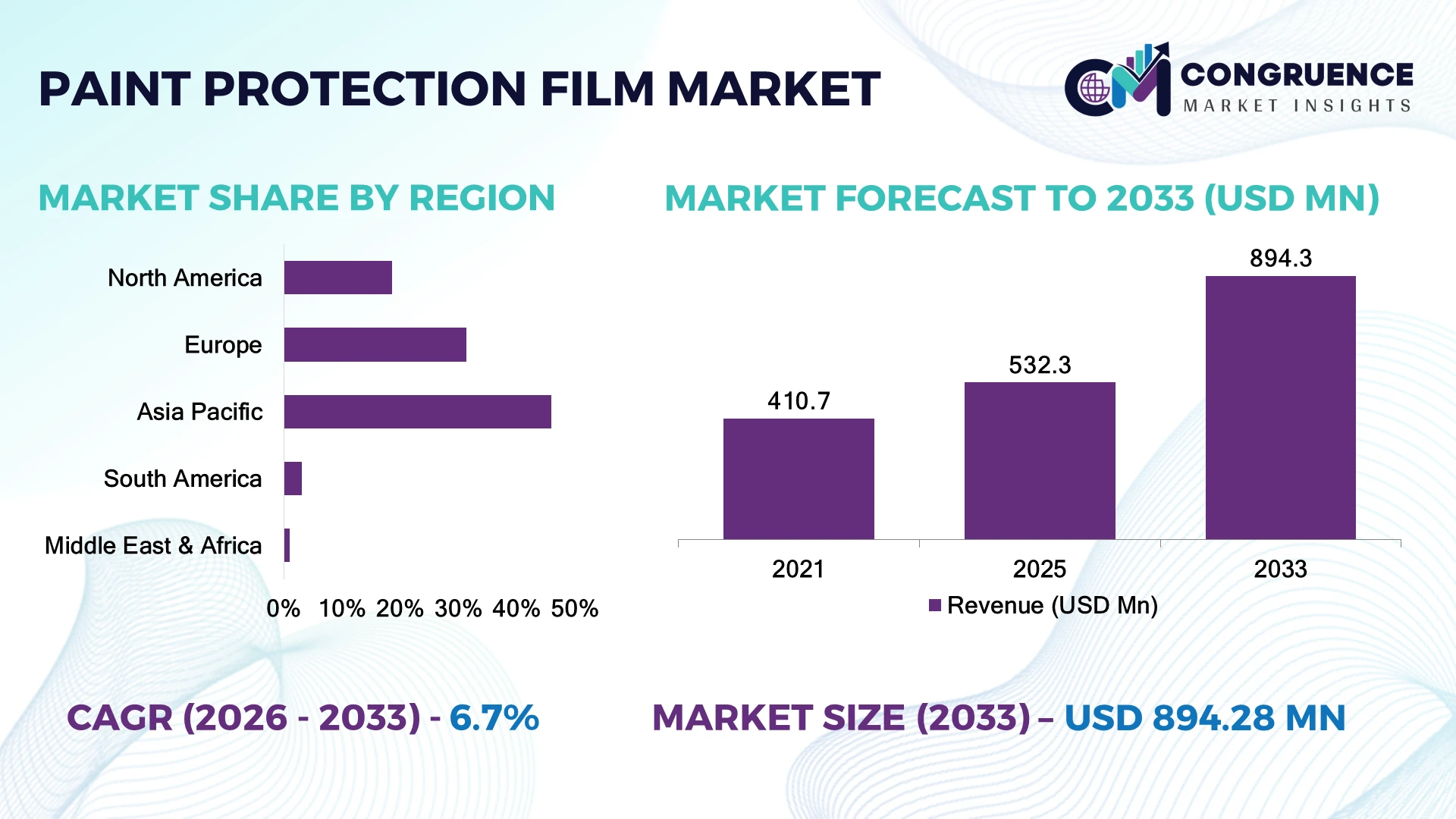
The Global Paint Protection Film Market was valued at USD 532.3 Million in 2025 and is anticipated to reach a value of USD 894.3 Million by 2033 expanding at a CAGR of 6.7% between 2026 and 2033. Growth is driven by the shift toward self-healing polyurethane films, factory-applied protective coatings, premium vehicle customization, and rising replacement of conventional protective solutions with longer-life multilayer films.
China accounted for approximately 31% of global paint protection film consumption in 2025, supported by automotive manufacturing, premium vehicle detailing, and expanding domestic film production capacity. The United States followed with about 24%, driven by luxury vehicles and aftermarket installations. Adoption of self-healing and hydrophobic films reached roughly 38% among premium PPF installations, while India is emerging rapidly as automotive detailing expands. Supply-chain localization across Asia is strengthening production resilience following Red Sea shipping disruptions.
Strategically, manufacturers should prioritize localized production, advanced polyurethane formulations, and installer networks in high-volume automotive markets.
Market Size & Growth: The market reached USD 532.3 million in 2025 and is projected to reach USD 894.3 million by 2033 at a 6.7% CAGR, supported by self-healing and hydrophobic film technologies.
Top Growth Drivers: Premium automotive customization contributes approximately 32%, aftermarket vehicle protection 28%, and self-healing technology adoption 21% to major demand drivers.
Short-Term Forecast: By 2028, installation efficiency is expected to improve by about 15% as pre-cut digital patterns, automated plotters, and standardized installation systems expand.
Emerging Technologies: AI-assisted pattern cutting, multilayer TPU films, and advanced nano-hydrophobic topcoats are reshaping product performance, with premium formulations achieving approximately 30% higher surface durability.
Regional Leaders: Asia Pacific is projected to reach about USD 365 million, North America USD 275 million, and Europe USD 190 million by 2033, with digital installation platforms and premium automotive adoption strengthening demand.
Consumer/End-User Trends: Approximately 38% of premium PPF installations now incorporate self-healing or hydrophobic characteristics, reflecting greater preference for low-maintenance exterior protection.
Pilot/Case Example: A 2025 automated cutting and installation initiative reduced material wastage by approximately 18%, demonstrating how digital pattern libraries can improve installer productivity and product utilization.
Competitive Landscape: Leading manufacturers collectively control an estimated 35% of the market, with 3M, XPEL, Eastman, Avery Dennison, and Saint-Gobain competing through film clarity, durability, warranty coverage, and installer networks.
Regulatory & ESG Impact: Greater emphasis on solvent reduction and recyclable packaging is reducing process-related material waste by approximately 10% across newer production systems.
Investment & Funding: Industry investment is estimated at more than USD 250 million across capacity expansion, polyurethane development, distribution partnerships, and automated converting technologies.
Innovation & Future Outlook: Next-generation films combining self-healing, hydrophobicity, stain resistance, and enhanced optical clarity are shifting competition from basic protection toward premium multifunctional surface technologies.
Paint Protection Film is increasingly concentrated in premium automotive detailing, electric vehicles, luxury fleets, and high-value aftermarket applications. Self-healing polyurethane structures now represent around 38% of premium installations, while digital pattern libraries are reducing installation waste and improving consistency. Manufacturers are therefore moving toward integrated material-plus-installation ecosystems, creating a stronger strategic focus on technology differentiation and installer capability.
Paint Protection Film is becoming strategically important as automakers, detailing networks, and vehicle owners prioritize exterior durability, residual value, and premium customization. The transition toward polyurethane-based multilayer structures is reshaping product competition, while supply-chain restructuring is encouraging manufacturers to diversify resin sourcing and increase localized converting capacity. China and the United States remain major demand centers, while India is strengthening its position through expanding automotive detailing infrastructure.
Advanced TPU films provide measurable advantages over conventional PVC protection systems, including approximately 20–30% greater flexibility and improved resistance to yellowing, while digitally generated cutting patterns can reduce material waste by roughly 15–18%. These improvements directly support installer profitability and reduce rework.
Over the next 2–3 years, automated pattern libraries, EV-focused protection packages, and premium hydrophobic finishes are positioned to increase professional installation penetration. In the United States, partnerships between film manufacturers and certified installer networks are strengthening market coverage, while Indian distributors are expanding training and localized service capabilities. Competitive positioning will increasingly depend on film chemistry, installation precision, supply reliability, and ecosystem partnerships rather than product availability alone.
Premium vehicle ownership and rising customization are strengthening demand for advanced PPF, particularly in the United States, China, Germany, and the United Arab Emirates. Approximately 32% of demand is linked to premium automotive applications, while self-healing films account for nearly 38% of high-end installations. EV owners are also increasing protection spending because large body panels and high-gloss finishes emphasize surface damage. Manufacturers are responding with multilayer TPU structures, hydrophobic topcoats, and certified installer programs. The operational effect is significant: digital pattern systems can reduce material waste by approximately 15%, improving installer margins. The non-obvious shift is that PPF is increasingly positioned as a vehicle-value preservation solution rather than simply an aftermarket accessory.
Raw-material exposure remains a structural constraint because polyurethane chemistry, specialty adhesives, release liners, and optical-grade coatings influence overall production economics. Material costs can represent roughly 45–55% of manufacturing expenditure for premium films, while currency and freight fluctuations can add 8–12% to delivered costs in import-dependent markets such as India. Red Sea shipping disruptions have also reinforced the importance of shorter supply routes and regional inventories. Manufacturers are responding through multi-supplier procurement, localized converting, longer-term resin contracts, and selective vertical integration. The key operational issue is margin protection: premium positioning cannot fully offset unstable input costs when installers and distributors resist frequent price adjustments.
Digital pattern libraries and automated cutting represent an underexploited opportunity for manufacturers seeking recurring revenue beyond film sales. Automated plotters can reduce cutting-related material waste by approximately 15–18%, while standardized digital templates can shorten installation preparation time by nearly 20%. India, the United Arab Emirates, and Southeast Asian automotive hubs offer particularly attractive opportunities as professional detailing networks expand. Manufacturers are increasingly combining film subscriptions, software platforms, installer certification, and technical training into integrated ecosystems. AI-assisted pattern generation is the next strategic step, enabling faster vehicle-model onboarding and more consistent coverage. Companies that control both film technology and installer workflow can capture greater value per vehicle while reducing dependence on commodity film pricing.
Scaling professional installation remains difficult because PPF performance depends heavily on surface preparation, environmental conditions, installer skill, and pattern accuracy. Labor can account for more than 40% of the final customer price in premium installations, while inexperienced application can increase rework rates by 10–15%. EV model proliferation further complicates template management because manufacturers introduce new body designs at shorter intervals. Companies must therefore invest in installer certification, automated pattern systems, quality-control protocols, and technical partnerships. A less visible challenge is digital template accuracy: even a small dimensional mismatch can create wrinkles, exposed edges, or excessive trimming. Long-term competitiveness will depend on connecting advanced film chemistry with standardized, digitally controlled installation processes.
TPU Films Gain Premium Preference: Thermoplastic polyurethane films now command more than 80% of the market in several industry estimates, reflecting stronger flexibility, optical clarity, self-healing, and weather resistance than PVC. Premium installers are increasingly shifting toward multilayer TPU structures, while manufacturers are expanding high-clarity and hydrophobic grades. The non-obvious shift is the growing use of TPU as a long-term vehicle-value preservation layer rather than a basic scratch barrier.
Digital Cutting Reshapes Installation: Automated plotters, cloud-based pattern libraries, and vehicle-specific digital templates are changing installation workflows, with material waste reductions of roughly 15–18% and preparation-time improvements approaching 20%. U.S. and Indian detailing networks are increasingly integrating software with installer operations. Companies are responding through certified installer programs and proprietary template ecosystems, shifting competition toward workflow control rather than film specifications alone.
EV Protection Packages Expand: Electric vehicles are creating new PPF configurations around large body panels, charging-port areas, gloss-black trim, and sensor-adjacent surfaces. EV-related demand is strengthening alongside rapid vehicle electrification, with global electric commercial-vehicle sales exceeding 500,000 units in 2025. Manufacturers are developing thinner, conformable films and model-specific kits, while China and India are expanding specialized EV detailing capacity.
Localized Supply Chains Accelerate: Resin availability, freight volatility, and trade-policy changes are pushing producers toward regional sourcing and localized converting. India’s PPF import market recorded a 25.57% year-on-year increase in 2024, reinforcing the need for stronger domestic distribution and inventory capabilities. Manufacturers are responding with supplier diversification, regional warehouses, and local partnerships, while automotive hubs increasingly favor shorter replenishment cycles and reduced import dependency.
Thermoplastic polyurethane (TPU) is the leading type, accounting for approximately 83% of the global market in 2025 in one major industry estimate. Its dominance reflects superior flexibility, optical clarity, impact resistance, self-healing behavior, and resistance to yellowing. PVC remains strategically relevant in price-sensitive aftermarket channels because its lower material cost supports basic scratch and abrasion protection. However, PVC’s shorter service life and greater rigidity limit penetration into premium applications. Companies are therefore directing a larger share of formulation and coating investment toward high-performance TPU grades, particularly for luxury vehicles and EVs.
TPU is also the fastest-growing type as buyers increasingly prioritize durability over initial purchase price. Premium TPU products with hydrophobic and self-healing topcoats can command higher installation values, while advanced formulations improve conformability on complex body panels. PVC retains approximately 10–15% share across broader market estimates, while other materials remain niche. In India, TPU represented approximately 89.4% of the market in 2025, demonstrating especially strong premium-material penetration.
Automotive & transportation is the leading application, representing approximately 74% of global demand in 2025. The concentration reflects extensive use across passenger cars, SUVs, luxury vehicles, commercial fleets, and aftermarket detailing. Electrical & electronics and aerospace & defense represent smaller but technically demanding applications, where optical clarity, abrasion resistance, and dimensional stability are more important than high-volume installation. Companies are increasingly tailoring film thickness, adhesive systems, and surface finishes to specific application requirements.
Aerospace & defense is emerging as a faster-developing specialist application, supported by aircraft surface protection and expanding aerospace activity in countries including India, the United States, and the United Kingdom. Automotive remains substantially larger, but aerospace projects can generate higher-value technical specifications and longer qualification cycles. Electrical & electronics is also gaining relevance as manufacturers seek protective layers for sensitive finished surfaces. Companies are responding by developing specialty films and application-specific adhesive systems rather than relying on standardized automotive grades.
Automotive is the dominant end-user group, accounting for more than 79% of paint protection film demand in 2025 under an industry end-use assessment. Passenger and luxury vehicles generate the strongest purchasing intensity because owners prioritize paint preservation, appearance, and resale value. Aerospace represents a smaller but technically sophisticated buyer group, while other industrial users remain specialized. Manufacturers are targeting automotive buyers through pre-cut kits, hydrophobic finishes, extended warranties, and installer certification rather than competing solely on film price.
Within automotive purchasing, aftermarket channels remain central, but OEM integration is becoming increasingly important as manufacturers seek factory-level surface protection. Premium aftermarket buyers generally favor TPU, whereas cost-sensitive customers continue to use PVC-based solutions. Aerospace and specialized industrial buyers place greater emphasis on qualification, surface compatibility, and environmental durability. Companies are consequently adopting differentiated pricing and product portfolios, with premium TPU positioned for high-value vehicles and specialized grades developed for technically demanding applications. The strategic shift is toward segment-specific product engineering rather than one-film-fits-all distribution.
Asia-Pacific accounted for the largest market share at 45.9% in 2025 however, Europe is expected to register the fastest growth, expanding at a CAGR of 6.2% between 2026 and 2033.
North America accounted for approximately 18.6% of the global Paint Protection Film Market in 2025, with the United States representing the dominant country market. Demand is concentrated across luxury vehicles, SUVs, EVs, dealership protection programs, and professional detailing networks. The region benefits from mature installer infrastructure and strong adoption of high-performance TPU films. U.S. automotive manufacturing and aftermarket spending continue to support premium PPF deployment, while digital pattern systems improve installation precision and material utilization. Manufacturers are strengthening certified-installer networks, expanding pre-cut vehicle templates, and developing self-healing and hydrophobic formulations. The region's operational advantage is its established service ecosystem, which allows premium film technologies to move rapidly from product development into commercial installation.
United States Market Outlook: The United States remains the principal North American market, supported by a large vehicle parc, premium-car ownership, established detailing businesses, and strong OEM infrastructure. The country accounted for the largest national share in the region, while automotive manufacturing contributes approximately 3% of U.S. GDP, reinforcing the depth of its vehicle-related industrial ecosystem.
Europe accounted for approximately 31.4% of the global Paint Protection Film Market in 2025, making it the second-largest regional market. Germany, the United Kingdom, France, Italy, and Spain form the principal demand centers, supported by premium automotive manufacturing and established aftermarket detailing. The European automotive sector represents more than 7% of EU GDP, providing a substantial industrial base for vehicle protection technologies. High labor costs are also encouraging digital cutting and pre-patterned installation systems that reduce trimming and rework. Manufacturers are emphasizing TPU formulations, low-waste application processes, and partnerships with premium automotive service networks. Environmental requirements surrounding coatings and solvents are further strengthening the commercial positioning of film-based protection solutions.
Germany Market Outlook: Germany is the region's leading country market, supported by its concentration of premium automotive manufacturers, component suppliers, dealerships, and specialist detailing operators. Germany's 2025 PPF market was approximately USD 65.3 million, making it the largest national market within Europe and an important base for premium film technologies and OEM-oriented partnerships.
Asia-Pacific accounted for approximately 45.9% of the global Paint Protection Film Market in 2025, making it the largest regional market. China represents the dominant country market, while Japan, India, and South Korea provide additional demand through automotive manufacturing, premium vehicle ownership, and advanced detailing services. The region's 2025 market value reached approximately USD 290.5 million. China benefits from extensive vehicle production and domestic film manufacturing, while India is developing rapidly through professional detailing networks. Manufacturers are increasing regional production, distributor coverage, and installer training while prioritizing TPU, self-healing, and hydrophobic technologies. The region's scale advantage is reinforced by shorter supply chains and proximity to major automotive production hubs.
China Market Outlook: China is the strategically dominant country within Asia-Pacific, supported by extensive automotive manufacturing, a large domestic vehicle market, and a substantial specialty-film production ecosystem. China's 2025 PPF market was approximately USD 172.6 million, exceeding the individual markets of Japan and India and providing manufacturers with significant scale for localized production and distribution.
South America accounted for approximately 3.1% of the global Paint Protection Film Market in 2025, with Brazil representing the principal demand center. Automotive aftermarket activity is concentrated in major metropolitan areas where premium vehicles, SUVs, imported models, and professional detailing services support PPF adoption. Brazil's established automotive manufacturing ecosystem provides a stronger foundation than smaller neighboring markets, while Mexico-linked supply channels and international film distributors improve product availability. However, currency volatility and dependence on imported advanced films continue to influence pricing and inventory planning. Manufacturers are responding through distributor partnerships, localized warehousing, installer training, and broader portfolios spanning value-oriented and premium TPU products. The region's strategic opportunity is concentrated in professional installation capacity rather than broad retail distribution.
Brazil Market Outlook: Brazil is the most strategically significant South American market because of its large automotive base, established aftermarket service network, and concentration of vehicle-detailing businesses. The country accounted for a substantial portion of regional demand in 2025, while premium vehicle owners increasingly favor TPU-based films. Expanding installer certification and regional inventory can improve access to higher-value PPF applications.
Middle East & Africa accounted for approximately 1.0% of the global Paint Protection Film Market in 2025, with the United Arab Emirates and Saudi Arabia serving as the principal demand hubs. Dubai and Riyadh have dense automotive customization and detailing ecosystems supported by premium and luxury vehicle ownership. Extreme heat, UV exposure, dust, and sand increase the practical importance of abrasion resistance, hydrophobic surfaces, and durable adhesive systems. Premium TPU films therefore command stronger positioning than basic protective materials. Manufacturers are expanding distributor partnerships, regional inventory, installer certification, and premium product portfolios. The region remains heavily dependent on imported specialty films, making inventory localization and reliable logistics increasingly important for maintaining installation availability and controlling lead times.
United Arab Emirates Market Outlook: The United Arab Emirates is the leading country market in the region, supported by Dubai's luxury automotive ecosystem and extensive professional detailing infrastructure. The country's high-value vehicle concentration supports premium PPF packages, particularly self-healing and hydrophobic TPU films. Manufacturers and distributors are increasingly emphasizing rapid installation, certified technicians, and localized inventory to serve high-frequency customization demand.
XPEL competes with 3M, Eastman, Avery Dennison, and Saint-Gobain in the top tier, while regional film producers and specialty brands compete on price and localized distribution. The top five players collectively control 64% of the market, creating a moderately concentrated structure. Competition centers on TPU chemistry, self-healing performance, optical clarity, installation speed, pattern software, warranty coverage, and supply reliability. Films command 20–30% higher pricing than basic alternatives, while digital pattern systems can reduce material waste by 15–18%. XPEL is strengthening vertical integration and OEM relationships; Avery Dennison is expanding color and dry-apply PPF; Eastman emphasizes film chemistry and pattern infrastructure; 3M leverages scale and OEM reach. The competitive shift is moving from film-only differentiation toward integrated ecosystems combining materials, software, training, and installer networks. Entry barriers include formulation expertise, pattern databases, certification networks, and manufacturing scale. Winning requires superior film performance, reliable supply, installer productivity, and OEM and aftermarket partnerships.
3M Company
XPEL, Inc.
Eastman Chemical Company
Avery Dennison Corporation
Saint-Gobain S.A.
RENOLIT SE
HEXIS S.A.S.
ORAFOL Europe GmbH
STEK Automotive
Garware Hi-Tech Films Limited
SWM International
Madico, Inc.
Thermoplastic polyurethane (TPU) remains the core technology, replacing older PVC constructions across premium PPF because of superior flexibility, optical clarity, impact resistance, and self-healing capability. Advanced TPU films can deliver roughly 20–30% better conformability and durability than legacy PVC, while hydrophobic topcoats improve stain resistance and cleaning performance by about 15%. Adoption is strongest in premium automotive installations across luxury vehicles, EVs, and high-value aftermarket programs, where TPU represents more than 80% of material demand.
Digital installation technology is becoming equally important. Computer-controlled plotters, cloud pattern libraries, and installer software reduce trimming waste by approximately 15–18% and shorten preparation workflows by nearly 20%. Eastman, XPEL, and 3M increasingly integrate pre-cut patterns with professional installation systems, creating productivity advantages for certified shops. AI-assisted pattern generation is emerging as the next step, particularly for rapidly expanding EV model portfolios.
From 2026–2028, color PPF, dry-apply films, advanced self-healing topcoats, and digitally managed installation ecosystems will reshape competition. Avery Dennison’s dry-apply and color-film development illustrates the shift toward faster application and personalization. Manufacturers with proprietary pattern databases, formulation expertise, and installer networks will benefit most, while traditional film-only suppliers face pressure to add software, training, and service capabilities globally.
February 2025: XPEL and Rivian expanded their collaboration, enabling R1T and R1S owners in the United States and Canada to order ULTIMATE PLUS or STEALTH PPF online. Program offers a 5-year/60,000-mile warranty, strengthening OEM-linked aftermarket access and installation coordination. Source: XPEL.com
October 2025: Avery Dennison launched Neo Matte Black PPF, adding an 8.5-mil polyurethane film with self-healing and hydrophobic properties to its color portfolio. The product carries a 7-year warranty, expanding customization options while reinforcing Avery’s premium wet-apply protection positioning. Source: AveryDennison.com
June 2025: Eastman and Covr Group reached a settlement over intellectual-property claims involving PPF cutting patterns. Covr agreed not to infringe Eastman’s rights, reinforcing control over digital pattern assets as Eastman serves customers across 100+ countries and strengthens pattern-led differentiation. Source: Eastman.com
March 2024: 3M issued its Series 150 Gloss PPF technical bulletin, specifying self-healing technology, optimized adhesive, and a 10-year consumer warranty. The updated product positioning strengthens durability credentials and supports faster, more consistent installation through flexible construction and repositionable adhesive. Source: 3M.com
The report covers the global Paint Protection Film market across TPU, PVC, and other film constructions, with detailed assessment of automotive & transportation, electrical & electronics, aerospace & defense, and other specialized applications. End-user analysis evaluates automotive, aerospace, and other commercial or industrial buyers, while regional coverage spans North America, Europe, Asia-Pacific, South America, and Middle East & Africa. The scope also tracks premium, color, matte, hydrophobic, self-healing, and digitally patterned PPF technologies.
The analysis evaluates adoption patterns, installer networks, OEM integration, supply-chain localization, material innovation, digital cutting platforms, and emerging EV-focused protection requirements. Company profiling covers leading global manufacturers and specialist suppliers, supporting benchmarking of product positioning and competitive capabilities. The report provides decision-oriented insights for investment planning, market-entry assessment, manufacturing expansion, partnerships, channel development, and competitive positioning from 2026 through 2033, with emphasis on technology transitions and regional deployment priorities.
| Report Attribute / Metric | Details |
|---|---|
| Market Revenue (2025) | USD 532.3 Million |
| Market Revenue (2033) | USD 894.3 Million |
| CAGR (2026–2033) | 6.7% |
| Base Year | 2025 |
| Forecast Period | 2026–2033 |
| Historic Period | 2021–2025 |
| Segments Covered |
By Type
By Application
By End-User
|
| Key Deliverables | Revenue Forecast; Market Trends; Growth Drivers & Restraints; Technology Insights; Segmentation Analysis; Regional Insights; Competitive Landscape; Regulatory & ESG Overview; Recent Developments |
| Regions Covered | North America; Europe; Asia-Pacific; South America; Middle East & Africa |
| Companies Profiled | 3M Company; XPEL, Inc.; Eastman Chemical Company; Avery Dennison Corporation; Saint-Gobain S.A.; RENOLIT SE; HEXIS S.A.S.; ORAFOL Europe GmbH; STEK Automotive; Garware Hi-Tech Films Limited; SWM International; Madico, Inc. |
| Customization & Pricing | Available on Request (10% Customization Free) |




