
Reports
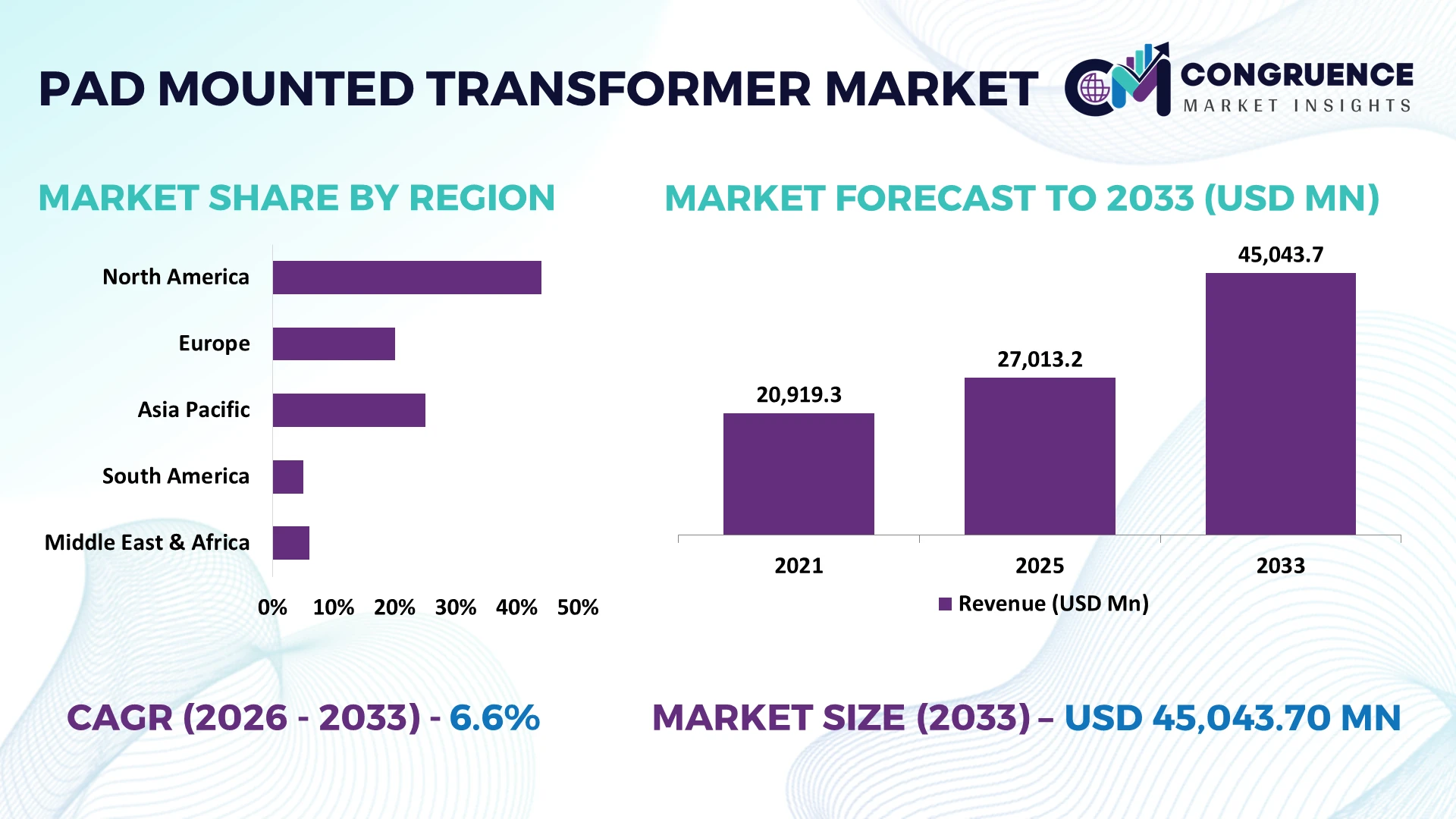
The Global Pad Mounted Transformer Market was valued at USD 27013.22 Million in 2025 and is anticipated to reach a value of USD 45043.7 Million by 2033 expanding at a CAGR of 6.6% between 2026 and 2033. Growth is driven by underground distribution network expansion, replacement of aging utility transformers, data center electrification, and higher-capacity distribution equipment required for renewable energy integration.
The United States is a major market for pad mounted transformers, supported by extensive underground distribution infrastructure and utility replacement programs. Approximately 55% of US distribution transformers are over 33 years old, creating substantial replacement requirements. The Department of Energy's 2024 transformer efficiency regulations target approximately 10% lower energy losses in newly regulated equipment compared with existing standards. Compared with India, where overhead distribution networks remain prevalent, US utilities deploy more ground-level enclosed transformers across suburban, commercial, and industrial developments. Domestic manufacturing investment is strengthening supply security.
Utilities and equipment manufacturers prioritizing domestic production, standardized transformer specifications, and lower-loss distribution designs will secure stronger positions in grid modernization procurement.
Market Size & Growth: USD 27,013.22 million in 2025, reaching USD 45,043.7 million by 2033 at 6.6% CAGR, driven by underground distribution modernization.
Top Growth Drivers: Approximately 55% of US distribution transformers exceed 33 years; replacement, electrification, and weather resilience drive procurement.
Short-Term Forecast: By 2029, revised US efficiency standards target approximately 10% energy savings across regulated distribution transformer shipments.
Emerging Technologies: Three innovations—amorphous-metal cores, digital condition monitoring, and biodegradable insulating fluids—reshape transformer design and maintenance.
Regional Leaders: North America, Asia-Pacific, and Europe anchor three major procurement centers; underground networks, urban electrification, and efficiency upgrades shape adoption.
Consumer/End-User Trends: US utilities operate within an installed base of approximately 60–80 million distribution transformers, prioritizing aging-asset replacement.
Pilot/Case Example: In 2025, Eaton announced a $340 million South Carolina transformer facility, targeting production from 2027 and approximately 700 jobs.
Competitive Landscape: Eaton, Hitachi Energy, Schneider Electric, Siemens Energy, and GE Vernova compete through manufacturing capacity, equipment specifications, and delivery reliability.
Regulatory & ESG Impact: Updated US efficiency standards are projected to avoid approximately 85 million metric tons of carbon emissions over 30 years.
Investment & Funding: Hitachi announced approximately $1.5 billion in US manufacturing commitments by September 2026, strengthening domestic transformer supply chains.
Innovation & Future Outlook: The 2029 efficiency compliance deadline accelerates low-loss core adoption, while digital monitoring supports condition-based maintenance and improved asset utilization.
The pad mounted transformer industry is undergoing a procurement shift as utilities replace aging distribution assets while accommodating data centers, electric vehicle charging, and distributed energy resources. Ground-level, tamper-resistant enclosures support underground electricity networks across residential developments, commercial campuses, and industrial facilities. Approximately 55% of installed US distribution transformers exceed 33 years of age, creating substantial replacement pressure. Meanwhile, manufacturing expansions by Eaton and Hitachi Energy address equipment availability and domestic supply-chain requirements. The transition toward lower-loss transformer cores and monitored distribution assets establishes a stronger basis for evaluating supplier competitiveness, investment priorities, and grid infrastructure modernization.
Pad mounted transformers are becoming strategically important as electricity distributors restructure procurement around grid resilience, equipment availability, and rising distribution capacity requirements. The United States faces substantial infrastructure renewal pressure, with approximately 55% of distribution transformers exceeding 33 years of service. Domestic manufacturing expansion is reducing dependence on extended international supply chains, while revised federal efficiency requirements are influencing transformer core selection and equipment specifications. Utilities increasingly prioritize standardized, readily serviceable units that support underground distribution networks.
Technology differentiation is shifting toward lower-loss magnetic cores and digital condition monitoring. Amorphous-metal transformer cores can reduce no-load losses by approximately 60–70% compared with conventional silicon-steel designs, improving lifetime operating efficiency. North American utilities emphasize replacement programs and localized equipment supply, whereas European operators prioritize compact installations and environmental compliance. In India, underground distribution expansion remains concentrated in urban redevelopment and critical infrastructure projects, creating different equipment deployment economics.
Between 2026 and 2028, manufacturers will expand production capacity, improve insulation technologies, and introduce monitoring-enabled distribution transformers. Eaton's planned South Carolina facility, targeting production in 2027, illustrates the shift toward domestic manufacturing. Hitachi Energy and Schneider Electric are strengthening transformer engineering and supply-chain capabilities. Competitive advantage will depend on reliable delivery, lower lifetime losses, and equipment compatibility with increasingly complex distribution networks.
Replacement of aging distribution infrastructure is accelerating procurement of pad mounted transformers across US utility networks. Approximately 55% of installed distribution transformers exceed 33 years of age, increasing replacement exposure and maintenance requirements. The US Department of Energy's updated efficiency standards are expected to deliver approximately 10% energy savings across newly regulated distribution transformer equipment, reinforcing demand for advanced magnetic core designs. Underground distribution systems are expanding across suburban developments, commercial facilities, and critical infrastructure installations. Eaton announced a $340 million manufacturing facility in South Carolina, with production targeted for 2027. Manufacturers are increasing domestic production and optimizing transformer configurations to shorten procurement cycles. Standardized equipment designs strengthen utility inventory management and accelerate replacement deployment.
Pad mounted transformer manufacturing remains constrained by specialized electrical steel availability, copper requirements, and concentrated component supply chains. The United States relies on imported grain-oriented electrical steel for a substantial portion of domestic demand, exposing manufacturers to international trade policies and procurement volatility. Copper accounts for a significant share of transformer material costs, creating sensitivity to global metal prices. The US Department of Energy's revised standards establish approximately 10% expected energy savings, increasing requirements for optimized magnetic materials and manufacturing processes. Domestic manufacturers face competition for electrical steel, insulating fluids, and specialized winding components. Eaton, Hitachi Energy, and other suppliers are strengthening procurement contracts and manufacturing localization. Securing qualified core materials and predictable component delivery remains essential for maintaining production schedules and equipment affordability.
Distributed energy resources and advanced monitoring technologies are creating new opportunities for pad mounted transformer manufacturers. Solar photovoltaic generation accounted for approximately 7% of global electricity production in 2024, increasing distribution network requirements for bidirectional power management. Electric vehicles represented more than 20% of worldwide car sales during the same year, expanding localized electricity demand around charging infrastructure. Advanced transformer monitoring systems integrate temperature sensors, load measurement, and predictive analytics to identify abnormal operating conditions before equipment failure. In the United States, commercial charging installations and distributed solar projects require coordinated distribution equipment upgrades. Schneider Electric, Hitachi Energy, and Eaton are advancing digital power management capabilities. Manufacturers combining conventional transformer reliability with monitoring-enabled services gain opportunities in lifecycle maintenance and utility asset optimization.
Increasingly variable distribution loads create technical challenges for pad mounted transformer deployment and long-term reliability. Electric vehicle charging and distributed generation introduce reverse power flows, rapid loading changes, and localized voltage fluctuations. Advanced distribution systems must maintain voltage quality within operational limits, commonly around ±5% under utility service requirements. Transformer thermal performance also becomes critical as loading approaches or exceeds rated capacity during concentrated charging periods. The US Department of Energy's 2029 efficiency compliance timeline adds engineering and qualification requirements during equipment redesign. Manufacturers must validate insulation performance, protective coordination, and monitoring-system interoperability across diverse utility networks. Eaton, Siemens Energy, and Hitachi Energy are strengthening digital engineering and equipment testing capabilities. Reliable deployment requires integrated thermal design, protection coordination, and utility-specific field validation rather than transformer capacity expansion alone.
Factory Automation Accelerates Transformer Production: US manufacturers are expanding automated winding, core assembly, and electrical testing to address skilled labor shortages. Eaton's planned South Carolina facility represents a $340 million investment and approximately 700 manufacturing jobs. Production scheduled for 2027 reflects a shift toward standardized assembly processes. Automated testing improves manufacturing consistency, while integrated production planning reduces scheduling bottlenecks for utility orders.
Natural Ester Fluids Gain Procurement Attention: Transformer suppliers are introducing biodegradable insulating fluids for installations requiring enhanced environmental protection. Natural ester fluids commonly exhibit fire points above 300°C, compared with approximately 160°C for conventional mineral oil. Their higher fire resistance supports installation near buildings and sensitive infrastructure. Manufacturers are developing ester-compatible sealing systems and insulation designs, allowing utilities to evaluate fire safety alongside lifecycle maintenance requirements.
Utility Procurement Shifts Toward Standardization: Distribution operators are consolidating transformer specifications to improve interchangeability and reduce equipment inventory complexity. The US electricity system contains an estimated 60–80 million distribution transformers, creating substantial maintenance coordination requirements. Manufacturers are aligning enclosure dimensions, voltage configurations, and protection accessories with utility purchasing frameworks. Standardized specifications support repeatable manufacturing and simplify field replacement, although customized installations still require application-specific engineering.
Compact Enclosures Support Space-Constrained Installations: Urban utilities are prioritizing transformer designs with reduced footprints, improved cable access, and tamper-resistant construction. Common pad mounted transformer configurations include 15 kV and 25 kV voltage classes, supporting varied underground distribution requirements. Manufacturers are refining compartment layouts and cooling arrangements to improve installation accessibility. Compact designs strengthen deployment flexibility across commercial campuses, transportation facilities, and densely developed residential locations.
Liquid-Filled transformers hold a leading position in pad mounted transformer installations because their insulating fluids provide effective heat dissipation, electrical insulation, and dependable performance under sustained distribution loads. Mineral-oil and ester-filled designs support outdoor utility applications, including residential feeders and commercial distribution networks. Liquid-Filled equipment commonly operates at efficiencies exceeding 98%, depending on capacity and loading conditions. Dry-Type transformers serve installations requiring alternative insulation arrangements, particularly where fluid containment or environmental restrictions influence equipment selection. Manufacturers are developing improved cooling systems and insulation materials to strengthen product suitability across demanding operating environments.
Three-Phase transformers are positioned for accelerated adoption as commercial facilities, industrial operations, and high-capacity distribution connections require balanced power delivery. Single-Phase units remain essential for residential distribution and smaller electricity loads. Three-Phase configurations commonly serve 480 V secondary distribution systems, while Single-Phase equipment frequently supports 120/240 V residential service. Eaton, Hitachi Energy, and Schneider Electric are expanding configurable transformer portfolios, emphasizing manufacturing efficiency, equipment reliability, and application-specific electrical specifications.
Utilities represent the leading application for pad mounted transformers because electricity distributors operate extensive underground feeder networks and manage recurring equipment replacement requirements. Distribution operators prioritize standardized transformer configurations, protection coordination, and predictable equipment availability. The United States operates an estimated 60–80 million distribution transformers across its electricity infrastructure, illustrating the scale of installed equipment management. Residential applications remain important in suburban developments, where enclosed ground-level equipment provides access to underground electricity distribution. Commercial installations emphasize dependable service for retail facilities, offices, and institutional buildings, while Industrial applications require higher-capacity equipment for manufacturing and processing operations.
Renewable Energy represents an increasingly important application as solar and distributed generation installations require specialized distribution connections. Global solar photovoltaic generation accounted for approximately 7% of electricity production in 2024, increasing the importance of transformer compatibility with variable generation profiles. Eaton, Hitachi Energy, and Siemens Energy are developing application-specific transformer configurations and strengthening utility engineering partnerships. Procurement differentiation increasingly depends on thermal performance, voltage compatibility, and reliable equipment delivery.
Electric Utilities dominate pad mounted transformer procurement through ownership of extensive distribution networks, recurring asset replacement requirements, and standardized equipment purchasing programs. Approximately 55% of US distribution transformers exceed 33 years of age, reinforcing long-term replacement planning and maintenance expenditure. Utilities prioritize transformer efficiency, service reliability, and compatibility with existing protection systems. Residential Developers purchase pad mounted equipment for underground distribution in housing projects, emphasizing standardized voltage configurations and compact installations. Commercial Buildings require dependable electricity distribution for offices, shopping facilities, and institutional infrastructure, where enclosure safety and maintenance accessibility influence equipment selection.
Industries are positioned for accelerated adoption as manufacturing electrification and facility modernization increase requirements for dedicated distribution capacity. Industrial customers frequently specify three-phase equipment with secondary voltages around 480 V, supporting motors, processing machinery, and facility electrical systems. Eaton, Schneider Electric, and Hitachi Energy are strengthening configurable equipment portfolios and technical support capabilities. Manufacturers offering shorter lead times, application-specific protection features, and predictable maintenance requirements gain advantages across industrial procurement programs.
North America accounted for the largest market share at an estimated 38% in 2025 however, Asia-Pacific is expected to register the fastest growth, expanding at a CAGR of approximately 7.8% between 2026 and 2033.

Domestic Manufacturing Expansion and Underground Grid Modernization
North America maintains a leading position in pad mounted transformer deployment, supported by extensive underground electricity distribution networks, utility replacement programs, and established transformer manufacturing infrastructure. The United States dominates regional procurement, while Canada contributes through utility modernization and industrial electrification projects. Equipment manufacturers are expanding domestic production to address transformer availability and utility delivery requirements. Eaton announced a $340 million manufacturing investment in South Carolina, with production scheduled to begin in 2027 and approximately 700 jobs expected. Hitachi Energy is strengthening its North American manufacturing network, while Schneider Electric supports distribution equipment integration and electrical infrastructure modernization. Regional procurement emphasizes standardized voltage configurations, tamper-resistant enclosures, and reliable thermal performance. Increasing demand from commercial facilities and large electricity consumers is also encouraging utilities to coordinate transformer capacity planning with distribution feeder upgrades and installation schedules.
United States Market Outlook: The United States maintains substantial procurement requirements through utility-owned underground networks and commercial distribution infrastructure. Approximately 55% of installed distribution transformers exceed 33 years of age, creating sustained replacement pressure. Federal efficiency requirements scheduled for 2029 are influencing magnetic core selection and equipment qualification. Domestic manufacturers are prioritizing production scalability, shorter delivery schedules, and standardized equipment configurations to serve electricity distributors and industrial customers.
Efficiency Regulation and Compact Distribution Infrastructure
Europe's pad mounted transformer market is shaped by distribution efficiency requirements, urban electricity infrastructure modernization, and increasing electrification of commercial and industrial facilities. Germany, France, the United Kingdom, and Italy maintain established transformer manufacturing and engineering capabilities. European distribution networks frequently use compact substations and enclosed ground-level transformer installations, reflecting different equipment configurations from conventional North American pad mounted systems. The European Union's Ecodesign Regulation establishes minimum efficiency requirements for transformers, encouraging lower-loss core materials and improved thermal performance. Germany's distribution infrastructure is adapting to extensive renewable electricity integration, while France emphasizes network reliability and equipment replacement planning. Siemens Energy, Schneider Electric, and regional transformer manufacturers compete through application-specific engineering and compliance expertise. Manufacturers increasingly prioritize recyclable insulating materials, reduced no-load losses, and compact equipment configurations suited to constrained urban installation sites.
Germany Market Outlook: Germany represents a major European market for advanced distribution transformer engineering, supported by industrial electricity consumption and decentralized energy generation. Renewable sources supplied approximately 54% of German gross electricity consumption in 2024, increasing requirements for flexible distribution infrastructure. German manufacturers and grid operators emphasize transformer efficiency, compact substations, and compatibility with distributed generation. Siemens Energy and specialized equipment suppliers support modernization through advanced electrical engineering and grid integration technologies.
Urban Electrification and Regional Manufacturing Scale
Asia-Pacific combines extensive transformer manufacturing capacity with rapidly expanding electricity distribution infrastructure. China leads regional equipment production through established electrical steel processing, transformer assembly, and power equipment manufacturing networks. India is expanding urban underground distribution installations, while Japan and South Korea prioritize high-efficiency transformer engineering and compact electricity infrastructure. China's State Grid and Southern Power Grid continue investing in distribution modernization, strengthening procurement opportunities for enclosed transformer equipment. India allocated approximately INR 3.03 trillion to its Revamped Distribution Sector Scheme, supporting distribution infrastructure improvements and electricity network modernization. Regional manufacturers benefit from established component supply chains and large domestic electricity equipment markets. However, deployment configurations vary substantially between countries because overhead distribution remains prevalent in several markets. Suppliers offering adaptable enclosure designs and locally compliant voltage configurations maintain advantages across diverse utility procurement requirements.
China Market Outlook: China maintains a substantial transformer manufacturing ecosystem supported by domestic electrical steel production, power equipment engineering, and extensive distribution network investment. The country added approximately 277 GW of solar photovoltaic capacity in 2024, increasing requirements for electricity network reinforcement. Manufacturers including TBEA and China XD Electric supply transformer technologies across utility and industrial applications. Domestic manufacturing scale supports equipment customization, while urban infrastructure modernization creates opportunities for compact ground-level distribution systems.
Distribution Reliability and Industrial Electrification Investment
South America's pad mounted transformer market is concentrated in urban electricity distribution, industrial facilities, commercial developments, and infrastructure modernization projects. Brazil leads regional manufacturing and procurement activity through its extensive electricity network and established electrical equipment industry. Chile's mining operations require dependable medium-voltage distribution equipment, while Colombia is strengthening electricity infrastructure in expanding metropolitan areas. Brazil's electricity distribution network serves more than 90 million consumer units, illustrating the operational scale of transformer maintenance and replacement requirements. Manufacturers including WEG support domestic transformer production and specialized industrial equipment applications. Regional procurement remains sensitive to imported electrical components, financing conditions, and differences in utility investment capacity. Pad mounted equipment adoption is strongest where underground distribution improves safety, accessibility, or land-use efficiency. Local assembly capabilities and maintenance support are important differentiators for manufacturers serving dispersed industrial and municipal installations.
Brazil Market Outlook: Brazil maintains the region's strongest transformer manufacturing base through WEG and established electrical equipment suppliers. Hydropower, solar generation, and industrial electricity requirements support diverse distribution equipment applications. Renewable sources accounted for approximately 88% of Brazil's electricity generation in 2024, reinforcing the importance of reliable grid infrastructure. Domestic manufacturers are developing efficient transformer designs and expanding industrial supply capabilities, while utilities prioritize equipment durability and predictable maintenance costs.
Urban Infrastructure Expansion and Utility Network Modernization
The Middle East & Africa pad mounted transformer market is supported by urban development, industrial diversification, electricity network expansion, and investment in critical infrastructure. Saudi Arabia and the United Arab Emirates emphasize underground distribution systems across planned communities, commercial districts, and transportation infrastructure. South Africa prioritizes electricity network rehabilitation and equipment replacement, while Egypt is expanding power infrastructure supporting industrial and urban development. Saudi Arabia's Vision 2030 programs encourage domestic electrical equipment manufacturing and utility infrastructure investment. The UAE's industrial development initiatives are strengthening demand for locally supported power distribution equipment. Across African markets, transformer procurement is influenced by electricity access limitations, equipment financing, and maintenance capabilities. Manufacturers increasingly offer modular transformer configurations, corrosion-resistant enclosures, and localized technical services. Regional competitiveness depends on equipment reliability, environmental suitability, and the ability to support long-term distribution network operation.
Saudi Arabia Market Outlook: Saudi Arabia is expanding electricity distribution infrastructure to support industrial development, residential construction, and major urban projects. The Saudi Electricity Company operates extensive distribution networks serving millions of electricity customers. Saudi Arabia's National Renewable Energy Program targets approximately 50% renewable electricity generation by 2030, reinforcing requirements for network modernization. Domestic manufacturing partnerships and equipment localization initiatives support procurement opportunities for transformer suppliers offering efficient designs, robust enclosures, and reliable field servicing.
Eaton, Hitachi Energy, Schneider Electric, Siemens Energy, and GE Vernova compete for utility modernization contracts, while WEG and Howard Industries challenge established suppliers through regional manufacturing and customized distribution equipment. The combined global pad mounted transformer share of the leading five remains undisclosed. Competition centers on delivery reliability, electrical efficiency, pricing, and domestic manufacturing capacity. Amorphous-metal cores can reduce no-load losses by 60–70% compared with conventional silicon-steel designs, while revised US efficiency standards target approximately 10% energy savings. Eaton's $340 million South Carolina manufacturing investment illustrates capacity-led competition; Hitachi Energy emphasizes localization and advanced transformer engineering. Procurement increasingly favors standardized equipment, vertically coordinated component sourcing, and shorter qualification cycles. Electrical steel availability, specialized winding capabilities, and utility certification requirements restrict new entrants. Winning against established manufacturers requires secure material supply, verified low-loss performance, application-specific engineering, and dependable delivery commitments across demanding utility procurement and maintenance programs worldwide.
Eaton Corporation plc
Hitachi Energy Ltd.
Schneider Electric SE
Siemens Energy AG
GE Vernova Inc.
WEG S.A.
Howard Industries, Inc.
ERMCO, Inc.
Prolec GE
Hammond Power Solutions Inc.
Hyosung Heavy Industries Corporation
TBEA Co., Ltd.
CG Power and Industrial Solutions Limited
Virginia Transformer Corporation
Current pad mounted transformer technology emphasizes advanced magnetic cores, improved insulation systems, and efficient thermal management. Amorphous-metal cores reduce no-load losses by approximately 60–70% compared with conventional silicon-steel designs, improving lifetime electricity efficiency. Natural ester insulating fluids provide fire points exceeding 300°C, compared with approximately 160°C for mineral oil, strengthening installation safety. Manufacturers including Eaton, Hitachi Energy, and Schneider Electric are integrating optimized winding designs and environmentally preferable insulation materials into distribution equipment portfolios.
Emerging technologies include digital condition monitoring, predictive maintenance analytics, and advanced transformer protection systems. Embedded temperature sensors, load monitoring devices, and wireless communication modules support real-time equipment assessment. Digital monitoring enables utilities to identify abnormal loading, insulation deterioration, and developing thermal faults before service interruptions. The US distribution network contains an estimated 60–80 million transformers, creating substantial opportunities for selective monitoring deployment. Manufacturers are developing interoperable monitoring platforms and utility-compatible communication interfaces to improve maintenance planning and equipment utilization.
Between 2026 and 2028, transformer engineering will increasingly prioritize lower-loss cores, modular configurations, and manufacturing automation. Updated US efficiency requirements beginning in 2029 are influencing equipment qualification and production planning. Suppliers combining standardized designs, advanced insulation systems, and dependable digital monitoring will strengthen competitive positioning through improved asset reliability and lower lifecycle operating costs.
November 2024: Prolec GE completed a $34 million Shreveport manufacturing expansion, introducing a third production line for three-phase pad-mounted transformers. The project increases equipment availability for renewable energy and industrial installations, strengthening domestic distribution transformer supply. Source: prolec.energy
February 2025: Eaton announced a $340 million investment to establish transformer manufacturing operations in Jonesville, South Carolina. The project targets 700 jobs and production beginning in 2027, expanding domestic three-phase equipment capacity for utilities and industrial customers. Source: governor.sc.gov
August 2025: Hitachi Energy India announced a Mysuru insulation manufacturing expansion, targeting doubled pressboard capacity and 100% fossil-free process energy. The investment strengthens transformer component availability while reducing production emissions, supporting domestic manufacturing and international supply requirements. Source: hitachienergy.com
January 2026: ERMCO announced a new manufacturing facility in Maricopa County, Arizona, expanding three-phase transformer production capabilities. The project is expected to create more than 500 jobs, improving regional equipment availability and logistics responsiveness for western utility customers. Source: ermco-eci.com
The Pad Mounted Transformer Market Report evaluates equipment procurement, manufacturing capacity, distribution infrastructure modernization, and competitive positioning between 2026 and 2033. Type segmentation covers Liquid-Filled, Dry-Type, Single-Phase, and Three-Phase transformers. Application analysis examines Residential, Commercial, Industrial, Utilities, and Renewable Energy installations, while end-user coverage includes Electric Utilities, Industries, Commercial Buildings, and Residential Developers. The assessment distinguishes standardized utility replacement programs from customized equipment requirements for industrial facilities and distributed generation connections.
Regional coverage includes North America, Europe, Asia-Pacific, South America, and the Middle East & Africa. Technology evaluation addresses amorphous-metal cores, ester insulation, digital condition monitoring, and automated manufacturing. Competitive analysis examines 14 manufacturers, domestic production investments, component sourcing, and utility qualification requirements. These insights support supplier selection, capacity investment, geographic expansion, and procurement strategies for evolving electricity distribution networks.
| Report Attribute/Metric | Report Details |
|---|---|
Market Revenue in 2025 | USD 27013.22 Million |
Market Revenue in 2033 | USD 45043.7 Million |
CAGR (2026 - 2033) | 6.6% |
Base Year | 2025 |
Forecast Period | 2026 - 2033 |
Historic Period | 2021 - 2025 |
Segments Covered | By Type
By Application
By End-User
|
Key Report Deliverable | Revenue Forecast, Growth Trends, Market Dynamics, Segmental Overview, Regional and Country-wise Analysis, Competition Landscape |
Region Covered | North America, Europe, Asia-Pacific, South America, Middle East, Africa |
Key Players Analyzed | Eaton Corporation plc, Hitachi Energy Ltd., Schneider Electric SE, Siemens Energy AG, GE Vernova Inc., WEG S.A., Howard Industries, Inc., ERMCO, Inc., Prolec GE, Hammond Power Solutions Inc., Hyosung Heavy Industries Corporation, TBEA Co., Ltd., CG Power and Industrial Solutions Limited, Virginia Transformer Corporation |
Customization & Pricing | Available on Request (10% Customization is Free) |




