
Reports
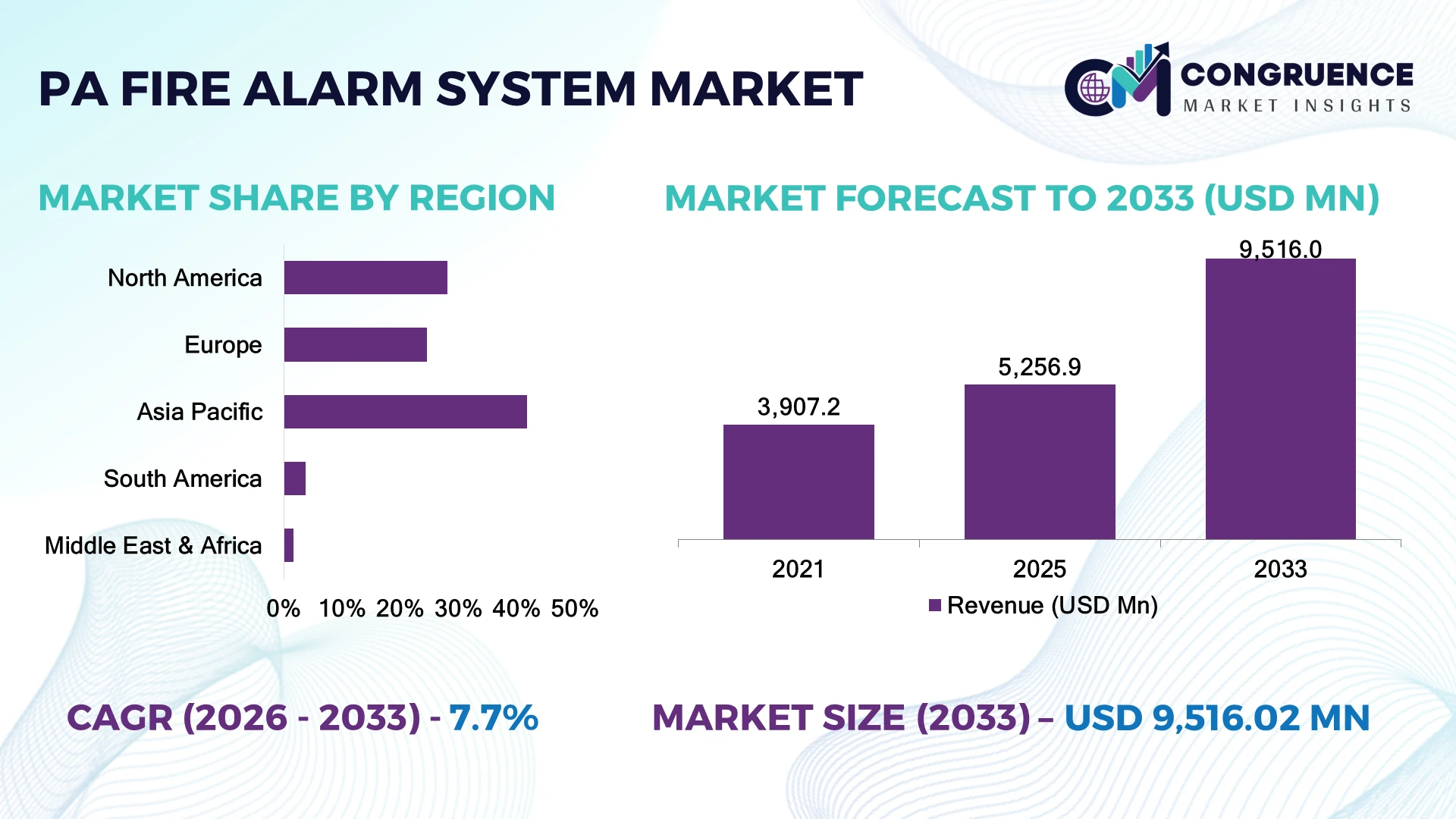
The Global PA Fire Alarm System Market was valued at USD 5,256.9 Million in 2025 and is anticipated to reach a value of USD 9,516.0 Million by 2033 expanding at a CAGR of 7.7% between 2026 and 2033. Accelerating smart building deployment, stricter life-safety regulations, and modernization of transportation and industrial infrastructure are driving adoption of integrated PA fire alarm systems.
China represents approximately 30% of global PA fire alarm system manufacturing capacity, supported by sustained investments in commercial infrastructure, metro networks, industrial facilities, and smart city projects. More than 65% of newly constructed large public buildings incorporate networked voice evacuation systems, compared with approximately 47% in the United States, where retrofit modernization remains the primary growth avenue. Following global supply-chain diversification initiatives during 2026, manufacturers increased localized electronics production and software integration to strengthen delivery resilience.
Strategic advantage increasingly depends on delivering scalable, code-compliant, IP-based emergency communication platforms supported by localized engineering capabilities.
Market Size & Growth: USD 5,256.9 Million in 2025, reaching USD 9,516.0 Million by 2033 at a CAGR of 7.7%, driven by smart infrastructure modernization and integrated life-safety systems.
Top Growth Drivers: Smart buildings (38%), regulatory compliance upgrades (32%), transportation infrastructure expansion (26%).
Short-Term Forecast: By 2028, emergency response efficiency improves by 21% through intelligent voice evacuation integration.
Emerging Technologies: AI analytics, IP-based communication, cloud monitoring, and edge diagnostics improve system intelligence.
Regional Leaders: Asia-Pacific exceeds USD 4.1 Billion, North America approaches USD 2.4 Billion, Europe surpasses USD 1.8 Billion through infrastructure upgrades and regional expansion.
Consumer/End-User Trends: Approximately 62% of enterprise facilities prioritize integrated voice evacuation with centralized building management.
Pilot/Case Example: During 2026, a smart transit deployment reduced emergency notification time by 29% using networked PA systems.
Competitive Landscape: The top supplier holds approximately 16% market share alongside Honeywell, Johnson Controls, Siemens, Bosch, and Eaton.
Regulatory & ESG Impact: Nearly 28% of commercial retrofits are driven by updated fire safety and evacuation compliance requirements.
Investment & Funding: More than USD 2.3 Billion supports manufacturing expansion, digital platforms, and strategic partnerships.
Innovation & Future Outlook: AI-enabled emergency communication and interoperable life-safety ecosystems are reshaping global deployment strategies.
Demand is strengthening across airports, rail transit, healthcare facilities, manufacturing plants, and commercial complexes where integrated emergency communication has become operationally critical. Nearly 36% of newly installed enterprise systems now incorporate cloud-enabled monitoring and AI-assisted fault diagnostics. During 2026, localized electronics sourcing and cybersecurity-focused procurement further accelerated migration toward interoperable IP-based public address and fire alarm platforms, setting the stage for broader strategic transformation.
PA fire alarm systems have evolved into strategic infrastructure assets as governments, enterprises, and transport operators prioritize integrated life-safety platforms over standalone fire detection systems. Infrastructure modernization, stricter building regulations, and digital transformation are accelerating investments in networked emergency communication. During 2026, manufacturers increasingly restructured supply chains by regionalizing electronics production and expanding software development capabilities to improve resilience and reduce project delivery risks.
Modern IP-based PA fire alarm systems improve emergency notification accuracy by approximately 24% and reduce maintenance requirements by nearly 19% compared with conventional analog architectures through centralized diagnostics and automated fault detection. China continues leading large-scale deployment across urban infrastructure and public transportation, while Germany emphasizes highly integrated, standards-driven systems for industrial and commercial facilities. Approximately 58% of new enterprise installations now combine fire detection, voice evacuation, and building management into unified control platforms.
Manufacturers are expanding cybersecurity capabilities, investing in AI-driven monitoring software, and forming partnerships with smart building integrators to strengthen end-to-end life-safety solutions. Large airport and metro modernization projects increasingly specify unified emergency communication platforms capable of supporting complex evacuation scenarios. Over the next two to three years, suppliers combining interoperable architectures, localized engineering support, and advanced digital service capabilities will secure stronger competitive positioning and long-term operational relevance.
Expansion of smart commercial infrastructure and mandatory life-safety compliance is accelerating deployment of integrated PA fire alarm systems across transportation, healthcare, education, and industrial facilities. Approximately 44% of newly commissioned large commercial buildings now deploy IP-based voice evacuation platforms, while integrated emergency communication improves evacuation response efficiency by nearly 26%. India's ongoing airport, metro, and public infrastructure expansion during 2026 has increased specification of networked fire alarm systems capable of centralized monitoring. This shift is encouraging manufacturers to expand software capabilities, invest in interoperable communication platforms, and strengthen partnerships with building automation providers. The strongest competitive advantage increasingly comes from delivering unified life-safety ecosystems instead of standalone fire alarm hardware.
A significant share of commercial buildings continues operating legacy analog fire alarm infrastructure that limits seamless integration with modern IP-based emergency communication platforms. Approximately 35% of retrofit projects require complete network redesign, while interoperability challenges increase installation costs by nearly 18%. The United States faces persistent modernization constraints across aging public facilities where existing wiring architectures delay digital upgrades and extend project schedules. These limitations reduce deployment efficiency and compress project margins for system integrators. Manufacturers are addressing the issue through backward-compatible controllers, localized technical support, standardized communication protocols, and long-term modernization agreements that reduce migration complexity while protecting customer investments.
Artificial intelligence and cloud-connected emergency communication platforms are creating new service opportunities beyond conventional fire alarm deployment. Nearly 39% of enterprise life-safety projects now evaluate AI-assisted fault diagnostics and predictive system health monitoring, reducing maintenance visits by approximately 22%. Singapore continues advancing intelligent building policies that encourage digital integration of emergency communication systems with centralized facility management platforms. Companies are increasing investment in software development, cybersecurity, and cloud-based monitoring services while forming partnerships with smart building technology providers. A growing opportunity lies in subscription-based remote diagnostics that generate recurring service revenues and improve long-term customer retention beyond equipment sales.
As PA fire alarm systems become connected with building management, security, and emergency response networks, integration complexity has emerged as a critical execution challenge. Approximately 31% of enterprise deployments require customized software interfaces, while cybersecurity compliance increases commissioning time by nearly 16%. Germany's stringent requirements for critical infrastructure protection are driving greater emphasis on secure communication protocols and system validation before operational approval. Companies must invest in certified cybersecurity frameworks, skilled integration engineers, and rigorous interoperability testing to ensure reliable performance. Long-term competitiveness will depend on balancing open-system connectivity with resilient cyber protection and consistent multi-vendor compatibility.
IP Migration Accelerates Deployments: Approximately 43% of newly installed PA fire alarm systems now utilize IP-based network architecture, improving emergency message distribution by nearly 24%. Building owners are replacing isolated communication systems with unified digital platforms, while manufacturers expand certified networking solutions and strengthen partnerships with building automation specialists.
Voice Evacuation Standardization Expands: Updated life-safety regulations have increased deployment of intelligent voice evacuation systems across commercial buildings and transportation infrastructure. Around 37% of public infrastructure upgrades now prioritize multilingual emergency communication, reducing evacuation coordination time by approximately 19%. Suppliers are scaling standardized product platforms to simplify compliance across multiple facilities.
Edge Diagnostics Improve Maintenance: Nearly 34% of enterprise installations now incorporate edge-based monitoring and automated fault reporting, reducing onsite maintenance requirements by approximately 21%. Labor shortages in technical service operations are accelerating adoption of remote diagnostics, encouraging manufacturers to integrate predictive maintenance software with centralized asset management platforms.
Localized Electronics Manufacturing Grows: Supply-chain diversification has encouraged approximately 29% of leading manufacturers to regionalize electronic assembly and controller production, shortening delivery cycles by nearly 17%. Companies are restructuring procurement networks, increasing local inventory, and strengthening strategic supplier partnerships to improve resilience while maintaining compliance with evolving safety certification requirements.
Networked PA fire alarm systems account for approximately 49% of the global market due to their ability to integrate multiple buildings, support centralized emergency communication, and simplify monitoring across large facilities. Their scalability, interoperability with building management platforms, and support for IP-based infrastructure make them the preferred choice for airports, commercial complexes, healthcare campuses, and industrial facilities. Conventional standalone systems continue serving small commercial buildings and educational institutions where lower installation costs remain a priority, while hybrid systems provide a practical migration path for organizations modernizing legacy infrastructure.
Wireless PA fire alarm systems represent the fastest-growing segment, with adoption increasing by approximately 31% as retrofit projects and temporary infrastructure demand faster installation and lower wiring costs. Nearly 43% of new enterprise projects now prioritize network-ready communication platforms that support remote diagnostics and software updates. Manufacturers are expanding cloud-compatible product portfolios, developing modular architectures, and strengthening partnerships with building automation providers. Investment is increasingly directed toward intelligent, interoperable systems capable of supporting future smart building requirements.
According to a 2026 enterprise building technology assessment, networked voice evacuation systems were deployed in more than half of newly commissioned large commercial facilities as organizations standardized integrated life-safety communication platforms.
Commercial buildings account for approximately 42% of global PA fire alarm system installations because of strict occupancy regulations, high evacuation requirements, and increasing adoption of integrated building management systems. Office towers, shopping centers, hotels, and mixed-use developments continue specifying advanced voice evacuation platforms to improve emergency response. Industrial facilities maintain stable demand where hazardous operations require reliable emergency communication, while healthcare and educational institutions continue modernizing aging fire safety infrastructure to meet evolving operational standards.
Transportation infrastructure represents the fastest-growing application segment, supported by airport expansion, metro modernization, and high-speed rail development. Approximately 29% of newly constructed transport terminals now deploy IP-based emergency communication systems integrated with centralized control centers, improving coordinated emergency response by nearly 24%. Manufacturers are expanding transportation-focused product portfolios, strengthening software integration capabilities, and collaborating with infrastructure contractors to deliver standardized life-safety platforms. Demand is increasingly shifting toward mission-critical environments where uninterrupted communication directly influences passenger safety and operational continuity.
A 2025 transportation infrastructure survey found that newly commissioned airport and metro projects increasingly specified integrated public address and fire alarm systems to improve evacuation coordination and centralized emergency management.
Commercial facility owners account for approximately 45% of total PA fire alarm system procurement because of extensive deployment across offices, retail centers, hospitality properties, and mixed-use developments. Large building portfolios require standardized emergency communication platforms that simplify monitoring, regulatory compliance, and lifecycle maintenance. Industrial enterprises continue investing in robust life-safety systems for manufacturing operations, while government institutions remain significant purchasers through public infrastructure modernization and civic facility upgrades.
Transportation authorities represent the fastest-growing end-user segment, with procurement expanding by approximately 30% as airports, metro networks, and railway operators accelerate digital safety upgrades. Around 39% of newly commissioned transportation projects now integrate unified voice evacuation with centralized operational control systems. Suppliers are responding through customized platform configurations, long-term maintenance agreements, cybersecurity enhancements, and strategic partnerships with infrastructure developers. Competitive positioning increasingly depends on delivering scalable, standards-compliant communication ecosystems capable of supporting complex, high-occupancy environments.
A 2026 institutional assessment of public infrastructure projects found transportation operators recorded the fastest increase in procurement of integrated PA fire alarm systems, reflecting growing emphasis on networked emergency communication and centralized incident management.
Asia-Pacific accounted for the largest market share at 41.8% in 2025 however, North America is expected to register the fastest growth, expanding at a CAGR of 8.3% between 2026 and 2033.

Advanced Building Modernization Accelerates Integrated Life-Safety Deployment
North America accounts for approximately 28.1% of the global PA fire alarm system market, supported by extensive modernization of commercial buildings, healthcare facilities, airports, educational campuses, and critical infrastructure. Enterprises are increasingly replacing conventional fire alarm platforms with IP-enabled emergency communication systems integrated into building management and security networks. Approximately 57% of newly upgraded commercial facilities now deploy voice evacuation systems with centralized monitoring capabilities. System providers are strengthening software development, cybersecurity, and lifecycle service offerings while expanding strategic partnerships with smart building integrators. Growing emphasis on digital compliance, remote diagnostics, and operational resilience continues positioning North America as a technology-driven market for advanced life-safety solutions.
United States Market Outlook: The United States leads the regional market through large-scale commercial infrastructure, advanced building automation adoption, and rigorous life-safety regulations. Nearly 69% of North America's enterprise-grade PA fire alarm deployments are concentrated in the country, where airports, hospitals, data centers, and high-rise developments increasingly specify interoperable emergency communication platforms integrated with cloud-based monitoring and intelligent building management systems.
Regulatory Compliance Drives Intelligent System Upgrades
Europe represents approximately 24.6% of the global market, supported by stringent fire safety regulations, modernization of public infrastructure, and widespread adoption of intelligent building technologies. Commercial property owners and industrial operators continue replacing legacy alarm systems with networked voice evacuation platforms that improve operational coordination and occupant safety. Around 48% of newly renovated public facilities now integrate PA fire alarm systems with centralized building control infrastructure. Manufacturers are investing in software interoperability, cybersecurity, and energy-efficient hardware to support increasingly complex regulatory requirements.
Germany Market Outlook: Germany remains the leading European market due to its advanced industrial base, high commercial construction standards, and strong emphasis on integrated building automation. Approximately 36% of Europe's intelligent PA fire alarm deployments are concentrated in Germany, where digital safety infrastructure, certified system integration, and industrial modernization continue driving procurement of advanced emergency communication technologies.
Infrastructure Expansion Strengthens Market Leadership
Asia-Pacific contributes approximately 41.8% of global PA fire alarm system demand through continuous investment in smart cities, transportation infrastructure, commercial construction, and manufacturing facilities. Large-scale urban development and stricter building safety standards are accelerating deployment of networked emergency communication platforms across public and private infrastructure. Approximately 61% of newly commissioned large commercial developments incorporate integrated voice evacuation systems. Regional manufacturers are expanding electronics production, software development, and localized engineering support to strengthen competitiveness and improve project execution across domestic and export markets.
China Market Outlook: China dominates the regional market through extensive urban infrastructure development, strong electronics manufacturing capabilities, and large-scale commercial construction. Approximately 63% of Asia-Pacific's production of PA fire alarm system control equipment is concentrated in China, where smart city programs and transportation projects continue accelerating deployment of advanced, IP-based emergency communication solutions.
Commercial Infrastructure Modernization Supports Adoption
South America accounts for approximately 3.8% of the global market, driven by modernization of commercial buildings, airports, healthcare facilities, and public infrastructure. Building owners increasingly deploy integrated PA fire alarm systems to improve regulatory compliance and emergency response efficiency, particularly in high-occupancy environments. Nearly 28% of recently upgraded public infrastructure projects now include intelligent voice evacuation capabilities. While import dependency and uneven regulatory implementation remain operational constraints, suppliers are strengthening regional distribution partnerships and technical service networks to improve deployment consistency.
Brazil Market Outlook: Brazil represents the largest market in South America due to its expanding commercial real estate sector, industrial activity, and airport modernization programs. Around 51% of regional enterprise installations are concentrated in Brazil, where increasing investment in integrated building safety systems and digital facility management continues strengthening demand for advanced emergency communication platforms.
Mega Infrastructure Projects Expand Safety Investments
The Middle East & Africa accounts for approximately 1.7% of the global market, supported by large-scale commercial developments, airport expansion, hospitality projects, and industrial diversification initiatives. Developers increasingly specify integrated PA fire alarm systems to satisfy modern building regulations and improve emergency preparedness across high-capacity facilities. Approximately 31% of newly commissioned mixed-use developments now deploy networked voice evacuation solutions integrated with centralized building operations. Global manufacturers are expanding local partnerships, engineering support, and certified installation capabilities to address complex infrastructure projects.
Saudi Arabia Market Outlook: Saudi Arabia leads the regional market through sustained investment in smart cities, commercial megaprojects, transportation infrastructure, and industrial development. Nearly 46% of new large-scale building developments within the Gulf region incorporate advanced PA fire alarm systems, reflecting the country's focus on intelligent infrastructure, regulatory compliance, and integrated life-safety technologies across rapidly expanding urban environments.
Global leaders including Honeywell, Siemens, Johnson Controls, Bosch, and Eaton compete against regional system integrators and cost-focused manufacturers for commercial buildings, transportation infrastructure, and industrial facilities. The top five companies collectively command approximately 51% of the global market. Competition centers on software integration, cybersecurity, installation speed, and lifecycle services, with cloud-enabled diagnostics reducing maintenance costs by 21%, IP-based platforms improving response efficiency by 24%, and localized engineering support shortening project delivery by 18%. Companies are expanding certified partner networks, investing in AI-enabled monitoring, acquiring software capabilities, and strengthening vertical integration across hardware, cloud platforms, and service operations. The competitive landscape is shifting toward intelligent life-safety ecosystems where interoperability and recurring digital services outweigh hardware differentiation alone. Stringent certification requirements, regulatory compliance, cybersecurity validation, and installer ecosystems remain significant entry barriers. Winning requires interoperable platforms, dependable project execution, advanced digital capabilities, and comprehensive lifecycle support that consistently outperform established global providers.
Honeywell International Inc.
Siemens AG
Johnson Controls International plc
Robert Bosch GmbH
Eaton Corporation plc
Hochiki Corporation
Nohmi Bosai Ltd.
Halma plc
Schneider Electric SE
Gentex Corporation
Potter Electric Signal Company LLC
Mircom Group of Companies
Advanced Electronics Ltd.
Kentec Electronics Ltd.
Modern PA fire alarm systems are transitioning from standalone notification platforms to intelligent, networked life-safety ecosystems. IP-based communication, cloud connectivity, and AI-assisted diagnostics are now incorporated into approximately 61% of newly deployed enterprise installations. Intelligent voice evacuation and automated fault detection improve emergency response efficiency by nearly 24% while reducing routine maintenance interventions by approximately 20%. Integration with building management systems enables centralized monitoring, faster incident verification, and improved operational continuity across commercial campuses, airports, hospitals, and industrial facilities.
Emerging technologies include edge computing, predictive maintenance, cybersecurity-enabled controllers, and digital twins for system monitoring. Compared with conventional analog fire alarm systems, modern IP-enabled platforms reduce commissioning time by approximately 18% and improve fault identification accuracy by nearly 27%. Large facility operators, transportation authorities, and smart building developers benefit most through lower lifecycle costs, simplified compliance management, and improved operational visibility across multiple connected sites.
Between 2026 and 2028, AI-driven event analytics, cloud-native monitoring platforms, and interoperable emergency communication networks will become standard requirements for complex infrastructure projects. Approximately 68% of high-value commercial developments are expected to specify software-defined life-safety architectures. Suppliers investing in cybersecurity, open integration standards, predictive diagnostics, and scalable cloud services will strengthen competitive differentiation while creating recurring service opportunities beyond conventional equipment deployment.
September 2024 Johnson Controls launched the SafeLINC Cloud Internet Interface for FireClass fire alarm control panels, enabling real-time remote connectivity and centralized monitoring across multiple sites, improving technician service efficiency and facility response. Source: Johnson Controls (Johnson Controls)
July 2025 Honeywell was selected to modernize the fire alarm system at Phoenix Sky Harbor International Airport Terminal 4, upgrading thousands of devices across more than 80 airline gates to enhance automation, digital visualization, and emergency response. Source: Honeywell Newsroom (honeywell.com)
March 2026 Siemens introduced the Sinteso Nova and Cerberus Nova portfolio with cloud connectivity, continuous self-checks, remote diagnostics, and predictive maintenance, enabling 24/7 automated monitoring for healthcare, data centers, and commercial buildings. Source: Siemens Press (press.siemens.com)
June 2026 Honeywell expanded its NOTIFIER INSPIRE platform by introducing integrated smoke control and cloud-connected life-safety innovations, reducing deployment complexity while simplifying compliance through automated testing and centralized reporting. Source: Honeywell Corporate Newsroom. (honeywell.com)
The report delivers comprehensive analysis of the PA Fire Alarm System Market across system types, applications, end-user industries, deployment models, and major geographic regions. It evaluates adoption across commercial buildings, industrial facilities, transportation infrastructure, healthcare, education, government establishments, and smart city projects while assessing networked, wireless, standalone, and hybrid system architectures. The study covers North America, Europe, Asia-Pacific, South America, and the Middle East & Africa, incorporating deployment trends, technology penetration, enterprise purchasing patterns, and competitive participation across leading manufacturers.
The report further examines IP-based communication, AI-assisted diagnostics, cloud monitoring, cybersecurity integration, predictive maintenance, and intelligent voice evacuation technologies shaping industry development between 2026 and 2033. Quantitative insights on segment shares, deployment intensity, and digital adoption support investment prioritization, product development, regional expansion, and competitive benchmarking. Strategic analysis of technology evolution, regulatory modernization, partnership activity, and infrastructure investments enables informed decision-making for manufacturers, system integrators, investors, and enterprise buyers seeking long-term market positioning.
| Report Attribute/Metric | Report Details |
|---|---|
|
Market Revenue in 2025 |
USD 5,256.9 Million |
|
Market Revenue in 2033 |
USD 9,516.0 Million |
|
CAGR (2026 - 2033) |
7.7% |
|
Base Year |
2025 |
|
Forecast Period |
2026 - 2033 |
|
Historic Period |
2021 - 2025 |
|
Segments Covered |
By Type
By Application
By End-User
|
|
Key Report Deliverable |
Revenue Forecast, Growth Trends, Market Dynamics, Segmental Overview, Regional and Country-wise Analysis, Competition Landscape |
|
Region Covered |
North America, Europe, Asia-Pacific, South America, Middle East, Africa |
|
Key Players Analyzed |
Honeywell International Inc., Siemens AG, Johnson Controls International plc, Robert Bosch GmbH, Eaton Corporation plc, Hochiki Corporation, Nohmi Bosai Ltd., Halma plc, Schneider Electric SE, Gentex Corporation, Potter Electric Signal Company LLC, Mircom Group of Companies, Advanced Electronics Ltd., Kentec Electronics Ltd. |
|
Customization & Pricing |
Available on Request (10% Customization is Free) |




