
Reports
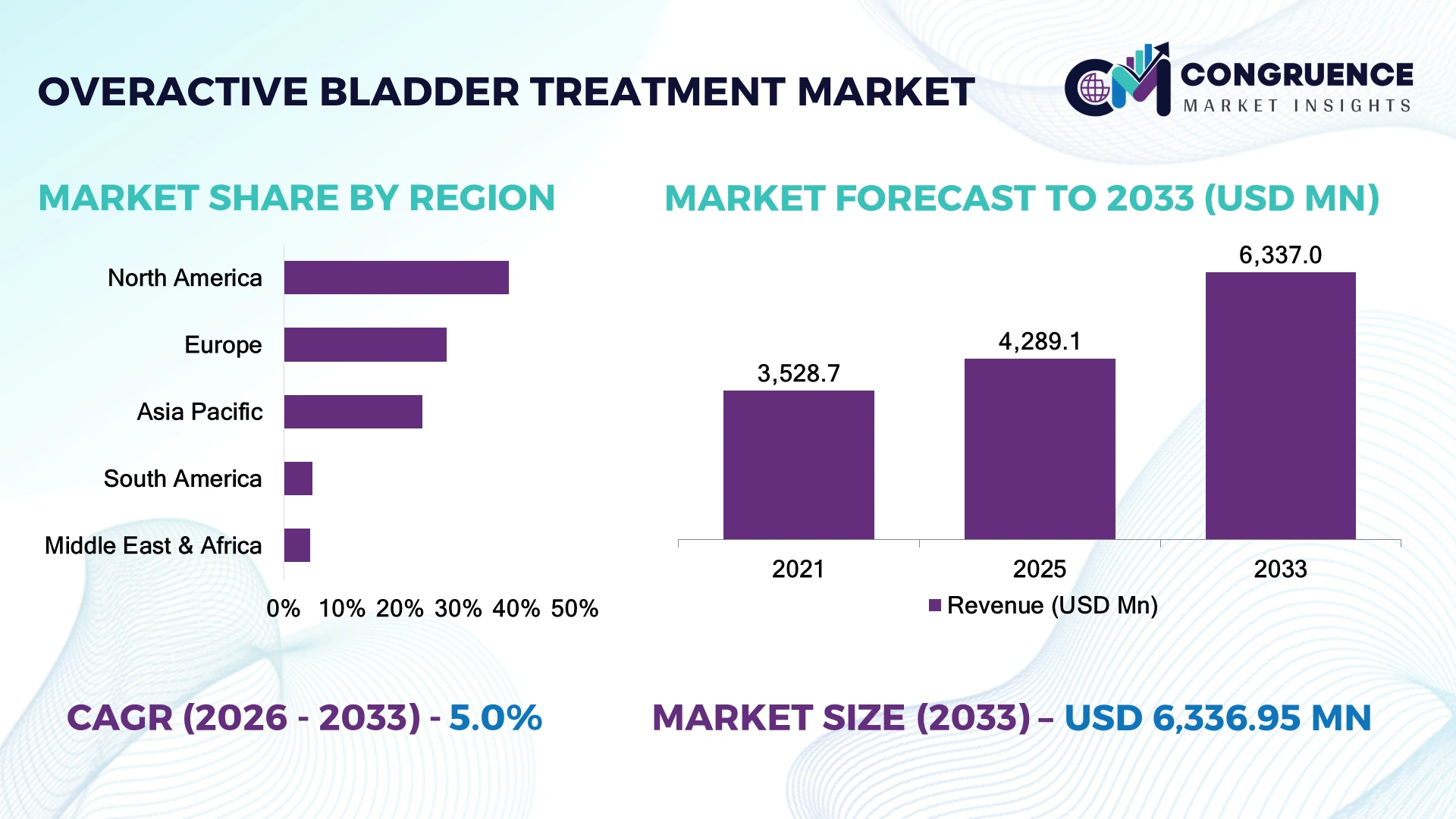
The Global Overactive Bladder Treatment Market was valued at USD 4,289.1 Million in 2025 and is anticipated to reach a value of USD 6,337.0 Million by 2033 expanding at a CAGR of 5.0% between 2026 and 2033. Growth is being driven by the shift from antimuscarinics toward β3-agonists, combination regimens, and minimally invasive neuromodulation as clinicians prioritize tolerability and durable symptom control.
The U.S. remains the dominant country market, supported by approximately 330 million residents, extensive urology infrastructure, and rapid adoption of advanced pharmacological and neuromodulation therapies; Europe follows with mature reimbursement systems, while Japan and China are expanding specialist capacity. The 2024 U.S. guideline removed mandatory step therapy, accelerating treatment personalization and widening access to advanced interventions.
Strategic implication: prioritize β3-agonists, differentiated delivery, neuromodulation platforms, and partnerships that expand specialist access.
Market Size & Growth: USD 4.29 billion in 2025 to USD 6.34 billion by 2033 at 5.0% CAGR, supported by β3-agonist adoption.
Top Growth Drivers: Antimuscarinics 43.6%, β3-agonists 23.5%, minimally invasive therapies expanding fastest.
Short-Term Forecast: By 2028, digital monitoring and treatment personalization target 10–15% improvement in adherence.
Emerging Technologies: AI-supported treatment selection, tibial stimulation, rechargeable neuromodulation, and advanced drug-delivery systems reshape care.
Regional Leaders: North America approaches USD 2.8 billion; Europe USD 1.8 billion; Asia Pacific USD 1.1 billion by 2033.
Consumer/End-User Trends: Specialty clinics and urology centers increasingly use combination approaches, reflecting guideline-based personalized treatment.
Pilot/Case Example: 2024 guideline modernization eliminated mandatory step therapy across 33 recommendations, expanding direct access to advanced options.
Competitive Landscape: Antimuscarinics lead at 43.6%; β3-agonists, botulinum toxin, and neuromodulation intensify competitive differentiation.
Regulatory & ESG Impact: 2026 generic mirabegron approval increases price competition while expanding pharmaceutical treatment accessibility.
Investment & Funding: Device-pharma partnerships increasingly target neuromodulation, digital monitoring, and differentiated oral therapies.
Innovation & Future Outlook: Next-generation β3 therapies, rechargeable stimulation, combination treatment, and personalized care will define competitive positioning.
The Overactive Bladder Treatment Market is centered on antimuscarinics, β3-agonists, botulinum toxin, sacral neuromodulation, and tibial nerve stimulation, with β3-agonists representing approximately 23.5% of 2025 treatment revenue. In 2026, generic mirabegron expansion is intensifying price competition, while personalized combination therapy and minimally invasive treatment pathways gain clinical relevance.
The Overactive Bladder Treatment Market is becoming strategically important as treatment selection shifts from rigid sequencing toward personalized therapy. The 2024 clinical framework removed conventional step therapy, allowing behavioral, pharmacological, noninvasive, and minimally invasive interventions to be selected according to patient needs. This expands commercial relevance for β3-agonists, neuromodulation, botulinum toxin, and combination approaches.
Pharmaceutical competition is simultaneously changing. Antimuscarinics represented approximately 43.6% of treatment revenue in 2025, but β3-agonists captured about 23.5% and are expanding faster as tolerability and adherence become stronger purchasing considerations. Generic mirabegron availability in the United States in 2026 is also restructuring pricing, while branded developers increasingly defend differentiation through indications, formulations, and clinical positioning.
Technology investment is shifting toward less invasive and more durable treatment delivery. Compared with conventional medication-only management, neuromodulation can provide a procedural pathway for patients inadequately controlled by pharmacotherapy, while digital monitoring can improve follow-up efficiency by approximately 10–15%. North America leads commercialization, whereas Asia Pacific offers faster infrastructure expansion. Over the next 2–3 years, companies with differentiated therapies, specialist partnerships, and scalable patient-support infrastructure will gain the strongest competitive advantage.
β3-agonists are gaining treatment preference as clinicians seek efficacy with fewer anticholinergic burden concerns. Antimuscarinics represented approximately 43.6% of treatment revenue in 2025, while β3-agonists accounted for about 23.5%, creating substantial switching potential. In the United States, updated clinical guidance supporting individualized treatment sequencing is accelerating prescribing flexibility. Pharmaceutical companies are expanding generic and branded β3 portfolios, strengthening formulation differentiation and patient-support programs. Japan and the United States remain important adoption markets because of established urology infrastructure. The non-obvious shift is that competitive advantage increasingly depends on tolerability and persistence rather than prescription volume alone, pushing manufacturers toward lifecycle management, combination strategies, and differentiated patient adherence programs.
Generic entry is creating pricing pressure across established oral therapies while advanced interventions retain higher acquisition and procedural costs. Generic mirabegron availability in the United States in 2026 increases substitution pressure, with generic therapies typically competing at discounts of 20–40% against branded alternatives. Medication adherence also remains uneven, limiting realized treatment value despite strong prescription availability. Smaller hospitals in developing markets face specialist and equipment constraints that restrict access to botulinum toxin and neuromodulation. Companies are responding through multi-source procurement, contract manufacturing, differentiated formulations, and portfolio segmentation. The strategic pressure point is not simply drug pricing: lower-cost oral alternatives can delay escalation into higher-value procedures, changing revenue mix and utilization patterns across the treatment pathway.
Digital symptom tracking and connected-care platforms create an underdeveloped opportunity around treatment persistence, escalation timing, and remote follow-up. Digital interventions can reduce avoidable follow-up workload by approximately 10–15% in structured care pathways, while adherence monitoring can identify missed treatment behavior earlier. In the United States, smartphone-enabled patient engagement is increasingly compatible with specialist-led chronic-condition management. Companies are integrating patient-reported outcomes, medication reminders, bladder diaries, and clinician dashboards into therapy-support ecosystems. Japan offers another opportunity through its highly digitized healthcare environment and aging population. The non-obvious opportunity is monetizing treatment continuity rather than individual prescriptions: pharmaceutical and device companies can partner with urology networks to build longitudinal care pathways that improve persistence and create stronger differentiation around otherwise interchangeable therapies.
Advanced neuromodulation introduces execution complexity because clinical outcomes depend on specialist training, patient selection, programming, and follow-up infrastructure. Procedure-based therapies can require multiple clinical touchpoints, while programming and monitoring workflows can add 15–25% to operational workload compared with medication-only management. U.S. specialist centers are better positioned than smaller facilities to absorb these requirements, creating uneven deployment capability. Connected devices also introduce cybersecurity, interoperability, and data-management requirements that conventional therapies largely avoid. Companies must therefore invest in clinician training, remote programming capabilities, device-service networks, and interoperable patient-management systems. The critical long-term issue is scalability: technology that performs well in specialist centers must become operationally reproducible across broader outpatient networks without compromising safety, programming accuracy, or patient support.
Generic Substitution Intensifies: U.S. generic availability is increasing price competition across oral therapy, with branded products facing potential 20–40% acquisition-price pressure. Manufacturers are responding through differentiated formulations, combination strategies, and patient-support programs. The commercial shift is moving competition from molecule availability toward persistence, tolerability, and treatment-pathway positioning.
Minimally Invasive Care Expands: Neuromodulation and botulinum toxin are gaining relevance where pharmacotherapy delivers inadequate control, while procedure-based pathways can increase clinical workload by 15–25%. U.S. specialist centers are expanding programming and follow-up capabilities. Device companies are strengthening training networks and remote-management infrastructure to improve procedural scalability.
Personalized Sequencing Gains Ground: Treatment pathways increasingly combine behavioral therapy, pharmacotherapy, botulinum toxin, and neuromodulation according to symptom burden and patient tolerance. Approximately 43.6% of treatment revenue remained associated with antimuscarinics in 2025, but prescribing flexibility is increasing. Companies are restructuring portfolios around patient segmentation rather than single-treatment dominance.
Digital Monitoring Enters Care: Bladder diaries, symptom tracking, adherence reminders, and remote consultations are becoming more integrated into specialist workflows. Structured digital pathways can reduce selected follow-up workload by roughly 10–15%. U.S. and Japanese providers are adopting connected monitoring, while pharmaceutical and device companies increasingly partner with digital-health platforms to extend treatment support beyond clinic visits.
Antimuscarinics remain the leading treatment type, estimated at approximately 44% of the market, supported by extensive clinical familiarity, broad availability, and established prescribing pathways. β3-adrenergic agonists represent roughly 24% and are the fastest-growing type as clinicians increasingly prioritize tolerability and treatment persistence. Botulinum toxin and sacral neuromodulation remain specialized options for patients inadequately controlled with medication, while tibial nerve stimulation occupies an emerging minimally invasive niche. Companies are shifting investment toward β3-agonist portfolios, combination regimens, and differentiated formulations rather than relying exclusively on mature antimuscarinic franchises.
The competitive distinction is increasingly based on persistence and patient suitability rather than efficacy alone. In a recent U.S. analysis, 43% of women prescribed β3-agonists did not initiate treatment because of cost, demonstrating that reimbursement and affordability can materially constrain adoption. Companies are therefore expanding access programs, generic portfolios, and payer partnerships alongside clinical innovation.
A 2025 U.S. academic study found that 37% of women evaluated for overactive bladder had a high-risk anticholinergic cognitive-burden score, reinforcing the commercial relevance of alternatives to antimuscarinic therapy.
Idiopathic overactive bladder represents the dominant application, accounting for an estimated 80–85% of treatment demand because of its large diagnosed population and broad use of pharmacotherapy. Neurogenic detrusor overactivity represents the faster-growing specialized application, supported by demand for botulinum toxin and neuromodulation among patients with neurological disorders. Refractory OAB is also gaining importance as treatment pathways increasingly progress from oral medication toward minimally invasive interventions. Companies are strengthening specialist networks and expanding evidence generation around treatment sequencing.
The opportunity is strongest where conventional pharmacotherapy does not deliver adequate control. Approximately 10% of patients in a large clinical-practice dataset experienced a treatment change, including switching or adding another therapy. This supports a growing combination and escalation pathway rather than a single-treatment model. Pharmaceutical companies are developing combination strategies, while device manufacturers are targeting specialist centers with integrated programming, training, and follow-up capabilities.
A 2025 clinical-practice study found that approximately 79.6% of women and 75.8% of men with OAB in its dataset visited clinics, highlighting the central role of outpatient specialist pathways in treatment delivery.
Hospitals and integrated healthcare systems represent the leading end-user group, estimated at approximately 46% of treatment utilization, reflecting their concentration of urology specialists, procedural infrastructure, pharmacy services, and complex OAB cases. Specialty urology clinics follow at roughly 34% and represent the fastest-growing end-user group as minimally invasive therapies and longitudinal medication management become more specialized. Ambulatory surgical centers and other outpatient providers account for the remaining demand, increasingly handling selected procedures and follow-up services.
Buying behavior is shifting toward integrated treatment ecosystems rather than individual products. Specialty centers prioritize procedure efficiency, device support, clinical training, and patient monitoring, while hospitals emphasize formulary economics and standardized pathways. Approximately 7% of U.S. OAB prescribers in Medicare data were urologists, with prescribing activity concentrated in major metropolitan areas. Companies are consequently expanding specialist partnerships, clinical education, patient-support programs, and outpatient device infrastructure to capture higher-value treatment pathways.
A 2025 analysis of Medicare Part D prescribing data identified 257,929 unique providers prescribing OAB medications during 2013–2023, with most prescribers located in major metropolitan areas, reinforcing the importance of concentrated specialist networks.
North America accounted for the largest market share at approximately 38.7% in 2025 however, Asia-Pacific is expected to register the fastest growth, expanding at a CAGR of approximately 5.8% between 2026 and 2033.
North America represented approximately 38.7% of the global market in 2025, supported by high diagnosis rates, mature reimbursement, established urology networks, and rapid adoption of β3-agonists and minimally invasive therapies. The United States generates more than 80% of North American demand, while Canada contributes through publicly funded specialist care. Updated U.S. clinical guidance in 2024 strengthened individualized treatment sequencing, supporting broader movement beyond antimuscarinics. Medicare reimbursement for posterior tibial nerve stimulation also supports procedural adoption. Pharmaceutical companies are expanding β3-agonist portfolios, while device manufacturers are strengthening specialist-center partnerships and training infrastructure. The key commercial advantage is concentrated specialist capacity: approximately 75–77% of U.S. OAB prescribers in recent Medicare data were located in metropolitan areas, enabling faster uptake of advanced therapies.
U.S. Market Outlook: The United States remains the principal commercialization and innovation hub, accounting for approximately 82% of North American demand. Its advantage combines extensive urology infrastructure, broad payer coverage, pharmaceutical launch activity, and established neuromodulation pathways. More than 250,000 providers have prescribed OAB medications in Medicare data, creating a broad treatment-access network.
Europe accounted for approximately 28% of global demand in 2025, supported by established national health systems, specialist urology capacity, and broad access to pharmacological treatment. Germany, the United Kingdom, France, and Italy represent important commercial markets. Treatment decisions are increasingly influenced by tolerability, adherence, and long-term symptom control rather than medication class alone. Germany's large outpatient specialist network supports advanced treatment escalation, while Nordic systems emphasize structured chronic-care pathways. Companies are strengthening local reimbursement strategies, clinical education, and hospital partnerships. The region's fragmented reimbursement environment remains an operational consideration, requiring country-specific market access strategies rather than a single European launch model.
Germany Market Outlook: Germany represents a strategically important European market because of its extensive statutory healthcare system, specialist outpatient infrastructure, and strong pharmaceutical distribution network. Its mature urology ecosystem supports adoption of β3-agonists, botulinum toxin, and neuromodulation when conventional pharmacotherapy is insufficient. Manufacturers increasingly prioritize reimbursement evidence and specialist engagement alongside product launches.
Asia-Pacific represented approximately 23.8% of global demand in 2025 and is positioned as the fastest-expanding major market as diagnosis, specialist access, and pharmaceutical availability improve. Japan has highly developed OAB treatment infrastructure, while China and India provide substantially larger untreated patient pools. Japan accounted for approximately 3.4% of global OAB treatment demand in 2023, demonstrating the importance of its mature therapeutic market despite its smaller population. China is accelerating innovative-drug approvals through priority pathways. Companies are expanding generic manufacturing, local clinical partnerships, and specialist distribution to reach secondary cities, where diagnosis and treatment penetration remain lower.
Japan Market Outlook: Japan is a technology-intensive OAB market with strong physician familiarity with β3-agonists and advanced urological care. Mirabegron represented approximately 27.6% of Japan's treatment market in 2023, while neuromodulation was identified as the fastest-growing treatment category. Manufacturers therefore prioritize differentiated therapies, specialist education, and adherence-focused treatment strategies.
South America remains a smaller but strategically relevant market, with Brazil accounting for the majority of regional treatment activity. Brazil's extensive private healthcare network and large public health system provide the strongest platform for pharmaceutical and procedural OAB adoption. Demand remains concentrated in major metropolitan urology centers, while smaller cities face specialist and diagnostic limitations. Pharmaceutical companies are prioritizing established oral therapies and localized distribution before expanding higher-cost interventions. Brazil's scale also makes it an important launch and clinical-partnership market for companies seeking Latin American coverage. The primary commercial opportunity lies in improving diagnosis and specialist referral rather than simply increasing product availability.
Brazil Market Outlook: Brazil is the region's principal commercial market, supported by a large healthcare system, established pharmaceutical distribution, and concentrated specialist infrastructure in São Paulo, Rio de Janeiro, and other major cities. Companies targeting Brazil benefit from established regulatory and distribution capabilities, while partnerships with urology networks can improve access to advanced therapies.
Middle East & Africa remains an emerging OAB treatment market where demand is concentrated in Gulf healthcare systems and major South African urban centers. Saudi Arabia and the United Arab Emirates are investing heavily in hospital modernization, specialist-care capacity, and digital health infrastructure, creating stronger channels for advanced urology therapies. Saudi healthcare transformation is also encouraging private-sector participation and localized pharmaceutical investment. Companies are responding through distributor partnerships, hospital contracts, specialist education, and selective introduction of minimally invasive treatments. The principal constraint is uneven specialist density outside major cities, making hub-and-spoke care models more commercially practical than broad infrastructure deployment.
Saudi Arabia Market Outlook: Saudi Arabia is the region's strongest strategic opportunity because healthcare transformation is expanding tertiary-care capacity and private-sector participation. The country is targeting substantial localization of pharmaceutical and biotechnology production, creating opportunities for multinational companies to combine technology partnerships with local distribution and manufacturing relationships. Urology services are increasingly concentrated within advanced hospital networks.
Astellas, Sumitomo Pharma, Viatris, Pfizer, and pharmaceutical generics compete primarily across oral OAB therapies, while Boston Scientific competes through neuromodulation against drug-led treatment pathways. The top five pharmaceutical players collectively command an estimated 55% share, creating a concentrated branded-drug structure alongside fragmented generic competition. Competition centers on efficacy, tolerability, reimbursement, and access: β3-agonists can deliver roughly 10–20% better persistence in selected populations, while generic entrants pursue 20–40% price discounts. Sumitomo is extending vibegron into BPH-associated OAB; Astellas and partners emphasize combination and lifecycle strategies; Boston Scientific is integrating Axonics technologies following its $3.7 billion acquisition. The competitive shift is moving from single-drug differentiation toward treatment-pathway ownership, combining pharmaceuticals, devices, and specialist services. Regulatory approvals and complex clinical evidence remain major barriers. Winning requires differentiated efficacy, payer access, specialist adoption, reliable supply, and a broader treatment ecosystem rather than price leadership alone.
Astellas Pharma Inc.
Sumitomo Pharma Co., Ltd.
Pfizer Inc.
Viatris Inc.
Teva Pharmaceutical Industries Ltd.
AbbVie Inc.
Laborie Medical Technologies, Inc.
Boston Scientific Corporation
Medtronic plc
Urovant Sciences, Inc.
Pierre Fabre
Kyorin Pharmaceutical Co., Ltd.
Taiho Pharmaceutical Co., Ltd.
Adalvo
β3-adrenergic agonists, neuromodulation, and connected monitoring are reshaping treatment delivery. Vibegron targets bladder β3 receptors without the anticholinergic mechanism of legacy therapies, while phase-3 evidence supports reductions in daily urgency and micturition. Real-world studies increasingly evaluate persistence, with digital symptom tracking supporting 10–15% improvements in selected follow-up workflows. Companies are integrating medication support with specialist monitoring.
Neuromodulation is advancing through rechargeable sacral systems, peripheral stimulation, and wearable bioelectronic devices. Axonics’ rechargeable R20 platform offers battery life of 20 years or more, compared with shorter-life legacy implants requiring more frequent replacement procedures. FemPulse received FDA IDE approval for a pivotal wearable OAB study in 2024, signaling movement toward non-surgical stimulation. Device companies benefit through lower intervention burden and broader outpatient deployment.
From 2026–2028, integrated treatment platforms should become increasingly important. Compared with medication-only pathways, connected monitoring can reduce selected follow-up workload by approximately 10–15%, while rechargeable neuromodulation reduces replacement frequency. Pharmaceutical companies gain from better adherence intelligence; device manufacturers gain from longitudinal patient relationships. The competitive advantage will shift toward interoperable platforms combining drug therapy, digital monitoring, specialist workflows, and minimally invasive stimulation, particularly in the United States and Japan where urology infrastructure supports rapid technology deployment and reimbursement-based commercialization.
November 2024 Boston Scientific completed its Axonics acquisition for approximately $3.7 billion, adding sacral neuromodulation and strengthening its urology portfolio. Axonics devices had reached more than 20 countries, expanding Boston Scientific’s international treatment-access platform and competitive positioning. Source: bostonscientific.com
December 2024 Sumitomo Pharma received U.S. FDA approval for GEMTESA in men with OAB symptoms receiving BPH medication, based on a Phase 3 trial involving 1,105 participants. The approval expanded vibegron’s addressable treatment pathway and strengthened β3-agonist positioning. Source: sumitomo-pharma.com
August 2025 Adalvo reported positive pivotal fed-study results for a fixed-dose mirabegron/solifenacin combination, advancing a single-tablet formulation through development. The program targets improved convenience and adherence while preparing for regulatory submissions following relevant patent expiries in key markets. Source: adalvo.com
September 2026 Kyorin announced Taiwan launch of vibegron through Marubeni Pharmaceuticals, following Taiwanese approval in April 2025 and import licensing in July 2025. The once-daily β3 agonist launch expands Asian commercialization and supports broader availability through regional licensing infrastructure. Source: kyorin-pharm.co.jp
The report evaluates Overactive Bladder Treatment across antimuscarinics, β3-adrenergic agonists, botulinum toxin, sacral neuromodulation, tibial nerve stimulation, and emerging bioelectronic approaches. Application coverage includes idiopathic OAB, neurogenic bladder-related symptoms, refractory cases, urgency, frequency, and urge urinary incontinence. End-user analysis spans hospitals, specialty urology clinics, ambulatory centers, and other healthcare providers across North America, Europe, Asia Pacific, South America, and Middle East & Africa.
The analysis examines established oral therapies alongside connected monitoring, rechargeable neuromodulation, wearable stimulation, combination formulations, and minimally invasive treatment pathways. β3-agonists account for approximately 24% of treatment demand, while antimuscarinics remain near 44%, highlighting the transition between mature and emerging therapies. The report supports investment planning, market-entry decisions, specialist-network expansion, portfolio positioning, partnership strategy, and technology prioritization through 2033, with particular attention to U.S. commercialization, Japanese technology adoption, Chinese market expansion, and emerging outpatient treatment models.
| Report Attribute/Metric | Report Details |
|---|---|
|
Market Revenue in 2025 |
USD 4,289.1 Million |
|
Market Revenue in 2033 |
USD 6,336.9 Million |
|
CAGR (2026 - 2033) |
5% |
|
Base Year |
2025 |
|
Forecast Period |
2026 - 2033 |
|
Historic Period |
2021 - 2025 |
|
Segments Covered |
By Type
By Application
By End-User
|
|
Key Report Deliverable |
Revenue Forecast, Growth Trends, Market Dynamics, Segmental Overview, Regional and Country-wise Analysis, Competition Landscape |
|
Region Covered |
North America, Europe, Asia-Pacific, South America, Middle East, Africa |
|
Key Players Analyzed |
Astellas Pharma Inc., Sumitomo Pharma Co., Ltd., Pfizer Inc., Viatris Inc., Teva Pharmaceutical Industries Ltd., AbbVie Inc., Laborie Medical Technologies, Inc., Boston Scientific Corporation, Medtronic plc, Urovant Sciences, Inc., Pierre Fabre, Kyorin Pharmaceutical Co., Ltd., Taiho Pharmaceutical Co., Ltd., Adalvo |
|
Customization & Pricing |
Available on Request (10% Customization is Free) |




