
Reports
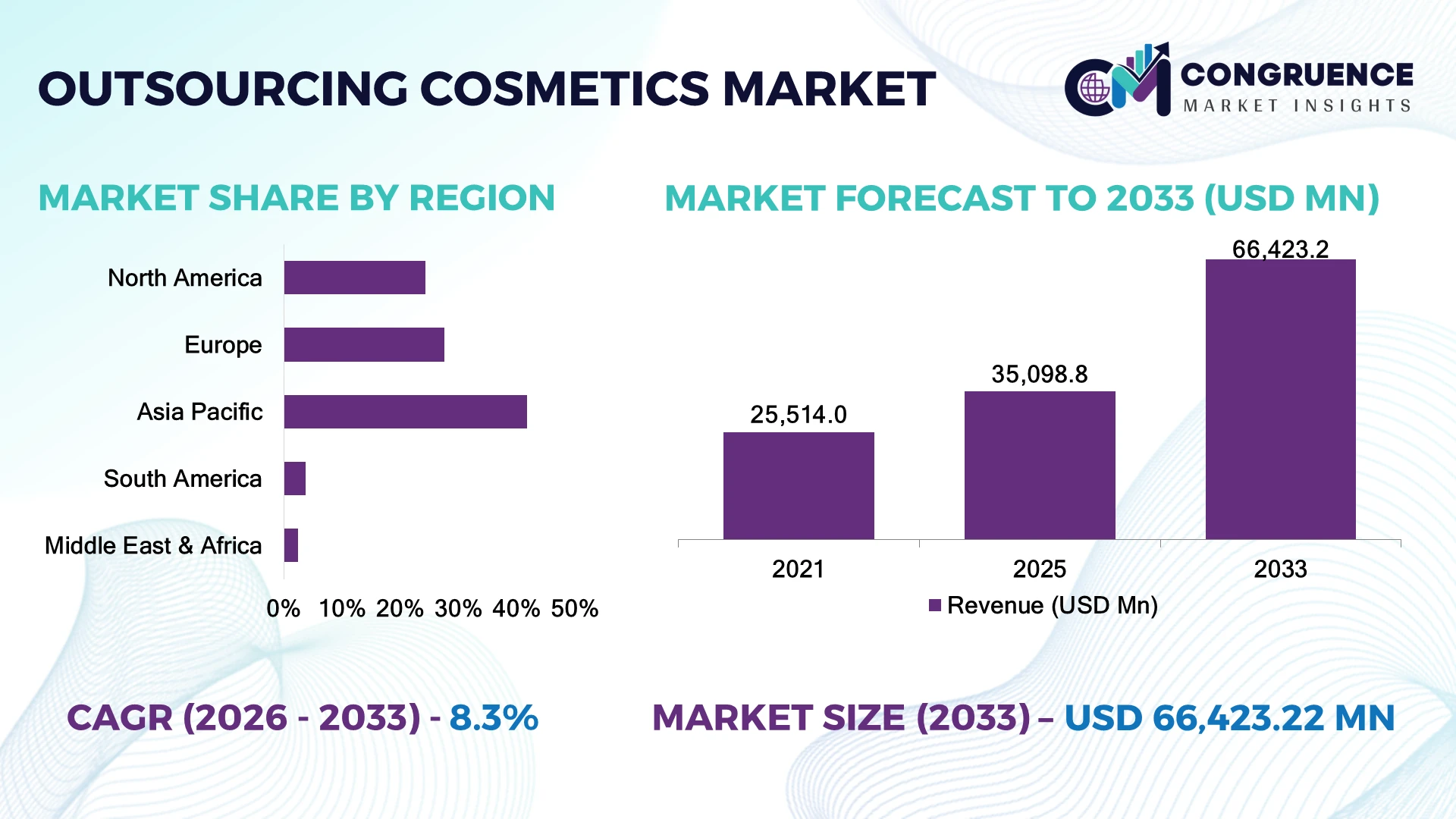
The Global Outsourcing Cosmetics Market was valued at USD 35,098.8 Million in 2025 and is anticipated to reach a value of USD 66,423.2 Million by 2033 expanding at a CAGR of 8.3% between 2026 and 2033. Growth is driven by increasing outsourcing of formulation, manufacturing, filling, and packaging as beauty brands accelerate product launches while optimising production costs and regulatory compliance.
South Korea accounts for approximately 29% of global outsourced cosmetics manufacturing capacity, supported by advanced OEM/ODM infrastructure, rapid formulation capabilities, and strong skincare innovation. More than 62% of newly launched skincare products from international beauty brands utilise outsourced development and manufacturing services. Compared with France's premium formulation expertise, South Korea leads in production speed and scalable contract manufacturing. Ongoing supply-chain diversification following global trade realignment during 2025–2026 has strengthened investment in flexible manufacturing networks and regional production hubs.
Companies securing agile manufacturing partnerships, regulatory expertise, and innovation-driven OEM capabilities will strengthen long-term competitive positioning in the global cosmetics value chain.
Market Size & Growth: USD 35,098.8 Million in 2025, reaching USD 66,423.2 Million by 2033 at a CAGR of 8.3%, driven by rapid OEM/ODM expansion and faster product commercialisation.
Top Growth Drivers: Private label demand (+31%), skincare innovation (+27%), contract manufacturing adoption (+24%).
Short-Term Forecast: By 2028, production lead times decline by 18% through digital manufacturing and supply-chain optimisation.
Emerging Technologies: AI-assisted formulation, robotic filling systems, and digital quality management improve manufacturing precision.
Regional Leaders: Asia-Pacific exceeds USD 29 Billion, Europe approaches USD 17 Billion, North America surpasses USD 12 Billion through premium beauty outsourcing.
Consumer/End-User Trends: Approximately 64% of emerging beauty brands rely on outsourced production for initial commercial launches.
Pilot/Case Example: In 2026, automated cosmetic filling reduced batch processing time by 21% within a multi-brand manufacturing facility.
Competitive Landscape: Leading manufacturers hold nearly 36% market share, led by Intercos, Cosmax, Kolmar Korea, Fareva, and Ancorotti Cosmetics.
Regulatory & ESG Impact: Sustainable packaging integration reduces virgin plastic consumption by approximately 22%.
Investment & Funding: More than USD 2.3 Billion supports capacity expansion, automation, and regional manufacturing partnerships.
Innovation & Future Outlook: Biotechnology ingredients, AI formulation platforms, and flexible batch manufacturing are transforming outsourced cosmetics production.
Outsourcing cosmetics services are increasingly supporting skincare, colour cosmetics, haircare, and personal care brands seeking faster innovation cycles and regulatory efficiency. Advanced formulation platforms, automated filling technologies, and sustainable packaging solutions have improved manufacturing productivity by approximately 20%, while evolving regulatory compliance and regional supply-chain diversification continue strengthening demand, setting the stage for the market's strategic evolution.
The Outsourcing Cosmetics market has become strategically important as global beauty brands prioritise faster product development, flexible production capacity, and efficient regulatory compliance. Supply-chain restructuring and increasing reliance on specialised OEM and ODM partners are transforming how cosmetic products are formulated, manufactured, packaged, and commercialised. Contract manufacturers capable of delivering rapid product launches and scalable production are becoming essential competitive partners rather than simply production providers.
AI-assisted formulation platforms combined with automated manufacturing improve product development efficiency by approximately 24% while reducing formulation validation time by nearly 18% compared with conventional laboratory workflows. South Korea continues leading high-speed innovation and skincare outsourcing, whereas Italy and France maintain strong positions in premium cosmetic formulation and luxury manufacturing. Over the next two to three years, more than 52% of outsourced production facilities are expected to expand investments in automation, sustainable packaging integration, and digital quality management systems.
Leading outsourcing partners are establishing regional manufacturing hubs, expanding laboratory capabilities, and strengthening partnerships with independent beauty brands and multinational companies. Flexible batch production enables rapid commercialisation of niche product portfolios without significant capital investment by brand owners. Organisations combining advanced formulation expertise, regulatory excellence, digital manufacturing, and resilient regional supply networks will secure stronger competitive positioning as cosmetics innovation cycles continue to shorten.
The rapid expansion of independent beauty brands and direct-to-consumer business models is significantly increasing demand for outsourced cosmetics development and manufacturing. Approximately 61% of emerging beauty brands now rely on OEM or ODM partners for formulation and production, while outsourced product launches have shortened commercialisation timelines by nearly 27%. South Korea continues expanding high-speed formulation capabilities as international brands diversify production beyond single-country sourcing following recent global supply-chain adjustments. Faster innovation cycles enable brands to introduce seasonal and limited-edition products with lower operational risk. Contract manufacturers are responding through laboratory expansion, automated filling lines, strategic partnerships, and integrated regulatory services. Companies offering end-to-end development capabilities are capturing greater long-term client retention and higher-value manufacturing contracts.
Diverging cosmetic regulations across major consumer markets continue creating structural challenges for outsourcing providers. Approximately 35% of product development projects require reformulation or packaging modifications to satisfy country-specific regulatory requirements, while compliance-related validation activities increase development costs by nearly 16%. European ingredient restrictions and evolving product documentation standards require manufacturers to maintain multiple regulatory workflows for identical product categories. These complexities reduce manufacturing flexibility, delay international product launches, and increase operational overhead. Companies are reducing compliance risks through regional regulatory teams, formulation standardisation, digital documentation systems, and long-term partnerships with certified ingredient suppliers. Regulatory expertise has become a decisive competitive differentiator rather than a support function.
Artificial intelligence and predictive formulation technologies are transforming outsourced cosmetics development from contract manufacturing into innovation partnerships. AI-assisted formulation reduces prototype development time by approximately 23%, while digital ingredient screening improves formulation success rates by nearly 19%. Japan and South Korea continue integrating machine learning into research laboratories to accelerate personalised skincare and clean beauty product development. Manufacturers are expanding biotechnology research, investing in digital laboratories, and collaborating with ingredient innovators to create differentiated formulations. A significant emerging opportunity lies in offering data-driven formulation platforms that combine rapid innovation, regulatory readiness, and small-batch manufacturing for premium niche beauty brands.
Managing high product variation while maintaining manufacturing consistency remains a critical execution challenge for outsourcing providers. Approximately 47% of production facilities now manufacture short-run customised products, while batch changeovers reduce line utilisation by nearly 18%. Increasing demand for personalised formulations, sustainable packaging, and multiple packaging formats places additional pressure on manufacturing planning and workforce capabilities. Maintaining quality assurance across hundreds of stock-keeping units requires sophisticated digital production management and highly skilled technical teams. Manufacturers must invest in modular production systems, intelligent scheduling software, workforce development, and advanced process automation to sustain operational efficiency while supporting increasingly customised customer requirements.
Flexible Batch Manufacturing Expands: Small-batch production volumes have increased by approximately 29%, while production changeover times have fallen by nearly 17% through modular manufacturing workflows. Independent beauty brands are demanding faster launch schedules, prompting contract manufacturers to automate production planning, expand multi-product facilities, and strengthen packaging partnerships to improve responsiveness.
Sustainable Packaging Integration Grows: Recyclable and refillable packaging adoption has increased by approximately 26%, while lightweight packaging materials reduce logistics weight by nearly 13%. Tightening environmental packaging regulations and retailer sustainability commitments are encouraging outsourcing partners to restructure procurement strategies and establish long-term collaborations with sustainable packaging suppliers.
Digital Quality Systems Advance: Automated quality monitoring now supports approximately 54% of premium outsourcing facilities, reducing batch documentation errors by nearly 20% and improving manufacturing traceability. Companies are deploying electronic batch records, digital validation platforms, and real-time production analytics to strengthen compliance while reducing operational delays across multi-country manufacturing networks.
Biotechnology Ingredients Accelerate: Fermentation-derived cosmetic ingredients have experienced approximately 22% higher adoption among premium skincare launches, while formulation development cycles have improved by nearly 16%. Ingredient innovation and clean beauty positioning are encouraging manufacturers to expand biotechnology partnerships and dedicated research laboratories. A notable shift is the integration of ingredient development with contract manufacturing, enabling faster commercial scaling without extending production lead times.
OEM (Original Equipment Manufacturing) services account for approximately 57% of the global Outsourcing Cosmetics market, supported by large-scale production capabilities, cost efficiency, and the ability to manufacture established formulations across multiple product categories. Global beauty companies and private label retailers continue relying on OEM partners for high-volume manufacturing, packaging, and supply-chain reliability. ODM (Original Design Manufacturing) services remain strategically important for brands seeking differentiated formulations and rapid innovation, while contract filling and packaging providers strengthen operational flexibility by supporting shorter production runs and customised packaging requirements.
ODM services represent the fastest-growing type as independent beauty brands increasingly seek complete product development rather than manufacturing alone. Demand for integrated ODM solutions has increased by approximately 28%, while AI-assisted formulation platforms have reduced prototype development time by nearly 22%. Around 61% of emerging beauty brands now prefer end-to-end outsourcing partners that combine formulation, manufacturing, regulatory support, and packaging under one operational platform. Leading contract manufacturers are expanding R&D laboratories, investing in digital formulation technologies, and integrating manufacturing with packaging operations to strengthen customer retention and accelerate commercial product launches.
A 2026 enterprise assessment by a leading international cosmetics manufacturing association found that integrated OEM-ODM business models are becoming the preferred operating structure for independent beauty brands launching multi-product portfolios.
Skincare accounts for approximately 43% of the global Outsourcing Cosmetics market, reflecting high formulation complexity, frequent product innovation, and extensive reliance on specialised OEM and ODM partners. Demand is concentrated among premium skincare brands requiring advanced active ingredients, stability testing, and regulatory documentation before commercialisation. Haircare outsourcing remains a mature segment driven by scalable production, while colour cosmetics continue benefiting from rapid seasonal product launches. Fragrance and personal care outsourcing retain strategic importance where specialised filling, packaging precision, and compliance capabilities create operational advantages across diverse product portfolios.
Colour cosmetics represent the fastest-growing application as shorter product lifecycles and social commerce accelerate demand for rapid product launches. Outsourced production for colour cosmetics has increased by approximately 26%, while automated filling and packaging have improved manufacturing throughput by nearly 21%. Around 58% of independent beauty brands now outsource multiple product categories through integrated manufacturing partners rather than individual suppliers. Contract manufacturers are expanding automated production lines, investing in digital formulation platforms, and integrating packaging operations to reduce lead times while supporting multi-category product portfolios and global brand expansion.
A 2026 enterprise survey conducted by a leading international cosmetics industry association found that integrated formulation, manufacturing, and packaging services have become the preferred outsourcing model for a majority of newly launched beauty brands.
Independent and emerging beauty brands account for approximately 47% of outsourced cosmetics demand due to limited in-house manufacturing capabilities, rapid innovation cycles, and strong dependence on flexible production partners. These companies increasingly outsource formulation, regulatory support, packaging, and commercial manufacturing to accelerate product launches without major capital investment. Large multinational beauty companies remain significant buyers for specialised product categories, regional production balancing, and overflow manufacturing, while retailer-owned private label brands continue expanding procurement through long-term contract manufacturing relationships.
Private label retailers represent the fastest-growing end-user segment as supermarkets, pharmacies, and online retailers strengthen exclusive beauty portfolios. Outsourced production for private label cosmetics has increased by approximately 24%, while demand for sustainable packaging solutions has expanded by nearly 19%. More than 54% of contract manufacturers now offer dedicated private label development programmes combining formulation, branding, and packaging services. Companies are responding through customised manufacturing platforms, strategic retail partnerships, flexible pricing models, and expanded innovation centres to secure long-term customer relationships and strengthen competitive differentiation.
A 2025 international beauty industry enterprise assessment reported that retailer-owned and independent beauty brands are increasing reliance on full-service OEM and ODM partners to accelerate product development and shorten commercial launch timelines.
Asia-Pacific accounted for the largest market share at 44.2% in 2025 however, Middle East & Africa is expected to register the fastest growth, expanding at a CAGR of 9.2% between 2026 and 2033.
Premium Brand Outsourcing Expands High-Value Manufacturing
North America accounts for approximately 23.6% of the global Outsourcing Cosmetics market, supported by premium beauty brands, advanced formulation laboratories, and increasing outsourcing by direct-to-consumer companies. Demand is concentrated in skincare, colour cosmetics, and clean beauty products requiring regulatory expertise and rapid commercialisation. More than 52% of outsourced production contracts in the region now include formulation, packaging, and regulatory support within a single agreement. Contract manufacturers are expanding automated filling facilities and digital quality systems to improve production flexibility. Strategic partnerships between beauty brands and specialised manufacturers are accelerating product launch cycles while strengthening supply-chain resilience for premium cosmetic portfolios.
United States Market Outlook: The United States leads the regional market through a large concentration of independent beauty brands, established contract manufacturers, and advanced cosmetic research capabilities. Companies continue investing in AI-assisted formulation, automated manufacturing, and sustainable packaging infrastructure to improve operational efficiency. Approximately 61% of outsourced cosmetic production supports premium skincare and clean beauty brands, reinforcing the country's leadership in innovation, product development, and high-value manufacturing services.
Regulatory Excellence Drives Premium Manufacturing
Europe represents approximately 27.4% of the Outsourcing Cosmetics market, supported by premium formulation expertise, stringent product quality standards, and advanced cosmetic manufacturing infrastructure. Contract manufacturers continue expanding biotechnology capabilities and environmentally responsible production systems to serve luxury and dermocosmetic brands. Around 48% of premium outsourced formulations now incorporate sustainable ingredient selection and environmentally compliant packaging. Manufacturers are modernising production facilities and strengthening integrated formulation and packaging capabilities to improve efficiency while meeting evolving regulatory requirements.
France Market Outlook: France remains the region's strategic centre for premium cosmetics outsourcing due to its globally recognised formulation expertise, luxury beauty ecosystem, and sophisticated research infrastructure. Contract manufacturers continue strengthening innovation laboratories and specialised ingredient development capabilities. Nearly 57% of outsourced premium skincare projects involve advanced formulation development before commercial production, positioning France as a preferred destination for high-value cosmetic innovation.
Integrated Manufacturing Ecosystems Sustain Global Leadership
Asia-Pacific leads the global Outsourcing Cosmetics market through large-scale OEM and ODM manufacturing, integrated supply chains, and rapid product development capabilities. South Korea, China, and Japan collectively support extensive formulation, packaging, and commercial manufacturing capacity for international beauty brands. Approximately 66% of outsourced skincare production is concentrated within established manufacturing clusters, enabling shorter lead times and competitive production economics. Manufacturers continue investing in intelligent production systems, biotechnology laboratories, and high-speed packaging facilities while expanding export-oriented manufacturing operations.
South Korea Market Outlook: South Korea is the region's leading outsourcing hub because of its mature OEM and ODM ecosystem, strong skincare innovation, and advanced cosmetic research infrastructure. Manufacturers continue expanding smart factories and AI-assisted formulation laboratories to accelerate commercial product development. More than 62% of international skincare product launches manufactured in South Korea utilise integrated formulation, manufacturing, and packaging services, strengthening the country's global competitive advantage.
Regional Manufacturing Supports Private Label Expansion
South America is strengthening its outsourcing cosmetics industry through expanding private label production, growing domestic beauty brands, and improving manufacturing capabilities. Demand is primarily concentrated in skincare, haircare, and personal care products supplied through regional contract manufacturers. Approximately 34% of outsourcing agreements now include integrated packaging and logistics services, reflecting increasing operational sophistication. Manufacturers continue expanding production capacity and investing in flexible manufacturing systems despite infrastructure and logistics challenges that influence delivery efficiency across certain markets.
Brazil Market Outlook: Brazil dominates the regional market through its extensive cosmetics industry, established manufacturing base, and strong consumer demand for personal care products. Domestic contract manufacturers continue modernising production lines and increasing automation to improve operational efficiency. Around 53% of outsourced cosmetics manufacturing in Brazil serves domestic brands alongside expanding private label programmes, strengthening the country's position as South America's leading production hub.
Manufacturing Investments Strengthen Regional Supply Networks
The Middle East & Africa market is becoming increasingly important as multinational beauty companies diversify manufacturing footprints and regional governments encourage industrial development. Demand is rising for contract manufacturing of halal-certified, premium skincare, and personal care products supported by expanding local distribution infrastructure. Approximately 29% of newly established outsourcing facilities are designed with flexible multi-category production capabilities. Manufacturers are increasing partnerships with regional distributors and investing in modern filling, packaging, and quality control systems to improve local manufacturing competitiveness.
United Arab Emirates Market Outlook: The United Arab Emirates has emerged as the region's strategic outsourcing hub due to its advanced logistics infrastructure, international trade connectivity, and expanding cosmetics manufacturing investment. Companies continue developing integrated manufacturing and distribution facilities to serve Middle Eastern and African markets efficiently. Nearly 41% of newly established contract manufacturing projects focus on export-oriented production, positioning the country as a preferred operational gateway for international cosmetics brands.
The Outsourcing Cosmetics market is moderately consolidated, with the top five players accounting for approximately 36% of global demand. Intercos, COSMAX, Kolmar Korea, Fareva, and kdc/one compete for multinational beauty contracts through innovation, while regional OEM and ODM manufacturers compete primarily on cost, production flexibility, and local regulatory expertise. Competition is increasingly centred on formulation speed, integrated development, sustainable packaging, and resilient supply chains rather than manufacturing cost alone. Companies with end-to-end ODM capabilities reduce product development timelines by nearly 25%, while automated production improves manufacturing efficiency by approximately 20% and integrated packaging lowers fulfilment costs by around 15%. Leading manufacturers are expanding global production networks, investing in biotechnology research, forming strategic partnerships, and vertically integrating formulation with packaging services. The competitive shift favours technology-enabled innovation platforms over conventional contract manufacturing. Winning requires scalable global operations, rapid commercialisation capabilities, regulatory excellence, and differentiated formulation expertise rather than low-cost production alone.
Intercos S.p.A.
COSMAX Inc.
Kolmar Korea Co., Ltd.
Fareva Group
kdc/one
Cosmecca Korea Co., Ltd.
Toyo Beauty Co., Ltd.
Nox Bellow Cosmetics Co., Ltd.
Cosmobeauty Co., Ltd.
Ancorotti Cosmetics S.p.A.
Chromavis S.p.A.
BioTruly Group
HCT Group
Mana Products Inc.
Artificial intelligence, digital formulation platforms, and laboratory automation are transforming outsourced cosmetics development. AI-assisted ingredient screening reduces formulation development time by approximately 23%, while automated laboratory workflows improve testing efficiency by nearly 18%. Around 46% of leading OEM and ODM manufacturers have adopted digital formulation systems to accelerate prototype development and regulatory validation. These technologies enable faster product launches, improve formulation accuracy, and strengthen customer retention through innovation-led service models.
Smart manufacturing, robotic filling lines, and digital quality management systems are replacing conventional production processes. Automated production improves overall equipment effectiveness by approximately 21%, while digital batch records reduce documentation errors by nearly 30% compared with manual quality systems. Manufacturers operating integrated smart factories gain superior production flexibility, particularly when serving independent beauty brands requiring smaller production volumes and frequent product changes.
Between 2026 and 2028, biotechnology-derived ingredients, predictive analytics, and digital twin manufacturing are expected to reshape outsourcing competitiveness. Early adopters integrating AI, biotechnology research, and intelligent manufacturing will benefit from faster commercialisation, stronger regulatory compliance, and lower operational costs. Companies delaying digital transformation risk longer product development cycles and weaker competitiveness as multinational brands increasingly prioritise innovation capability over manufacturing capacity alone.
May 2025 Intercos confirmed continued industrial expansion across China and South Korea while strengthening regional innovation capabilities. The South Korean manufacturing footprint was expanded and innovation centres gained greater operational autonomy, improving production responsiveness for multinational beauty brands. Source: Intercos Investor Relations
April 2025 COSMAX and Kolmar Korea surpassed a combined 8,800 overseas customers, reflecting accelerating international demand for Korean ODM services. Growing client diversification strengthened production utilisation and reinforced South Korea's position as a global cosmetics development hub. Source: BusinessKorea
November 2025 Intercos doubled the size of its South Korean manufacturing facility and expanded one Chinese production site while advancing new production technologies. The capacity expansion strengthened supply-chain resilience and improved support for premium beauty product launches. Source: Intercos Investor Relations
March 2026 Intercos announced expanded production capacity investments in China and South Korea alongside a strategic partnership with Meiyume to strengthen Southeast Asian operations. The expansion supported accelerating outsourcing demand and reinforced the company's integrated global manufacturing network. Source: Intercos Annual Results
The report provides comprehensive analysis of the Outsourcing Cosmetics market across OEM, ODM, and specialised contract manufacturing services, covering applications including skincare, haircare, colour cosmetics, fragrances, and personal care. It evaluates demand across independent beauty brands, multinational cosmetics companies, private label retailers, and emerging direct-to-consumer brands while assessing operational developments across North America, Europe, Asia-Pacific, South America, and the Middle East & Africa. The study also examines adoption of AI-assisted formulation, laboratory automation, biotechnology ingredients, smart manufacturing, and digital quality management systems.
The report delivers strategic intelligence covering competitive positioning, manufacturing expansion, supply-chain transformation, regulatory developments, and technology integration between 2026 and 2033. It includes detailed segmentation, regional benchmarking, company profiling, technology assessment, and evolving outsourcing models. With analysis spanning leading global manufacturers and emerging regional specialists, the study supports investment planning, market entry evaluation, production expansion, partnership strategies, product innovation, and long-term competitive decision-making across the global cosmetics outsourcing ecosystem.
| Report Attribute/Metric | Report Details |
|---|---|
|
Market Revenue in 2025 |
USD 35,098.8 Million |
|
Market Revenue in 2033 |
USD 66,423.2 Million |
|
CAGR (2026 - 2033) |
8.3% |
|
Base Year |
2025 |
|
Forecast Period |
2026 - 2033 |
|
Historic Period |
2021 - 2025 |
|
Segments Covered |
By Type
By Application
By End-User
|
|
Key Report Deliverable |
Revenue Forecast, Growth Trends, Market Dynamics, Segmental Overview, Regional and Country-wise Analysis, Competition Landscape |
|
Region Covered |
North America, Europe, Asia-Pacific, South America, Middle East, Africa |
|
Key Players Analyzed |
Intercos S.p.A., COSMAX Inc., Kolmar Korea Co., Ltd., Fareva Group, kdc/one, Cosmecca Korea Co., Ltd., Toyo Beauty Co., Ltd., Nox Bellow Cosmetics Co., Ltd., Cosmobeauty Co., Ltd., Ancorotti Cosmetics S.p.A., Chromavis S.p.A., BioTruly Group, HCT Group, Mana Products Inc. |
|
Customization & Pricing |
Available on Request (10% Customization is Free) |




