
Reports
The Global Outdoor Security Lighting Market was valued at USD 1,426.0 Million in 2025 and is anticipated to reach a value of USD 2,395.7 Million by 2033 expanding at a CAGR of 6.7% between 2026 and 2033. The market is driven by perimeter security modernization, LED-based floodlight installations, motion-activated surveillance systems, and intelligent lighting integration across residential, commercial, and industrial infrastructure.
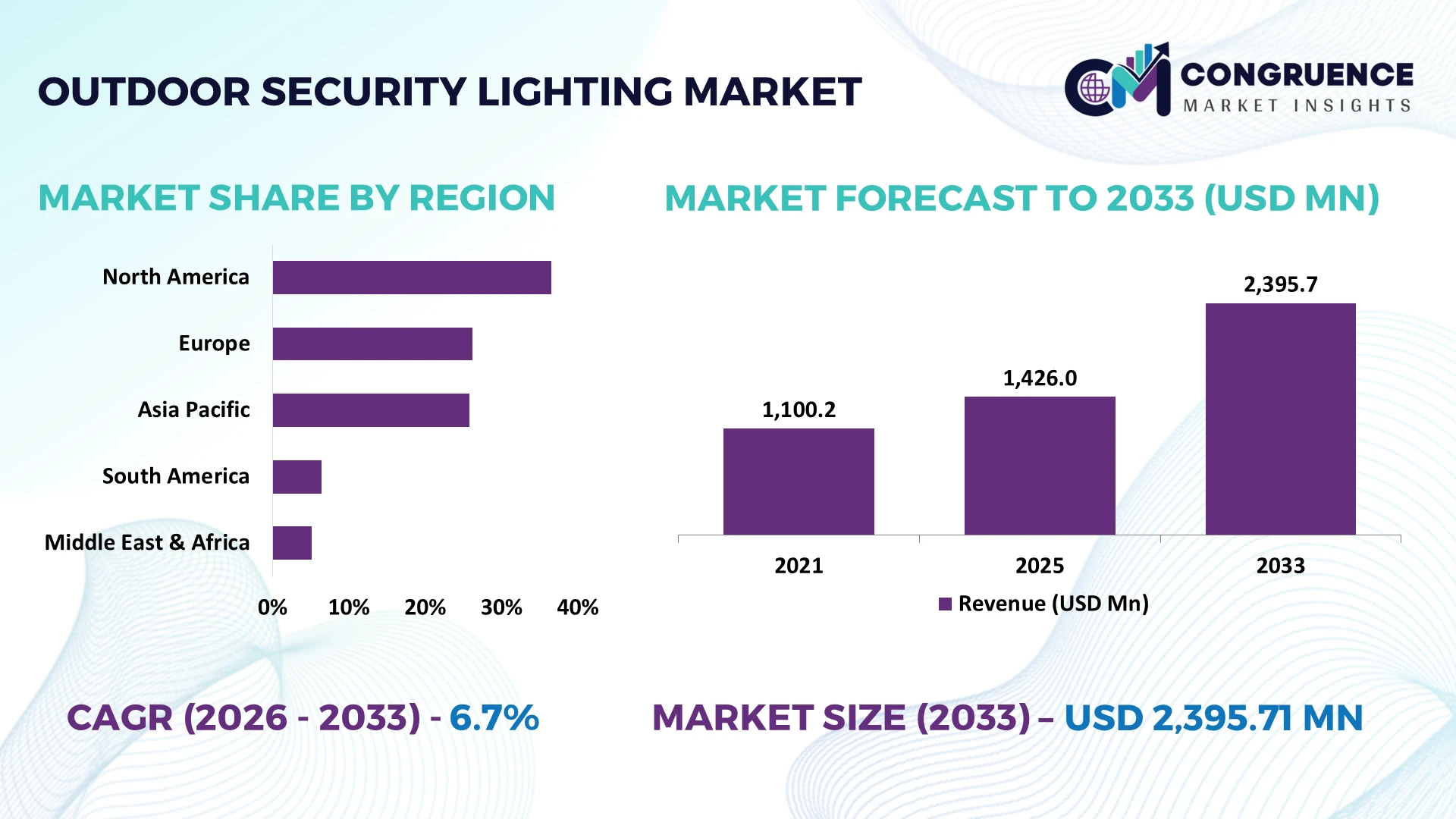
The United States represents the dominant country market, with an estimated 28.5% global share in 2025, supported by infrastructure modernization under the USD 1.2 trillion Bipartisan Infrastructure Law. LED security lighting delivers approximately 75% energy savings compared with incandescent alternatives. Compared with China’s manufacturing-led ecosystem, the United States emphasizes connected security systems across logistics facilities, residential properties, commercial buildings, and critical infrastructure.
Manufacturers must prioritize intelligent lighting controls, surveillance interoperability, and energy-efficient product portfolios to secure high-value infrastructure contracts.
Market Size & Growth: USD 1,426.0 million in 2025, reaching USD 2,395.7 million by 2033 at 6.7% CAGR, driven by intelligent perimeter security modernization.
Top Growth Drivers: LED energy savings (75%), occupancy-based lighting savings (30%), and lighting maintenance reduction potential (40%).
Short-Term Forecast: By 2028, intelligent lighting installations target 20–30% additional electricity savings through adaptive controls.
Emerging Technologies: AI-enabled motion detection, IoT connectivity, and solar-powered systems support 24-hour security coverage.
Regional Leaders: North America (USD 862.5 million), Asia Pacific (USD 742.7 million), and Europe (USD 575.0 million) represent indicative 2033 projections, emphasizing connected, solar, and sustainable lighting, respectively.
Consumer/End-User Trends: Residential consumers increasingly prioritize motion-activated fixtures offering up to 50,000 operating hours.
Pilot/Case Example: Los Angeles' LED streetlight modernization program, initiated in 2009, achieved approximately 63% energy savings.
Competitive Landscape: Signify holds an indicative 12% share, competing with Acuity Brands, LEDVANCE, Eaton, and Hubbell.
Regulatory & ESG Impact: Energy-efficient LED replacements consume at least 75% less electricity than incandescent lighting.
Investment & Funding: The USD 1.2 trillion U.S. infrastructure legislation provides indirect opportunities for public-space lighting modernization.
Innovation & Future Outlook: IP66-rated intelligent floodlights and integrated surveillance platforms accelerate the transition toward automated perimeter protection.
The Outdoor Security Lighting Market is evolving through demand from warehouses, transportation terminals, residential communities, and critical infrastructure facilities. Advanced innovations include camera-integrated floodlights, wireless lighting controllers, and solar-powered motion sensors. LED technology reduces electricity consumption by approximately 75% compared with incandescent lighting, while European energy-efficiency regulations encourage sustainable fixture replacement, positioning intelligent illumination as a strategic security infrastructure component.
Outdoor security lighting is becoming a strategic component of infrastructure protection, operational efficiency, and integrated surveillance ecosystems. Commercial property operators, logistics companies, and public authorities increasingly evaluate lighting infrastructure according to lifecycle costs and security performance rather than illumination alone. Infrastructure modernization and connected building adoption are accelerating the transition toward digitally managed perimeter lighting.
Advanced LED security fixtures consume approximately 75% less electricity than incandescent alternatives, while occupancy-based controls provide additional energy-saving potential of 20–30%, depending on operating conditions. The United States emphasizes surveillance-integrated lighting across commercial and residential properties, whereas China leverages large-scale LED manufacturing and solar lighting production. Between 2026 and 2028, commercial deployments are expected to increasingly incorporate remote monitoring, programmable illumination, and automated fault detection.
For example, logistics facilities can maintain low-intensity perimeter illumination during inactive periods and automatically increase brightness when motion is detected, reducing unnecessary electricity consumption without compromising security coverage. Companies are expanding investments in wireless controllers, weather-resistant luminaires, and security technology partnerships. Competitive leadership will depend on delivering interoperable lighting platforms that combine reliable perimeter protection, measurable operational savings, and scalable infrastructure management.
The replacement of conventional outdoor lighting with energy-efficient LED security fixtures is accelerating across industrial facilities, residential developments, transportation infrastructure, and commercial properties. LED lighting consumes approximately 75% less electricity than incandescent alternatives, while motion-responsive controls can deliver additional energy savings of 20–30%, depending on occupancy patterns. Modernization projects in the United States, supported by federal infrastructure investment, are strengthening demand for durable and remotely managed outdoor luminaires. Warehouse operators increasingly prioritize targeted illumination to reduce electricity expenditure without compromising surveillance visibility. Manufacturers are responding through advanced optical designs, intelligent motion sensors, and partnerships with security system integrators, transforming conventional lighting replacement into a broader perimeter infrastructure upgrade.
The upfront cost of intelligent outdoor security lighting remains a structural constraint for budget-sensitive property owners and infrastructure operators. Even with approximately 75% electricity savings over incandescent alternatives, achieving favorable payback depends heavily on operating hours, installation expenses, and existing electrical infrastructure. For project sensitivity analysis, a 10–15% increase in electronic component costs or a 20% increase in installation expenditure significantly weakens retrofit economics. Dependence on Asian semiconductor and LED component manufacturing exposes international suppliers to procurement disruptions and trade-related cost pressures. Manufacturers are mitigating these constraints through diversified sourcing, modular luminaire designs, regional assembly operations, and standardized mounting systems that reduce installation complexity and replacement expenditure.
The integration of solar power, intelligent motion detection, and connected surveillance creates new commercial opportunities across remote infrastructure, agricultural properties, construction sites, and transportation corridors. Adaptive illumination offers potential electricity savings of 20–30%, while switching compatible installations to standalone solar-powered fixtures eliminates 100% of their direct grid electricity consumption. India's renewable energy expansion and decentralized infrastructure development support opportunities for autonomous perimeter lighting in locations with unreliable electricity access. Camera-integrated floodlights also enable security operators to consolidate illumination and surveillance hardware. Manufacturers are investing in battery management systems, edge-based motion analytics, and wireless communication platforms, creating opportunities for recurring maintenance contracts and remotely managed security lighting services.
Maintaining consistent performance across interconnected outdoor security lighting networks presents a significant execution challenge. Commercial installations increasingly require continuous connectivity, cybersecurity protection, and compatibility with existing surveillance infrastructure. A network availability target of 99.9% still permits approximately 8.8 hours of annual downtime, while a 99.99% target reduces this exposure to approximately 53 minutes. European cybersecurity requirements for connected products are increasing compliance responsibilities for intelligent lighting manufacturers. Inadequate firmware maintenance and proprietary communication protocols create operational vulnerabilities and restrict system expansion. Companies must invest in secure device authentication, standardized communication interfaces, remote diagnostics, and long-term software support to ensure reliable perimeter illumination throughout increasingly complex infrastructure lifecycles.
Modular Fixtures Streamline Maintenance Operations: Manufacturers are introducing replaceable LED drivers, optical modules, and sensor assemblies to simplify field servicing. With LED lifespans reaching 50,000 hours and conventional halogen lamps typically lasting 2,000–4,000 hours, maintenance priorities are shifting toward component replacement. Suppliers are standardizing fixture architectures to minimize inventory requirements and servicing downtime.
Dark Sky Compliance Reshapes Designs: Municipalities and commercial developers are adopting shielded luminaires with color temperatures of 3,000K or below and 0% direct upward light emission where required. Light pollution regulations are encouraging manufacturers to redesign optical systems, limiting unnecessary illumination beyond property boundaries while maintaining effective security coverage and improving planning approval prospects.
Advanced Materials Improve Outdoor Durability: Industrial buyers increasingly specify IP65 and IP66 protection alongside IK08 or IK10 impact resistance for exposed security fixtures. Coastal facilities, transportation terminals, and manufacturing plants are driving demand for corrosion-resistant housings. Companies are expanding accelerated environmental testing and protective coating capabilities to reduce premature fixture failures and warranty liabilities.
Regional Manufacturing Strengthens Supply Resilience: Trade-related procurement pressures are encouraging lighting manufacturers to diversify component sourcing and regional assembly. Standardized 120–277V and 220–240V product configurations simplify international distribution and inventory management. Suppliers are expanding contract manufacturing partnerships and consolidating component platforms, enabling faster order fulfillment while reducing dependence on geographically concentrated production networks.
Motion Sensor Security Lighting accounted for approximately 38.0% of the global market in 2025, supported by widespread deployment across residential entrances, commercial premises, parking facilities, and industrial perimeters. Its dominance reflects automated illumination capabilities, installation flexibility, and lower operating expenditure. Motion-activated systems can reduce electricity consumption by up to 60% compared with continuously operating fixtures, depending on movement frequency. Manufacturers are incorporating passive infrared sensors, adjustable detection zones, and programmable illumination settings to strengthen product differentiation and improve detection accuracy.
Solar Security Lighting, representing approximately 34.0% of the market, is expected to register the fastest growth, driven by expanding off-grid infrastructure and increasing demand for installations without underground electrical cabling. Hardwired Security Lighting remains strategically important across industrial facilities, transportation infrastructure, and high-security establishments requiring dependable power availability. While hardwired systems offer consistent illumination, solar alternatives improve installation flexibility in remote locations. Companies are expanding photovoltaic integration, battery storage capabilities, and weather-resistant product portfolios, shifting investment priorities toward autonomous and adaptable security lighting solutions.
Streets represent the leading application, with an indicative market share of approximately 22.0% in 2025, supported by municipal infrastructure modernization, pedestrian safety requirements, and neighborhood security initiatives. Streets and highways collectively account for approximately 36.0% of outdoor security lighting demand, reflecting extensive public infrastructure deployment. Highway applications prioritize consistent illumination, weather resistance, and reduced maintenance interruptions. Manufacturers are developing precision optical systems and remotely monitored luminaires that enable infrastructure operators to improve visibility while optimizing maintenance schedules.
Parking Lots are expected to experience the fastest growth, supported by expanding logistics infrastructure, commercial complexes, and transportation facilities requiring effective nighttime surveillance. Accounting for approximately 18.0% of market demand, parking facilities increasingly incorporate adaptive illumination to accommodate fluctuating vehicle movement. Stadiums require high-performance lighting around entrances and exterior circulation areas, while tunnels prioritize uninterrupted visibility and emergency readiness. Other applications include public parks, institutional pathways, and specialized infrastructure. Suppliers are expanding application-specific lighting configurations and collaborating with infrastructure contractors to address varying operational requirements, installation conditions, and security standards.
Commercial Enterprises accounted for an estimated 38.0% of the global market in 2025, supported by extensive deployment across shopping centers, hospitality establishments, office complexes, and logistics properties. Commercial buyers prioritize reliable illumination, surveillance compatibility, and lifecycle cost optimization. Motion-responsive lighting can deliver additional electricity savings of approximately 20–30%, depending on occupancy patterns and control configurations. Residential Consumers represent another established buyer group, emphasizing affordable installation, automated operation, and property protection. Manufacturers are targeting these customers through differentiated product configurations, professional distribution channels, and simplified installation capabilities.
Government and Public Sector Organizations are expected to register the fastest growth, supported by infrastructure modernization, public safety programs, and increasingly stringent energy-efficiency procurement requirements. LED replacements can reduce electricity consumption by approximately 75% compared with incandescent alternatives, strengthening public-sector investment economics. Industrial Enterprises remain significant purchasers because manufacturing plants, warehouses, and energy facilities require durable perimeter illumination under demanding environmental conditions. Companies are strengthening institutional partnerships, developing customized industrial fixtures, and expanding maintenance service capabilities to capture long-term procurement contracts and recurring infrastructure replacement demand.
North America accounted for the largest market share at 36.5% in 2025 however, Asia Pacific is expected to register the fastest growth, expanding at a CAGR of 8.2% between 2026 and 2033.
North America accounted for 36.5% of the global Outdoor Security Lighting Market in 2025, supported by extensive commercial infrastructure, advanced residential security systems, and established industrial safety requirements. Warehouse operators, transportation authorities, and commercial property managers increasingly prioritize integrated lighting and surveillance platforms to strengthen perimeter protection. Municipal modernization programs are accelerating the replacement of conventional outdoor fixtures with energy-efficient LED luminaires. Los Angeles has converted more than 140,000 streetlights to LED technology through its modernization initiative, demonstrating the operational scale of public lighting upgrades. Canada is strengthening demand through commercial construction, transportation infrastructure, and energy-efficient building development. Manufacturers are expanding intelligent lighting portfolios, professional installation networks, and security technology partnerships. Regional procurement increasingly emphasizes lifecycle performance, remote diagnostics, weather resistance, and compatibility with existing security management infrastructure.
United States Market Outlook: The United States dominates regional demand through its extensive logistics infrastructure, residential security ecosystem, and commercial property network. The USD 1.2 trillion Bipartisan Infrastructure Law supports broader transportation and public infrastructure modernization, creating indirect opportunities for outdoor security lighting deployment. Manufacturers are targeting industrial campuses, distribution centers, and residential properties through customizable illumination systems and integrated security solutions.
Europe accounted for 26.2% of the global Outdoor Security Lighting Market in 2025, driven by energy-efficiency regulations, municipal infrastructure modernization, and sustainable commercial building practices. Germany, France, and the United Kingdom are strengthening demand for precision-controlled outdoor luminaires that balance security requirements with environmental performance. The European Union's revised Energy Efficiency Directive establishes an 11.7% energy consumption reduction target by 2030 against projected consumption, encouraging efficient infrastructure upgrades. Municipal authorities increasingly specify shielded fixtures, programmable illumination schedules, and reduced light spill to address environmental concerns. Industrial facilities prioritize durable lighting systems with standardized communication interfaces and replaceable components. Manufacturers are investing in recyclable materials, advanced optical designs, and modular product architectures. Competitive differentiation increasingly depends on regulatory compliance, product serviceability, and documented lifecycle environmental performance rather than initial installation cost alone.
Germany Market Outlook: Germany represents a strategically significant market through its advanced manufacturing infrastructure, automotive production facilities, and established electrical engineering industry. The country's Climate Action Act targets at least a 65% reduction in greenhouse gas emissions by 2030 compared with 1990 levels. Industrial operators are prioritizing energy-efficient perimeter illumination, while manufacturers are developing application-specific luminaires for automated factories, logistics terminals, and commercial establishments.
Asia Pacific accounted for 25.8% of the global Outdoor Security Lighting Market in 2025, supported by rapid urbanization, competitive electronics manufacturing, and expanding transportation infrastructure. China, India, Japan, and South Korea represent major demand centers, combining large-scale infrastructure deployment with advanced lighting technology development. India's Street Lighting National Programme has facilitated the installation of more than 13 million LED streetlights, demonstrating the scale of public lighting modernization. Industrial parks, logistics facilities, residential developments, and transportation corridors increasingly require reliable perimeter illumination. Regional manufacturers benefit from established semiconductor, photovoltaic, and electronic component supply chains, enabling competitive production costs and accelerated product development. Suppliers are expanding solar-powered lighting portfolios, automated manufacturing capabilities, and local distribution partnerships. Infrastructure expansion and affordable intelligent lighting systems are strengthening adoption across both metropolitan and underserved locations.
China Market Outlook: China maintains a significant competitive advantage through its integrated LED manufacturing ecosystem, electronic component availability, and extensive infrastructure development. The country's urbanization rate reached approximately 67% in 2024, supporting continued investment in residential communities, transportation facilities, and industrial parks. Domestic manufacturers leverage vertically integrated production, automated assembly, and photovoltaic supply chains to deliver cost-competitive outdoor security lighting systems for domestic and international markets.
South America accounted for 6.4% of the global Outdoor Security Lighting Market in 2025, supported by urban infrastructure upgrades, commercial property development, and increasing investment in public safety systems. Brazil, Argentina, and Chile represent important deployment markets, with municipalities prioritizing energy-efficient lighting across streets, public spaces, and transportation facilities. São Paulo's public lighting modernization concession covers more than 600,000 lighting points, illustrating the scale of infrastructure replacement opportunities. Commercial establishments and industrial operators increasingly require durable perimeter lighting to improve nighttime visibility and operational security. However, currency volatility, imported electronic component costs, and uneven municipal financing constrain deployment consistency. Manufacturers are responding through regional distribution partnerships, competitively priced LED fixtures, and simplified installation designs. Public-private infrastructure partnerships and modular replacement programs provide practical mechanisms for expanding security lighting coverage while managing capital expenditure limitations.
Brazil Market Outlook: Brazil leads regional demand through its extensive urban population, industrial infrastructure, and commercial development activity. Approximately 87% of the country's population resides in urban areas, creating substantial requirements for residential, commercial, and public-space security illumination. Domestic suppliers and international manufacturers are targeting municipal concession projects, retail establishments, and logistics facilities through weather-resistant luminaires and energy-efficient retrofit solutions.
The Middle East & Africa accounted for 5.1% of the global Outdoor Security Lighting Market in 2025, supported by large-scale infrastructure development, industrial security requirements, and expanding urban construction. Saudi Arabia, the United Arab Emirates, and South Africa represent strategically important markets, with demand concentrated across commercial developments, transportation terminals, energy facilities, and residential communities. Dubai's 2040 Urban Master Plan targets a 105% increase in land allocated to public beaches, creating additional requirements for safe and sustainable outdoor infrastructure. Harsh climatic conditions encourage procurement of heat-resistant, dust-protected, and corrosion-resistant luminaires. African markets increasingly prioritize autonomous solar-powered security lighting where grid reliability remains limited. Manufacturers are strengthening regional contractor partnerships, developing climate-specific product configurations, and expanding standalone lighting portfolios. Long-term competitiveness depends on environmental durability, installation flexibility, and dependable after-sales support across geographically dispersed infrastructure projects.
Saudi Arabia Market Outlook: Saudi Arabia is strengthening market demand through Vision 2030 infrastructure development, industrial diversification, and tourism expansion. The country targets 150 million annual tourist visits by 2030, supporting investment in hospitality facilities, transportation infrastructure, and public-space development. Security lighting manufacturers are targeting large construction contractors and infrastructure developers through high-temperature-resistant fixtures, intelligent illumination controls, and customized perimeter protection systems.
The Outdoor Security Lighting Market exhibits moderate fragmentation, with Signify, Acuity Brands, LEDVANCE, Eaton, and Hubbell collectively accounting for an estimated 38% of global demand. Established lighting manufacturers compete against regional suppliers and smart security specialists through optical performance, pricing, distribution coverage, and system interoperability. LED fixtures deliver approximately 75% electricity savings compared with incandescent alternatives, while adaptive controls offer additional savings of 20–30%, strengthening lifecycle cost differentiation. Signify emphasizes connected lighting ecosystems, while Acuity Brands and Hubbell prioritize commercial infrastructure applications and specification driven procurement. Regional manufacturers compete through affordable solar fixtures, localized assembly, and flexible distribution arrangements. Strategic partnerships with surveillance providers and electrical contractors are expanding integrated security offerings. Competition is shifting from standalone luminaires toward connected, serviceable perimeter protection systems. Certification requirements, environmental durability testing, and established contractor relationships restrict market entry. Winning requires dependable product performance, competitive lifecycle economics, scalable distribution, and seamless security system integration.
Signify N.V.
Acuity Brands, Inc.
LEDVANCE GmbH
Eaton Corporation plc
Hubbell Incorporated
Legrand S.A.
Zumtobel Group AG
Dialight plc
RAB Lighting Inc.
LSI Industries Inc.
Fagerhult Group
STEINEL GmbH
Ring LLC
Cree Lighting
Advanced LED technology dominates outdoor security illumination, delivering approximately 75% lower electricity consumption than incandescent lighting and operational lifespans approaching 50,000 hours. Precision optical systems improve illumination uniformity while minimizing unnecessary light dispersion. Commercial facilities and municipal infrastructure operators increasingly specify IP65 and IP66 rated luminaires, strengthening demand for environmentally protected fixtures. Modular LED drivers and replaceable components improve maintenance flexibility, allowing operators to address individual failures without replacing complete lighting assemblies.
Intelligent motion detection, wireless connectivity, and edge computing are transforming security lighting into responsive infrastructure. Occupancy based controls offer additional electricity savings of 20–30%, depending on movement patterns and operating schedules. Camera integrated floodlights combine surveillance and illumination within unified installations, reducing hardware duplication. Commercial security providers benefit from centralized monitoring, automated alerts, and programmable lighting configurations that improve operational responsiveness across geographically distributed properties.
Between 2026 and 2028, autonomous solar lighting, advanced battery management, and interoperable control platforms will increasingly influence procurement decisions. Standalone solar fixtures eliminate 100% of direct grid electricity consumption where deployment conditions permit. Manufacturers integrating photovoltaic modules, intelligent charging algorithms, and remote diagnostics gain advantages in underserved infrastructure markets. Competitive differentiation increasingly depends on reliable connectivity, cybersecurity, environmental durability, and measurable lifecycle savings across demanding environments.
May 2026, Ring introduced its second-generation Floodlight Cam, combining 2K video resolution with 2,000-lumen illumination. The launch extends advanced surveillance capabilities to more affordable residential security products, strengthening the company's competitive positioning across North American, European, and international consumer markets. Source: blog.ring.com
September 2025, Signify introduced its SunStay Pro gen2 solar streetlighting portfolio, featuring a compact model manufactured using 80% recycled aluminum housing material. The introduction strengthens its sustainable outdoor lighting portfolio while supporting motion-responsive illumination across campuses, pedestrian areas, and public infrastructure. Source: signify.com
May 2025, Dialight partnered with Swivelpole to integrate industrial LED luminaires with lowering-pole technology featuring a patented 45-degree joint. The collaboration enables ground-level fixture maintenance, reducing elevated working risks and improving servicing accessibility across industrial facilities and outdoor lighting installations. Source: dialight.com
September 2024, Acuity Brands expanded its Hydrel SAF outdoor floodlight portfolio through a 100-degree beam distribution option, bringing available configurations to 13. The expansion improves specification flexibility for exterior pathways and building facades, strengthening the company's positioning within professional outdoor illumination. Source: acuitybrands.com
The Outdoor Security Lighting Market Report provides comprehensive analysis across three product categories: Motion Sensor Security Lighting, Solar Security Lighting, and Hardwired Security Lighting. Application coverage includes Streets, Highways, Parking Lots, Stadiums, Tunnels, and Others, alongside end-user analysis encompassing Commercial Enterprises, Residential Consumers, Industrial Enterprises, and Government and Public Sector Organizations. Geographic assessment covers North America, Europe, Asia Pacific, South America, and the Middle East & Africa.
The report evaluates competitive positioning, technological innovation, regulatory developments, procurement patterns, and infrastructure modernization opportunities. Key technology coverage includes LED illumination, intelligent motion detection, solar power integration, wireless connectivity, and surveillance-compatible lighting systems. Strategic assessment supports investment planning, product portfolio optimization, geographic expansion, and distribution development. The report identifies emerging opportunities across autonomous security lighting, connected perimeter protection, and energy-efficient infrastructure modernization between 2026 and 2033.
| Report Attribute / Metric | Details |
|---|---|
| Market Revenue (2025) | USD 1,426.0 Million |
| Market Revenue (2033) | USD 2,395.7 Million |
| CAGR (2026–2033) | 6.7% |
| Base Year | 2025 |
| Forecast Period | 2026–2033 |
| Historic Period | 2021–2025 |
| Segments Covered |
By Type
By Application
By End-User
|
| Key Report Deliverables | Revenue Forecast; Market Trends; Growth Drivers & Restraints; Technology Insights; Segmentation Analysis; Regional Insights; Competitive Landscape; Regulatory & ESG Overview; Recent Developments |
| Regions Covered | North America; Europe; Asia-Pacific; South America; Middle East & Africa |
| Key Players Analyzed | Signify N.V.; Acuity Brands, Inc.; LEDVANCE GmbH; Eaton Corporation plc; Hubbell Incorporated; Legrand S.A.; Zumtobel Group AG; Dialight plc; RAB Lighting Inc.; LSI Industries Inc.; Fagerhult Group; STEINEL GmbH; Ring LLC; Cree Lighting |
| Customization & Pricing | Available on Request (10% Customization Free) |




