
Reports
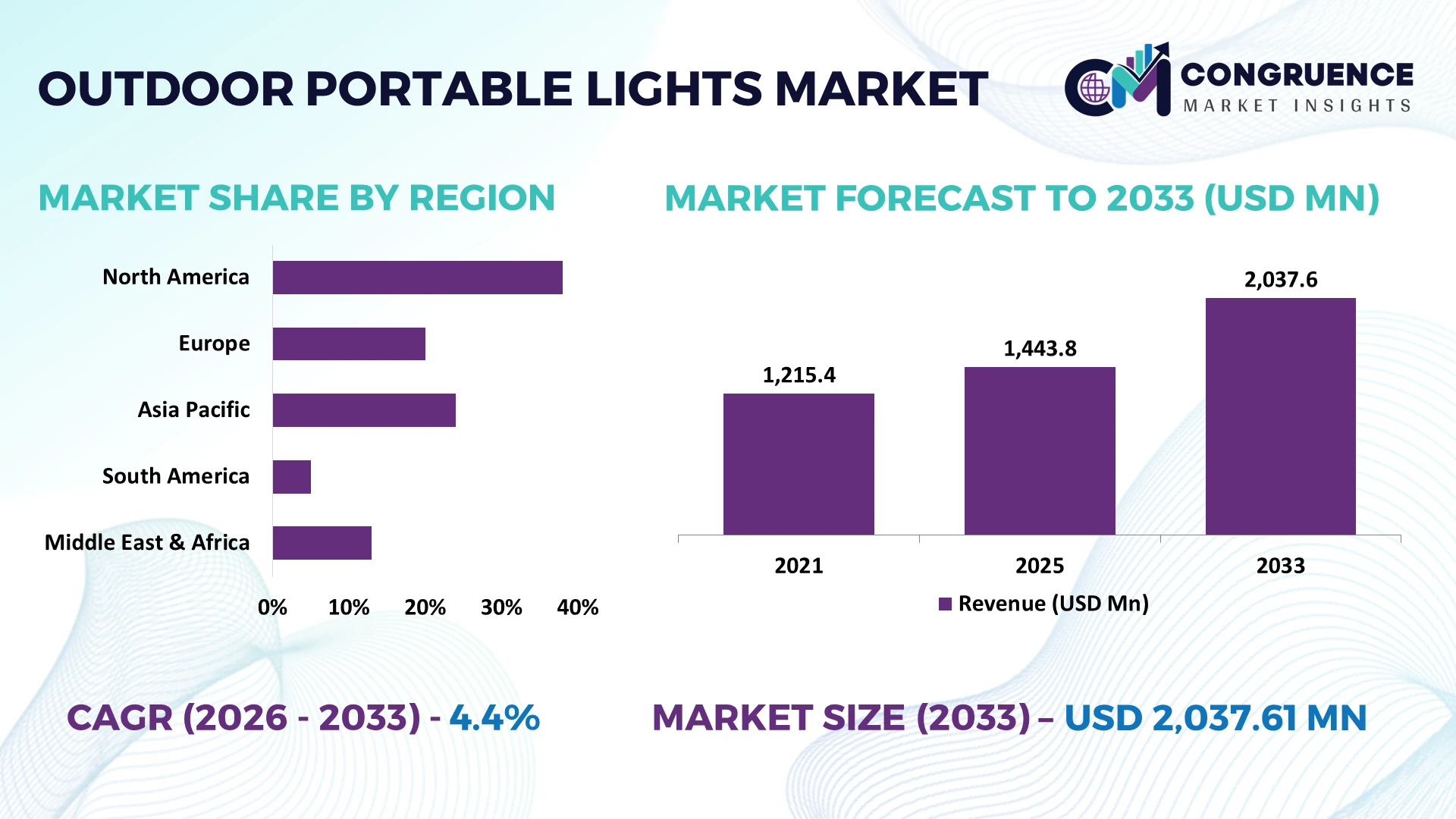
The Global Outdoor Portable Lights Market was valued at USD 1443.83 Million in 2025 and is anticipated to reach a value of USD 2037.61 Million by 2033 expanding at a CAGR of 4.4% between 2026 and 2033. Growth is driven by rechargeable LED conversion, USB-C battery ecosystems, higher outdoor recreation participation, emergency-preparedness purchases, and demand for lightweight high-lumen lanterns, headlamps, and flashlights across camping, hiking, construction, fishing, and off-grid applications.
The United States remains the dominant demand center, supported by 183.2 million outdoor-recreation participants in 2025, representing 59% of Americans aged six and older. The U.S. outdoor recreation economy generated USD 696.7 billion in value added during 2024, while retail trade contributed 24.3%, creating a powerful distribution base for premium rechargeable lanterns, headlamps, work lights, and tactical portable lighting. China provides the strongest scale comparison, with its outdoor-sports industry targeted above CNY 3 trillion and policy supporting up to 100 outdoor-sports destinations by 2030. While the U.S. leads premium consumption, China combines large-scale lighting manufacturing with rapidly expanding domestic outdoor infrastructure; continuing U.S.–China trade realignment reinforces the strategic value of diversified sourcing.
Manufacturers should prioritize rechargeable platforms, longer runtime, higher lumen-per-watt performance, and geographically diversified supply chains to defend margins while capturing premium outdoor and professional-lighting demand.
Market Size & Growth: USD 1,443.83 million in 2025 advances to USD 2,037.61 million by 2033 at 4.4% CAGR, supported by rechargeable LED replacement, outdoor recreation participation, and portable emergency-lighting adoption.
Top Growth Drivers: Outdoor participation reaching 59% of the U.S. population, LED efficacy gains exceeding 80% versus traditional incandescent lighting, and rechargeable battery platforms eliminating repeated disposable-battery purchases are strengthening replacement demand.
Short-Term Forecast: By 2028, advanced LED and battery-management integration is positioned to improve practical runtime by approximately 15–25% across premium portable lights while intelligent power modes reduce unnecessary energy consumption.
Emerging Technologies: USB-C fast charging, intelligent battery-management systems, COB LEDs, solar-assisted charging, motion sensing, and adaptive brightness are shifting outdoor portable lighting from basic illumination toward multifunctional energy-managed devices.
Regional Leaders: North America remains the premium consumption hub, Asia-Pacific anchors manufacturing scale, and Europe leads sustainability-oriented product adoption; rechargeable formats increasingly displace disposable-battery models across all three advanced lighting markets.
Consumer/End-User Trends: U.S. outdoor participation reached 183.2 million people, or 59% of the eligible population, expanding the addressable customer base for headlamps, camping lanterns, rechargeable flashlights, and emergency lighting.
Pilot/Case Example: In 2025, China's outdoor-sports development push targeted an industry exceeding CNY 3 trillion, strengthening campsite, hiking, tourism, and outdoor-equipment ecosystems that directly expand portable illumination use cases.
Competitive Landscape: Signify, Ledlenser, Black Diamond Equipment, Goal Zero, Coleman, Fenix, and Streamlight compete through lumen output, IP-rated durability, battery runtime, weight reduction, charging compatibility, and specialized outdoor or professional positioning.
Regulatory & ESG Impact: LED technology delivers energy savings approaching 75% compared with incandescent lighting, while rechargeable batteries reduce dependence on single-use cells, making energy efficiency, repairability, and battery lifecycle management increasingly important product-development criteria.
Investment & Funding: China's broader sports industry is targeted to exceed CNY 7 trillion by 2030, alongside public funding and infrastructure expansion, strengthening downstream opportunities for portable lighting suppliers serving outdoor venues, tourism, camping, and recreation.
Innovation & Future Outlook: Smart power management, modular rechargeable batteries, solar integration, sensor-controlled output, and increasingly compact high-lumen LEDs will shift competition from maximum brightness toward runtime-per-gram, charging speed, durability, and ecosystem compatibility.
The Outdoor Portable Lights Market is increasingly centered on rechargeable headlamps, camping lanterns, tactical flashlights, and portable work lights, with 59% U.S. outdoor participation reinforcing a broad user base. USB-C charging, COB LEDs, intelligent power management, and solar-assisted products are accelerating replacement cycles. Supply-chain diversification beyond concentrated Asian manufacturing is simultaneously making battery sourcing and component standardization strategically important, setting up the market’s broader strategic priorities.
Outdoor portable lighting is becoming strategically important as manufacturers compete on runtime, charging architecture, durability, and ecosystem compatibility rather than lumen output alone. U.S. outdoor participation has reached roughly 59% of the eligible population, widening the installed user base for headlamps, lanterns, and rechargeable flashlights. Simultaneously, supply-chain restructuring is encouraging brands to reduce dependence on concentrated Chinese battery-cell, LED, and electronics sourcing.
Technology economics strengthen this transition. Modern LEDs consume approximately 75% less energy and can last up to 25 times longer than incandescent alternatives, while lithium-ion rechargeable systems eliminate recurring disposable-cell replacement. The United States emphasizes premium, professional, and recreational products; China combines manufacturing scale with an outdoor-sports industry targeted above CNY 3 trillion, supporting high-volume deployment and faster product commercialization.
A practical example is multi-day camping, where USB-C rechargeable lanterns now combine lighting, power-bank functionality, and adaptive output in one platform, reducing equipment complexity. Through 2028, intelligent battery management, solar-assisted charging, replaceable cells, and higher-efficiency LEDs will increasingly define premium specifications. Suppliers are investing in battery partnerships, diversified assembly, and ruggedized designs. Competitive advantage will therefore depend on controlling energy efficiency, component availability, charging interoperability, and field reliability simultaneously.
Rechargeable LED adoption is the strongest structural driver as consumers and professional users shift away from disposable-cell and incandescent portable lighting. LEDs use approximately 75% less energy than incandescent alternatives and can operate up to 25 times longer, while modern lithium-ion platforms support hundreds of charging cycles. U.S. outdoor participation at approximately 59% of the eligible population expands recurring demand across camping, hiking, fishing, emergency preparedness, and trail activities. USB-C standardization is simultaneously simplifying charging across phones, power banks, headlamps, and lanterns. Manufacturers including outdoor-equipment and professional-lighting brands are responding with integrated battery management, multiple brightness modes, fast charging, and modular power systems. The strategic advantage is shifting from maximum lumen claims toward usable runtime, charging convenience, and lifetime operating cost.
Portable-light manufacturers remain exposed to lithium-ion cells, LEDs, electronic drivers, magnets, and processed battery-material supply chains concentrated in Asia. China accounts for more than 75% of global battery-cell manufacturing capacity and dominates several downstream battery-material processing stages, creating procurement concentration for rechargeable-light producers. Lithium prices have also demonstrated swings exceeding 50% across recent commodity cycles, complicating battery-cost planning and inventory valuation. Trade measures affecting Chinese batteries and electronic components further increase landed-cost uncertainty for U.S.-focused brands. These pressures directly compress margins in entry-level lanterns and flashlights where component costs represent a larger proportion of selling prices. Companies are countering exposure through dual sourcing, Southeast Asian assembly, longer supplier contracts, standardized battery formats, and inventory buffers. Procurement resilience is consequently becoming as important as product differentiation.
The strongest opportunity lies in transforming portable lights into multifunctional off-grid energy platforms integrating illumination, solar charging, sensors, power-bank functionality, and intelligent battery management. Solar photovoltaic module prices have declined by more than 80% since 2010, improving the economics of compact solar-assisted lanterns, while LED technology delivers approximately 75% energy savings against incandescent lighting. India presents an additional opportunity because hundreds of millions of consumers participate in expanding domestic tourism, trekking, camping, roadside commerce, and distributed work environments where dependable portable power remains valuable. Adaptive brightness and occupancy sensing can further extend practical runtime by 20% or more in suitable operating modes. Suppliers are expanding R&D around lightweight photovoltaics, USB-C power delivery, replaceable batteries, and connected diagnostics. The non-obvious opportunity is monetizing portable lighting as a small-scale energy-management device rather than a standalone illumination product.
The long-term challenge is delivering advertised brightness, runtime, ingress protection, and battery safety consistently under real outdoor conditions. Lithium-ion performance can decline by approximately 20% or more in severe cold, while high-output LEDs convert significant electrical input into heat that must be dissipated from increasingly compact housings. Battery capacity can also fall toward 80% of original performance after hundreds of charge cycles, depending on chemistry, temperature, and charging behavior. These characteristics create a widening gap between laboratory specifications and field performance across hiking, emergency response, construction, and expedition applications. Brands therefore face warranty, reputation, and certification pressure as products become more powerful. Manufacturers must invest in thermal management, battery-health algorithms, IP-rated enclosures, accelerated lifecycle testing, and replaceable-cell architectures. Sustained competitiveness will depend on verified usable performance, not headline lumen specifications.
Runtime Replaces Peak Brightness Competition: Product positioning is moving from headline lumen output toward sustained illumination and usable battery duration. Premium models increasingly offer 5–10 operating modes, while adaptive dimming can extend runtime by 20–40% under variable use. Manufacturers are recalibrating LED drivers, thermal controls, and battery-management software to deliver predictable output, reducing overheating-related throttling and strengthening premium differentiation.
USB-C Consolidates Charging Architecture: USB-C is rapidly replacing proprietary connectors and micro-USB across rechargeable headlamps, lanterns, and work lights, with USB Power Delivery supporting up to 240 W under the latest specification. Standardized charging reduces cable inventories and enables shared power banks across outdoor equipment. Brands are redesigning product families around common charging electronics, lowering accessory complexity while accelerating platform-based product launches.
Ruggedization Moves Into Mainstream Products: IP67 and IP68 protection, impact-resistant polymers, and aluminum housings are expanding beyond professional flashlights into recreational products. IP67 designs withstand temporary immersion at depths up to 1 meter, while selected professional lights target drop resistance around 1–2 meters. Companies are strengthening enclosure engineering and testing as extreme-weather preparedness and demanding jobsite use raise reliability expectations.
Repairability Reshapes Product Engineering: European battery regulation is pushing manufacturers toward replaceability, lifecycle documentation, and improved battery accountability, with portable-battery removability requirements applying from 2027. Rechargeable cells commonly retain around 80% capacity after hundreds of cycles, making serviceable architectures commercially relevant. Brands are redesigning housings, battery compartments, and component access, shifting premium competition toward lifecycle value and lower replacement frequency.
Flashlights account for approximately 35% of Outdoor Portable Lights Market demand, maintaining leadership through broad household, security, automotive, camping, and professional applications. Their established distribution base, compact architecture, replaceable or rechargeable battery compatibility, and output spanning basic illumination to 1,000-plus-lumen professional products sustain scale advantages. Lanterns represent another mature category, particularly for campsite and emergency-area illumination, while area lights increasingly address wider stationary coverage requirements.
Headlamps are the fastest-growing type as hands-free illumination becomes essential for hiking, trail running, maintenance, rescue, and technical work. U.S. outdoor participation reaching roughly 59% of the eligible population expands the addressable recreational base, while LED systems consuming around 75% less energy than incandescent technology support longer wearable runtime. Work lights remain strategically important in construction and industrial maintenance, where magnetic mounts, adjustable beams, and rechargeable packs improve task flexibility. Manufacturers are prioritizing lighter headlamps, modular batteries, higher-output work lights, and multifunctional lanterns, shifting R&D investment toward application-specific performance rather than undifferentiated brightness.
Camping & Hiking represents the leading application, accounting for approximately 32% of market demand as portable illumination remains essential for overnight navigation, campsite setup, cooking, and trail safety. Rechargeable lanterns and headlamps increasingly replace disposable-battery products, while modern LEDs use approximately 75% less energy than incandescent alternatives. Outdoor Recreation provides adjacent demand across fishing, cycling, climbing, and overlanding, encouraging brands to develop lighter, weather-resistant products with multiple output modes and integrated charging.
Emergency Lighting is the fastest-growing application as extreme-weather preparedness, grid disruptions, and household resilience programs increase requirements for stored, immediately deployable illumination. Products combining 20–40-hour low-output runtime, USB charging, power-bank functionality, and solar replenishment are strengthening this use case. Construction Work remains concentrated around rugged work lights and area lights, while Security & Safety prioritizes high-intensity beams, reliability, and rapid deployment. Manufacturers are responding with emergency-ready product bundles, intelligent battery indicators, IP-rated housings, and specialized professional platforms, directing investment toward applications where illumination availability is operationally critical.
Outdoor Enthusiasts represent the largest end-user group at approximately 34% of demand, supported by frequent replacement, performance upgrades, and multi-device ownership across camping, hiking, fishing, climbing, trail running, and overlanding. With roughly 59% of eligible Americans participating in outdoor recreation, brands have a substantial installed customer base for headlamps, flashlights, and lanterns. Households form a mature segment focused on emergency preparedness, vehicle storage, garden use, and general-purpose illumination, where affordability and battery simplicity remain central purchasing criteria.
Emergency Services represent the fastest-growing buyer group as responders require high-output, waterproof, impact-resistant lighting for disaster response, roadside incidents, firefighting support, and search operations. Professional products increasingly target IP67/IP68 protection and approximately 1–2-meter impact resistance. Construction Companies prioritize rechargeable work and area lights that reduce cable dependence, while Industrial Facilities require inspection lighting, magnetic mounting, and task-specific beam control. Suppliers are differentiating professional portfolios through fleet charging, replaceable batteries, warranty support, and standardized battery ecosystems, while consumer brands compete through bundled pricing and lightweight designs. Procurement is consequently separating into value-focused household platforms and specification-driven professional systems.
North America accounted for the largest market share at approximately 34% in 2025 however, Asia-Pacific is expected to register the fastest growth, expanding at a CAGR of approximately 5.5% between 2026 and 2033.
Premium Rechargeable Systems Reshape Product Mix
North America holds approximately 34% of global demand, supported by high outdoor participation, emergency-preparedness spending, established specialty retail, and professional adoption across construction and public safety. U.S. outdoor participation reached 183.2 million people in 2025, representing approximately 59% of the population aged six and above, creating substantial recurring demand for headlamps, lanterns, and flashlights. Product portfolios are moving toward USB-C rechargeable batteries, IP67/IP68 protection, adaptive brightness, and multi-function emergency platforms. Construction and maintenance users increasingly favor cordless work lights compatible with existing tool-battery ecosystems, allowing fewer chargers and batteries across jobsites. Extreme-weather preparedness is also strengthening household demand for long-runtime lanterns. Suppliers are consequently separating consumer and professional portfolios, emphasizing lightweight designs for recreation while developing higher-output, replaceable-battery platforms for industrial users.
United States Market Outlook: The United States anchors regional commercialization through large specialty-retail networks, professional tool ecosystems, and a highly active outdoor consumer base. Outdoor recreation contributed approximately 2.4% of national GDP in 2024. Premium suppliers increasingly differentiate through verified runtime, rugged housings, rechargeable architectures, and warranties rather than competing primarily on maximum brightness.
Battery Regulation Accelerates Product Redesign
Europe accounts for approximately 25% of global Outdoor Portable Lights Market demand, with Germany, the United Kingdom, France, and Nordic countries supporting strong penetration of rechargeable recreational and professional products. The structural shift is regulatory: EU battery rules introduce portable-battery removability and replaceability requirements from 2027, directly influencing enclosure architecture, servicing, and product lifecycle strategies. USB-C adoption across consumer electronics is simultaneously reinforcing user expectations for interoperable charging in portable lighting. Hiking, cycling, camping, industrial maintenance, and emergency preparedness sustain a diversified application base, while sustainability requirements favor longer-lived LEDs and serviceable batteries. Suppliers are redesigning premium lanterns and flashlights around replaceable cells, recyclable materials, and improved battery documentation. This creates an operational advantage for manufacturers capable of integrating regulatory compliance early without increasing product weight or compromising ingress protection.
Germany Market Outlook: Germany combines a large outdoor-equipment customer base with advanced industrial and trades demand for professional lighting. Its manufacturing and construction users favor robust rechargeable work lights with standardized batteries, magnetic mounting, and high ingress protection. EU 2027 battery requirements strengthen Germany’s role as an early commercialization market for repairable, replaceable-cell lighting architectures.
Manufacturing Scale Meets Expanding Outdoor Demand
Asia-Pacific represents approximately 29% of global demand while maintaining the strongest manufacturing concentration for LEDs, lithium-ion cells, electronic drivers, housings, and finished portable lights. China provides the region’s core production ecosystem, while Vietnam and India are gaining assembly relevance as brands diversify supply chains. China’s outdoor-sports industry has been targeted to exceed CNY 3 trillion, accompanied by development of approximately 100 high-quality outdoor-sports destinations by 2030, expanding domestic demand for camping lanterns and headlamps alongside export production. Japan and South Korea emphasize compact, technologically advanced rechargeable products, while India offers growing demand across trekking, construction, emergency preparedness, and distributed infrastructure. Manufacturers are using China's component density for rapid product iteration while establishing secondary sourcing elsewhere, creating a dual strategy combining manufacturing efficiency with geopolitical resilience.
China Market Outlook: China remains strategically decisive because it combines LED production, battery manufacturing, electronics integration, tooling, and high-volume assembly within dense supplier clusters. China holds more than three-quarters of global battery-cell manufacturing capacity, giving portable-light producers substantial procurement advantages. Domestic outdoor-infrastructure expansion is additionally converting an export-oriented manufacturing base into a meaningful consumption platform.
Outdoor Tourism and Utility Needs Converge
South America represents approximately 6% of global demand, with Brazil, Argentina, Chile, and Colombia generating requirements across camping, ecotourism, construction, agriculture, security, and emergency lighting. Brazil provides the largest consumer and industrial base, while Chile's extensive trekking and mining activities support specialized rugged-lighting applications. Portable rechargeable products have particular operational relevance in remote worksites and locations where grid access or dependable fixed lighting remains constrained. Falling LED energy requirements and broader availability of lithium-ion products are improving total ownership economics, although imported components, currency volatility, and fragmented distribution constrain premium-product penetration. Brands are therefore emphasizing mid-priced rechargeable lanterns, durable flashlights, and solar-assisted products rather than exclusively premium specifications. Distributor partnerships and localized inventories are becoming important for reducing import lead times and improving replacement availability.
Brazil Market Outlook: Brazil combines the region's largest population with extensive construction, agriculture, outdoor tourism, and emergency-management requirements. Renewable electricity supplies more than 80% of the country's power generation, creating strong familiarity with lower-carbon energy technologies. Portable-light suppliers can differentiate through solar-compatible charging, localized distribution, weather resistance, and accessible replacement components.
Infrastructure Expansion Broadens Professional Deployment
Middle East & Africa accounts for approximately 6% of global demand, with portable lighting increasingly deployed across construction, oil and gas, mining, tourism, security, humanitarian operations, and off-grid communities. Saudi Arabia and the UAE concentrate premium construction and outdoor-recreation requirements, while South Africa anchors industrial, mining, and household backup-light demand. Saudi Arabia's large tourism and infrastructure pipeline is expanding requirements for portable work lights and outdoor illumination across construction sites and desert-recreation environments. In Africa, distributed solar systems create an additional pathway for rechargeable and solar-assisted lanterns where electricity reliability remains uneven. Suppliers are differentiating products through dust resistance, thermal management, extended runtime, and solar compatibility. Partnerships with industrial distributors, construction contractors, humanitarian organizations, and energy-access networks provide a more effective deployment route than conventional consumer retail alone.
Saudi Arabia Market Outlook: Saudi Arabia is emerging as the region's strategically significant premium market as large construction, tourism, entertainment, and outdoor projects increase professional portable-light requirements. The Kingdom surpassed 100 million tourist visits ahead of its original 2030 target, reinforcing demand around camps, desert tourism, events, infrastructure projects, and mobile service operations.
The Outdoor Portable Lights Market pits specialized leaders such as Ledlenser, Streamlight, Fenix, Black Diamond Equipment, and Goal Zero against diversified outdoor brands including Coleman and professional tool suppliers. The top five players collectively control approximately 28% of demand, leaving substantial space for regional and private-label competition. Premium brands compete through beam control, battery management, ingress protection, and warranties, while cost-focused manufacturers leverage Chinese component ecosystems and high-volume assembly. Advanced LED platforms deliver roughly 75% lower energy consumption than incandescent systems, while adaptive output can extend usable runtime by 20–40%. Companies are introducing USB-C architectures, replaceable batteries, solar integration, and shared battery platforms while diversifying assembly toward Vietnam and other Asian manufacturing hubs. Competition is shifting from maximum lumen ratings toward verified runtime, serviceability, charging interoperability, and supply resilience. Battery quality, thermal engineering, certification, and distribution access remain significant entry barriers. Winning requires reliable field performance, efficient sourcing, differentiated power architecture, and application-specific product engineering.
Ledlenser
Streamlight
Fenix Lighting
Black Diamond Equipment
Goal Zero
Coleman
Coast Products
Nitecore
Olight
NEBO
Petzl
Princeton Tec
BioLite
Energizer Holdings
Current outdoor portable lighting is shifting toward high-efficiency LEDs, USB-C rechargeable lithium-ion packs, regulated drivers, and serviceable batteries. Modern LEDs use about 75% less energy than incandescent lighting, while adaptive output can extend practical runtime 20–40% by reducing unnecessary brightness. Premium headlamps increasingly deploy IP67 protection, battery indicators, multiple beam patterns, and dual-fuel architectures, giving professional and recreational users longer operating continuity with fewer disposable cells.
Emerging platforms combine reactive lighting, digital focusing, high-efficiency optics, solar charging, and intelligent thermal management. Petzl’s rechargeable CORE architecture can replace up to 900 disposable batteries over its lifetime, while newer performance headlamps deliver 1,200–1,500 lumens without abandoning wearable form factors. Compared with legacy incandescent portable lights, LED systems provide roughly 75% energy improvement and dramatically longer service life. Brands controlling battery electronics and optical engineering gain stronger premium positioning.
Through 2026–2028, serviceable lithium-ion batteries, USB-C interoperability, sensor-driven dimming, recycled materials, and compact solar integration will become stronger procurement criteria. Professional users benefit from reduced charging downtime, while outdoor consumers gain lighter multifunctional products. Manufacturers investing now in standardized power architectures, thermal control, replaceability, and software-managed illumination can lower lifecycle costs, accelerate platform reuse, and differentiate beyond lumen-based competition across increasingly crowded global portfolios.
October 2024 NITECORE launched the HC70 UHE rechargeable work headlamp using six-core UHE optics, delivering 1,600 lumens and a 156-meter beam from a replaceable 6,000mAh battery. The launch strengthened high-output, serviceable lighting options for demanding outdoor and professional users worldwide. Source: NITECORE
August 2025 Petzl upgraded its ACTIK CORE headlamp to 625 lumens, adding 25 lumens versus the preceding specification, alongside USB-C charging and longer burn-time improvements across its TIKKA family. The refresh strengthened rechargeable performance for hiking, running, and camping users. Source: Petzl
April 2025 BioLite acquired Goal Zero, combining outdoor energy portfolios while retaining both brands and integrating sales, operations, marketing, and engineering teams. The transaction followed BioLite’s MPOWERD integration, whose combined platforms had reached over 14 million people with safe energy. Source: BioLite
September 2026 Ledlenser introduced its HF7R Signature premium headlamp with output up to 1,300 lumens, a 220-meter beam, 60-hour maximum runtime, IP67 protection, Adaptive Light Beam, and digital focusing. The platform strengthens hands-free premium differentiation for demanding outdoor applications worldwide. Source: Ledlenser
The Outdoor Portable Lights Market Report evaluates flashlights, lanterns, headlamps, area lights, and work lights across Camping & Hiking, Emergency Lighting, Outdoor Recreation, Construction Work, and Security & Safety applications. End-user coverage includes households, construction companies, outdoor enthusiasts, emergency services, and industrial facilities. The analysis assesses rechargeable LED platforms, USB-C integration, intelligent power management, solar-assisted charging, serviceable batteries, advanced optics, and ruggedized lighting architectures.
Geographic coverage spans North America, Europe, Asia-Pacific, South America, and Middle East & Africa, including country-level manufacturing, adoption, distribution, and regulatory dynamics. North America represents approximately 34% of current demand, while Asia-Pacific combines roughly 29% demand share with substantial LED and battery manufacturing capacity. The 2026–2033 assessment supports investment planning, geographic expansion, portfolio positioning, sourcing strategy, technology prioritization, competitive benchmarking, and identification of emerging professional and off-grid lighting opportunities.
| Report Attribute/Metric | Report Details |
|---|---|
Market Revenue in 2025 | USD 1443.83 Million |
Market Revenue in 2033 | USD 2037.61 Million |
CAGR (2026 - 2033) | 4.4% |
Base Year | 2025 |
Forecast Period | 2026 - 2033 |
Historic Period | 2021 - 2025 |
Segments Covered | By Type
By Application
By End-User
|
Key Report Deliverable | Revenue Forecast, Growth Trends, Market Dynamics, Segmental Overview, Regional and Country-wise Analysis, Competition Landscape |
Region Covered | North America, Europe, Asia-Pacific, South America, Middle East, Africa |
Key Players Analyzed | Ledlenser, Streamlight, Fenix Lighting, Black Diamond Equipment, Goal Zero, Coleman, Coast Products, Nitecore, Olight, NEBO, Petzl, Princeton Tec, BioLite, Energizer Holdings |
Customization & Pricing | Available on Request (10% Customization is Free) |




