
Reports
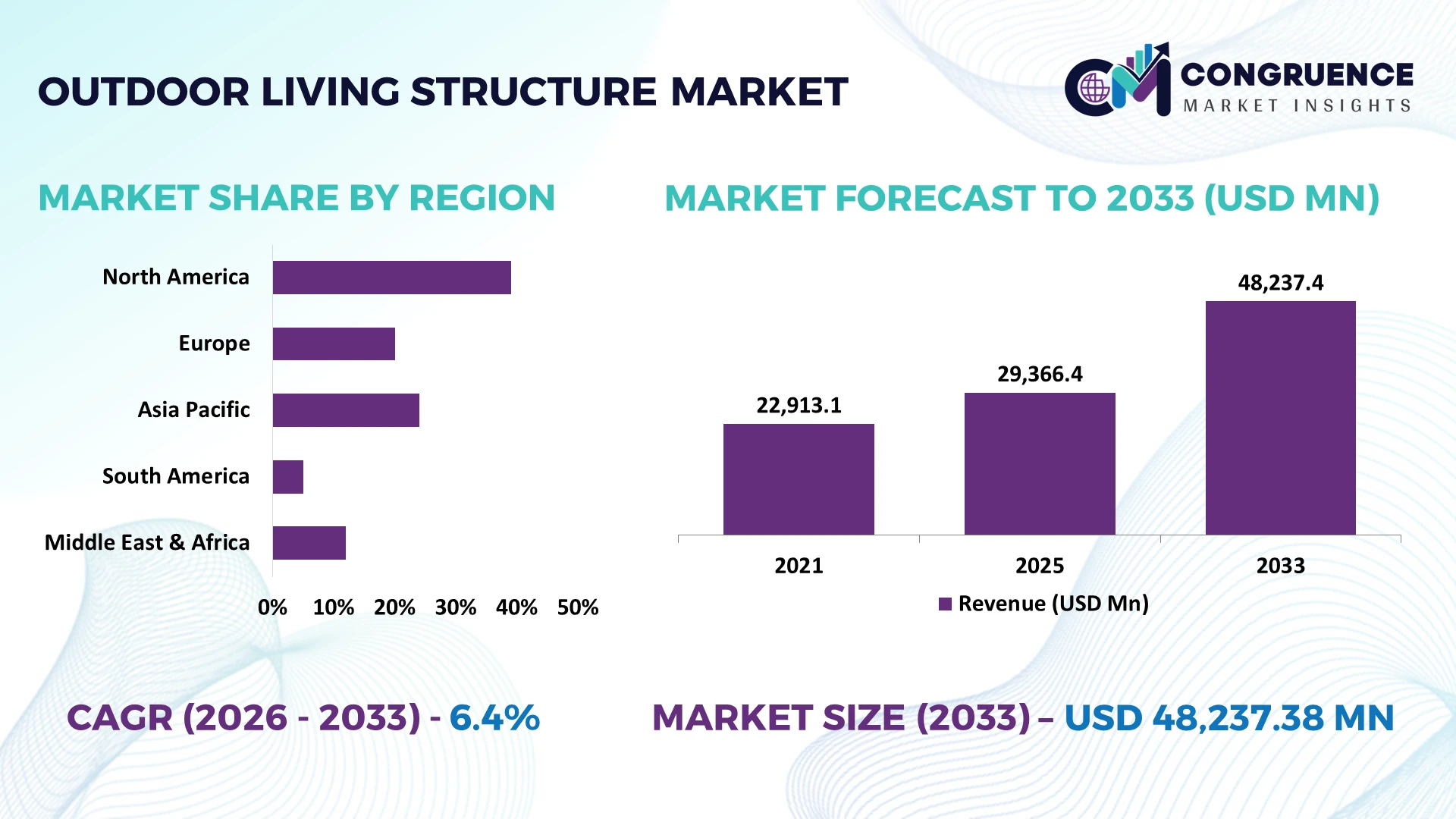
The Global Outdoor Living Structure Market was valued at USD 29366.4 Million in 2025 and is anticipated to reach a value of USD 48237.38 Million by 2033 expanding at a CAGR of 6.4% between 2026 and 2033. Market expansion is driven by residential renovation expenditure, demand for functional outdoor entertainment spaces, commercial hospitality development, and increasing adoption of automated pergolas and weather resistant construction materials.
The United States represents a major outdoor living structure market, supported by residential remodeling, landscaping services, and commercial hospitality investment. According to the American Institute of Architects, outdoor living spaces remain an important feature of residential architectural design. The United States has approximately 86 million owner occupied housing units, providing an extensive potential customer base. Compared with Germany, where outdoor construction frequently emphasizes compact gardens and weather protection, American installations include larger decks, pergolas, gazebos, and integrated entertainment structures.
Manufacturers should prioritize modular construction, automated weather protection, and professional installation partnerships to strengthen their position in established residential renovation markets.
Market Size & Growth: USD 29366.4 million in 2025, reaching USD 48237.38 million by 2033 at 6.4% CAGR, supported by residential remodeling and outdoor space modernization.
Top Growth Drivers: Residential renovation, hospitality development, and automated outdoor structures represent 3 principal demand drivers; their individual percentage contributions require comparable market segmentation data.
Short Term Forecast: By 2028, manufacturers targeting 10% faster installation through modular assembly can strengthen contractor productivity and improve project completion schedules.
Emerging Technologies: Three technologies are reshaping outdoor structures: automated retractable roofing, intelligent weather sensors, and digitally fabricated aluminum components.
Regional Leaders: North America, Europe, and Asia Pacific represent 3 important markets, with residential renovation, architectural shading, and urban outdoor development shaping their respective demand patterns.
Consumer & End User Trends: Approximately 86 million American owner occupied households represent a substantial potential market for residential outdoor structures and renovation services.
Pilot & Case Example: In 2024, automated pergola installations demonstrated the commercial application of integrated rain sensors, motorized louvers, and adjustable shading across 3 functional systems.
Competitive Landscape: Established manufacturers including Renson, StruXure, Brustor, Corradi, and KE Outdoor Design compete across 3 principal dimensions: customization, automated functionality, and installation networks.
Regulatory & ESG Impact: Aluminum offers substantial recycling advantages, with recycled production requiring up to 95% less energy than primary aluminum manufacturing.
Investment & Funding: Investment priorities encompass 3 areas: automated manufacturing, modular product development, and expansion of professional installation and distribution partnerships.
Innovation & Future Outlook: Next generation outdoor structures integrate 3 increasingly important features: intelligent climate control, automated shading, and modular architectural components.
The outdoor living structure market encompasses residential pergolas, gazebos, patios, decks, outdoor pavilions, and architectural shading installations. Residential remodeling remains an important demand source, while hotels, restaurants, and recreational properties support commercial adoption. Manufacturers are introducing motorized louvers, integrated lighting, weather sensors, and modular aluminum construction to improve functionality and installation efficiency. Recycled aluminum production requires up to 95% less energy than primary production, creating opportunities for manufacturers incorporating sustainable materials. Increasing architectural integration and demand for adaptable outdoor environments are shifting competitive priorities toward intelligent structures, customized design, and dependable installation services.
The outdoor living structure market is becoming strategically important as residential remodeling, hospitality infrastructure, and automated architectural systems reshape construction investment. Manufacturers are shifting from conventional standalone structures toward integrated outdoor environments incorporating motorized shading, weather protection, and intelligent controls. The United States provides substantial renovation opportunities, with Harvard University's remodeling indicators projecting continued homeowner improvement expenditure through 2026. Manufacturers are strengthening contractor partnerships and developing modular product platforms to improve installation consistency and expand distribution.
Technological differentiation increasingly depends on automation and material efficiency. Automated pergola systems incorporate rain sensors, adjustable louvers, and integrated controls, replacing conventional manually operated shading structures. Advanced aluminum fabrication enables precision manufacturing, while modular construction reduces installation complexity. Aluminum recycling requires up to 95% less energy than primary production, strengthening material sustainability. European manufacturers emphasize architectural integration and automated weather protection, while American suppliers prioritize residential customization and professional installation networks.
Between 2026 and 2028, investment priorities will increasingly favor connected outdoor structures, prefabricated components, and digitally supported installation. Renson's automated pergola systems demonstrate practical integration of motorized roofing, lighting, and weather responsive controls. Manufacturers are expanding installer certification programs and developing standardized component platforms. Competitive advantage will depend on combining product intelligence, efficient installation, dependable distribution, and adaptable architectural design.
Residential renovation is strengthening demand for permanent outdoor structures as homeowners prioritize usable exterior living areas and integrated entertainment environments. The National Association of Home Builders reported that 85% of new single family homes completed in 2023 included patios, compared with 63% in 2005. This structural shift increases opportunities for pergolas, covered patios, and integrated shading systems. American manufacturers are responding through modular product development, expanded contractor networks, and customizable aluminum construction. Companies including StruXure are emphasizing automated architectural solutions that combine weather protection with outdoor functionality. The strategic advantage lies in converting established patio installations into higher value outdoor living environments through integrated structures and professional installation services.
Material pricing and construction affordability constrain outdoor structure installations, particularly projects requiring customized aluminum components, engineered foundations, and professional electrical integration. American construction companies remain exposed to imported material costs and changing trade policies. United States Section 232 measures increased tariffs on covered steel and aluminum imports to 50% in June 2025, compared with the previous 25% rate, subject to applicable exceptions. These measures increase procurement uncertainty for manufacturers dependent on imported structural components. Customized outdoor installations also face permitting requirements and variable contractor availability. Manufacturers are responding through domestic sourcing, standardized structural components, and longer procurement agreements. Localized manufacturing and simplified installation designs help protect project margins and reduce delivery uncertainty.
Connected outdoor structures create opportunities to integrate architectural shading with intelligent building management and energy efficient exterior design. Automated louvers adjust roof positioning according to sunlight and rainfall, while connected controls coordinate lighting, ventilation, and weather protection. Exterior shading systems can reduce solar heat gain through windows by up to 77%, depending on glazing characteristics and installation conditions. This performance advantage strengthens opportunities for integrated architectural solutions in warm climates. Manufacturers including Renson and Brustor are developing automated outdoor structures that combine shading, lighting, and configurable architectural components. Investment in standardized control interfaces, modular fabrication, and installer training will help suppliers address increasingly sophisticated residential and commercial projects.
Scaling intelligent outdoor structures requires manufacturers to address structural engineering, electrical integration, software compatibility, and installation quality across different building environments. Motorized systems introduce additional maintenance requirements compared with conventional fixed structures. In the United States, exterior structures must comply with applicable building regulations, including wind resistance, structural loading, and electrical safety requirements. The International Residential Code establishes minimum structural requirements, while local jurisdictions impose additional installation conditions. Manufacturers face increasing pressure to maintain consistent performance across customized architectural configurations. Companies are responding through installer certification, standardized mounting systems, and integrated product testing. Long term competitiveness depends on reducing installation errors, maintaining reliable automation, and establishing dependable technical support throughout the product lifecycle.
Prefabricated Construction Gains Commercial Traction: Outdoor structure manufacturers are expanding factory fabrication to improve installation consistency and reduce construction site requirements. Modular systems increasingly incorporate 3 standardized components: structural frames, roofing assemblies, and integrated drainage. Manufacturers are introducing configurable product dimensions and simplified assembly connections. In the United States, construction workforce shortages are encouraging greater factory preparation. Standardized manufacturing also supports more predictable installation schedules, particularly for commercial projects involving multiple identical structures.
Architectural Aluminum Systems Gain Preference: Manufacturers are expanding aluminum pergola and patio cover portfolios to address maintenance requirements and changing architectural preferences. Aluminum offers 2 important operational advantages: corrosion resistance and dimensional stability. Recycled aluminum production requires up to 95% less energy than primary production. European manufacturers are strengthening material procurement partnerships and introducing powder coated structural components. These developments improve product durability while reducing maintenance requirements for commercial property owners operating in demanding outdoor environments.
Hospitality Installations Emphasize Revenue Utilization: Hotels and restaurants are increasingly treating outdoor structures as operational infrastructure rather than decorative additions. Commercial installations commonly integrate 3 functional systems: adjustable roofing, lighting, and weather protection. Hospitality operators are adopting configurable structures that accommodate seasonal dining and entertainment requirements. Manufacturers are responding through project customization, architectural partnerships, and integrated installation services. The important operational shift involves improving the usability of existing commercial property rather than acquiring additional development space.
Digital Configuration Reshapes Product Distribution: Outdoor structure suppliers are introducing digital design platforms that integrate 3 commercial functions: product visualization, configuration, and installation planning. These systems support standardized quotations and reduce communication gaps between manufacturers, distributors, and installation contractors. American and European suppliers are strengthening digital sales capabilities alongside traditional architectural specification channels. The transition improves configuration accuracy and enables manufacturers to offer customized structures without maintaining extensive inventories of every available product variation.
Pergolas represent a prominent category within the global outdoor living structure market, supported by residential landscaping, commercial hospitality installations, and architectural customization. Their exact global market share under the specified six category classification is not independently established. Pergolas offer structural flexibility through adjustable roofing, modular aluminum frames, and integrated lighting systems. Manufacturers including Renson, Brustor, and Corradi emphasize configurable designs and automated architectural features. Patio Covers compete through permanent weather protection and integration with existing buildings, while Gazebos serve residential gardens and recreational installations.
Outdoor Kitchens represent an emerging premium product category, supported by demand for integrated cooking, dining, and entertainment environments. Their comparative growth ranking requires consistent global segment data. Pavilions address commercial hospitality and recreational infrastructure, while Sunrooms provide enclosed spaces suitable for extended seasonal use. Manufacturers are developing integrated product portfolios and expanding architectural distribution partnerships. Investment priorities increasingly distinguish standardized outdoor shelters from sophisticated installations incorporating electrical systems, customized finishes, and advanced environmental protection.
Residential Spaces represent a principal application for outdoor living structures, supported by established home improvement activity and demand for functional exterior environments. A consistent global percentage for this application within the specified classification remains unavailable. Residential installations encompass permanent weather protection, architectural shading, and integrated entertainment facilities. Manufacturers emphasize configurable dimensions, aesthetic customization, and compatibility with existing buildings. Residential projects also benefit from standardized structural components that simplify professional installation and reduce design complexity.
Hospitality Areas represent an important commercial expansion opportunity as hotels and accommodation operators develop functional outdoor facilities. However, comparable evidence does not establish their position as the fastest growing application. Dining Areas increasingly incorporate weather protection and adjustable shading, while Entertainment Areas require integrated lighting and flexible spatial configurations. Poolside Areas emphasize corrosion resistant construction and sun protection. Recreational Spaces prioritize structural durability and dependable maintenance performance. Manufacturers are responding through commercial architectural partnerships, customized structural engineering, and specialized product configurations. Commercial purchasing increasingly emphasizes operational usability, installation reliability, and maintenance requirements rather than initial product appearance alone.
Homeowners represent a major purchasing group within the outdoor living structure market because residential properties provide an extensive potential installation base. Their precise global market share under the requested classification is not established through comparable industry data. Homeowner purchasing decisions emphasize architectural compatibility, product durability, maintenance requirements, and installation costs. Manufacturers address these priorities through modular pergolas, customizable patio covers, and integrated product warranties. Professional installation networks remain important because permanent structures require appropriate foundations, structural connections, and compliance with local building requirements.
Property Developers represent an important opportunity for standardized installations across residential and commercial development projects, although their comparative growth ranking remains unverified. Hotels and Resorts increasingly incorporate customized outdoor environments into hospitality infrastructure. Restaurants prioritize functional dining capacity and dependable weather protection. Commercial Property Owners emphasize maintenance efficiency and structural adaptability. Manufacturers are differentiating their commercial offerings through architectural specification services, project based pricing, and partnerships with construction contractors. Future competitive positioning depends on balancing standardized manufacturing with the customization requirements of individual customer groups.
North America accounted for the largest market share at 42.6% in 2025 however, Middle East & Africa is expected to register the fastest growth, expanding at a CAGR of 8.0% between 2026 and 2033.
Residential Renovation and Premium Outdoor Infrastructure
North America maintained the largest position in the global outdoor living structure market, supported by established residential renovation activity, professional installation networks, and extensive home improvement distribution infrastructure. The regional market is projected to expand at a CAGR of 5.3% between 2026 and 2033. The United States dominates regional demand, followed by Canada, while Mexico offers opportunities for architectural shading installations. Pergolas and patio structures represented 62.71% of regional product demand in 2025, reflecting their suitability for residential construction and exterior modernization. Manufacturers increasingly emphasize customized aluminum structures, integrated lighting, and automated weather protection. Established distribution networks enable suppliers to combine standardized manufacturing with professional installation services. Investment in modular construction and specialized contractor partnerships strengthens project delivery capabilities and improves access to premium residential customers.
United States Market Outlook: The United States represented 38.1% of the global outdoor living structures market under the referenced market definition. Its established residential construction industry supports demand for customized pergolas, patio covers, and permanent outdoor entertainment facilities. Manufacturers benefit from specialized architectural distribution, professional installation capabilities, and established home improvement retail networks. Automated roofing systems and integrated exterior lighting strengthen product differentiation.
Architectural Modernization and Advanced Shading Integration
Europe accounted for 32.1% of the global outdoor living structures market in 2025. The regional market is projected to register a CAGR of 6.0% between 2026 and 2033, supported by residential modernization, established landscaping industries, and architectural demand for adaptable exterior environments. Germany, France, Belgium, Italy, and the United Kingdom contribute through residential improvement activity and specialized manufacturing capabilities. European manufacturers emphasize architectural compatibility, automated shading, weather resistant materials, and customizable structural systems. Premium product development is particularly important in countries with established architectural shading industries. Manufacturers are expanding integrated outdoor systems that combine motorized roofing, ventilation, and lighting. Hospitality installations provide additional opportunities, particularly in Mediterranean destinations where outdoor dining and recreational facilities form important components of commercial property design. Investment priorities increasingly favor advanced architectural integration and manufacturing precision.
Germany Market Outlook: Germany represents an important European market for outdoor living structures, supported by established engineering capabilities, residential modernization, and demand for durable architectural products. Manufacturers emphasize precision fabricated components, automated shading, and weather resistant construction. Professional installation networks and architectural specification services support customized residential projects, while commercial applications encourage investment in reliable motorized systems and efficient exterior climate management.
Urban Development and Expanding Manufacturing Capabilities
Asia Pacific represented 18.3% of the global outdoor living structures market in 2025. Its projected CAGR of 7.2% between 2026 and 2033 reflects opportunities associated with residential construction, hospitality investment, and expanding demand for contemporary outdoor architectural solutions. China, India, Australia, and Japan represent important markets with different installation requirements. China combines substantial manufacturing capabilities with domestic construction activity, while Australia maintains established residential landscaping and outdoor entertainment industries. Manufacturers are increasingly developing modular pergolas, prefabricated gazebos, and adaptable shading structures suitable for different climatic conditions. International suppliers are strengthening relationships with local distributors and construction contractors to improve market accessibility. Product localization is particularly important because installation requirements vary considerably between tropical, temperate, and densely populated urban environments. Expanding manufacturing partnerships support product customization and regional distribution.
China Market Outlook: China combines established aluminum manufacturing infrastructure with substantial construction material production capabilities. Its industrial supply chains support the fabrication of structural frames, architectural components, and motorized outdoor systems. Domestic manufacturers benefit from production scale and established export infrastructure, while premium residential and hospitality developments provide opportunities for customized installations. Coastal construction markets are particularly relevant for corrosion resistant materials and adaptable weather protection.
Hospitality Development and Localized Construction Demand
South America benefits from expanding residential improvement activity, commercial hospitality development, and demand for adaptable exterior architectural structures. The broader Latin American market accounted for 2.5% of global outdoor living structures demand in 2025 and is projected to register a CAGR of 7.9% between 2026 and 2033. Brazil, Argentina, Chile, and Colombia represent important markets for residential landscaping and commercial exterior construction. Manufacturers increasingly emphasize affordable modular structures, weather resistant materials, and adaptable installation systems. Regional distribution remains influenced by imported architectural components, local fabrication capabilities, and construction contractor availability. Manufacturers strengthen competitiveness through localized assembly and partnerships with established building material distributors. Hospitality developments and premium residential construction provide opportunities for differentiated pergolas, gazebos, and customized outdoor entertainment structures. The reported regional percentage includes Latin America rather than South America exclusively.
Brazil Market Outlook: Brazil represents an important South American market because of its substantial construction industry, established architectural manufacturing capabilities, and extensive hospitality infrastructure. São Paulo and other major urban centers provide opportunities for customized residential outdoor structures. Domestic fabrication partnerships support localized product development, while coastal hospitality installations create demand for corrosion resistant materials and durable exterior construction systems.
Hospitality Investment and Climate Responsive Construction
The Middle East and Africa accounted for 4.5% of global outdoor living structures demand in 2025. The region is projected to register a CAGR of 8.0% between 2026 and 2033, supported by increasing investment in hospitality infrastructure, premium residential construction, and architectural shading solutions. Saudi Arabia, the United Arab Emirates, Egypt, and South Africa represent important markets with different construction and climatic requirements. Pergolas and patio structures accounted for 75.7% of regional product demand in 2025, demonstrating the importance of adaptable exterior shading. Manufacturers emphasize corrosion resistant aluminum structures, automated roofing systems, and integrated weather protection. Hospitality developers require durable installations capable of supporting outdoor dining, recreation, and guest entertainment. International suppliers are strengthening relationships with local construction contractors and architectural firms to improve project execution. Regional expansion increasingly depends on climate appropriate engineering, reliable installation capabilities, and access to major property development projects.
Saudi Arabia Market Outlook: Saudi Arabia represents an important investment destination for outdoor architectural structures, supported by tourism development, residential construction, and hospitality modernization. Vision 2030 initiatives encourage investment in recreational infrastructure and commercial property development. Projects associated with major tourism destinations create opportunities for customized pavilions, architectural pergolas, and advanced shading systems. Manufacturers prioritize thermal performance, structural durability, and partnerships with established construction contractors.
The global outdoor living structure market features competition between premium architectural manufacturers, specialized automation providers, and regional construction suppliers. Renson, StruXure, Brustor, Corradi, and KE Outdoor Design compete through customized pergolas, integrated weather protection, architectural design, and professional installation networks. Their combined global market share remains unverified under a consistent market definition. Premium manufacturers differentiate through automated controls, while regional suppliers emphasize competitive pricing, localized fabrication, and installation flexibility. Recycled aluminum manufacturing requires up to 95% less energy than primary production, creating material procurement advantages. Exterior shading systems can reduce solar heat gain by up to 77%, strengthening performance differentiation. Manufacturers are expanding architectural partnerships, developing modular product platforms, and integrating intelligent control systems. Competition increasingly centers on connected structures, standardized components, and dependable installation services. Engineering certification, distribution access, and installation expertise create substantial entry barriers. Sustainable competitive positioning requires manufacturing precision, technological differentiation, efficient procurement, and reliable project execution.
Renson
StruXure
Brustor
Corradi
KE Outdoor Design
Sunair Awnings
Four Seasons Outdoor Living
TEMO
Palram Canopia
Yardistry
Biohort
Gibus
Brustor
Solisysteme
Automated pergola systems, precision aluminum fabrication, and intelligent weather monitoring are transforming outdoor structure manufacturing. Motorized louvers automatically regulate sunlight and rainfall exposure, replacing conventional manually operated roofing. Exterior shading technologies can reduce solar heat gain by up to 77%, depending on installation conditions. Integrated rain sensors, lighting controls, and automated ventilation improve operational flexibility. Manufacturers including Renson and StruXure are integrating these technologies into premium residential and commercial architectural installations.
Emerging technologies include digital product configuration, modular construction, and connected environmental controls. Advanced fabrication systems improve component accuracy and simplify structural assembly. Compared with conventional primary aluminum manufacturing, recycled aluminum production requires up to 95% less energy, strengthening material efficiency and sustainability. Digital configuration platforms enable manufacturers to standardize component specifications while accommodating customized architectural requirements. Established suppliers benefit from integrated manufacturing capabilities, while regional manufacturers gain access to modular production technologies.
Between 2026 and 2028, intelligent outdoor structures will increasingly incorporate predictive weather monitoring, automated climate adjustment, and integrated building management connectivity. Manufacturers are prioritizing standardized control interfaces, advanced structural engineering, and digitally supported installation workflows. Modular fabrication supports efficient product customization and simplifies replacement component management. Competitive differentiation increasingly depends on combining intelligent automation, architectural adaptability, reliable installation, and efficient material utilization.
| Report Attribute/Metric | Report Details |
|---|---|
Market Revenue in 2025 | USD 29366.4 Million |
Market Revenue in 2033 | USD 48237.38 Million |
CAGR (2026 - 2033) | 6.4% |
Base Year | 2025 |
Forecast Period | 2026 - 2033 |
Historic Period | 2021 - 2025 |
Segments Covered | By Type
By Application
By End-User
|
Key Report Deliverable | Revenue Forecast, Growth Trends, Market Dynamics, Segmental Overview, Regional and Country-wise Analysis, Competition Landscape |
Region Covered | North America, Europe, Asia-Pacific, South America, Middle East, Africa |
Key Players Analyzed | Renson, StruXure, Brustor, Corradi, KE Outdoor Design, Sunair Awnings, Four Seasons Outdoor Living, TEMO, Palram Canopia, Yardistry, Biohort, Gibus, Brustor, Solisysteme |
Customization & Pricing | Available on Request (10% Customization is Free) |




