
Reports
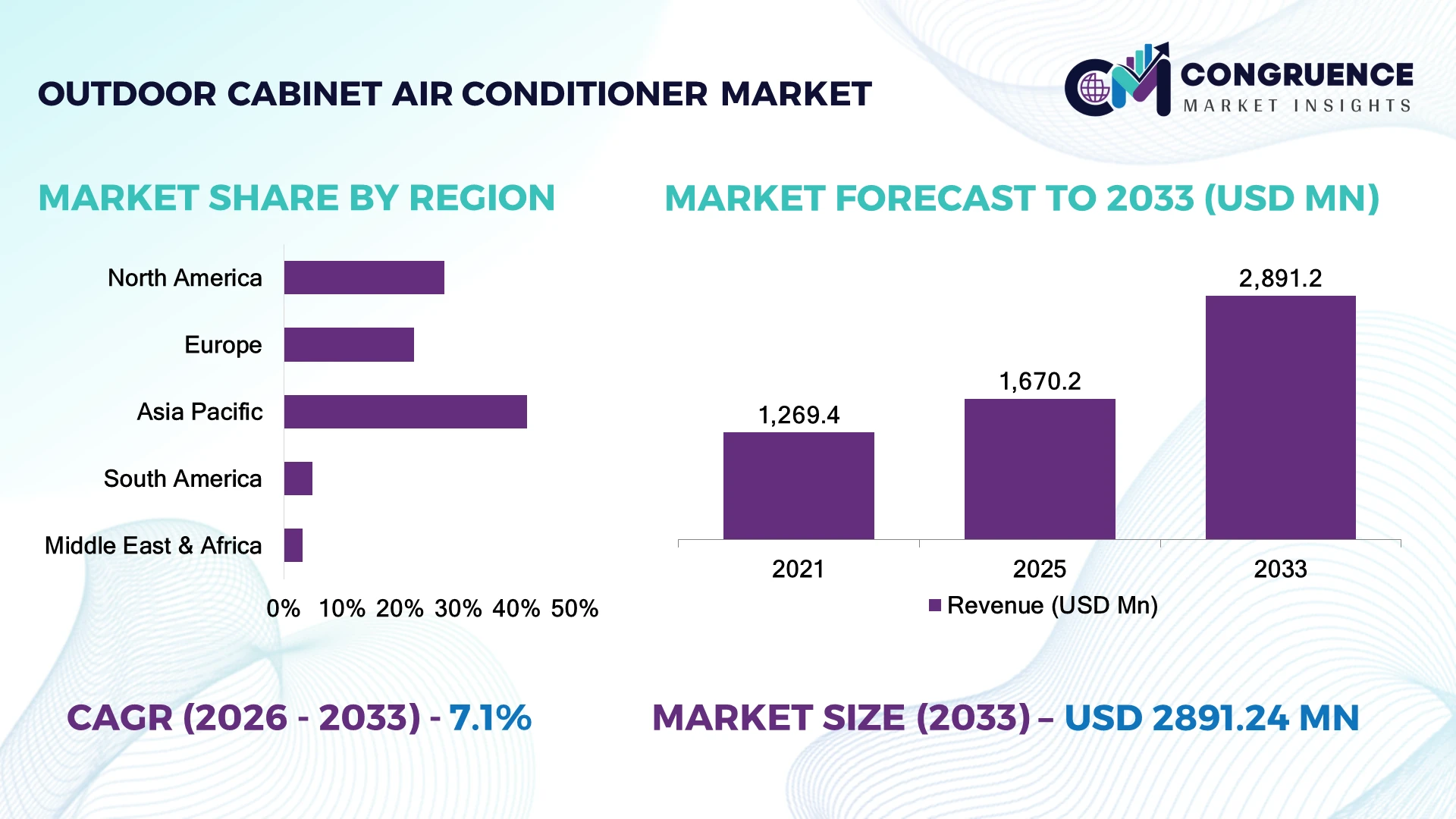
The Global Outdoor Cabinet Air Conditioner Market was valued at USD 1,670.2 Million in 2025 and is anticipated to reach a value of USD 2,891.2 Million by 2033 expanding at a CAGR of 7.1% between 2026 and 2033. Expansion of 5G telecom infrastructure, edge data deployment, renewable energy installations, and intelligent power distribution cabinets is accelerating adoption of high-efficiency outdoor cabinet air conditioning systems with advanced thermal management and remote monitoring capabilities.
China remains the dominant country, accounting for approximately 36% of global production capacity, supported by telecom equipment manufacturing, renewable energy infrastructure, and electronics industries. More than 4.3 million 5G base stations strengthen cooling equipment deployment, while India is expanding faster through nationwide digital infrastructure programs and grid modernization. Ongoing semiconductor supply-chain diversification following recent geopolitical trade realignments further reinforces regional manufacturing investments and localized component sourcing.
Manufacturers prioritizing energy-efficient designs, localized production, and intelligent monitoring capabilities are positioned to strengthen long-term competitiveness across infrastructure-intensive industries.
Market Size & Growth: USD 1,670.2 Million in 2025, projected to reach USD 2,891.2 Million by 2033 at a CAGR of 7.1%, supported by telecom and edge infrastructure expansion.
Top Growth Drivers: 5G infrastructure (+31%), renewable energy cabinet installations (+24%), and smart grid modernization (+19%) continue accelerating equipment deployment.
Short-Term Forecast: By 2028, intelligent cooling systems reduce maintenance costs by nearly 22% while improving operational efficiency by approximately 18%.
Emerging Technologies: AI-enabled controllers, inverter compressors, and IoT-based predictive monitoring are becoming standard across advanced outdoor cabinet air conditioner installations.
Regional Leaders: Asia-Pacific exceeds USD 1,250 Million, North America approaches USD 690 Million, and Europe surpasses USD 510 Million, supported by digital infrastructure expansion and industrial modernization.
Consumer/End-User Trends: More than 62% of telecom operators prioritize remote monitoring and predictive maintenance to improve network uptime and reduce field service visits.
Pilot/Case Example: A 2026 telecom network modernization program achieved roughly 28% lower energy consumption after replacing conventional cabinet cooling systems with intelligent inverter units.
Competitive Landscape: Leading manufacturers collectively hold around 42% market share, with key participants including Vertiv, Delta Electronics, Schneider Electric, Rittal, and STULZ.
Regulatory & ESG Impact: Higher energy-efficiency standards deliver approximately 20% lower electricity consumption while supporting broader corporate ESG commitments.
Investment & Funding: More than USD 1.4 Billion in manufacturing expansion and strategic partnerships reflects continuing supply-chain regionalization across Asia and North America.
Innovation & Future Outlook: Next-generation liquid-assisted cooling, AI diagnostics, and modular thermal management strengthen competitive differentiation for high-growth infrastructure applications.
Outdoor Cabinet Air Conditioner systems are increasingly deployed across telecom shelters, battery energy storage systems, EV charging infrastructure, and industrial automation cabinets where thermal stability directly influences equipment reliability. Smart diagnostics, variable-speed compressors, and IoT connectivity now represent over 45% of newly specified premium systems. Regional manufacturing expansion and stricter energy-efficiency requirements continue accelerating product innovation while strengthening supply-chain resilience, setting the stage for broader strategic discussion.
The Outdoor Cabinet Air Conditioner Market has become strategically important as operators modernize digital infrastructure, strengthen power resilience, and decentralize computing through edge facilities. Infrastructure investment is shifting toward intelligent outdoor equipment capable of operating continuously in demanding climates. Regional supply-chain restructuring and localized manufacturing initiatives are also reducing procurement risks while shortening equipment delivery cycles for telecom, utility, and industrial customers.
Modern inverter-driven systems equipped with intelligent controls consume approximately 18–25% less energy than conventional fixed-speed units while extending compressor service life through adaptive load management. Asia-Pacific leads large-scale deployment because of extensive telecom expansion and electronics manufacturing, whereas North America emphasizes high-performance cooling for edge computing, utility automation, and critical communications infrastructure. Over the next two to three years, predictive monitoring integration and remote fleet management are expected to become standard across a growing share of enterprise installations.
A practical example is the deployment of intelligent cabinet cooling across distributed telecom sites, where centralized monitoring reduces unplanned maintenance visits and improves network availability during peak operating conditions. Manufacturers are expanding regional production, strengthening component partnerships, and investing in digital service platforms to improve responsiveness and lifecycle support. Organizations combining energy-efficient engineering with intelligent asset management will secure stronger competitive positioning, higher operational reliability, and sustained relevance across critical infrastructure markets.
Rapid deployment of digital infrastructure is strengthening demand for high-performance outdoor cabinet air conditioners across telecom, utility, and industrial networks. More than 68% of newly installed telecom cabinets now incorporate intelligent thermal management, while inverter-based cooling systems improve energy efficiency by nearly 20%. China continues expanding nationwide communication infrastructure, and India's power distribution modernization is accelerating outdoor equipment installations. Rising deployment of battery energy storage systems has also increased demand for precision cabinet cooling. This infrastructure shift is improving equipment reliability and reducing field failures, prompting manufacturers to expand localized production, integrate remote diagnostics, and establish technology partnerships to deliver higher-performance cooling platforms with shorter deployment timelines.
Outdoor cabinet air conditioner manufacturers continue facing structural pressure from compressor, electronic controller, and semiconductor component availability. Imported electronic components still account for nearly 40% of critical system value in several manufacturing supply chains, while raw material costs have remained approximately 15% above pre-disruption averages. Extended procurement cycles directly affect production planning, inventory management, and customer delivery commitments. European environmental compliance requirements also require continuous redesign of refrigerant systems, increasing engineering complexity. To reduce operational exposure, companies are localizing component sourcing, negotiating long-term supplier agreements, qualifying multiple vendors, and redesigning products around standardized modules that improve procurement flexibility and manufacturing resilience.
Growing deployment of AI-enabled edge computing, renewable energy infrastructure, and distributed industrial automation is creating new opportunities for intelligent outdoor cabinet air conditioners. More than 55% of new premium installations now specify remote monitoring capabilities, while predictive maintenance reduces unexpected service interventions by nearly 30%. Japan and South Korea are accelerating deployment of digitally connected infrastructure requiring continuous thermal optimization and equipment health monitoring. Intelligent control platforms also support lower maintenance costs through condition-based servicing rather than scheduled inspections. Manufacturers are investing in AI-driven diagnostics, cloud-connected monitoring platforms, and strategic software partnerships to create recurring service ecosystems beyond conventional equipment sales.
Managing thousands of geographically distributed cooling units creates significant operational complexity as digital infrastructure expands. Approximately 35% of maintenance activities still require on-site technician intervention, while integration across multiple building management and network control platforms increases commissioning time by nearly 18%. Cybersecurity requirements for remotely connected cooling equipment are becoming stricter as critical infrastructure operators strengthen operational resilience. These execution challenges directly affect lifecycle service costs, deployment consistency, and customer confidence. Companies are investing in secure communication architectures, workforce training, standardized digital protocols, and centralized asset management platforms to improve fleet-wide visibility while supporting reliable long-term operations.
AI-Based Remote Cooling Intelligent monitoring platforms are becoming standard across telecom and utility cabinet networks, with more than 60% of newly deployed premium systems integrating remote diagnostics and predictive maintenance. Automated fault detection reduces service visits by approximately 25% while improving equipment availability. Rising labor shortages and increasing infrastructure density are encouraging manufacturers to expand software capabilities, strengthen cloud partnerships, and automate lifecycle service management.
Transition to Low-GWP Refrigerants Environmental compliance initiatives are accelerating adoption of next-generation refrigerants, with nearly 45% of newly introduced product platforms designed around lower-emission cooling technologies. Advanced compressor optimization improves energy efficiency by around 18% while maintaining stable thermal performance. Manufacturers are redesigning product portfolios, upgrading production lines, and strengthening supplier collaboration to meet evolving environmental standards without compromising operational reliability.
Localized Manufacturing Expansion Supply-chain diversification is reshaping production strategies as companies reduce dependence on single-country sourcing. Localized procurement has increased by nearly 30% among leading manufacturers, shortening equipment delivery cycles by approximately 20%. India and Mexico continue attracting manufacturing investments supporting telecom and industrial infrastructure programs. Companies are expanding regional assembly capacity and increasing standardized component utilization to improve supply continuity and customer responsiveness.
Modular High-Density Cooling Designs Compact modular architectures are replacing conventional fixed configurations as cabinet power density continues increasing. Variable-speed thermal control improves cooling efficiency by roughly 22%, while modular maintenance reduces equipment downtime by nearly 15%. Edge computing expansion and higher outdoor electronics density are accelerating demand for scalable cooling platforms. Manufacturers are introducing configurable product families and standardized modular designs that simplify installation, accelerate servicing, and support diverse infrastructure applications.
Air-cooled outdoor cabinet air conditioners remain the dominant product type, accounting for approximately 58% of global installations due to their straightforward deployment, lower maintenance requirements, and compatibility with telecom, utility, and industrial control cabinets. Their independence from external water infrastructure makes them the preferred solution for remote installations and distributed network assets. Liquid-cooled systems are the fastest-growing segment as edge computing, battery energy storage systems, and high-density electronics generate significantly higher thermal loads. Nearly 35% of newly commissioned high-power electronic enclosures now incorporate advanced liquid-assisted or hybrid thermal management to maintain stable operating temperatures. Manufacturers are expanding inverter-based air-cooled platforms while investing in modular liquid-cooling technologies for mission-critical applications.
Thermoelectric cooling solutions continue serving compact electronic cabinets where silent operation and reduced maintenance are prioritized, while hybrid cooling systems are gaining traction in environments with fluctuating thermal loads. Product development increasingly focuses on intelligent thermal controls, modular construction, and predictive diagnostics to improve operational efficiency and simplify lifecycle management. Companies are prioritizing scalable product portfolios capable of supporting increasingly dense electronic equipment while lowering service complexity across multiple infrastructure sectors.
According to technical guidance issued by the Telecommunications Engineering Centre (TEC) during 2025, sealed active cooling systems remain the preferred thermal management solution for outdoor telecom cabinets operating under high ambient temperatures, supporting equipment reliability, environmental protection, and continuous network availability.
Telecommunications remains the largest application segment, representing approximately 52% of installed outdoor cabinet air conditioner demand as expanding 5G infrastructure, fiber broadband deployment, and distributed communication networks require stable operating temperatures for sensitive electronics. Remote monitoring and intelligent cooling controls are becoming standard to improve equipment availability while reducing maintenance visits. Renewable energy infrastructure is the fastest-growing application as battery energy storage systems, solar inverter cabinets, and distributed grid assets increasingly require precision thermal management. Around 40% of newly deployed utility-scale battery storage enclosures now integrate dedicated active cooling systems to maintain battery efficiency and operational safety.
Industrial automation, transportation infrastructure, and outdoor surveillance systems continue strengthening market diversification through greater deployment of intelligent outdoor control cabinets. Manufacturers are introducing application-specific cooling platforms featuring higher ingress protection, corrosion resistance, and integrated digital monitoring to address demanding operating environments. Investment priorities increasingly favor configurable thermal management systems capable of supporting multiple infrastructure applications with lower lifecycle operating costs.
Industry guidance released by the Telecommunications Engineering Centre (TEC) during 2025 recommends active environmental control for outdoor communication cabinets to maintain equipment performance, extend component life, and ensure uninterrupted operation across mission-critical telecom infrastructure.
Telecommunication operators remain the dominant end-user group, accounting for nearly 49% of purchasing activity as nationwide network expansion, fiber connectivity, and edge infrastructure projects require reliable outdoor thermal management. Large operators increasingly standardize intelligent cooling platforms to improve network uptime while reducing field maintenance frequency. Utilities represent the fastest-growing end-user segment as smart grid modernization, renewable energy integration, and distributed power infrastructure significantly increase deployment of outdoor electrical cabinets. Approximately 33% of newly deployed smart utility control cabinets now integrate intelligent environmental monitoring alongside precision cooling technologies.
Industrial manufacturers continue investing in cabinet cooling for automation systems, process control equipment, and outdoor electrical enclosures, while transportation agencies expand deployments supporting intelligent traffic management and railway signaling infrastructure. Vendors are strengthening competitive positioning through customized product configurations, long-term service agreements, localized manufacturing, and digital lifecycle management platforms that improve customer retention while reducing total ownership costs across diverse enterprise applications.
Enterprise and infrastructure guidance issued during 2025 and 2026 increasingly recommends integrated outdoor cabinet cooling for telecom, power, and industrial control installations to improve equipment reliability, maintain sealed enclosure performance, and support continuous field operation under harsh environmental conditions.
Asia-Pacific accounted for the largest market share at 41.8% in 2025 moreover Asia-Pacific is also expected to register the fastest growth, expanding at a CAGR of 8.0% between 2026 and 2033.
Edge Infrastructure Expansion Strengthens Intelligent Thermal Management
North America represents a mature market supported by extensive deployment of edge data centers, 5G communication networks, utility automation, and intelligent transportation systems. The region accounted for approximately 27.6% of global demand in 2025, with widespread adoption of inverter-driven cooling systems and remote monitoring technologies improving operational efficiency. Increasing investments in distributed digital infrastructure continue driving replacement of legacy cabinet cooling equipment with energy-efficient platforms. More than 65% of newly deployed telecom outdoor cabinets now integrate intelligent environmental monitoring alongside active cooling systems. Manufacturers are expanding localized engineering capabilities, strengthening software integration, and developing advanced service platforms to support long-term infrastructure modernization.
United States Market Outlook: The United States remains the largest contributor to regional demand through nationwide telecom modernization, utility digitalization, and rapid edge computing deployment. More than 4,000 edge data center locations and continuous expansion of broadband infrastructure are increasing requirements for reliable outdoor thermal management. Equipment suppliers are investing in AI-enabled monitoring, domestic assembly capabilities, and strategic partnerships with telecom and power infrastructure operators to improve equipment lifecycle performance while reducing maintenance frequency.
Energy-Efficient Infrastructure Modernization Drives Product Innovation
Europe accounts for approximately 22.4% of the global market, supported by modernization of telecom infrastructure, industrial automation, and stringent energy-efficiency regulations. Replacement demand remains strong as operators upgrade aging outdoor electrical cabinets with intelligent cooling systems using environmentally compliant refrigerants and digital controls. Industrial facilities increasingly prioritize lower operating energy consumption, while transportation and utility sectors continue expanding outdoor control infrastructure. Manufacturers are accelerating product redesign, refrigerant transition, and regional production investments to strengthen regulatory compliance and supply resilience.
Germany Market Outlook: Germany leads regional deployment through its advanced manufacturing sector, industrial automation ecosystem, and extensive electrical infrastructure. Factory digitalization programs and smart energy projects continue expanding demand for intelligent cabinet cooling solutions across industrial control systems. Domestic engineering expertise and strong equipment manufacturing capabilities encourage suppliers to develop higher-efficiency cooling platforms with integrated predictive maintenance and advanced thermal control technologies.
Manufacturing Scale and Digital Infrastructure Sustain Market Leadership
Asia-Pacific remains the largest and fastest-expanding regional market, contributing approximately 41.8% of global demand through strong electronics manufacturing, telecom infrastructure expansion, renewable energy deployment, and industrial automation investments. Large-scale production capacity enables competitive pricing and rapid product innovation, while increasing deployment of battery energy storage systems creates additional demand for precision cabinet cooling. More than half of global telecom equipment manufacturing is concentrated within the region, encouraging continuous investment in intelligent thermal management technologies. Companies continue expanding manufacturing facilities, automation capabilities, and export-oriented production networks.
China Market Outlook: China maintains the strongest competitive position through its extensive electronics manufacturing ecosystem, telecom equipment production, and digital infrastructure expansion. The country accounts for roughly 36% of global outdoor cabinet air conditioner manufacturing capacity, supported by widespread deployment of 5G infrastructure and renewable energy installations. Manufacturers continue investing in automated production, intelligent quality control, and AI-enabled thermal management technologies to strengthen domestic leadership and international competitiveness.
Telecom Modernization Expands Infrastructure Demand
South America represents an emerging market where telecom modernization, utility network expansion, and industrial digitalization are steadily increasing demand for outdoor cabinet cooling systems. The region contributes approximately 4.9% of global installations, with infrastructure investment concentrated in communication networks and electrical distribution projects. Expansion of broadband connectivity and renewable energy assets is creating demand for reliable outdoor thermal management despite logistics and supply-chain constraints. Manufacturers are improving regional distribution networks, expanding local service capabilities, and strengthening partnerships with infrastructure contractors to improve deployment efficiency.
Brazil Market Outlook: Brazil remains the largest market within South America owing to its extensive telecom network, expanding renewable energy sector, and industrial manufacturing base. Continued investments in fiber broadband, transmission infrastructure, and utility automation are increasing deployment of outdoor electrical cabinets. Equipment suppliers are strengthening local distribution partnerships, expanding technical support services, and introducing energy-efficient cooling systems designed for tropical operating environments.
Critical Infrastructure Investment Supports Advanced Cooling Deployment
The Middle East & Africa market is strengthening through investments in digital infrastructure, smart cities, utility modernization, and renewable energy projects requiring reliable outdoor equipment protection. The region accounts for approximately 3.3% of global demand, with deployment concentrated in telecommunications, oil and gas facilities, transportation infrastructure, and power distribution networks. High ambient temperatures continue driving adoption of high-capacity precision cooling systems capable of maintaining equipment reliability under extreme environmental conditions. Companies are expanding regional service networks, strengthening distributor partnerships, and developing climate-optimized product portfolios.
Saudi Arabia Market Outlook: Saudi Arabia leads regional demand through large-scale digital transformation initiatives, smart city development, and major investments in telecom and utility infrastructure. National infrastructure projects continue increasing deployment of intelligent outdoor electrical cabinets across communication and power networks. Manufacturers are expanding regional partnerships, local technical support capabilities, and application-specific cooling solutions engineered to operate reliably in high-temperature desert environments while supporting long-term infrastructure resilience.
The market is led by global thermal management providers including Vertiv, Rittal, STULZ, Schneider Electric, and Delta Electronics, competing directly against regional enclosure cooling manufacturers specializing in telecom and industrial applications. The top five companies collectively control approximately 42% of global market share, while regional suppliers compete aggressively through lower-cost manufacturing and localized customization. Technology leaders differentiate through intelligent controls, inverter-driven compressors, and IoT-enabled monitoring, delivering 18–25% higher energy efficiency than conventional systems. Regional manufacturers typically achieve 12–18% pricing advantages in standardized deployments, while premium suppliers compete through lifecycle reliability and digital service capabilities. Competition increasingly centers on localized manufacturing, strategic partnerships, software-enabled asset management, and vertically integrated supply chains that shorten delivery times by nearly 20%. Growing demand for edge computing and battery energy storage is accelerating product innovation and industry consolidation. High engineering certification requirements, thermal performance validation, and established service networks remain major entry barriers. Sustainable competitive advantage increasingly depends on intelligent thermal platforms, rapid customization, resilient supply chains, and comprehensive aftermarket support.
Vertiv
Rittal
STULZ
Schneider Electric
Delta Electronics
Pfannenberg
Kooltronic
Seifert Systems
nVent
Cosmotec
Ice Qube
EIC Solutions
Dantherm Group
Outdoor cabinet air conditioner technology is shifting from conventional fixed-speed cooling toward intelligent inverter-driven thermal management integrated with IoT connectivity and AI-based diagnostics. Variable-speed compressors improve energy efficiency by approximately 20%, while predictive monitoring reduces unplanned maintenance by nearly 30%. Around 60% of newly specified premium systems now include remote monitoring and digital controller integration, enabling continuous equipment supervision across telecom, utility, and industrial infrastructure. These technologies improve equipment availability while lowering operational intervention costs.
Emerging technologies include low-GWP refrigerants, adaptive electronic expansion valves, modular cooling architectures, and cloud-connected asset management platforms. Compared with legacy fixed-speed systems, intelligent inverter-based platforms deliver 18–25% lower energy consumption and faster thermal stabilization under fluctuating electronic loads. Manufacturers serving edge computing, battery energy storage, and smart grid infrastructure benefit most from these innovations because higher equipment density demands greater cooling precision and operational resilience.
Between 2026 and 2028, intelligent thermal ecosystems combining AI diagnostics, digital twins, predictive maintenance, and integrated building management interfaces will become increasingly common across mission-critical infrastructure. Wider deployment of modular cooling platforms and software-enabled lifecycle services will strengthen competitive differentiation while reducing field maintenance requirements by approximately 25%. Companies investing in intelligent controls, cybersecurity-ready connectivity, and scalable thermal management architectures will secure stronger positioning as infrastructure operators prioritize reliability, automation, and long-term operating efficiency.
February 2026 – Vertiv introduced the Vertiv™ CoolPhase Ceiling and CoolPhase Row precision cooling solutions for edge computing applications, offering cooling capacities up to 40 kW with variable-speed technology to improve thermal efficiency and support higher-density infrastructure deployments. Business impact: strengthens edge cooling portfolio. Source: vertiv.com
February 2026 – Schneider Electric inaugurated its Motivair liquid cooling manufacturing facility in Bengaluru, establishing India's first production site for the technology and the company's third globally to support AI-ready high-density cooling infrastructure. Business impact: expands localized manufacturing and regional supply resilience. Source: se.com
March 2025 – Vertiv launched the upgraded Liebert® EFC indirect evaporative free-cooling solution using low-GWP refrigerant with cooling capacities ranging from 150 kW to 450 kW for mission-critical facilities. Business impact: strengthens environmentally compliant thermal management offerings. Source: vertiv.com
February 2024 – Rittal introduced its Vented Outdoor UL 3R enclosure featuring integrated cooling, simplified field maintenance, and enhanced corrosion protection for demanding outdoor environments. Business impact: improves deployment efficiency and lifecycle reliability across industrial and telecom installations.
The report provides a comprehensive assessment of the Outdoor Cabinet Air Conditioner Market across major product types, applications, end-user industries, and key geographical markets. It evaluates technology evolution, competitive positioning, deployment patterns, manufacturing strategies, and intelligent thermal management innovations supporting telecom, utility, industrial automation, transportation, renewable energy, and edge computing infrastructure. More than 60% of premium deployments now incorporate digital monitoring capabilities, reflecting the market's transition toward intelligent lifecycle management.
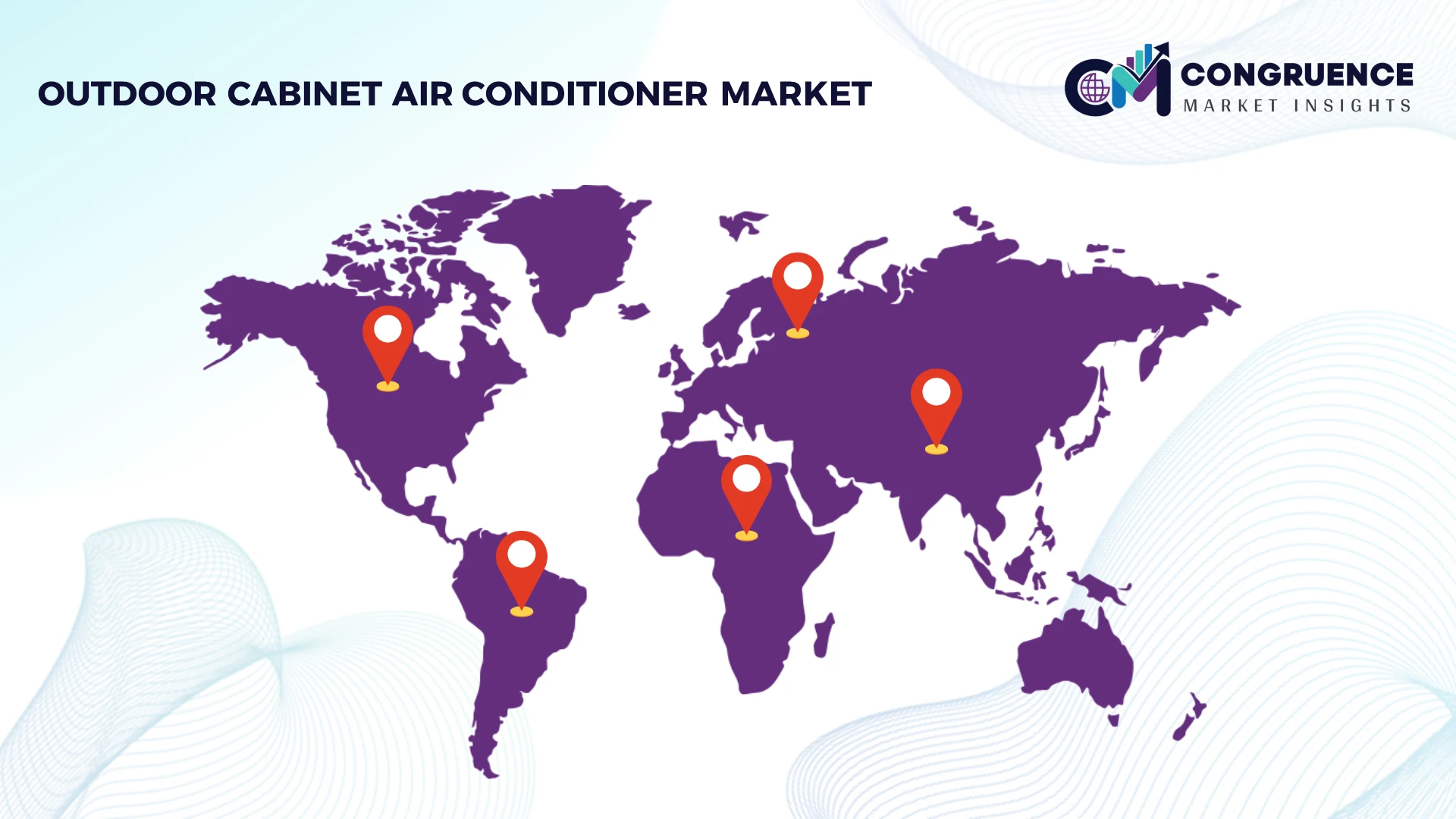
The analysis covers North America, Europe, Asia-Pacific, South America, and the Middle East & Africa, highlighting country-level industrial developments, infrastructure investment, and operational trends shaping market competitiveness between 2026 and 2033. It also examines adoption patterns, product differentiation, company strategies, supply-chain evolution, and emerging application areas including battery energy storage and edge computing. The report supports investment planning, expansion decisions, technology benchmarking, competitive intelligence, and long-term strategic positioning across the global outdoor cabinet cooling ecosystem.
| Report Attribute/Metric | Report Details |
|---|---|
|
Market Revenue in 2025 |
USD 1,670.2 Million |
|
Market Revenue in 2033 |
USD 2,891.2 Million |
|
CAGR (2026 - 2033) |
7.1% |
|
Base Year |
2025 |
|
Forecast Period |
2026 - 2033 |
|
Historic Period |
2021 - 2025 |
|
Segments Covered |
By Type
By Application
By End-User
|
|
Key Report Deliverable |
Revenue Forecast, Growth Trends, Market Dynamics, Segmental Overview, Regional and Country-wise Analysis, Competition Landscape |
|
Region Covered |
North America, Europe, Asia-Pacific, South America, Middle East, Africa |
|
Key Players Analyzed |
Vertiv, Rittal, STULZ, Schneider Electric, Delta Electronics, Pfannenberg, Kooltronic, Seifert Systems, nVent, Cosmotec, Ice Qube, EIC Solutions, Dantherm Group |
|
Customization & Pricing |
Available on Request (10% Customization is Free) |




