
Reports
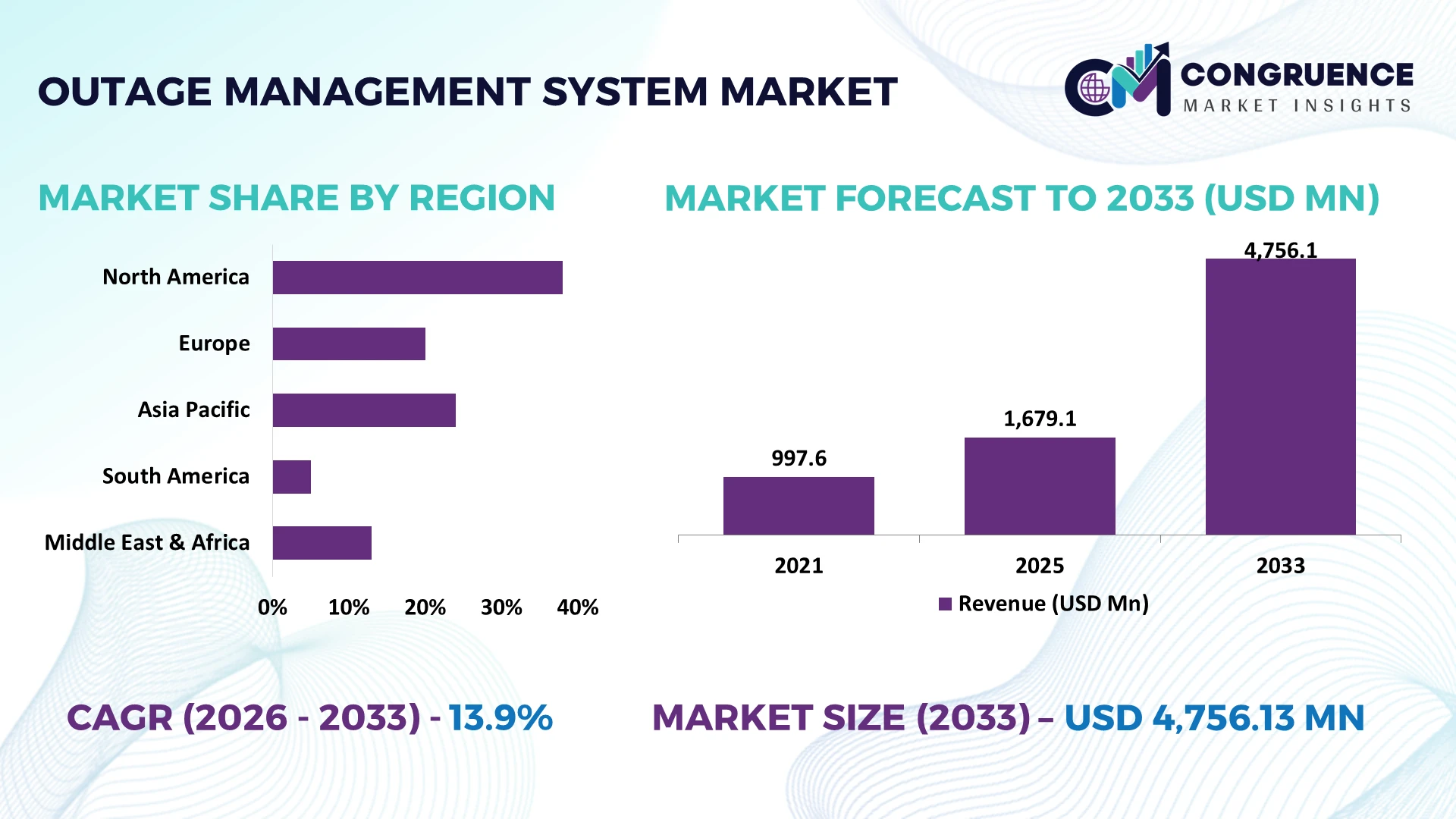
The Global Outage Management System Market was valued at USD 1679.05 Million in 2025 and is anticipated to reach a value of USD 4756.13 Million by 2033 expanding at a CAGR of 13.9% between 2026 and 2033. Growth is driven by utility integration of AMI, ADMS, GIS, distribution automation, and predictive analytics to detect faults faster, automate restoration workflows, and manage increasingly distributed electricity networks.
The United States represents approximately 35% of global OMS deployment value, supported by more than 3,000 electric utilities and large-scale grid digitization. U.S. customers averaged 11 hours of electricity interruptions during 2024, with major events responsible for 80% of outage hours. Hurricanes Helene, Milton, and Beryl intensified utility investment in automated fault localization and restoration. Compared with India’s rapidly digitizing distribution utilities, U.S. operators maintain deeper AMI–GIS–SCADA integration, while federal grid programs exceeding USD 10 billion reinforce modernization.
Utilities prioritizing interoperable OMS platforms with real-time network visibility, automated crew dispatch, and predictive restoration will secure measurable reliability and operating-cost advantages.
Market Size & Growth: USD 1,679.05 million in 2025 reaches USD 4,756.13 million by 2033 at 13.9% CAGR, driven by AMI–ADMS integration and automated restoration.
Top Growth Drivers: Extreme-weather resilience contributes approximately 35%, grid digitization 30%, and distributed-energy integration 20% to incremental OMS deployment momentum.
Short-Term Forecast: By 2028, advanced outage analytics and automated fault localization are positioned to reduce utility restoration workflows by approximately 20–30%.
Emerging Technologies: AI-based prediction, digital twins, and edge analytics can improve fault identification speed by 20–40% when integrated with real-time distribution telemetry.
Regional Leaders: North America approaches USD 1.55 billion, Asia-Pacific USD 1.45 billion, and Europe USD 1.05 billion by 2033, supported by automation, smart-grid expansion, and resilience programs.
Consumer/End-User Trends: Major weather events caused 80% of U.S. customer outage hours in 2024, intensifying utility focus on restoration visibility and proactive communications.
Pilot/Case Example: In 2024, U.S. grid modernization programs covered 105 selected projects across all 50 states, accelerating digital reliability and resilience deployments.
Competitive Landscape: GE Vernova holds an estimated 15% position, competing with Schneider Electric, Siemens, Oracle, and Hitachi Energy across integrated utility software deployments.
Regulatory & ESG Impact: Modern OMS platforms can reduce truck-roll requirements by approximately 10–20% through remote fault verification, supporting lower restoration-related fuel consumption and field exposure.
Investment & Funding: The U.S. GRIP program carries USD 10.5 billion in funding, strengthening utility investment in smart-grid technologies, automation, resilience, and outage restoration capabilities.
Innovation & Future Outlook: Cloud-native OMS, AI-assisted restoration, and distributed-energy visibility are targeting 20%+ faster operational decision cycles as utilities transition toward integrated ADMS environments.
Outage management systems are moving from reactive interruption tracking toward integrated grid orchestration across electric utilities, transmission-distribution operators, municipal networks, and cooperatives. Demand is concentrated around AMI connectivity, GIS-based network models, automated crew management, predictive fault analytics, and customer communication platforms. Major events accounted for 80% of U.S. outage hours in 2024, strengthening the operational case for faster situational awareness. Cloud-native architectures and AI-assisted restoration are now reducing dependence on isolated control-room workflows, while extreme-weather resilience programs accelerate modernization. This operating shift establishes the foundation for evaluating the market’s broader strategic relevance.
Outage management systems are becoming strategic grid-control assets as utilities move from reactive restoration toward data-driven network resilience. Extreme weather, distributed energy resources, and aging infrastructure are accelerating modernization; major events accounted for roughly 80% of U.S. customer outage hours in 2024. Utilities are consequently integrating OMS with AMI, GIS, SCADA, and ADMS platforms, shifting technology spending toward unified operational visibility rather than isolated control-room applications.
Advanced OMS platforms combining smart-meter last-gasp signals and automated fault localization can shorten outage identification and dispatch workflows by approximately 20–30% versus legacy customer-call-driven processes. U.S. utilities lead in integrated AMI and distribution automation, while India is rapidly digitizing distribution networks through smart-meter deployment. Through 2028, cloud deployment, predictive analytics, and DER visibility will increasingly determine platform selection as utilities automate more restoration decisions.
A practical deployment uses AMI outage notifications to identify affected transformers before customer calls accumulate, allowing crews to receive precise fault locations and restoration priorities. Vendors are therefore expanding cloud capabilities, utility partnerships, cybersecurity investment, and ADMS integration. Competitive advantage will concentrate around interoperability, restoration speed, scalable analytics, and the ability to convert fragmented grid telemetry into operational decisions.
Weather-driven reliability pressure is pushing utilities toward automated outage detection and restoration orchestration. Major events generated approximately 80% of U.S. customer outage hours in 2024, while customers averaged around 11 hours of interrupted electricity service. Hurricanes Helene, Milton, and Beryl exposed the operational cost of fragmented outage intelligence and manual crew coordination. Integrating OMS with AMI, GIS, SCADA, and distribution automation can shorten fault-location workflows by roughly 20–30%, improving restoration prioritization during widespread events. U.S. utilities are increasing resilience investment through grid-hardening and digital modernization programs, while technology providers are expanding predictive analytics, automated switching interfaces, and mobile workforce integration. The strategic shift is clear: restoration speed increasingly depends on data orchestration before additional field crews are deployed.
Fragmented utility technology stacks remain a structural limitation because OMS performance depends on accurate connectivity models and dependable data exchange with GIS, AMI, SCADA, CIS, and workforce systems. Many utilities still operate assets exceeding 30–40 years of age, while digital platforms often span multiple vendor generations. Integration and data-conversion activities can absorb 20–30% of complex modernization project effort, extending implementation schedules and increasing customization costs. Smaller U.S. municipal and cooperative utilities face greater pressure because limited IT resources restrict simultaneous platform replacement. Utilities are reducing exposure through phased migrations, standardized APIs, middleware, and cloud-hosted architectures rather than wholesale system replacement. Vendors are expanding interoperability frameworks and migration services. Operationally, inaccurate network models can neutralize advanced analytics, making data quality a critical constraint alongside software cost.
Distributed energy resources are expanding OMS functionality beyond conventional outage restoration. Solar, batteries, EV charging, and microgrids create bidirectional power flows that legacy outage models were not designed to interpret. Renewables supplied more than 30% of global electricity generation in 2024, while distributed solar continues expanding across utility territories. Advanced OMS integration with DERMS and ADMS can reduce restoration decision cycles by approximately 20–25% by showing available distributed resources, energized islands, and switching constraints. California provides a critical deployment environment because high rooftop-solar penetration combines with wildfire-related shutoffs and battery adoption. Vendors are developing DER-aware network models, cloud analytics, and microgrid coordination capabilities while partnering with utilities and grid-software providers. The non-obvious opportunity is using OMS data between outages for asset prioritization and reliability investment planning.
Deeper OMS integration expands the operational technology attack surface because outage platforms increasingly exchange real-time information with SCADA, AMI, mobile workforce applications, cloud environments, and customer systems. Electricity organizations face a growing cyber threat environment, while remotely accessible operational interfaces can multiply integration points by 20–30% during enterprise-wide modernization. U.S. critical-infrastructure requirements and Europe’s NIS2 framework are raising expectations for access control, incident reporting, supplier governance, and operational resilience. Utilities must therefore balance faster data sharing against segmentation and authentication requirements that can complicate restoration workflows. Vendors are investing in zero-trust architectures, encrypted APIs, continuous monitoring, redundancy, and secure cloud operations. The long-term challenge is maintaining sub-minute operational responsiveness without weakening security controls; platforms that cannot achieve both will struggle in mission-critical utility deployments.
Cloud Migration Accelerates Control-Room Modernization: Utilities are shifting OMS workloads from dedicated infrastructure toward cloud-enabled operating environments, reducing hardware provisioning requirements by roughly 20–30% and shortening software-update cycles from months to weeks. Hybrid deployment remains important for operational control. Vendors are expanding subscription platforms, containerized applications, and secure API integration while utilities restructure IT teams around continuous platform management and faster disaster recovery.
Mobile Restoration Workflows Replace Paper: Field crews increasingly receive switching instructions, damage assessments, GIS locations, and restoration assignments through connected mobile applications. Digitized workflows can reduce dispatch-to-field communication time by 20–25% and eliminate multiple manual status updates per incident. Utilities are integrating workforce management with OMS platforms, while suppliers expand offline synchronization, geospatial routing, and mobile damage-assessment tools to accelerate restoration without proportionally increasing control-room staffing.
Customer Communications Become Event Driven: Utilities are replacing periodic outage updates with automated notifications triggered by OMS status changes, smart-meter information, and estimated restoration calculations. Digital messaging can handle thousands of simultaneous notifications and reduce outage-related contact-center demand by approximately 15–25%. Providers are integrating SMS, mobile applications, web portals, and conversational AI, turning customer communications into an operational workflow rather than a separate service function.
Interoperability Reshapes Procurement Decisions: Utilities increasingly require OMS platforms to exchange data through standardized APIs across GIS, CIS, AMI, workforce, and distribution-management applications. Integration programs targeting 5–7 operational systems can eliminate 15–20% of repetitive data-handling tasks. Regulatory cybersecurity requirements are reinforcing controlled interfaces. Vendors are responding with modular architectures, partner ecosystems, prebuilt connectors, and common network models; interoperability is becoming a procurement differentiator alongside restoration functionality.
Cloud-Based systems account for an estimated 40–44% of OMS deployments, leading because utilities can scale computing capacity during major events without maintaining equivalent permanent infrastructure. Centralized upgrades, disaster recovery, and API-based integration also lower lifecycle administration compared with traditional On-Premise installations. On-Premise systems retain approximately 25–30% share, particularly among utilities requiring direct infrastructure control, customized operational environments, and established data-center investments. Hybrid architectures bridge these models by retaining mission-critical functions locally while moving analytics, integration, and customer-facing workloads into scalable environments.
Hybrid is the fastest-growing type as utilities seek modernization without replacing operational technology simultaneously. Hybrid implementations can move 30–50% of suitable non-control workloads toward cloud infrastructure while preserving local operational continuity. Mobile-Based OMS remains strategically important for field execution rather than becoming a complete control-room substitute. Technology suppliers are consequently prioritizing cloud-native modules, containerization, mobile workforce integration, cybersecurity, and migration services. Investment is shifting toward architectures that modernize incrementally rather than requiring high-risk system replacement.
Outage Restoration represents an estimated 30–34% of OMS application demand because restoration sequencing, switching coordination, estimated restoration times, and incident management form the platform’s core operational function. Fault Detection follows closely as AMI, SCADA, and distribution sensors increasingly automate outage verification. Crew Management connects network events with workforce availability and field assignments, while Customer Alerts translate operational status into automated digital communications. Asset Monitoring and Grid Monitoring provide broader situational context by identifying equipment condition and network abnormalities before restoration decisions are executed.
Fault Detection is the fastest-growing application as utilities replace customer-call-dependent identification with telemetry-driven workflows. AMI-based detection can reduce outage recognition and localization time by approximately 20–30%, while integrated analytics can process thousands of endpoint events during widespread incidents. Grid Monitoring is simultaneously becoming more operationally important as network complexity increases. Vendors are integrating event correlation, predictive algorithms, geospatial visualization, and automated dispatch functionality. Spending is therefore shifting toward applications that convert raw network signals directly into prioritized restoration actions.
Electric Utilities account for approximately 45–50% of OMS demand because they manage customer interruptions, distribution assets, field crews, switching operations, and regulatory reliability reporting within unified operating environments. Distribution Operators form another substantial buyer group as increasing network complexity requires granular fault localization and restoration coordination. Transmission Operators emphasize wide-area situational awareness and high-consequence event management, while Power Generators primarily deploy outage-related platforms around plant availability, interconnection status, and operational coordination. Industrial Users remain smaller but require rapid restoration visibility where electrical interruptions directly affect production.
Distribution Operators represent the fastest-growing end-user segment as smart meters, distributed generation, EV charging, and automated switching increase distribution-network observability. Advanced metering deployment exceeds 70% of electricity meters in several mature utility markets, providing increasingly granular event data for OMS platforms. Vendors are targeting operators through AMI integration, ADMS partnerships, configurable SaaS offerings, and modular deployment models. Competitive positioning increasingly depends on supporting both large investor-owned utilities and smaller operators without requiring identical infrastructure footprints.
North America accounted for the largest market share at 38% in 2025 however, Asia-Pacific is expected to register the fastest growth, expanding at a CAGR of 15.8% between 2026 and 2033.
Grid Resilience Drives Integrated Utility Operations
North America accounted for approximately 38% of global OMS demand in 2025, reflecting extensive smart-meter infrastructure, mature GIS adoption, distribution automation, and exposure to severe weather events. U.S. utilities are increasingly integrating OMS with ADMS, AMI, SCADA, customer information, and workforce-management platforms to create unified restoration workflows. Major events generated roughly 80% of U.S. customer outage hours in 2024, reinforcing investment in predictive fault localization and automated crew dispatch. Federal grid modernization programs exceeding USD 10 billion are supporting resilience, advanced monitoring, and distribution-system upgrades. Canadian utilities are similarly investing in wildfire, storm, and vegetation-risk management. Technology vendors are prioritizing cloud migration, interoperable network models, mobile restoration tools, and cybersecurity as utilities replace fragmented applications with enterprise-scale operational platforms.
United States Market Outlook: The United States combines more than 3,000 electric utilities with extensive smart-meter deployment and advanced distribution infrastructure. Utilities are moving procurement toward platforms that correlate meter events, network topology, customer calls, and field information. Hurricane and wildfire exposure further strengthens requirements for scalable incident management capable of coordinating restoration across thousands of simultaneous outage events.
Smart-Grid Regulation Accelerates Digital Integration
Europe represents approximately 24% of global OMS demand, with deployment shaped by smart-meter expansion, renewable integration, regulatory reliability requirements, and distribution-network digitalization. Germany, the United Kingdom, France, Italy, and Spain are upgrading distribution operations as wind, solar, EV charging, and flexible loads create increasingly dynamic power flows. EU smart-meter penetration has moved beyond 50%, improving the endpoint visibility available to outage and grid-management platforms. NIS2 requirements are simultaneously tightening cybersecurity expectations around operational technology and critical energy infrastructure. Distribution operators are therefore connecting OMS with ADMS, DER management, GIS, and customer communication platforms while strengthening identity management and incident response. Technology suppliers are responding with cloud-compatible architectures, secure APIs, automated network-model synchronization, and localized compliance capabilities, making interoperability and cybersecurity increasingly decisive purchasing criteria.
Germany Market Outlook: Germany provides a strategically important operating environment because renewable electricity supplies more than half of national power consumption, creating complex distribution-network conditions. Millions of photovoltaic systems, growing heat-pump installations, and EV charging loads are increasing requirements for granular network visibility. Utilities consequently prioritize topology accuracy, automated incident analysis, and coordinated outage restoration across increasingly decentralized infrastructure.
Smart-Meter Scale Accelerates Grid Digitization
Asia-Pacific accounts for approximately 27% of global OMS demand and combines large electricity networks with aggressive smart-meter, renewable-energy, and distribution-automation programs. China operates the world’s largest smart-grid infrastructure, while India is rapidly deploying intelligent metering across distribution companies and Japan maintains highly reliable automated networks. India’s Revamped Distribution Sector Scheme targets approximately 250 million smart prepaid meters, creating a major telemetry foundation for automated outage identification and network analytics. China’s expanding renewable fleet and distributed generation are increasing requirements for real-time grid visibility and coordinated switching. Utilities are moving from standalone outage applications toward integrated OMS-ADMS environments capable of processing meter events, GIS topology, and field information. Vendors are expanding local partnerships, cloud deployments, analytics capabilities, and implementation capacity to address large, geographically dispersed utility territories.
India Market Outlook: India offers exceptional deployment scale because smart-meter modernization is being implemented across state distribution utilities serving hundreds of millions of connections. The national smart-meter pipeline exceeds 200 million sanctioned units, enabling utilities to replace call-dependent outage recognition with endpoint telemetry. Vendors offering scalable SaaS, multilingual mobile workflows, and integration with existing billing and GIS systems gain stronger positioning.
Distribution Reliability Drives Utility Digitalization
South America represents approximately 6% of global OMS demand, led by Brazil, Chile, Colombia, and Argentina, where utilities are modernizing distribution networks and integrating renewable generation. Brazil dominates operational scale through a national electricity system serving more than 90 million consumer units, creating substantial requirements for outage localization, workforce coordination, and customer communications. Severe storms, vegetation exposure, geographically extensive service territories, and aging distribution assets increase restoration complexity. Smart-meter deployment remains uneven compared with North America, limiting automated endpoint visibility across several markets. Utilities are consequently prioritizing GIS modernization, mobile workforce systems, fault indicators, and modular OMS platforms before undertaking deeper ADMS integration. Vendors are responding through local implementation partnerships, phased cloud deployments, Portuguese and Spanish interfaces, and flexible integration models designed around heterogeneous utility infrastructure.
Brazil Market Outlook: Brazil combines continental-scale distribution networks with substantial hydro, wind, and solar generation, making accurate operational visibility increasingly important. Distributed solar capacity has expanded beyond 30 GW, introducing bidirectional flows across networks originally designed for centralized generation. Utilities are strengthening digital network models and field automation to manage outages without losing visibility of distributed resources.
Grid Modernization Expands Digital Control Investment
Middle East & Africa accounts for approximately 5% of global OMS demand, with adoption concentrated in Gulf utilities, South Africa, and digitally modernizing African power networks. Saudi Arabia and the UAE are investing heavily in smart grids, advanced metering, renewable integration, and automated distribution as electricity systems support industrial diversification and expanding urban infrastructure. Saudi smart-meter deployment has exceeded 10 million units, providing granular consumption and outage information across the national network. South Africa presents a contrasting requirement, where reliability constraints, load interruptions, and infrastructure pressure strengthen demand for accurate incident management but restrict modernization budgets. Vendors are targeting the region through utility partnerships, cloud-enabled platforms, advanced metering integration, and localized implementation services. Investment priorities increasingly favor systems capable of combining outage restoration with network analytics and automated customer communication.
Saudi Arabia Market Outlook: Saudi Arabia provides the strongest digital-grid foundation through nationwide smart-meter coverage, large renewable projects, and utility modernization under Vision 2030. More than 10 million intelligent meters create an extensive endpoint-data layer for automated outage verification. Integration of this telemetry with GIS and distribution-management platforms strengthens the business case for predictive restoration and centralized network operations.
The Outage Management System market pits GE Vernova, Schneider Electric, Siemens, Oracle, and Hitachi Energy against specialized grid-software providers competing through cloud flexibility and utility-specific integration. The top five account for approximately 50–55% of deployments, supported by installed ADMS, SCADA, GIS, and utility-enterprise relationships. Integrated vendors compete on platform breadth and interoperability, while specialists target implementation speed and customization, cutting deployment cycles by roughly 15–25%. Cloud architectures can lower infrastructure administration requirements by 20–30%, making migration capability increasingly decisive. Suppliers are expanding through utility partnerships, SaaS offerings, AI-based fault analytics, mobile workforce integration, and cybersecurity investment. Competition is shifting from standalone OMS functionality toward unified ADMS environments connecting meters, distributed resources, network models, and crews. Complex legacy integration, critical-infrastructure cybersecurity, and lengthy utility procurement cycles remain substantial entry barriers. Winning requires proven reliability, open integration, scalable event processing, secure cloud operations, and measurable restoration improvement across diverse utility environments.
GE Vernova
Schneider Electric
Siemens
Oracle
Hitachi Energy
ABB
Eaton
Itron
Landis+Gyr
Survalent
Open Systems International
Milsoft Utility Solutions
Gentrack
Trimble
Current OMS technology combines AMI, GIS, SCADA, ADMS, workforce systems, and network models to automate outage detection and restoration. Smart-meter last-gasp events and FLISR replace customer-call-led identification, cutting fault-location and restoration workflows by 20–30%. Integrated platforms let storm teams scale rapidly while improving crew dispatch, estimated restoration times, and control-room productivity.
Emerging architectures add AI forecasting, cloud deployment, digital twins, edge analytics, and DER-aware network modeling. AI correlates weather, sensor, asset, and historical outage data to prioritize failures, while digital twins provide synchronized topology for switching decisions. Compared with legacy siloed OMS environments, integrated ADMS-OMS platforms can reduce outage duration by up to 30% and eliminate 15–20% of repetitive data handling. Utilities with mature AMI and GIS foundations benefit first because integration converts existing telemetry into automated decisions.
From 2026–2028, disruptive development will center on agentic AI, predictive restoration, autonomous switching recommendations, and tighter OMS-DERMS integration. Cloud and edge orchestration will move analytics from post-event reporting into pre-event preparation, targeting 10–20% faster operational decision cycles. Vendors combining cybersecurity, open APIs, mobile execution, and AI-ready data models gain competitive advantage. Acting now matters because utilities must establish clean network models and interoperable data foundations before autonomous restoration can scale safely globally.
February 2024 GE Vernova launched GridOS Data Fabric, its first grid-specific federated data fabric, with Itron collaborating on grid-edge integration. The platform unifies decentralized IT/OT data, improving real-time orchestration and strengthening outage analytics across increasingly distributed electricity networks. Source: gevernova.com
March 2025 Oracle enhanced Utilities Network Management System with improved OMS crew-assignment visibility and DER orchestration. The platform supports over 61 million customers and six of the top 10 U.S. utilities, strengthening scalable restoration and distributed-grid operations globally. Source: oracle.com
December 2025 ISG evaluated 16 power-and-utilities grid software providers across outage management, ADMS, DER coordination, AI, integration, and digital twins. GE Vernova, Oracle, and Hitachi Energy ranked as overall leaders, intensifying competition around integrated utility platforms and selection decisions. Source: isg-one.com
March 2026 Hitachi Energy launched HMAX Energy, an AI-powered suite for critical energy infrastructure spanning planning, prediction, and prevention. Proven reference cases can reduce losses from equipment breakdowns by up to 60%, strengthening predictive reliability operations and resilience. Source: hitachi.com
The Outage Management System Market Report evaluates Cloud-Based, On-Premise, Hybrid, and Mobile-Based platforms across Fault Detection, Outage Restoration, Crew Management, Asset Monitoring, Grid Monitoring, and Customer Alerts. Electric Utilities, Power Generators, Transmission Operators, Distribution Operators, and Industrial Users form the end-user coverage. Cloud-Based solutions represent approximately 40–44% of deployment, while Outage Restoration contributes an estimated 30–34% of application demand.
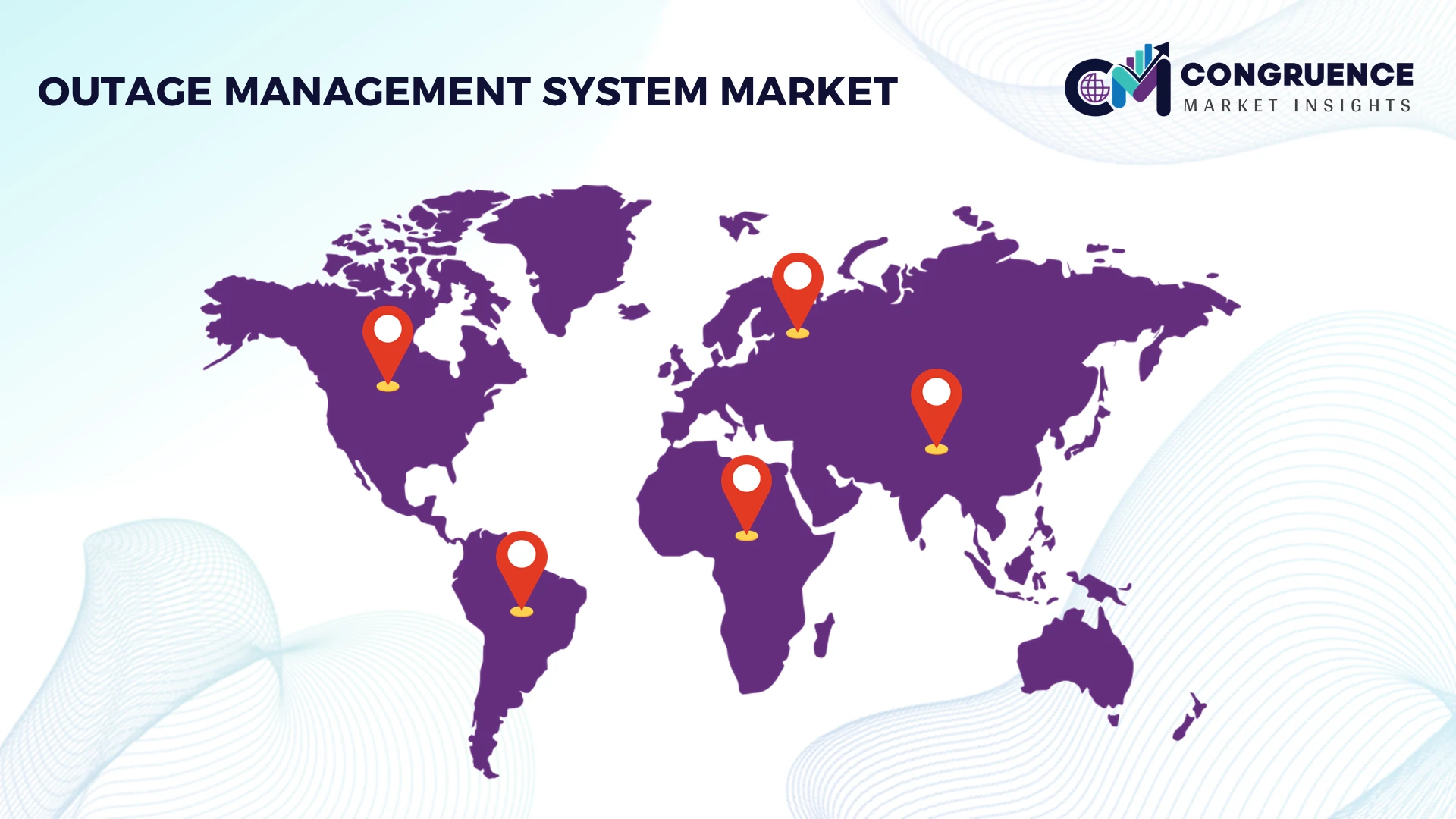
Regional assessment covers North America, Europe, Asia-Pacific, South America, and Middle East & Africa, including mature and rapidly digitizing utility networks. Technology coverage examines AMI integration, FLISR, AI analytics, digital twins, cloud architectures, mobile operations, DER-aware network models, and automated switching. The 2026–2033 framework assesses modernization priorities, interoperability, cybersecurity, utility procurement, deployment models, and competitive positioning, supporting investment planning, geographic expansion, partnership selection, product development, and long-term grid-software strategy.
| Report Attribute/Metric | Report Details |
|---|---|
Market Revenue in 2025 | USD 1679.05 Million |
Market Revenue in 2033 | USD 4756.13 Million |
CAGR (2026 - 2033) | 13.9% |
Base Year | 2025 |
Forecast Period | 2026 - 2033 |
Historic Period | 2021 - 2025 |
Segments Covered | By Type
By Application
By End-User
|
Key Report Deliverable | Revenue Forecast, Growth Trends, Market Dynamics, Segmental Overview, Regional and Country-wise Analysis, Competition Landscape |
Region Covered | North America, Europe, Asia-Pacific, South America, Middle East, Africa |
Key Players Analyzed | GE Vernova, Schneider Electric, Siemens, Oracle, Hitachi Energy, ABB, Eaton, Itron, Landis+Gyr, Survalent, Open Systems International, Milsoft Utility Solutions, Gentrack, Trimble |
Customization & Pricing | Available on Request (10% Customization is Free) |




