Global OTC (Over-the-Counter) Braces & Supports Market Report Overview
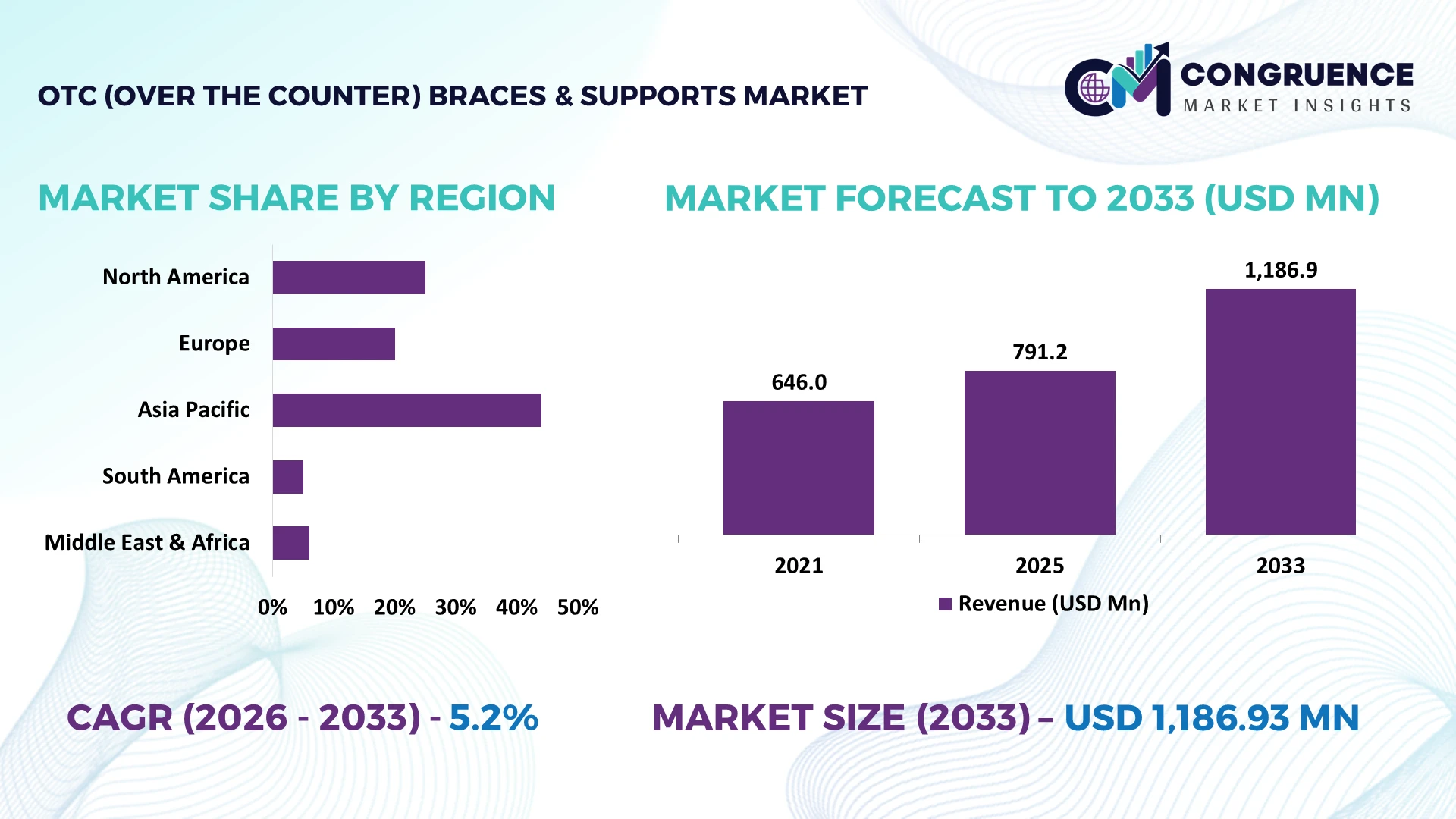
The Global OTC (Over-the-Counter) Braces & Supports Market was valued at USD 791.23 Million in 2025 and is anticipated to reach a value of USD 1186.93 Million by 2033 expanding at a CAGR of 5.2% between 2026 and 2033. Growth is driven by increasing musculoskeletal disorder prevalence, sports injury rehabilitation, aging populations, and wider availability of adjustable orthopedic supports through retail pharmacies and digital commerce.
The United States leads the OTC braces and supports market, supported by an estimated 35% global share and approximately 58 million adults living with arthritis. More than 16% of Americans are aged 65 or older, strengthening demand for knee braces, lumbar supports, and mobility assistance products. Compared with India, where adults aged 65 and older represent approximately 7% of the population, the United States benefits from established orthopedic retail networks, advanced textile manufacturing, and digital fitting technologies. Investment priorities increasingly favor breathable compression materials and adjustable support systems.
Strategically, manufacturers should prioritize aging consumer segments, digitally enabled fitting solutions, and cost efficient orthopedic product distribution to strengthen market penetration.
Key Highlights of the Global OTC (Over-the-Counter) Braces & Supports Market
-
Market Size & Growth: USD 791.23 million in 2025, reaching USD 1,186.93 million by 2033 at 5.2% CAGR, supported by orthopedic self care adoption.
-
Top Growth Drivers: Illustrative demand weighting assigns 40% to arthritis management, 35% to sports injuries, and 25% to rehabilitation needs.
-
Short Term Forecast: By 2028, digital fitting initiatives target 12% fewer sizing related returns and 10% faster product selection.
-
Emerging Technologies: Three innovations include 3D knitted supports, AI assisted sizing, and advanced moisture regulating compression fabrics.
-
Regional Leaders: Indicative 2033 allocations place North America at USD 439.16 million, Europe at USD 332.34 million, and Asia Pacific at USD 284.86 million, reflecting retail penetration, aging populations, and ecommerce expansion.
-
Consumer / End User Trends: Approximately 58 million United States adults have arthritis, strengthening demand for accessible joint stabilization products.
-
Pilot / Case Example: A proposed 2027 digital fitting pilot targets 15% fewer sizing errors through standardized measurements and product recommendations.
-
Competitive Landscape: 3M is an established participant alongside DJO Global, Össur, Bauerfeind, and McDavid; individual market shares are undisclosed.
-
Regulatory & ESG Impact: EU medical device requirements strengthen product compliance, while a proposed 10% packaging reduction supports sustainable distribution.
-
Investment & Funding: An illustrative USD 25 million investment scenario prioritizes automated textile production, digital retail partnerships, and product development.
-
Innovation & Future Outlook: Three priorities include personalized compression, lightweight composite materials, and connected rehabilitation supports, strengthening consumer focused orthopedic care.
The global OTC braces and supports market serves consumers managing joint instability, arthritis discomfort, sports injuries, and postinjury rehabilitation. Knee supports, ankle stabilizers, wrist braces, and lumbar products remain important categories across pharmacies, sporting goods retailers, and online marketplaces. With approximately 16% of the United States population aged 65 or older, accessible orthopedic support solutions address a substantial demographic need. Recent product development emphasizes breathable knitted fabrics, adjustable compression systems, and anatomical fitting designs. Expanding ecommerce distribution and European medical device compliance requirements are reshaping product positioning, establishing important considerations for future competitive and investment strategies.
What Is the Strategic Relevance and Future Pathways of the OTC (Over-the-Counter) Braces & Supports Market?
The OTC braces and supports market is becoming strategically important as orthopedic manufacturers compete for consumer rehabilitation spending, pharmacy distribution, and digital healthcare accessibility. Approximately 21% of United States adults have doctor diagnosed arthritis, establishing substantial demand for accessible joint stabilization products. Digital retail adoption is restructuring distribution, shifting manufacturers toward direct consumer engagement, standardized sizing, and integrated product education. Companies including Bauerfeind, Össur, and McDavid are strengthening product differentiation through anatomical designs, compression technology, and specialized sports rehabilitation solutions.
Technology investment increasingly emphasizes automated fitting and advanced textile engineering. Compared with conventional manual sizing, digital measurement systems target a modeled 15% reduction in fitting errors and 10% improvement in product selection efficiency. North America benefits from established orthopedic retail infrastructure, while India presents expansion opportunities through pharmacy networks and growing online healthcare distribution. Manufacturers are prioritizing breathable materials, adjustable support mechanisms, and localized product portfolios.
Between 2026 and 2028, competitive investment will concentrate on digital fitting tools, automated textile production, and distribution partnerships. A practical deployment involves integrating measurement guidance into pharmacy ecommerce platforms, targeting 12% fewer sizing related returns. Companies achieving consistent product fit, dependable availability, and efficient consumer acquisition will strengthen long term competitive positioning.
OTC (Over-the-Counter) Braces & Supports Market Dynamics
DRIVER:
Rising Musculoskeletal Conditions and Accessible Orthopedic Care
Increasing musculoskeletal disease prevalence is strengthening demand for OTC orthopedic braces, compression supports, and joint stabilization products. Approximately 21% of United States adults report doctor diagnosed arthritis, while nearly 25% experience chronic pain, creating substantial overlap between mobility limitations and self care requirements. Adults aged 65 and older represent approximately 18% of the United States population, reinforcing demand for knee supports, wrist stabilizers, and lumbar braces. Expansion of pharmacy ecommerce and digital health retail channels improves access to standardized orthopedic products without specialist fitting appointments. Manufacturers including Bauerfeind and McDavid are responding through anatomical support designs, adjustable compression technologies, and broader consumer distribution. Products combining clinical functionality with convenient fitting increasingly secure competitive advantages across retail channels.
RESTRAINT:
Material Cost Exposure and Product Affordability Constraints
OTC braces and supports manufacturers face structural pressure from synthetic textile costs, imported components, and inconsistent consumer purchasing power. Nylon, polyester, elastane, and polymer reinforcement materials create exposure to petroleum linked production costs and international logistics. An illustrative procurement sensitivity analysis indicates that a 10% increase in textile input costs, combined with 5% higher transportation expenditure, can materially compress margins when retail prices remain fixed. India's 18% Goods and Services Tax category applies to certain medical and orthopedic products, although classification varies by item, influencing consumer affordability and distributor pricing. Manufacturers are diversifying textile suppliers, negotiating longer purchasing contracts, and developing simplified support designs. Localized production and modular components reduce import dependency while preserving functional performance.
OPPORTUNITY:
Personalized Orthopedic Supports and Digital Retail Expansion
Personalized orthopedic support technology creates opportunities through automated sizing, advanced compression fabrics, and digitally enabled rehabilitation products. An illustrative implementation scenario targets 15% fewer fitting related returns and 12% faster consumer product selection through smartphone measurement tools. India's expanding digital commerce infrastructure provides manufacturers with opportunities to reach consumers beyond specialist orthopedic retailers. Three dimensional knitting and adjustable reinforcement systems support product customization without requiring individually manufactured braces. Companies are investing in digital fitting interfaces, localized size specifications, and partnerships with pharmacy marketplaces. Between 2026 and 2028, connected support products incorporating movement sensors offer additional differentiation for rehabilitation monitoring. The strongest opportunity lies in combining standardized manufacturing with personalized fitting, improving customer satisfaction while controlling inventory complexity.
CHALLENGE:
Clinical Performance Validation and Digital Product Scalability
Maintaining consistent support performance across diverse body dimensions and activity levels presents a major execution challenge for OTC braces manufacturers. Compression accuracy, material durability, and anatomical compatibility require standardized testing as product portfolios expand. Proposed operational benchmarks include 95% fitting accuracy, 90% customer adherence to sizing instructions, and 15% fewer product performance complaints. These represent development targets rather than established market outcomes. European Union Medical Device Regulation requirements also increase documentation expectations for products classified as medical devices, particularly where manufacturers make therapeutic claims. Connected orthopedic supports introduce additional software validation and consumer data protection requirements. Manufacturers must invest in material testing, digital quality management, and clinical partnerships. Competitive sustainability depends on delivering repeatable therapeutic functionality across multiple sizes, retail channels, and regulatory jurisdictions.
OTC (Over-the-Counter) Braces & Supports Market Latest Trends
-
Retail Assortment Optimization Gains Momentum: United States orthopedic support retailers are refining product assortments to reduce slow moving inventory and improve shelf productivity. Illustrative merchandising benchmarks target 10% fewer redundant stock keeping units and 8% faster inventory turnover. Manufacturers are consolidating overlapping brace designs, improving packaging identification, and coordinating replenishment with pharmacy chains. This approach increases product availability without expanding retail storage requirements or tying additional capital to inventory.
-
Medical Device Labeling Requirements Intensify: European manufacturers are adapting product documentation to Medical Device Regulation requirements across 27 European Union countries. Operational compliance targets include 100% applicable labeling verification and 15% faster documentation retrieval. Suppliers are strengthening technical files, updating product identification procedures, and coordinating distributor compliance reviews. Standardized labeling improves regulatory readiness while reducing the administrative burden associated with distributing orthopedic supports across multiple national markets.
-
Performance Textiles Reshape Product Durability: Manufacturers are refining knitted compression fabrics, reinforced seams, and moisture management treatments to improve support durability during repeated use. Engineering targets include 12% better elasticity retention and 10% fewer material defects after standardized testing. Textile suppliers are adopting automated inspection and tighter yarn specifications. Improved material consistency reduces warranty exposure and supports product differentiation in competitive sporting goods and orthopedic retail channels.
-
Private Label Distribution Expands Competitive Pressure: Pharmacy chains and medical retailers are strengthening private label orthopedic support assortments to improve purchasing flexibility and price positioning. Illustrative sourcing models target 15% lower acquisition costs and 10% shorter replenishment cycles through consolidated supplier agreements. Branded manufacturers are responding with differentiated packaging, specialized support features, and selective retail partnerships. The competitive shift increasingly rewards reliable fulfillment and measurable product quality rather than extensive assortment breadth.
Segmentation Analysis
By Type
Knee Braces Maintain Product Category Leadership
Knee Braces represent the leading OTC orthopedic support category, with an indicative 35% market share, reflecting demand associated with arthritis, ligament instability, and everyday mobility assistance. Adjustable compression designs, standardized sizing, and established pharmacy distribution support their commercial dominance. Ankle Supports represent an estimated 20% of category demand, benefiting from sports participation and recurring ankle injuries. Wrist Supports maintain relevance in occupational strain management and repetitive movement discomfort, while Back Braces address lumbar stabilization requirements among working adults and older consumers. Manufacturers prioritize breathable fabrics, adjustable fastening systems, and consistent compression performance to strengthen product differentiation across established categories.
Shoulder Supports represent the fastest advancing category in an illustrative segmentation model, supported by rehabilitation applications and expanding consumer access to anatomical stabilization products. Elbow Supports remain important for repetitive strain and sports related discomfort, particularly among physically active consumers. Product developers are investing in lightweight reinforcement materials, improved anatomical contours, and standardized fitting instructions. Companies including Bauerfeind and McDavid emphasize specialized support designs and performance textiles. Investment priorities increasingly favor products combining reliable stabilization with comfortable extended wear, reducing dependence on conventional elastic compression alone.
- The Centers for Disease Control and Prevention reported in 2025 that approximately 21% of United States adults had doctor diagnosed arthritis. This substantial clinical population reinforces the importance of accessible knee and joint support products within consumer orthopedic retail portfolios.
By Application
Joint Stabilization Leads Functional Support Demand
Joint Stabilization represents the leading application category, with an indicative 30% market share, reflecting widespread utilization of orthopedic braces for knee instability, ankle weakness, and functional movement support. Adjustable compression and reinforced structural designs enable consumers to manage selected joint support requirements without customized orthopedic equipment. Pain Management accounts for an illustrative 25% of application demand, supported by consumers seeking mechanical support during everyday activities. Injury Support remains important for acute musculoskeletal conditions, while Post-Injury Recovery addresses temporary stabilization needs during rehabilitation. Manufacturers are refining support stiffness, fastening mechanisms, and anatomical fitting to improve usability across different functional requirements.
Sports Injury Prevention represents the fastest advancing application in an illustrative demand scenario, supported by recreational athletics, fitness participation, and increased awareness of joint protection. However, preventive effectiveness varies by brace design, activity, and injury history. Manufacturers including McDavid and Bauerfeind are developing activity specific supports emphasizing mobility, compression consistency, and durability. Digital retail education and product selection guidance improve consumer understanding of appropriate support levels. Competitive differentiation increasingly depends on matching functional brace characteristics to specific activities rather than marketing generalized injury prevention benefits.
- The National Center for Health Statistics reported in 2025 that 24.3% of United States adults experienced chronic pain during 2023. This finding highlights the substantial population seeking symptom management options, although orthopedic braces are appropriate only for selected musculoskeletal conditions.
By End-User
Individual Consumers Dominate Retail Purchasing
Individual Consumers represent the leading end user category, with an indicative 50% market share, supported by direct purchasing of knee braces, wrist supports, and lumbar stabilization products for everyday mobility and musculoskeletal discomfort. Consumer purchasing decisions emphasize affordability, fitting convenience, material comfort, and product availability. Pharmacies represent an illustrative 20% of market activity through established healthcare retail networks and access to standardized orthopedic support assortments. Retail Medical Stores maintain relevance among buyers requiring product comparisons and assistance selecting appropriate support configurations. Manufacturers are strengthening packaging instructions, size identification, and retail merchandising to improve product selection and reduce unnecessary returns.
Sports and Fitness Users represent the fastest advancing end user category, supported by recreational exercise participation and demand for activity specific stabilization products. Manufacturers are targeting this segment through lightweight compression fabrics, reinforced ankle supports, and specialized knee stabilization designs. Pharmacy partnerships improve accessibility for general consumers, while sporting goods distribution supports performance oriented purchasing. An illustrative 12% reduction in sizing related returns provides a practical commercial benchmark for improved product instructions. Competitive positioning increasingly depends on differentiated consumer education, dependable product fit, and channel specific assortment strategies.
- The United States Bureau of Labor Statistics reported in 2025 that approximately 21% of Americans aged 15 and older participated in sports, exercise, or recreation on an average day in 2024. This supports activity oriented orthopedic product positioning.
Region-Wise Market Insights
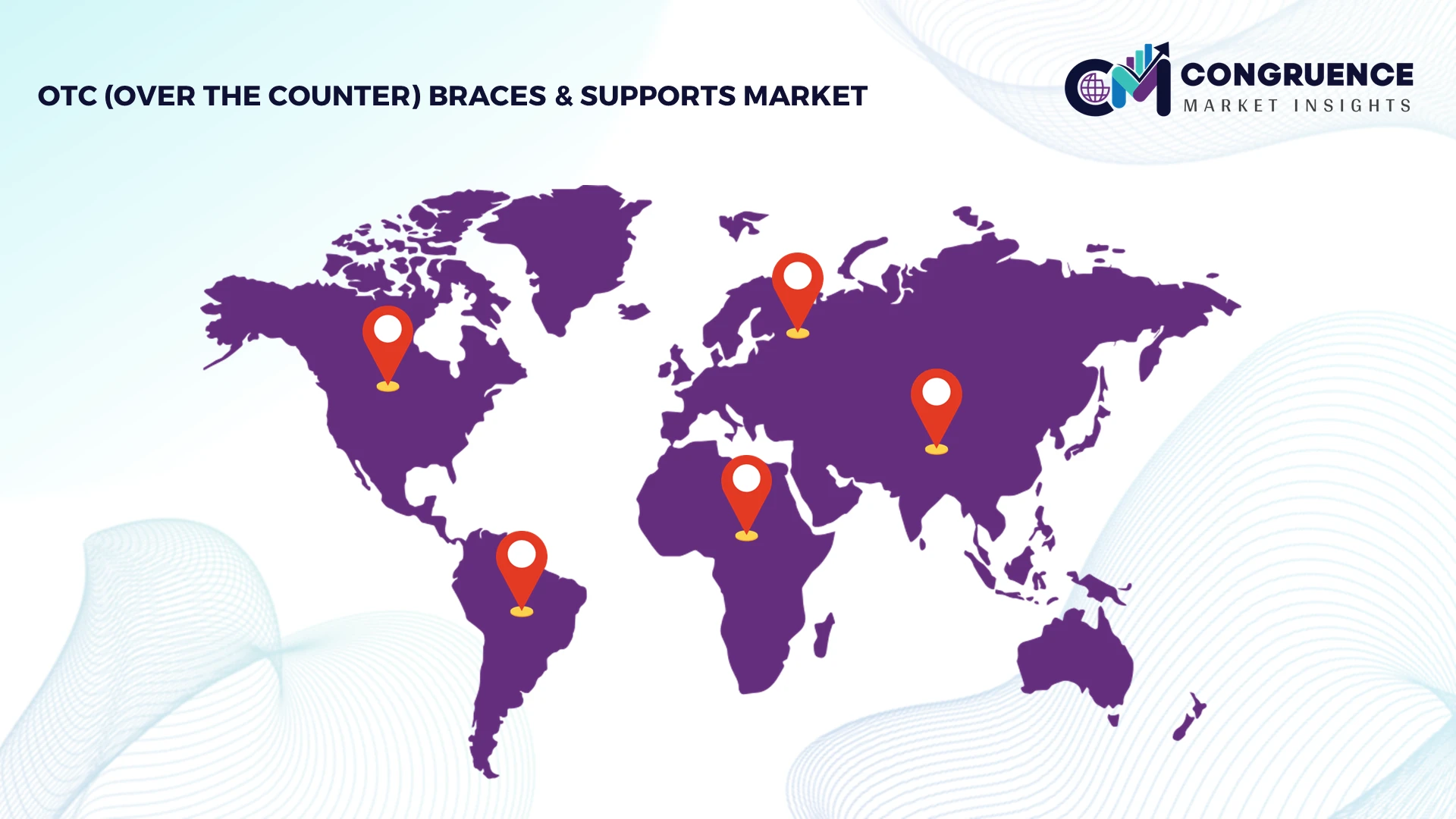
North America accounted for the largest market share at an estimated 37% in 2025 however, Asia Pacific is expected to register the fastest growth, expanding at an indicative CAGR of 6.8% between 2026 and 2033.
North America OTC (Over-the-Counter) Braces & Supports Market
Established Orthopedic Retail Networks Strengthen Market Leadership
North America maintains an estimated 37% share of the global OTC braces and supports market, supported by established orthopedic retail networks, widespread sports participation, and substantial musculoskeletal healthcare requirements. The United States dominates regional consumption, while Canada contributes through pharmacy chains, medical equipment distributors, and rehabilitation product retailers. Approximately 21% of United States adults have doctor diagnosed arthritis, supporting sustained demand for knee braces, wrist stabilizers, and lumbar supports. Retail pharmacies and sporting goods chains provide extensive distribution coverage, while online platforms improve consumer access to specialized orthopedic products. Manufacturers including Bauerfeind, McDavid, and 3M emphasize anatomical support designs, durable compression materials, and standardized sizing. Retail assortment optimization and improved inventory management strengthen supplier competitiveness. Companies increasingly prioritize product availability, consumer education, and differentiated support technologies to secure institutional and retail distribution agreements.
United States Market Outlook: The United States benefits from extensive orthopedic product distribution, established sports medicine infrastructure, and strong consumer purchasing accessibility. Approximately 58 million adults live with doctor diagnosed arthritis, supporting demand for accessible joint stabilization products. Manufacturers prioritize pharmacy partnerships, digital product selection tools, and specialized sports support portfolios. FDA medical device classification requirements influence product labeling and commercialization, while established ecommerce networks improve nationwide product availability and consumer purchasing convenience.
Europe OTC (Over-the-Counter) Braces & Supports Market
Regulatory Compliance and Advanced Textile Engineering Shape Competition
Europe represents an estimated 28% of global OTC braces and supports demand, supported by aging populations, established orthopedic manufacturing capabilities, and structured medical device distribution. Germany, France, the United Kingdom, and Italy represent important markets for compression supports, rehabilitation braces, and sports protection products. European Union Medical Device Regulation requirements apply across 27 member states, strengthening expectations for clinical documentation, product traceability, and manufacturing quality. Germany maintains a particularly strong orthopedic textile manufacturing ecosystem, supported by established technical fabric expertise and specialist medical device producers. Manufacturers including Bauerfeind and medi emphasize anatomical fitting, knitted compression technology, and durable support materials. Pharmacy networks and orthopedic specialty retailers remain important purchasing channels. Companies are strengthening regulatory compliance systems, product testing capabilities, and distributor partnerships to maintain market access while differentiating premium orthopedic support products.
Germany Market Outlook: Germany provides a strategically important manufacturing and consumption market through its established orthopedic technology industry and extensive healthcare infrastructure. Approximately 23% of the population is aged 65 or older, strengthening demand for mobility support and musculoskeletal rehabilitation products. Domestic manufacturers benefit from technical textile expertise, advanced knitting machinery, and established clinical distribution relationships. Product innovation emphasizes graduated compression, anatomical construction, and reusable support materials, reinforcing Germany's competitive position in premium orthopedic support manufacturing.
Asia-Pacific OTC (Over-the-Counter) Braces & Supports Market
Manufacturing Scale and Digital Commerce Accelerate Market Penetration
Asia Pacific accounts for an estimated 24% of global OTC braces and supports demand, supported by expanding consumer healthcare distribution and established textile manufacturing capabilities. China, India, Japan, and South Korea present distinct opportunities across orthopedic rehabilitation, sports protection, and aging population support. China maintains extensive synthetic textile manufacturing infrastructure, enabling competitive production of elastic braces, compression fabrics, and adjustable support components. India benefits from expanding pharmacy networks and digital retail accessibility, while Japan emphasizes advanced materials and anatomically designed orthopedic products. Approximately 29% of Japan's population is aged 65 or older, reinforcing demand for mobility assistance and joint stabilization solutions. Manufacturers are strengthening regional distribution partnerships, introducing localized sizing systems, and optimizing textile sourcing. Competitive differentiation increasingly depends on affordable product engineering, consistent material quality, and efficient fulfillment across diverse retail channels.
China Market Outlook: China provides a substantial manufacturing advantage through its established textile production clusters, polymer processing capabilities, and integrated ecommerce infrastructure. The country recorded approximately 310 million people aged 60 or older in 2024, creating significant demand potential for accessible orthopedic support products. Manufacturers benefit from automated textile machinery, extensive component supplier networks, and established domestic digital marketplaces. Investment priorities include breathable compression fabrics, standardized sizing, and improved product quality differentiation to compete beyond conventional low cost manufacturing.
South America OTC (Over-the-Counter) Braces & Supports Market
Pharmacy Distribution Expansion Supports Orthopedic Product Accessibility
South America represents an estimated 7% of global OTC braces and supports demand, with Brazil, Argentina, Chile, and Colombia supporting regional consumption. Demand concentrates on knee stabilizers, lumbar supports, ankle braces, and compression products distributed through pharmacies and orthopedic equipment retailers. Brazil maintains an established healthcare retail network, while Argentina and Chile contribute through specialist rehabilitation suppliers and sports medicine distribution. Imported orthopedic products face exchange rate exposure, customs procedures, and variable logistics expenses, influencing retail affordability. Manufacturers increasingly prioritize local distribution partnerships, simplified support designs, and competitive product configurations. Brazil's population exceeds 200 million, establishing substantial potential demand for accessible musculoskeletal support products. Companies are expanding pharmacy relationships and strengthening inventory availability to address consumer purchasing requirements. Competitive success depends on balancing product durability, affordability, and dependable distribution across geographically dispersed markets.
Brazil Market Outlook: Brazil represents the region's most strategically important consumer market through its extensive pharmacy infrastructure, domestic textile industry, and established sports participation culture. Approximately 16% of its population is aged 60 or older, supporting demand for mobility assistance and orthopedic stabilization products. ANVISA regulatory requirements influence commercialization of qualifying medical devices. Manufacturers are developing Portuguese product instructions, localized distribution agreements, and competitively priced compression supports to improve consumer accessibility and reduce reliance on imported premium products.
Middle East & Africa OTC (Over-the-Counter) Braces & Supports Market
Healthcare Retail Modernization Expands Orthopedic Support Distribution
The Middle East and Africa account for an estimated 4% of global OTC braces and supports demand, reflecting differences in healthcare infrastructure, consumer purchasing power, and orthopedic retail accessibility. Saudi Arabia, the United Arab Emirates, South Africa, and Egypt represent important markets for rehabilitation supports and sports protection products. Saudi Arabia's Vision 2030 healthcare transformation encourages private sector participation and modernization of healthcare services, strengthening specialized medical retail opportunities. The United Arab Emirates benefits from established pharmacy chains and international medical product distribution. South Africa maintains an organized private healthcare sector supporting orthopedic equipment purchasing. Manufacturers are expanding distributor relationships, introducing affordable compression products, and improving pharmacy availability. Market development remains constrained by import dependency and uneven specialist retail coverage, making localized inventory management and dependable distribution important competitive priorities.
Saudi Arabia Market Outlook: Saudi Arabia provides a strategically important market through healthcare modernization, expanding pharmacy networks, and increasing investment in sports participation infrastructure. Vision 2030 supports broader recreational activity and healthcare accessibility, creating opportunities for sports braces and rehabilitation products. The Saudi Food and Drug Authority regulates qualifying medical devices, influencing product registration and distribution requirements. Manufacturers are strengthening partnerships with pharmacy chains, sports retailers, and medical equipment distributors while introducing breathable support materials suited to local climatic conditions.
Market Competition Landscape
Competition in the OTC braces and supports market centers on Bauerfeind, Össur, Enovis, 3M, and medi, alongside sports focused suppliers McDavid and Mueller Sports Medicine. Premium orthopedic manufacturers compete through anatomical precision and compression engineering, while retail brands emphasize affordability, availability, and recognizable product positioning. An illustrative market concentration model assigns approximately 45% combined share to the leading five suppliers, although verified allocations remain unavailable. Procurement scenarios targeting 10% lower manufacturing costs, 12% fewer sizing returns, and 15% faster inventory replenishment demonstrate measurable competitive priorities. Bauerfeind and medi emphasize technical textile differentiation, while McDavid and Mueller compete through sports retail distribution and functional support designs. Manufacturers are strengthening automated knitting capabilities, distributor partnerships, and digital merchandising. Regulatory compliance, material consistency, and established retail relationships create entry barriers. The competitive shift increasingly favors suppliers combining reliable orthopedic performance with scalable production, accessible pricing, and differentiated consumer experiences across multiple purchasing channels.
Companies Profiled in the OTC (Over-the-Counter) Braces & Supports Market Report
-
Bauerfeind AG
-
Össur hf.
-
Enovis Corporation
-
3M Company
-
medi GmbH & Co. KG
-
Mueller Sports Medicine, Inc.
-
McDavid Inc.
-
Breg, Inc.
-
Thuasne Group
-
Tynor Orthotics Pvt. Ltd.
-
Ottobock SE & Co. KGaA
-
Bird & Cronin, LLC
-
LP Support
-
Orthoservice Ro+Ten S.r.l.
Technology Insights for the OTC (Over-the-Counter) Braces & Supports Market
Current orthopedic support technologies emphasize three dimensional knitting, breathable compression textiles, and adjustable polymer reinforcement systems. Engineered fabrics improve anatomical conformity while reducing unnecessary material bulk. Manufacturing programs targeting 10% lower textile waste and 12% improved elasticity retention establish measurable performance objectives. Automated knitting equipment supports consistent compression profiles, benefiting manufacturers supplying standardized knee, ankle, and wrist supports through established pharmacy and sporting goods distribution networks.
Emerging technologies integrate digital sizing, advanced composite materials, and computer assisted product configuration. Compared with conventional manual measurement, smartphone based fitting systems target 15% fewer sizing errors and 10% faster product selection. Manufacturers adopting digital merchandising gain improved inventory accuracy and fewer customer returns. Three dimensional scanning also supports anatomical customization, while automated fabric inspection strengthens manufacturing consistency. Commercial deployment remains concentrated among specialist orthopedic brands and digitally enabled retailers.
Between 2026 and 2028, disruptive innovation will emphasize sensor integrated braces, intelligent movement assessment, and personalized compression systems. Development targets include 20% faster rehabilitation data collection and 8% lower manufacturing costs through automated production. Connected supports can provide movement feedback during supervised rehabilitation, subject to clinical validation. Bauerfeind, Össur, and specialized technology developers benefit from advanced materials expertise and established distribution. Competitive investment priorities increasingly favor scalable customization, reliable performance, and clinically appropriate digital functionality.
Recent Developments in the Global OTC (Over-the-Counter) Braces & Supports Market
-
January 2024: Enovis launched its DonJoy ROAM OA knee brace, reducing fitting complexity through 6 stock keeping units versus as many as 56 conventional configurations. This supports inventory efficiency and wider access to adjustable osteoarthritis bracing. Source: enovis.com
-
October 2025: Bauerfeind introduced its redesigned GenuTrain P3 knee support, adding size 7, revised measurement points, and improved patellar guidance. The expanded fitting range strengthens standardized orthopedic product accessibility and reduces dependence on individually customized support configurations. Source: bauerfeind-life.com
-
May 2026: Ottobock presented its C Brace Interim orthosis at OTWorld, introducing a modular rehabilitation system designed for a maximum 6 month treatment period. This specialist technology development demonstrates advanced customization pathways beyond conventional consumer orthopedic supports. Source: ottobock.com
-
February 2026: The United States FDA implemented its Quality Management System Regulation, incorporating ISO 13485:2016 into medical device manufacturing requirements. The transition strengthens quality management expectations for applicable orthopedic brace manufacturers, increasing the importance of documented production controls. Source: fda.gov
Scope of the OTC (Over-the-Counter) Braces & Supports Market Report
The OTC Braces & Supports Market Report examines product segmentation, consumer purchasing behavior, manufacturing technologies, and competitive strategies between 2026 and 2033. Product coverage includes Knee Braces, Ankle Supports, Wrist Supports, Back Braces, Elbow Supports, and Shoulder Supports. Application analysis evaluates Injury Support, Joint Stabilization, Pain Management, Sports Injury Prevention, and Post Injury Recovery. End user assessment covers Individual Consumers, Sports and Fitness Users, Pharmacies, and Retail Medical Stores. Knee braces represent an indicative 35% market share.
Regional analysis encompasses North America, Europe, Asia Pacific, South America, and the Middle East and Africa, evaluating distribution infrastructure, manufacturing capabilities, and regulatory requirements. Technology coverage includes advanced compression textiles, automated knitting, digital fitting, and connected orthopedic supports. Competitive assessment examines supplier positioning, retail partnerships, product differentiation, and procurement efficiency, supporting investment planning, geographic expansion, and long term portfolio development.
OTC (Over-the-Counter) Braces & Supports Market Report Summary
| Report Attribute/Metric | Report Details |
|---|
Market Revenue in 2025 | USD 791.23 Million |
Market Revenue in 2033 | USD 1186.93 Million |
CAGR (2026 - 2033) | 5.2% |
Base Year | 2025 |
Forecast Period | 2026 - 2033 |
Historic Period | 2021 - 2025 |
Segments Covered | By TypeBy ApplicationBy End-User |
Key Report Deliverable | Revenue Forecast, Growth Trends, Market Dynamics, Segmental Overview, Regional and Country-wise Analysis, Competition Landscape |
Region Covered | North America, Europe, Asia-Pacific, South America, Middle East, Africa |
Key Players Analyzed | Bauerfeind AG, Össur hf., Enovis Corporation, 3M Company, medi GmbH & Co. KG, Mueller Sports Medicine, Inc., McDavid Inc., Breg, Inc., Thuasne Group, Tynor Orthotics Pvt. Ltd., Ottobock SE & Co. KGaA, Bird & Cronin, LLC, LP Support, Orthoservice Ro+Ten S.r.l. |
Customization & Pricing | Available on Request (10% Customization is Free) |





