
Reports
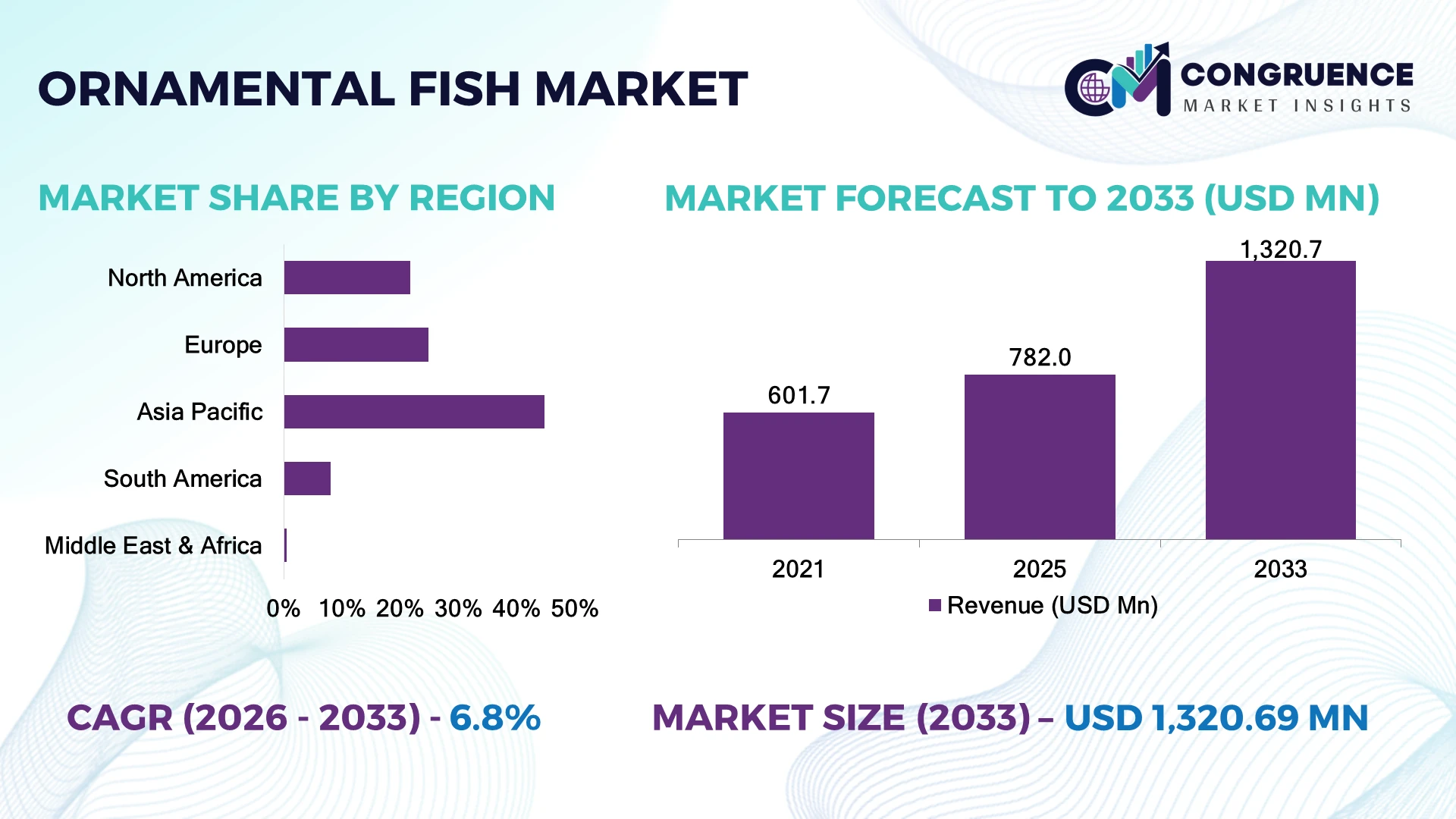
The Global Ornamental Fish Market was valued at USD 782.0 Million in 2025 and is anticipated to reach a value of USD 1,320.7 Million by 2033 expanding at a CAGR of 6.77% between 2026 and 2033. Growth is driven by commercial breeding, improved fish-health management, automated aquarium systems, and expanding international trade of captive-bred species.
Singapore remains a dominant ornamental-fish trading hub, accounting for about 10% of reported global export value, with USD 32.8 million in live ornamental-fish exports in 2024. Japan exported USD 48.6 million, placing it ahead of Singapore, while Indonesia reached USD 40.7 million and India recorded USD 2.1 million. Singapore’s regulated export ecosystem and advanced logistics strengthen its position.
The strategic priority is to combine captive breeding, biosecurity, digital monitoring, and specialized logistics to protect margins while expanding into emerging markets.
Market Size & Growth: USD 782.0 million in 2025 is projected to reach USD 1,320.7 million by 2033 at a 6.77% CAGR, supported by captive breeding and aquarium automation.
Top Growth Drivers: Captive breeding 8%; aquarium automation 7%; online specialty sales 6%.
Short-Term Forecast: By 2028, automated monitoring can reduce routine maintenance costs by 10–15% and improve water-quality response efficiency by 15%.
Emerging Technologies: AI-based water monitoring, automated feeding, smart filtration, and digital fish-health tracking are reshaping premium aquarium operations.
Regional Leaders: Asia-Pacific is projected at about USD 620 million by 2033, Europe at USD 350 million, and North America at USD 300 million, driven by digital aquarium adoption.
Consumer/End-User Trends: Around 60% of premium hobbyists increasingly prioritize captive-bred, disease-screened, and traceable species.
Pilot/Case Example: Singapore’s 2024 export ecosystem generated USD 32.8 million in live ornamental-fish exports, demonstrating the value of specialized logistics and certification.
Competitive Landscape: Singapore-based exporters hold about 10% of trade value, competing with Japan, Indonesia, Sri Lanka, Thailand, and the Netherlands.
Regulatory & ESG Impact: Biosecurity controls can reduce disease-transmission exposure by approximately 15%, while captive breeding lowers dependence on wild collection.
Investment & Funding: An estimated USD 100 million-plus in cumulative industry investment is shifting toward hatcheries, quarantine systems, logistics, and aquarium technology.
Innovation & Future Outlook: AI diagnostics, recirculating aquaculture systems, genetic selection, and traceability will shift competition toward controlled production and premium species.
Ornamental fish demand is concentrating around premium aquascaping, captive-bred species, smart aquariums, and professionally managed displays. Captive breeding is increasingly important as biodiversity controls tighten, while digital monitoring can improve operational efficiency by approximately 15%. Singapore’s export licensing framework and Asia’s specialized logistics networks are reinforcing biosecurity-led trade, creating a stronger transition toward traceable and technology-enabled ornamental-fish supply chains.
The ornamental fish market is becoming strategically important as commercial breeders, exporters, aquarium retailers, and technology providers compete on survival rates, species quality, traceability, and delivery reliability rather than fish variety alone. International trade restructuring is increasing the value of controlled breeding and specialized logistics, particularly across Singapore, Japan, Indonesia, Thailand, and the Netherlands.
Technology is accelerating this transition. Smart water-quality monitoring can reduce manual inspection requirements by roughly 15%, while automated feeding and filtration improve consistency compared with conventional aquarium management. Singapore combines high-value exports with stringent licensing and health-certification requirements, whereas Indonesia and Thailand emphasize production scale and species diversity. India remains a developing production and consumption base, with export value substantially below leading Asian exporters.
Over the next 2–3 years, commercial operators are positioned to increase automated monitoring, quarantine capacity, captive-breeding programs, and digital sales infrastructure. A practical deployment model combines sensor-controlled recirculation with automated feeding and centralized disease screening, reducing operational variability. Companies are consequently prioritizing hatchery expansion, technology partnerships, and certified supply networks, making biosecure production and reliable distribution decisive competitive advantages.
Commercial captive breeding is strengthening supply reliability as breeders reduce dependence on wild collection and improve species consistency. Captive-bred freshwater varieties already represent a substantial portion of international trade, while specialized exporters such as Singapore demonstrate the value of controlled logistics. Automated water-quality systems can improve monitoring efficiency by about 15%, while disease-screening protocols can reduce shipment-related losses by roughly 10%. Regulatory tightening around exotic species is accelerating this transition, particularly in biodiversity-sensitive markets such as India. Producers are responding through hatchery expansion, quarantine infrastructure, selective breeding, and partnerships with logistics providers. The non-obvious advantage is margin protection: controlled breeding gives suppliers greater predictability over size, coloration, health status, and shipment timing.
Live-animal logistics remain a structural constraint because temperature, oxygenation, water quality, handling time, and disease controls directly influence shipment survival. Specialized treatment, quarantine, and certification can add approximately 10–20% to operating costs for international consignments, while transport delays can materially increase mortality exposure. Singapore’s licensing framework illustrates the tighter compliance environment facing commercial traders. Smaller exporters in India and Southeast Asia therefore face higher per-unit compliance and logistics burdens than established hubs. Companies are reducing exposure through regional hatcheries, supplier diversification, longer-term freight agreements, and pre-shipment health screening. The key operational issue is not fish availability but maintaining consistent biological quality across multiple transport stages.
Smart aquarium technology creates an opportunity to move ornamental fish from hobby merchandise toward technology-enabled ecosystems. Sensor-based monitoring can reduce routine manual checks by around 15%, while automated feeding can improve feeding consistency by approximately 10%. Premium demand is also expanding around rare coloration, selectively bred varieties, nano species, and aquascaping-focused collections. India, Indonesia, and Thailand offer particularly attractive production opportunities because of established freshwater breeding capabilities and lower operating costs. Companies are positioning through R&D in selective breeding, connected aquarium equipment, digital commerce, and breeder-retailer partnerships. A distinctive opportunity lies in bundled offerings combining captive-bred fish, smart equipment, water-treatment products, and maintenance services, increasing customer lifetime value beyond individual fish sales.
Scaling ornamental-fish operations requires consistent biological quality across breeding facilities, quarantine centers, packaging systems, airports, and retail destinations. Mortality rates can increase sharply when temperature or dissolved-oxygen conditions deviate from controlled ranges, making a 5–10% handling-performance difference commercially significant at scale. Workforce shortages in specialized fish health, breeding, and aquaculture operations further complicate expansion. At the same time, evolving biodiversity and invasive-species controls require stronger traceability and documentation. Companies must invest in sensor-based environmental control, standardized handling protocols, staff training, and digital shipment tracking. The strategic challenge is maintaining uniform quality while expanding geographically; operators that scale infrastructure faster than biosecurity capabilities risk losing both export approvals and premium-market credibility.
Captive-Bred Species Gain Ground: Retailers and breeders are increasing captive-bred inventories as biodiversity controls and disease-screening requirements tighten. Captive-bred fish can achieve approximately 10–20% better transport survival than comparable wild-caught stock, while selective breeding improves color consistency by roughly 15%. Singapore’s licensing requirements are pushing exporters toward documented breeding, quarantine, and traceability workflows, strengthening premium positioning.
Smart Aquarium Automation Expands: Sensor-enabled water monitoring, automated feeding, LED systems, and digital alerts are moving from premium installations into mainstream aquariums. Automated systems can reduce routine maintenance effort by 15% and improve water-quality response times by about 20%. Companies are integrating sensors with mobile dashboards, creating recurring equipment and maintenance opportunities rather than relying solely on live-fish sales.
Digital Trade Reshapes Distribution: Online specialty retail is expanding species accessibility, with digital purchasing increasingly supporting 10–15% faster product discovery and broader availability of rare varieties. Sellers are responding with insulated packaging, live-arrival guarantees, video-based selection, and scheduled delivery. The non-obvious shift is that digital channels are increasingly influencing premium species selection before customers visit physical aquarium stores.
Biosecure Logistics Become Standard: Temperature control, oxygen management, quarantine, and health certification are receiving greater attention as international shipments face tighter operational controls. Singapore requires commercial ornamental-fish traders to operate under licensing requirements, increasing compliance discipline across exporters. Companies are investing in regional holding facilities and standardized packaging, while specialized logistics partnerships can reduce handling losses by approximately 10% and improve shipment consistency by 15%.
Tropical Freshwater is the leading type, holding approximately 52.7% of the global market in 2025. Its dominance reflects broad species availability, relatively simple maintenance, strong breeding scalability, and suitability for both beginner and advanced aquariums. Temperate fish remain established through goldfish and koi demand, while Marine varieties command higher-value niche purchases but require more specialized filtration and water chemistry. Companies are therefore concentrating production capacity on tropical species while maintaining premium marine portfolios.
Marine ornamental fish represent the faster-moving premium category, supported by reef aquariums, rare species, and captive-breeding programs. Marine demand is strengthening by roughly 8–10% in specialist channels as retailers improve availability of captive-bred clownfish, gobies, and other reef species. Tropical freshwater remains approximately 2.5 times the scale of marine demand, but marine suppliers gain higher value per shipment. Breeders are responding with selective propagation, quarantine systems, and partnerships with specialty retailers.
Household applications lead the market with more than 70% share, reflecting recurring purchases from home aquarists, aquarium upgrades, species replacement, feed, and maintenance requirements. Residential demand is strongest for tropical freshwater fish because they fit smaller aquarium formats and require less specialized infrastructure than marine systems. Companies are expanding beginner-friendly species portfolios, bundled aquarium packages, and digital after-sales support to capture recurring household spending.
Commercial applications are the faster-growing use case as hotels, restaurants, offices, shopping centers, and hospitality venues deploy larger decorative installations. Commercial adoption is strengthening by roughly 8–10% as businesses use aquatic displays for interior differentiation and visitor engagement. Household demand remains over twice the scale of commercial demand, but commercial installations generate larger orders and recurring maintenance contracts. Suppliers are responding with turnkey aquarium design, remote monitoring, maintenance partnerships, and managed fish-replacement programs.
Residential Consumers represent the dominant end-user group at approximately 75% share, supported by home aquariums, aquascaping, leisure use, and recurring replacement purchases. Residential buyers favor tropical freshwater varieties because of lower setup complexity and broader availability. Commercial and Public Displays account for about 25%, but their purchasing behavior is more specification-driven, with demand centered on larger tanks, premium species, installation services, and scheduled maintenance. Companies are increasingly separating product lines by buyer sophistication rather than using a single retail assortment.
Commercial and Public Displays are the fastest-growing end-user group, expanding as hotels, offices, malls, and public-facing facilities integrate aquariums into interior and visitor-experience strategies. Deployment growth of roughly 8–10% is strengthening demand for professional maintenance and livestock-management services. Residential demand remains approximately three times larger, but commercial accounts offer higher contract value and longer supplier relationships. Companies are responding through turnkey installation partnerships, service agreements, customized species selection, and remote aquarium monitoring.
Asia-Pacific accounted for the largest market share at 44.8% in 2025 however, Asia-Pacific is expected to register the fastest growth, expanding at a CAGR of 7.98% between 2026 and 2033.

North America accounted for approximately 21.7% of the global ornamental fish market in 2025, making it the second-largest regional market under the selected regional benchmark. The United States represents the dominant national market, supported by specialty aquatic stores, e-commerce, professional aquarium services, and premium marine-fish consumption. The region remains strongly import-dependent, with Asian exporters supplying a substantial proportion of live ornamental species. Digital retail and specialized livestock logistics are improving species accessibility, while automated filtration and water-monitoring equipment are strengthening premium aquarium installations. Companies are responding through domestic distribution expansion, captive-bred inventory programs, supplier diversification, and partnerships with specialist retailers. The combination of high household spending and sophisticated aquarium infrastructure keeps North America commercially important despite its smaller production base than Asia-Pacific.
United States Market Outlook: The United States accounted for approximately 18% of the global market in 2025 within the selected country-level benchmark, making it one of the world's largest individual markets. Strong specialty-pet retail infrastructure, premium aquarium ownership, and advanced equipment adoption support demand. Importers are increasingly diversifying Asian sourcing relationships while expanding online livestock sales and professional aquarium-management services.
Europe accounted for approximately 24.9% of the global ornamental fish market in 2025, ranking behind Asia-Pacific but ahead of North America in the selected regional benchmark. Germany, the United Kingdom, France, and the Netherlands form the principal commercial centers, supported by established aquarium-keeping cultures, specialty retail, aquascaping, professional maintenance, and sophisticated distribution networks. European buyers increasingly favor traceable, disease-screened, and sustainably bred species, strengthening demand for certified supply chains. The Netherlands functions as an important distribution and re-export hub, while Germany provides a large consumer base. Companies are investing in captive breeding, quarantine infrastructure, digital retail, and specialized livestock logistics. The region's approximately 25% share reflects strong consumption and premium purchasing rather than the large-scale breeding capacity characteristic of Southeast Asia.
Germany Market Outlook: Germany is Europe's most strategically significant market, supported by established aquarium ownership, specialist retailers, breeding expertise, and strong demand for aquarium equipment and livestock. Household and enthusiast purchasing remains central, while professional aquascaping is expanding premium species demand. Companies are emphasizing captive-bred inventories, health-screened shipments, and integrated aquarium-service offerings to serve increasingly quality-conscious buyers.
Asia-Pacific accounted for 44.8% of the global ornamental fish market in 2025, establishing the region as the clear market leader. Its advantage comes from concentrated breeding clusters, favorable tropical conditions, competitive production costs, and established export infrastructure across Singapore, Indonesia, Thailand, China, India, and Japan. Indonesia captured approximately 11.4% of global ornamental-fish exports in 2024, while domestic transactions reached about USD 424 million, illustrating the region's substantial internal market alongside its export role. Thailand, Singapore, and Indonesia are strengthening specialized live-fish logistics, while South Korea is incorporating AI and IoT into its industry-development strategy. Companies are expanding hatcheries, selective-breeding programs, quarantine capacity, and international distribution partnerships, reinforcing Asia-Pacific's structural supply advantage.
China Market Outlook: China is the largest individual market within Asia-Pacific, accounting for approximately 22.6% of the region's market in 2023. Its advantage combines extensive freshwater aquaculture infrastructure, large domestic consumption, established goldfish breeding clusters, and growing premium-aquarium adoption. Fuzhou alone has more than 80 goldfish breeding farms producing around 15 million fish annually, supporting China's role in both production and domestic distribution.
South America accounted for approximately 8.1% of the broader freshwater ornamental fish market in the 2025 regional benchmark, placing it well below Asia-Pacific and Europe but ahead of the Middle East and Africa. Brazil and Colombia are the principal commercial centers, benefiting from exceptional freshwater biodiversity and established ornamental-fish collection and breeding networks. Colombia exported approximately USD 3.1 million of live ornamental fish to the United States in 2024, demonstrating its role in international supply. Brazil combines substantial domestic aquarium demand with access to diverse native species. Infrastructure and specialized logistics remain less developed than Asian export hubs, increasing the importance of quarantine facilities, airfreight connectivity, and standardized handling. Companies are increasingly shifting toward captive breeding and formal export channels, creating more predictable supply while reducing dependence on wild collection.
Colombia Market Outlook: Colombia is strategically positioned as a specialized exporter of freshwater ornamental species, supported by high aquatic biodiversity and established international trade relationships. Its approximately USD 3.1 million in live ornamental-fish exports to the United States in 2024 demonstrates established external demand. Producers are strengthening captive breeding, health certification, and export logistics to improve shipment reliability and access premium markets.
Middle East & Africa accounted for approximately 0.5% of the global freshwater ornamental fish market in the 2025 regional benchmark, making it the smallest major regional market. The United Arab Emirates is the principal commercial hub, supported by luxury hotels, shopping centers, premium residential developments, and large decorative aquarium installations. Demand is increasingly concentrated in professionally managed commercial displays rather than high-volume household fishkeeping. Climate conditions increase the importance of temperature control, filtration, oxygenation, and specialized livestock logistics. Companies are therefore combining imported fish with installation, maintenance, water-treatment, and monitoring services. The region's relatively small market share contrasts with its high-value commercial installations, creating opportunities for service-led business models rather than volume-oriented livestock distribution.
United Arab Emirates Market Outlook: The UAE is the region's strongest strategic market because of its concentration of luxury hospitality and high-end commercial developments. Large aquarium installations require sophisticated filtration and temperature-management systems, creating demand for integrated service providers. Suppliers are increasingly using long-term maintenance contracts and specialized import partnerships, allowing them to capture recurring revenue beyond the initial sale of ornamental fish and aquarium equipment.
The ornamental fish market pits integrated exporters such as Qian Hu Corporation and Sunbeam Aquarium against regional breeders, wholesalers, specialty retailers, and digital sellers including Segrest Farms, Aqua Leisure International, and LiveAquaria. The top five players command approximately 15% combined share, leaving a fragmented field. Competition centers on species breadth, price, biosecurity, logistics, and customization. Integrated exporters gain roughly 10–15% efficiency through breeding, quarantine, packaging, and distribution control, while digital retailers improve customer reach and selection speed by about 20%. Regional breeders compete through lower production costs and rare-species specialization. Players are expanding hatcheries, strengthening airfreight relationships, adding captive-bred varieties, and integrating aquarium accessories with livestock sales. The competitive shift is moving from simple species availability toward traceability, controlled breeding, and supply-chain reliability. Entry barriers remain high because live-fish handling, quarantine, export compliance, and mortality control require specialized infrastructure. Winning requires biosecure supply, differentiated species, dependable delivery, and integrated customer services.
Qian Hu Corporation Limited
Sunbeam Aquarium Pte Ltd.
Sanyo Aquarium (Pte) Ltd.
Aqua-Nautic Specialist Pte Ltd.
Tropical Fish International Pte Ltd.
AlgaeBarn LLC
bioAquatiX
Imperial Tropicals
Oasis Fish Farm Co.
LiveAquaria
Segrest Farms
Aqua Leisure International
Smart water-quality monitoring, automated feeding, and connected filtration are becoming core technologies in premium and commercial aquariums. Sensor-based systems can reduce manual checking by about 15% and improve response speed by roughly 20%, while digital alerts help operators control temperature, pH, dissolved oxygen, and ammonia continuously. Adoption is strongest in commercial displays and advanced hobbyist systems, where remote monitoring reduces labor dependence and supports service contracts.
Recirculating aquaculture systems and land-based controlled farming are gaining importance for captive breeding. Compared with conventional open or manually managed systems, controlled recirculation can reduce water consumption by more than 50% while improving biosecurity and production consistency. Qian Hu’s Aqua-Ring Technology illustrates the shift toward integrated, low-discharge production. Breeders and exporters benefit through tighter disease control, predictable stocking, and greater traceability.
From 2026–2028, AI-assisted fish-health diagnostics, automated image recognition, digital provenance, and predictive water management will become stronger competitive differentiators. Technology-led operators can improve survival, reduce handling losses, and standardize quality across distributed facilities. The strongest beneficiaries will be integrated breeders and exporters that connect production data with quarantine, logistics, and customer platforms.
January 2025 — Qian Hu expanded its use of Aqua-Ring Technology, adding 8 systems for controlled ornamental-fish production in Singapore. The technology supports zero-waste discharge and stronger biosecurity, strengthening controlled breeding capacity and reducing disease exposure. Source: qianhu.com
April 2025 — OATA launched its 2024 Annual Trade Statistics Report, adding UK retail-distribution analysis and maps of aquatic-shop availability. The expanded dataset strengthens market planning around imports, exports, retail coverage, and supply-chain positioning. Source: ornamentalfish.org
June 2025 — Ornamental Fish International partnered with CIPS to co-host the 2nd Aquatic Industry Convention in Guangzhou, bringing together more than 1,400 exhibitors and visitors from over 120 countries. The collaboration strengthened global networking, innovation exchange, and industry coordination. Source: ofish.org
April 2026 — OATA introduced a free sustainability-sourcing tool for importers, wholesalers, and retailers to assess whether ornamental fish are captive-reared or wild-collected. The initiative directly strengthens supply-chain traceability and responsible sourcing decisions across commercial aquatic businesses. Source: ornamentalfish.org
The report evaluates the global ornamental fish market across Tropical Freshwater, Temperate Freshwater, and Marine Ornamentals, with application coverage spanning Residential and Commercial uses and end-user analysis covering Residential Consumers and Commercial and Public Displays. The assessment examines major markets across North America, Europe, Asia-Pacific, South America, and the Middle East & Africa, with country-level emphasis on leading production, trading, and consumption hubs.
The scope also evaluates captive breeding, selective breeding, recirculating aquaculture systems, smart aquarium monitoring, automated feeding, biosecurity, digital commerce, traceability, and specialized live-fish logistics. With household applications representing roughly 70% of demand, the report identifies where commercial installations and technology-enabled services are gaining importance. The analysis supports investment planning, geographic expansion, supplier diversification, competitive positioning, technology prioritization, and strategic decisions through 2033.
| Report Attribute / Metric | Details |
|---|---|
| Market Revenue (2025) | USD 782.0 Million |
| Market Revenue (2033) | USD 1,320.7 Million |
| CAGR (2026–2033) | 6.77% |
| Base Year | 2025 |
| Forecast Period | 2026–2033 |
| Historic Period | 2021–2025 |
| Segments Covered |
By Type
By Application
By End-User
|
| Key Deliverables | Revenue Forecast; Market Trends; Growth Drivers & Restraints; Technology Insights; Segmentation Analysis; Regional Insights; Competitive Landscape; Regulatory & ESG Overview; Recent Developments |
| Regions Covered | North America; Europe; Asia-Pacific; South America; Middle East & Africa |
| Companies Profiled | Qian Hu Corporation Limited; Sunbeam Aquarium Pte Ltd.; Sanyo Aquarium (Pte) Ltd.; Aqua-Nautic Specialist Pte Ltd.; Tropical Fish International Pte Ltd.; AlgaeBarn LLC; bioAquatiX; Imperial Tropicals; Oasis Fish Farm Co.; LiveAquaria; Segrest Farms; Aqua Leisure International |
| Customization & Pricing | Available on Request (10% Customization Free) |




