Global Ornamental Fish Feed Market Report Overview
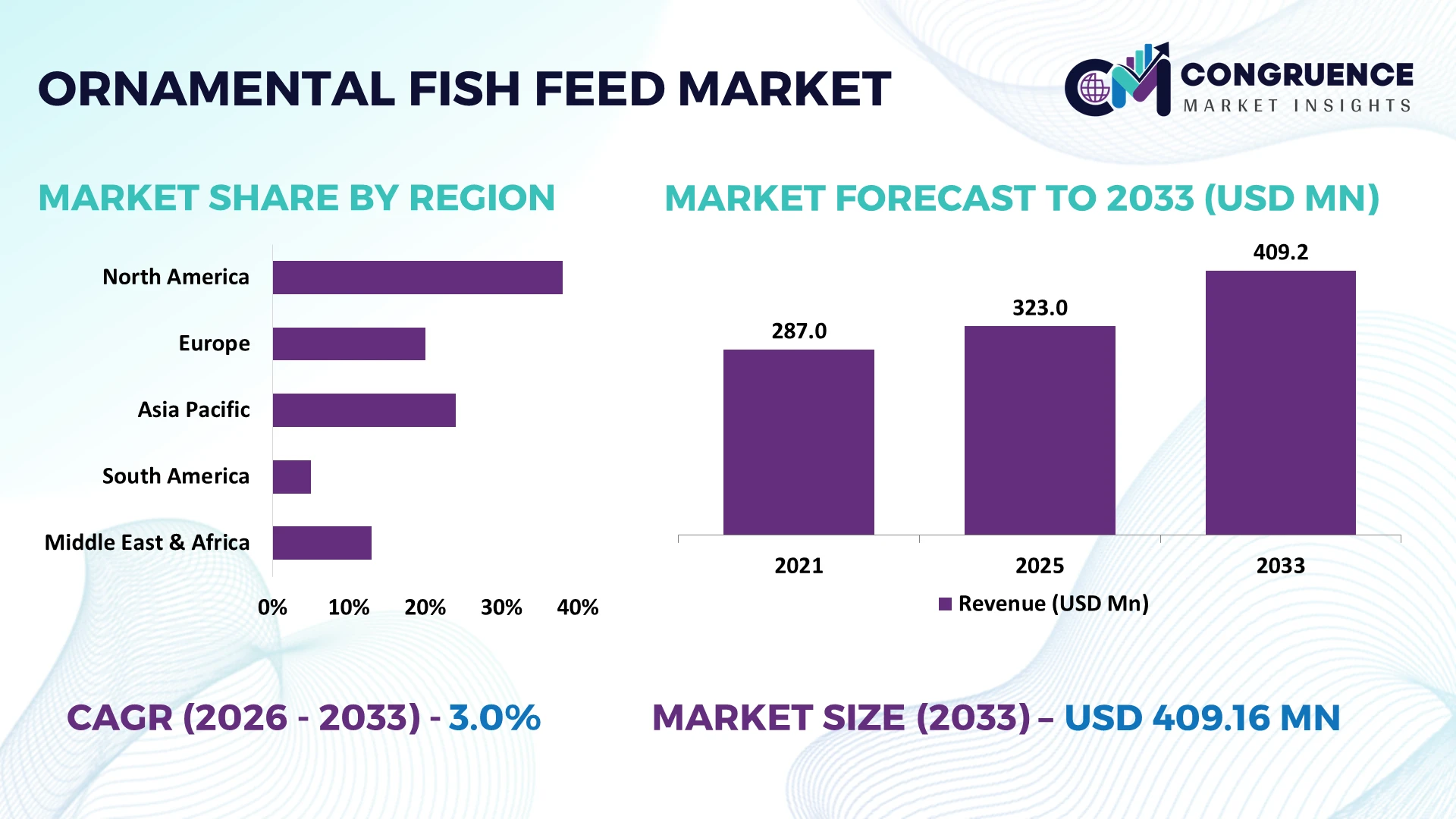
The Global Ornamental Fish Feed Market was valued at USD 323 Million in 2025 and is anticipated to reach a value of USD 409.16 Million by 2033 expanding at a CAGR of 3% between 2026 and 2033. Growth is driven by species-specific aquarium nutrition, increased adoption of color-enhancing formulated diets, and advances in water-stable micro-pellet extrusion technology.
China maintains a dominant position in ornamental fish feed manufacturing through its integrated aquaculture supply chain, aquarium product exports, and large-scale feed processing infrastructure. China produces approximately 40% of global aquaculture output, providing substantial upstream ingredient procurement advantages. Thailand remains a major competitor in ornamental fish breeding and exports, particularly tropical aquarium species. Chinese manufacturers leverage automated extrusion, precision ingredient blending, and established distribution networks, while Thailand emphasizes specialized ornamental fish production. China's aquaculture scale and Southeast Asia's ornamental fish trade strengthen regional feed formulation and distribution capabilities.
Strategically, manufacturers should prioritize species-specific formulations, export-compliant ingredient sourcing, and premium micro-pellet technologies to strengthen margins and international distribution competitiveness.
Key Highlights of the Global Ornamental Fish Feed Market
-
Market Size & Growth: USD 323 million in 2025, reaching USD 409.16 million by 2033 at 3% CAGR, supported by premium species-specific nutrition.
-
Top Growth Drivers: Japan's ornamental fish export value increased 36.9%, Indonesia's 4.4%, and Singapore's remained approximately stable during 2024–2025, supporting differentiated feed demand.
-
Short-Term Forecast: By 2028, manufacturers targeting 5–10% feed waste reduction through precision feeding can strengthen aquarium maintenance economics; improvement remains a target.
-
Emerging Technologies: Three innovations—automated micro-extrusion, AI-assisted formulation, and microencapsulation—support improved pellet stability and nutrient delivery.
-
Regional Leaders: Asia-Pacific, North America, and Europe lead aquarium feed distribution; separate regional USD forecasts remain unverified, while premium formulated diets gain prominence.
-
Consumer/End-User Trends: The United States represented approximately 24.6% of reported freshwater ornamental fish imports in 2025, supporting specialized aquarium nutrition demand.
-
Pilot/Case Example: In 2025, Singapore exported 278,409 kg of ornamental fish, highlighting the operational scale requiring consistent hatchery feeding and specialized nutrition.
-
Competitive Landscape: Hikari, Tetra, sera, Tropical, and Ocean Nutrition compete in premium aquarium feeds; verified individual company market shares remain unavailable.
-
Regulatory & ESG Impact: EU Regulation 767/2009 establishes feed marketing requirements; 100% compliance is necessary for products within its scope.
-
Investment & Funding: Dedicated ornamental feed investment totals remain undisclosed; manufacturers prioritize extrusion equipment, formulation laboratories, and specialized distribution partnerships.
-
Innovation & Future Outlook: Astaxanthin-enriched diets, probiotic formulations, and precision feeding technologies support 3 differentiated product development priorities.
The Ornamental Fish Feed Market is evolving through specialized nutrition for koi, goldfish, discus, betta, and marine aquarium species. Manufacturers are developing slow-sinking micro-pellets, astaxanthin-enriched color-enhancing diets, and probiotic formulations that address species-specific digestive requirements. Japan's ornamental fish export value increased approximately 36.9% between 2024 and 2025, indicating strengthening international trade activity that supports specialized feeding requirements. Meanwhile, feed producers are adapting ingredient sourcing and labeling practices to European regulatory standards. These developments reinforce the importance of nutritional differentiation, reliable distribution, and formulation efficiency in shaping future competitive strategies.
What Is the Strategic Relevance and Future Pathways of the Ornamental Fish Feed Market?
The ornamental fish feed industry is becoming strategically important as aquarium nutrition shifts from conventional general purpose formulations toward specialized diets supporting pigmentation, digestive health, and water quality. Japan's established koi breeding industry and Indonesia's ornamental fish export ecosystem create distinct opportunities for premium feed manufacturers. Ingredient traceability and European feed labeling requirements are reshaping product development and procurement practices. Manufacturers increasingly prioritize controlled ingredient sourcing, standardized nutrient composition, and specialized retail distribution to strengthen product differentiation and customer retention.
Modern precision extrusion enables manufacturers to control pellet diameter, buoyancy, and nutrient distribution more consistently than conventional bulk feed processing. Commercial ornamental fish diets commonly contain 30% to 50% crude protein, depending on species and life stage, making formulation accuracy commercially significant. Japan emphasizes premium koi nutrition, while China benefits from extensive feed manufacturing infrastructure. Between 2026 and 2028, manufacturers are expected to prioritize automated dosing, improved pellet water stability, and enhanced ingredient traceability. These investments support more consistent product quality and lower formulation variability.
Hikari's specialized koi and tropical fish nutrition portfolio demonstrates how targeted formulations support premium product positioning. Manufacturers are strengthening relationships with aquarium retailers, ornamental fish breeders, and ingredient suppliers to improve distribution and formulation performance. Competitive advantage increasingly depends on documented nutritional quality, reliable feed availability, and species specific product development.
Ornamental Fish Feed Market Dynamics
DRIVER:
Increasing Adoption of Specialized Aquarium Nutrition
Growing emphasis on ornamental fish health, pigmentation, and digestive performance is strengthening demand for specialized formulated feeds. Commercial tropical fish diets commonly contain 30% to 50% crude protein, while selected carnivorous ornamental species require formulations exceeding 45%. Astaxanthin supplementation in experimental ornamental fish diets has demonstrated measurable pigmentation improvements, although outcomes vary with species and dosage. Japan's premium koi breeding industry reinforces demand for consistent nutrient composition and color enhancing ingredients. Manufacturers such as Hikari and Tropical are expanding specialized product portfolios incorporating carotenoids, probiotics, and controlled pellet characteristics. The strategic advantage lies in matching nutritional formulations to species requirements, supporting premium pricing and stronger retailer differentiation.
RESTRAINT:
Ingredient Price Volatility and Import Dependency
Dependence on fishmeal, fish oil, specialty proteins, and natural pigments exposes ornamental fish feed manufacturers to raw material cost fluctuations. Fishmeal commonly contains approximately 60% to 72% crude protein, making it a concentrated nutritional ingredient that is difficult to replace without formulation adjustments. Peru's anchoveta fisheries remain important to international marine ingredient supply, creating procurement exposure when fishing quotas or environmental conditions change. Experimental aquafeed formulations demonstrate that partial fishmeal substitution can reach 25% to 50%, depending on species and alternative protein quality. However, replacement requires careful amino acid balancing and palatability testing. Manufacturers are diversifying suppliers, incorporating insect protein and plant concentrates, and negotiating longer procurement contracts to protect formulation consistency and manufacturing margins.
OPPORTUNITY:
Precision Nutrition and Alternative Protein Innovation
Advanced ornamental fish nutrition creates opportunities for manufacturers combining sustainable ingredients with automated feeding technologies. Black soldier fly larvae meal commonly contains approximately 35% to 60% crude protein, depending on processing and fat removal, supporting its evaluation as an alternative protein ingredient. Selected experimental aquafeed formulations have demonstrated successful replacement of 25% to 50% of conventional fishmeal without significant growth deterioration under specific feeding conditions. Singapore's established ornamental fish trading infrastructure provides opportunities for specialized nutrition products serving exporters and aquarium retailers. Manufacturers are investing in insect protein research, microencapsulation, and digital feeding systems to improve nutrient delivery. The strongest opportunity involves developing verified functional diets that reduce feeding waste while maintaining pigmentation and digestive performance.
CHALLENGE:
Species Specific Formulation and Quality Standardization
Commercial scaling requires feed manufacturers to maintain consistent nutritional performance across ornamental species with substantially different feeding requirements. Herbivorous ornamental fish generally require lower protein concentrations than carnivorous species, while commercial formulations commonly range between 25% and 55% crude protein. Juvenile fish require smaller particles and more frequent feeding than mature aquarium species, increasing production complexity. Pellet moisture levels commonly require control near or below 10% to 12% for stable dry feed storage, depending on formulation and packaging. Indonesia's diverse ornamental fish breeding industry intensifies demand for differentiated feed specifications across export species. Manufacturers must invest in precision extrusion, laboratory nutrient analysis, controlled drying, and standardized feeding trials. Long term competitiveness depends on maintaining consistent pellet quality, nutritional performance, and product stability across international distribution channels.
Ornamental Fish Feed Market Latest Trends
-
Premium Color Diets Gain Shelf Space: Japanese koi feed brands are emphasizing carotenoid enriched products alongside conventional maintenance diets. Commercial formulas commonly contain 30% to 40% protein, while specialized growth products reach 40% or higher. Manufacturers are expanding premium ranges and improving pigment stability during extrusion, helping retailers differentiate products through visible fish coloration and feeding performance.
-
Smaller Packaging Reshapes Retail Distribution: Aquarium retailers increasingly stock compact feed containers designed for household aquariums and controlled feeding quantities. Commercial packs commonly range from 20 g to 100 g, while larger formats exceed 1 kg. Tetra and Hikari offer multiple package sizes, allowing distributors to address different consumption volumes. Smaller formats improve purchasing accessibility but increase packaging costs per kilogram.
-
Water Stability Becomes Product Differentiator: Manufacturers are refining floating and sinking feed characteristics to reduce uneaten particles and aquarium filtration burdens. Commercial flakes disperse rapidly, whereas extruded pellets retain their structure longer under controlled conditions. Feed specifications increasingly distinguish 2 feeding behaviors: surface feeding and bottom feeding. Producers are adjusting extrusion parameters and ingredient binders to improve handling consistency and support cleaner aquarium maintenance.
-
Digital Retail Expands Product Accessibility: Aquarium feed suppliers are strengthening online product catalogs and distributor networks to reach specialized hobbyist communities. Product listings increasingly distinguish 4 nutritional functions: maintenance, coloration, growth, and breeding. Manufacturers are integrating digital product information, feeding instructions, and package identification into retail workflows. This improves product selection accuracy and supports repeat purchasing across established aquarium brands.
Segmentation Analysis
By Type
Flakes Maintain Leadership as Pellets Gain Preference
Flakes represent an established ornamental fish feed category, with an indicative market share of approximately 35% to 40%, although a verified global distribution across the five specified types is unavailable. Their position reflects widespread use in household freshwater aquariums, convenient portioning, and compatibility with surface feeding species. Commercial flake formulations typically contain 30% to 45% crude protein, depending on nutritional positioning. Manufacturers such as Tetra and sera maintain extensive flake portfolios, supported by established retail distribution and accessible packaging. Pellets represent a rapidly developing category because controlled particle dimensions, sinking characteristics, and concentrated nutrition support species specific feeding requirements.
Granules provide intermediate particle sizes for small tropical fish, while Freeze Dried Feed offers convenient access to preserved natural food ingredients. Live Feed remains important for specialized breeding and juvenile feeding, particularly where feeding responses depend on prey movement. Manufacturers are expanding pellet varieties, refining granule uniformity, and improving preservation technologies. Investment priorities increasingly favor production flexibility and consistent nutrient delivery rather than reliance on a single feed format.
- In 2025, the American Pet Products Association reported that approximately 10 million United States households kept freshwater fish, reinforcing the substantial household customer base supporting established flake products and increasingly specialized pellet formulations.
By Application
Growth Nutrition Leads Functional Feed Demand
Growth and Development represents a major application of ornamental fish feed, with an indicative market share of approximately 35% to 40%, although independently verified application shares remain unavailable. Demand reflects the continuous nutritional requirements of aquarium fish across juvenile and adult life stages. Commercial growth formulations commonly contain 35% to 50% crude protein, depending on species and feeding objectives. Manufacturers prioritize digestible protein sources, balanced amino acids, and controlled pellet characteristics to support consistent feeding performance. Color Enhancement remains an important premium application, particularly for koi, goldfish, and ornamental cichlids, where carotenoid supplementation supports pigmentation development.
Disease Prevention is emerging as a differentiated functional nutrition category through formulations incorporating probiotics, vitamins, and immune supporting ingredients. Breeding Support addresses specialized nutritional requirements associated with reproductive conditioning and early development. Manufacturers are expanding functional product portfolios and investing in controlled feeding trials to establish application specific performance. Commercial differentiation increasingly depends on documented nutritional outcomes, ingredient consistency, and compatibility with aquarium management practices rather than broad nutritional claims.
- In 2025, the American Pet Products Association identified freshwater fish ownership across approximately 10 million United States households, highlighting a substantial consumer base for maintenance and growth nutrition alongside specialized coloration and health oriented formulations.
By End-User
Home Aquariums Anchor Retail Feed Consumption
Home Aquariums represent the leading ornamental fish feed end user category, with an indicative market share of approximately 50% to 55%, although independently verified global segmentation remains unavailable. Household aquarium owners purchase recurring feed quantities through specialty retailers, pet stores, and digital channels. The United States maintains a substantial aquarium ownership base, supporting established demand for flakes, pellets, and specialized nutritional products. Manufacturers emphasize convenient packaging, clear feeding instructions, and species specific formulations to improve product accessibility and encourage repeat purchases. Aquarium Retailers remain strategically important because product recommendations, shelf placement, and assortment management directly influence purchasing behavior.
Ornamental Fish Farms represent a developing commercial customer category, particularly in Indonesia, Thailand, and Singapore, where breeding operations require consistent nutritional performance across multiple species and growth stages. Public Aquariums maintain specialized demand for professionally managed feeding programs and diverse species requirements. Manufacturers are developing bulk packaging, customized formulations, and distributor partnerships for institutional customers. Competitive positioning increasingly depends on balancing household product accessibility with reliable commercial supply and specialized nutritional support.
- The American Pet Products Association's 2025 industry findings identified approximately 10 million freshwater fish owning households in the United States, demonstrating the importance of household aquarium participation for recurring feed purchases and specialty retail distribution.
Region-Wise Market Insights
Asia Pacific accounted for the largest market share at an estimated 42% in 2025 however, Asia Pacific is expected to register the fastest growth, expanding at an estimated CAGR of 4.2% between 2026 and 2033.

North America Ornamental Fish Feed Market
Premium Aquarium Nutrition and Specialized Retail Distribution
North America's ornamental fish feed industry benefits from established aquarium ownership, specialized pet retail networks, and increasing product differentiation. The United States represents the region's principal consumption center, supported by aquarium hobbyists purchasing flakes, pellets, and functional nutrition products. The American Pet Products Association reported approximately 10 million freshwater fish owning households in its 2025 industry findings, demonstrating a substantial recurring feed customer base. Manufacturers including Tetra and Hikari compete through specialized formulations, convenient packaging, and extensive retailer relationships. Canada contributes demand through independent aquarium stores and specialty aquatic product distributors. Premium product positioning increasingly emphasizes digestibility, color enhancement, and feeding convenience. Retailers are expanding species specific assortments, while manufacturers prioritize consistent product availability and packaging formats that accommodate household aquarium consumption patterns.
United States Market Outlook: The United States maintains a strong position through established pet retail infrastructure, specialized aquarium distributors, and digital commerce platforms. Petco operates more than 1,400 pet care centers across the United States, Mexico, and Puerto Rico, providing substantial distribution infrastructure for aquarium products. Feed manufacturers are strengthening retail partnerships and developing differentiated nutrition portfolios to improve product visibility, customer retention, and recurring household purchases.
Europe Ornamental Fish Feed Market
Regulated Feed Manufacturing and Premium Product Innovation
Europe's ornamental fish feed industry is characterized by established aquarium product manufacturers, regulated ingredient procurement, and specialized retail distribution. Germany represents a major manufacturing and product development center, supported by established aquarium nutrition brands including Tetra and sera. European feed producers operate under Regulation 767/2009 governing feed marketing and use, reinforcing requirements for product labeling and ingredient transparency. Manufacturers are improving pellet stability, nutrient consistency, and packaging functionality to meet consumer expectations and regulatory requirements. The United Kingdom, France, and Italy contribute demand through household aquariums, specialty retailers, and ornamental pond fish ownership. Product differentiation increasingly emphasizes functional nutrition, natural pigments, and species specific feeding requirements. European manufacturers are strengthening formulation research and distributor partnerships while adjusting ingredient procurement strategies to manage marine protein supply exposure and maintain consistent production quality.
Germany Market Outlook: Germany maintains a competitive advantage through established aquarium equipment manufacturing, feed formulation expertise, and specialized pet retail infrastructure. Tetra and sera support product development across tropical fish, goldfish, and ornamental pond species. European feed legislation requires accurate composition declarations and labeling, reinforcing investment in laboratory testing and ingredient traceability. German manufacturers prioritize premium formulations, automated processing, and export distribution to strengthen their international competitive positioning.
Asia Pacific Ornamental Fish Feed Market
Aquarium Fish Production and Feed Manufacturing Scale
Asia Pacific holds a leading position in ornamental fish feed manufacturing and consumption through China's extensive aquaculture infrastructure, Japan's premium koi industry, and Southeast Asia's ornamental fish breeding networks. China benefits from established feed ingredient processing, extrusion equipment manufacturing, and aquarium product distribution capabilities. Japan maintains specialized expertise in koi nutrition, color enhancement, and premium formulated diets. Indonesia, Thailand, and Singapore support regional feed demand through ornamental fish breeding, trading, and export operations. Singapore exported approximately 278,409 kg of ornamental fish in 2025, illustrating the commercial scale of specialized aquatic animal supply chains. Manufacturers are developing targeted feed formulations, expanding domestic distribution, and improving production consistency. Competitive advantages increasingly depend on ingredient procurement efficiency, specialized nutritional performance, and reliable supply to breeding operations and aquarium retailers.
China Market Outlook: China maintains a substantial manufacturing advantage through integrated aquaculture production, ingredient processing, and established feed equipment supply chains. The country accounts for approximately 40% of global aquaculture output, providing extensive upstream capabilities relevant to formulated feed manufacturing. Chinese producers are investing in precision extrusion, controlled ingredient blending, and specialized aquarium nutrition products. Domestic manufacturing scale supports competitive pricing, while export opportunities encourage improvements in packaging, product traceability, and nutritional consistency.
South America Ornamental Fish Feed Market
Ornamental Fish Trade Supports Specialized Nutrition Demand
South America's ornamental fish feed market is influenced by aquarium ownership, tropical fish breeding, and established ornamental fish collection and trading activities. Brazil represents a major regional demand center, supported by aquarium retailers, domestic ornamental fish producers, and specialized aquatic product distributors. Colombia and Peru contribute through freshwater ornamental fish export activities, creating demand for appropriate feeding and conditioning practices. The Amazon basin supports diverse ornamental fish species, including discus, tetras, and catfish, requiring differentiated nutritional formulations. Manufacturers face operational challenges associated with imported specialty ingredients, fragmented distribution networks, and varying retail purchasing power. Local feed producers are expanding product assortments and strengthening distributor relationships to improve availability. Competitive positioning depends on balancing affordable maintenance diets with specialized products for commercially valuable ornamental species.
Brazil Market Outlook: Brazil benefits from extensive freshwater biodiversity, domestic aquarium retail networks, and established ornamental fish breeding activities. The Amazon basin contains thousands of freshwater fish species, supporting specialized aquarium husbandry and nutritional requirements. Brazilian manufacturers and distributors are developing locally accessible feed portfolios while addressing imported ingredient costs and regional logistics constraints. Product opportunities center on tropical freshwater nutrition, controlled pellet characteristics, and formulations suited to domestic ornamental fish breeding operations.
Middle East & Africa Ornamental Fish Feed Market
Urban Aquarium Retail and Specialized Distribution Development
The Middle East and Africa ornamental fish feed market is shaped by specialized aquarium retail, commercial aquarium installations, and imported premium nutrition products. The United Arab Emirates and Saudi Arabia support demand through urban pet retail networks, aquarium maintenance businesses, and hospitality related aquatic displays. South Africa maintains established aquarium hobbyist communities and specialized pet product distribution. Feed suppliers primarily compete through imported branded products, retailer relationships, and availability of species specific formulations. High ambient temperatures increase the importance of moisture resistant packaging and appropriate storage conditions. Commercial aquarium operators require consistent feeding programs and reliable product availability to maintain animal health and display quality. Distributors are strengthening inventory planning, product education, and supplier relationships to address fragmented demand and imported product dependence.
United Arab Emirates Market Outlook: The United Arab Emirates provides a concentrated market for premium aquarium nutrition through Dubai and Abu Dhabi's specialized retail and hospitality infrastructure. The National Aquarium Abu Dhabi houses more than 46,000 animals across 10 themed zones, illustrating the scale of professionally managed aquatic displays. Feed distributors are prioritizing specialized nutrition, controlled storage conditions, and dependable supply arrangements for household and commercial aquarium customers.
Market Competition Landscape
Tetra, Hikari, sera, Tropical, and Ocean Nutrition compete through established aquarium nutrition portfolios, while New Life Spectrum and NorthFin emphasize specialized formulations. The combined global market share of the five leading suppliers remains undisclosed, preventing a defensible concentration estimate. Competitive differentiation centers on protein quality, pellet stability, pigmentation performance, pricing, and retail distribution. Commercial ornamental diets commonly contain 30% to 50% crude protein, while premium carnivorous formulations exceed 45%, creating distinct formulation requirements. Manufacturers strengthen positioning through automated extrusion, expanded specialty product ranges, and partnerships with aquarium retailers. Japanese suppliers emphasize premium koi nutrition, whereas European manufacturers prioritize formulation consistency and regulatory compliance. Ingredient procurement remains a competitive pressure because fishmeal typically contains 60% to 72% protein and faces variable supply conditions. Established brand recognition, nutritional validation, and distribution access create entry barriers. Sustainable competitiveness requires reliable product performance, differentiated formulations, disciplined procurement, and consistent retail availability across markets.
Companies Profiled in the Ornamental Fish Feed Market Report
Technology Insights for the Ornamental Fish Feed Market
Precision extrusion and controlled drying technologies are improving ornamental fish feed consistency across flakes, pellets, and granules. Commercial formulations typically contain 30% to 50% crude protein, requiring accurate ingredient blending and thermal processing to preserve nutritional quality. Automated dosing systems regulate ingredient proportions, while optical inspection identifies particle inconsistencies. Compared with conventional manual batching, automated production offers improved formulation repeatability, although a verified percentage efficiency advantage remains unavailable. Established manufacturers benefit from scalable production and reduced quality variation across specialized aquarium diets.
Emerging technologies include microencapsulation, probiotic stabilization, and advanced carotenoid delivery systems. Astaxanthin concentrations of 50 to 100 mg/kg are investigated in ornamental fish nutrition research, with pigmentation responses depending on species and feeding duration. Microencapsulation protects sensitive ingredients during processing, while controlled buoyancy extrusion supports targeted feeding behavior. Japanese premium feed manufacturers gain differentiation through pigmentation performance, whereas European producers emphasize ingredient traceability and consistent product specifications.
Between 2026 and 2028, automated formulation optimization and digital quality monitoring will influence manufacturing investment priorities. Sensor based moisture monitoring supports controlled drying, with many commercial dry feeds targeting moisture below 10%. Manufacturers integrating nutritional testing, process automation, and specialized packaging will strengthen product reliability, reduce manufacturing variability, and improve competitiveness in premium aquarium nutrition markets.
Recent Developments in the Global Ornamental Fish Feed Market
-
September 2024: Tetra introduced NutriEvolution, reformulating ornamental fish diets with improved ingredients and recyclable packaging. Internal trials reported up to 25% better fish growth against competing diets, strengthening premium nutrition differentiation and supporting improved aquarium feeding performance. Source: tetra.net
-
February 2025: Insectika Biotech introduced YuM ToM aquarium feed with ICAR CIBA, incorporating black soldier fly protein. Developed through 2 years of research, the formulation reduces reliance on conventional marine ingredients while expanding sustainable ornamental fish nutrition options. Source: aquafeed.co.uk
-
July 2026: ICAR CIFRI unveiled sustainable fish feed technologies incorporating agricultural waste and alternative proteins. Demonstrations achieved 20% to 30% feed cost reductions, supporting commercially scalable formulations and strengthening domestic manufacturing opportunities, including specialized ornamental fish nutrition products. Source: icar.gov.in
-
September 2026: Tropical introduced Shrimp UP!, expanding specialized aquarium nutrition through 6 sinking feed formulations. The portfolio combines functional diets and natural ingredient products, supporting ornamental shrimp health while creating additional retail assortment opportunities and complementary product sales. Source: globalpetindustry.com
Scope of the Ornamental Fish Feed Market Report
The Ornamental Fish Feed Market Report evaluates industry developments between 2026 and 2033 across five product types: Flakes, Pellets, Granules, Freeze Dried Feed, and Live Feed. Application coverage includes Color Enhancement, Growth and Development, Breeding Support, and Disease Prevention. End user analysis examines Home Aquariums, Public Aquariums, Ornamental Fish Farms, and Aquarium Retailers. Technology assessment covers precision extrusion, automated formulation, functional ingredients, and advanced nutrient delivery systems.
Regional analysis encompasses North America, Europe, Asia Pacific, South America, and the Middle East & Africa, emphasizing manufacturing capabilities, aquarium ownership, breeding infrastructure, and distribution networks. Competitive assessment evaluates nutritional differentiation, ingredient procurement, packaging innovation, and retailer partnerships. The report supports investment planning, geographic expansion, product portfolio optimization, and competitive positioning across premium aquarium nutrition and emerging specialized feed applications.
Ornamental Fish Feed Market Report Summary
| Report Attribute/Metric | Report Details |
|---|
Market Revenue in 2025 | USD 323 Million |
Market Revenue in 2033 | USD 409.16 Million |
CAGR (2026 - 2033) | 3% |
Base Year | 2025 |
Forecast Period | 2026 - 2033 |
Historic Period | 2021 - 2025 |
Segments Covered | By TypeBy ApplicationBy End-User |
Key Report Deliverable | Revenue Forecast, Growth Trends, Market Dynamics, Segmental Overview, Regional and Country-wise Analysis, Competition Landscape |
Region Covered | North America, Europe, Asia-Pacific, South America, Middle East, Africa |
Key Players Analyzed | Tetra, Hikari Sales USA, Inc., sera GmbH, Tropical Tadeusz Ogrodnik, Ocean Nutrition, New Life International, Inc., NorthFin Inc., Cobalt Aquatics, Dainichi Fish Food, Aquatic Foods Inc., Saki Hikari, Wardley, Kyorin Co., Ltd. |
Customization & Pricing | Available on Request (10% Customization is Free) |





