
Reports
The Global Organic Impurity Tester Market was valued at USD 361 Million in 2025 and is anticipated to reach a value of USD 505.57 Million by 2033 expanding at a CAGR of 4.3% between 2026 and 2033. Growth is being driven by tighter pharmaceutical impurity control requirements, expanded GMP-compliant quality laboratories, and wider deployment of automated analytical testing systems across drug manufacturing and contract testing facilities.
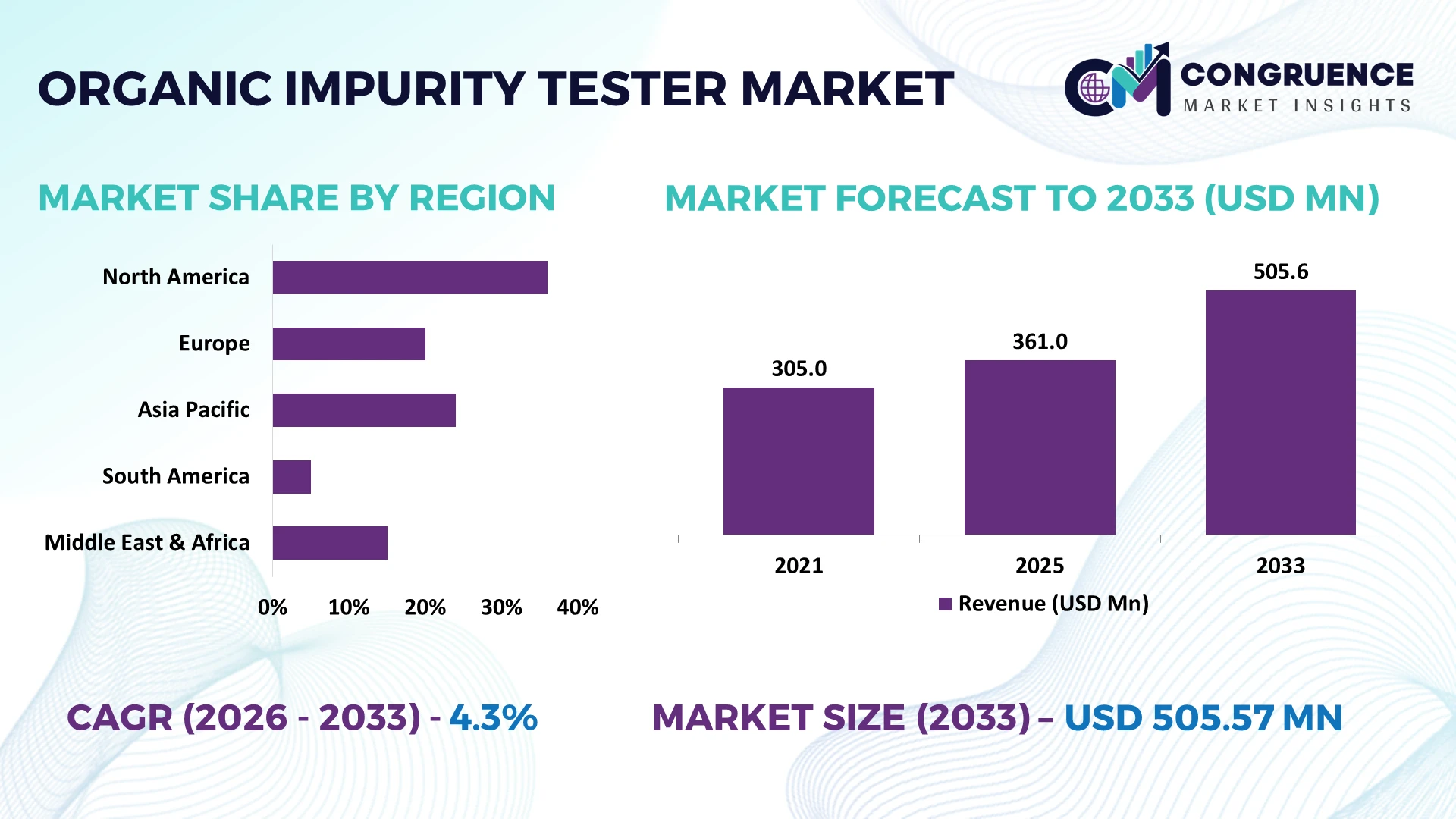
The United States accounts for approximately 31% of global market demand, supported by large-scale pharmaceutical manufacturing, advanced analytical laboratory infrastructure, and sustained investments exceeding 12% in laboratory modernization during 2026. China follows with nearly 22% share, benefiting from expanding active pharmaceutical ingredient production and over 35% adoption of automated chromatography-integrated impurity testing platforms, while supply-chain diversification after recent geopolitical realignments has accelerated regional laboratory investments. This leadership strengthens supplier positioning and directs future capacity expansion toward technology-intensive testing ecosystems.
Market Size & Growth: USD 361 Million in 2025, projected to reach USD 505.57 Million by 2033 at a CAGR of 4.3%, supported by advanced pharmaceutical quality-control automation.
Top Growth Drivers: Pharmaceutical R&D spending contributes 38%, regulatory compliance initiatives 34%, and laboratory automation adoption 28% of market expansion momentum.
Short-Term Forecast: By 2028, automated impurity testing reduces analysis time by 24% while improving laboratory productivity by 18%.
Emerging Technologies: AI-assisted chromatography, automated sample preparation, and cloud-enabled laboratory analytics increase testing accuracy by approximately 20% across high-throughput facilities.
Regional Leaders: North America approaches USD 170 Million, Europe exceeds USD 135 Million, and Asia-Pacific nears USD 145 Million by 2033, driven by pharmaceutical capacity expansion and regional manufacturing shifts.
Consumer/End-User Trends: More than 62% of pharmaceutical quality laboratories prioritize integrated impurity testing platforms for faster batch release and compliance management.
Pilot/Case Example: A 2026 pharmaceutical laboratory modernization program improved testing throughput by 27% while reducing repeat analyses by 16% through workflow automation.
Competitive Landscape: Leading suppliers collectively hold about 43% market share, with competition centered on Agilent Technologies, Thermo Fisher Scientific, Waters Corporation, Shimadzu Corporation, and PerkinElmer.
Regulatory & ESG Impact: Digital laboratory documentation lowers paper consumption by approximately 35% while strengthening data integrity and global regulatory readiness.
Investment & Funding: More than USD 650 Million in laboratory expansion, strategic partnerships, and analytical technology upgrades supports resilient global pharmaceutical supply chains.
Innovation & Future Outlook: Next-generation intelligent impurity analyzers with predictive diagnostics and connected laboratory platforms improve operational efficiency by over 25%, reinforcing long-term strategic competitiveness.
The Organic Impurity Tester Market is advancing through increasing demand from pharmaceutical manufacturing, biopharmaceutical development, and contract analytical laboratories requiring faster, highly accurate impurity characterization. AI-assisted analytical software, integrated chromatography workflows, and automated sample handling have improved laboratory efficiency by nearly 20%. Strengthened regulatory inspections and diversified pharmaceutical supply chains are accelerating investment in advanced testing platforms, establishing a stronger foundation for the strategic market assessment that follows.
The Organic Impurity Tester Market has become strategically important as pharmaceutical manufacturers strengthen product quality assurance, accelerate batch release timelines, and prepare for increasingly stringent global compliance frameworks. Regulatory harmonization and digital laboratory modernization are reshaping competitive dynamics, encouraging investment in integrated analytical platforms that improve traceability and reduce manual intervention. Supply-chain restructuring since recent pharmaceutical manufacturing diversification has also increased demand for standardized impurity testing across multiple production sites.
Modern automated impurity testing systems integrated with chromatography data software improve analytical throughput by nearly 28% while reducing manual processing costs by approximately 18% compared with conventional standalone laboratory workflows. The United States leads in deployment through highly digitized pharmaceutical quality laboratories, whereas India is expanding installations alongside active pharmaceutical ingredient manufacturing capacity and contract testing services. Over the next two to three years, automated workflow adoption is expected to exceed 55% among newly commissioned pharmaceutical quality laboratories, supported by increasing investment in digital laboratory infrastructure.
A practical example is the deployment of automated impurity analysis platforms across multi-site pharmaceutical manufacturing networks, enabling standardized validation protocols and reducing repeat testing requirements. Companies are expanding strategic partnerships with laboratory automation providers, investing in intelligent software integration, and strengthening localized service capabilities. Organizations that combine advanced analytical technologies with scalable laboratory operations will secure stronger regulatory readiness, faster product commercialization, and sustainable competitive differentiation.
Pharmaceutical manufacturers are accelerating investment in advanced impurity testing to support stricter quality standards, faster product release, and higher laboratory productivity. More than 63% of newly upgraded quality-control laboratories now prioritize automated analytical workflows, while digital laboratory systems reduce documentation errors by approximately 24%. India continues expanding pharmaceutical manufacturing capacity, increasing demand for validated impurity testing across production facilities. This structural shift has prompted instrument suppliers to introduce integrated software, automated sample handling, and predictive maintenance capabilities. Companies are responding through laboratory expansion, strategic technology partnerships, and continuous product innovation, creating standardized testing environments that improve operational consistency and strengthen long-term regulatory competitiveness.
High capital expenditure and complex validation requirements continue to limit faster deployment, particularly among mid-sized pharmaceutical manufacturers. Initial implementation and qualification activities account for nearly 30% of total laboratory setup expenditure, while instrument validation extends project timelines by approximately 20%. Dependence on imported precision components has also increased procurement uncertainty in several manufacturing hubs during ongoing supply-chain adjustments. Companies are reducing operational exposure by diversifying component sourcing, establishing localized calibration services, and negotiating long-term procurement agreements. Organizations that successfully standardize validation procedures achieve stronger laboratory utilization and lower lifecycle operating costs despite persistent infrastructure constraints.
Artificial intelligence, cloud-connected laboratory management, and predictive analytical software are creating high-value opportunities beyond conventional impurity detection. AI-assisted interpretation reduces analytical review time by nearly 26%, while automated workflow orchestration improves laboratory utilization by approximately 22%. China is accelerating digital pharmaceutical manufacturing initiatives, encouraging wider deployment of intelligent quality-control infrastructure. Companies are investing in software-driven analytical ecosystems, collaborative research programs, and modular laboratory platforms that simplify future upgrades. An emerging strategic opportunity lies in combining impurity testing with real-time manufacturing analytics, enabling faster release decisions and improving production efficiency without significantly increasing laboratory resources.
Long-term competitiveness depends on integrating sophisticated analytical instruments with digital manufacturing systems while maintaining highly skilled laboratory personnel. More than 41% of pharmaceutical laboratories report challenges integrating multi-vendor analytical software, and specialized workforce shortages extend implementation timelines by approximately 17%. Japan's advanced pharmaceutical facilities increasingly require seamless interoperability between laboratory information systems and automated testing platforms, raising integration complexity. Companies must strengthen technical training, develop standardized data architectures, and collaborate with software providers to improve compatibility. Organizations that overcome interoperability and workforce constraints will achieve more consistent deployment, stronger data integrity, and greater operational resilience across expanding pharmaceutical production networks.
• AI-Driven Laboratory Intelligence Modern pharmaceutical laboratories are integrating AI-assisted chromatographic interpretation and automated peak identification, reducing manual analytical review by approximately 27% while improving result consistency by nearly 21%. More than 58% of newly upgraded quality laboratories now deploy intelligent data-processing modules. Increasing regulatory scrutiny and laboratory workforce shortages are accelerating adoption, prompting instrument manufacturers to expand software partnerships and embed predictive analytics into impurity testing workflows to improve throughput and compliance readiness.
• Connected Multi-Site Testing Networks Pharmaceutical manufacturers are standardizing impurity testing across geographically distributed production facilities through cloud-enabled laboratory connectivity. Around 46% of multinational manufacturers now synchronize analytical data between sites, reducing method transfer time by nearly 24% and improving audit readiness by approximately 19%. Supply-chain diversification across India and Southeast Asia has increased demand for harmonized laboratory operations, encouraging companies to scale digital infrastructure and strengthen enterprise-wide analytical governance.
• Compact High-Throughput Platforms Laboratory modernization increasingly favors compact impurity testing systems with automated sample preparation, reducing laboratory footprint by approximately 18% while increasing daily analytical capacity by nearly 30%. More than 40% of newly installed platforms emphasize modular expansion rather than complete laboratory replacement. This operational shift allows pharmaceutical companies to expand testing capability with lower infrastructure disruption, leading suppliers to introduce scalable instrument configurations and flexible service agreements.
• Lifecycle-Based Service Expansion Companies are increasingly prioritizing long-term instrument performance through predictive maintenance, digital calibration, and remote diagnostics. Service-enabled analytical platforms reduce unexpected downtime by approximately 23% while lowering maintenance planning costs by nearly 16%. Japan and the United States are driving lifecycle management adoption as laboratories seek continuous operational availability. Instrument manufacturers are responding through subscription-based service models, strategic calibration partnerships, and expanded technical support networks that strengthen customer retention beyond initial equipment deployment.
HPLC-Based Organic Impurity Testers remain the dominant segment with an estimated 44% market share due to proven analytical reliability, standardized regulatory acceptance, and cost-effective deployment across pharmaceutical quality laboratories. Their compatibility with established validation protocols and routine quality-control workflows continues to support widespread adoption. GC-Based systems remain strategically relevant for volatile organic compounds, representing approximately 22% of installations where solvent residue characterization is essential. Hybrid Systems are expanding steadily as pharmaceutical companies seek integrated analytical flexibility without duplicating laboratory infrastructure.
LC-MS Based systems represent the fastest-growing segment as pharmaceutical developers increasingly require ultra-sensitive impurity characterization for complex formulations and biologics. Adoption of LC-MS platforms has increased by nearly 19% across advanced pharmaceutical laboratories during recent modernization initiatives, while integrated analytical workflows improve identification accuracy by approximately 24%. Instrument suppliers are expanding high-resolution portfolios, strengthening software capabilities, and collaborating with pharmaceutical manufacturers to deliver scalable analytical ecosystems. Investment priorities increasingly favor platforms capable of supporting both routine compliance and advanced research applications, reinforcing long-term demand for intelligent, multi-functional testing technologies.
Quality Control represents the leading application, accounting for approximately 42% of market demand because every pharmaceutical production batch requires validated impurity verification before release. Continuous manufacturing expansion and stricter quality documentation have increased laboratory utilization, with automated testing reducing routine analytical turnaround by nearly 22%. Regulatory Testing remains an essential application for product registration and compliance verification, while Drug Development continues supporting impurity profiling during formulation optimization and process validation.
Stability Testing is emerging as the fastest-growing application as pharmaceutical companies expand long-term product lifecycle monitoring and accelerated stability programs. Automated stability testing workflows have improved laboratory efficiency by approximately 20%, while integrated digital documentation reduces reporting delays by nearly 17%. Companies are expanding laboratory automation, deploying centralized analytical platforms, and integrating testing workflows across development and manufacturing operations. Demand is shifting toward unified analytical environments capable of supporting both commercial production and product development with consistent regulatory documentation.
Pharmaceutical companies remain the largest end-user group with an estimated 56% market share due to extensive manufacturing capacity, regulatory obligations, and continuous investment in quality-control infrastructure. High testing frequency, advanced laboratory networks, and increasing production volumes sustain consistent equipment demand. Biotechnology companies continue expanding analytical capabilities for complex biologics, while research institutes support specialized impurity characterization and analytical method development for emerging therapeutic technologies.
CROs represent the fastest-growing end-user segment as pharmaceutical companies increasingly outsource analytical testing to improve operational flexibility and optimize laboratory utilization. Outsourced analytical programs have increased by approximately 18%, while automated testing improves sample processing capacity by nearly 25%. Instrument suppliers are responding with customized service packages, scalable analytical platforms, and collaborative technology partnerships tailored to contract laboratories. Competitive positioning is increasingly shifting toward flexible deployment models, integrated software ecosystems, and lifecycle support designed to serve both large pharmaceutical manufacturers and expanding outsourced analytical service providers.
North America accounted for the largest market share at 36% in 2025 however, Asia-Pacific is expected to register the fastest growth, expanding at a 5.4% between 2026 and 2033.
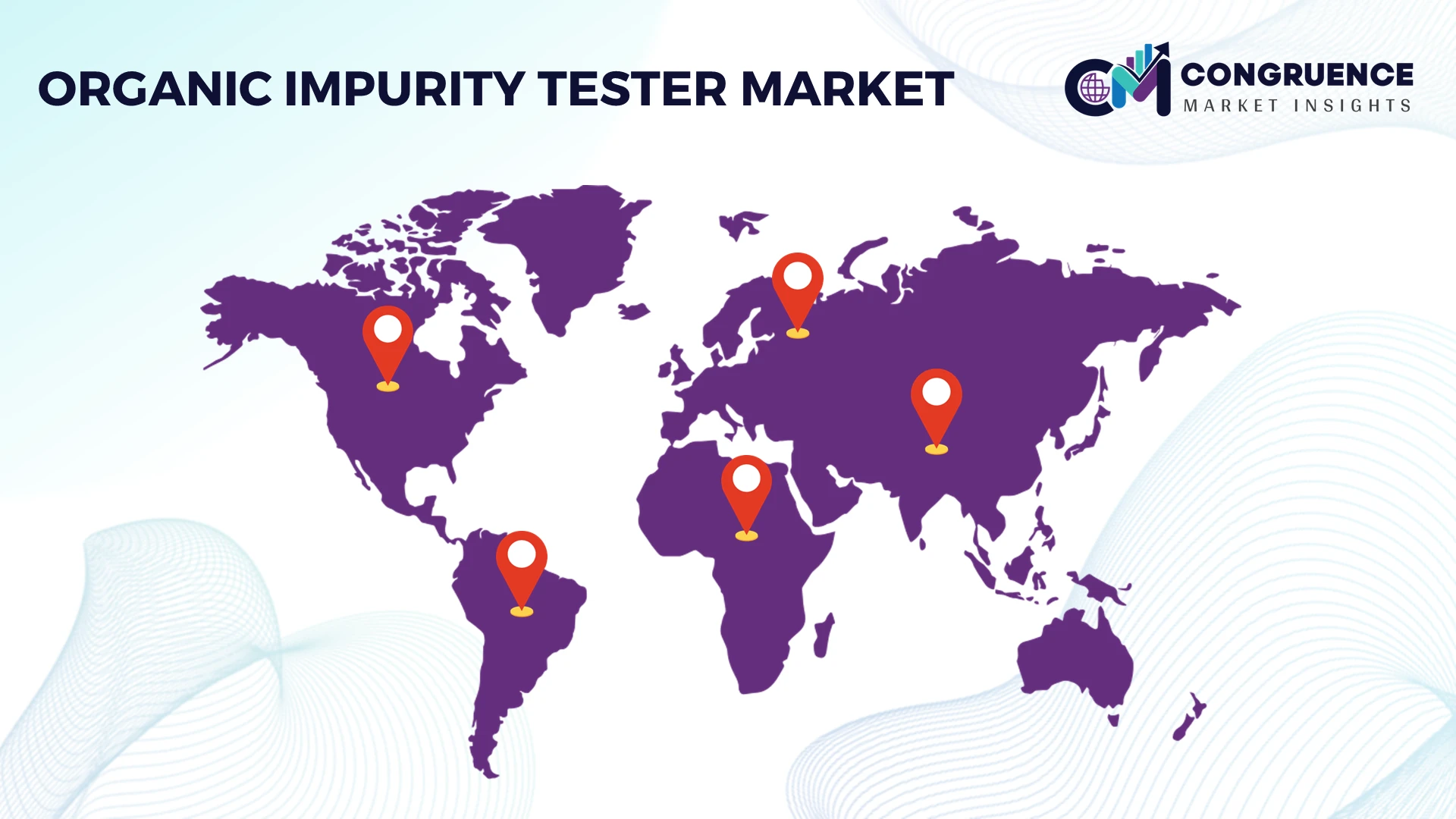
Advanced Pharmaceutical Quality Infrastructure Driving Laboratory Automation
North America maintains the leading position through its extensive pharmaceutical manufacturing base, mature analytical laboratory infrastructure, and early adoption of automated impurity testing technologies. The region contributes approximately 36% of global demand, supported by large-scale biologics production and continuous investment in digital quality-control systems. More than 64% of newly modernized pharmaceutical laboratories have implemented integrated chromatography workflows to improve testing accuracy and regulatory documentation. Enterprise investment increasingly focuses on AI-enabled analytical platforms, laboratory information management integration, and predictive instrument maintenance. Strategic collaborations between instrument manufacturers and pharmaceutical companies are accelerating deployment of standardized impurity testing systems while reducing analytical turnaround times by nearly 22%, strengthening operational resilience across commercial manufacturing facilities.
United States Market Outlook: The United States leads regional demand through its concentration of innovative pharmaceutical companies, contract manufacturing organizations, and advanced quality-control laboratories. More than 68% of large pharmaceutical manufacturing sites operate automated impurity testing environments integrated with digital laboratory systems. Continuous investment in biologics manufacturing, regulatory compliance technologies, and laboratory modernization strengthens demand for high-performance analytical instruments. Companies continue expanding service networks, software integration capabilities, and lifecycle support to maintain analytical consistency and accelerate commercial product release.
Regulatory Standardization Accelerates Analytical Modernization
Europe remains a strategically significant market, supported by stringent pharmaceutical quality standards, advanced manufacturing infrastructure, and widespread laboratory modernization. The region represents approximately 28% of global market activity, with Germany, Switzerland, and France leading deployment of high-performance analytical platforms. Nearly 57% of pharmaceutical laboratories have increased investment in digital analytical workflows to improve compliance efficiency and laboratory productivity. Sustainability initiatives are also encouraging laboratories to adopt solvent-efficient analytical systems that reduce operational waste while maintaining testing precision. Companies are strengthening technology partnerships, expanding regional technical support capabilities, and integrating automation into quality-control operations to improve long-term laboratory performance.
Germany Market Outlook: Germany serves as the region's primary analytical technology hub due to its advanced pharmaceutical manufacturing ecosystem and precision laboratory engineering capabilities. Approximately 61% of newly commissioned pharmaceutical quality laboratories incorporate automated chromatography-based impurity testing platforms. Strong collaboration between pharmaceutical manufacturers and analytical instrument developers continues driving deployment of intelligent laboratory technologies, improving testing consistency and supporting efficient validation across commercial production facilities.
Manufacturing Expansion and Digital Laboratories Reshape Demand
Asia-Pacific is emerging as the fastest-expanding regional market through large-scale pharmaceutical manufacturing growth, expanding API production, and increasing laboratory automation investments. The region accounts for approximately 25% of current market demand while recording the highest deployment momentum. More than 35% of newly established pharmaceutical analytical laboratories now integrate automated impurity testing technologies from initial commissioning. Manufacturing diversification and growing exports are encouraging investment in standardized quality-control infrastructure. Companies are establishing regional production facilities, strengthening distributor partnerships, and expanding localized service capabilities to support rapidly growing pharmaceutical manufacturing clusters.
China Market Outlook: China continues strengthening its market position through expanding pharmaceutical manufacturing capacity, increasing analytical laboratory investments, and accelerated digital transformation initiatives. Nearly 38% of newly installed impurity testing systems support integrated pharmaceutical production environments with centralized laboratory management. Domestic manufacturers and international instrument suppliers are expanding collaborative research, localized manufacturing, and technical training programs to improve deployment efficiency and strengthen long-term analytical capabilities across pharmaceutical production facilities.
Pharmaceutical Infrastructure Upgrades Drive Laboratory Demand
South America is experiencing steady market development as pharmaceutical manufacturers modernize quality-control laboratories and strengthen compliance with international manufacturing standards. The region contributes approximately 6% of global market demand, supported by increasing domestic pharmaceutical production and expanding analytical testing capacity. Around 29% of laboratory modernization projects now include automated impurity testing platforms to improve operational consistency. Infrastructure limitations and equipment import dependency remain practical constraints; however, companies are responding through regional distribution partnerships, localized technical services, and expanded training programs that improve deployment efficiency and instrument utilization across growing pharmaceutical facilities.
Brazil Market Outlook: Brazil remains the largest national market due to its extensive pharmaceutical manufacturing sector and expanding analytical laboratory network. Approximately 34% of pharmaceutical laboratory upgrades include advanced impurity testing technologies supporting regulatory quality assurance. Domestic manufacturers, contract laboratories, and global instrument suppliers continue investing in laboratory automation, workforce development, and service infrastructure to strengthen analytical capabilities while supporting increasing pharmaceutical production volumes.
Healthcare Investment Supports Laboratory Transformation
The Middle East & Africa market is progressing through healthcare infrastructure investment, pharmaceutical manufacturing expansion, and laboratory modernization initiatives. The region represents approximately 5% of global demand, with deployment concentrated in countries investing in domestic pharmaceutical production and advanced healthcare systems. Nearly 26% of newly developed pharmaceutical quality laboratories are integrating automated analytical platforms to improve testing accuracy and compliance efficiency. Public-private partnerships and industrial diversification programs continue supporting laboratory infrastructure expansion. Companies are increasing regional technical support, distributor networks, and specialized training to strengthen long-term deployment capability and improve laboratory performance.
Saudi Arabia Market Outlook: Saudi Arabia is emerging as the region's leading market through substantial pharmaceutical manufacturing investments and national healthcare localization initiatives. More than 31% of newly commissioned pharmaceutical laboratories include advanced impurity testing capabilities integrated with digital laboratory management systems. Strategic industrial development programs, technology partnerships, and expanding pharmaceutical production capacity continue driving demand for high-performance analytical instruments while strengthening local technical expertise and long-term operational sustainability.
The Organic Impurity Tester Market is led by Agilent Technologies, Thermo Fisher Scientific, Waters Corporation, Shimadzu Corporation, and PerkinElmer, competing directly on analytical precision, automation capability, software integration, and lifecycle service, while specialized laboratory instrument suppliers challenge through customized solutions and faster regional support. The top five players collectively control approximately 58% of the market, reflecting a technology-driven competitive structure. Performance differentiation increasingly depends on intelligent workflow automation that improves laboratory productivity by nearly 25% and reduces manual analytical intervention by around 20%. Companies are expanding through strategic partnerships with pharmaceutical manufacturers, localized service centers, product portfolio upgrades, and vertically integrated analytical software ecosystems. Competition is shifting toward connected laboratory platforms, predictive maintenance, and integrated compliance solutions rather than standalone instrumentation. High validation requirements, regulatory qualification, and long customer procurement cycles create substantial entry barriers. Success increasingly depends on combining advanced analytical performance, scalable digital integration, responsive technical support, and long-term customer partnerships.
Agilent Technologies
Thermo Fisher Scientific
Waters Corporation
Shimadzu Corporation
PerkinElmer
Bruker Corporation
JEOL Ltd.
Hitachi High-Tech Corporation
JASCO Corporation
Metrohm AG
Sartorius AG
Bio-Rad Laboratories
Merck KGaA
Tosoh Corporation
Modern organic impurity testing is centered on high-performance liquid chromatography (HPLC), LC-MS platforms, automated sample preparation, and chromatography data systems integrated with laboratory information management software. More than 64% of newly commissioned pharmaceutical quality laboratories now deploy automated analytical workflows. AI-assisted peak identification improves analytical efficiency by approximately 24%, while intelligent instrument diagnostics reduce unplanned downtime by nearly 18%. Integration between analytical instruments and digital laboratory platforms is becoming standard, enabling faster validation, improved traceability, and consistent regulatory documentation across multi-site pharmaceutical manufacturing operations.
Emerging technologies between 2026 and 2028 include high-resolution mass spectrometry with AI-driven spectral interpretation, cloud-enabled analytical data management, and predictive maintenance supported by machine learning. Automated impurity profiling increases analytical throughput by approximately 21%, while cloud-connected workflow management reduces laboratory review time by nearly 17%. Compared with conventional standalone analytical systems, integrated AI-enabled testing environments deliver about 30% faster workflow execution and significantly lower manual intervention. Adoption of intelligent laboratory ecosystems is expected to exceed 60% among newly modernized pharmaceutical quality laboratories during this period.
Disruptive innovation is shifting competition from instrument performance alone toward complete digital analytical ecosystems. Global technology leaders offering integrated software, automation, and lifecycle services gain stronger competitive positioning than hardware-focused suppliers. Companies investing in intelligent chromatography platforms, cybersecurity-ready laboratory infrastructure, and interoperable analytical software will achieve superior operational scalability, faster regulatory readiness, and sustainable differentiation as pharmaceutical quality requirements continue advancing through 2028.
April 2025 Waters Corporation expanded its Alliance iS Bio HPLC portfolio with integrated PDA detection, delivering up to 80× greater sensitivity and reducing common user errors by up to 40%, strengthening impurity analysis capabilities for biopharmaceutical quality-control laboratories. Source: https://www.waters.com
May 2025 Agilent Technologies introduced the InfinityLab Pro iQ Series LC-Mass Detectors to enhance impurity profiling and intelligent mass detection for regulated laboratories, improving analytical sensitivity while supporting more sustainable workflows across pharmaceutical testing operations.
September 2025 Shimadzu Corporation launched LabSolutions Detect with AI-powered automatic impurity detection, minimizing analyst oversight of anomalies and accelerating chromatogram review through automated comparison, improving quality inspection efficiency for pharmaceutical laboratories. Source: https://www.shimadzu.com (Shimadzu) (Shimadzu)
May 2026 Agilent Technologies released its Multi-Attribute Method (MAM) solution integrating LC/HRMS workflows for regulated quality-control laboratories, enabling routine monitoring of critical quality attributes while expanding operational adoption of advanced impurity analysis in commercial pharmaceutical manufacturing. Source: https://www.agilent.com
This report delivers comprehensive analysis across HPLC-Based, GC-Based, LC-MS Based, and Hybrid Systems, covering Drug Development, Quality Control, Stability Testing, and Regulatory Testing applications, together with Pharmaceutical, Biotechnology, CRO, and Research Institute end-users. It evaluates market performance across North America, Europe, Asia-Pacific, South America, and the Middle East & Africa while assessing deployment trends, laboratory modernization, digital analytical workflows, and technology adoption. More than 60% of advanced pharmaceutical laboratories are transitioning toward automated impurity testing environments, making technology integration a central competitive factor.
The study provides strategic assessment of industry participants, competitive positioning, regional deployment patterns, innovation pipelines, and operational priorities between 2026 and 2033. It highlights evolving analytical technologies, AI-enabled laboratory platforms, regulatory compliance strategies, and emerging pharmaceutical manufacturing hubs. The report supports investment planning, product portfolio optimization, expansion decisions, partnership evaluation, and long-term market positioning through detailed segmentation, technology benchmarking, and business-focused operational insights.
| Report Attribute/Metric | Report Details |
|---|---|
Market Revenue in 2025 | USD 361 Million |
Market Revenue in 2033 | USD 505.57 Million |
CAGR (2026 - 2033) | 4.3% |
Base Year | 2025 |
Forecast Period | 2026 - 2033 |
Historic Period | 2021 - 2025 |
Segments Covered | By Type
By Application
By End-User
|
Key Report Deliverable | Revenue Forecast, Growth Trends, Market Dynamics, Segmental Overview, Regional and Country-wise Analysis, Competition Landscape |
Region Covered | North America, Europe, Asia-Pacific, South America, Middle East, Africa |
Key Players Analyzed | Agilent Technologies, Thermo Fisher Scientific, Waters Corporation, Shimadzu Corporation, PerkinElmer, Bruker Corporation, JEOL Ltd., Hitachi High-Tech Corporation, JASCO Corporation, Metrohm AG, Sartorius AG, Bio-Rad Laboratories, Merck KGaA, Tosoh Corporation |
Customization & Pricing | Available on Request (10% Customization is Free) |




