
Reports
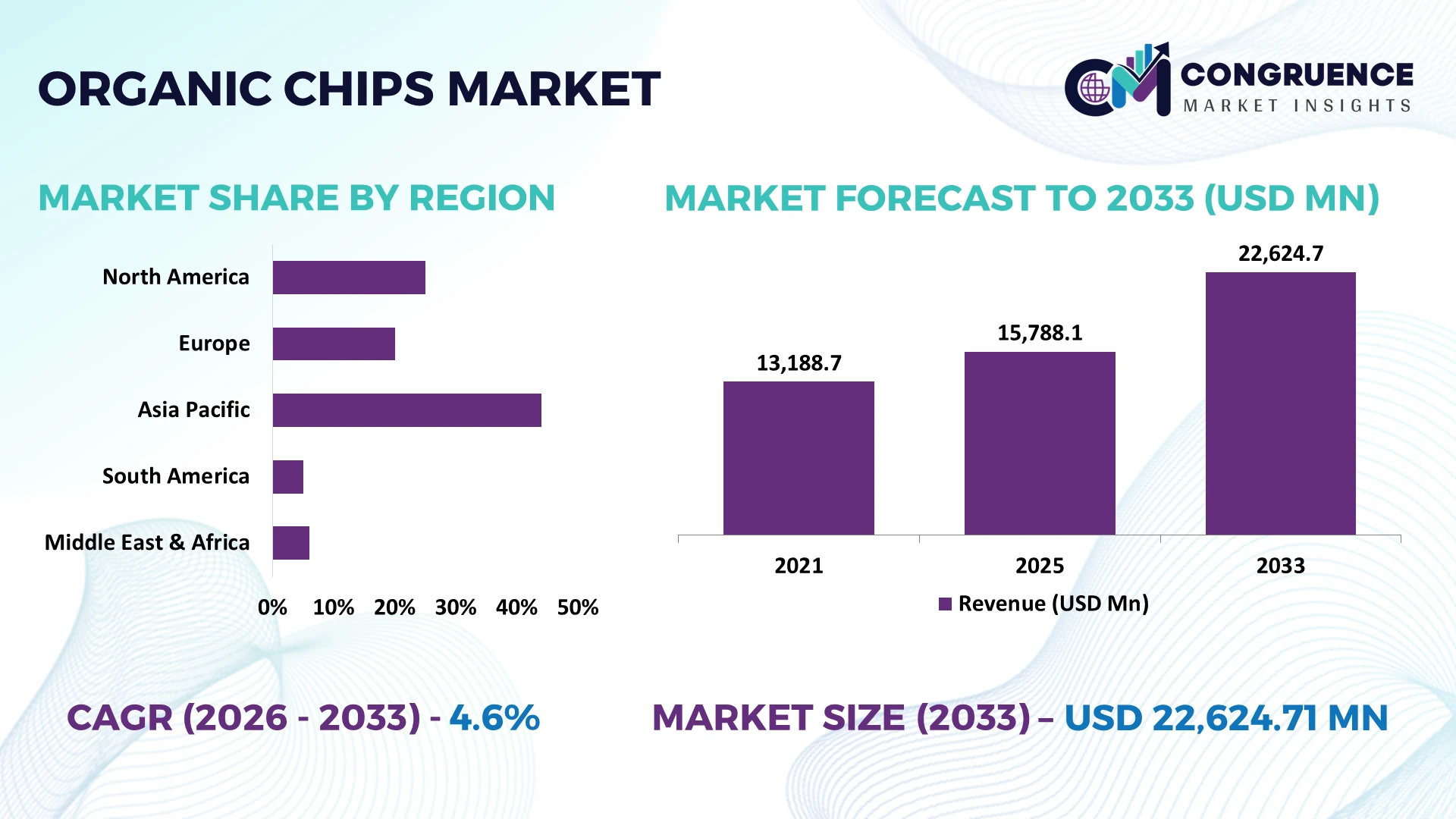
The Global Organic Chips Market was valued at USD 15788.09 Million in 2025 and is anticipated to reach a value of USD 22624.71 Million by 2033 expanding at a CAGR of 4.6% between 2026 and 2033. Growth is driven by certified organic ingredient sourcing, clean label snacking, premium retail penetration, vegetable based formats, and expanded organic private label shelf space.
The United States anchors global organic chip consumption through a mature organic food ecosystem spanning supermarkets, natural retailers, convenience channels, and ecommerce. US certified organic sales exceeded USD 70 billion in 2023, while organic products are available in more than 80% of conventional grocery stores. Compared with Germany, where organic purchasing is strongly supported by established certification awareness, US snack manufacturers benefit from greater retail scale and product variety. USDA organic certification and tighter ingredient traceability are simultaneously reinforcing investment in segregated sourcing and processing.
Manufacturers controlling certified raw material procurement and differentiated flavor innovation are positioned to capture premium shelf space while protecting supply continuity.
Market Size & Growth: USD 15,788.09 million in 2025 reaches USD 22,624.71 million by 2033 at 4.6% CAGR, supported by certified ingredient expansion and premium snacking.
Top Growth Drivers: Organic purchasing penetration above 80%, clean label preference above 60%, and plant based snacking adoption above 40% strengthen category demand.
Short Term Forecast: By 2028, automated seasoning and optical inspection can reduce processing waste by 10% while improving batch consistency across premium chip lines.
Emerging Technologies: Optical sorting, precision frying, and automated seasoning systems increasingly control 3 critical variables: color, oil absorption, and flavor uniformity.
Regional Leaders: North America leads premium organic retailing, Europe advances certification driven consumption, and Asia Pacific strengthens distribution through expanding modern grocery networks across 3 major demand centers.
Consumer and End User Trends: More than 50% of younger consumers actively examine ingredient composition, strengthening demand for recognizable seasonings, organic oils, and simplified formulations.
Pilot and Case Example: In 2025, precision frying optimization demonstrated potential oil reductions exceeding 10%, improving nutritional positioning and lowering edible oil requirements per production batch.
Competitive Landscape: PepsiCo competes alongside Campbell’s, Late July, Kettle Brand, and Jackson’s, with major portfolios increasingly spanning 2 or more organic and better for you snack formats.
Regulatory & ESG Impact: USDA organic packaged products generally require at least 95% certified organic ingredients, raising procurement discipline and supply chain segregation requirements.
Investment & Funding: More than USD 100 million in broader snack manufacturing investments is supporting automated production, distribution modernization, and capacity optimization across key consumer markets.
Innovation & Future Outlook: Multi ingredient vegetable, pulse, and root based chips increasingly combine 3 product attributes: organic certification, recognizable ingredients, and differentiated nutritional positioning.
The Organic Chips Market is expanding beyond conventional potato formats into tortilla, vegetable, root crop, pulse, and multigrain snacks designed around certified ingredients and cleaner formulations. Air frying technologies, precision oil management, natural seasoning systems, and improved barrier packaging are strengthening product consistency and shelf stability. Organic packaged foods must generally contain at least 95% certified organic ingredients to carry the USDA organic label, making ingredient traceability operationally important. Retailers are simultaneously widening premium snack assortments while manufacturers diversify agricultural sourcing to manage crop variability, establishing a more sophisticated competitive foundation for strategic market development.
Organic chips are becoming strategically important as snack competition shifts from flavor proliferation toward verified ingredient provenance, nutritional differentiation, and resilient agricultural sourcing. Organic acreage represents less than 2% of global farmland, creating tighter procurement economics than conventional snacks. Manufacturers are consequently strengthening grower relationships and contracting potatoes, corn, pulses, and specialty vegetables closer to processing facilities to secure certified supply.
Production technology is changing alongside sourcing. Continuous vacuum frying can lower frying temperatures by roughly 40°C compared with conventional atmospheric systems, helping preserve color while limiting oil degradation. European processors emphasize certified sourcing and environmental packaging compliance, whereas US brands compete through broader retail distribution and rapid flavor commercialization. Through 2028, capital allocation will increasingly favor flexible lines capable of processing multiple organic substrates without compromising segregation or allergen controls.
A practical facility can alternate potato, sweet potato, and vegetable chip production using automated cleaning, optical sorting, recipe controls, and dedicated ingredient handling. Producers are investing in adaptable fryers, traceability systems, contract farming, and retailer partnerships to improve utilization across seasonal crops. Competitive advantage will increasingly depend on coordinating agricultural procurement, processing flexibility, certification integrity, and differentiated product development as one operating system.
Consumer movement toward recognizable ingredients is strengthening organic chip placement within premium snack assortments. In the United States, organic food represented about 6% of total food sales, while snacks account for roughly 20% of daily calorie intake among adults, creating meaningful overlap between convenience and ingredient conscious purchasing. Organic products also reach more than 80% of conventional grocery stores, moving certified snacks beyond specialist retail. Large supermarkets are expanding private label organic ranges while established snack manufacturers broaden tortilla, root vegetable, and multigrain offerings. Producers are responding with simplified ingredient decks, organic seasonings, and differentiated pack sizes. The operational insight is that distribution breadth, rather than specialist natural store concentration, now determines scale, pushing suppliers to design products that satisfy both certification requirements and mainstream merchandising economics.
Organic agricultural supply remains structurally narrower than conventional sourcing, exposing chip manufacturers to crop availability and procurement premiums. Certified organic farmland represents about 2% of global agricultural land, while conversion typically requires a 36 month transition period before US acreage qualifies for organic production. Organic potatoes and specialty vegetables also require more complex pest management and segregation throughout storage and transportation. Weather disruption therefore produces sharper procurement pressure when processors cannot readily substitute conventional crops without losing certification. Manufacturers are reducing exposure through multiyear grower agreements, geographically diversified sourcing, dedicated storage, and forward purchasing. The strategic constraint is inventory flexibility: conventional snack producers can switch suppliers rapidly, whereas certified manufacturers must preserve chain of custody, making agricultural supplier development as important as processing capacity for scalable operations.
Chips based on pulses, cassava, plantain, beetroot, and other crops create opportunities beyond mature potato and corn formats while allowing manufacturers to align products with locally available agriculture. India produces more than 25% of global pulses, creating an extensive ingredient base for differentiated pulse snacks, while cassava contains roughly 30% starch in fresh roots and supports crisp processing applications. Advanced extrusion can also produce expanded snacks with 30% or more pulse flour while maintaining commercially acceptable texture when formulations are optimized. Manufacturers are investing in formulation laboratories, flexible extrusion systems, farmer partnerships, and regional ingredient procurement. A non obvious advantage is sourcing diversification: developing multiple crop platforms reduces dependence on individual harvest cycles while enabling localized product positioning. Successful suppliers can therefore combine agricultural resilience with premium innovation rather than competing solely through conventional chip flavors.
Scaling diversified organic chips creates processing complexity because moisture, starch composition, sugar concentration, slice geometry, and oil absorption vary materially between crops and harvests. Potatoes typically contain around 75% to 80% water before processing, while frying can reduce finished chip moisture below 2%, demanding precise thermal control to maintain crispness. Acrylamide formation adds another technical pressure because European benchmark levels for potato crisps are measured at 750 micrograms per kilogram. Manufacturers must balance browning, flavor, moisture removal, and contaminant mitigation without excessive processing intervention. Companies are investing in inline moisture measurement, raw material grading, blanching optimization, automated temperature controls, and cultivar specific processing recipes. Long term competitiveness depends on translating naturally variable organic crops into standardized sensory performance across industrial production volumes.
Avocado Oil Moves Mainstream: Organic chip brands are replacing conventional seed oils with avocado oil to strengthen premium positioning and ingredient transparency. Avocado oil contains roughly 70% monounsaturated fat and tolerates frying temperatures above 200°C. US brands are expanding avocado oil potato and tortilla ranges as shoppers scrutinize ingredient panels. Producers are adjusting fryer parameters and oil filtration systems while negotiating dedicated supply contracts, turning cooking oil selection into a visible product differentiator rather than a background manufacturing input.
Protein Fortification Enters Chips: Snack developers are adding chickpea, lentil, pea, and bean ingredients to increase protein density without abandoning familiar crunchy formats. Pulses typically provide 20% to 25% protein by dry weight, while formulated chips can deliver 4 to 6 grams per serving. Brands are modifying extrusion, seasoning adhesion, and moisture management to maintain texture. The shift enables organic snack producers to compete across both indulgence and functional nutrition occasions, broadening placement beyond conventional chip aisles.
Portion Formats Reshape Packaging: Multipacks and individually portioned bags are gaining operational importance as consumers distribute snacks across school, workplace, and travel occasions. Single serve chip packs commonly range from 28 to 42 grams, while multipacks consolidate 6 to 18 units. Retailers are allocating more assortment space to portion controlled formats. Manufacturers are responding with higher speed vertical packaging equipment and automated case packing, increasing packaging throughput while creating additional price points from identical production recipes.
Flavor Localization Accelerates Portfolios: Organic chip portfolios are moving beyond sea salt toward regionally recognizable chili, lime, barbecue, cheese, and spice profiles. Seasoning systems can now control application within roughly 1% variation across continuous runs, supporting faster flavor switching. US producers are widening Hispanic inspired offerings while European portfolios increasingly incorporate Mediterranean seasonings. Automated dosing allows manufacturers to operate more localized portfolios without proportional increases in processing complexity, making flavor architecture an increasingly scalable route to shelf differentiation.
Potato Chips lead the type segment with an estimated 42% share, supported by established consumer familiarity, scalable slicing and frying infrastructure, and extensive retail distribution. Industrial lines can process several tonnes of potatoes per hour, giving mature producers strong unit economics. Tortilla Chips form another established segment because corn based products support dips, sharing occasions, and diverse seasoning profiles. Corn Chips retain relevance through recognizable texture and efficient extrusion based processing, particularly within mainstream snack portfolios.
Vegetable Chips are the fastest growing type as beetroot, carrot, sweet potato, kale, and mixed vegetable formats extend organic snacking into premium positioning. Some vegetable formulations contain 20% or more dietary fiber by dry ingredient composition before processing, strengthening differentiation from conventional formats. Plantain Chips are expanding through Latin American and tropical food channels, while Cassava Chips offer gluten free positioning and locally sourced production opportunities. Manufacturers are allocating product development toward mixed vegetable assortments, specialized frying controls, and packaging differentiation, balancing potato scale economics against higher value specialty formats.
Snacking represents the leading application with an estimated 55% share because chips are primarily purchased for immediate or planned between meal consumption. Frequent household replenishment, broad flavor choice, and shelf stable packaging support consistent turnover. Party Foods remain strategically important through larger sharing formats, while Lunchboxes favor controlled portions and simpler ingredient formulations. Gifting occupies a smaller premium niche where differentiated packaging and specialty flavor combinations carry greater importance than volume efficiency.
On the Go Eating is the fastest growing application as commuting, travel, workplace consumption, and convenience retail increase demand for portable portions. Pack sizes between 25 and 50 grams provide controlled consumption while supporting higher value per kilogram than family formats. Foodservice is developing differently, with restaurants and cafés using organic chips as sides, accompaniments, or premium packaged additions. Manufacturers are responding through flexible bagging lines, channel specific case configurations, and assortment packs. Investment priorities are therefore shifting toward packaging versatility because consumption occasion increasingly determines pack architecture independently of the underlying chip formulation.
Supermarkets represent the leading end user with an estimated 48% share, benefiting from extensive grocery traffic, dedicated organic sections, private label programs, and sufficient shelf capacity for multiple chip varieties. Their purchasing scale supports larger case volumes and promotional programs. Convenience Stores emphasize smaller packages and immediate consumption, while Specialty Stores provide valuable distribution for premium formulations requiring stronger product education. Restaurants, Hotels, and Foodservice Operators remain selective buyers, generally using organic chips within curated menus, catering, or premium guest offerings.
Online Retail is the fastest growing end user because digital channels support broader assortments without physical shelf constraints. Ecommerce multipacks commonly contain 6 to 24 individual packages, improving shipping economics and encouraging repeat purchasing. Digital platforms also allow emerging brands to test flavors before pursuing nationwide store listings. Manufacturers are adapting through ecommerce optimized cartons, variety bundles, subscription formats, and direct consumer fulfillment partnerships. The strategic shift gives smaller organic brands a lower barrier route to geographic expansion while providing established producers with direct visibility into assortment and repeat purchase behavior.
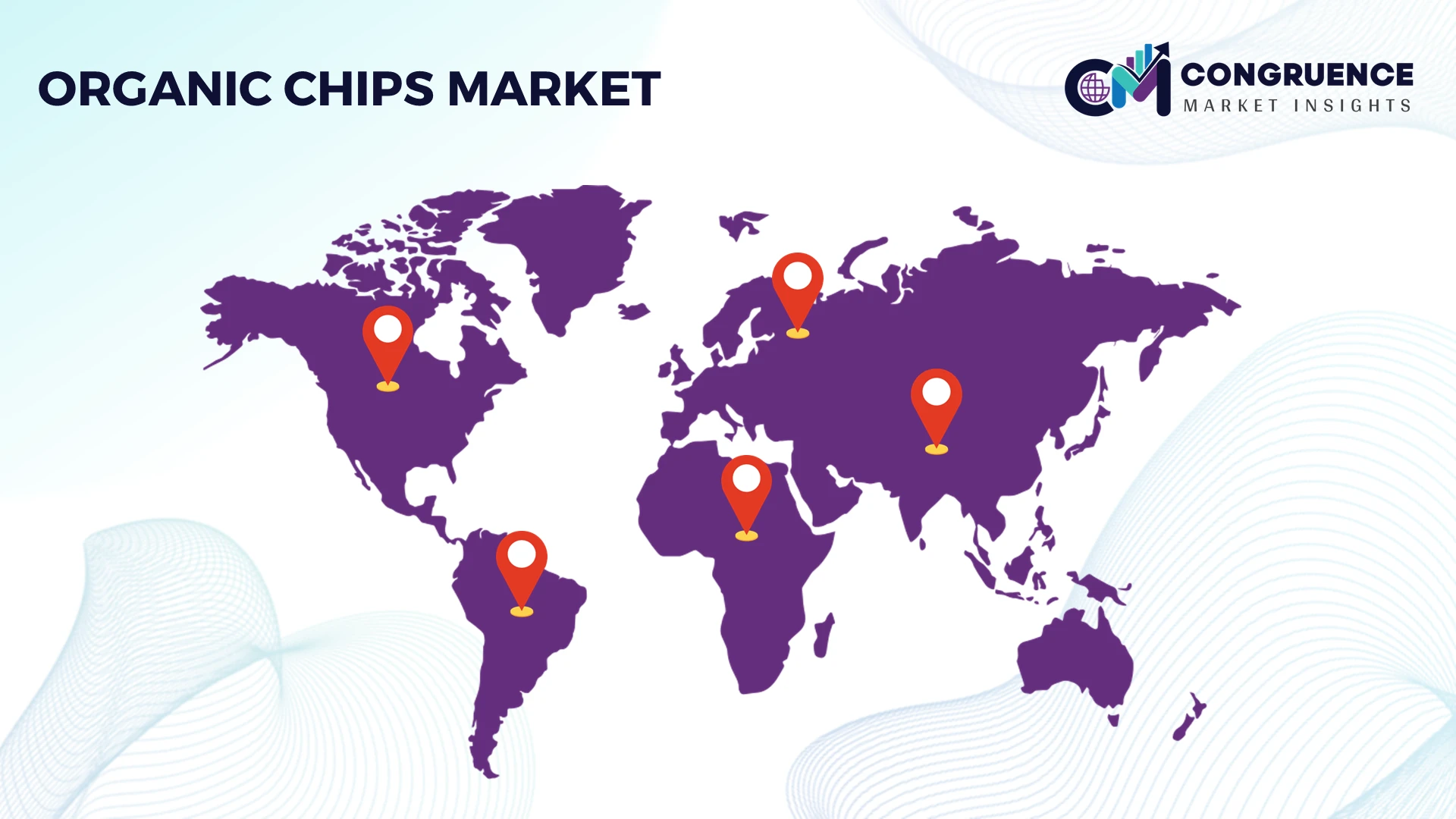
North America accounted for the largest market share at 38% in 2025 however, Asia Pacific is expected to register the fastest growth, expanding at a CAGR of 6.8% between 2026 and 2033.
Mainstream Grocery Deepens Organic Distribution
North America represented about 38% of global organic chip demand in 2025, supported by established certification infrastructure, sophisticated snack manufacturing, and broad supermarket penetration. The United States anchors regional consumption, while Canada provides a smaller but mature certified food channel. US certified organic product sales increased 5.2% in 2024, more than twice the 2.5% expansion recorded across the overall marketplace, demonstrating stronger category momentum despite household price sensitivity. Organic chip manufacturers are using national grocery networks to extend potato, tortilla, vegetable, and specialty formats beyond natural food retailers. Processing investment increasingly targets high speed packaging, automated inspection, and segregated ingredient handling. Retailers are simultaneously widening organic private label assortments, increasing competitive pressure on branded suppliers to defend shelf productivity through differentiated flavors and pack architecture.
United States Market Outlook: The United States remains the region’s principal commercial market, with organic food sales reaching USD 65.4 billion in 2024. Its advantage lies in nationwide grocery infrastructure, established USDA certification, contract manufacturing capacity, and sophisticated snack distribution. Producers capable of coordinating certified farms, processors, warehouses, and retailers can scale launches nationally while maintaining traceability across complex ingredient networks.
Certification Depth Supports Premium Positioning
Europe accounted for an estimated 28% share in 2025, supported by extensive organic agriculture, mature certification systems, and consumers accustomed to certified food labels. Organic farmland covered 19.6 million hectares in 2024, giving processors a substantial agricultural ecosystem for potatoes, cereals, vegetables, and seasoning inputs. Switzerland recorded organic products at 12.3% of total food sales, illustrating the depth attainable in highly developed markets. European chip manufacturers increasingly combine certification with reduced ingredient complexity, premium oils, and recyclable packaging formats. EU packaging regulation is also forcing suppliers to evaluate material reduction and recyclability alongside food formulation. Spain, France, and Italy provide extensive organic agricultural acreage, while northern markets offer stronger premium retail economics. Manufacturers are strengthening procurement partnerships and packaging redesign capabilities to protect margins while satisfying increasingly demanding certification and environmental requirements.
Germany Market Outlook: Germany is Europe’s largest organic consumer market and provides dense supermarket, discount, natural retail, and private label distribution. Its organic market reached EUR 17 billion in 2024. German snack suppliers benefit from established certification recognition and retailer scale, but purchasing discipline forces brands to combine credible organic positioning with competitive pack economics and consistent availability.
Certified Agriculture Meets Modern Retail Expansion
Asia Pacific represented roughly 22% of 2025 demand, with market development shaped by very different agricultural and retail structures across China, India, Japan, Australia, and South Korea. China ranks among the world’s largest organic consumer markets, while India combines extensive certified cultivation with a rapidly modernizing packaged food system. India recorded 4.39 million tonnes of certified organic farm production during 2024 to 2025, providing processors with substantial agricultural inputs across cereals, oilseeds, spices, pulses, and horticultural products. Australia contributes exceptional certified land availability but has a smaller consumer population. Manufacturers are increasingly developing locally adapted spice profiles and smaller packages rather than replicating Western assortments unchanged. Expansion through supermarkets, quick commerce, and digital marketplaces is reducing dependence on specialist organic stores and giving emerging brands faster routes to metropolitan consumers.
India Market Outlook: India provides a distinctive supply side advantage with 3.97 million hectares of farm area under the National Programme for Organic Production certification process in 2024 to 2025. Madhya Pradesh alone accounted for more than 1 million hectares. This certified agricultural base supports localized snack innovation using potatoes, grains, pulses, spices, and alternative crops while strengthening export possibilities.
Native Crops Strengthen Product Differentiation
South America accounted for an estimated 7% share in 2025, with Brazil providing the largest consumer and processing base and Chile, Argentina, Colombia, and Peru supporting specialized organic food channels. The region’s strategic advantage lies in agricultural diversity rather than standardized potato chip scale. Plantain, cassava, sweet potato, corn, and other locally established crops give processors a differentiated raw material platform for organic snack development. Brazil maintains a national organic producer registration framework, while Chile has established organic trade cooperation with Brazil, supporting stronger cross border certification connectivity. However, fragmented cold and dry storage infrastructure, certification costs, and long domestic transport distances constrain smaller processors. Manufacturers are concentrating production near agricultural clusters and major metropolitan consumption centers while using modern retail and ecommerce to improve distribution economics.
Brazil Market Outlook: Brazil offers the strongest regional combination of population scale, agricultural depth, food processing capability, and organized retail infrastructure. Its national organic producer registry is updated multiple times each month, strengthening market oversight. Local processors can differentiate through cassava, plantain, corn, and vegetable formats while reducing dependence on imported specialty ingredients through domestic agricultural sourcing.
Import Hubs Accelerate Premium Availability
Middle East and Africa represented approximately 5% of global demand in 2025, with the UAE, Saudi Arabia, South Africa, and selected metropolitan markets forming the principal commercial centers. Gulf countries rely heavily on imported packaged foods, making distributor capability, certification recognition, and temperature controlled warehousing important for premium organic snack availability. Dubai’s logistics infrastructure provides access to more than 200 national markets through international trade connections, supporting its role as a regional distribution hub. South Africa provides a comparatively developed food manufacturing and supermarket ecosystem, while other African markets remain constrained by lower organic certification density and fragmented formal retail. Suppliers are prioritizing affluent urban centers, premium supermarkets, hospitality channels, and ecommerce rather than broad geographic rollout, allowing controlled expansion without building extensive local processing infrastructure immediately.
United Arab Emirates Market Outlook: The UAE provides an efficient entry platform through high urbanization, sophisticated grocery retail, international tourism, and globally connected ports and airports. Imported organic snack suppliers benefit from concentrated demand in Dubai and Abu Dhabi. Competitive advantage depends on distributor execution, certification compliance, shelf visibility, and inventory planning suited to long international replenishment cycles.
PepsiCo, The Campbell’s Company, Hain Celestial, General Mills, and Utz Brands compete through scaled retail access, while Barnana and LesserEvil challenge incumbents with specialized organic ingredients and faster innovation. The top five suppliers account for an estimated 34% of organic chip sales, leaving space for specialists and regional brands. Scaled manufacturers gain procurement and distribution advantages that can lower logistics costs by 8%, while automated frying and seasoning controls improve line efficiency by 12%. Premium specialists command price premiums exceeding 20% through avocado oil, regenerative sourcing, and differentiated crop formats. Competition is shifting from flavor proliferation toward ingredient ownership, certified supply continuity, and portfolio acquisition. Companies are securing growers, expanding retailer partnerships, modernizing processing, and acquiring high growth snack platforms. Organic crop availability, certification integrity, retailer slotting, and manufacturing scale remain decisive entry barriers. Winning requires protected ingredient supply, efficient processing, distinctive formulations, and national distribution without weakening organic credibility.
PepsiCo
The Campbell’s Company
Hain Celestial Group
General Mills
Utz Brands
Intersnack Group
Barnana
LesserEvil
Jackson’s Food Company
Rhythm Superfoods
The Good Crisp Company
Enjoy Chips
Current organic chip production is moving toward sensor controlled frying, optical sorting, and automated seasoning systems that stabilize color, moisture, and oil uptake across variable certified crops. Inline optical inspection can improve defect removal by 15%, while automated seasoning control can reduce seasoning overuse by 8%. Deployment is strongest on scaled potato and tortilla lines, where processors benefit from yield consistency and fewer manual quality interventions.
Emerging vacuum frying and intelligent oil management are changing processing economics for vegetable and specialty chips. Vacuum systems operate at lower temperatures than conventional atmospheric fryers and can reduce oil absorption by about 20%. Compared with legacy batch frying, continuous digitally controlled systems can improve thermal efficiency by 12% through tighter temperature and dwell time management. Premium vegetable and root chip producers benefit most because color retention and texture consistency support shelf positioning.
From 2026 through 2028, hyperspectral inspection, AI process control, digital traceability, and recyclable high barrier packaging will become integrated. AI enabled predictive maintenance can reduce unplanned line downtime by 10%, while digital batch records accelerate organic certification audits. Manufacturers investing now gain faster changeovers, stronger traceability, and more consistent multicrop processing, turning production technology into a defensible advantage at scale.
May 2024 The Campbell’s Company announced $230 million in supply chain investments through fiscal 2026, while designating Jeffersonville, Indiana, to specialize in Late July tortilla chips. The restructuring concentrates production and strengthens efficiency for its organic snack platform.
January 2025 PepsiCo completed its $1.2 billion acquisition of Siete Foods, adding tortilla chips and Mexican American foods to its portfolio. The transaction gives Siete access to PepsiCo’s scaled distribution capabilities, accelerating competition across premium ingredient focused snacking.
August 2025 Barnana secured $1.85 million through Steward to strengthen its regenerative supply chain linking Ecuadorian farmers with its organic plantain and cassava snacks. The financing supports farm to shelf scaling while reinforcing differentiated agricultural sourcing and traceability.
April 2026 Late July introduced two tortilla chip varieties, Smoked BBQ and Restaurant Style Garlic Herb, plus a 10 count variety pack. Smoked BBQ ranked first in flavor testing, while 44% of snackers expressed interest in smoked snacks.
The Organic Chips Market report evaluates six product types: Potato Chips, Corn Chips, Tortilla Chips, Vegetable Chips, Plantain Chips, and Cassava Chips. Application analysis covers Snacking, Party Foods, Lunchboxes, On the Go Eating, Foodservice, and Gifting, while end user coverage examines Supermarkets, Convenience Stores, Specialty Stores, Online Retail, Restaurants, Hotels, and Foodservice Operators. The assessment also tracks specialty crop formats, premium oils, and certified ingredient strategies.
Geographic analysis spans North America, Europe, Asia Pacific, South America, and Middle East and Africa, comparing processing infrastructure, agricultural sourcing, retail penetration, and certification environments. Technology coverage examines optical sorting, intelligent frying, automated seasoning, predictive maintenance, digital traceability, and advanced packaging. The 2026 to 2033 framework supports capacity planning, portfolio investment, geographic expansion, supplier partnerships, competitive benchmarking, and positioning across mainstream and specialized organic snack channels.
| Report Attribute/Metric | Report Details |
|---|---|
Market Revenue in 2025 | USD 15788.09 Million |
Market Revenue in 2033 | USD 22624.71 Million |
CAGR (2026 - 2033) | 4.6% |
Base Year | 2025 |
Forecast Period | 2026 - 2033 |
Historic Period | 2021 - 2025 |
Segments Covered | By Type
By Application
By End-User
|
Key Report Deliverable | Revenue Forecast, Growth Trends, Market Dynamics, Segmental Overview, Regional and Country-wise Analysis, Competition Landscape |
Region Covered | North America, Europe, Asia-Pacific, South America, Middle East, Africa |
Key Players Analyzed | PepsiCo, The Campbell’s Company, Hain Celestial Group, General Mills, Utz Brands, Intersnack Group, Barnana, LesserEvil, Jackson’s Food Company, Rhythm Superfoods, The Good Crisp Company, Enjoy Chips |
Customization & Pricing | Available on Request (10% Customization is Free) |




